



On this pageGas Fireplace Smells: Find Your Smell and What It Means8 sections+7
- Gas Fireplace Smells: Find Your Smell and What It Means
- The First Sixty Seconds, Before You Diagnose Anything
- The Normal Smells: Dust, Paint, and the First Fire of the Season
- When the Smell Is Telling You Something Is Wrong
- Same Smell, Opposite Meaning: Vent-Free vs. Direct-Vent
- What Nobody Tells You: Your Nose Is Not a Carbon Monoxide Detector
- Gas Fireplace Smells When the Fireplace Is Off
- How VIO Helps With Gas Fireplace Smells
Quick answer
Gas fireplace smells fall into three groups. A rotten egg or sulfur odor means unburned gas is escaping, so leave the house with everyone and call 911 or your gas utility from outside. A burning dust or hot plastic smell on the first fire of the season is normal and clears after a few hours of running. Smoke, black soot on the glass, or any odor that never fades means shut the unit off and have it inspected.
Gas Fireplace Smells: Find Your Smell and What It Means
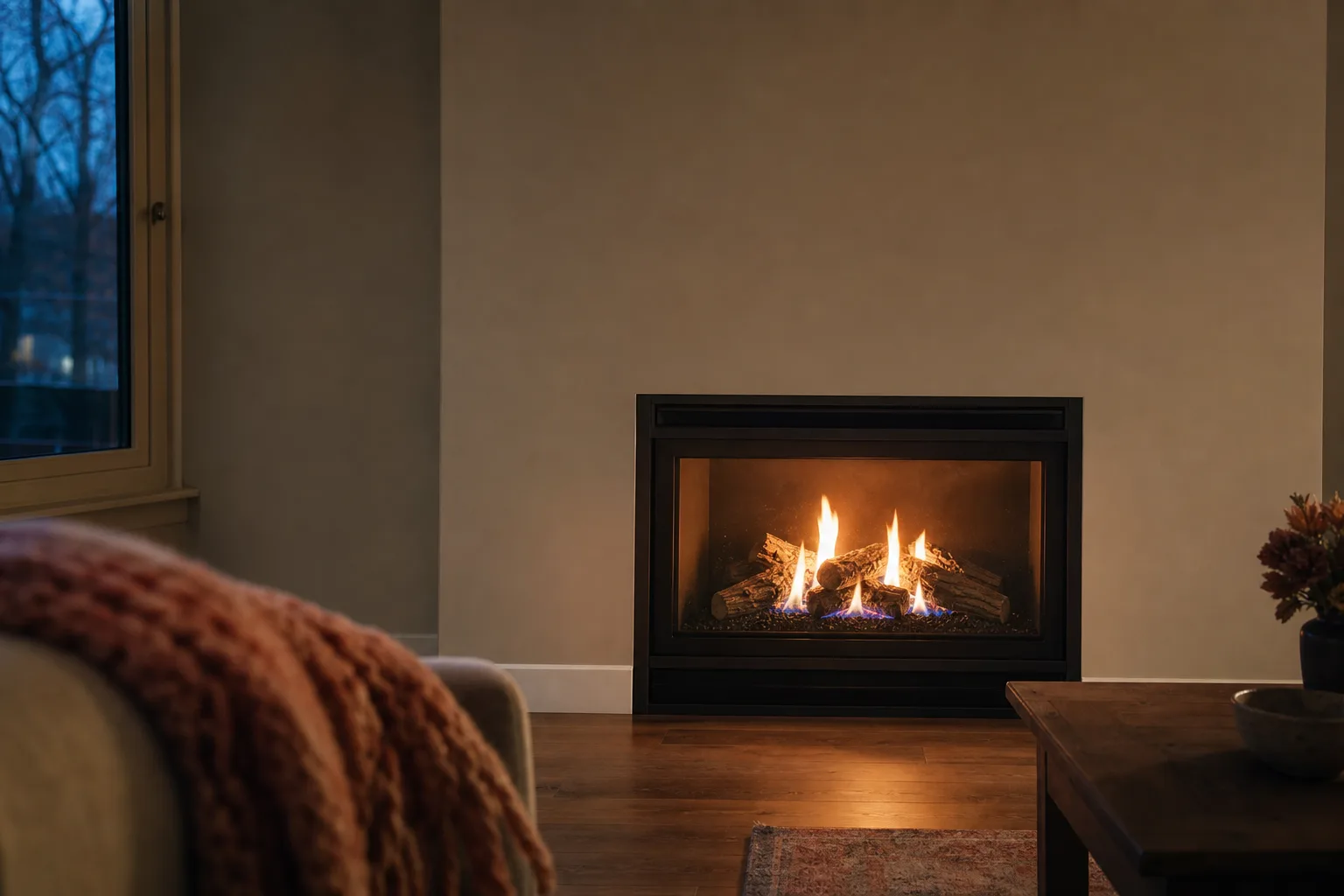
Gas fireplace smells tend to show up on the same night every year. The first properly cold evening, when you turn the thermostat down, find the remote or the wall switch, and light the fireplace for the first time since March.
Then something reaches you from across the room, and you stop.
Most of those odors are harmless, a few are not, and the difference matters too much to bury under two thousand words. So here is the table first. Find the smell you can actually name, and read across.
| What you smell | Most likely cause | What to do right now |
|---|---|---|
| Rotten eggs, sulfur, skunk | Unburned gas escaping into the room | Leave the house with everyone and every pet. Call 911 or your gas utility's emergency line from outside. |
| Burning dust, hot plastic, singed hair, on the season's first burn or a new unit | Household dust and factory residue burning off interior surfaces | Open a window and let it run. It should fade within a few hours. If it does not fade, or it starts mid-season, use the row below. |
| Smoke, or a sooty campfire smell | Combustion products entering the room instead of leaving through the vent | Shut the fireplace off. Ventilate. Do not run it again until it has been inspected. |
| Musty, damp, like a basement | Moisture in the chimney or chase, usually when the unit is off | Not urgent. Worth an inspection, especially if it comes and goes with the weather. |
| Sour, sharp, chemical, and it will not clear | Overheating components, or something in the room air being cooked | Shut it off. Have it inspected before the next burn. |
| Nothing at all | Possibly nothing. Possibly the one thing you cannot smell. | Keep reading. This row is not a joke. |
That table will settle it for most people in about thirty seconds, which is the point of putting it at the top.
But two of those smells mean something the table cannot fully tell you, and one of them cannot be smelled at all.
The First Sixty Seconds, Before You Diagnose Anything
Diagnosis can wait a minute. What you do in the next sixty seconds is the part that actually matters.
Gas fireplace smells sort into three response categories, and the branch you are standing in decides everything that follows.
If you smell rotten eggs or sulfur
Get out. That is the whole instruction.
Natural gas and propane have no smell of their own. Both are genuinely odorless coming out of the ground, and the gas industry adds a mercaptan compound on purpose, precisely so that a leak announces itself. That sulfur smell is a chemical warning label. It exists for this exact moment and it is doing its job.
So take everyone outside, pets included, walk a good distance from the house, and call 911 or your gas utility's emergency number from out there.
Safety note: On your way out, do not flip any switches, do not unplug anything, and do not use a garage door opener. Electrical switching makes sparks. Leave the lights however you found them and make the call outdoors.
This is also the one branch of this article where I am not going to suggest you call us. Do not call a chimney company about a live gas leak. Call the people whose job is shutting off gas.
If you smell smoke, or the room looks hazy
A gas fireplace working correctly does not make the room smell like a campfire. If it does, combustion products are coming into the room rather than going out through the vent.
Shut it off at the wall switch or remote. Open windows. Get some air moving through the room and let it clear.
Then leave it off. Not for the evening, for however long it takes to have someone look at it. A venting problem does not resolve itself between Tuesday and Wednesday.
If the smell is dusty, plasticky, or just odd
This is where most people reading this actually are, and it is the calm branch. Work through it in order:
- Note exactly what it smells like, in your own words. "Burning dust" and "sour chemical" send a technician to different places.
- Note whether the fireplace is on or off when it happens. This matters more than almost anything else.
- Note whether this is the first burn of the season, the first burn ever, or an ordinary day in January.
- Open a window and let the room air out.
- Let the unit run for an hour or two, if nothing about it alarms you, and see whether the smell fades or holds steady.
- Look at the inside of the glass. Note anything black, powdery, or filmed over.
- If the smell is still there after a few hours of running, stop guessing and have it inspected.
The Normal Smells: Dust, Paint, and the First Fire of the Season
Here is what is happening on that first cold night, and it is more mundane than it smells.
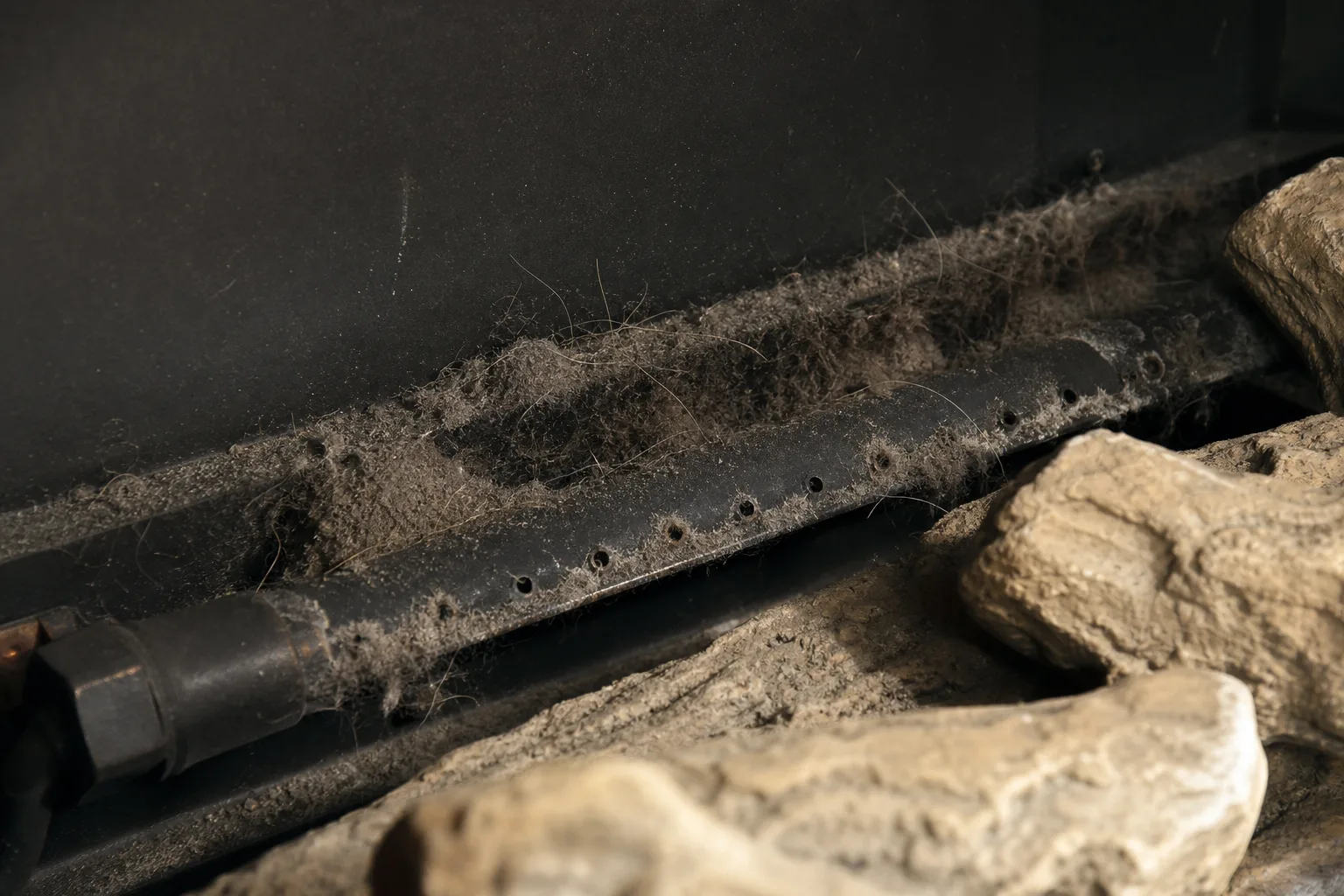
Your fireplace sat idle for six or seven months, and its interior surfaces collected what every surface in your house collects: dust, pet dander, hair, and skin cells. A remarkable amount of it, in a place you never clean because it sits behind glass.
Then you light a burner under all of it.
That is the burning-hair, hot-plastic, scorched-dust smell that arrives every autumn. It is dust cooking, and it goes away when the dust is gone, which is generally a matter of a few hours of burning rather than days.
A brand new fireplace, or a new set of logs, has a second layer on top of that. Manufacturing leaves things behind: paints, curing finishes, lubricants, casting residue in the passageways. Those burn off too, and manufacturers themselves describe the break-in as roughly one to three hours of running.
Good to know: The intensity of that smell depends heavily on the air inside your home, because the appliance is heating and circulating that air. Tobacco smoke, pet dander, harsh cleaning products, and plug-in air fresheners all end up being cooked. If the seasonal burn-off smell in your house is genuinely awful rather than merely noticeable, that is often the reason. Vacuum more, smoke outside, and skip the plug-ins near the hearth.
There is also the whiff you get at the moment of ignition. A small amount of gas moves through the line before the burner catches, and for a second or two you smell it. That one is normal and it is over almost immediately.
How Long Normal Gas Fireplace Smells Should Last
Duration is the most useful thing you can measure, so here is the clock.
Ignition whiff: seconds. Seasonal dust burn-off on a unit you have owned for years: an hour or so of running. A new appliance or a fresh set of logs: one to three hours, because factory residue is burning off on top of the dust.
None of those are measured in days. Gas fireplace smells that survive a weekend of normal use have stopped being a break-in and started being a condition.
Which brings me to a claim you will find repeated on a lot of fireplace websites, and I want to be blunt about it.
Myth vs. fact: Myth: a gas smell from a gas fireplace is nothing to worry about and just means the appliance is working. Fact: only the brief whiff at the instant of ignition is documented as normal. A gas smell that lingers, or that appears when the fireplace is off, is not, and "of course it smells like gas" is how a real leak gets ignored for a week. Notice who publishes the reassuring version. Companies that sell fireplaces have a reason to under-alarm you; gas utilities, who answer the emergency line, have a reason to over-alarm you.
When the Smell Is Telling You Something Is Wrong
Now the smaller group, and the reason this article exists rather than just the table.
Some gas fireplace smells are not residue burning off. They are a report on how the appliance is burning and where the exhaust is going, and they deserve to be taken at face value.
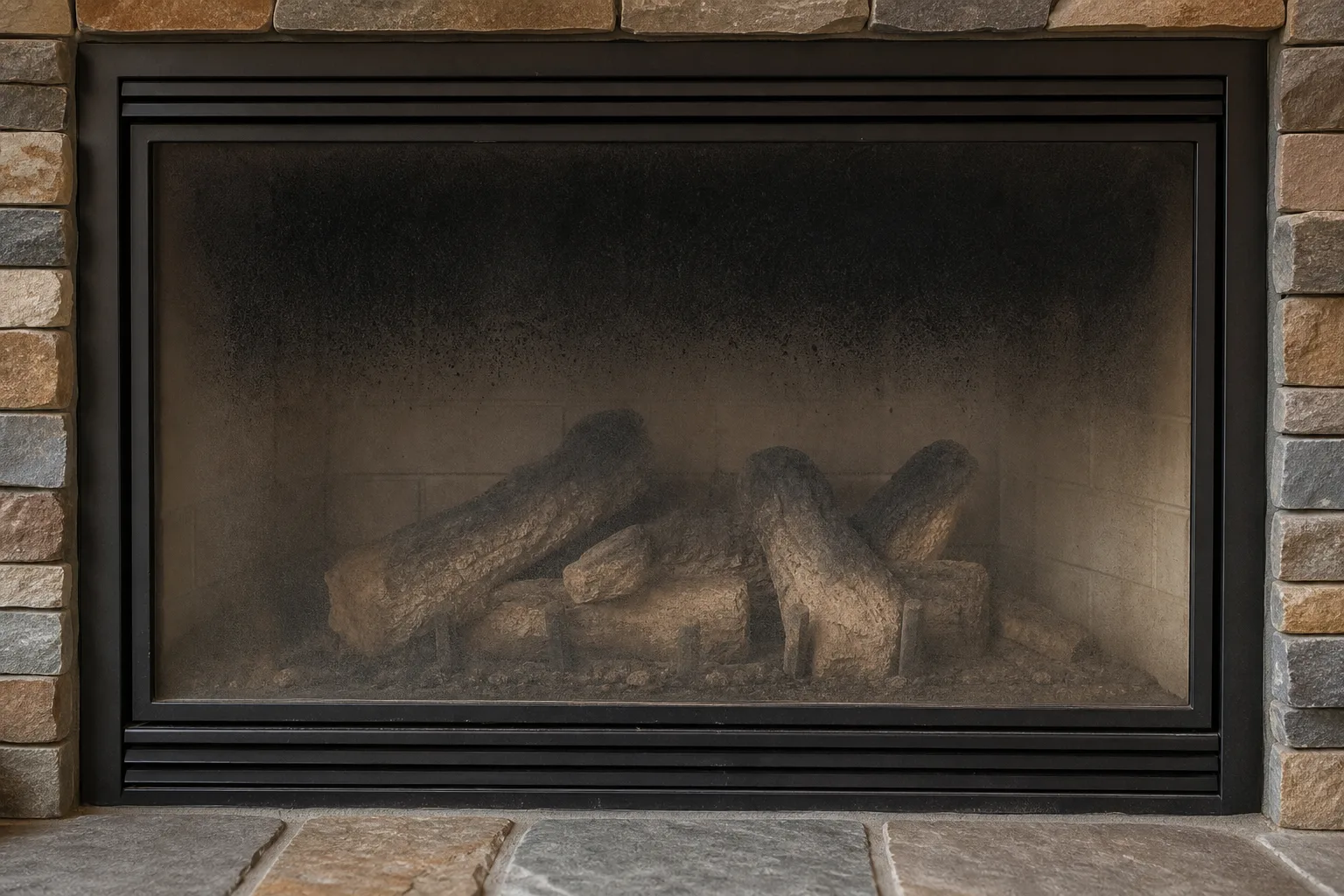
Soot is the clearest one. Black, powdery film on the inside of the glass, heaviest toward the top, or black smudging and blackened tips on the upper surfaces of the ceramic logs. This is never normal on a gas fireplace. Not "a little is fine." Never normal.
Soot means incomplete combustion. The fuel is not burning all the way, and the same condition that produces visible carbon is the condition that produces gases you would rather not have in the room.
Learn the difference between that and the faint whitish-grey haze direct-vent glass slowly develops, which is ordinary and cleans off. Soot is black, and it comes off on your finger.
A lazy, all-yellow flame is worth noticing too. A healthy gas flame sits blue at the base with yellow-orange tips. A flame that has gone entirely yellow and floppy, with no blue anywhere, is burning differently than it was designed to.
Acrid, sharp, electrical smells point somewhere else again. Poor venting lets heat build where heat was not supposed to go, and gaskets, wiring insulation, and nearby components start cooking. That smell has a hot-electronics quality to it, distinct from dust.
And the timing test cuts through most of this. Burn-off fades. Conditions do not. If you have run the thing for three or four hours across two evenings and the smell is exactly as strong as it was at minute one, you are not waiting out a residue.
From the field: The problem with an odor is rarely panic. It is habituation. A smell becomes background noise over a season, and by the following autumn it gets mentioned as an afterthought, if at all. Getting used to a smell is not the same as the smell going away, and the glass is worth a look every few weeks precisely because it is the one part of the appliance you can actually see.
Smell you cannot explain? Have it looked at.
If the odor is not rotten eggs, and it has not burned off after a few hours of running, the useful next step is an inspection rather than more guessing.
Tell us what you are smelling and when it happens, and we will match you with a local chimney and fireplace company that works on gas appliances.
Call (513) 655-6702, or request service and describe the smell.
Same Smell, Opposite Meaning: Vent-Free vs. Direct-Vent
Here is the distinction that reframes everything above it, and almost nobody writing about this topic bothers to make it.
The same odor can be expected behavior in one kind of gas fireplace and a warning in another. Not similar. Opposite.
It is why two neighbors can describe identical gas fireplace smells and need completely different advice, and why the first question a good technician asks is what kind of unit you own.
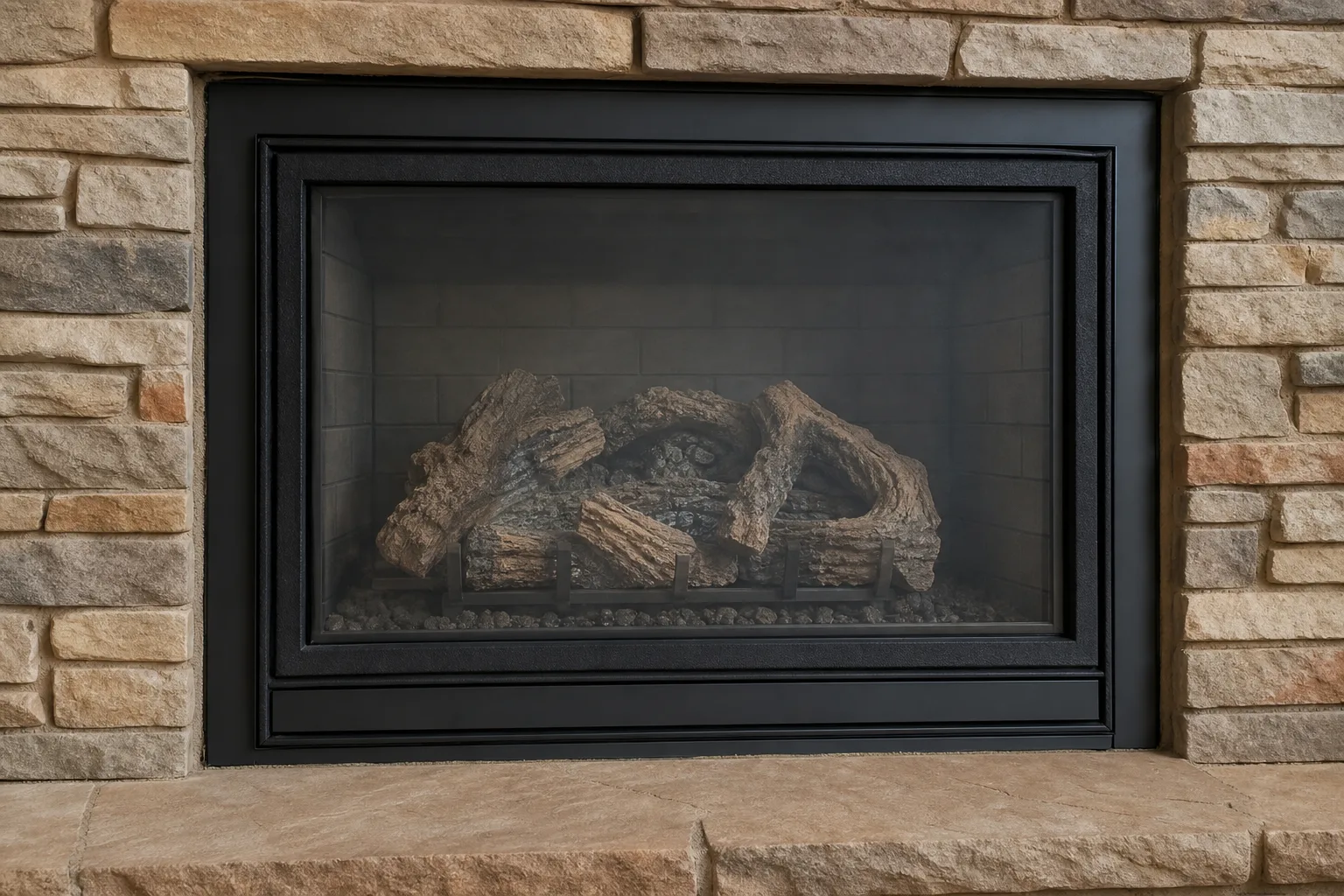
A direct-vent unit is a sealed system. It draws combustion air from outside, burns behind a fixed pane of glass, and sends every bit of exhaust back outside through a pipe. The firebox and your living room are two separate worlds. Combustion products in the room mean that separation has failed somewhere, full stop.
A vent-free unit, sometimes sold as ventless, has no flue at all. It burns in the open and puts its combustion products into the room by design. That is not a defect, it is the entire concept.
So a faint combustion smell that would justify an immediate inspection on a direct-vent insert is, in a vent-free appliance, the appliance doing what it was built to do.
That does not make it pleasant or universally acceptable. Vent-free units have a documented reputation for odor and for leaving residue on nearby surfaces, and local codes differ on where they are permitted at all. I am not going to rule on ventless from here. Check your local code, and know what you own.
How to tell which one you have
You can usually settle this in a minute without tools.
Look at the glass. If there is a single fixed pane sealed in a frame with a black rope gasket around the edge, and it does not open without removing hardware, you have a direct-vent or similar sealed unit. If the flames are open to the room with no glass in front of them, or the glass is a decorative screen you can swing open while it runs, you are very likely looking at vent-free.
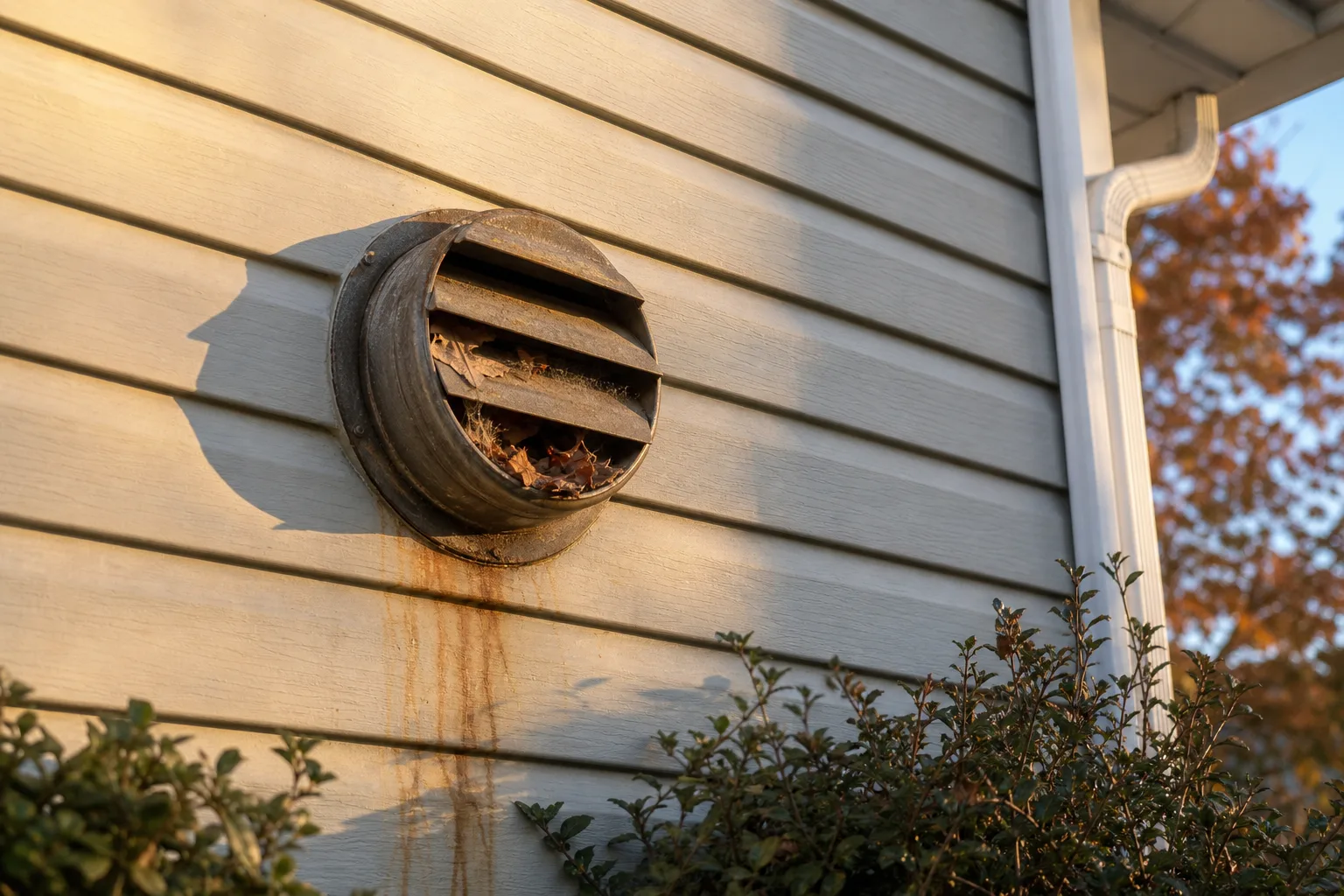
Then go outside. A direct-vent unit terminates somewhere: a stainless steel cap eight to fourteen inches across on the sidewall, louvered or screened, often weathered to a dull brown-grey, or a pipe through the roof with a flat or mushroom cap. A vent-free unit has no termination anywhere, because it has nothing to terminate.
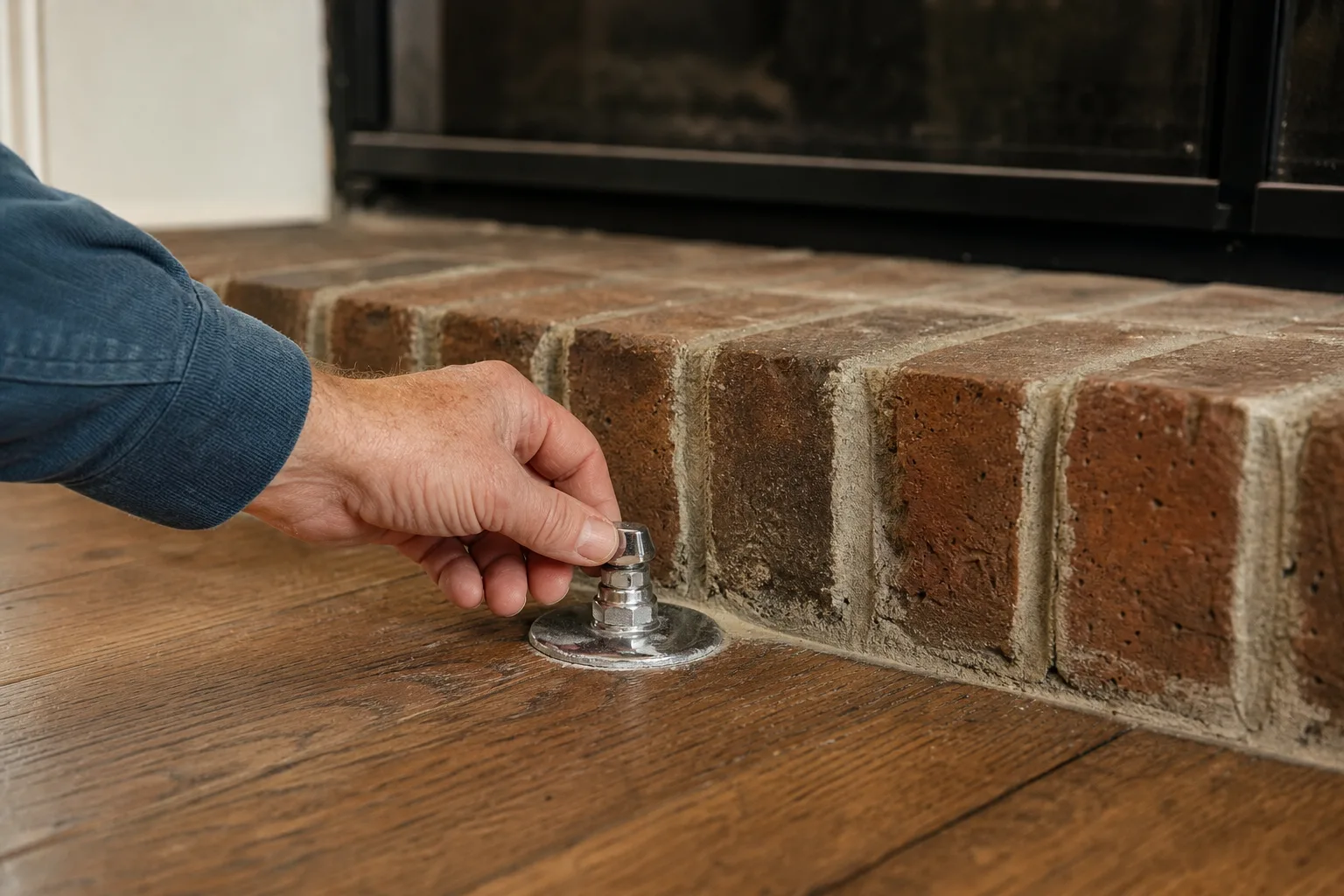
Pro tip: While you are outside looking at that termination, look at it properly. Leaves packed against the screen, a spiderweb thick enough to see, a bird nest wedged into the louvers. A partially blocked termination changes how the appliance breathes, and it is both a common cause of odor complaints and one of the few things you can spot from your own driveway.
What counts as normal for each
For a direct-vent unit: seasonal dust burn-off, yes. The ignition whiff, yes. Anything else reaching your nose from a sealed firebox deserves an explanation.
For a vent-free unit: a mild combustion smell during operation is within the design. A strong one, a worsening one, or one that arrives with headaches is not, and vent-free appliances are exactly where room air quality deserves the most attention.
What Nobody Tells You: Your Nose Is Not a Carbon Monoxide Detector
Everything up to here has been teaching you to read gas fireplace smells. This section is about the hard limit of that skill, and it is the most useful thing on this page. I have not found it stated plainly anywhere else competing for this topic.
Carbon monoxide is colorless. It is tasteless. And it is completely odorless.
Which means your nose, the instrument you have been using to run this entire investigation, cannot detect it at all. Not faintly. Not at high concentrations. Not ever.
So "it doesn't smell dangerous in here" is not a safety clearance. It is one data point about mercaptan and dust, and zero data points about the gas that actually sends people to the hospital.
It shows up in the body instead: headache, nausea, shortness of breath, and with prolonged exposure, loss of consciousness. Those symptoms are easy to mistake for a virus, which is part of what makes it dangerous. A household where several people get headaches on the evenings the fireplace runs, and feel fine otherwise, is describing something worth investigating.
To complicate the picture honestly: incomplete combustion can produce aldehydes, which do smell somewhat like natural gas. So sometimes an odor accompanies a venting problem. You cannot count on it, and the absence of odor tells you nothing.
Safety note: Working carbon monoxide detectors are how a household gets warned. A technician can also measure combustion and carbon monoxide directly with instruments, but that happens while somebody is standing there; a detector watches the room the rest of the year. Install them according to the manufacturer's instructions for your specific model, test them on a schedule rather than when you happen to think of it, and replace them at the end of their rated life, because the sensors expire whether or not the unit still chirps. If you have a fuel-burning appliance in your home and no working CO detector, that is the highest-value thing you will fix this week.
Gas Fireplace Smells When the Fireplace Is Off
Everything up to this point assumed the unit was running. Plenty of people asking about gas fireplace smells are not describing a burn at all. They are describing a room that smells wrong while the fireplace sits cold and dark.
That is a different problem with a different list of causes, and it is the question I see asked most often and answered least often.
Reverse draft is the usual suspect. Your house is a pressure system. Bath fans, a range hood, a clothes dryer, a leaky return duct, and stack effect on a windy day all pull air out of the house, and the air has to come back in from somewhere. Sometimes the easiest path is backwards down the flue. When that happens, you get the smell of everything sitting inside that flue, delivered into your living room, with the appliance completely off.
The tell is that it comes and goes. It is worse on windy days, or when the dryer is running, or after somebody showers.
Moisture is the second one. A damp chimney or chase smells like a basement, because it is essentially the same situation: cool masonry, standing humidity, and organic material. This one tracks the weather rather than your appliance use.
Debris at the termination is the third. Leaves, nesting material, and general accumulation pack into a cap or a louvered sidewall termination, get damp, and rot. That smell then has a straight path back into the house on any reverse draft.
And for open masonry configurations specifically, an animal that got in and did not get out is a real possibility. Be careful with this one, because it gets copied onto pages about sealed units where it makes much less sense. A properly screened direct-vent termination is not an animal entrance. An uncapped masonry flue absolutely is.
When an inspection is not optional
Most of this article is advice you can weigh. This part is not, because NFPA 211 sets out specific circumstances that call for a Level 2 inspection, the kind that includes the accessible portions of the chimney structure and the flue's interior.
A Level 2 inspection is required when a property is sold or transferred, when the system is changed in any way, including a change of fuel or a new appliance, after a malfunction, after a chimney fire, and after an external event such as a building fire, a weather event, or an earthquake.
Read "after a malfunction" carefully, because it is the one most likely to apply here. Smoke in the room, soot on the glass, or an appliance that will not stay lit are malfunctions, and at that point an inspection stops being a judgment call.
A lingering odor on its own is not automatically a malfunction. Room air, housekeeping, and damp weather can all produce one with a sound appliance. But an odor nobody can explain is exactly what an inspection exists to settle.
How VIO Helps With Gas Fireplace Smells
Let me be exact about what we are, because it matters when you are deciding who to call about gas fireplace smells.
VIO is a referral service. We do not employ technicians and we do not do the work ourselves. What we do is connect you with independent local chimney and fireplace companies that work on gas appliances, in your area, and we do it on one phone call instead of the afternoon you would otherwise spend reading reviews of companies you know nothing about.
For this problem that matters more than usual. An odor complaint is a diagnostic job, not a cleaning job. It needs someone who works on gas appliances specifically and will look at the combustion picture and the venting, not just run a brush down a flue. Sorting that out from a search results page is hard.
So tell us three things when you call: what it smells like in your own words, whether the unit is on or off when it happens, and whether anything about the fireplace or the house changed recently. Those three answers shape which company we match you with, and what they bring in the truck.
On money, here is our actual conduct. We ask every company in the network to put its estimate in writing before any work starts, and you should insist on exactly that. If someone wants to begin work on a gas appliance on a verbal number, that is your signal to slow down, whether we matched you or not.
And one more piece of honesty about gas fireplace smells: sometimes nothing is wrong. Sometimes a technician finds a season of dust and a sound vent and tells you to stop worrying, and that hour was still worth it. Peace of mind about a fuel-burning appliance in the room where your family sits is not a consolation prize.
Get your gas fireplace smells identified.
A smell is real information about how an appliance is burning and venting, and it is worth an hour of a qualified person's time.
We will connect you with an independent local company that works on gas fireplaces, and we ask every company in our network to put its estimate in writing before any work starts. Insist on exactly that.
Call (513) 655-6702 to get matched with a local pro.
Symptom checker
What is your chimney doing?
Tap the closest match for an honest first answer.