



On this pageWhat the fireplace actually is: two systems that meet8 sections+7
- What the fireplace actually is: two systems that meet
- The parts of the fireplace, from the floor up
- Which kind do you have? Identify it without tools
- What you can check yourself, tonight
- What you cannot see, and why it decides the answer
- So, can you light the fireplace tonight?
- How VIO helps with the fireplace you inherited
- What to do with the fireplace now
Quick answer
The fireplace is the part of the system inside your room, and it joins a chimney that carries smoke out through the roof. Its main parts, from the floor up, are the hearth, firebox, lintel, throat, damper, smoke shelf, smoke chamber and flue. It works by draft: hot gas rises and pulls fresh air across the fire. NFPA 211 calls for an annual inspection.
There is a question underneath this search that almost nobody types out, and almost no page answers: am I actually allowed to light the fireplace sitting in my living room?
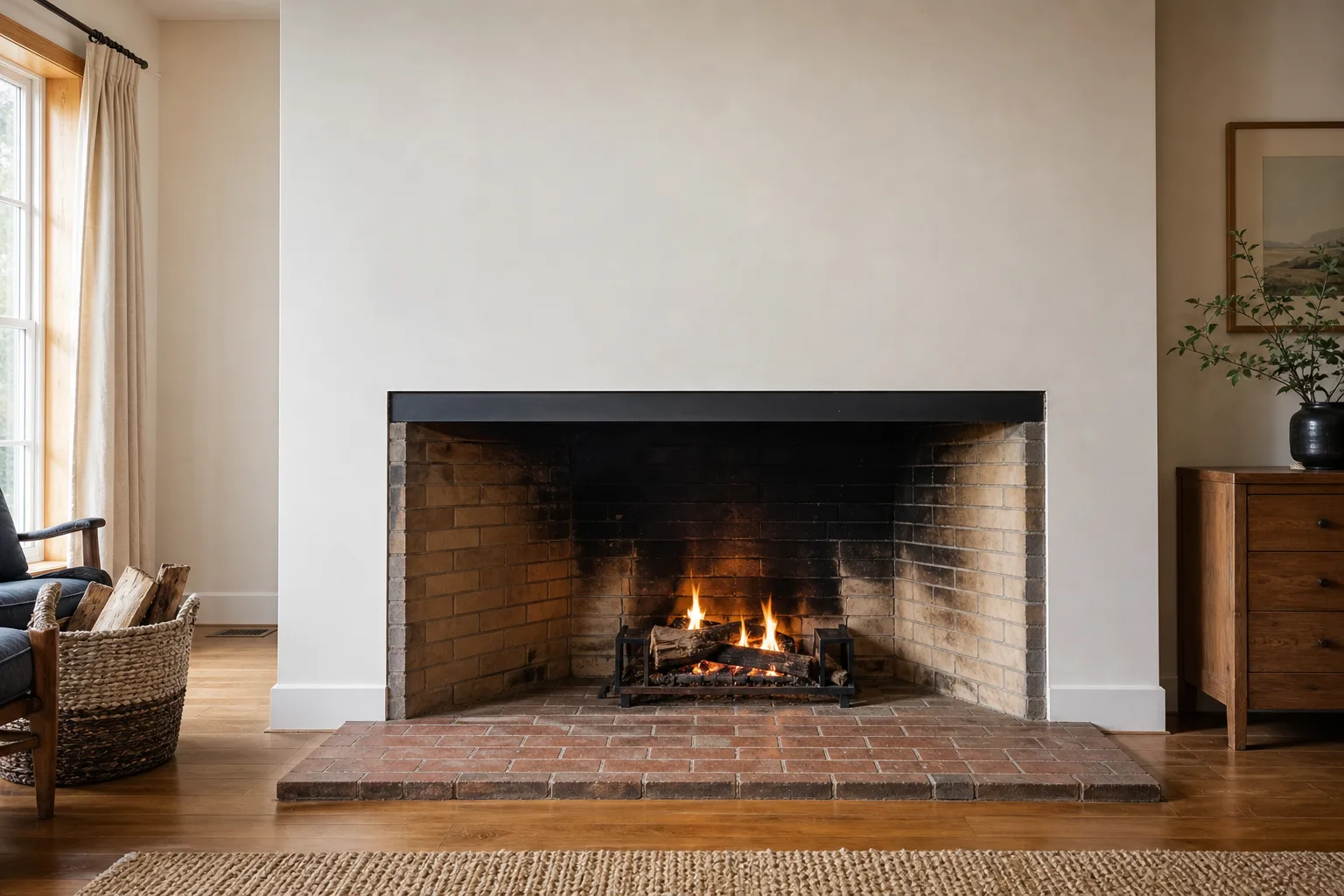
Most people who look up the fireplace are not shopping. They are standing in a living room, looking at an opening in a wall that came with the house, and realizing they cannot name a single part of it. The metal flap up in the dark. The bar across the top. The shelf of brick sticking out into the room.
This page is written for that person, in the order the evening actually goes: look at it, figure out what kind it is, check the things you can check, then decide whether tonight is a fire or a phone call.
What the fireplace actually is: two systems that meet
What you are looking at is not one object. It is two, joined at a seam you cannot see from the couch.
The part in the room is the fireplace. The part going up through the roof is the chimney. They were often built at the same time by the same mason, and they fail in completely different ways.
The fire needs air more than it needs wood
A fireplace works on one physical trick. Hot combustion gases are lighter than the air in your living room, so they rise, pulling fresh air in behind them, across the fire and out the top.
That flow is called draft. Not the wood, not the grate, not the fancy doors. Draft.
Good to know: A lot of what goes wrong with a fireplace is a draft problem wearing a costume. Smoke rolling into the room, a fire that will not catch, a smell in July: those usually come back to air not moving the way it should. Plenty of other faults have nothing to do with draft, including damaged liners and refractory panels, deteriorated masonry, clearance problems, gas component faults, and water getting in. An inspection looks at all of it, not just airflow.
Draft needs an unobstructed path from the fire to the open sky. Anything in the way, a closed damper, a bird's nest, a collapsed flue tile, a summer's worth of leaves, and the smoke has to go somewhere else. Somewhere else is your living room.
Where the fireplace ends and the chimney begins
Roughly speaking, the fireplace is everything you can touch. The chimney is everything above it.
The chimney's job is not only to carry smoke. It also surrounds the flue and keeps the heat of those gases away from the wood framing of your house. That is a structural safety function, and it happens entirely out of sight.
Hold onto that, because it comes back later.
The parts of the fireplace, from the floor up
Other pages give you a numbered list. Some say thirteen parts, some say nine. The count is an editorial decision, not a standard, so learn them in the order your eye travels instead.
What you can see from the couch
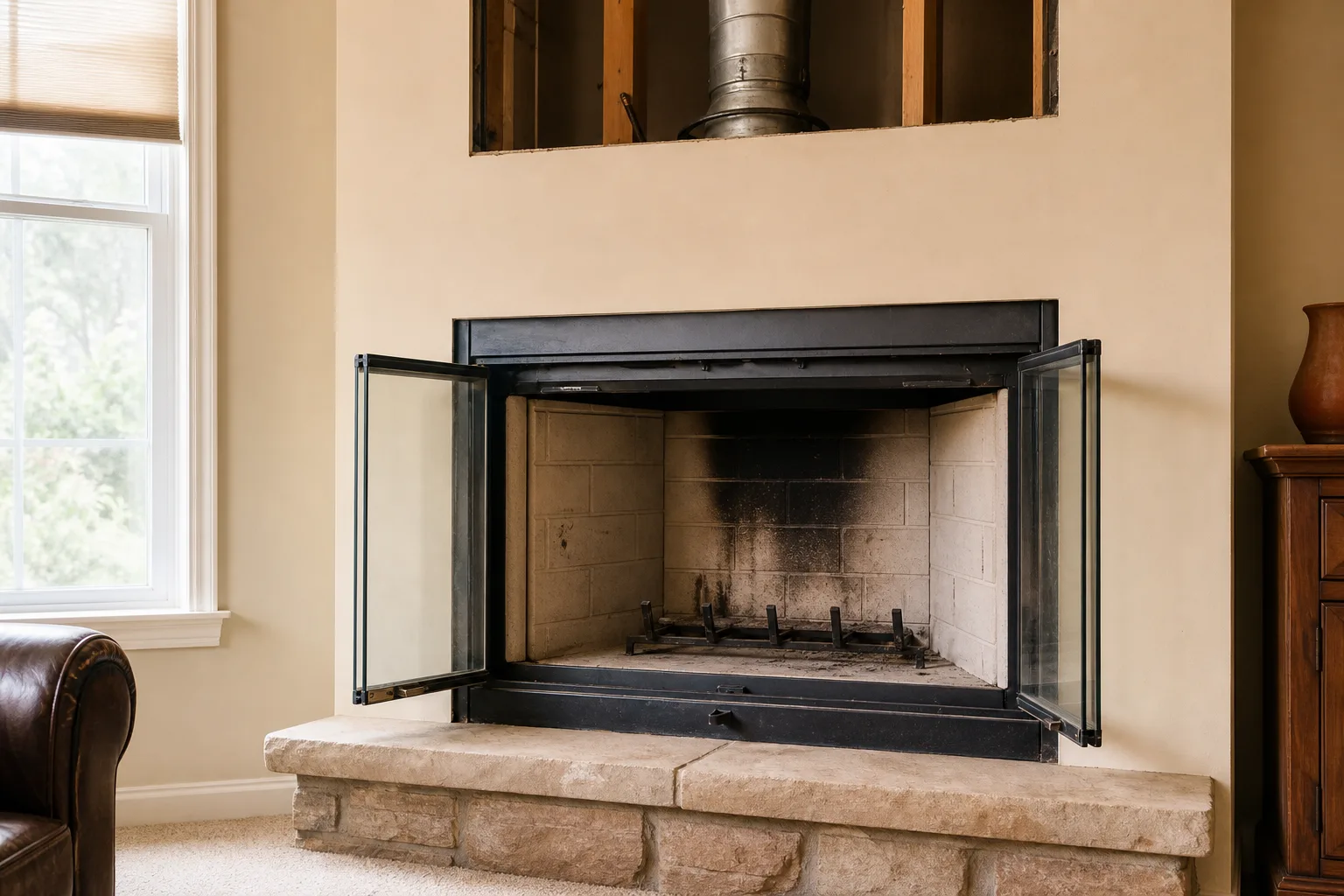
The hearth is the floor, built of noncombustible material and extending past the opening into the room, deliberately, to catch anything that rolls or pops out.
The face and the mantel are the decoration around the opening. Brick, tile, stone, wood. Mostly cosmetic, though how far the mantel sits from the opening is a clearance question worth asking about.
The lintel is the bar across the top of the opening. Usually steel angle iron, painted or rusting. It holds up all the masonry above the opening, and building guidance calls for it to bear on the brickwork at least four inches at each end.
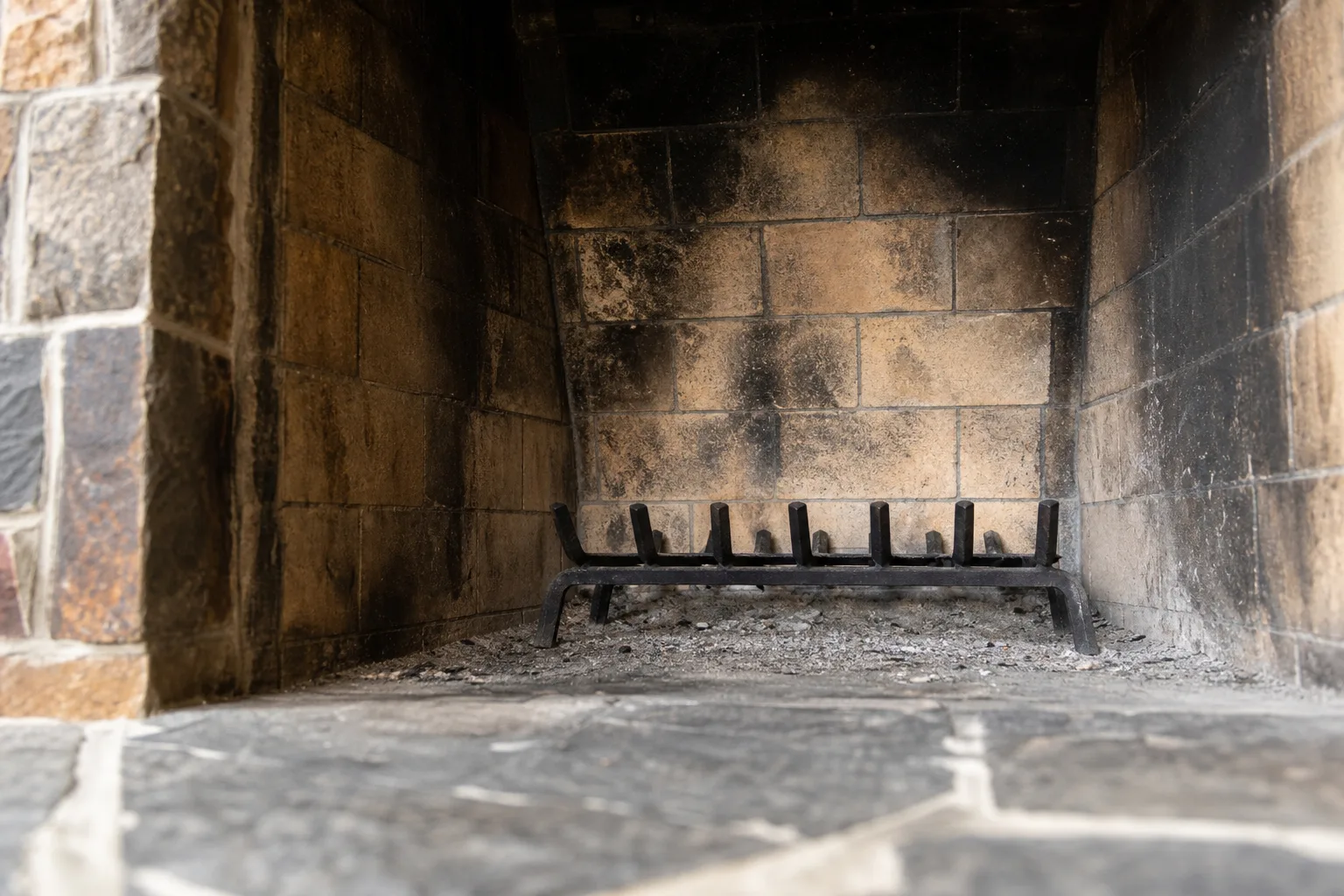
The firebox is the chamber itself, the part that holds the fire. In a masonry fireplace it should be at least twenty inches deep, and the walls run about eight inches thick when they include a two inch firebrick lining, or ten inches without one.
Those numbers are a sanity check, not trivia. A shallow, thin firebox is a hint that you are not looking at true masonry at all.
Pro tip: Learn four words before you ever call a chimney company: hearth, firebox, damper, flue. Being able to say "the damper will not move" instead of "the metal thing is stuck" changes the entire phone call, and it changes what gets quoted.
What is above your head
Now look up into the opening with a flashlight. This is where most people have never been.
The throat is the narrowed slot directly above the firebox, where combustion products leave. In a properly built masonry fireplace it sits roughly eight inches above the top of the opening.
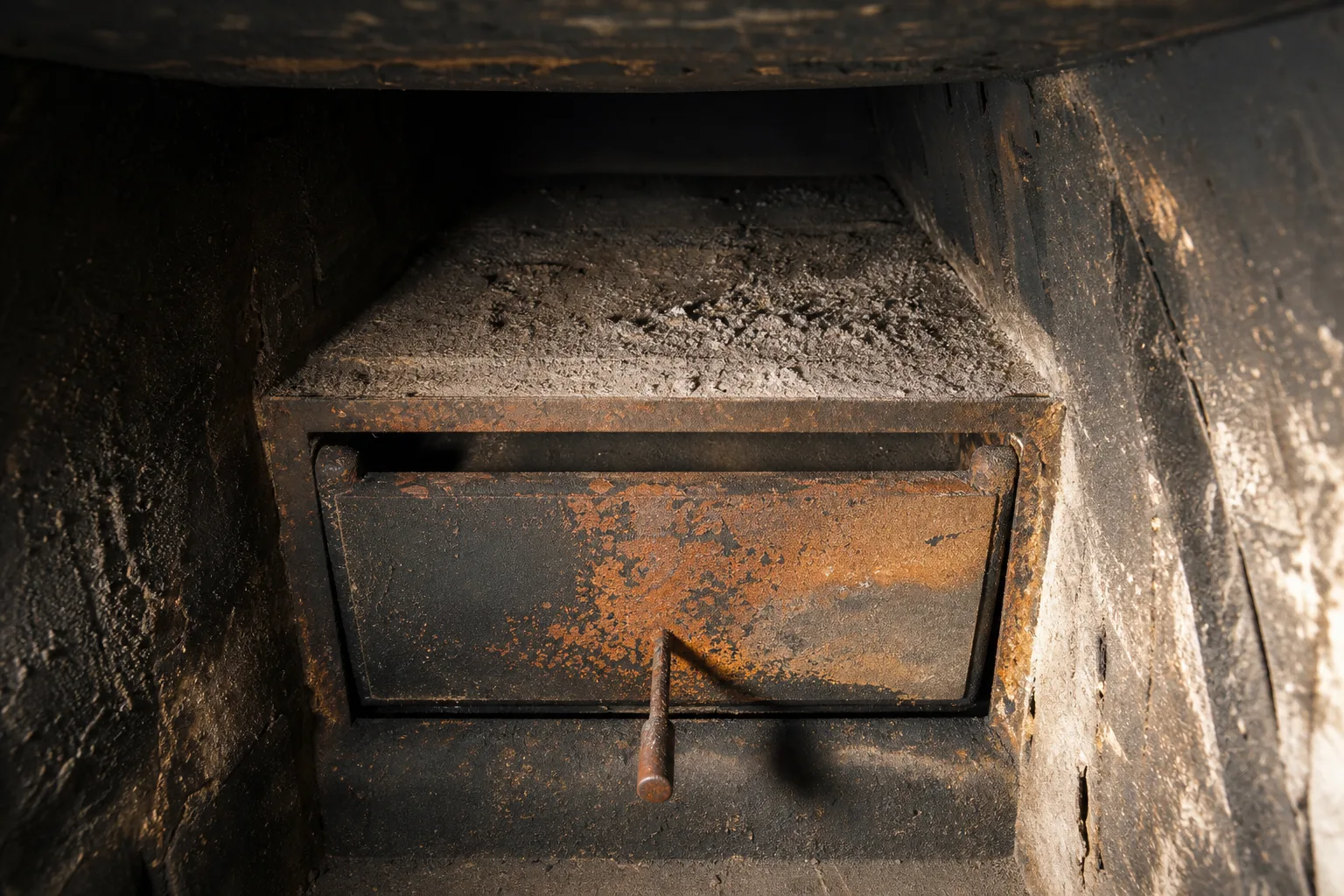
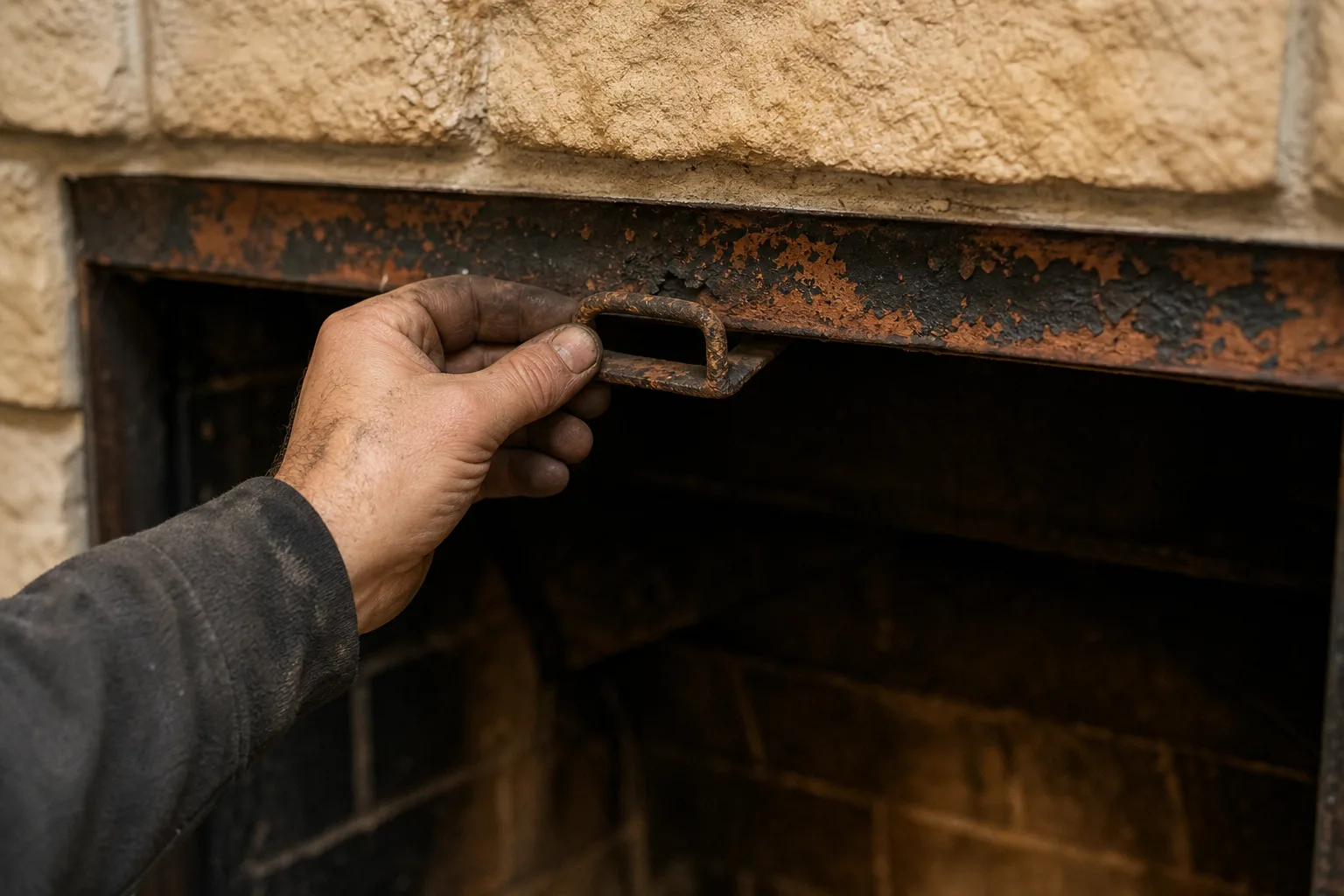
The damper lives in the throat. It is a hinged plate of cast iron or steel that opens and closes, regulating draft when there is a fire and sealing the firebox from the outdoors when there is not. You operate it with a handle, a knob, or a small screw crank just inside the opening. When one is rusted through or will not seat properly, replacing the fireplace damper becomes its own small project.
The smoke shelf is the flat ledge behind and above the throat. Its only job is to break downdrafts, catching air that tries to come back down the flue and turning it around. It collects ash and grit, and it always looks filthy.
The smoke chamber sits above the damper, shaped like an upside down funnel, narrowing the wide firebox opening down to the flue.
The flue is the passage the smoke actually travels through. The liner is what the flue is made of on the inside: stacked clay tiles in older homes, in standard sizes like 8.5 by 8.5 inches or 13 by 13 inches, or a stainless steel chimney liner in relined and newer systems.
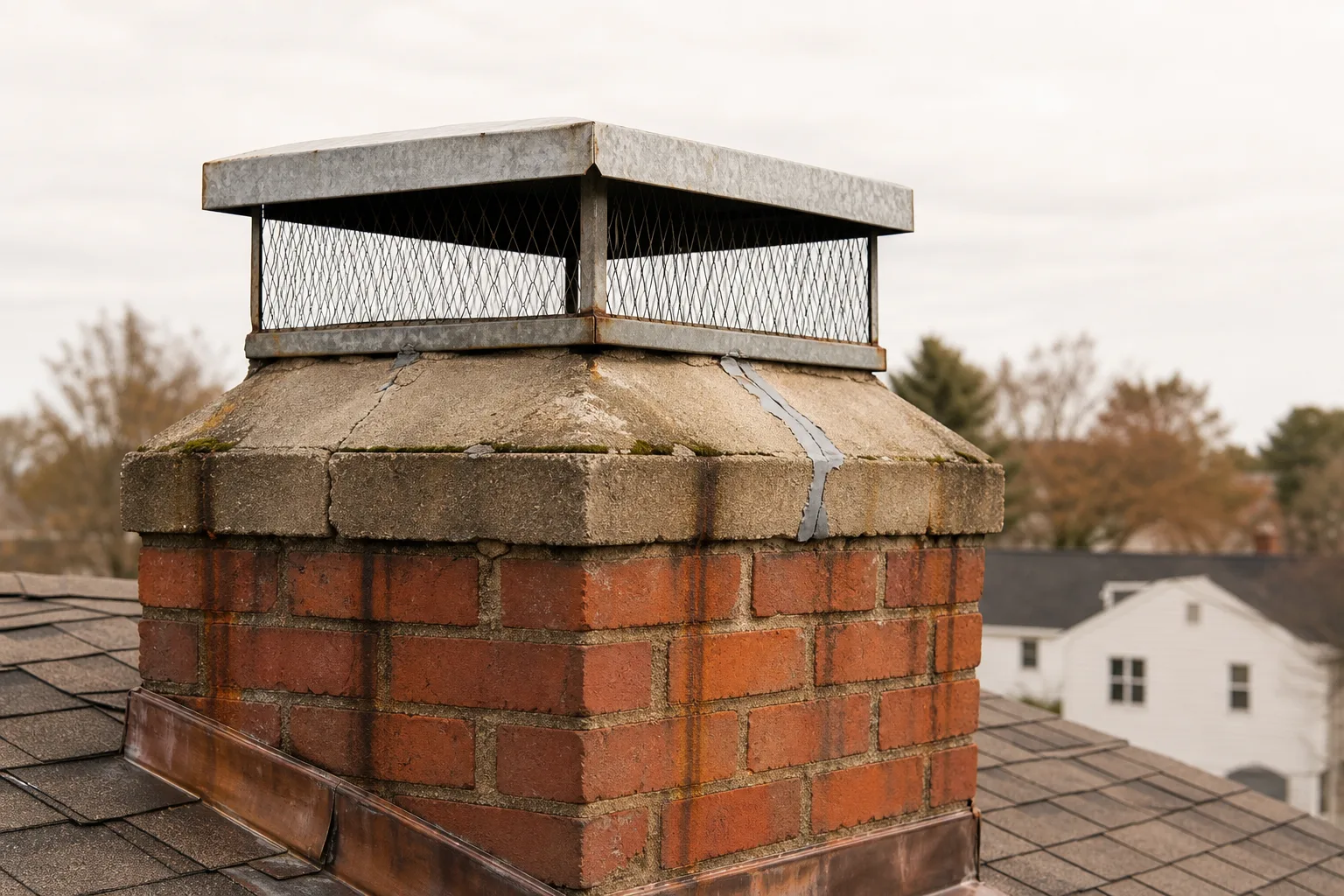
Above that, out of reach entirely: the crown, a sloped slab of concrete on top of the brickwork that sheds water. The cap, a metal lid on legs over the flue opening that keeps rain and animals out. And the mesh on the cap's sides, the spark arrestor, which stops burning material from being carried out onto your roof.
Some masonry fireboxes also have an ash dump, a small metal door in the floor leading to a pit below.
Count that up and notice something. Of everything on that list, you can see maybe the first third from where you are sitting.
Some of what decides whether this is safe to use is right in front of you: the condition of the firebox, the hearth, and what sits near the opening. Much of the rest is above your head, in the dark, or on the roof.
Which kind do you have? Identify it without tools
The anatomy pages skip this and the identification pages rush it. You need both, because the type you own changes everything that comes next. There are four common answers, and you can reach yours with a flashlight.
Masonry, prefab, gas, electric: the tells
A masonry fireplace is built, not installed: brick, stone or block all the way up, a firebox lined in firebrick, a masonry stack through the roof.
A factory-built or prefab unit is a manufactured metal box in a framed chase, with flat refractory panels instead of laid brick and a round double wall metal pipe above. A prefab fireplace looks convincing from ten feet away and obvious from two.
A gas fireplace has a gas line: black iron pipe entering the firebox, often with a key valve nearby, and ceramic logs sitting on a burner tube.
An electric fireplace plugs into a wall outlet. No gas fitting, no special wiring, no flue that does anything.
| Type | The firebox looks like | What is above it | The giveaway | What it changes |
|---|---|---|---|---|
| Masonry wood-burning | Laid firebrick, sooty, sloped back wall | Masonry stack through the roof | Real mortar joints between individual firebricks | Full flue inspection matters most; liner condition is the question |
| Factory-built (prefab) | Flat refractory panels, metal frame | Round double wall metal pipe | A metal rating label riveted inside the opening | Parts are model specific; damaged panels are a stop-use issue |
| Gas | Ceramic logs on a burner, sand or embers below | Vent pipe, or nothing on a vent-free unit | Black iron gas pipe and a key valve | Gas fitting and venting, not sweeping, is the concern |
| Electric | Plastic or glass, no combustion residue at all | Nothing | A power cord | No chimney work applies |
The rating plate, and why it matters more than the logs
If your fireplace was manufactured rather than built, there is a metal label on it, usually in the control compartment or near the burner assembly on a gas unit, riveted just inside the opening on a prefab.
It carries the make and model, and it is the single most useful thing you can photograph before making a phone call.
Myth vs. fact: You will read that flame color tells you the fuel, blue for gas and yellow for wood. It does not. Gas log sets are deliberately tuned to burn yellow and lazy, because that is what people think a fire should look like. Find the gas line instead.
What you can check yourself, tonight
The good news: a lot of this is available to you right now, with a flashlight and no tools.
Work down the list.
- The damper moves. Find the handle, knob or crank inside the top of the opening. It should move without a fight, and you should be able to see the plate swing.
- The damper is open when you look up. With it open you are looking into a dark shaft. With it closed you are looking at a rusty plate a foot above your head.
- Nothing obvious is blocking the throat. Twigs, nesting material, chunks of masonry sitting on the smoke shelf. Any of those is a stop.
- The firebox brick and mortar are intact. Look for missing mortar between firebricks, cracked or crumbling brick, or gaps you can put a finger into. Crumbling masonry is what brick chimney repair exists to fix, and it is worth naming on the call.
- The hearth extends past the opening and is not carpeted, rugged, or stacked with anything.
- The firebox is empty of everything except a grate. People store things in unused fireboxes and then forget.
- The gas key valve is closed if you found a gas line and are not using it.
- Your smoke alarms and carbon monoxide alarms work. Not optional, and not a formality on a fireplace with unknown history.
Safety note: If the damper will not move, stop. Do not lean on it, do not tap it with a hammer, do not spray it and yank. A stuck damper is stuck for a reason, and the reasons range from ordinary rust to a plate that is holding back debris.
From the field: The seized damper handle is one of the most ordinary things a homeowner meets on an unused fireplace, and forcing it is how a routine service call turns into masonry work. The plate is cast iron sitting in a frame that has been through decades of moisture and acidic flue gas. It gives up in the direction you do not want.
Notice what happened. Every item on that list sat inside the room, at arm's length, checkable by anyone. That is exactly where a homeowner's ability to assess this system ends.
You have done the part you can do.
Much of the rest of the fireplace is above your head and out of sight, and it weighs heavily on whether tonight's fire is a good idea. Tell us what you found and we will match you with an independent local chimney company.
Ask for a Level 1 inspection, or a Level 2 if you just bought the house.
Call (513) 655-6702
What you cannot see, and why it decides the answer
Everything above happened in the room. Now the part that does not.
The inside of your flue is a vertical shaft running twenty or thirty feet up through masonry. You cannot see it and you cannot reach it, and a real share of the risk sits up there, out of view, which is why the checks you just did cannot close the question on their own.
Two things go wrong up there, and they go wrong quietly.
Soot or creosote: how to tell them apart
Burning wood leaves residue on the flue wall. Which kind depends on how the fires burned, and the difference is a chore versus a hazard.
Soot is dull. It is powdery, matte black, and it brushes off. It is the ordinary byproduct of combustion, but do not read "ordinary" as "ignore it": visible soot or debris in the flue is itself a trigger for having the chimney swept.
Creosote is glossy. Third stage creosote in particular is black and shiny, tar-like, sometimes rippled or bubbled where it ran and hardened. It looks wet even when it is dry. It is condensed, unburned fuel, and it burns extremely well.
If you have ever wondered why chimney people are so insistent about dry wood, that is why. Wet wood burns cool, cool smoke condenses, condensed smoke is creosote. Burning properly seasoned firewood is the cheapest chimney maintenance that exists.
The other quiet failure is the liner. Clay flue tiles are orange terracotta tubes stacked in sections, mortared every couple of feet. They crack. When they crack, the barrier between flue gas and your framing has a gap in it, and no amount of sweeping fixes that.
The three inspection levels, in plain English
NFPA 211, the standard the trade works from, defines three levels. Knowing which one you need is most of what makes you sound competent on the phone.
Level 1 is the routine annual inspection: verifying the chimney or vent is clear of combustible deposits and obstructions, checking the basic soundness of the appliance installation and its connections, and visually inspecting the readily accessible parts of the venting system without cameras or special equipment. NFPA 211 calls for this annually regardless of how much you use the system, and CSIA recommends the same for every fireplace and wood stove.
Level 2 is required, not suggested, in specific situations: at the sale or transfer of the property, on a change of fuel or appliance or other system change, after a malfunction, after a chimney fire, and after an external event such as severe weather or an earthquake.
Level 3 is for suspected concealed damage, and involves removing portions of the chimney or building structure to reach hidden areas.
Safety note: That Level 2 trigger at sale is a requirement under the standard, not a nicety, and most buyers have never heard of it. If you bought your house in the last year and nobody looked inside the flue, that inspection did not happen. Local code adoption varies, so what your jurisdiction enforces may differ, but the standard is the standard.
One more distinction, because most pages blur it. The annual rule is about inspection. Sweeping is a separate thing, and it is triggered by what is actually on the flue wall: roughly an eighth of an inch of creosote accumulation, or any visible soot and debris. Some households need sweeping every season. Some do not. You find out by having someone look, which is the annual inspection, and the sweeping follows from what they find. Our guide to what chimney cleaning actually involves covers the rest.
So, can you light the fireplace tonight?
Time to pay that off honestly, which means giving you two different answers.
If the history is unknown, no. Not tonight. If you cannot say when it was last inspected, when it was last swept, or whether anyone has looked up the flue in this decade, the honest answer is to wait. Not because something is definitely wrong, but because the specific failures that matter, glazed creosote and cracked tiles, are invisible from where you are standing, and they are exactly the ones that put fire in a wall cavity rather than in a firebox.
That is not a scare line, just the shape of the information. You checked eight things and passed them all, and none of them reached the flue.
If it has been inspected within the year, nothing has happened since that would trigger a Level 2, and your checks passed, you are in a much better position. A past inspection is not a permanent pass. A malfunction, a chimney fire, severe weather, or any change to the fuel or the appliance reopens the question no matter how recent the last visit was.
What "run it well" means also depends on what you own. Everything in the rest of this section is about open masonry wood-burning fireplaces.
If yours is gas or factory-built, operate it according to its listing and the manufacturer's instructions for that specific model, which is exactly what the rating plate is there to help you find. Some gas units are vent-free and have damper requirements of their own. An electric unit is an appliance on a cord and none of this applies to it.
If the fireplace has sat unused for years
Treat it as unknown history, because it is. Disuse does its own damage. Moisture gets into the masonry, mortar joints in the smoke chamber let go, animals move in, and the damper seizes wherever it was left.
The first cold evening of the season is the worst moment to discover any of that, which is the argument for looking now rather than in December.
Closing the damper is as important as opening it
Open the damper before you strike the match, every time. Then leave it open until the ash is completely cold, because a fire that looks out still produces carbon monoxide.
And then actually close it. An open damper on a fireplace nobody is using is a hole in your house, and it sits there all summer while you pay to cool air that goes straight up it.
Pro tip: The first fire of the season smells different, and that is normal. A flue that has sat all summer holds humid air and a faint sourness that clears early on. What is not normal is smoke coming into the room. Build a small fire first, watch which way the smoke goes, and be willing to put it out.
Build small anyway. A modest fire that draws properly beats a big one that fights you, and a stack of dry hardwood does more for how the fireplace performs than any accessory you can buy for it.
How VIO helps with the fireplace you inherited
Here is the plain version, because the referral model is not always obvious from the outside.
VIO is not a chimney company. We do not own trucks and we do not sweep flues. We match homeowners with independent local chimney companies, which is useful in exactly this situation: you do not know what you have, what to ask for, or who in your area is any good.
The pro we send is an independent local business. You tell us what you found, we point you at a company that works your area and handles your type of system, and you deal with them directly from there.
We ask every company in the network to put its estimate in writing before any work starts, and you should insist on exactly that.
To make the call short, have three answers ready. What kind of fireplace it appears to be, using the table above. When it was last used, even roughly. And whether it has ever been swept as far as anyone knows, including "no idea," which is a real and common answer.
Then ask for the level. A Level 1 if you are doing your annual due diligence, a Level 2 if the house changed hands, if anything about the system was changed, or if anything strange has happened in it. If it turns out you need work rather than a look, our guide to chimney service covers what that usually means in practice.
What to do with the fireplace now
You came here with an opening in a wall you could not describe. You should be leaving with the vocabulary, a type identified, eight checks done, and a clear line between what you settled yourself and what somebody has to climb a ladder to answer.
The fireplace in your living room is not a mystery and it is not a menace. It is a system with a known set of parts, a known way of failing, and a standard that says look at it once a year.
The only genuinely bad move is the one most people make: lighting it and hoping, when a good deal of what would have told you not to sits out of sight from the couch.
Reading this before the cold arrives? That is the right time.
Have the fireplace looked at while it is still just a plan rather than a cold evening and a chimney nobody has checked. We will match you with an independent local company that works your area.
Call (513) 655-6702
Symptom checker
What is your chimney doing?
Tap the closest match for an honest first answer.