



On this pageWhat a chimney pot actually is7 sections+6
- What a chimney pot actually is
- Chimney crown, chimney cap, and pot: three parts, three jobs
- What holds a pot in place up there
- How to tell a chimney pot is in trouble, from the ground
- Repair, replace, or leave it alone
- Choosing a chimney pot: clay, steel, and the height rules
- How VIO helps with a chimney pot
Quick answer
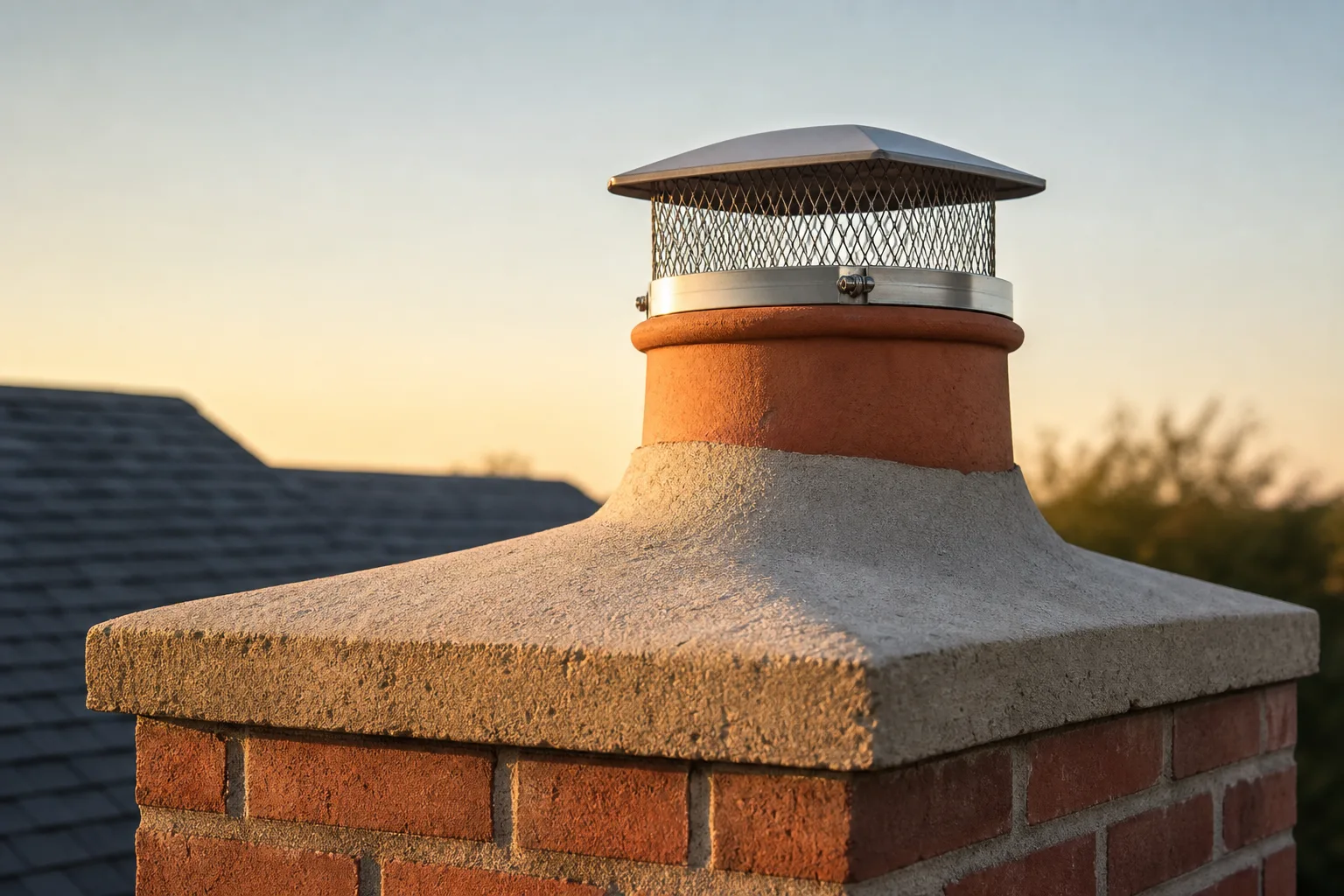
A chimney pot is a clay, terra cotta, or metal pipe fitted to the top of a chimney flue. It extends the flue's height, which helps the chimney carry smoke and combustion gases clear of the roof. A chimney pot sits on the chimney crown and is bedded in a mortar collar called haunching, so it can crack, loosen, or lean as that mortar ages.
Stand in the driveway and look up. If a clay or metal pipe rises above the brickwork at the top of your chimney, that is a chimney pot.
It is easy to read one as decoration, a leftover flourish from a period when houses were built with more ornament on them. That reading is wrong, and it is the reason a cracked one gets ignored for years.
A chimney pot is part of the venting system, and on a traditional masonry chimney it is bedded in mortar rather than fixed with hardware.
This guide is written for the person in the driveway, not the person shopping. By the end you should be able to read the top of your own chimney well enough to describe it to somebody who can act on it.
What a chimney pot actually is
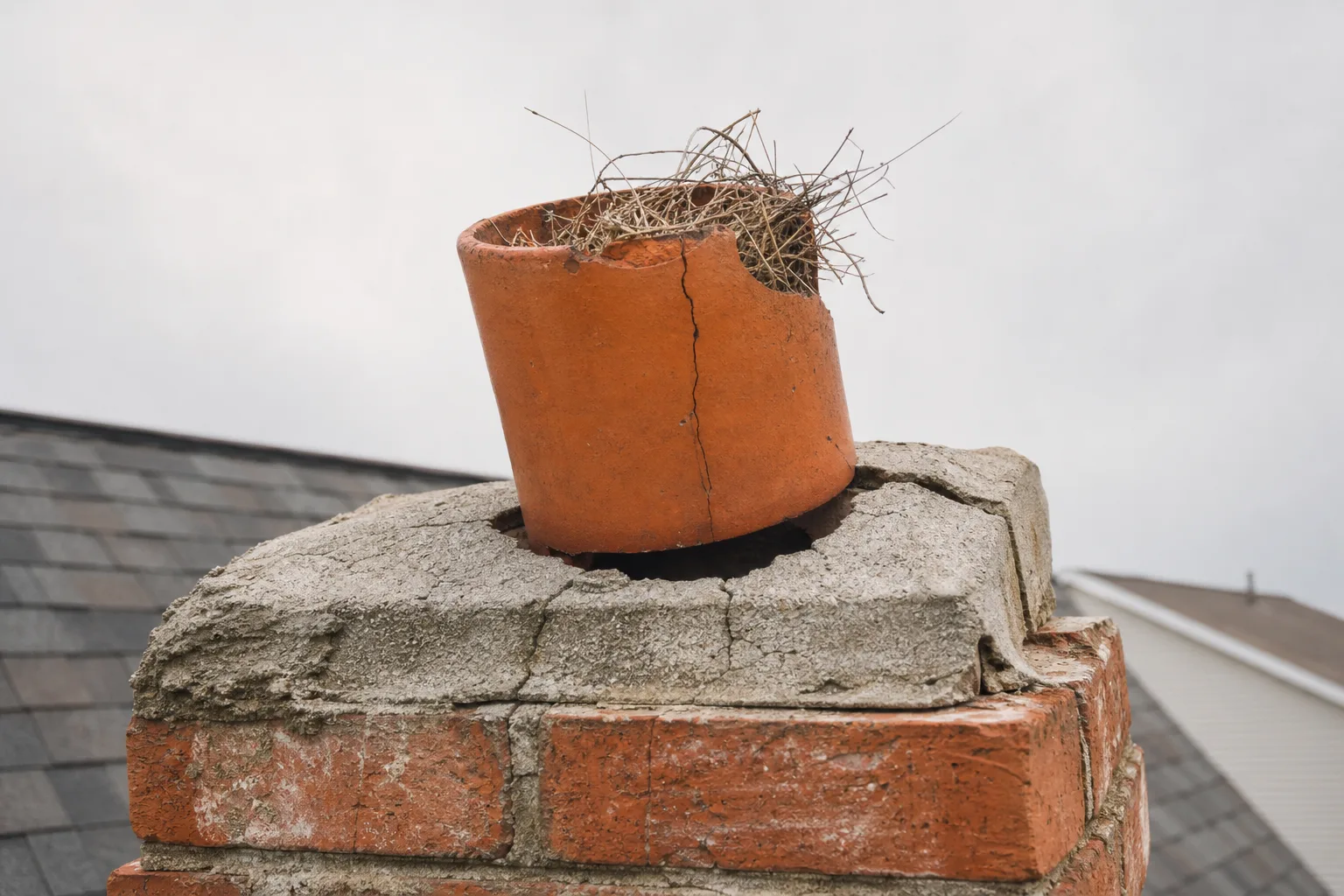
A chimney pot is a pipe fitted to the top of a chimney flue. Traditionally it is fired clay or terra cotta. Newer ones are cast or coated steel, and custom copper shows up on high-end work.
The term is generic. "Chimney pot" describes the whole category of flue extension that sits on top of a chimney, not any one maker's product, so you will see the same words on a hand-thrown Victorian piece and on a factory-pressed steel one.
Shapes vary: plain cylinders, tapered cannon heads, octagonal sections with a corbelled top, some with moulded bands near the rim.
The job it does at the top of the flue
The pot extends the effective height of the flue.
That matters because draft is a function of height. A taller column of hot gas pulls harder than a short one, so adding length at the top helps the chimney carry smoke and combustion gases clear of the roof rather than letting them spill back down into the room.
Venting references set a minimum total height, measured from the appliance outlet to the top, for a system that draws on natural draft alone. A pot is one of the ways that height gets made up on a stack that is short.
It is also the part that gives the chimney its silhouette. Both things are true at once, which is why the decoration idea sticks.
Myth vs. fact: A chimney pot is purely ornamental. Fact: it is a working part of the flue. It adds height, and height is what drives natural draft. Whatever it does for the look of the house, it is doing a job at the same time.
Why older houses have one
Chimney pots became a common fixture through the 18th and 19th centuries, as households moved to burning coal.
Coal wants a strong, steady draft, and a pot was a cheap way to get more pull without rebuilding masonry. The style outlasted the fuel.
That history is why the pots on American houses skew toward older brick stacks, sitting on mortar that has been up there through a long run of freeze and thaw cycles. It is a good argument for putting the top of the stack on the list when you plan routine chimney maintenance.
Chimney crown, chimney cap, and pot: three parts, three jobs
Here is the thing the retail pages will not sort out for you, because they sell two of these in the same aisle.
Crown, cap and pot are three separate parts. They sit within inches of each other, they are made of different materials, they fail in different ways, and mixing them up is how a homeowner ends up asking a company to fix the wrong thing.
The crown
The crown is the sloped slab on top of the masonry. Concrete, grey, poured or precast, sloping away from the flue in every direction so that rain runs off the stack instead of soaking into it.
It is the roof of the chimney. Everything else up there is sitting on it.
The cap
The cap is the covering over the flue opening itself. A steel box with mesh sides and a flat lid, clamped or mortared into the flue or onto the top of the pot, in stainless or a black painted finish.
Covering the opening is the cap's job. If you want the flue closed to rain, leaves and animals, and you want a spark arrestor in the path, the cap is the part that does that work. It is a separate purchase and a separate installation from the pot.
The pot
The pot is the pipe extension standing on the crown, carrying the flue up above the level of the masonry.
| Part | Where it sits | What it does | Material | What failure can look like |
|---|---|---|---|---|
| Crown | On top of the masonry, under everything else | Sheds water off the top of the stack | Concrete | Cracking, spalling, sections lifting away from the brick |
| Chimney pot | On the crown, over the flue | Extends flue height, shapes the chimney's profile | Clay, terra cotta, cast or coated steel, copper | Vertical cracks, chipped or broken rim, leaning, gap at the base |
| Cap | Over the flue opening, on the pot or in the flue | Covers the opening, carries mesh and spark arrestor | Stainless or painted steel, copper | Rust, crushed or torn mesh, missing entirely |
| Flue liner, top course | Inside the masonry, ending at the crown | Contains the flue gases | Clay tile or stainless steel | Cracked or spalled top tile, tile standing proud of a failed crown |
Good to know: A pot and a cap are not alternatives to each other. A chimney can carry both, with the cap fitted onto the top of the pot. If you are told you need one, ask directly which of the two is being quoted.
What holds a pot in place up there
On a traditional masonry chimney, the answer is mortar rather than hardware. Manufactured metal pots can come with their own fittings, and there the manufacturer's instructions govern.
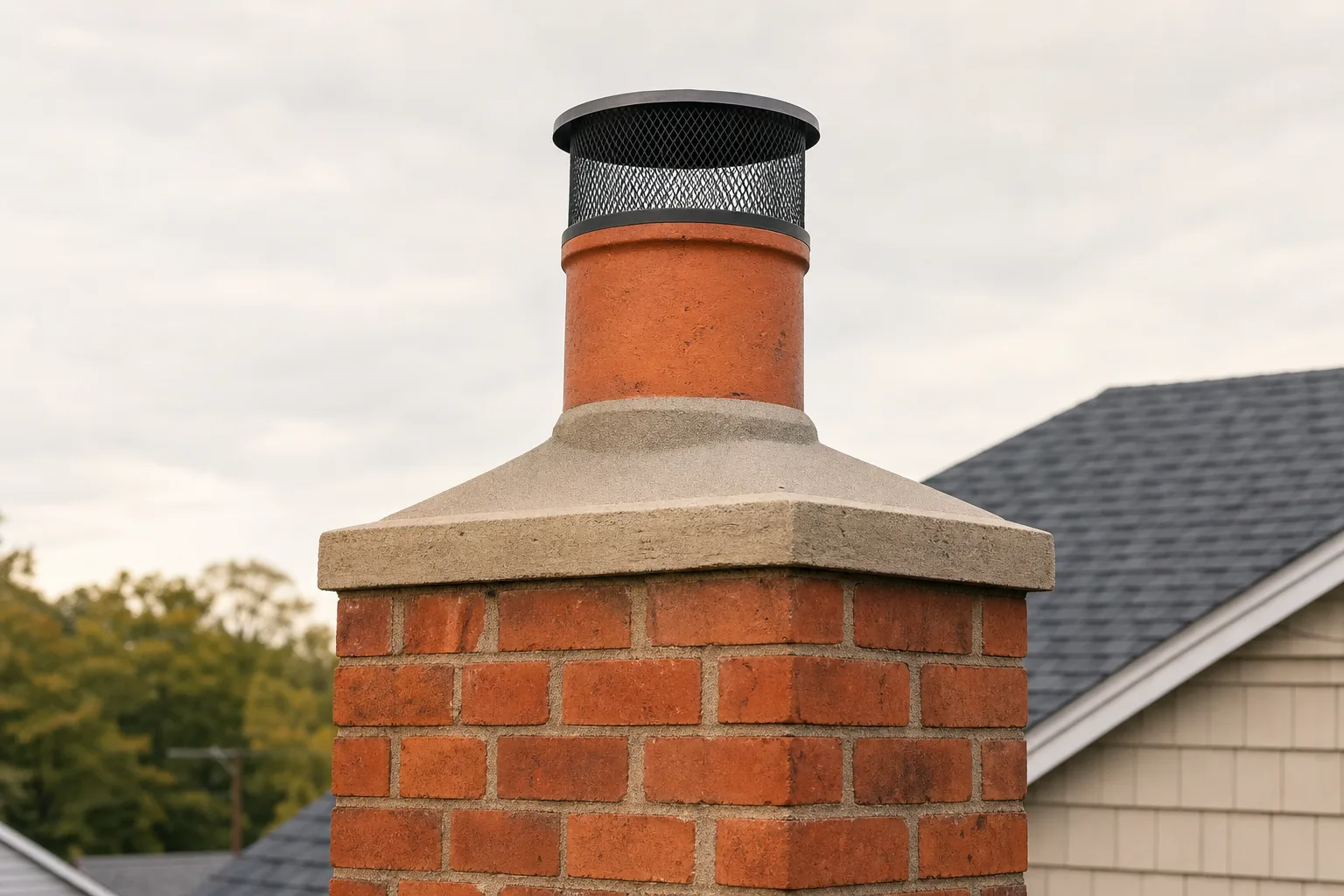
A clay pot is bedded on the crown and held with a cement fillet packed around its base, joining it to the crownwork. That fillet has a name: haunching.
Haunching, the mortar collar at the base
Haunching is formed with a curved profile that slopes downward and away, so water runs off it instead of standing against the clay.
It is a mortar detail sitting where the weather hits hardest. Sun on it all day, rain on it, and in a cold climate freeze and thaw cycling with water in every hairline gap.
Mortar in that position ages the way every other joint on the stack ages, and this particular mortar is what is keeping a heavy clay pipe upright at the highest point of the building.
Why the crown underneath matters just as much
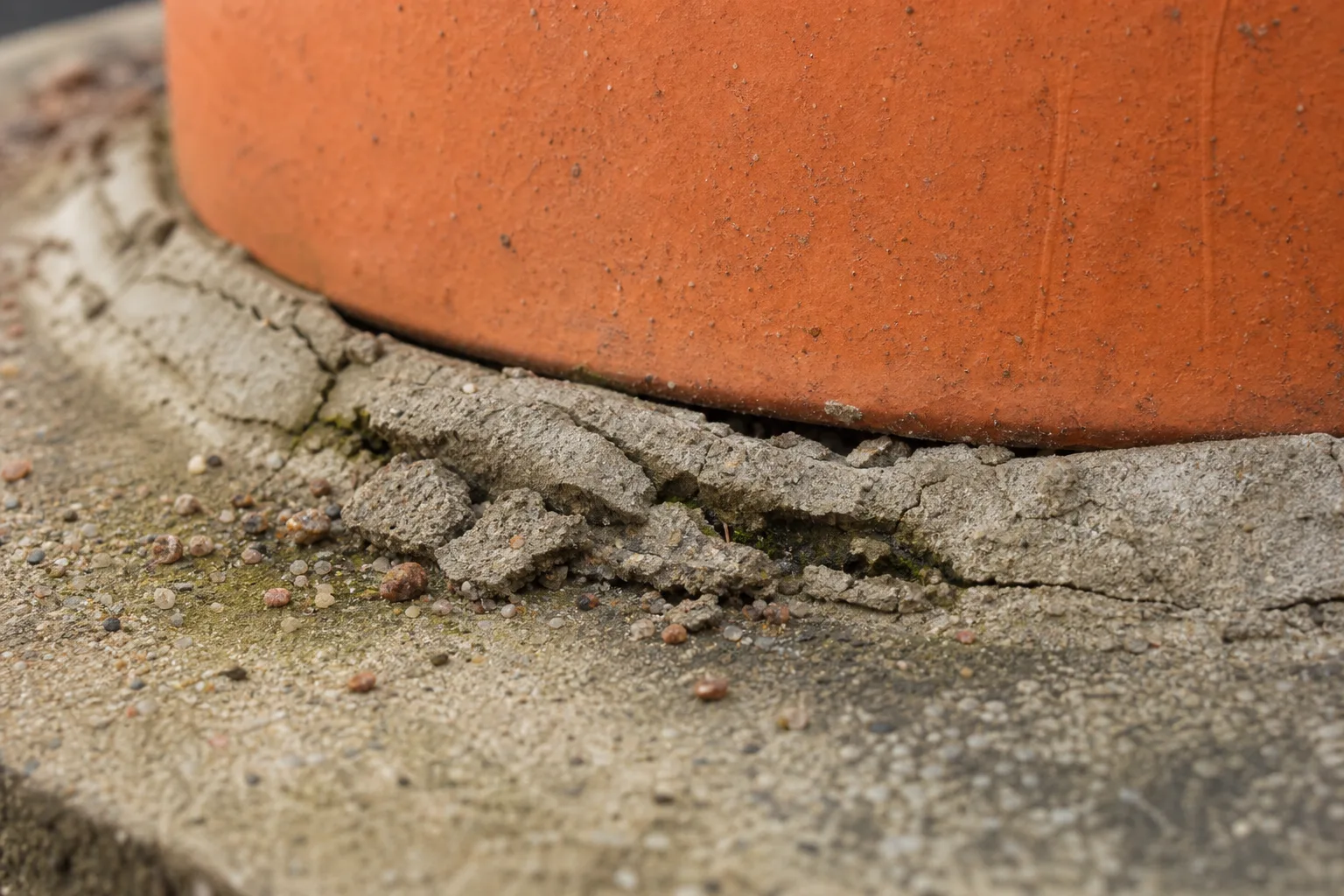
The haunching is bonded to the crown. If the crown is cracked or lifting, the collar sitting on it has lost the surface it was keyed into.
So the two questions are joined, and neither one can be read properly from the driveway.
From the field: When you go out with binoculars, look at the collar of mortar at the base before you look at the pot itself. It is the less interesting part of the picture and it is easy to skip. Give it a full minute before your eye travels up.
How to tell a chimney pot is in trouble, from the ground
You cannot inspect the top of a chimney from the driveway. What you can do is notice enough to know whether the roof trip is worth booking, and describe it accurately when you call.
Pick a flat, overcast day. Direct sun flattens the texture out of clay and hides exactly the cracks you are hunting for.
Cracks, chips, and a broken rim
Fired clay cracks vertically. A hairline running down the outside of the pot is the classic one, and it is the hardest to see from the ground.
Chips and missing chunks at the rim are easier. Look for a top edge that is no longer a clean circle or octagon, and for pieces of clay lying in the gutter or on the roof below.
Water gets into a crack, freezes, and opens it. That is the mechanism, and it is why a crack you spotted in August is a different crack in March.
A chimney pot that leans
A chimney pot should stand plumb. Sight it against the corner of the house or a doorframe if you need a reference line, because a slight lean reads as normal to the eye until you give it something straight to sit next to.
A lean is the one to take seriously without waiting. The object is heavy, it is ceramic, and it is standing on the highest point of the building.
A gap where the pot meets the crown
Follow the clay down to where it meets the slab. You are looking at the haunching: a curved grey collar of mortar sealing the joint.
What you want to notice is whether that collar still looks continuous. Cracks through it, crumbled edges, or a dark line where clay and mortar have separated are all worth photographing.
Nests, staining, and smoke that came back into the room
Twigs sticking out of the top of the flue in spring are unambiguous. Something has been living in there, and clearing a nest out of the chimney comes before anything else gets decided.
Dark soot staining running down the outside of the pot and heavy white efflorescence streaking on the clay are both worth reporting. So is a fireplace that pushed smoke back into the room over the winter.
Be careful with that last one. Draft has several inputs, and a smoky fireplace is a reason to book an evaluation rather than a verdict about the pot. Say what happened, and let somebody who is up there work out why.
What to check first, from the ground:
- Is the pot standing plumb against a straight vertical reference?
- Is the top edge intact, or is the rim chipped or broken?
- Can you see a vertical line running down the clay?
- Is the mortar collar at the base continuous, or cracked and open?
- Is the crown slab under it cracked, or lifting away from the brick?
- Is there a cap on top, and is its mesh intact?
- Is there anything growing out of, or nesting in, the opening?
- Are there pieces of clay or mortar in the gutters or on the roof?
- Has the fireplace pushed smoke back into the room?
Safety note: Do not go up a ladder to push on a suspect chimney pot to see if it moves. A clay pot is heavy, it is at the highest point of the house, and the mortar you would be testing is the only thing holding it. Assessment of anything above the roofline belongs to somebody equipped to be up there.
Pro tip: Photograph it with your phone at full zoom, from three sides of the house, on a grey day. One frame of the whole stack, one tight on the base of the pot. Send them when you call. It makes the conversation specific instead of vague.
Not sure what you are looking at up there?
Describe what you can see from the ground, a crack, a lean, a gap at the base, a nest in the top, and we will match you with a local chimney company that can get on the roof and tell you what it is.
Tell us what you can see and we will take it from there.
Call (513) 655-6702 or request service.
Repair, replace, or leave it alone
Here is where honesty is more useful than confidence.
What a professional evaluation is deciding
Somebody on the roof is answering a short list of questions. Is the pot sound. Is the haunching sound. Is the crown under it sound. Is the top course of the flue liner sound. Does the whole assembly have to come apart to fix any one of them.
Those questions are joined, which is why an answer over the phone is not worth much.
NFPA 211 sets out when a Level 2 inspection is called for: on sale or transfer of the property, on changes to the system such as fuel, appliance, or the shape or material of the flue, after a malfunction, after a chimney fire, and after an external event likely to have caused damage. If your situation falls into one of those, the evaluation is not a nice-to-have.
What replacement work involves
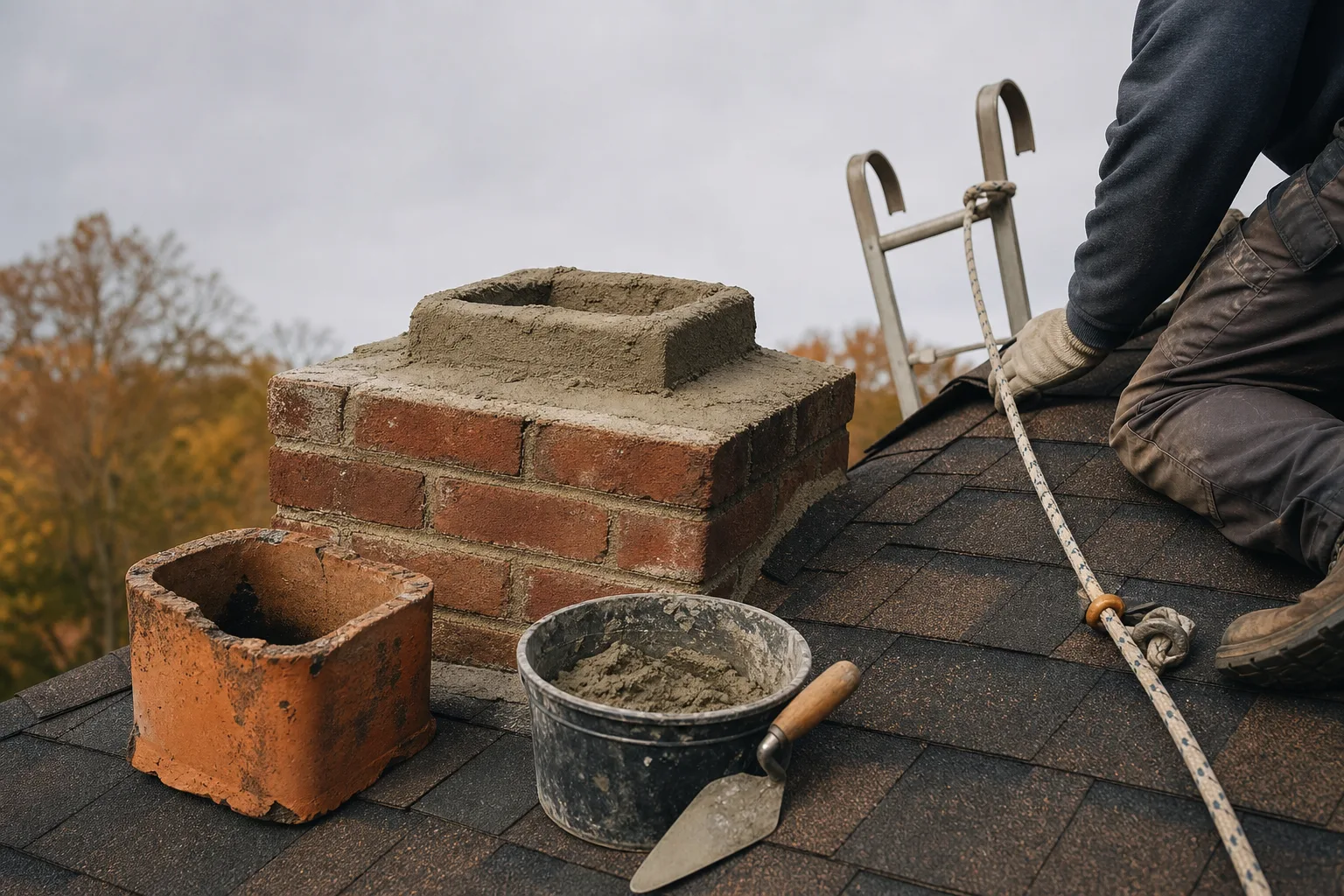
Setting a pot is roof work with a heavy object.
The crown gets cleaned off, the pot is set and bedded in the appropriate mortar, the haunching is formed around the base with its sloped profile, and the joint is sealed. Getting an old one off means breaking out the haunching that is holding it.
There is a genuine open question about cracked terra cotta, and it is worth stating plainly. Sources do not agree on where the line falls between a hairline crack that can be dealt with in place and a pot that has to come off. Some trade guidance says fine cracking can be addressed without full replacement. Other guidance treats a damaged pot as a replacement along with its haunching. That call needs eyes on the actual crack, and it is not one to make from a search result.
Good to know: Freeing a pot means breaking out the mortar collar around its base, so the haunching is part of the job whichever way the decision goes. If somebody quotes you a pot, ask whether the haunching is in the number.
When the crown gets rebuilt at the same time
If the crown is failing, doing the pot on its own puts a new collar on a compromised surface, and you are into restoring the masonry at the top of the stack rather than swapping a part.
Where the crown is being redone anyway, trade guidance is to pour the new wash in concrete rather than mortar. It is a stronger material in a position that takes weather from every direction.
Combining the two is worth asking about on the estimate, because the access, the setup and the ladder time are shared.
Choosing a chimney pot: clay, steel, and the height rules
If you are replacing rather than repairing, three things decide the answer: what the house wants to look like, what the flue measures, and how tall the stack needs to be.
Clay and terra cotta
Fired clay is the traditional material and it is what the whole idea of a chimney pot came from.
It is the right call on a period house, and it is the only material where you can find genuinely old reclaimed pieces that match what is already up there. It also weathers into something better looking than it started, which is not true of much else on a roof.
The tradeoff is weight, brittleness, and the fact that once it cracks the repair conversation gets complicated.
Cast and coated steel
Coated steel pots are marketed as a lighter alternative to clay, in colors, in shapes that copy the traditional profiles.
Copper turns up on custom work, and it changes color over its life the way exposed copper does.
I will say the unpopular thing: on a plain modern brick stack, a steel pot in a dark finish looks better than a decorative clay one pretending the house is a hundred years older than it is. Match the house, not the catalog.
Sizing and the height rules
Size is set by the flue, not by taste.
For masonry fireplaces, the convention is that the flue's cross-sectional area is at least one tenth of the fireplace opening area for rectangular clay tile flues, and one twelfth for round flues. Whatever goes on top has to respect the flue it is extending, not choke it.
Height has an actual rule behind it. NFPA 211 and the IRC require a chimney to extend at least 3 feet above the point where it passes through the roof, and at least 2 feet above any part of the building or any structure within 10 feet of it horizontally. That is the 3-2-10 rule, and it is one of the reasons a pot gets added to a stack that is short.
Pro tip: Measure the inside of the flue, not the outside of the brickwork, and have the company confirm the measurement before anything gets ordered. A pot that arrives at the wrong size is a delivery problem on a roof, which is the worst place for one.
How VIO helps with a chimney pot
VIO is a referral service. We do not do chimney work ourselves, and we are not going to pretend otherwise.
What we do is connect you with an independent local chimney company that does. You describe the chimney pot you are looking at, we match you with a company near you, and from that point you are dealing with them directly.
That matters here, because all of this job happens above the roofline. The evaluation, the repair-or-replace decision, the mortar work, and a roof is not a place to send yourself with a phone flashlight.
A few things to insist on, whoever you end up working with:
- Insist on a written estimate before any work starts, and do not let work begin without one in your hands.
- Ask whether the haunching and the crown are included, or whether the price covers the pot alone.
- Ask the company for its license and insurance details, and check them yourself before work begins.
- Ask for photographs from the roof, before and after. You paid for access to a place you cannot see.
The company we match you with is independent, and the choice of what to do with what they find stays yours.
Get your chimney pot looked at from the roof, not from the driveway
Tell us what your chimney is doing and we will connect you with an independent chimney company near you.
You deal with them directly, you get the inspection and the estimate from them, and you decide what happens next.
Call (513) 655-6702 or request service.
Symptom checker
What is your chimney doing?
Tap the closest match for an honest first answer.