



On this pageWhat Masonry Restoration Actually Means (and What It Does Not)8 sections+7
- What Masonry Restoration Actually Means (and What It Does Not)
- Read Your Own Masonry: What You Are Actually Looking At
- Water Is Always the Real Client
- The Mortar Question That Decides Whether the Repair Lasts
- What a Real Masonry Restoration Project Looks Like
- Hiring: Telling a Restoration Mason From Someone With a Bag of Mortar
- When the Masonry Is Your Chimney
- How VIO Helps
Quick answer
Masonry restoration is the repair and renewal of existing brick, block, or stone instead of replacing it. Typical work includes repointing failed mortar joints, replacing spalled units, rebuilding sections that are past saving, and repairing chimney crowns and flashing. Two rules govern the result: close the water route first, and match new mortar to the existing masonry, because mortar harder than the brick transfers stress into the brick and causes it to spall.
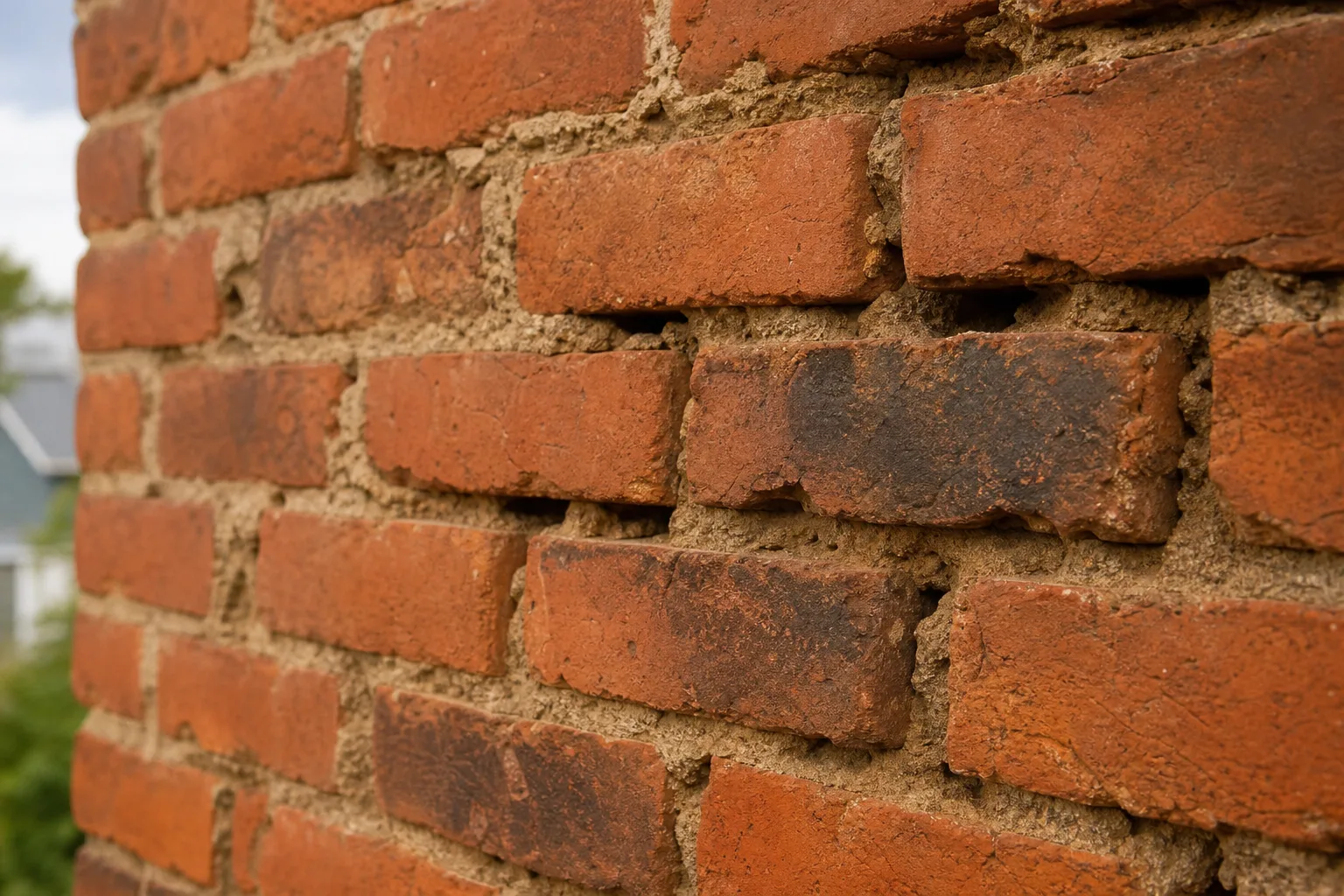
Take a house key and run it along a mortar joint on the oldest wall you own. If it drags across something hard, fine. If it sinks in and comes back with a little pile of sand on it, you have just done your first masonry inspection, and you now understand why people start searching for masonry restoration at nine o'clock at night. The wall looked fine yesterday. It looks fine right now, from the driveway. Up close, the stuff holding it together has turned back into what it was made of.
Here is the part that decides everything, and most homeowners never hear it: there is one question about the material going into those joints that determines whether the repair lasts for decades or quietly eats the brick around it. It gets asked less often than it should. We will get to it, because it changes how you read every estimate you are about to receive.
What Masonry Restoration Actually Means (and What It Does Not)
Masonry restoration is the work of bringing existing brick, block, or stone back to sound condition instead of tearing it out and starting over. It covers raking out failed mortar and replacing it, swapping individual damaged units, rebuilding sections that have gone past saving, and repairing the parts that keep water off the whole assembly, such as a chimney crown or the flashing where a stack meets the roof.
The word carries an assumption worth making explicit. Restoration means the structure is worth saving and can be saved. That is usually true. It is not always true, and a page that pretends otherwise is not helping you.
Restoration, repair, and rebuild are three different jobs
Repair is local and surgical. Three cracked bricks near a downspout, one section of joint, a hairline in a crown. You fix the thing that is broken and go home.
Restoration is systematic. It treats the wall or the stack as a unit, addresses the cause along with the symptoms, and aims to put the assembly back into a condition where it sheds water the way it was designed to.
A rebuild is exactly what it sounds like. The masonry comes down to a sound course and goes back up. On chimneys this is often a partial rebuild, above the roofline or from the crown down a few feet, since that is the zone that takes the weather.
These three get used loosely in conversation and precisely on invoices. Know which one you are buying.
Good to know: Restoration and rebuild are scoped, priced, and warrantied differently, and the difference is not cosmetic. If your estimate says "restore" but the crew is planning to take the top of the chimney down, you want that written the way it will actually happen, before anyone starts.
The words that will appear on your estimate
Repointing is removing deteriorated mortar from the joints to a proper depth and packing in fresh mortar. Tuckpointing technically refers to a decorative technique using two colors of mortar, though in American practice most contractors use the two words interchangeably. Spalling is when the face of a brick or stone flakes, pops, or crumbles off. Parging is a coat of mortar applied over masonry, often on a chimney's smoke chamber or a foundation face. The crown is the sloped concrete or mortar cap on top of a chimney. Flashing is the metal that seals the joint between masonry and roof.
Five minutes with that list and you will follow the entire conversation with your mason.
Read Your Own Masonry: What You Are Actually Looking At
Before you call anyone, walk the perimeter with your phone camera and look at four things. Masonry is unusually bad at communicating its own condition. Some of the most alarming things you can see are cosmetic. Some of the calmest looking walls are the ones with a problem.
| What you see | What it usually means | Restoration or rebuild | How urgent |
|---|---|---|---|
| Mortar you can scratch out with a key or a screwdriver | Joints have weathered past their service life | Restoration (repointing) | This season, before freeze cycles widen it |
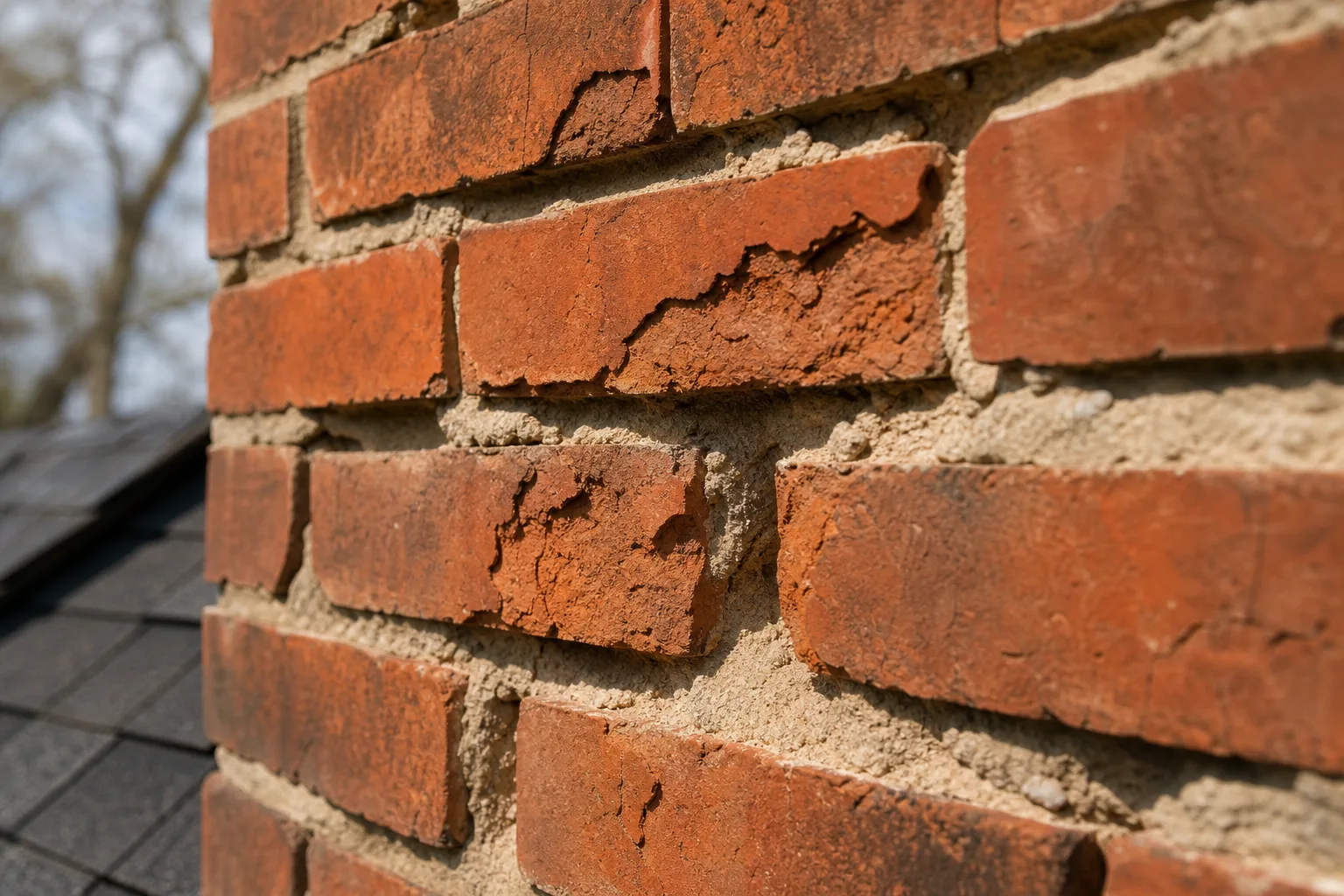
| Brick faces flaking, popping, or shedding | Water is getting behind the face and freezing, or a hard coating trapped it | Restoration if scattered, rebuild if widespread | Soon, since spalling accelerates |
| Isolated hairline cracks in a joint here and there, no pattern | Often old, often stable, sometimes seasonal movement | Usually restoration, monitor first | Low, unless it is growing |
| Diagonal cracking that steps along the mortar joints | Often differential movement or settlement below the wall | Neither until the cause is diagnosed | Get it looked at, do not just fill it |
| Chalky white bloom on the surface | Efflorescence, salts carried out by moisture moving through the wall | Restoration after the water route is fixed | Low on its own, but it is a signal |
| Top courses of a chimney leaning, gapped, or missing mortar | Weather exposure has taken the most vulnerable part of the structure | Usually partial rebuild | High, this is an exhaust route |
Mortar joints that have given up
Mortar is designed to be the wear layer. It takes the movement, the freeze cycles, and the moisture so the units do not have to. Failing joints are normal aging, not negligence. The problem is what comes next. Once the joint is open, water gets behind the face of the wall, and the failure stops being about mortar.
Spalling, flaking, and popped faces
A brick face pops off when moisture inside the unit freezes and expands. Scattered spalling in a splash zone or under a leaking gutter is a contained problem. Spalling across an entire elevation is a different conversation, and it often points back to a coating, a hard mortar, or a water source that has been running for years.
Cracks that mean movement
The useful distinction is the pattern, not the presence of a crack. Isolated hairline cracking, a joint here and a joint there with no shape to it, is usually the wall relieving stress. A diagonal crack that steps its way up along the mortar joints is the classic stair-step pattern, and it generally points to differential movement below, such as settlement. Cracking that passes straight through the brick units themselves is a separate pattern, and it usually indicates greater stress in the wall than the joints alone could absorb. Either of those last two wants the cause diagnosed. Filling them without that buys you a season of looking better.
White bloom and the wall that never dries
Efflorescence is salt left behind when water moves through masonry and evaporates at the surface. The powder itself is harmless and washes off. What it tells you is not harmless: water is traveling through that wall. Cleaning it without finding the route is treating a symptom.
Myth vs. fact: Myth: a crack in brickwork means the wall is failing. Fact: plenty of old walls have stable cracks that have not moved in decades. The reverse also holds. A wall with no visible cracks can have joints so far gone that the units are essentially stacked. Appearance and condition are two different measurements.
Water Is Always the Real Client
Almost every masonry problem you can name is a water problem wearing a costume. Get this in your head before you spend a dollar: restoring masonry without closing the water route is the most reliable way to pay twice.
The four ways water gets into masonry
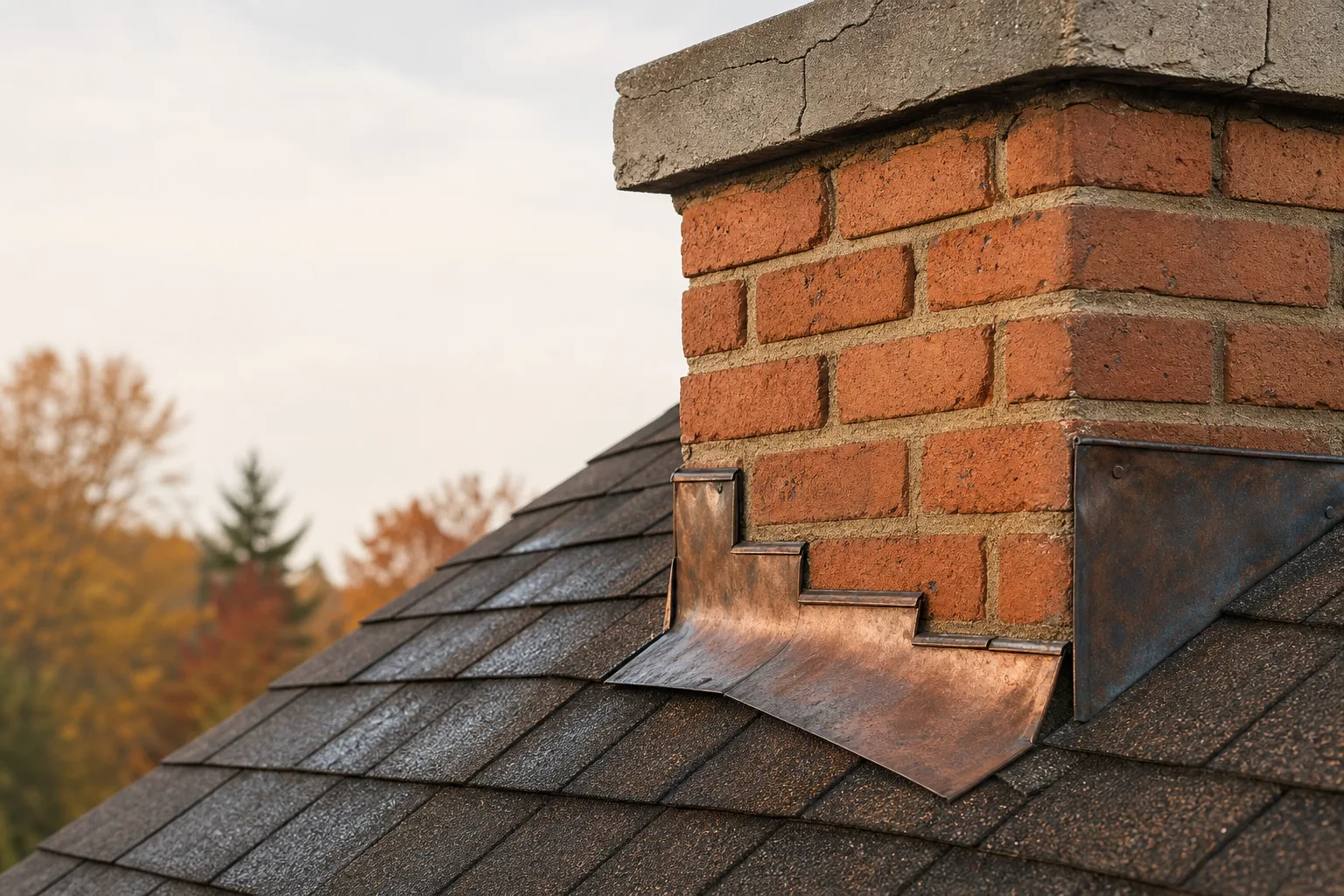
Down through the top. A cracked or undersized chimney crown, or a missing chimney cap, lets water run straight into the core of the structure. Water that gets in up there does not run off the outside of the masonry, it soaks down through the middle of it.
Through the joints. Open or eroded mortar is an invitation, especially on the weather-facing elevation.
Through the units themselves. Brick is porous by design. Older, softer brick more so. That is normal, as long as the wall can dry.
At the transitions. Where masonry meets roof, siding, or ground. Failed flashing puts water into the structure and into the house at the same time.
Why sealing brick can make it worse
This one surprises people. A film-forming sealer or a coat of paint on the outside of a masonry wall can stop water going in, but it also stops water coming out. Masonry is meant to breathe. Moisture that gets in another way, and it will, from behind, from below, from a crown, now has nowhere to go. It sits inside the unit, freezes, and pushes the face off. Some breathable vapor-permeable treatments are used appropriately in masonry work, but "just seal it" as a substitute for repair is a way to turn a joint problem into a brick problem.
Safety note: On a chimney, deteriorated masonry is not a cosmetic issue. That structure is the exhaust route for a combustion appliance. Gaps in the mortar, a failed crown, or a cracked liner can let combustion byproducts and heat reach places they were never meant to reach. Treat chimney masonry differently than you treat a garden wall.
The Mortar Question That Decides Whether the Repair Lasts
Here is the loop from the top of this article, closed.
New mortar must be compatible with the masonry it is going into, and for most older brickwork that means softer than the brick, not harder.
Softer than the brick, on purpose
The logic is simple once you see it. A wall moves. It expands in heat, contracts in cold, settles, and takes wind load. Something in the assembly has to absorb that movement. If the mortar is the softer element, it takes the stress, wears slowly, and gets replaced every few generations. That is the design.
Reverse the hardness and you reverse the sacrifice. Put a high-strength modern mortar into a wall of soft, historic brick and the mortar becomes the strong part. The movement still has to go somewhere, so it goes into the brick. The faces spall. The damage shows up along the edges of those new joints, and it is not reversible, because you cannot repoint a brick back into existence.
This is not a fringe opinion. It is standard preservation practice, and the reference to point your contractor at is the National Park Service's Preservation Brief 2, on repointing mortar joints in historic masonry buildings. Mortar types under ASTM C270 run from harder to softer (Type M and S at the hard end, Type N in the middle, Type O softer, with lime-based mixes softer still), and matching that choice to the actual units in your wall is the judgment that separates a restoration mason from someone who buys one bag for every job.
Color, texture, and the joint profile
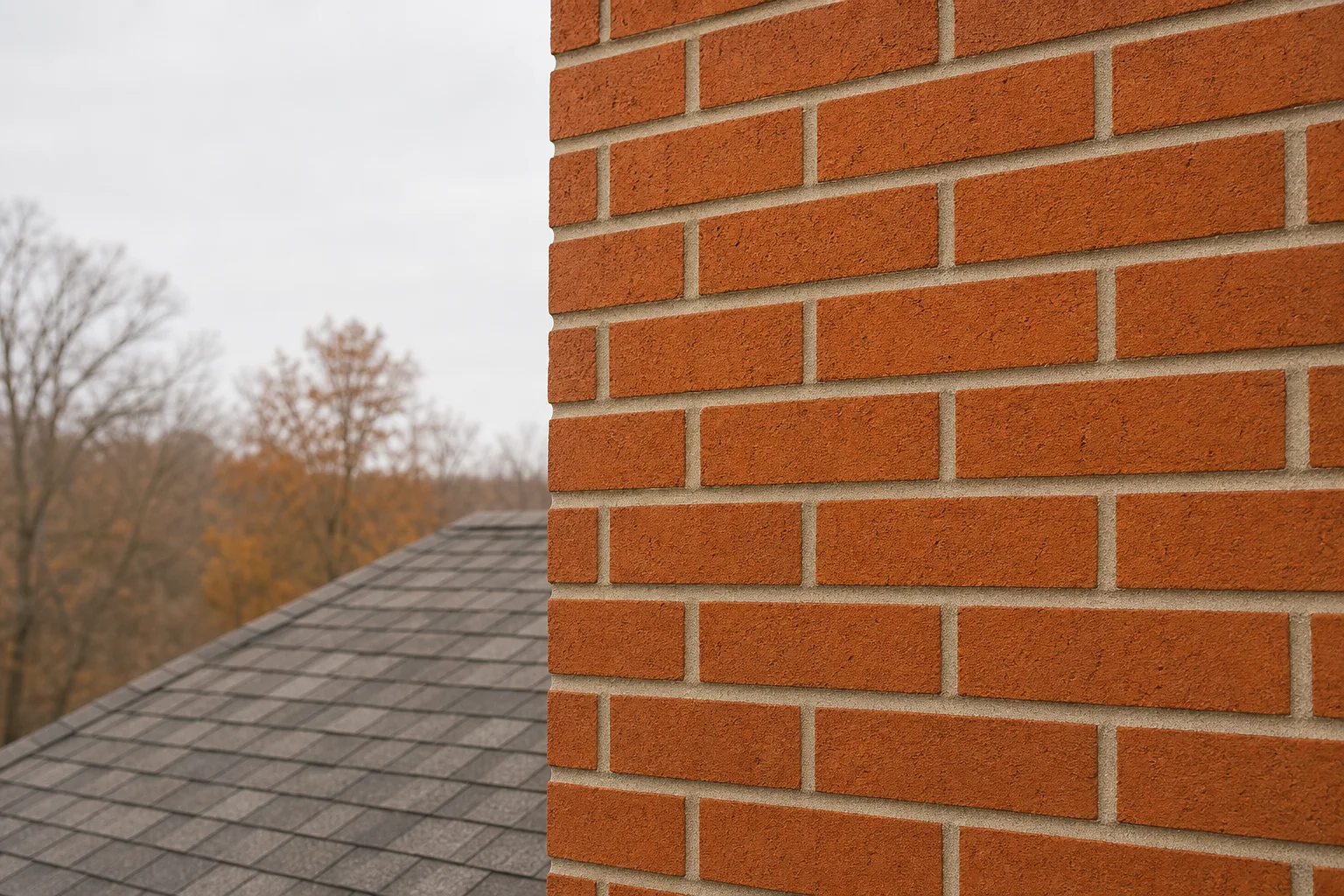
Good repointing disappears. That means matching not only the color of the existing mortar but its texture, its aggregate, and the profile of the joint, which is the shape the mason tools into the face. A concave joint next to a struck joint next to a flush joint reads as patchwork from the sidewalk forever. Ask to see the tooling on a sample area before the crew works across the whole elevation.
When a hard mortar is the right call
Softer is not a universal rule, and anyone who tells you it is has swapped one bag for another. Modern high-fired brick, concrete block, and structural applications are frequently specified for harder mortars, and using something too soft there is its own failure. The point is that the mortar is chosen to suit the units, the exposure, and the loading. The point is never that it comes off the same pallet as last week's job.
Pro tip: Before you sign anything, ask two questions. "What mortar type are you using on my wall, and why that one?" A restoration mason will answer with a reason grounded in your brick. Someone who has never thought about it will tell you what they always use. You will hear the difference in about four seconds.
You now know the question most homeowners never ask.
The next step is having someone put eyes on the actual wall, because hardness, exposure, and condition cannot be judged from a photo. VIO connects you with a screened independent local masonry company that can answer that question about your specific brick, and you can ask for a written estimate before agreeing to any work.
Call (513) 655-6702.
What a Real Masonry Restoration Project Looks Like
Knowing the sequence is how you tell a plan from a promise. Restoration work has an order to it, and the order is not arbitrary.
Assessment before anything is torn out
The job starts with somebody actually looking. On a wall that means close inspection of the joints and units, not a glance from the yard. On a chimney it means the crown, the cap, the flashing, the exterior faces, and the flue, because you cannot scope masonry work on a chimney without knowing whether the liner is intact. Good assessment produces photographs, a description of the conditions found, and a scope that names locations. "Repoint chimney" is not a scope. "Rake and repoint all joints, north and west elevations, above roofline" is a scope.
The sequence, and why it runs top down
Water falls. So the work follows it. Crown and cap first, then flashing, then the joints and units, then any surface treatment, if one is appropriate at all. Doing it in the other order means finishing beautiful joints under a crown that is still feeding water into them.
Within the repointing itself, the mortar gets cut out to a proper depth rather than smeared over the top of the old joint. A skim coat over failed mortar looks like new work for a season or two, then falls out in sheets, taking your money with it.
Weather, cure, and the limits nobody mentions
Mortar needs temperature and moisture conditions to cure properly. Cold weather masonry is done, with heated enclosures and admixtures and additional care, and it costs more for a reason. If a contractor is willing to lay mortar in freezing conditions without any of that, the willingness itself is the warning.
From the field: The repointing jobs that come back to be redone tend to share a pattern. Nobody looked for the water source, the joints were skimmed rather than cut, and the mortar was whatever was on the truck. None of those are exotic mistakes. They are what happens when a crew treats a restoration job like a patch job.
Hiring: Telling a Restoration Mason From Someone With a Bag of Mortar
Masonry is one of the trades where the finished work hides the shortcuts. A skimmed joint and a properly raked joint look identical on the day the scaffolding comes down. You find out the difference in year three. That is why your leverage sits in the estimate and the conversation before the work, not in the inspection after it.
Two questions that change the conversation
The first is the mortar question from earlier. The second: "How are you determining where the water is coming in?" A mason who is thinking about the assembly will talk about the crown, the flashing, the exposure, and the drying path. A mason who is thinking about a day rate will talk about joints only.
What the written estimate has to say
Before you sign, check that the document contains all of this:
- Specific locations and elevations, not just "the chimney" or "the wall"
- The mortar type being used, with the reason it was chosen for your masonry
- Joint preparation described, including cut depth, not just "repoint"
- Whether damaged units are being replaced, how many, and with what
- Crown, cap, and flashing work stated as included or excluded
- Color and profile matching, and whether a sample area will be tooled first
- Access method, meaning scaffolding or ladders or a lift
- Debris removal and site protection
- Weather limits, and what happens to the schedule if conditions turn
- License and insurance, in writing
- What the warranty covers, and for how long
- For chimney work, whether an inspection is included and at what level
Twelve lines. If most of them are missing, you are not holding an estimate, you are holding a number.
Red flags
Pressure to decide today. A refusal to put the mortar specification in writing. A quote produced from photos alone on a job that clearly needs someone on a ladder. "We will just seal it" offered as the whole solution. And a price that lands far below everyone else, which on masonry usually means skimmed joints, because that is the only place the hours can be removed from.
When the Masonry Is Your Chimney
Chimneys are where masonry restoration stops being about appearances. A chimney is the one masonry structure on your house that is exposed on all sides, sits above the roofline in the worst weather, gets heated and cooled from the inside, and carries combustion byproducts away from people who are asleep.
Why a chimney weathers faster than the rest of the house
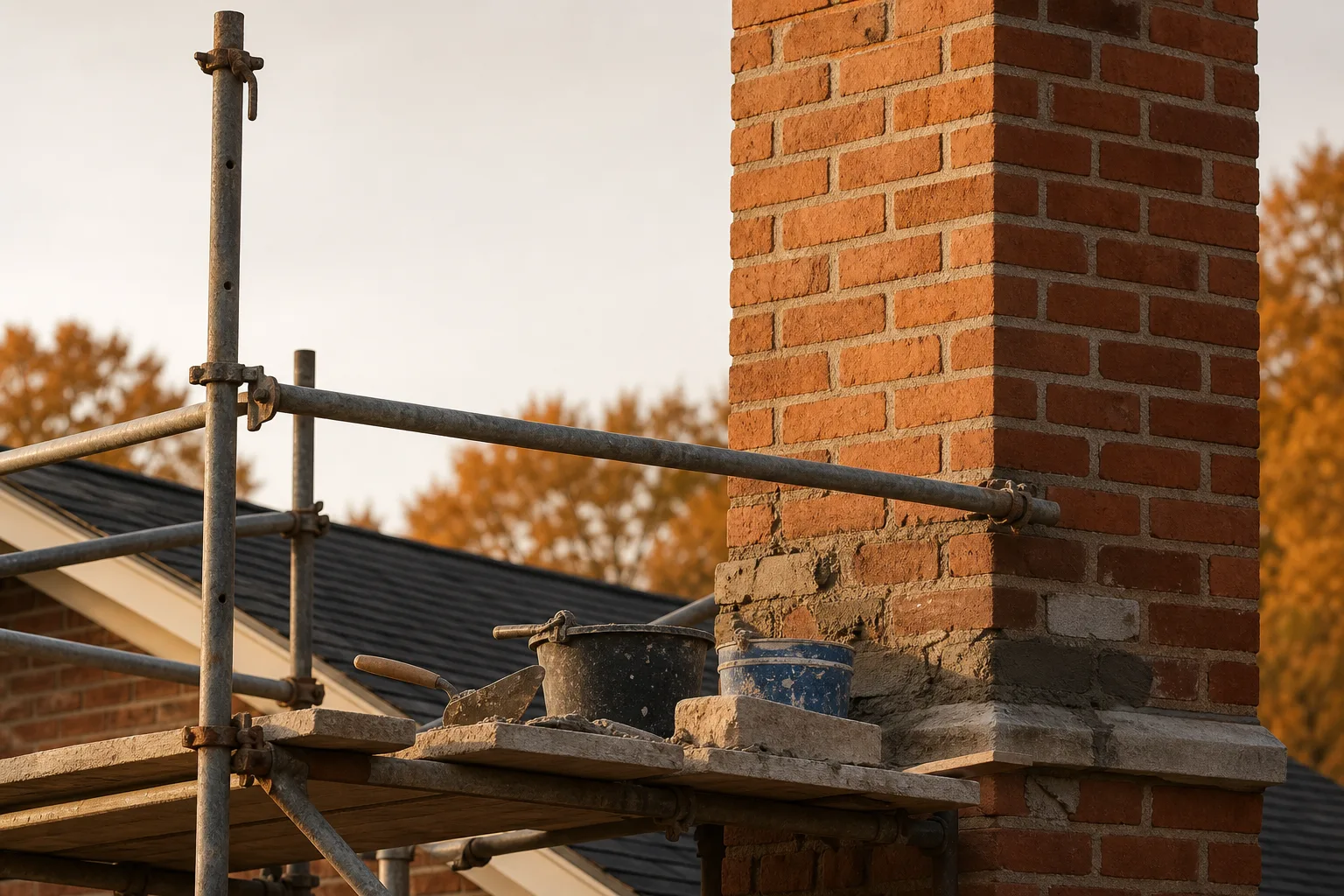
Take a wall, remove the shelter of the roof, expose all four faces to wind-driven rain, run a heat cycle through the middle of it, and set a slab of mortar on top as its only hat. That is a chimney. It is normal for the stack above the roofline to need attention long before the walls of the house do, and it is normal for the crown to be the first thing to fail.
The inspection that has to come first
NFPA 211 defines three levels of chimney inspection, and the standard calls for a Level 2 inspection in specific circumstances: when a property is sold or transferred, when the system is changed (a new appliance, a different fuel, a relined flue), after a malfunction, after a chimney fire, and after an external event such as a storm or an earthquake that could have damaged the structure. A Level 2 includes video evaluation of the flue interior and covers accessible areas including attics and crawlspaces.
That standard answers the question people actually came here with, which is "can this wait?" If any of those triggers apply to your house, NFPA 211 puts a Level 2 inspection on the table, and how it is enforced depends on which code your jurisdiction has adopted. Either way, the sensible order is inspection first and masonry scope second, because what the camera finds in the flue changes what the mason should be quoting.
Safety note: Do not evaluate a chimney by climbing onto your own roof. Deteriorated masonry is unstable in ways that are not visible from below, and a stack with failed joints in its top courses can shift under a hand placed on it. Height plus loose masonry is a job for someone with fall protection and experience.
How VIO Helps
Plainly: VIO does not do the masonry. We are a referral service, and knowing that is what makes the rest of this useful to you.
What we do is match you with a screened independent local company that does this work in your area, and tell you plainly to get the scope in writing before agreeing to anything. The independent company you connect with looks at your actual masonry, tells you whether you are dealing with restoration or a rebuild, and can put the mortar specification and the scope on paper where you are able to hold them to it. If your project is a chimney, that company can carry out the inspection first, so the scope is written against what the flue actually shows rather than what somebody assumed.
You came here to be able to tell a good answer from a confident one. That is the whole point of a screened referral and an estimate in writing.
Restore or rebuild is not a decision you can make from a photo.
Neither is the mortar. Both need someone standing in front of the wall who can read the units, the exposure, and the water route, and then write down what they propose to do about it. Call VIO at (513) 655-6702 and we will connect you with a screened independent local masonry pro in your area. Ask for a written estimate before you agree to any work, and you now know enough to read it properly.
Symptom checker
What is your chimney doing?
Tap the closest match for an honest first answer.