



On this pageWhat Is Tuckpointing? A Plain Answer7 sections+6
- What Is Tuckpointing? A Plain Answer
- Tuckpointing vs. Repointing vs. Pointing
- How to Tell If Your Chimney Needs Tuckpointing
- Mortar Match: The Detail Almost No Estimate Mentions
- How Tuckpointing Is Done, Step by Step
- Judging the Estimate: What Should Be on the Proposal
- How VIO Helps When You Need Tuckpointing
Quick answer
What is tuckpointing? It is the repair of deteriorated mortar joints in brick masonry: the failed mortar is cut out to a controlled depth and packed with fresh mortar, while the bricks stay in place. In everyday American usage it means the same thing as repointing. Chimneys usually need it first, because their mortar weathers fastest, and the repair restores the joint's job of keeping water out of the wall.
Someone hands you a proposal for work on your house, and most of the lines make sense. Chimney cap. Flashing. Then there is a line that says "tuckpointing," with a number next to it that is not small, and you have no idea what you just agreed to look at. That is how almost everybody arrives at the question of what is tuckpointing. Not out of curiosity about masonry, but because the word showed up on a piece of paper and started costing money.
Here is the short version, and then the long one. Tuckpointing is the repair of the mortar joints between bricks: the failed mortar is cut out to a controlled depth and packed with fresh mortar. The bricks stay. The stuff between them gets replaced.
That is easy enough. What is harder, and what almost no estimate mentions, is that one decision inside that repair has more bearing on how the work performs than anything else on the page, and getting it wrong can push the damage into the brick itself. We will get to it. It is not a trade secret, it is basic masonry, and once you know it you will never look at a mortar joint the same way.
What Is Tuckpointing? A Plain Answer
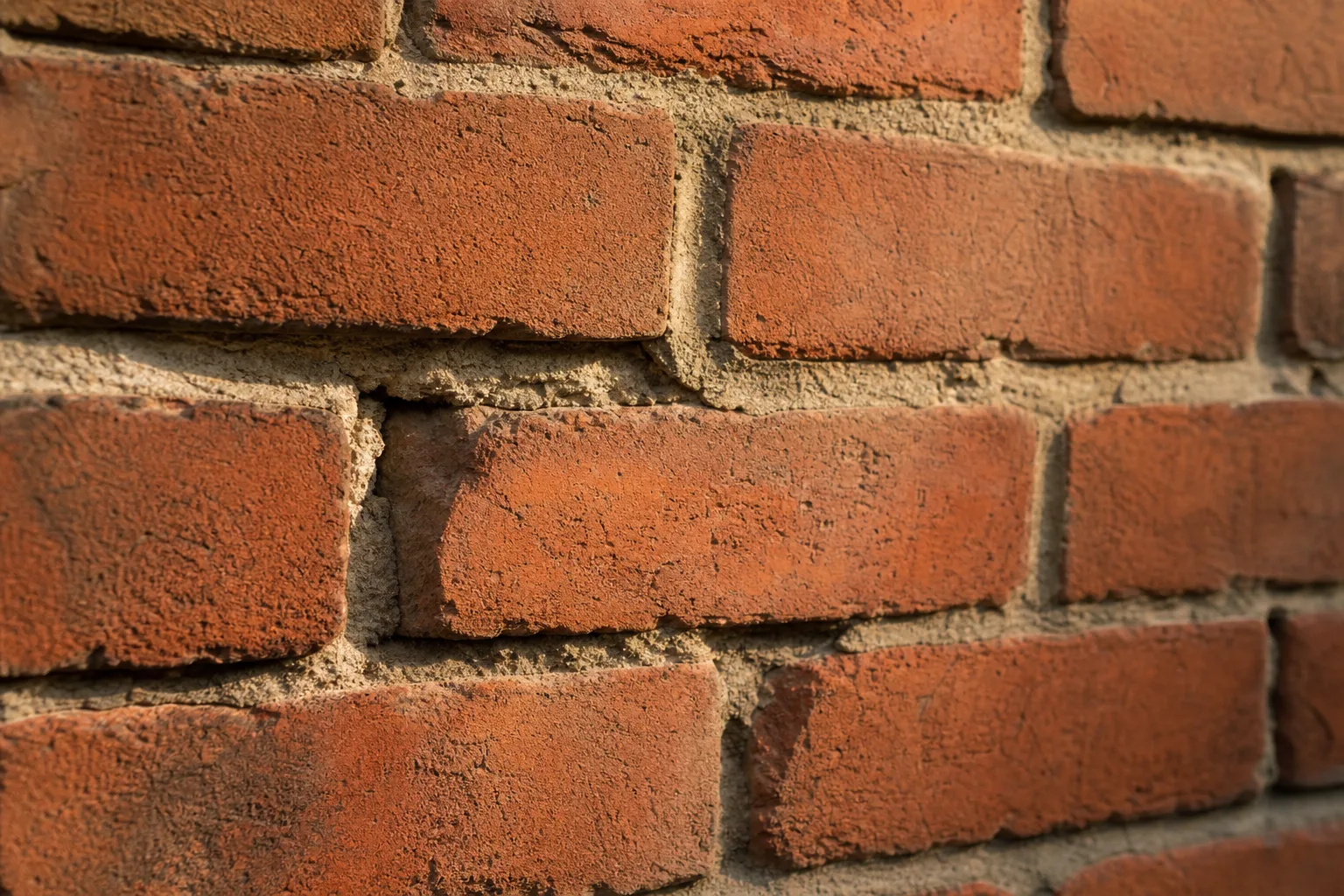
Brick walls are not solid. They are two materials working together: the brick, which is hard and does almost nothing except sit there, and the mortar, which is softer and does most of the actual work. The mortar holds the bricks apart at a consistent spacing, it transfers load, and above all it keeps water from walking straight through the wall.
Mortar has a service life. Brick, kept dry and undisturbed, can last well over a century. The joints between them cannot, and they are not supposed to.
What the work actually involves
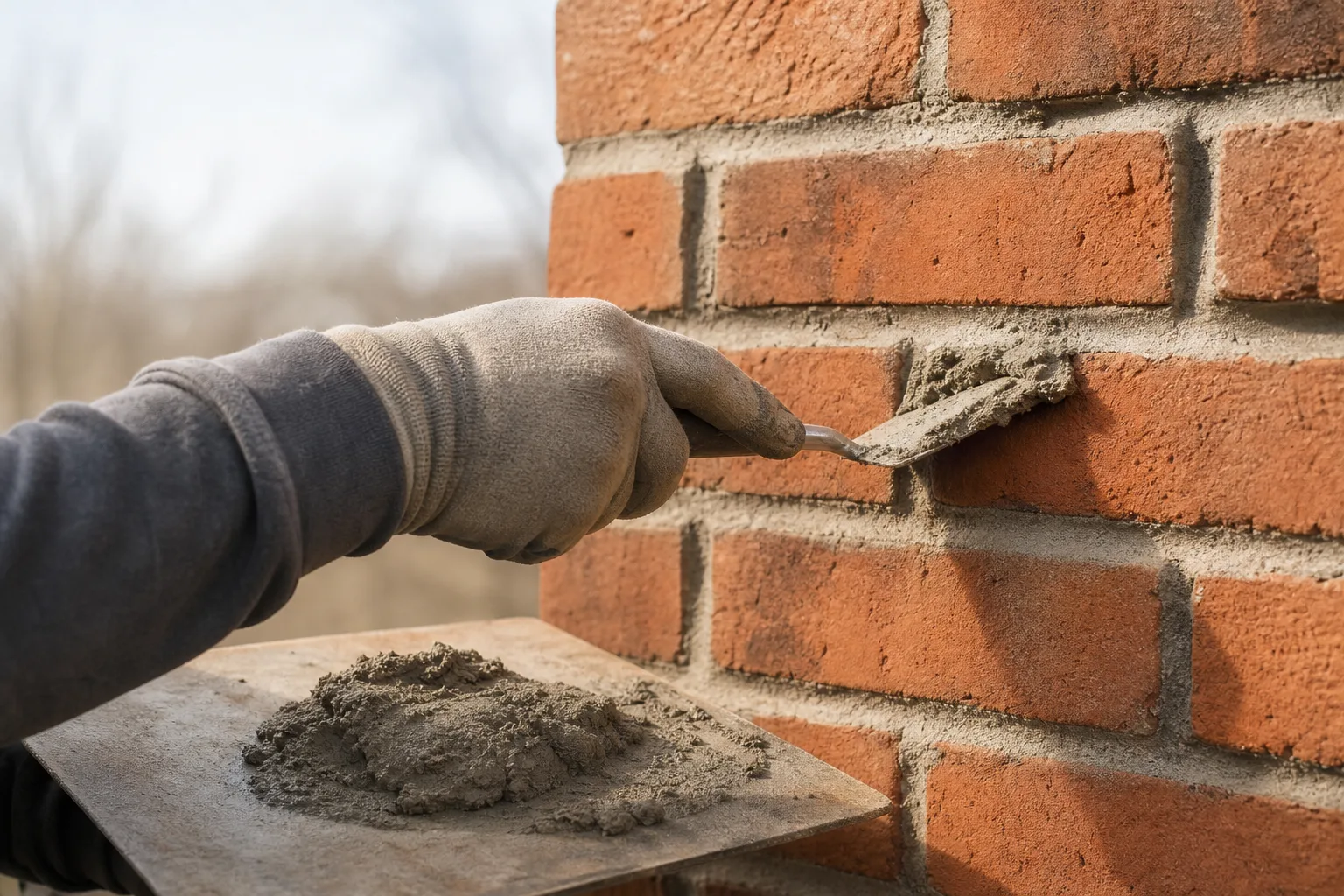
The mason works joint by joint, cutting the deteriorated mortar out of each one to a depth that gives the new material something to grip. The cavity gets cleaned and dampened so the old brick does not pull water out of the fresh mortar before it can cure. Then new mortar goes in, packed in layers, and each joint is tooled to a profile that sheds water instead of holding it.
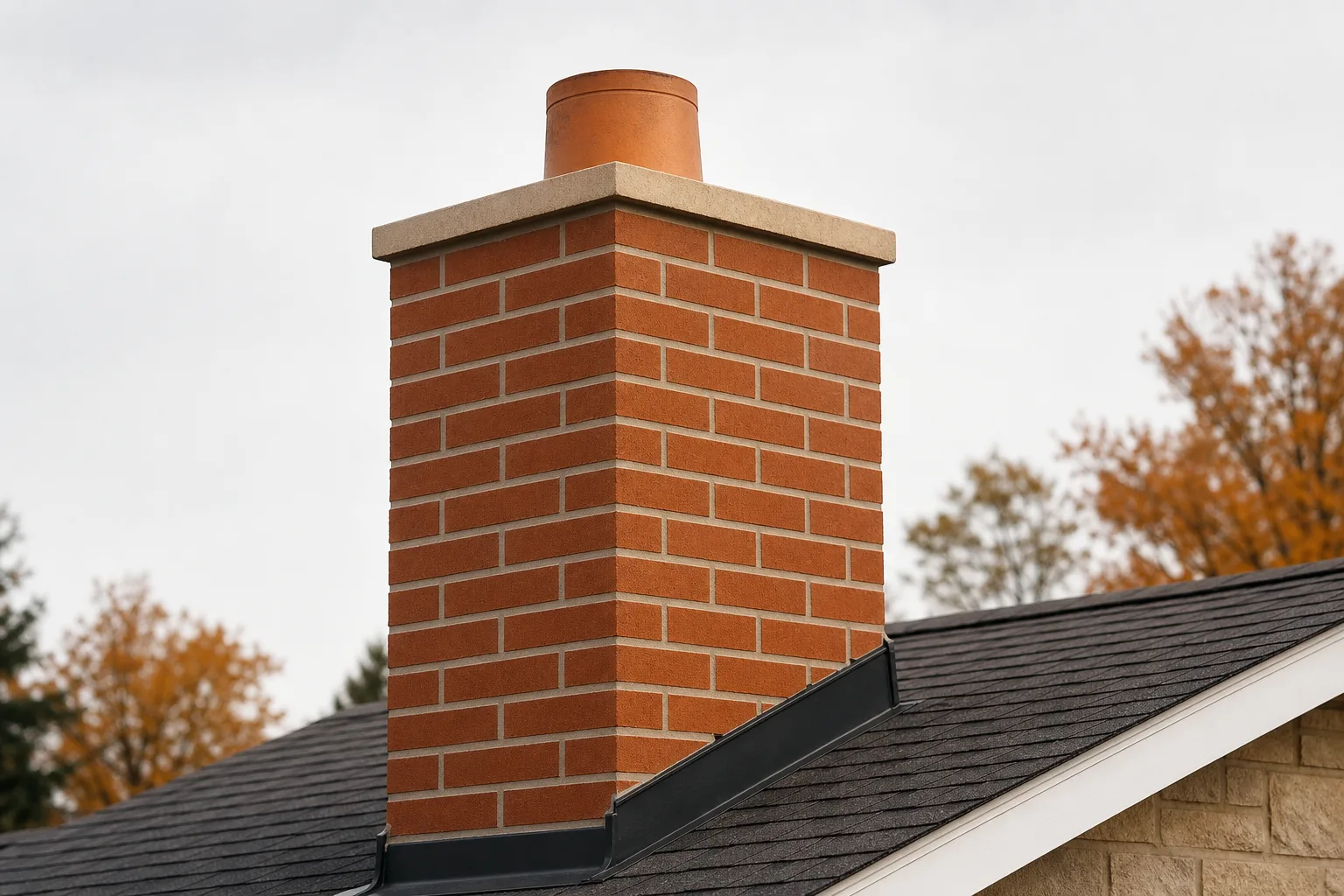
Done well, the finished wall looks like nothing happened. That is the goal. A tuckpointing job you can spot from the driveway is usually a tuckpointing job that went wrong somewhere.
Why the mortar fails long before the brick does
Water gets into a joint. It freezes. Ice takes up more room than water did, so it pushes the mortar apart from the inside. It thaws, more water gets into the slightly bigger gap, and it freezes again. Repeat that a few hundred times across a couple of decades and the joint turns from a solid band into something with the structure of a sugar cube.
Add the acidic condensation that forms inside a chimney flue, and you have the reason chimneys usually surrender their joints first. The north wall of your house is doing the same thing, just more slowly.
Tuckpointing vs. Repointing vs. Pointing
This trips up everyone, including people who have owned brick houses for thirty years, so let us settle it.
The original technique, and why the name stuck
Tuckpointing began in eighteenth century England as a bit of honest fakery. Fine gauged brickwork, the kind with hairline joints, was expensive. So masons working with ordinary rough brick would fill the joints with mortar tinted to match the brick color, then press a thin ribbon of contrasting lighter putty into the middle of each joint. From the street, the eye reads that crisp pale line as the joint, and the wall looks like it was laid with the precision of a much costlier job. That thin inserted ribbon is the "tuck."
Repointing, by contrast, has always just meant the repair: take out the bad mortar, put in good mortar, no decoration involved.
What the words mean on a quote today
In American usage, that distinction has almost entirely dissolved. When a contractor in Ohio writes "tuckpointing" on your estimate, they mean repointing. They mean cutting out failed joints and refilling them. Some regions lean one way, some the other, and plenty of companies use both words in the same paragraph without noticing. If you have already moved on to looking for a chimney repointing company near you, the search terms are just as interchangeable as the estimate language.
| Term | What it originally meant | What it usually means on a U.S. estimate | What to ask |
|---|---|---|---|
| Pointing | Finishing the mortar joints on new brickwork as it is laid | The same, on new construction only | "Is this new work or repair?" |
| Repointing | Cutting out deteriorated mortar and refilling the joints | Exactly that, no ambiguity | "How deep are you cutting?" |
| Tuckpointing | A decorative two-color technique that mimics fine joints | Usually just repointing | "Am I paying for repair, or for a color-matched finish?" |
| Grinding and sealing | Not a traditional term | Varies widely by company | "What exactly is being removed, and what is going back in?" |
Good to know: Do not spend energy on which word is printed on your estimate. Spend it on the physical description. Ask what depth is being cut out, what mortar is going back in, and how many linear feet or square feet are covered. A company that answers those three questions clearly is telling you more than any vocabulary ever will.
How to Tell If Your Chimney Needs Tuckpointing
You do not need a trained eye for the early part of this. You need ten minutes, decent light, and a willingness to actually walk around the house instead of looking at the chimney from the same angle you always do.
What you can see from the ground
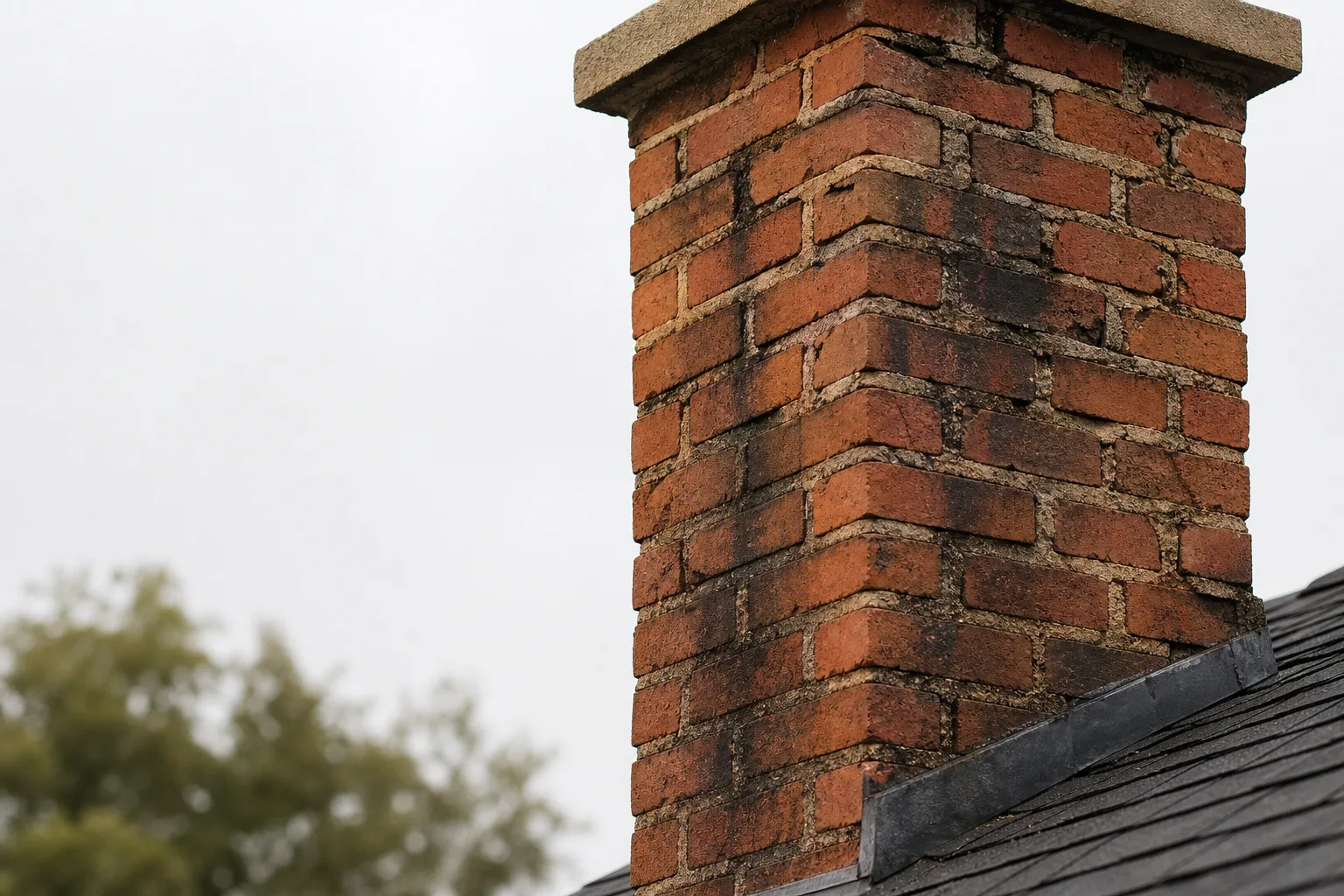
Start with a look up at the stack, ideally with binoculars if you have them. You are looking for joints that have gone dark and recessed compared to their neighbors, gaps where the mortar has fallen out entirely and left a shadow line, and any brick that looks like it is sitting slightly proud of the ones around it. White chalky streaking, the mineral bloom masons call efflorescence, tells you water is moving through the masonry and carrying salts out to the surface. It is not damage by itself. It is evidence.
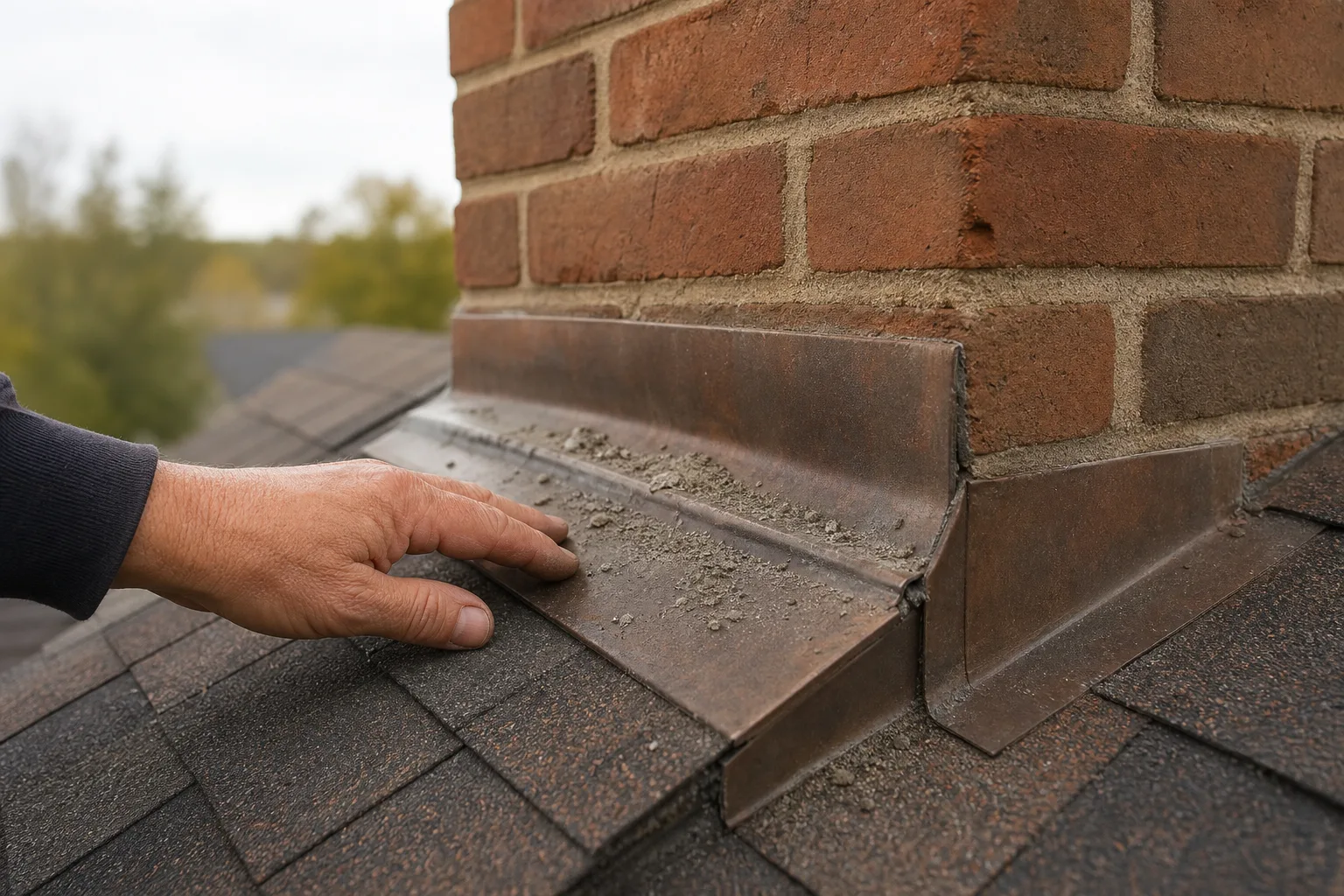
Then look down. Check the roof surface at the base of the chimney, where the flashing seals the stack to the roof, and the ground below. Sand, grit, and small mortar crumbs collecting there are the joints reporting on themselves.
What you find up close
If you can safely reach a section of the chimney, or if you want to practice on a garden wall first, the test is unglamorous and it works.
Pro tip: Take a flathead screwdriver or a house key and press the tip into a mortar joint with normal hand pressure. Sound mortar will feel like stone and barely mark. A joint that is finished will take the tip in like firm cheese, and you will pull out sand and crumbs. If the tip goes in more than a quarter inch without much effort, that joint has stopped keeping water out of your chimney.
Check depth too. Run a finger along the joint. Sound joints sit just slightly back from the brick face, and once one is recessed noticeably deeper than its neighbors, water has a shelf to sit on.
From the field: On most houses, the chimney shows joint failure before any other masonry does, and it is not because the chimney was built worse. It is the only masonry on the building exposed on all four sides with nothing above it, taking weather from every direction while the walls below get some shelter from the eaves. If you are going to inspect one piece of brick on your house, inspect that one.
What can honestly wait
Here is the part most articles about tuckpointing skip, because most of them are written by someone who wants the job.
Not every imperfect joint is a repair. Brick and mortar weather. A joint whose surface has gone slightly rough and lost its crisp tooled edge, but which is still hard when you press on it, is a joint doing its job. Hairline cracking in an otherwise firm joint is extremely common and usually not urgent on its own. Efflorescence on a chimney that has no other symptoms is worth watching through a season, not worth panicking over.
What does not wait: joints you can dig out with a key, missing mortar that leaves an open path into the wall, any brick that moves, stepped cracking that runs diagonally through both brick and joint, and a chimney that has started dropping material onto the roof. Those are water getting inside and structure changing shape, and neither improves with time.
If you are somewhere in between, the honest answer is that a season of watching is cheap and a wrong guess about structure is not. Have someone inspect the chimney before winter rather than after.
Mortar Match: The Detail Almost No Estimate Mentions
This is the loop from the top of the article, and here it is closed.
Mortar is supposed to be the sacrificial part
A brick wall is designed to fail in a specific place. Buildings move. They expand in July, contract in January, settle, shift, and absorb the vibration of the world around them. All of that movement has to go somewhere, and the wall is built so that it goes into the mortar, because mortar is the part you can replace.
That only works if the mortar is softer than the brick. It is the fuse in the circuit. When the joint takes the stress, the joint crumbles, and you repoint it. When the brick takes the stress, the brick face spalls off, and repointing cannot put it back. You replace the brick, which is masonry restoration work rather than tuckpointing, you patch it if the spalling is shallow enough, or you live with it.
What happens when the new mix is harder than the brick
Modern Portland cement mortars are strong. Much stronger, in many cases, than the soft, low-fired brick used in houses built before the mid twentieth century. Pack a hard modern mix into the joints of an old soft-brick chimney and you have reversed the design. Now the mortar is the strong part and the brick is the weak part.
The wall still moves. The water still freezes. But the pressure has nowhere to go except into the brick, and the visible result, a few winters later, is brick faces popping off in flakes and leaving raw pale interiors exposed. The joints will look great. The bricks will be disintegrating around them.
Myth vs. fact: Myth: the stronger the mortar, the stronger the repair. Fact: mortar is meant to be weaker than the brick it sits between. On older soft brick, a high-strength repair mix is not an upgrade, it is a slow-acting problem, and the damage lands on the one component that cannot be repointed.
This is why "what mortar are you using, and how did you decide?" is the most useful question a homeowner can ask about a tuckpointing job. The answer you want is that the mason looked at the age of the structure and the hardness of the existing brick and chose a mix accordingly, with more lime and less cement on older masonry. The answer you do not want is a shrug, or "the same stuff we always use."
Color and texture matter too, for a different reason: mortar that does not match the old will read as a patch forever.
Joint depth, and what a grinder can do to a brick edge
Two more things quietly decide the outcome.
Depth: the cut has to go deep enough for the new mortar to hold, generally a couple of times the width of the joint. Skim the surface with a shallow smear of fresh mortar over failed material underneath, and it will look finished and start falling out within a few seasons. There is a name for that in the trade, and none of the names are polite.
Grinder discipline: angle grinders make quick work of horizontal joints and can do real damage to the vertical ones, where the wheel wants to wander into the brick edge. Widened, chewed-up joints and nicked brick corners are the signature of speed over care. On soft or historic brick, hand chiseling the verticals is slower and it is the right call.
Not sure if your chimney needs tuckpointing or something bigger?
Bring your questions, or your quote. Tell us what you are seeing and what part of the country you are in, and VIO will connect you with an independent chimney company in your area that can look at the joints in person. VIO does not charge you for the match.
Call (513) 655-6702 or request service online.
How Tuckpointing Is Done, Step by Step
Cutting out the failed mortar
The crew sets up access, which on a chimney means ladders, roof staging, or scaffolding depending on height and pitch. Then the old mortar comes out, horizontals usually with a grinder fitted for masonry, verticals often by hand. The target is square, clean cavities of consistent depth, not ragged trenches. Everything gets brushed and blown out afterward, because mortar will not bond to dust.
Packing and tooling the new joints
The new mix goes in from a hawk with a tuckpointing trowel, pressed in firm layers rather than dumped in all at once, because a joint packed in one pass traps air and voids. Verticals typically get filled before horizontals. Then, once the mortar has stiffened to what masons call thumbprint hard, each joint is tooled: run with a jointer to compress the surface and shape a profile, usually slightly concave, that sheds water rather than collecting it.
Compression is the point of tooling, not decoration. A tooled joint has a denser surface than an untooled one, and that surface is a large part of how the joint sheds water.
Weather, curing, and the wrong time of year
Fresh mortar needs to cure, not dry, and it needs moderate temperatures to do it. Work happens when temperatures stay reliably above freezing for several days on both sides of the job. Mortar that freezes before it cures is compromised, permanently, no matter how good it looks in the spring. Heat and direct sun cause the opposite problem by pulling moisture out too fast. Late spring and early fall are the comfortable windows in most of the country.
Safety note: Two things make this a poor first project for even a capable homeowner. Cutting mortar generates crystalline silica dust, which calls for real respiratory protection and dust control rather than a paper mask. And chimney joints are reached from a ladder or a roof, at height, while operating a grinder with both hands.
Can you do it yourself?
On a garden wall or a low section of foundation, at ground level, with time to practice: yes, genuinely. It is a craft skill with a real but manageable learning curve.
On a chimney: no, and that has nothing to do with gatekeeping. It is the height, the dust, the top courses and crown that usually need attention at the same time, and the fact that a chimney is a working part of a heating system rather than a decorative wall.
Judging the Estimate: What Should Be on the Proposal
You now know more than enough to read a quote properly. Here is what should be written on it.
- Scope in measurable units. Linear feet of joint or square feet of wall, and which elevations. "Tuckpoint chimney" is not a scope, it is a gesture.
- Cut depth, stated as a number or as a multiple of joint width.
- The mortar, identified by type or mix, with a sentence about why it suits your masonry. Ask directly if it is not there.
- How verticals are being cut, by grinder or by hand, especially on older brick.
- Whether the top courses and the crown are included or excluded. This is the most common surprise on chimney work, because the top of the stack is where deterioration usually starts, and a failing crown or cap tends to turn up in the same conversation.
- Cleanup and dust control, and protection for the roof surface below.
- Weather terms, meaning what happens to the schedule if temperatures drop.
- Any warranty, in writing, with its actual duration and what voids it.
- Whether waterproofing or sealing is bundled in, and priced separately if so. Sealing a wall with failed joints is putting a raincoat on a leaking roof, and a vapor-impermeable sealer over masonry can trap moisture inside it. If a sealer is proposed, ask whether it is breathable.
Get more than one quote on anything structural, and compare the scopes before the numbers. Two prices that look far apart are usually two different jobs.
Good to know: NFPA 211 calls for a Level 2 chimney inspection at the sale or transfer of a property, after any change to the system such as a new appliance or liner, after a malfunction, after a chimney fire, and after an external event like a storm or an earthquake. If you are reading this because of an inspection report during a home sale, that Level 2 is the standard that applies, and it goes further than a visual look at the joints.
How VIO Helps When You Need Tuckpointing
Straight answer about who we are: VIO does not do masonry. We are a referral network. We match homeowners with independent local chimney and masonry companies, and those companies do the work and set their own prices. Licensing rules vary by state and by city, so ask any company you are considering, including one we match you with, to show you its license and its insurance certificate before work starts.
What that is worth in your exact situation: you have a quote you cannot evaluate, or damage you cannot classify, and the cheapest clarity available to you is a second independent company looking at the same joints. Tell us what you are seeing and where you are, and we will connect you with a company in your area. We ask every company in our network to put its estimate in writing before any work starts, and you should insist on exactly that, from us or from anyone else.
Bring the questions from the section above to whoever shows up. Depth, mortar, verticals, crown, sealer. A good mason will enjoy answering them.
Get a real set of eyes on those joints.
A photo and a guide can only take you so far. Someone standing at the base of your chimney with a screwdriver can tell you things an article cannot. VIO matches homeowners with independent chimney and masonry companies across the country, and we ask every company in our network to put its estimate in writing before any work starts. You should insist on exactly that, from us or from anyone else.
Call (513) 655-6702 or request service to get matched.
Symptom checker
What is your chimney doing?
Tap the closest match for an honest first answer.