



On this pageWhat Copper Chimney Caps Actually Do, and the Three Things Sold Under That Name7 sections+6
- What Copper Chimney Caps Actually Do, and the Three Things Sold Under That Name
- Measuring: The Step That Decides Whether Your Cap Stays On
- Copper vs. Stainless vs. Galvanized: An Honest Comparison
- The Mesh: What NFPA 211 Asks of a Spark Arrester
- Patina, Staining, and How Copper Chimney Caps Age
- Mounting, Fasteners, and Why Caps Blow Off
- How VIO Helps With Copper Chimney Caps
Quick answer
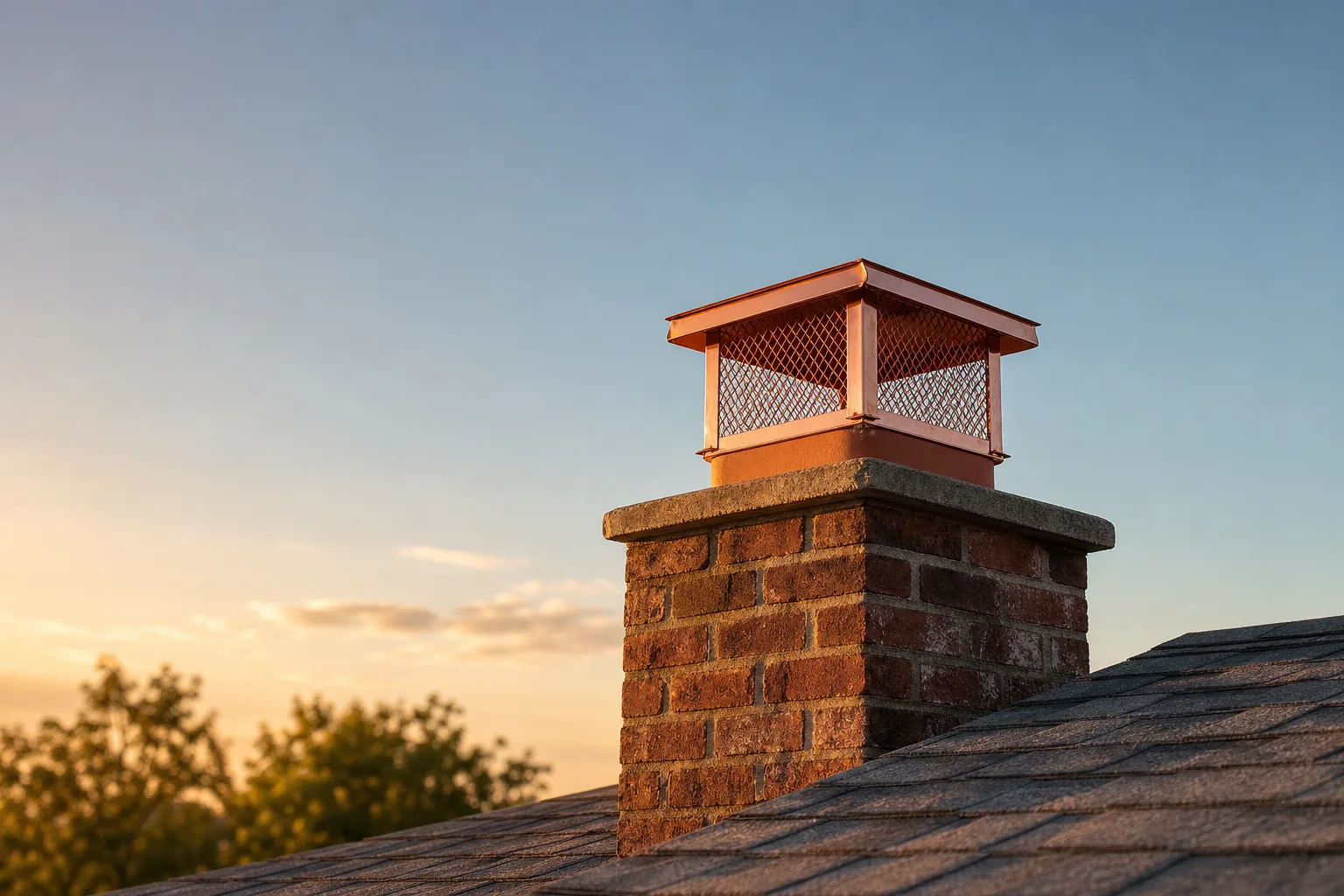
Copper chimney caps are copper covers that sit above a chimney flue to keep out rain, animals and debris while holding a spark arrester screen. They come in two forms: single-flue caps, sized from the outside dimensions of the flue tile, and multi-flue caps, sized from the length and width of the chimney crown. Copper's advantage over stainless steel is appearance and corrosion resistance in damp air, not extra protection.
You have probably already decided you want the copper one. The metal is not really the question with copper chimney caps. What stops the purchase is the step right before it, the moment you realize you cannot tell which object you are supposed to be buying.
Because there are three different things sold under this name.
They look similar in a product photo, they are priced against each other on the same supplier pages, and they fit completely different chimneys. Buying the wrong one is an easy mistake to make, and you may not find out you made it until the box is open on your driveway.
So before anything else: with copper chimney caps, the shape of your chimney top decides everything. Not your taste, not the finish, not the brand. Let's figure out which one you own.
What Copper Chimney Caps Actually Do, and the Three Things Sold Under That Name
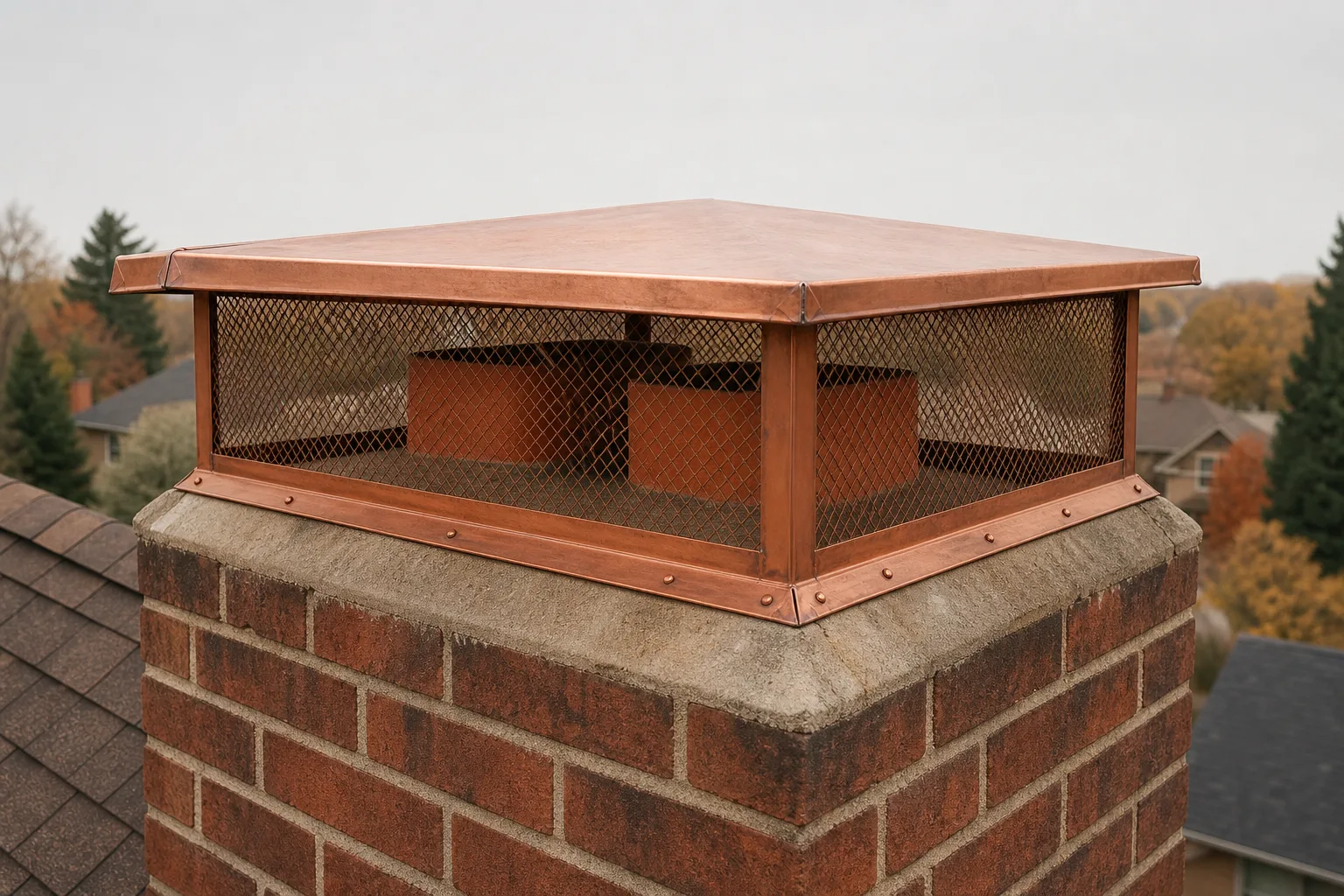
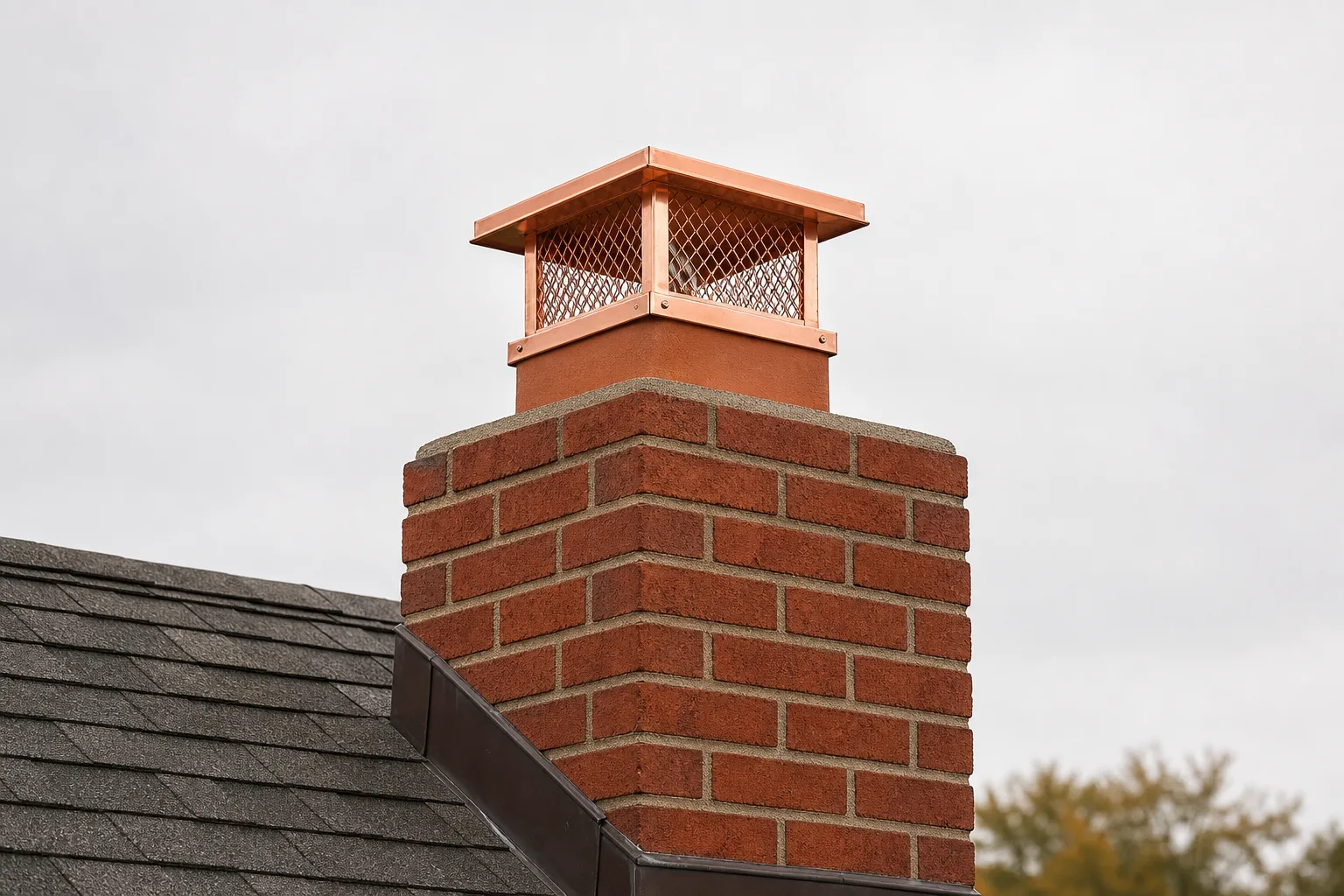
A chimney cap is a small roof held above the opening of your flue on legs, with screen filling the space between the lid and the base. That gap is the whole design. Smoke leaves sideways through the screen, and rain, snow, leaves, squirrels and birds do not get in.
Four jobs, then. Keep water out of the flue. Keep animals and debris out. Hold a spark arrester screen that stops most rising embers from reaching your roof. And break up the wind that would otherwise push smoke back down the chimney on a gusty night.
Copper does none of that better than steel does. What copper chimney caps change is how the thing looks in year one and year twenty, and how it behaves in salt air and constant damp. We will get to that honestly in a minute.
Now the fork.
The single-flue cap
This is the small one. It sits on top of one clay flue tile, the terracotta-orange rectangle standing a few inches proud of the concrete at the top of your chimney.
The cap either slips down inside that tile or wraps around the outside of it. Either way it is attached to the tile, not to the chimney.
If you look up and see one tile sticking up out of the crown, this is your family.
The multi-flue cap
Much bigger. Picture a copper lid the size of a small tabletop covering the entire top of the chimney, standing on a mesh-walled box that comes down over the whole crown.
Two or three flue tiles live underneath it together. A fireplace flue and a furnace flue, usually. The cap does not touch the tiles at all; it anchors to the crown, the sloped concrete wash the tiles come up through.
If you see two or three tiles up there, a single cap over the whole crown is one route and separate caps on each tile is another. Which one makes sense depends on the condition of the tiles and how the crown is built, not on the tile count alone.
Chase covers and chimney pots, which are not caps
Here is where people get lost.
If your chimney is not brick or stone but a framed box wrapped in siding, stucco or a stone veneer, you probably do not have a crown at all. You have a chase, and the flat metal lid across the top of it is a chase cover. Understanding how chimney chase covers fail is a separate exercise from cap shopping, and copper is a genuinely popular material for them.
A chimney pot is a third thing again: a tall decorative flue extension, usually clay, sometimes copper, that sits on the crown and lifts the flue opening higher. Pots and caps get sold side by side by the same architectural metal shops, which is exactly why the confusion happens.
Good to know: If the top of your chimney is a flat metal panel with siding below it, you are shopping for a chase cover, not a cap. Ordering a multi-flue cap for a chase is an easy mistake to make, and a cover or cap that has been formed to your dimensions may not be returnable, so settle which one you have before anyone cuts metal.
Sorted out which one you have? Good. Now comes the part that actually decides whether it stays on your roof.
Measuring: The Step That Decides Whether Your Cap Stays On
Sizes here are not approximate. Copper chimney caps are often formed to a number you supply, and a cap that is a half inch too wide can rock in the wind and work its fasteners loose. A cap that is a half inch too narrow simply does not go on.
And the two families are measured off completely different objects, which is where most of the wrong numbers come from.
Measuring for a single-flue cap
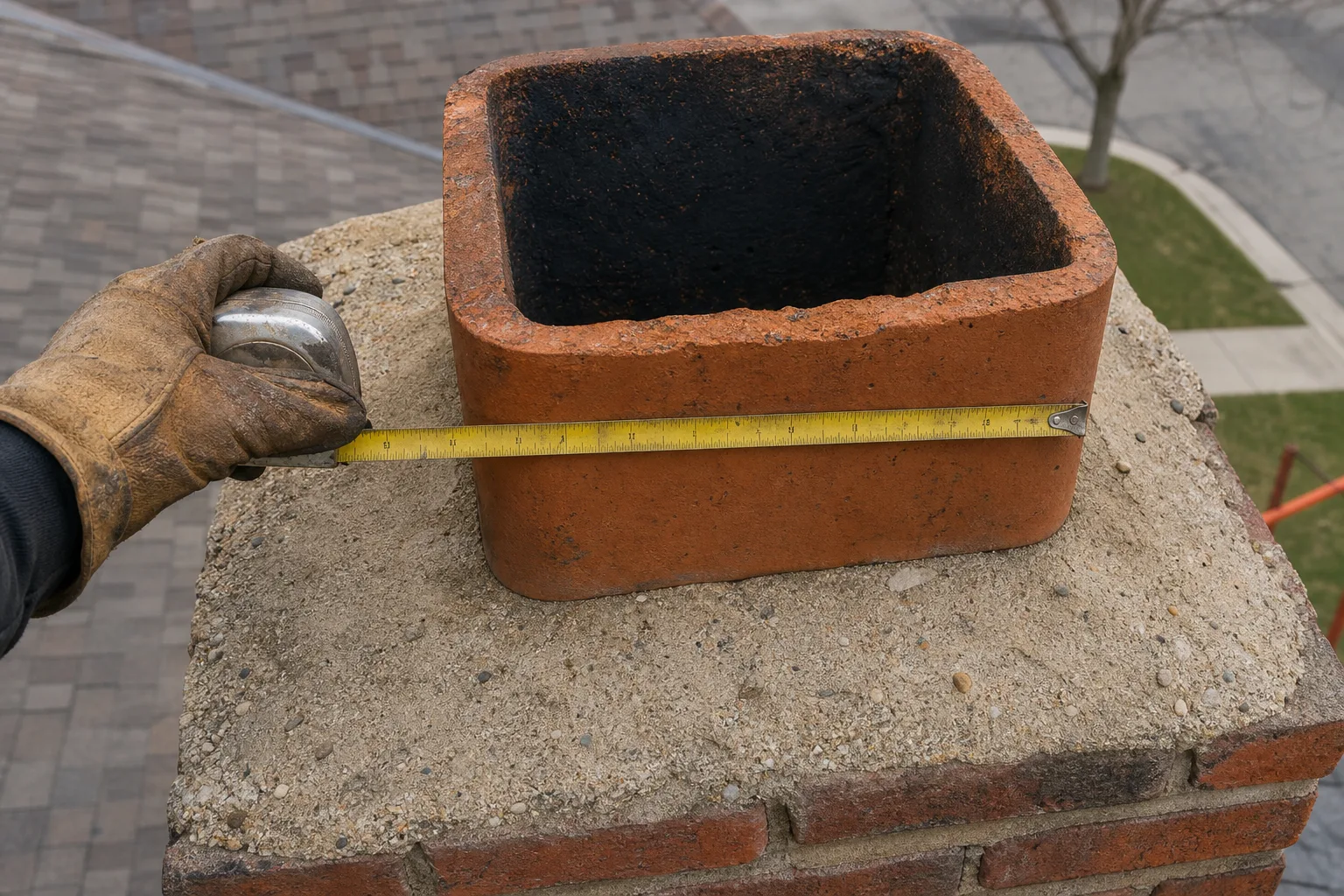
Measure the outside dimensions of the flue tile itself. Length and width, at the very top, on the outside faces of the clay.
Not the inside opening. Not the crown. The outside of the tile, because that is what the cap grips.
Take both numbers twice. Clay tiles can sit out of square, and a chipped or spalled top edge can throw a reading by enough to matter. If the two readings disagree, use the larger one and say so when you order.
Note the height of the tile above the crown as well. A cap that clamps to the outside needs a few inches of sound tile to grip, and if the tile only rises an inch or two, a clamp-on model is not going to hold.
Measuring for a multi-flue cap
Now forget the tiles entirely. Measure the crown: the full outside length and width of the concrete wash at the top of the chimney.
The cap comes down over that whole surface, so the crown is the number. This is why trade suppliers list multi-flue caps in dimensions like 10 by 55, which sound strange until you realize they describe a chimney top rather than a pipe.
Note the tallest tile too. The lid has to clear it with room for the smoke to turn and leave sideways.
Pro tip: Photograph the chimney top from directly above before you come down, with a tape measure lying in the shot. Then write the number down along with what you measured it on. "13 by 13, outside of the tile" is an order. "13 by 13" is a guess that somebody else will interpret.
The point where this stops being a driveway job
Everything above assumes you are standing on the chimney with a tape measure. That is the honest problem with this purchase.
You cannot measure a flue tile from the ground, and you cannot see a cracked crown from the ground either. Binoculars from the lawn will tell you how many tiles you have and nothing else that matters.
Steep roof, slate or tile roof, two stories, anything wet: that is not a measuring trip, that is roof work. If you already have annual chimney service booked, the measurement is a five-minute addition to a visit that was happening anyway. There is no version of this where a wrong number is cheaper than the trip up.
Not sure what you're measuring?
A wrong flue measurement can leave you with a copper chimney cap that never seats properly. Tell us what you're looking at and we'll match you with an independent local chimney company that goes up, measures the flue or the crown, and checks the crown itself while they're there.
Request service, or call (513) 655-6702.
Copper vs. Stainless vs. Galvanized: An Honest Comparison
Let's take the romance out of it for one section.
| Material | How it holds up | How it looks over time | Best fit |
|---|---|---|---|
| Copper | Corrosion resistant, described in the trades as lasting well beyond fifty years for the metal itself | Bright metallic, then brown, then the green patina, arriving unevenly | Coastal and humid climates, historic homes, chimneys you actually see from the street |
| Stainless steel | Corrosion resistant, the functional equal of copper for most residential caps | Stays roughly the same silver-gray, dulls slightly | Almost everything else, and anywhere the cap is barely visible |
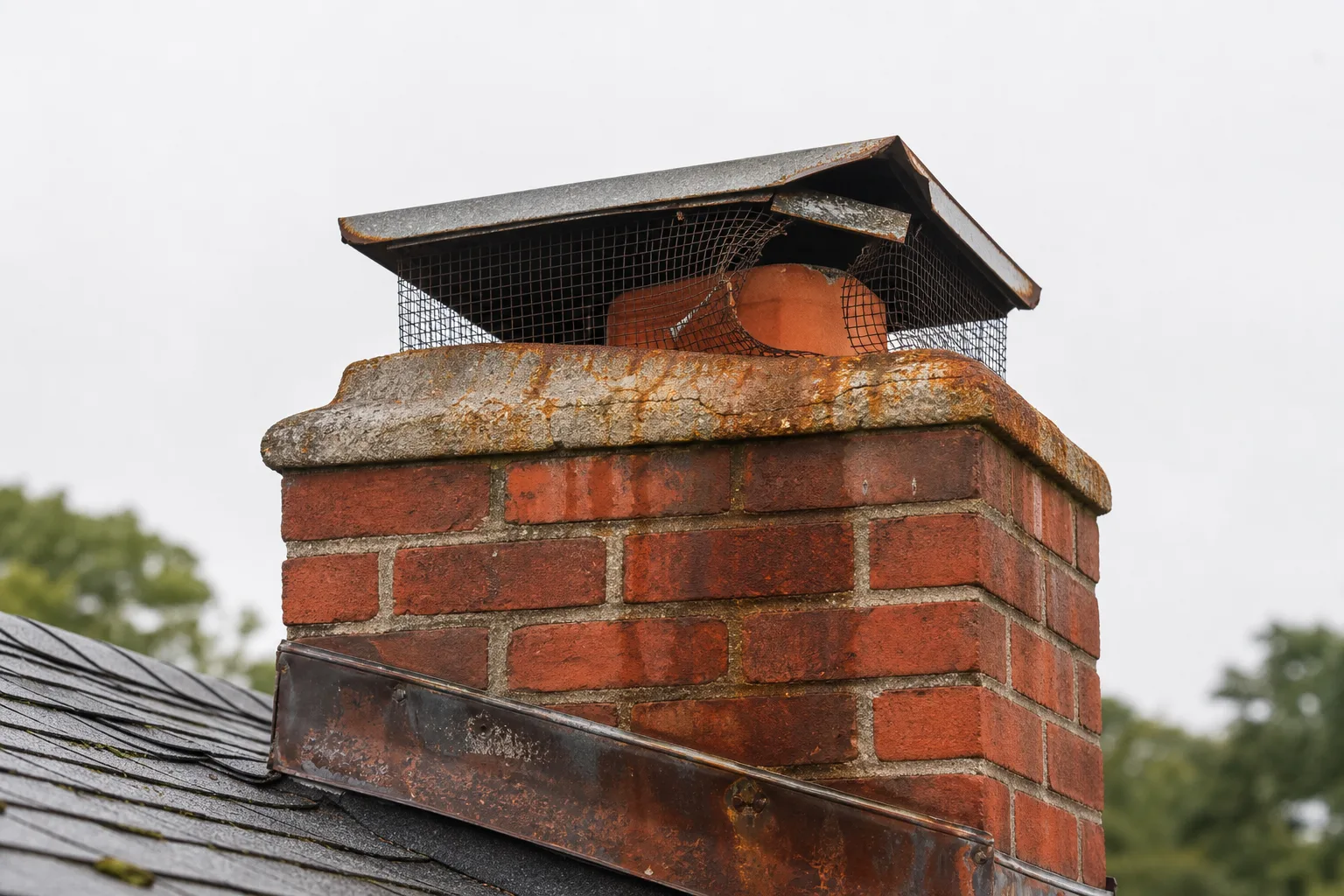
| Galvanized steel | Zinc coating degrades under acidic flue gas over years, then the steel underneath rusts | Dull gray, then orange, then rust streaks down the brick | Short-term or budget replacement only |
The galvanized row is the one worth reading twice. The rust does not stay on the cap. It runs down the masonry and leaves streaks that are genuinely difficult to remove from brick.
Where copper genuinely wins
Salt air and constant damp. The corrosion behavior of copper chimney caps is real, not marketing, and it is the reason coastal roofers reach for the metal.
Visibility. If the chimney is a feature of the house rather than a pipe on a back roof, copper is the only cap material anyone compliments.
Old houses. On a nineteenth-century brick stack, stainless reads as a repair and copper reads as part of the building.
Where stainless is the smarter buy
If the chimney is on a rear slope where nobody looks, you are paying a premium for an aesthetic nobody experiences.
If you are in a wildfire-prone area where the fire marshal cares about the screen and not the frame, spend the difference on getting the mesh and the fit right.
And if the crown underneath is cracked, fix the crown first. A beautiful cap on a failing crown is money placed on top of a problem.
Myth vs. fact: Myth: copper protects a chimney better than stainless steel. Fact: for most residential caps the two are functional equals. Copper buys you appearance and corrosion behavior in harsh, damp air. It does not keep more rain out, and it does not stop more sparks.
Which brings us to the part of the cap that actually does the safety work, and that almost nobody shops for.
The Mesh: What NFPA 211 Asks of a Spark Arrester
The screen is not decoration and it is not just an animal guard. On a wood-burning chimney it is a chimney spark arrestor, and NFPA 211, the standard for chimneys, fireplaces, vents and solid fuel burning appliances, is specific about it.
Three requirements are worth checking against any of the copper chimney caps you are considering, because a cap that fails them is a cap you will be replacing.
The half-inch sphere
NFPA 211 states that the openings shall not allow the passage of spheres larger than half an inch in diameter, and shall not block the passage of spheres smaller than three eighths of an inch.
Read that twice, because it is a window, not a maximum. There is a floor as well as a ceiling.
The standard also asks that the screen have heat and corrosion resistance equivalent to 19 gauge galvanized steel or 24 gauge stainless steel. It names no copper weight at all, which matters when a listing tells you its copper mesh meets a code requirement that does not exist in those terms.
Three times the flue's free area
This is the counterintuitive one. NFPA 211 asks that the net free area of the arrester be at least three times the net free area of the flue outlet it serves.
Three times. Not equal to.
Everyone assumes tighter mesh is safer mesh. It is not. A screen sized to match the flue chokes the draft, and a choked draft is smoke in the room and creosote in the flue. That is why cap screens are tall and wrap all four sides: the manufacturer is buying back free area with height.
If a cap looks like a flat lid with a shallow band of screen under it, ask what the free area actually is.
It has to come off for cleaning
NFPA 211 also requires that the spark screen be accessible for cleaning, and that the screen or the cap be removable so the flue can be cleaned.
A cap riveted permanently shut is not a bargain. It is an obstacle that the next sweep has to cut off.
Safety note: Two things to check against any cap you are considering. First, the mesh openings: NFPA 211 asks that they not pass a sphere larger than half an inch, and that they not block a sphere smaller than three eighths of an inch. Second, a screen with at least three times the free area of your flue opening. Local codes vary and some wildfire-prone jurisdictions enforce spark arrester rules more strictly than the national baseline, so ask locally before you order.
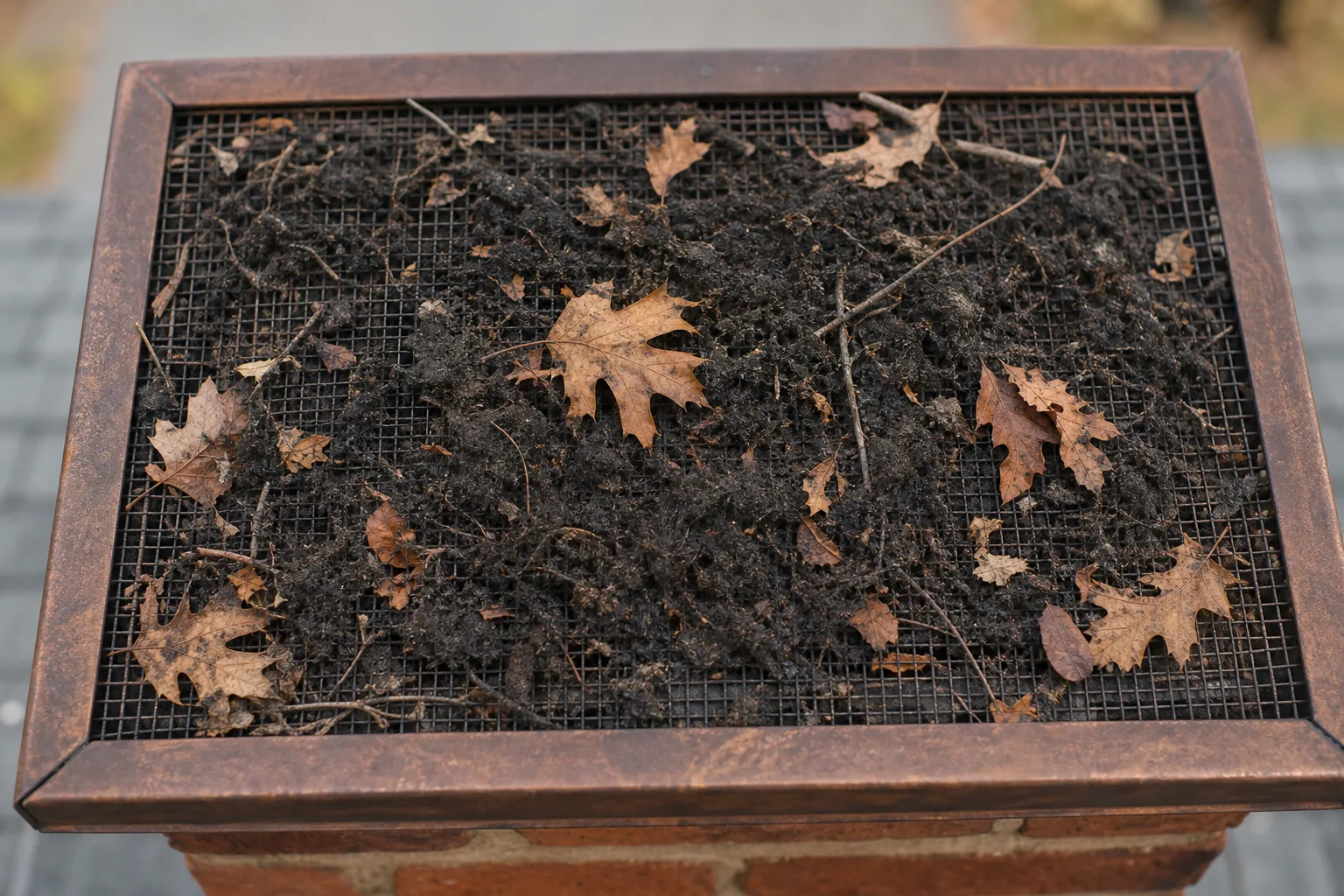
Screens also do the one job owners forget about, which is collecting things. Creosote flakes come off the flue walls and settle into the mesh, leaves and seed pods blow in, and over a few seasons the screen can mat into a dense felt that a clean-looking cap hides completely from the ground.
That is worth remembering when you are choosing between mesh patterns. The screen you can reach and brush is the screen that keeps working. Which is also a good moment to talk about what this cap will look like after a few winters.
Patina, Staining, and How Copper Chimney Caps Age
Nobody buys copper chimney caps for how they look on day one. They buy them for a photograph of a green roof in Vermont. It is worth knowing what actually happens in between.
The patina timeline
A new cap arrives bright, an orange-pink metal that is close to mirror-bright along the folded seams. It looks, honestly, a little loud on a weathered roof.
Within a season or two it goes matte and darkens to a chocolate brown. Most people like this stage more than they expected to.
The green carbonate patina, the one in the photograph, takes years, and how many depends on your rainfall and your air. There is no schedule anyone can promise you.
Good to know: The patina does not arrive evenly. It comes in patchy, and it comes greener on the weather side, so a cap can spend a year or two brown on one face and turning on the other. That is normal copper behavior, not a defect, and no supplier photograph will show it to you.
The blue-green streak nobody warns you about
Here is the thing not one page on the first screen of results will tell you.
Water running off a copper cap carries a little copper with it. Where that runoff lands on a light-colored surface below, it can leave a soft blue-green streak fanning down from the drip point.
Light gray or tan shingles show it. White or cream stucco shows it clearly. Dark asphalt shingles usually hide it entirely, and old red brick tends to absorb it into its own variation.
Whether it shows on your house depends on the roof color, the material, the slope and how the water actually comes off the cap, so nobody can tell you in advance that it will or will not. But it is a real, well documented mechanism in roofing, and it is worth thirty seconds of thought before you put copper above a pale roof.
The fix, when it matters, is planning the drip line rather than regretting it. Which is a mounting question, and mounting is where these caps mostly fail.
Mounting, Fasteners, and Why Caps Blow Off
Copper chimney caps are only as secure as what holds them on. The metal resists corrosion well; the fasteners and the mounting style are a separate question, and that is where the attention belongs.
Slip-in, clamp-on, screw-set, crown-mounted
Single-flue caps come in three mounting styles. A slip-in model has legs that go down inside the flue tile and hold by friction and a spring. A clamp-on model has a band that wraps the outside of the tile and tightens with a screw. A screw-set model fastens directly through into the outside of the tile.
Slip-in is the fastest to fit and the least secure of the three. Clamp-on needs sound tile with enough height to grip. Screw-set holds well but puts fasteners into clay, which is fine in good tile and a crack starter in a spalled one.
The choice is not about preference. It is about what your tile can take. A tile with a chipped, flaking top edge cannot be clamped and should not be drilled, and on that chimney the honest answer is often to stop looking at single-flue caps and put a crown-mounted cap over the whole top instead.
Multi-flue caps are different again. They anchor down to the crown through a bottom flange, into masonry, which is the most secure arrangement of the four and also the one most dependent on the condition of what is underneath.
Stainless fasteners, no exceptions
Copper against the wrong metal corrodes. Standard sheet metal practice is that fasteners touching a copper cap are stainless steel, specified that way to prevent galvanic corrosion and staining.
This is not a detail to leave to whoever is holding the drill. Plain steel screws in a copper flange will bleed rust into the metal and undo the reason you bought copper in the first place.
If a cap ships with unspecified hardware, replace it.
The crown underneath the cap
The crown is the sloped concrete wash on top of the brick, and on an older chimney it is usually cracked, often with hairline fractures radiating out from where the tiles come through.
A multi-flue cap anchors into that concrete. If it is crumbling, the anchors have nothing to hold, and you are looking at brick chimney repair before you are looking at metal.
This is why a cap and a crown get looked at in the same trip. They fail together and they get fixed together, and finding out about the crown after the cap is formed to size is the expensive order of operations.
From the field: When a cap comes off in a storm, the interesting evidence is what got left behind. A slip-in cap that was never meant to fight that kind of wind. Fasteners seated into tile or crown that had already gone soft. In those cases the failure was decided at installation, not during the storm.
A checklist before you buy copper chimney caps
Run this list before anyone forms metal to a number.
- Which family: single-flue, multi-flue, or a chase cover for a framed chase.
- The measurement, written down with what it was taken on. Outside of the tile for single-flue, the crown for multi-flue.
- Tile height above the crown, if you are considering a clamp-on.
- Mesh openings that do not pass a sphere larger than half an inch, and do not block a sphere smaller than three eighths of an inch.
- Screen free area at least three times the flue opening.
- The screen or the cap comes off for cleaning.
- Mounting style matched to the condition of what it fastens to.
- Stainless fasteners, confirmed, not assumed.
- Crown condition assessed at the same time.
- Roof color and material below the drip line, for staining.
- Whether your jurisdiction has stricter spark arrester rules than the baseline.
The first three items and the crown assessment cannot be answered from the ground. That is the honest shape of this purchase.
How VIO Helps With Copper Chimney Caps
VIO CHIMNEY is a referral service. We do not do the work ourselves. When you request service, we match you with an independent local chimney company, and that company does the inspecting, measuring and installing.
For copper chimney caps specifically, here is what that trip is for.
The independent company we match you with goes up and settles the question you cannot settle from the ground: whether you have one flue, several flues, or a framed chase. That determines the object before anyone talks about metal.
That company takes the measurement off the right thing and records what it was taken on. It looks at the tile height and the tile condition, which decides which mounting style will actually hold.
And it looks at the crown while it is up there, because a new cap anchored into failing concrete is a repeat visit waiting to happen.
We ask every company in the network to put its estimate in writing before any work starts, and you should insist on exactly that. Ask what the mesh spec is, ask what the fasteners are, and ask what condition the crown is in. A company that answers those three plainly is a company worth hiring.
Copper chimney caps are one of the few chimney purchases people make for how it looks, and that is a perfectly good reason. Just make sure the thing holding it on was chosen as carefully as the metal was.
Get the copper chimney caps question settled before you burn
Tell us about your chimney and we'll match you with an independent chimney company in your area. Ask for the estimate in writing before any work starts, and expect a straight answer about whether copper is the right call for your roof.
Request service, or call (513) 655-6702.
Symptom checker
What is your chimney doing?
Tap the closest match for an honest first answer.