



On this pageWhat brick chimney repair actually covers8 sections+7
- What brick chimney repair actually covers
- Read your chimney from the ground: a damage triage
- Why brick chimneys fail, and why it happens from the top down
- The four repairs, and what each one actually fixes
- Repair or rebuild: where the line actually is
- Timing, weather, and what a real brick chimney repair estimate contains
- How VIO helps with brick chimney repair
- Your next move on brick chimney repair
Quick answer
Brick chimney repair covers four kinds of work: repointing failed mortar joints, replacing spalled brick, repairing or recasting the crown, and correcting flashing at the roofline. Which one you need depends on whether the mortar failed or the brick itself did. Cost is driven by chimney height, roof access, how much joint or brick is involved, and staging, so the scope has to be defined in writing before any number means anything.
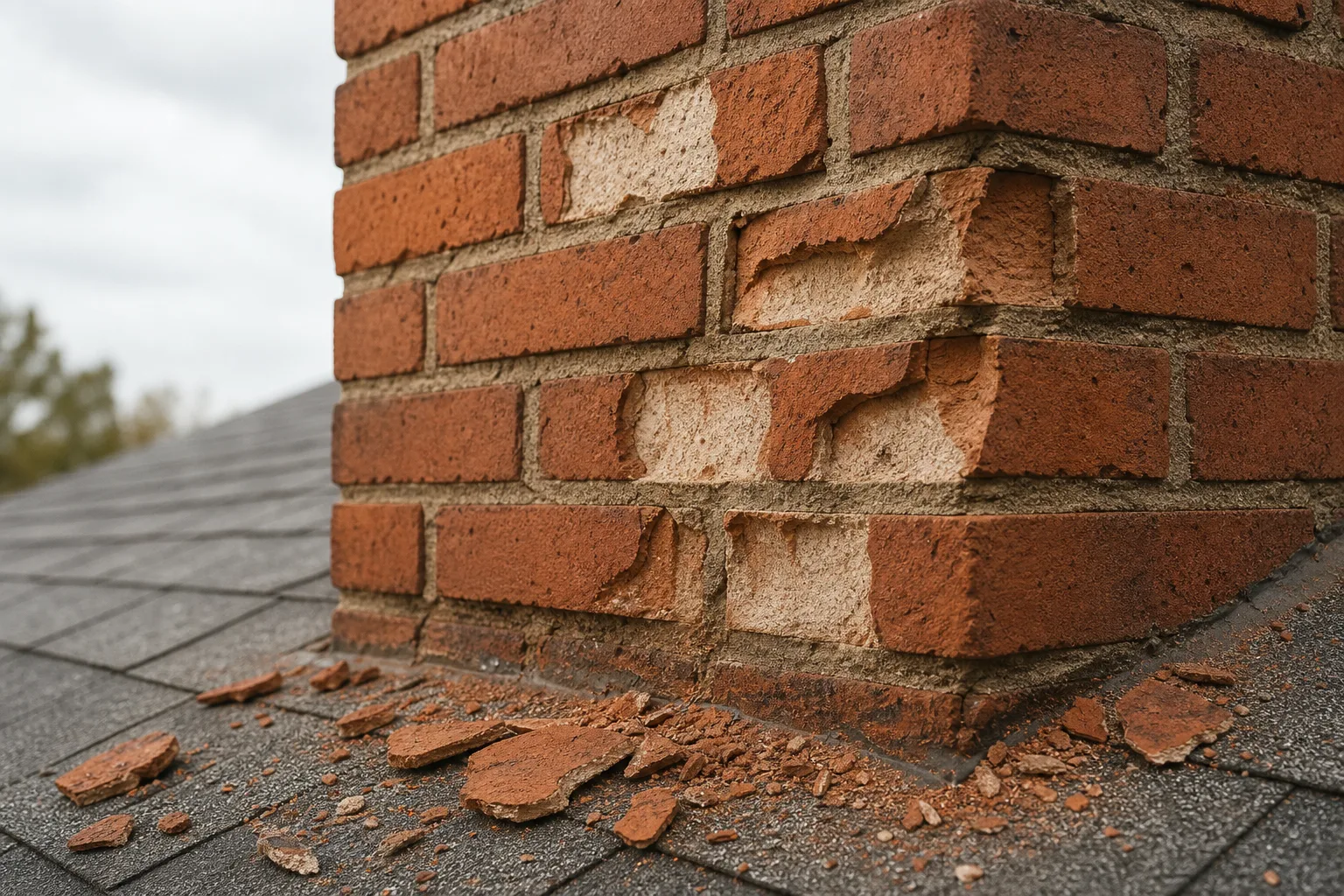
The first sign is usually grit on the roof.
Reddish, sandy, a scatter of thin flakes on the shingles below the stack. Most people notice it, decide it is nothing, and forget about it until a joint opens up or a brown ring appears on a bedroom ceiling. That grit is the face of your brick, and it is not going back on. Brick chimney repair starts with understanding what you are actually looking at, because the same chimney can need a small contained fix or a major rebuild, and from the driveway those two look almost identical.
Here is the part that surprises people: the worst thing you can do to a brick chimney is repair it with the wrong mortar. Not neglect it. Repair it, badly, with a mix that is too strong. It is an easy mistake to make, and I will come back to why in a few minutes.
Good to know: "Chimney repair" is not one job. It is four different kinds of work, done by people with different skills, at four different price points. Knowing which one you need is most of the battle.
What brick chimney repair actually covers
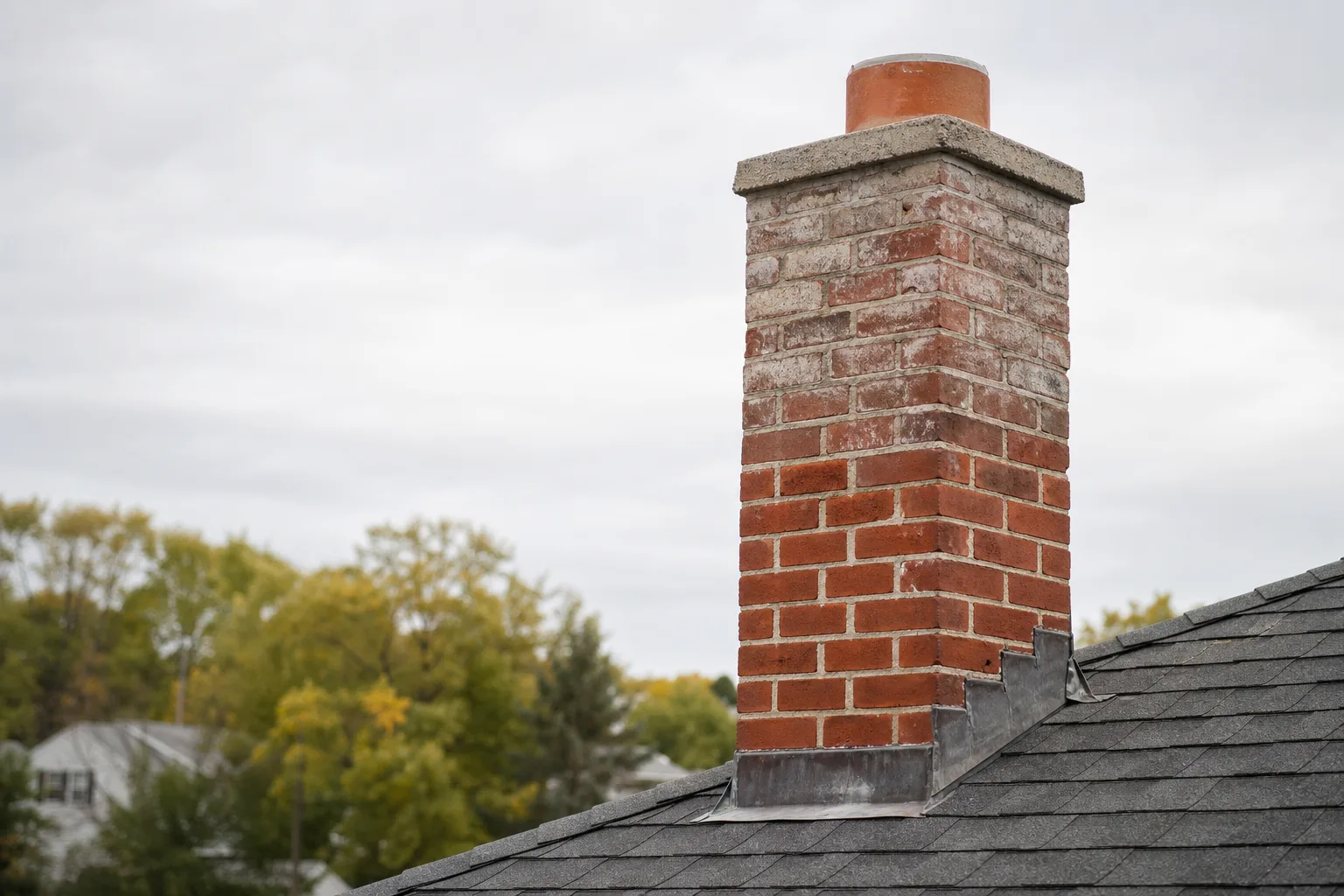
Brick chimney repair splits into four families of work.
Mortar joints. The gray lines between the bricks erode, go sandy, and eventually open. The fix is repointing, sometimes called tuckpointing, where the failed mortar is ground out and fresh mortar is packed in.
Brick faces. When a brick's face flakes, pops, or crumbles away, that is spalling. Spalled brick gets replaced, not patched.
The crown. The sloped slab on top of the stack that sheds water off the masonry. Not the metal cap, the concrete underneath it.
Flashing. The metal where the chimney meets the roof. Not masonry at all, but it lands in the same conversation because it causes the same symptom, water inside the house.
A single job can span more than one family. Failed joints and a cracked crown can come from the same water.
Masonry repairs versus flue and liner work
There is a second category of chimney work that this article is deliberately not about, and the distinction matters when you are getting priced.
Masonry repair is the structure: brick, mortar, crown, flashing. Flue work is the passage inside: the clay tiles or the metal liner that carries combustion gases out. A mason can rebuild your stack beautifully and leave a cracked flue tile untouched, and a liner company can sleeve your flue without touching a single deteriorated joint.
They are different scopes, often different companies, and you want both looked at in one visit. If the trouble turns out to be inside the passage rather than in the brick, you are looking at chimney flue repair instead, which is a different job at a different price.
Read your chimney from the ground: a damage triage
Every brick chimney repair decision begins here, with an honest read of what the damage is telling you.
You cannot diagnose a chimney from the yard. You can absolutely triage one, and knowing which bucket you are in changes how fast you need to move.
What you can see from the driveway
Get thirty or forty feet back, look up, and check these in order.
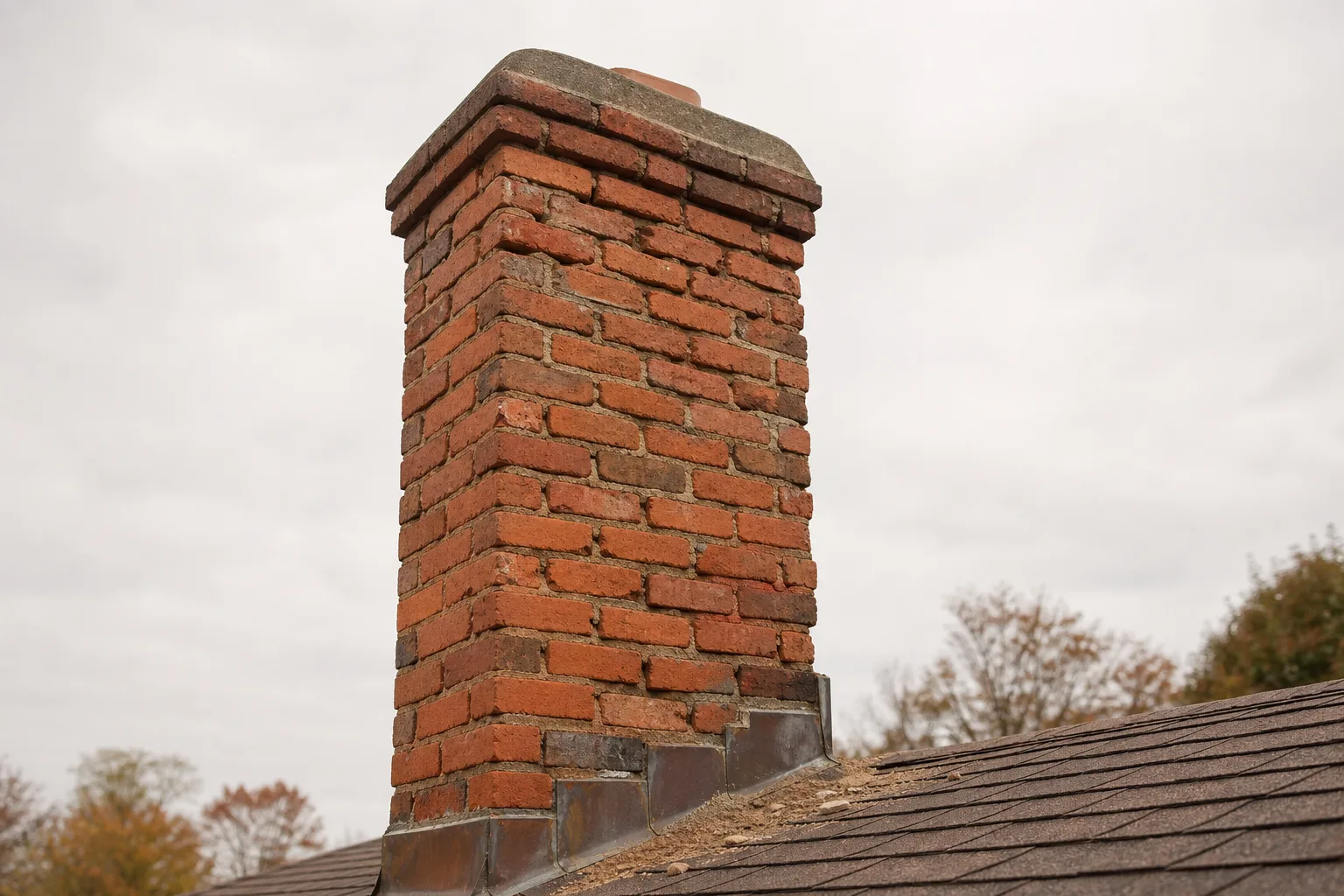
- Grit or brick chips on the roof. Reddish sand and thin curved flakes on the shingles below the stack. This is spalling in progress.
- Pale patches on the brick. Where a face has popped off, the exposed interior is lighter, rougher, and slightly recessed. Usually worst on the weather side.
- Recessed or missing mortar. Joints that read as dark shadow lines instead of flush gray. If you can see daylight through a joint, that is structural, not cosmetic.
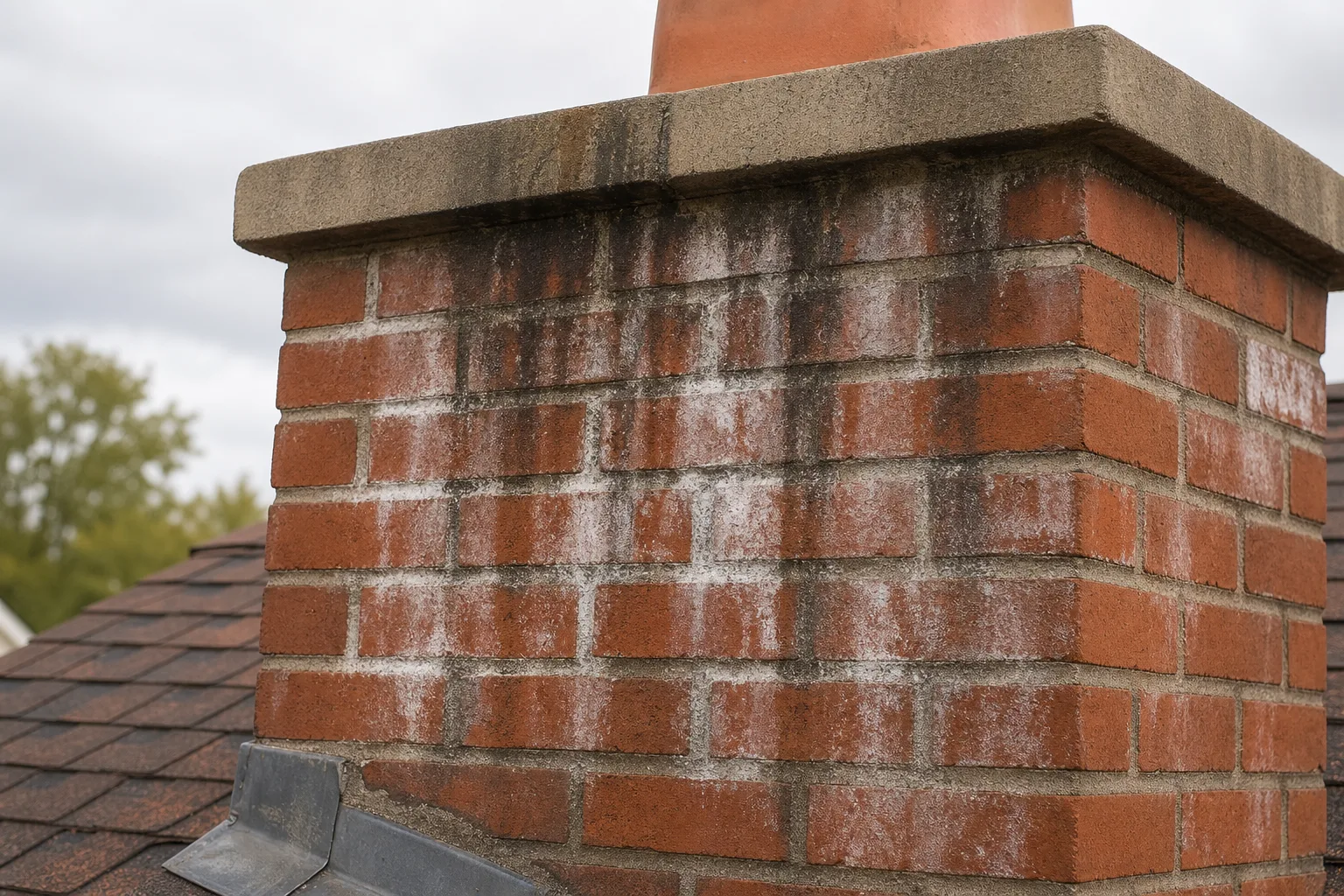
- A white chalky bloom. Efflorescence. It is salt left behind by water moving through the masonry and out the face. It is not dirt, and scrubbing it off does not solve anything.
- A crown that looks flat. A correct crown overhangs the brick by a couple of inches and slopes away from the flue tile. If the top of your chimney looks like a smooth gray lid flush with the brick, that is a mortar wash, and it will crack.
- A stack that is not plumb. Sight the vertical edge against the roofline or a corner of the house. Any visible lean is a stop-everything item.
- Rust streaks or lifted metal at the roof line. Failed flashing.
Then go inside and look at the ceiling and wall where the chimney passes through. Brown staining, bubbled paint, or a musty smell in that spot means water has already been getting in for a while.
From the field: The grit on the shingles is the thing homeowners notice first and take seriously last. It reads as debris. It is actually the chimney shedding its own weather protection, one brick face at a time.
What you can only see from the roof
This is the honest half. From the ground you can tell that something is wrong. You cannot tell how far it goes, and neither can anyone else without getting up there.
The crown's cracking pattern, whether the flue tile has separated from the crown, how deep the mortar erosion runs into the joint, whether the counterflashing is genuinely let into a mortar joint or just caulked against the brick, whether the brick above the roofline has gone soft all the way through: all of that requires hands on the masonry. A chimney can look tired from the yard and be fine, or look presentable and be five courses of crumbling brick behind a decent face.
That gap is the entire reason a real inspection exists.
Why brick chimneys fail, and why it happens from the top down
A chimney is the only part of your house that is exposed on all four sides, top included, with no roof of its own. The kind of damage that leads to brick chimney repair starts as water.
Water lands on the crown first. If the crown is cracked, thin, or poured flush with no overhang, water runs straight down the brick faces instead of dripping clear. Saturated brick soaks it up. Then the temperature drops, the water inside the brick freezes and expands, and the pressure pushes the face outward. Thaw, refreeze, repeat. Eventually the face lets go.
That is spalling, and the reason it clusters on the north and west faces of a stack is simply that those sides stay wet longest.
The same water erodes mortar joints, which lets more water in, which accelerates everything. It is a loop that gets faster the longer it runs, which is why routine chimney maintenance is mostly about keeping water out of the masonry in the first place.
Myth vs. fact: Myth: a coat of waterproofing sealer will stop a chimney from spalling. Fact: a breathable masonry water repellent is a maintenance step after the masonry is sound. It cannot restore a brick face that is already gone, and a non-breathable sealer can trap moisture inside the wall and make the problem worse. Repair first, then talk about repellent.
One more mechanism, and this one is not weather.
If a previous repair used mortar that is harder than the brick, the masonry can no longer move the way it needs to. Brick and mortar expand and contract with heat and cold. In a properly built wall, the softer mortar joint absorbs that movement. When the joint is the hard part, the movement goes into the brick face instead, and the brick spalls from ordinary seasonal cycling. That is the payoff to the promise I made at the top, and it is why the mortar question below is not a technicality.
The four repairs, and what each one actually fixes
Four families, four different jobs. Here is what each one involves and what it does not solve.
Repointing the mortar joints
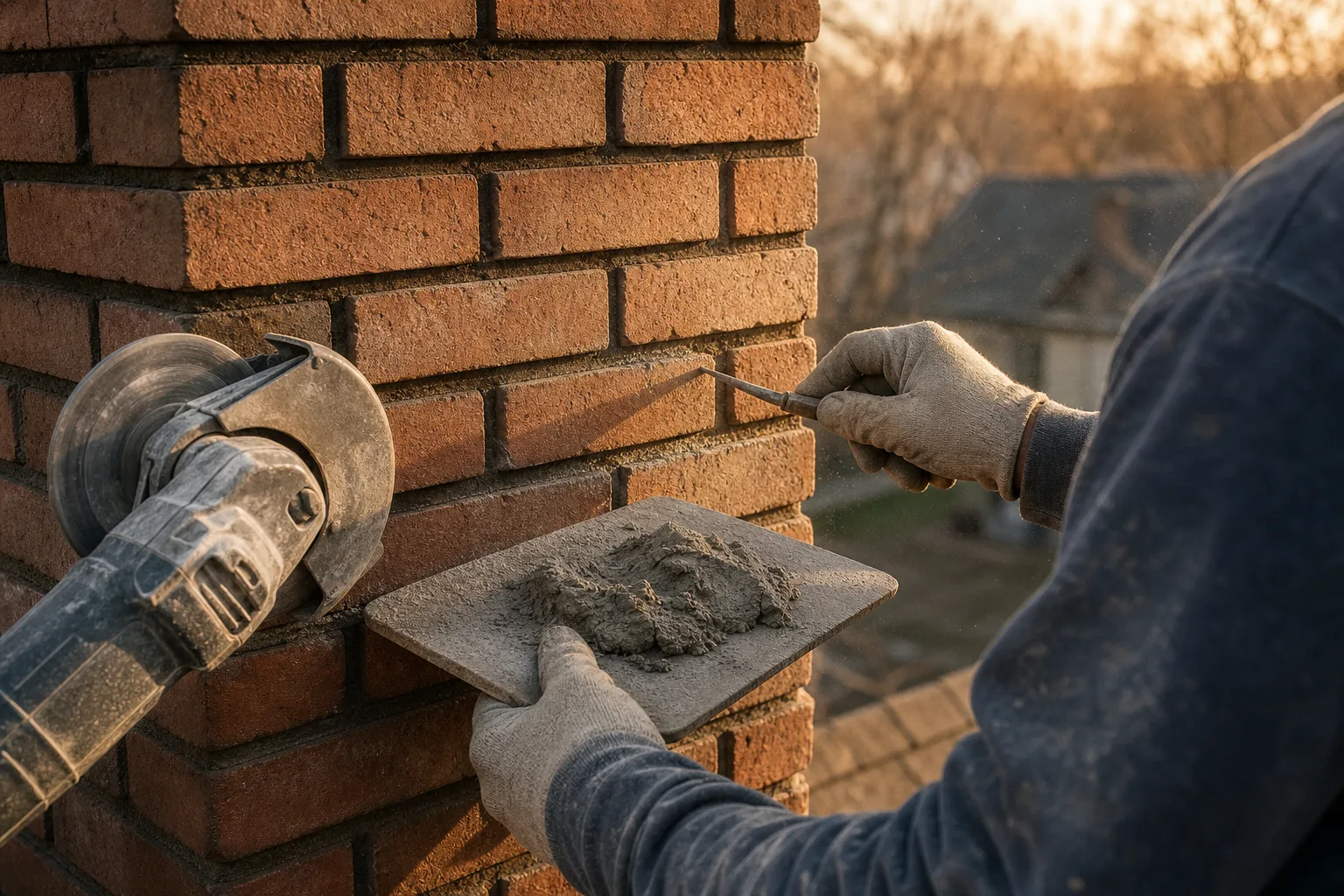
The mason grinds or rakes the failed mortar out of each joint to a sound depth, cleans it, and packs in fresh mortar, then tools the joint to shed water. Done well, the new joints look slightly cleaner than the old ones for a season and then blend.
The critical decision is the mix. Type N mortar, a portland cement, lime, and sand blend, is the general purpose choice for an exposed chimney stack: durable, and flexible enough to move. Type O, with more lime and lower compressive strength, is the right call on historic or soft brick, exactly because it is weaker than what it holds together.
Pro tip: Harder is not better. Ask the company which mortar type they are using on your chimney and why they chose it. A contractor who answers "whatever is in the mixer" on a hundred year old soft brick stack is about to cause the next round of spalling.
Replacing spalled brick
Spalled brick comes out and new brick goes in, matched as closely as possible to the existing size, color, and texture. There is no coating, filler, or patch that restores a lost brick face in a load-bearing wall. Anything that promises otherwise is cosmetic at best.
The practical question is how many, and how high. A dozen bricks near the top is contained work. Widespread spalling across every course above the roofline is a different conversation, and it belongs in the rebuild section.
Repairing or rebuilding the crown
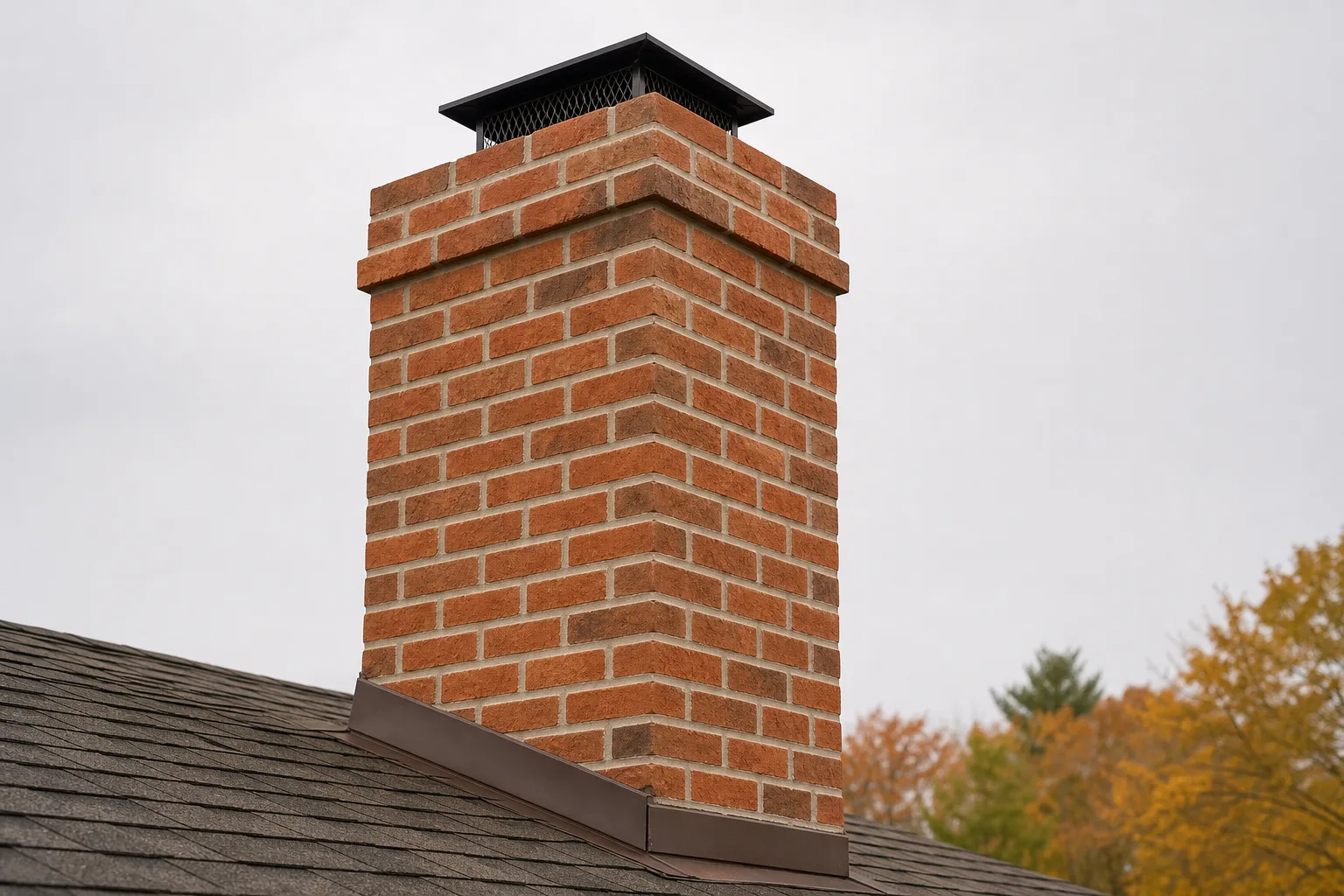
A correct crown is cast concrete, not a smear of leftover mortar. The specification that chimney professionals work from, as taught in Chimney Safety Institute of America materials, is specific: roughly a two and a half inch overhang past the brick, a drip edge groove cut into the underside about an inch in from the edge, a minimum thickness of around two inches at the edge, a slope of about an inch per foot away from the flue, and an expansion joint of roughly three eighths of an inch where the flue tile passes through.
That drip groove is the unglamorous hero of the whole assembly. It breaks the surface tension so water drops off the edge instead of curling back and running down your brick.
Small cracks in a sound crown can be sealed with a flexible crown coating. A crown that is map-cracked, spalling at the edges, or was never more than a mortar wash gets removed and recast.
Flashing and counterflashing
Chimney flashing is two overlapping layers, and the reason for two is movement. Base flashing, usually step flashing, is fastened to the roof deck. Counterflashing is let into a mortar joint on the chimney and laps down over the base flashing.
They overlap. They are deliberately not fastened to each other. The house and the chimney settle and move at different rates, and the two independent layers keep shedding water while that happens.
From the field: Counterflashing that has been caulked flat against the brick face instead of cut into a mortar joint is one of the most common leak sources on a residential roof, and it is invisible from the ground. Caulk is a sealant sitting on the surface. A mortar joint is part of the wall.
What drives brick chimney repair costs
Chimney work is not priced off a list. What the number reflects is chimney height, roof pitch, how the crew gets up there, how much joint or brick is actually involved, whether brick has to be matched, and where you live.
So instead of a price, here is what each repair is and what moves its cost. Read an estimate against this and you will know what you are comparing.
| Repair | What it fixes | What moves the cost | Signs you need it |
|---|---|---|---|
| Minor crack repair | Isolated cracks in brick or joints | The smallest of the four scopes; mostly access | A few hairline cracks, no other symptoms |
| Repointing / tuckpointing | Eroded, sandy, or open mortar joints | How much joint is cut out, and how high up | Recessed joints, sand at the base, daylight through a joint |
| Crown repair or recast | Cracked, thin, or flush crown | A flexible coating is modest work; a full recast is not | Map cracking on top, no overhang, water down the faces |
| Flashing repair | Leaks at the chimney-to-roof line | Roof pitch, metal type, how much is replaced | Ceiling stains near the chimney, lifted or rusted metal |
| Spalled brick replacement | Lost brick faces, crown to roofline | Brick count, staging, and finding a matching brick | Pale recessed patches, chips on the shingles |
Ask every company to break its estimate down along these lines. Two numbers for "chimney repair" tell you nothing; two numbers for the same defined scope tell you everything.
Repair or rebuild: where the line actually is
This is the brick chimney repair decision that costs real money, and it is the one nobody puts in writing.
Repointing assumes the brick is sound and the joints have failed. It is the right call when the faces are intact, the stack is plumb, and the erosion is in the mortar. That is the situation repointing was designed for.
A partial rebuild, usually everything above the roofline, becomes the honest answer when the brick itself has failed. The signals are consistent:
- Spalling across most of the exposed courses, not in isolated spots.
- Joints that have opened all the way through the wall rather than eroding at the surface.
- Any visible lean, bow, or displaced course.
- Brick that crumbles under a firm push or a screwdriver tip.
- Repeated repairs that keep failing in the same place.
Repointing a stack whose faces are already gone is money spent on a wall that is still failing. The joints will look excellent and the brick will keep shedding. A good mason will tell you that before taking the job, and it is fair to ask directly: is there enough sound brick here for repointing to be worth doing?
A rebuild that goes below the roofline is a larger question, tied to structural movement, fire damage, or long-term water intrusion into the chase.
Safety note: A chimney that is leaning, that has joints open through the wall, or that is dropping brick onto the roof is not a maintenance item. Stop using the fireplace and get it evaluated. Falling masonry and a compromised flue are both real hazards.
Not sure if it is repointing or a rebuild?
That call gets made on the roof, not from the ground. Tell us what you are seeing and VIO will match you with an independent local chimney company that inspects the stack. We ask every company in the network to put its estimate in writing before any work starts, and you should insist on exactly that.
Get matched with a local pro. Call (513) 655-6702.
Timing, weather, and what a real brick chimney repair estimate contains
Why mortar has a temperature floor
Fresh mortar has to cure, and curing is a chemical reaction that slows down and then stalls as temperatures drop. Standard cold-weather masonry practice calls for placing mortar when ambient temperatures are above roughly forty degrees Fahrenheit and rising, with heated enclosures and protection required below that.
Which is why repointing, brick replacement, and crown work are warm-season jobs across most of the country. It is not a scheduling preference. It is the material.
There is also a sequence argument. Masonry work finished in late summer or early fall is done before the stack goes back into service for the burning season, which is the order you want. It is also the order that puts chimney cleaning services after the masonry work rather than before it, since repointing dust and mortar debris end up in the flue. And if you noticed damage in the spring, you are usually looking at what last winter did, not at something new.
What belongs in a written estimate
Ask for these in writing, and read them before anyone sets a ladder against your house. A vague estimate is not a price, it is a placeholder.
- The scope in specifics. Not "repoint chimney." How much joint, which elevations, from what height to what height.
- The mortar type and why. Type N, Type O, or a specified custom mix, with a reason tied to your brick.
- Brick matching. If brick is being replaced, how they are sourcing a match for size, color, and texture.
- Crown detail. If the crown is in scope, whether it is being coated or recast, and whether the recast includes an overhang and a drip edge.
- Flashing detail. Whether counterflashing is being let into a mortar joint or surface-mounted and sealed.
- Access and setup. Ladder, roof jacks, or scaffold. This is a real cost line and it belongs on the page.
- What happens if they open it up and find worse. Every masonry job carries that possibility. You want the change-order process defined before it happens, not during.
- Cleanup and debris. Ground-out mortar and broken brick land on your roof and in your gutters.
Good to know: NFPA 211 defines three levels of chimney inspection, and a Level 2 is required in specific situations: at the sale or transfer of a property, when the system changes (fuel type, appliance, or flue material or size), after a malfunction, after a chimney fire, and after an external event such as an earthquake or severe weather. If you are selling, buying, or the chimney has been through something, that is the inspection to ask for by name.
How VIO helps with brick chimney repair
VIO CHIMNEY is a referral service. We do not do the masonry, and the crews are not ours. What we do is connect you with independent local companies that offer chimney repair services in your area and take on brick chimney repair of exactly the kind described above.
Here is how it works for this situation. You describe what you are seeing once, in plain language: the grit on the shingles, the open joint, the stain on the ceiling.
We match you with a local company that handles that scope. The company we match you with inspects the stack, tells you which of the four repair families you are actually in, and prices the work.
On estimates, so it is clear: we ask every company in the network to put its estimate in writing before any work starts, and you should insist on exactly that. A company that will not write down what it intends to do to your chimney has told you something useful.
The pro we send is an independent local business, not a VIO employee. That is the honest structure of what we do. You are hiring a local company, and we handle the part where you would otherwise be calling six numbers off a search page and hoping one of them knows brick.
Your next move on brick chimney repair
Do this before you call anyone, and the call goes twice as well.
Walk out to where you can see the whole stack. Look up. Take two photographs: one wide, showing the chimney against the roofline so its shape and any lean are visible, and one as close as your phone will focus, on the worst area you can see.
Then go inside and photograph the ceiling where the chimney passes through, stained or not.
Those three images turn a vague description into something a chimney company can actually respond to, and they give you a dated record of what the masonry looked like today.
Most brick chimney repair is not an emergency. Eroded joints and a few spalled faces have been getting worse for years and will survive the time it takes you to get two opinions. The exceptions are the ones in the safety note above: a leaning stack, joints open through the wall, brick landing on the roof, or a chimney that has been through a fire or a storm.
The rest is a decision you can make calmly, once you know which of the four repairs you are looking at, and once someone has actually put hands on the masonry.
Get your brick chimney repair scoped properly
One short description of the damage is enough to start. VIO connects you with independent chimney companies in your area. We ask every one of them to put the estimate in writing before any work starts, and you should insist on exactly that.
Request service. Call (513) 655-6702.
Symptom checker
What is your chimney doing?
Tap the closest match for an honest first answer.