



On this pageThose orange streaks on your chimney are telling you something9 sections+8
- Those orange streaks on your chimney are telling you something
- What chimney chase covers actually are (and what they are not)
- The anatomy of the pan on top of your chimney
- Why chase covers fail, and why age is not the real answer
- Repair or replace: how to tell where yours sits
- What chimney chase covers are made of, and which metal to pick
- What a proper chase cover replacement includes
- What replacing chimney chase covers costs, and what moves the number
- How VIO helps with chimney chase covers
Quick answer
Chimney chase covers are the flat metal pans that cap the top of a wood-framed chimney chase on a factory-built fireplace, with a hole where the flue pipe passes through. They keep water out of the framing below. A common failure happens when a flat or sagging pan holds standing water until the metal rusts through, which is what commonly puts orange streaks down the siding. Replacements are custom fabricated, usually in 304 stainless steel or copper.
Those orange streaks on your chimney are telling you something
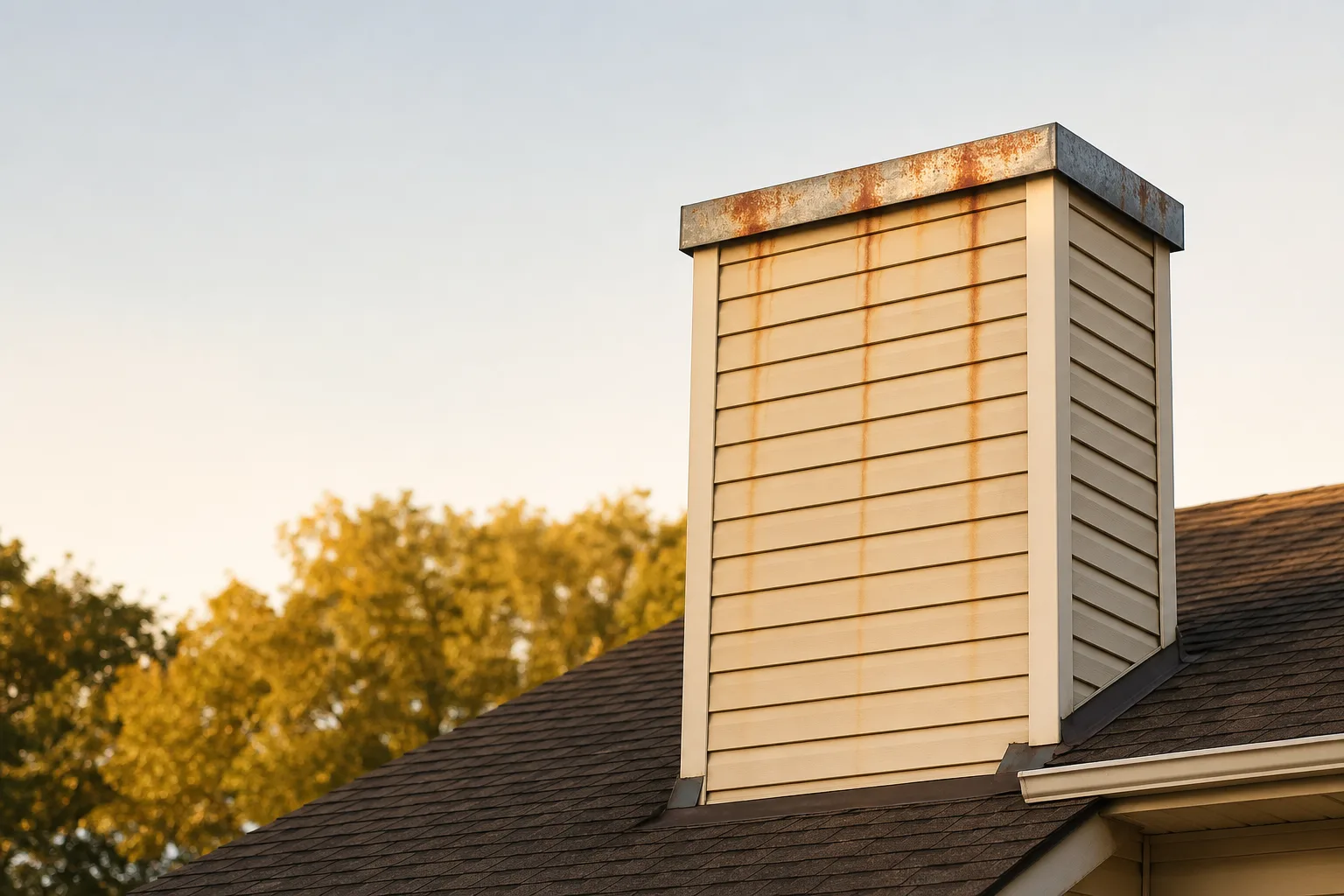
You noticed them from the driveway. Two or three rust-colored stripes running down the siding of that tall boxy chimney on the side of your house, starting right at the top and bleeding downward like something up there is melting.
They were not there last year. Or maybe they were, faintly, and you told yourself it was dirt.
It may not be dirt. Streaks like that commonly trace back to the flat metal pan capping the top of that box, and chimney chase covers are the part of a chimney that nobody thinks about until something starts writing on the siding. An inspection is what confirms it, but this is the first place to look.
Here is what this page will do. By the end you will know what chimney chase covers are, why yours failed, whether it can be patched or has to go, and what a correct replacement actually includes.
That last part matters more than you would guess. It is the difference between reading a quote and being handed one.
What chimney chase covers actually are (and what they are not)
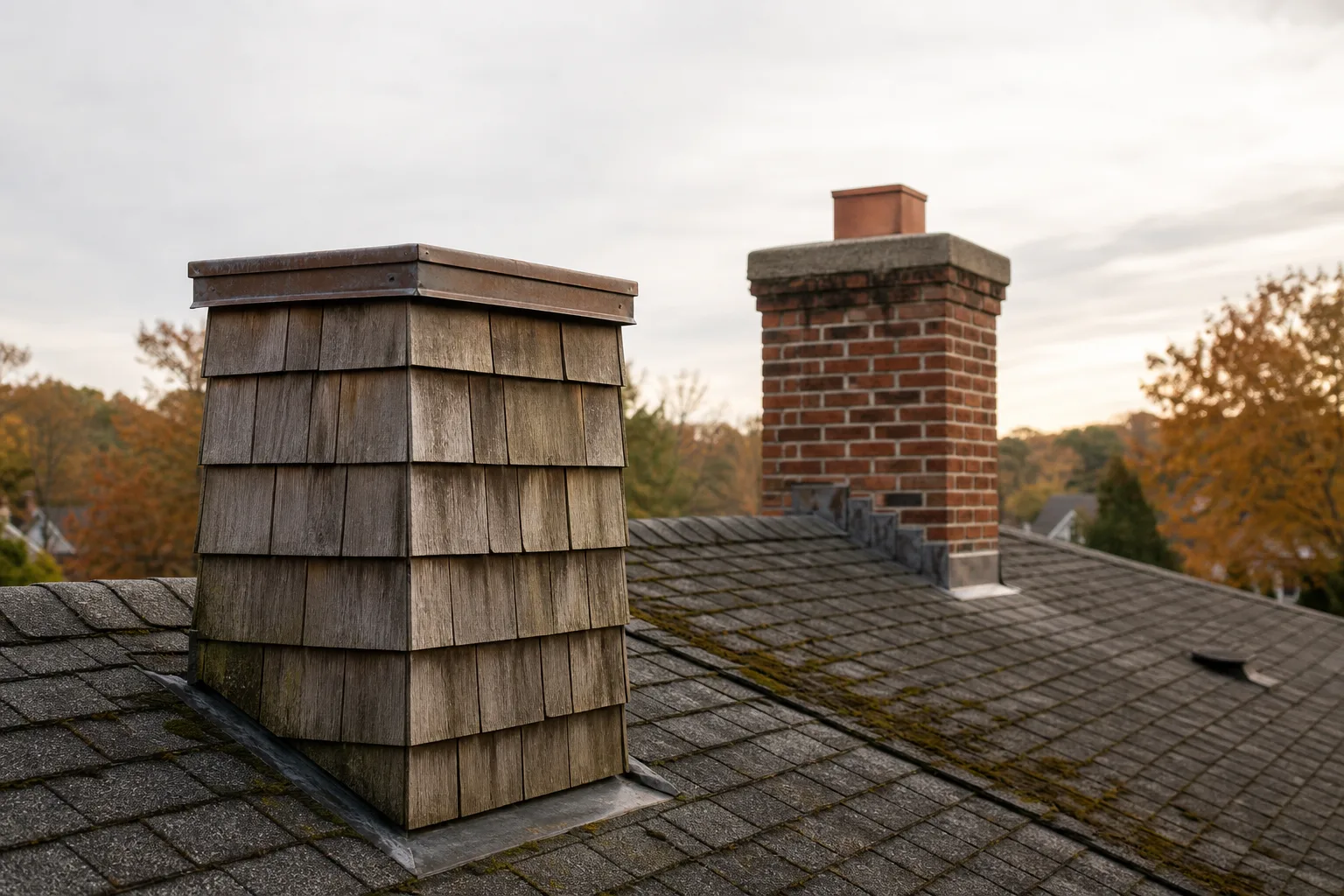
If your fireplace is factory-built, which is common on homes built from the 1980s onward, then your chimney is not a stack of bricks. It is a wood-framed box. Builders call it a chase.
The chase gets clad in whatever the rest of the house is wearing, vinyl siding, cedar shake, board and batten, brick veneer, stucco. Inside it, a round metal flue pipe runs from the top of the firebox straight up and out the top.
Something has to close off the top of that box so weather stays out. That something is the chase cover: a metal pan sized to the footprint of the chase, with a hole cut in it for the flue pipe to pass through.
That is the whole job. Chimney chase covers are the roof of your chimney. Everything below them, the framing, the insulation, the pipe, the firebox, depends on that one piece of sheet metal shedding water for years without complaint.
Chase cover vs chimney cap
This is where most of the confusion in this subject lives, and it costs people money.
The chimney cap is the small hood sitting above the flue opening, usually on short legs with mesh sides that double as a spark arrestor, keeping rain and birds out of the pipe itself. It is maybe a foot across.
The chase cover is the full pan underneath it, spanning the entire top of the chase. On a wide chimney that can be three feet square or larger.
Different parts, different prices, different problems. A cap can be fine while the cover beneath it is rotting away.
Good to know: Plenty of quotes use "cap" and "cover" loosely, and some use them interchangeably. Before you compare two prices, ask each company which part it is pricing and whether the other one is included. You may be comparing a hood to a pan.
Chase cover vs masonry crown
If your chimney is real brick, top to bottom, you do not have a chase cover. You have a crown, which is a sloped slab of concrete or mortar poured across the top of the brickwork.
Crowns crack. Covers rust. The symptoms overlap enough that people search for the wrong part all the time, and a cracked crown belongs in a conversation about brick chimney repair instead of this one.
Quick test from the ground: look for mortar joints. Brick coursing and mortar lines mean masonry and a crown. Siding, shake, or stucco on a squared-off box means a chase and a chase cover.
The anatomy of the pan on top of your chimney
Six words will let you hold your own in a conversation with a contractor. Learn them and the whole subject stops being intimidating.
Chimney chase covers are built from the same handful of features no matter who fabricates them, so this vocabulary travels, and it lines up with the rest of the chimney parts sitting above your firebox.
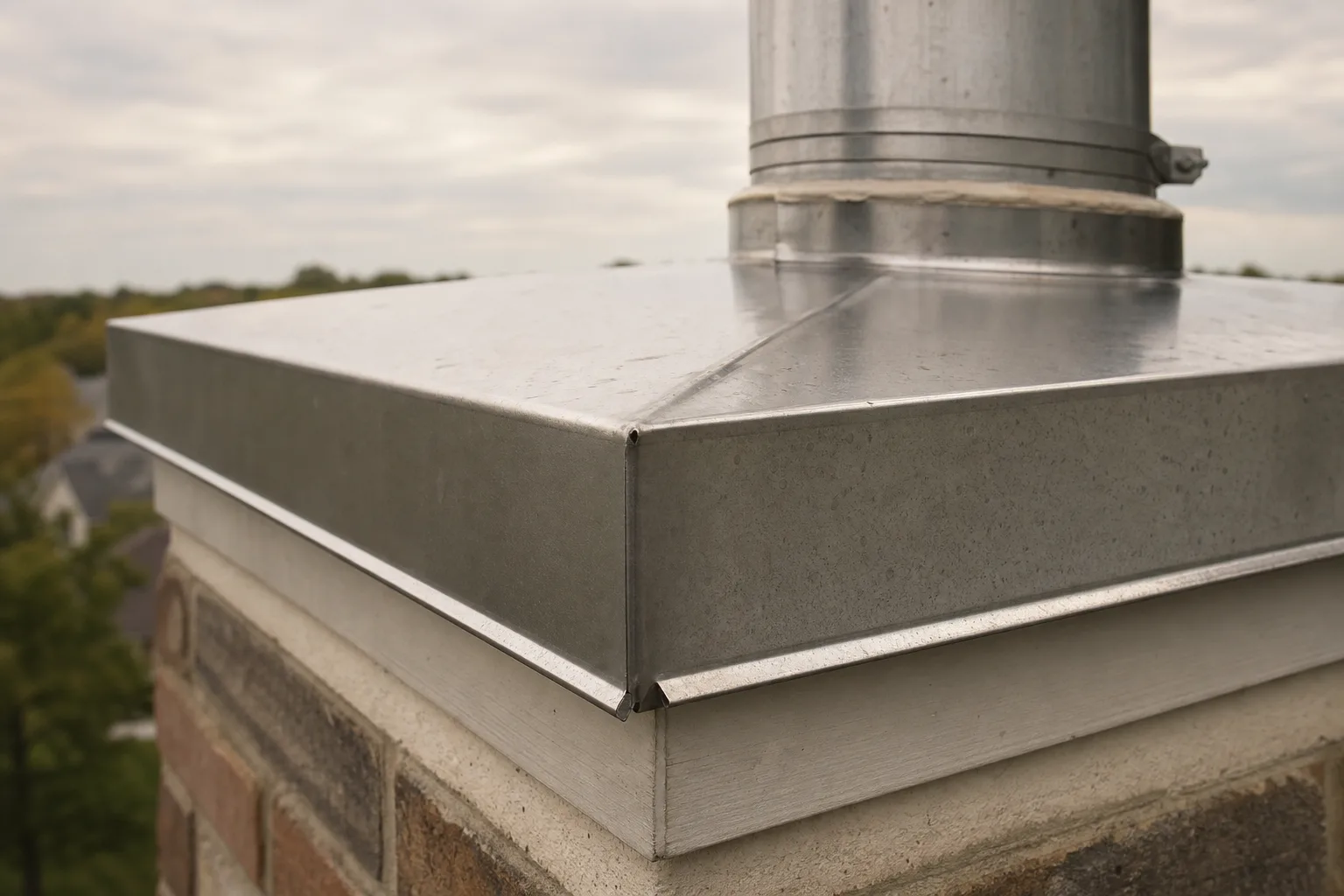
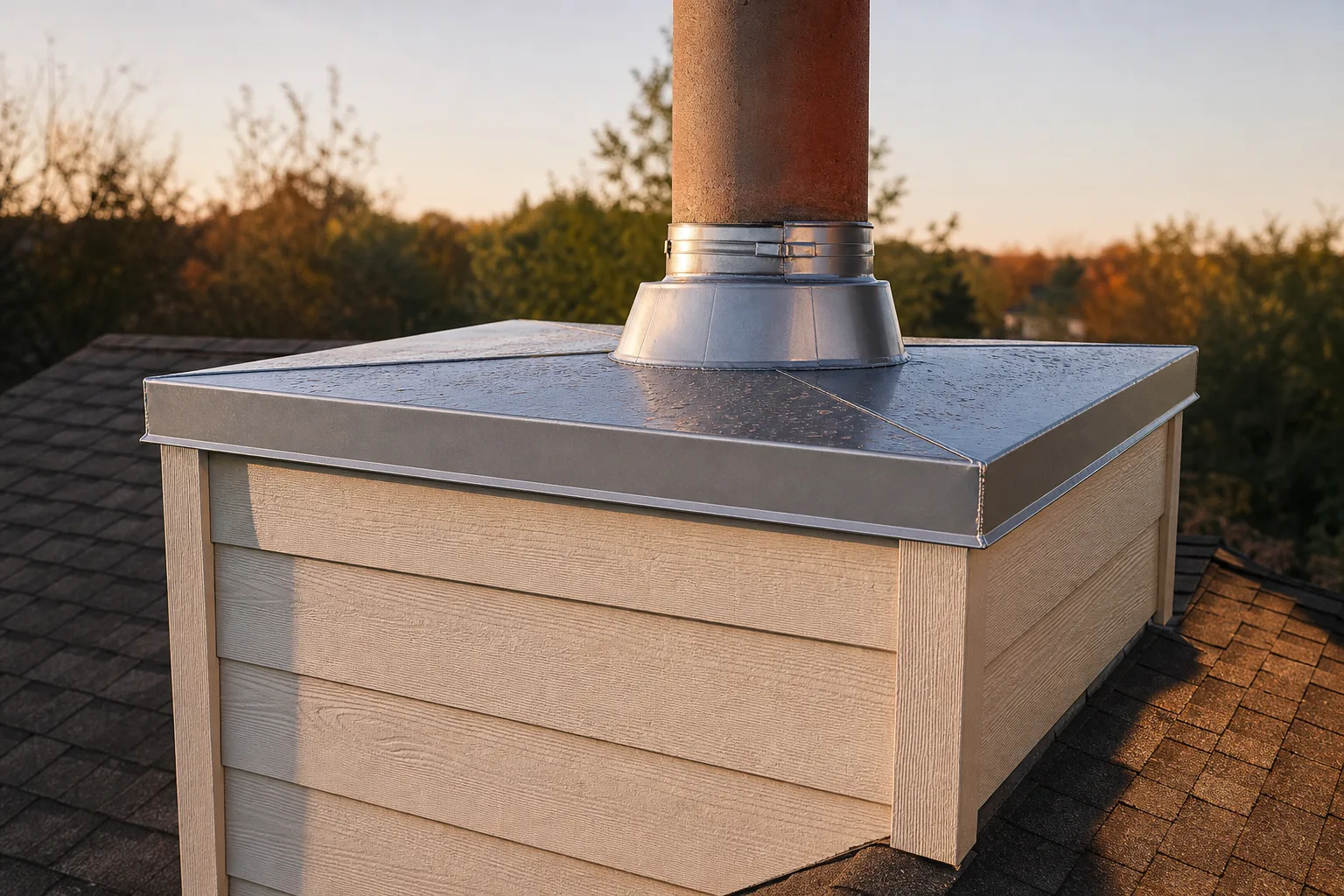
The pan. The flat top surface itself, cut to your chase dimensions.
The skirt. The vertical lip that hangs down over the top edge of the siding on all four sides. Suppliers offer two, three, and four inches, and three inches is generally described as the industry standard.
The drip edge. A small outward fold at the bottom of the skirt. Its whole purpose is to fling runoff clear of the wall instead of letting it run down the siding.
Cross breaks. Shallow diagonal creases pressed corner to corner across the pan, forming a soft X. They are subtle, easy to miss from the ground, and they are the single most important feature on the entire part. They create slope. Slope means water leaves.
The center hole and collar. The opening the flue pipe passes through, with a short raised lip around it so water does not run straight down into the hole.
The storm collar. A separate metal band that clamps around the flue pipe just above the cover, sealed at its top edge, closing the gap between pipe and pan.
That is it. A pan, a skirt, an edge, some creases, a hole, and a band. Nothing exotic, which is exactly why a bad one is so frustrating to look at.
Why chase covers fail, and why age is not the real answer
Ask most people why their chase cover rusted through and they will say it was old.
Age is a symptom. Drainage is the cause.
Chimney chase covers with real slope and the right metal age slowly. A flat one holds water, and holding water is what shortens its life. Same weather, same house, different outcome, and much of the difference was decided the day the pan was made.
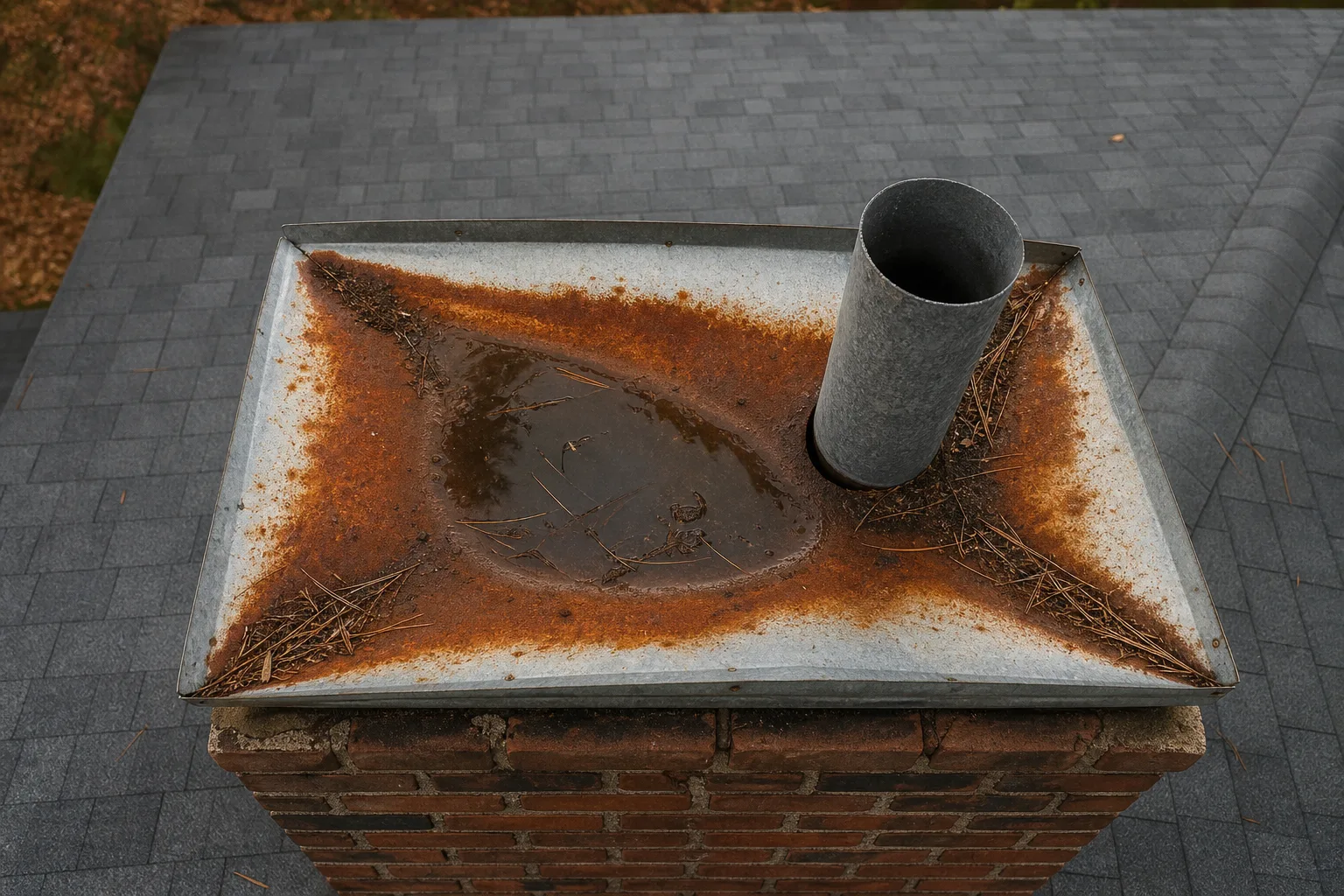
Standing water on a flat or sagging pan
This is the big one. When a cover is installed flat, or when thin steel dishes downward in the middle over time, rain does not run off. It sits.
A puddle that never fully dries is a chemistry experiment running against the metal twenty-four hours a day. Galvanized steel loses that fight. The zinc coating gives up first in the standing-water zone, then the steel underneath goes.
Which is why the rust on a failed pan blooms outward from the center, not inward from the edges. It is the opposite of what you would expect from weather.
Then winter arrives and the puddle freezes. Ice expands, works at any seam it can find, and thaws. In a cold climate that cycle repeats through the season.
The wrong metal for the job
A lot of chases got capped at original construction with the cheapest steel that would do the job on the day the builder was closing out the house.
Galvanized covers are commonly cited as lasting somewhere in the range of five to fifteen years, depending on climate and how well the pan drains. On a house that is thirty years old, that math has already run twice.
From the field: A rusted cover tends to tell its own story, and the order of the damage is the tell. A dull ring in the middle where water stood, rust blooming outward from that ring, then streaks starting at the low corner where the puddle finally spilled over the edge. When the damage reads that way, weather did not attack the pan from outside. It sat on top and waited.
A pan that does not overhang far enough
The skirt and drip edge exist to move water away from the wall. When the skirt is too short, or the pan was cut a little tight to the chase, runoff hugs the siding on its way down instead of dropping clear.
That is how you get streaking on the siding even from a cover that is not badly rusted yet. It is also how the top course of siding gets soft.
A failed storm collar
The storm collar is small, cheap, and responsible for the one gap the pan cannot close by itself.
Its sealant bead dries out, cracks, and separates from the pipe. Now water runs down the outside of the flue pipe, reaches the collar, finds the crack, and goes straight through the hole in your chase cover into the framed box below.
A cover in decent shape with a shot storm collar leaks like a cover with a hole in it. Same result, much smaller repair, and a good inspection catches which one you have.
And that brings up the part nobody tells you at the start. The pan is not the expensive problem. The framing under it is.
Water that gets past the cover lands on wood. Water intrusion is the leading cause of rot in prefabricated chimney chases, and prolonged intrusion rots framing and creates the conditions for mold. The sheet metal on top is inexpensive relative to what it protects. That is the entire argument for dealing with it early.
Repair or replace: how to tell where yours sits
Somewhere in the search for a cheaper answer, most homeowners land on the same idea: what if we just seal it?
It is a fair question and it deserves a straight answer instead of a scare.
Sealant over a surface-rusted pan that is still solid can buy time. Sealant over rust-through does not restore metal. It bridges a hole with a flexible film, and that film sits in the exact spot where water pools, moves with every freeze and thaw, and eventually fails in the least visible way possible: slowly, under a layer of black goop that hides how bad the metal underneath has gotten.
So the useful question is not "can it be sealed." It is "is this pan still metal where it needs to be."
Plenty of chimney chase covers get sealed after they have already answered that question. The homeowner just has not heard it yet.
Rough guide to which side you are on:
- Surface discoloration, no soft spots, pan still holds its shape. Often maintainable, and worth re-evaluating annually.
- Rust bloom in the center with a visible dish or sag. The sag will not go away, so the water will not go away. This one is on a clock.
- Pinholes, flaking layers, or daylight through the pan. Replace.
- Already patched once with roof cement. Replace, and have someone look at the framing while the pan is off.
- Cover looks decent but you have an active leak. Check the storm collar and the flashing where the chase meets the roof before you buy anything.
There is also the case where a sound cover is simply the wrong size, sitting tight against the chase with no real overhang. No amount of sealant fixes geometry.
Safety note: Please do not go up to look at this yourself. It is roof work at height, often on a pitch, and the structure you would be leaning on may be exactly the wet framing you are worried about. Judge what you can from the ground with binoculars or a zoomed-in phone photo, and let somebody with fall protection make the call from the top.
Not sure which side of the line yours falls on? You can see the rust from the driveway. You cannot judge the pan from there. Tell us what you are seeing and we will connect you with a local chimney company that will measure your chase and tell you what it needs. Call (513) 655-6702 or request service online.
What chimney chase covers are made of, and which metal to pick
Once you are replacing, you get a choice that the original builder probably did not agonize over. Take it seriously, because you are picking how long you go before having this conversation again.
What chimney chase covers are made of
The market runs on four materials, plus a couple of specialty finishes.
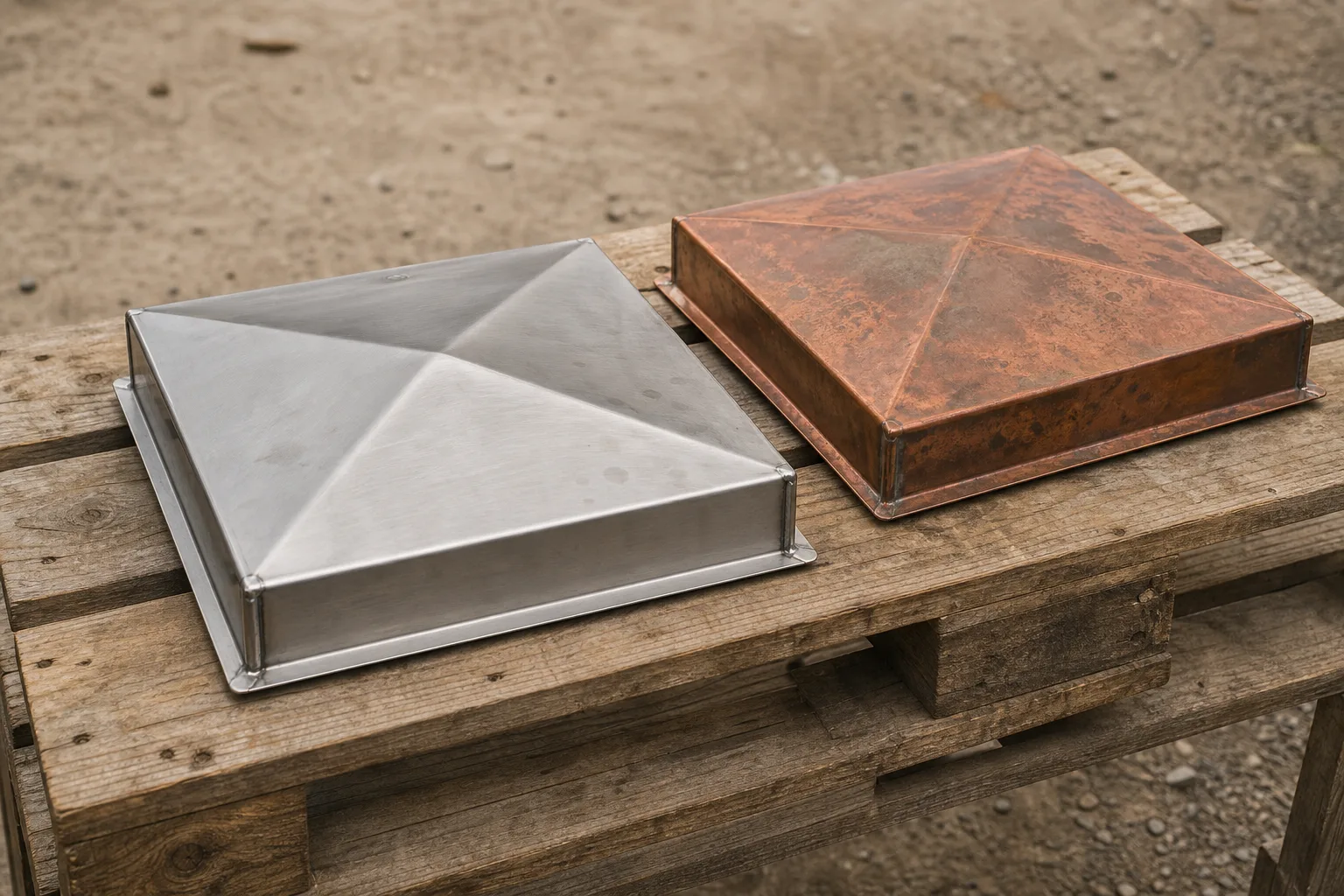
Galvanized steel is the budget option and the one most commonly found failing on older chases. Aluminum sits above it. Stainless steel, specifically 304, is the workhorse replacement. Copper is the premium choice, with lead-coated copper and a gray-finished copper called Freedom Gray available for people matching a specific look.
Thickness is described by gauge, and lower numbers mean thicker metal. Suppliers list 24, 22, and 20 gauge for stainless fabrication, and they do not agree on a single standard, so ask what you are being quoted rather than assuming.
| Material | How it holds up | Relative cost | Best suited to |
|---|---|---|---|
| Galvanized steel | Rusts once the coating wears, especially where water stands. Commonly cited at five to fifteen years | Lowest | Almost nobody replacing a cover on purpose |
| Aluminum | Does not rust like steel, but it is soft and dents, and thin gauges can oil-can and lose slope | Low to moderate | Mild climates, tight budgets, well-sloped installs |
| 304 stainless steel | The default replacement. Resists rust well, holds its shape in a heavier gauge, handles freeze-thaw | Moderate | Most homes, most climates |
| Copper | Weathers from bright salmon to brown to green patina, and does not rust | Highest | Visible chimneys, historic or high-end exteriors |
| Lead-coated copper / Freedom Gray | Copper performance with a muted gray finish that does not turn green | Highest | Matching a specific architectural palette |
How to choose for your climate and your chase
If you get real winters, weight matters more than material romance. A heavier gauge stainless pan with proper cross breaks resists the slow dishing that starts the whole problem over again.
Freeze-thaw is the test that separates good chimney chase covers from cheap ones, and in a cold climate it runs all winter.
If you are within reach of salt air, tell the fabricator. Coastal exposure is harder on every metal, and it changes the conversation about cut edges and fasteners.
If the chimney is visible from the street and you care how it looks, copper is a legitimate choice and not just a splurge. It is also the one material that gets better looking as it ages.
And if your chase is unusually wide, ask about gauge specifically. Big flat spans need more stiffness to keep their slope.
Myth vs. fact: You will hear "stainless steel never rusts," probably from someone selling you one. Fact: 304 stainless resists rust far better than galvanized and will not rust through the way a galvanized pan does, but it is not immune. Cut edges, coastal salt air, and contact with dissimilar metals all matter. "Resists rust" is the honest phrase, and a good fabricator will use it.
What a proper chase cover replacement includes
Here is the checklist I promised you. This is the part that turns a quote from a mystery into a document you can actually evaluate.
Chimney chase covers are custom parts, so there is no model number to look up and compare. The specification is the product. A replacement done right includes all of this:
- One-piece construction. The pan is fabricated from a single sheet, not assembled from panels seamed across the top where water sits.
- Welded corners, not riveted or caulked ones. Rivets and sealant at the corners are future leaks. Welded corners are the corner detail you want.
- Cross breaks pressed into the pan. Non-negotiable. Without slope, the new cover starts down the same road as the old one.
- A skirt of adequate depth. Three inches is the commonly cited standard, and it should overlap the top of the siding properly on all four sides.
- A drip edge along the bottom of the skirt. Small fold, big difference in whether your siding stains again.
- The collar sized and located to your flue. Measured on your chase, not assumed. The hole is often offset rather than dead center.
- A new storm collar and fresh sealant. Reusing the old one to save a small amount is how a new cover leaks in its first year.
- An inspection of the framing under the old pan. With the cover off, someone can see whether the wood beneath is dry or has been drinking for years. This is the moment to find out.
- Site measurements, taken by the person doing the work. Chase length, chase width, distance from the edges to each flue pipe, and skirt height.
Anything missing from that list is a fair question to ask, not an accusation. Good companies answer it happily because it is what separates them from the person with a roll of flashing and a caulk gun.
Pro tip: Ask for the measurements the fabricator used, in writing, before the pan is ordered. These are custom parts. A number that is off by an inch produces a cover that either will not seat or sits with no overhang, and you will not find out until installation day when the crane of goodwill has already left.
One more thing worth knowing. If the framing under the old cover turns out to be wet or soft, that is carpentry, and it is a separate scope of work from the metal. Nobody can price it before they see it, and a company that tells you otherwise is guessing.
What replacing chimney chase covers costs, and what moves the number
The honest answer is that there is no national price for chimney chase covers, and the cost guides you will find online do not agree with each other.
That is not evasion, it is the nature of the part. These are custom metal plus roof labor, and both halves swing with your specific chase. What you can do is understand the drivers well enough to know why one quote differs from another.
What actually moves your number:
- Size of the chase. More square footage, more metal, more weight to handle on a roof.
- Material and gauge. Copper costs more than stainless. Heavier gauge costs more than lighter.
- Number of flue holes. Some chases need one hole, others need two or three, and every additional hole is another cut and another collar.
- Roof access and pitch. A steep roof, a tall chase, or a chimney you can only reach over a second story changes the labor and the equipment.
- What is found underneath. Dry framing is a straightforward swap. Rotted framing is a different job.
Good to know: When one quote comes in far under the others, the gap is often a difference in product rather than a difference in value. Thinner metal, a seamed pan, no cross breaks, or the old storm collar going back on. Ask what gauge, whether the corners are welded, and whether cross breaks and a new storm collar are included, then compare the quotes on those answers instead of on the number.
Whatever number you land on, get it in writing before anyone starts, with the material and gauge named on the page.
How VIO helps with chimney chase covers
VIO is a referral service. We do not perform chimney work. We connect homeowners with independent local chimney companies, and the work is performed by those companies, not by VIO.
For this exact situation, that means you do not have to cold-call names off a map and hope one of them actually does chase work on factory-built chimneys, which is a different specialty from masonry repair. It is the same reason people end up sorting through general chimney service listings for hours and still not knowing who to trust.
Tell us what you are seeing from the ground, the streaks, the age of the house, the kind of siding on the chase, whether there is water showing up inside. We match you with a local company that handles chimney chase covers on prefabricated systems and can get up there safely to measure and assess.
We ask every company in the network to put its estimate in writing before any work starts, and you should insist on exactly that. A written scope with the material, the gauge, and the corner detail spelled out is your protection, and it is a reasonable thing to require from anyone working on your house.
One related note while you have somebody up there. NFPA 211 calls for a Level 2 inspection at the sale or transfer of a property, when the system changes, after a malfunction, after a chimney fire, and after an external event like a major storm. If any of those describe your situation, it is worth scheduling the inspection at the same time as the cover assessment rather than paying for two trips.
Ready to get your chase cover looked at? VIO connects you with independent chimney companies in your area. They do the work, we make the introduction. We ask every company in the network to put its estimate in writing before any work starts, and you should insist on exactly that. Call (513) 655-6702.
Symptom checker
What is your chimney doing?
Tap the closest match for an honest first answer.