



On this pageWhat Fireplace Gloves Actually Are (and What They Are Not)7 sections+6
- What Fireplace Gloves Actually Are (and What They Are Not)
- What the Heat Rating on Fireplace Gloves Really Means
- Two Different Jobs, Two Different Gloves
- How to Choose Fireplace Gloves: Length, Material, and Fit
- What Goes First: How Fireplace Gloves Fail
- What Fireplace Gloves Cannot Protect You From
- How VIO Helps With the Part Fireplace Gloves Cannot Reach
Quick answer
Fireplace gloves are fire-resistant leather or suede gauntlets, usually 14 to 16 inches long, that protect the hands and forearms when tending a hearth or wood stove. The heat rating printed on them comes from a laboratory contact-heat test measured in seconds, and both EN 407 and ASTM F1060 require a 15-second minimum. A temperature with no time attached tells you nothing about what you can safely hold.
Shop for fireplace gloves and the same number keeps coming back. Seller claims cluster at 932°F, sometimes 930°F, which is the same figure rounded differently.
That number is not invented. It traces back to a real laboratory test.
It also does not mean you can pick up something that is 932 degrees, and the tag will never tell you why.
Here is the piece that gets left off: every contact-heat standard that produces a figure like that measures seconds alongside degrees. Take the seconds away and what is left is marketing.
So this guide covers what actually decides whether a pair of fireplace gloves is right for your hearth. What the rating means. Which of two very different jobs you are buying for. What wears out first. And the one hazard no glove protects you from, which is the reason this article exists at all.
We will get to the number. Start with what these things are.
What Fireplace Gloves Actually Are (and What They Are Not)
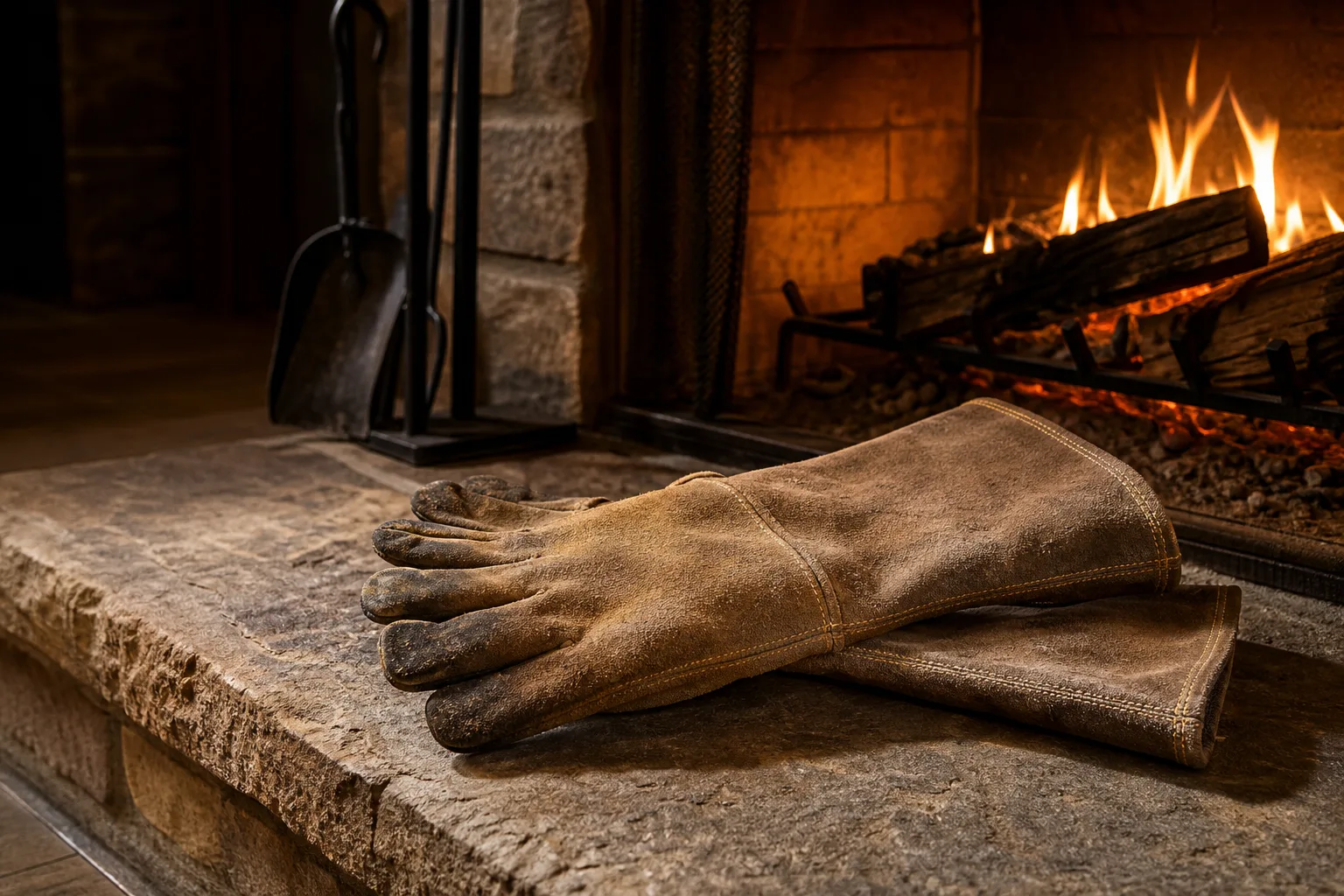
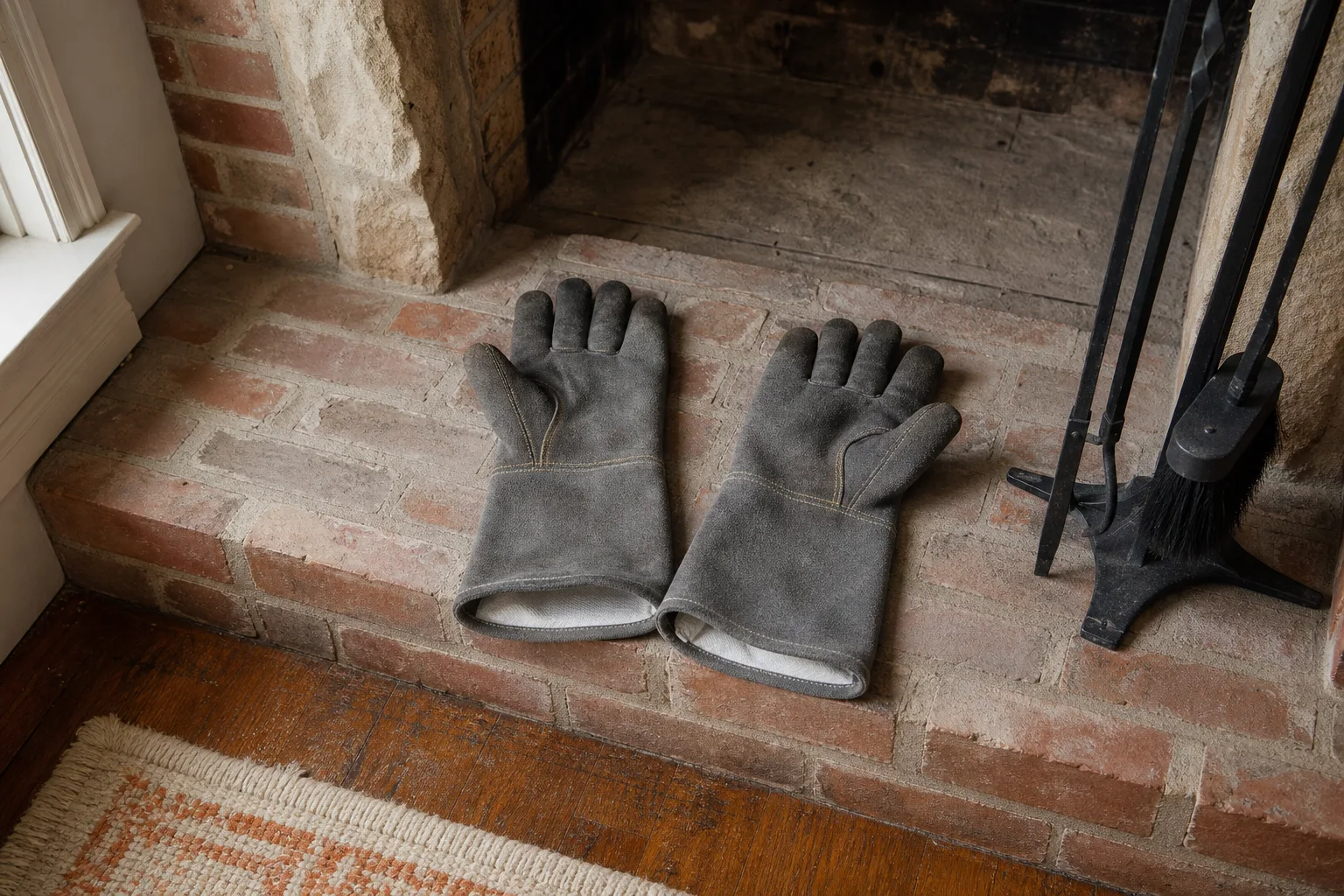
A hearth glove is a thick leather or suede gauntlet, usually tan, brown, grey or black, running 14 to 16 inches from fingertip to cuff edge. The cuff flares wide so it slides over a sleeve and covers most of the forearm.
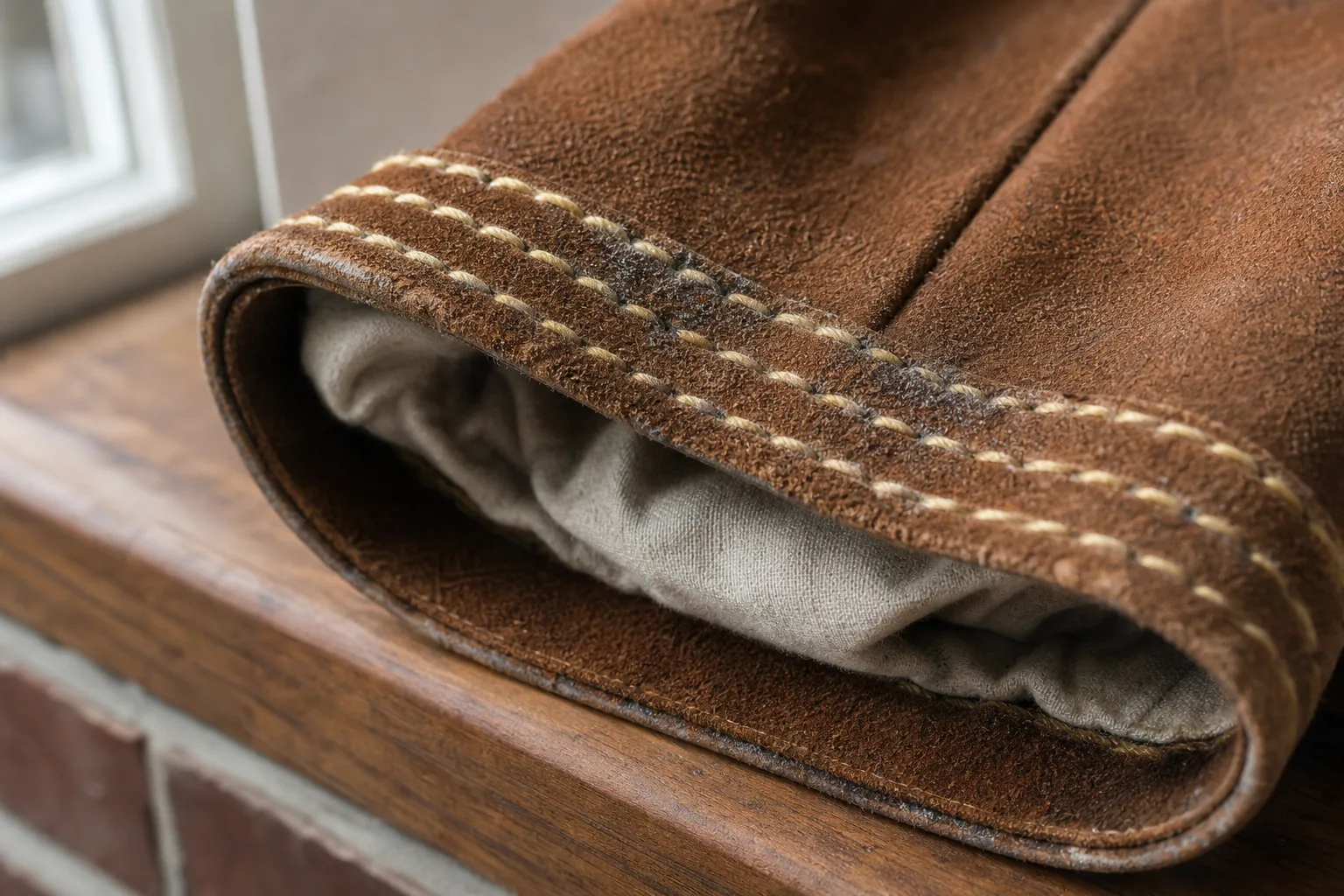
Look closely at a good pair and you will see heavy double rows of topstitching, often in a contrasting gold thread. Inside, a soft cotton liner. Some heavier models add a third layer between the two: an insulating aluminized sheet sandwiched between the leather shell and the lining.
They are sold everywhere. General retailers stock them next to the log carriers, and hearth-trade suppliers stock them next to the chimney brushes and the flue tools. Which aisle a pair came from tells you less than the material description on the back of the tag.
Fire resistant, not fireproof
No consumer hearth glove is fireproof. That word gets used loosely in product copy and it is wrong.
Fire resistant means the material will not readily ignite and will slow the transfer of heat to your skin for a defined stretch of time. It buys you seconds. Seconds are enough, if you know how many you have.
Where the aramid fiber actually is
Plenty of listings put a branded aramid fiber in the product title. What that fiber is usually doing is holding the seams together.
Aramid shows up in hearth gloves in three different roles, and they are not equivalent. It can be the stitching. It can be a knit liner inside the leather. Occasionally, in industrial gloves, it is the shell itself. A leather glove sewn with aramid thread is a good thing to own. It is not an aramid glove.
Myth vs. fact: When a brand-name aramid fiber appears in a fireplace gloves listing, it most often refers to the stitching rather than the body of the glove. That is genuinely useful, because thread is the first thing that burns through, but it is not the same as a shell made of aramid. Read the material description, not the product name.
What the Heat Rating on Fireplace Gloves Really Means
Now the number.
Contact heat is tested by pressing a glove sample against a heated plate and timing how long it takes the inside surface to get hot enough to cause a second-degree burn. That is the whole idea. A temperature, and a clock.
The standards behind the number
Three standards do this work, and they do it differently.
EN 407 is the international standard for glove protection against heat and flame. It is built from six separate tests, each graded from 0 to 4, and contact heat is one of them. Samples run against plates heated across a range from 100°C to 500°C, and to pass a given level the glove has to hold off a second-degree burn for a minimum of 15 seconds at that temperature. Level 1, the entry point, covers 100°C, which is 212°F.
ASTM F1060 is the North American contact-heat test method. It tops out lower, around 320°C, but it asks more of the glove: it requires both a time to pain and a time to second-degree burn, so the result tells you when you would flinch as well as when you would be injured.
ANSI/ISEA 105 is the broader North American classification for hand protection, covering mechanical, chemical, heat, vibration and dexterity properties. Its current edition is the 2024 revision, though plenty of packaging still in circulation carries the older 2016 markings. Under its approach, a glove at contact-heat Level 2 handles a surface up to 140°C, or 284°F, for at least 15 seconds before a second-degree burn becomes likely, with at least 4 seconds of warning time before it starts to hurt.
Notice what all three have in common. Not one of them reports a temperature by itself.
Why 932°F keeps coming back
Do the conversion. 500°C is 932°F, and 500°C is the top of the EN 407 contact-heat plate range.
So the figure sellers keep quoting lines up exactly with the ceiling of the test apparatus, converted to Fahrenheit. What a hangtag carrying that number does not tell you is whether the glove in your hand was tested against that plate at all, what level it reached, or for how long it held. A number printed on packaging is a claim. A rating is a test result. They are not the same document.
Good to know: 932°F is not a promise about your hands. It is the highest plate temperature the test uses, and passing a contact-heat level means the sample held off a second-degree burn for at least fifteen seconds in a laboratory. That is a minimum threshold for a test result, not a protection period you can lean on at the hearth. Fifteen seconds is a long time when you are grabbing a handle. It is no time at all when you are holding one.
What the lab test leaves out
This is not a criticism I invented. The testing houses say it themselves: these are laboratory procedures and they do not represent real-life applications.
What they exclude is everything that makes real contact different from a flat plate. The size of the object. Its weight, which decides how hard you have to grip. Its shape, which decides how much of your palm is touching it. Whether it is wet. And how long you actually hold on, which in practice is however long it takes you to realize you should let go.
A cast-iron door handle at 500°F, gripped hard because the door is stuck, is a harder test than any plate.
Two Different Jobs, Two Different Gloves
Here is a split the product listings rarely make. Handling wood and gripping hot metal are not the same hazard, and they do not reward the same glove.
Handling wood and tending the fire
Carrying split logs is mostly an abrasion problem. Bark scrapes, splinters, the occasional spark that lands on your forearm while you are feeding the firebox. Heat exposure is brief and glancing.
What you want here is coverage and toughness. A long cuff, a hide thick enough that a splinter does not find you, and enough flexibility that you can actually grip a log without fumbling it onto your foot.
Gripping hot metal
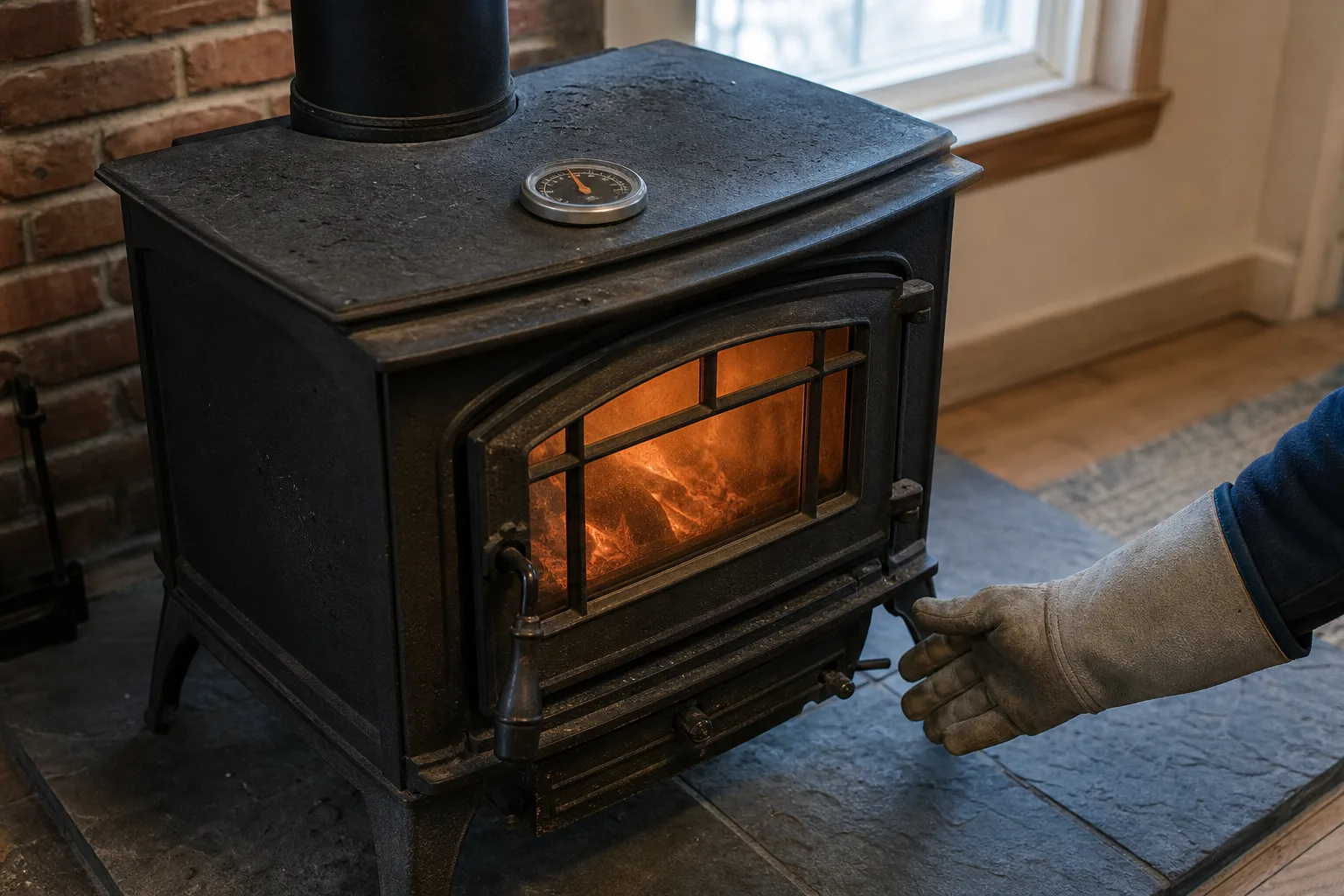
Sustained conduction is a different animal entirely. A wood stove running properly sits somewhere between 300°F and 600°F on its exterior surfaces, and the glass door reaches temperatures close to the same range. The door handle, the air control, the damper: all of that metal is hot, and when your hand closes around it the heat has a direct path through the palm.
That is where thickness, an insulating middle layer, and a real contact-heat rating start to matter. A glove that is excellent at carrying wood can be genuinely unsafe here.
| The job | What the hazard actually is | What to look for | Where it falls short |
|---|---|---|---|
| Loading and stacking wood | Abrasion, splinters, bark | Thick hide, long cuff, decent flex | Thin dress-style leather tears fast |
| Tending the fire with tools | Radiant heat, sparks, brief contact | 16 inch gauntlet, aramid stitching | Short cuffs leave the forearm bare |
| Gripping a hot handle or damper | Sustained conduction through the palm | Insulating layer, stated contact rating, thick palm | Single-layer suede transmits heat quickly |
| Ash and cleanout work | Fine abrasive dust, warm residue | Snug fit, washable liner, easy to shake out | Loose gauntlets funnel ash up your sleeve |
| Reaching into a live firebox | Radiant heat far beyond any test range | Nothing. Do not do it | No consumer glove is rated for this |
Pro tip: For a lot of hearth work, a good pair of welding gloves does the same job for less money. Leather with an aramid liner is the standard build for MIG welding, and it handles sparks, contact heat and cuts. Where welding gloves fall down is dexterity and cuff shape: they are built for holding a torch steady, not for pinching a small log or working a stiff air control. If your hearth routine is mostly loading and sweeping, they are fine. If it involves fiddly controls, buy the hearth version.
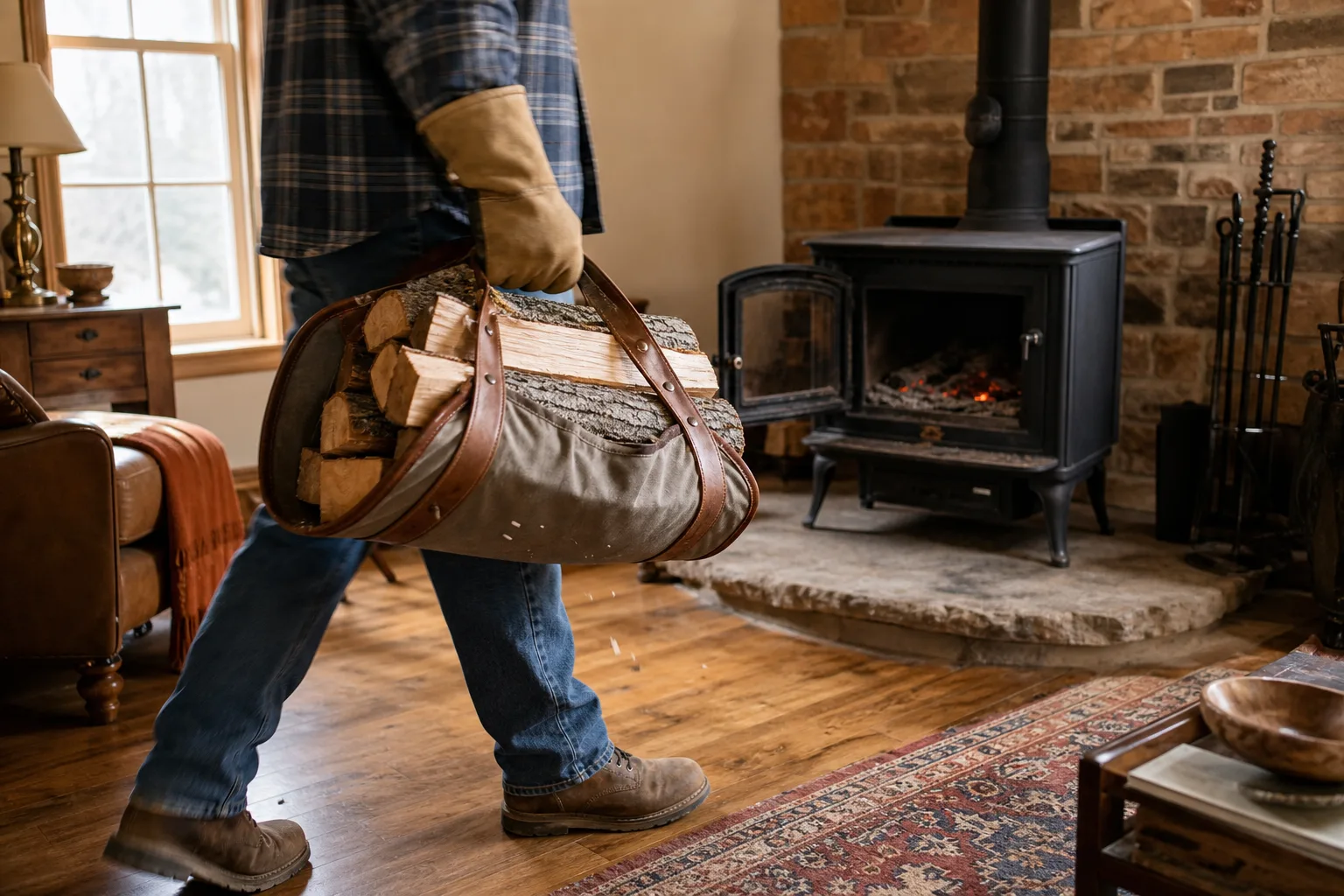
How to Choose Fireplace Gloves: Length, Material, and Fit
Choosing fireplace gloves comes down to three decisions, and only one of them is about heat.
How Long Should Fireplace Gloves Be?
Length is a forearm problem, not a hand problem.
Picture the log that is further back in the firebox than you judged. Your hand reaches it fine. What passes over the coal bed on the way is the underside of your wrist and forearm, and that is bare skin at maybe eight inches from a bed of embers.
The two lengths on the market are 14 inch and 16 inch, measured fingertip to cuff edge. The 16 inch version is sold specifically for wrist and forearm coverage, and on most adults it reaches close to the elbow.
If you have an open masonry fireplace with a deep firebox, take the 16. If you run a small stove and mostly work at the door, 14 is easier to live with and you will actually wear it.
Leather type, and what it costs you in dexterity
Cowhide is firm and tough, and it does not want to bend. Deerskin and goatskin are more flexible but thinner, which is a straight trade: you gain feel, you give up bulk between your skin and the heat.
Suede split leather sits in the middle and is what most hearth gloves are made from.
There is no correct answer here, only an honest one. Thick gloves protect better and drop things more.
Fit, and why "one size fits all" is not a spec
Plenty of fireplace gloves are sold as one size. That is a manufacturing decision, not a protective one.
A gauntlet that is too loose slides on your palm when you grip, which means the insulation shifts off the exact spot taking the heat. Too tight and the liner compresses, and compressed insulation insulates less.
Put your hand in them if you can. Close your fist. If the palm material bunches or slides, keep looking.
From the field: Not every failure here is a rating failure. A pair stiff enough and bulky enough to be annoying is a pair that can end up sitting on the mantel while somebody reaches for a log with a folded towel instead. A glove you will not wear protects nothing.
Before you buy, run this list:
- Cuff length matched to your firebox depth, 16 inch for deep open hearths
- Aramid stitching, visible as heavy contrasting thread at the seams
- A stated contact-heat rating, with the time it applies for, if you intend to grip hot metal
- A liner that is sewn in, not glued
- Palm thick enough that you cannot feel the seam through it
- Flexible enough to close your fist without fighting the leather
- Somewhere near the hearth to hang them, so they are within reach when a log rolls
What Goes First: How Fireplace Gloves Fail
A pair of fireplace gloves rarely dies all at once. It degrades in three predictable ways, and two of them are invisible until the moment they matter.
The stitching goes before the leather
Thread is thinner than hide, and it sits proud of the surface where it takes heat first. Cotton or polyester thread scorches, then parts, and the seam opens along a finger or across the palm.
The leather around it can look perfectly healthy. This is exactly why aramid stitching is worth paying for, and why the thread is the first thing worth checking on a used pair.
Wet leather conducts heat
This one surprises people. Water is a far better conductor of heat than dry leather, so a damp glove moves heat toward your skin faster, and it can flash to steam against your palm.
Gloves used to carry wood off an uncovered stack in the rain are wet gloves, which is one more reason to keep your firewood covered and properly dry. Gloves dried too fast on a hot stove are damaged gloves.
Safety note: Never use damp hearth gloves on hot metal. Set them somewhere warm and airy and let them dry slowly, away from direct heat. Drying leather on the stove top itself cooks it, and cooked leather is the third failure mode.
Cooked leather stiffens and cracks
Repeated heat cycling drives the oils out of the hide. The leather goes hard, then it cracks, usually across the knuckles where it flexes most.
A cracked glove has lost its continuous barrier even if the crack does not go all the way through. Once a pair has gone board-stiff, it has told you what it thinks of another season.
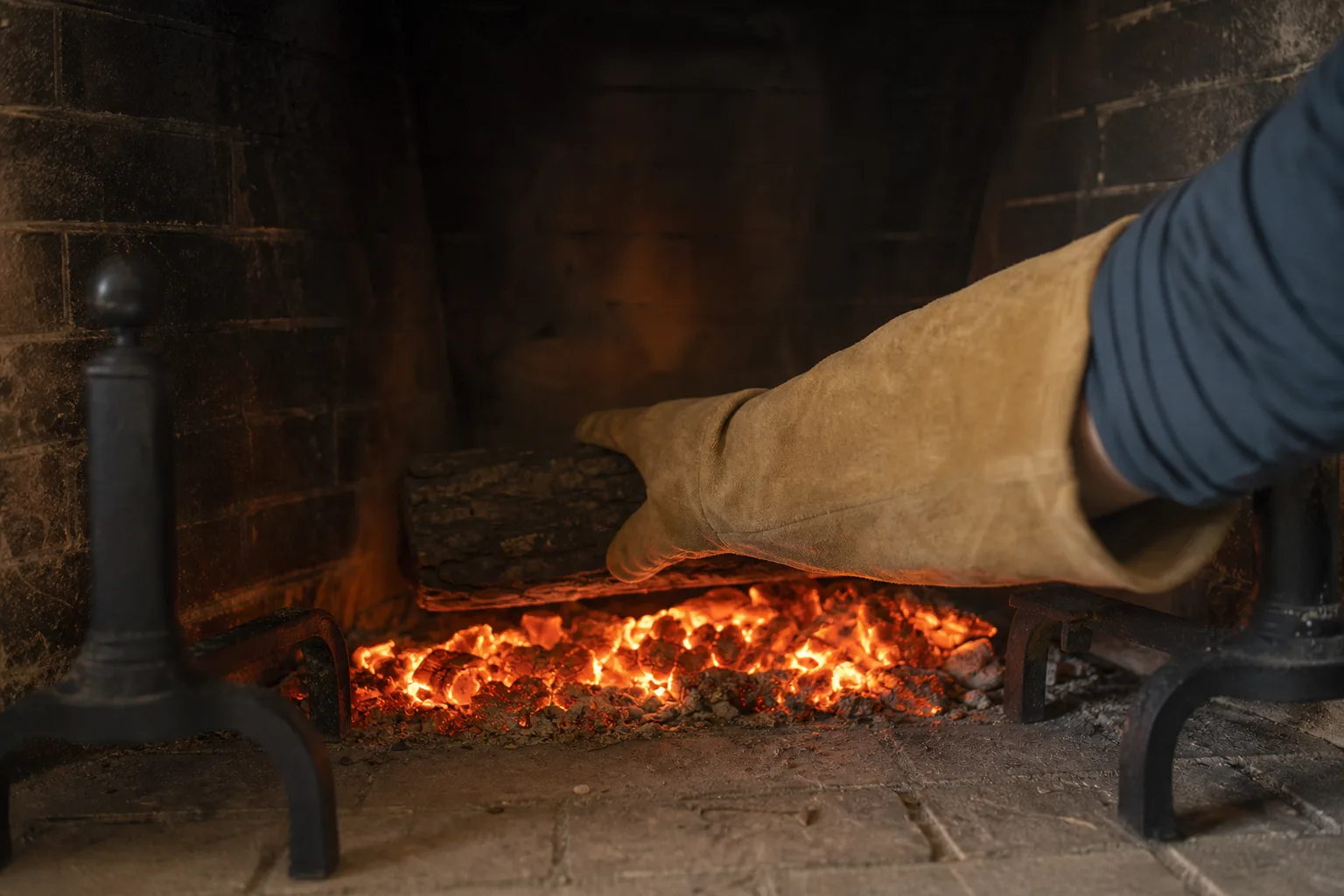
What Fireplace Gloves Cannot Protect You From
Now the honest part, and it is the reason I wanted to write this.
Fireplace gloves protect you from the fire you can see. Inside a firebox burning properly seasoned wood, temperatures commonly reach 1,100°F to 1,500°F. That is past the top of the entire contact-heat test range, which stops at 932°F. There is no consumer glove rated for reaching into a live fire, and any product copy that implies otherwise is selling you something.
So do not use gloves as permission. They are for handling wood, working tools and gripping metal that has cooled to the range a rating actually covers. They are not a reason to put your hand somewhere it should not go.
And then there is the fire you cannot see.
Creosote builds inside a flue every time you burn, and it builds fastest when a stove runs cool, below about 300°F on the surface. A chimney fire starts in that deposit, inside the masonry or the liner, often with no flame visible in the room at all. Nothing you wear on your hands has any bearing on it.
Safety note: NFPA 211 requires a Level 2 chimney inspection at the sale or transfer of a property, on any change to the system such as a new appliance or a different flue material, after a malfunction, after a chimney fire, and after an external event like an earthquake or severe weather. Buying protective gear is not one of the triggers. Selling your house is.
Gloves handle the fire in front of you. The flue behind it is the part that needs eyes on it before the season gets going. VIO connects homeowners with independent chimney companies in their area, and the local company we match you with can tell you what shape that flue is in. Call (513) 655-6702.
How VIO Helps With the Part Fireplace Gloves Cannot Reach
VIO does not sweep chimneys. We are a referral service: we connect homeowners with independent local chimney companies, and those companies do the work.
For the situation this article describes, a homeowner heading into the heating season with a hearth they are equipping and a flue they have not thought about since spring, that usually means one visit. Someone looks at the flue, tells you how much creosote is in there and whether it needs sweeping, checks the cap and the crown, and says whether it is safe to burn.
If it needs work beyond that, ask for the scope in writing before anyone starts. We ask every company in our network to put its estimate in writing before any work starts, and you should insist on exactly that, from us or from anybody else you call.
Buy the fireplace gloves. They are the cheap, easy, correct purchase, and you should own a good pair. Just know what they are actually doing for you, and what is still sitting unchecked above the firebox.
Buy the gloves. Then book the inspection you have been putting off since spring. VIO is a referral service: we connect you with independent local chimney companies, we do not do the work ourselves, and we ask every company in our network to put its estimate in writing before any work starts. You should insist on exactly that. Call (513) 655-6702.
Symptom checker
What is your chimney doing?
Tap the closest match for an honest first answer.