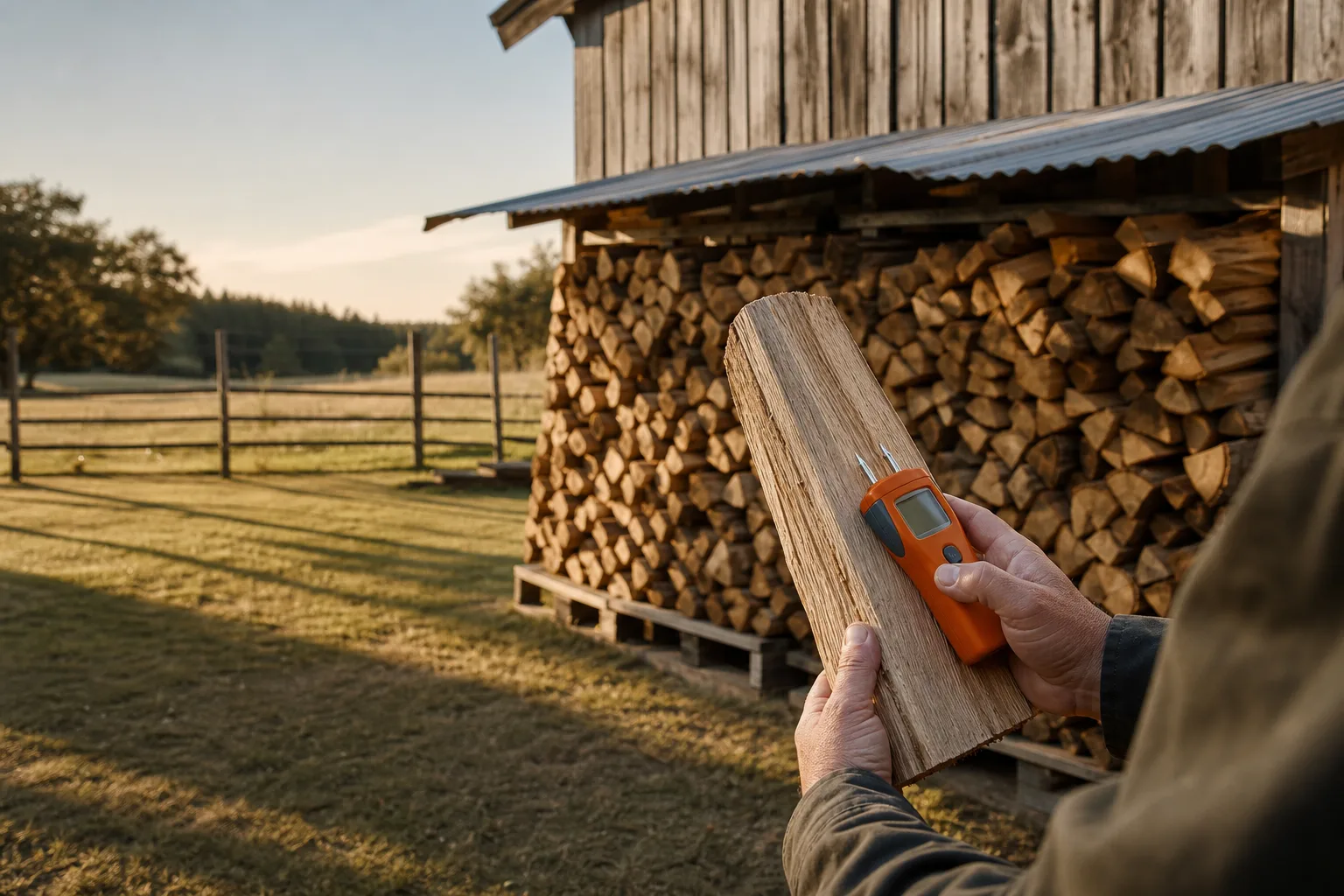




On this pageWhat Your Firewood Moisture Meter Reading Actually Means7 sections+6
- What Your Firewood Moisture Meter Reading Actually Means
- What a Moisture Meter Measures, and Which Type Fits Firewood
- How to Use a Firewood Moisture Meter So the Number Is True
- What Burning Wet Wood Leaves in Your Chimney
- Choosing a Firewood Moisture Meter Worth Owning
- What to Do With Wood That Reads Too Wet
- How VIO Helps With What the Firewood Moisture Meter Cannot Measure
Quick answer
A firewood moisture meter measures how much water is left in your firewood, using two pins pushed into a freshly split face. The US EPA's Burn Wise program says wood should be below 20 percent moisture content before you burn it. Always split the log and read the fresh inner surface, because the weathered outside of a log dries faster than the core and can read far drier than the wood you are actually burning.
You pushed the pins into a log, watched the screen settle, and got a number. Now what?
That is the part almost nobody explains. A firewood moisture meter is cheap to buy and easy to use badly, and the two-digit number on the screen only helps if you know what it means and whether you took the reading correctly.
Most pages about the firewood moisture meter are shopping pages. They will sell you one, rank eight of them, and stop there. Nobody tells you what to do when the meter says 26.
Two things before you scroll. There is a reading that looks perfectly fine and is not. And a meter can be working correctly and still hand you a number that sends you the wrong way.
Both are below, along with the part a chimney company thinks about more than a tool company does: what seasons of wet wood leave behind in the flue, which is the one thing no firewood moisture meter can measure.
What Your Firewood Moisture Meter Reading Actually Means
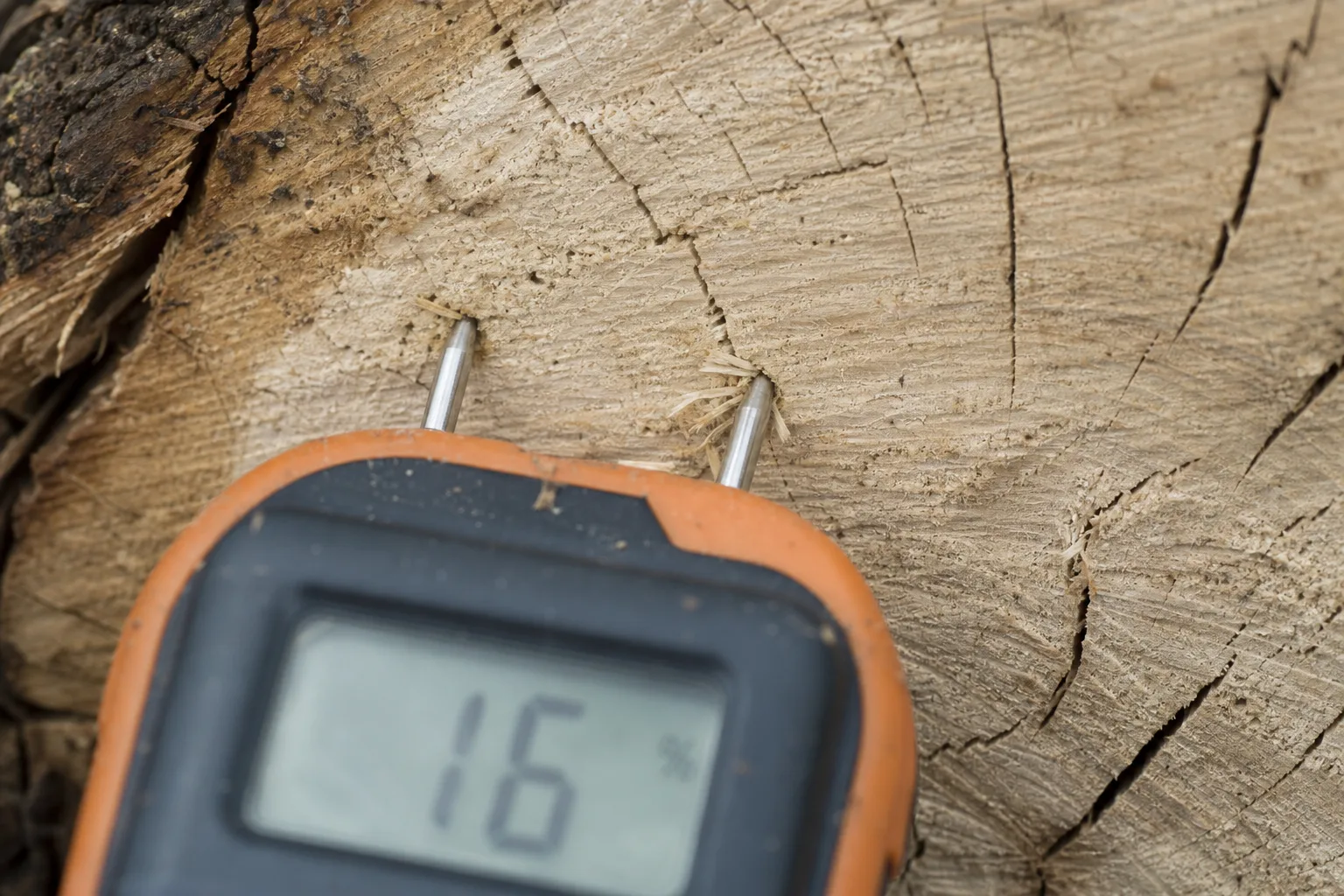
The short version: the US EPA's Burn Wise program says a moisture content of less than 20 percent is best for firewood.
That is the line to hang everything on. Under 20 percent, wood lights easily, burns hot, and gives up most of its energy as heat. Above it, an increasing share of that energy goes into boiling off water instead.
But 19 and 29 are not the same problem, and neither is 22. Here is the practical version.
The reading bands, and what to do about each
Here is how we read those numbers in practice — working guidance for a woodpile, not laboratory bands:
| Your reading | What it means | What to do this week |
|---|---|---|
| Under 15% | Very dry. Usually stored inside or under cover a long time. Tends to light easily and burn fast. | Burn it, but load it like the hot fuel it is. Very dry wood can run away from you in a full firebox. |
| 15% to 20% | The working range. This is what seasoned firewood looks like. | Burn it. Mark which rows these logs came from so you know what is ready. |
| 20% to 25% | Close, not there. Harder lighting, glass that dirties faster. | Move it to your windiest, sunniest row and re-check in a few weeks. Not your main fuel yet. |
| 25% to 30% | Wet. Much of the fire's early energy goes to drying the log instead of heating the room. | Restack it properly and plan around it. Unless it is softwood split small, it is not this winter's wood. |
| Above 30% | Usually freshly cut or soaked, and near the edge of what a pin meter reads reliably, so treat the figure as approximate. | Do not burn it. Split it smaller, stack it correctly, and give it the drying time its species and your climate demand. |
Screenshot that table if it helps. It is the whole decision in one place.
The reading that looks fine and is not
Here is the one I promised.
Take an unsplit round that has sat in the weather for a year, press the pins into the outside, and you may well see something in the teens. Encouraging, and close to meaningless.
The outside of a log dries first, and it dries faster than the core. Wood gives up moisture through its exposed surfaces, so a weathered outer face can be well on its way while the middle is still holding water.
A promising reading taken on that outer face can therefore sit over a core that is nowhere near ready. You load it, it hisses, and you wonder why the meter lied.
It did not lie. It measured exactly what you pointed it at.
Myth vs. fact: You will see "10 to 15 percent is ideal" repeated on retailer pages. The fact is narrower. EPA says under 20 percent, and firewood stored outdoors under cover equilibrates with the air around it. Wood that genuinely sits at 10 to 15 percent typically means very sheltered, warm storage.
What a Moisture Meter Measures, and Which Type Fits Firewood
Now the definition, in the place where it is actually useful.
Moisture content is a ratio, and the pins are reading electricity
Moisture content is expressed as a percentage of the wood's dry weight, not of the log, which is why a freshly felled tree can be startlingly wet.
Your meter does not weigh anything. It passes a small current between two pins, measures the electrical resistance, and converts that resistance to a percentage using a built-in reference.
That conversion is the entire game. Everything that goes wrong with a reading goes wrong there.
Pin meters versus pinless meters for split firewood
Pinless meters press a flat sensor plate against a surface and scan the material underneath. Excellent tools, built for planed lumber and flooring, where the surface is smooth and the reading depth is uniform.
Split firewood is neither smooth nor flat. A torn, fibrous, slightly cupped face is exactly what a pinless meter is worst at.
For firewood, use pins. They read at a depth you choose, in the fresh face you choose, and they do not care that the wood is rough.
Good to know: A pin meter is a useful instrument, not a laboratory. It is at its most dependable across the range that actually matters for firewood, and it gets less dependable at the very wet end, up near the point where the wood fibers are saturated. So treat a high reading as a category rather than a precise figure. It is telling you "very wet," not handing you a number to plan around.
How to Use a Firewood Moisture Meter So the Number Is True
This is the second thing I promised, and it is the section the shopping pages skip.
A firewood moisture meter can be perfectly functional and still hand you a number that sends you the wrong way. Four things cause it, and all four are in your control.
Split it first, read the fresh face
Every accurate reading starts with a maul.
- Split the log. Not last week. Right now, at the pile.
- Wipe the fresh face. Rain, dew or snowmelt sitting on the surface will pull the reading up noticeably, and it takes one pass with a glove.
- Drive the pins across the grain, unless your meter's manual says otherwise. Across the grain is the standard technique for pin meters; orientation changes the reading, so if your manual specifies its own method, the manual wins.
- Push them in a quarter to a half inch. Deep enough to be reading wood, not surface.
- Stay off the knots. Grain around a knot dries at its own rate and gives you a number that represents the knot, not the log.
- Read near the middle of the face, away from the outer edges that dried first.
- Do three logs, from three different parts of the stack. The row against the fence is not the row in the sun.
That is the routine. It takes about two minutes once you have done it twice.
Pro tip: Split your test log at the woodpile, not at the stove. A log that has spent two days in a warm living room next to a running stove is not representative of anything except that spot in your living room.
Cold wood reads low, and warm wood reads high
Wood conducts electricity better when it is warm and worse when it is cold, and your meter is measuring conductance. So temperature moves the answer.
Not a defect, just physics, which is why good pin meters ship with temperature correction charts.
A reading on a frozen January stack and a reading on a sun-warmed August one are not directly comparable. If your meter has a temperature setting or a chart in the manual, that is what it is for. If it has neither, know that readings on wood far from room temperature need correcting, so treat cold-stack numbers as rough and re-check a sample after it has warmed indoors.
Species correction, the setting nobody touches
Different species conduct differently. Oak is not ash is not pine.
That is why most meters have a species setting or a group selector, usually a number you look up in the manual. It lines the meter's reference up with the wood in your hands, and without it, readings drift outside the tight band the meter is capable of.
Almost nobody sets it. Set it, and follow your meter's own instructions for which group your species falls into, because the groupings are not standardized between makers.
From the field: When a reading disagrees with how the fire is actually behaving, check the technique before the tool — a face that was never fresh is a classic culprit. If the wood hisses at the ends, steams, and refuses to catch, believe the fire.
What a firewood moisture meter cannot tell you
It cannot tell you how long the wood needs. It measures where the wood is, not the slope it is on.
It cannot tell you whether the piece you tested represents the stack. That is on your sampling.
And it cannot tell you anything at all about your chimney, which is the next section, and the reason a chimney company wrote this page.
What Burning Wet Wood Leaves in Your Chimney
Here is the mechanism, worth understanding rather than memorizing.
When you put a wet log on the fire, the water in it has to leave before the wood can burn properly. That takes energy, and the only energy available is the fire's own. So the firebox runs cooler than it should.
Cooler combustion is incomplete combustion, which produces smoke, and smoke is unburned fuel in gas form drifting up a flue that is also cooler than it should be.
Cool flue plus unburned fuel equals condensation on the flue wall. That condensate is creosote.
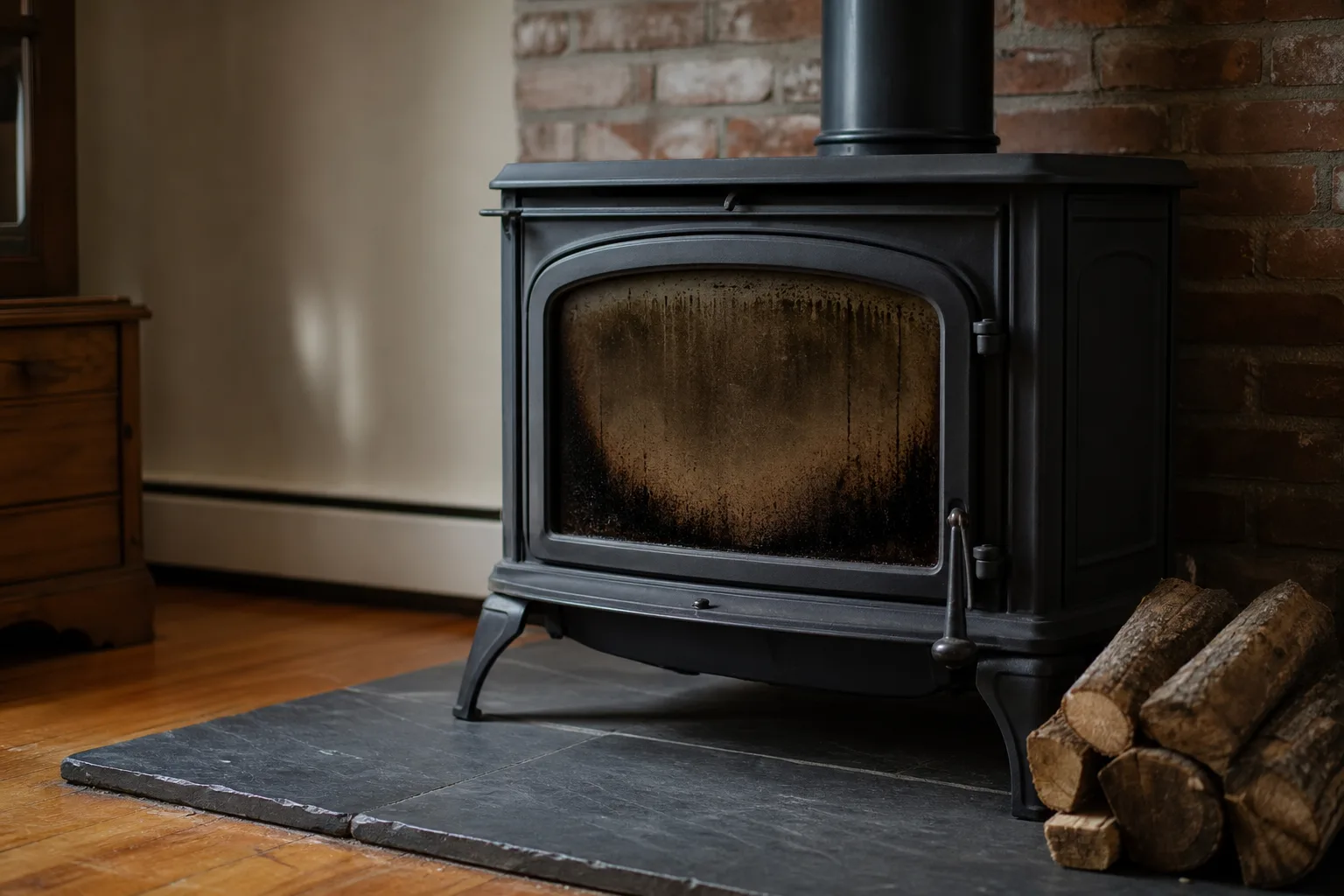
You have probably already seen the first symptom without naming it. Black stove glass is the classic one, and burning wet or unseasoned wood is its leading cause. Treat it as a prompt rather than a diagnosis: a smoky, cool burn tends to deposit where you cannot see, and an inspection of the flue itself is how you find out what is actually there.
The three degrees of creosote
The Chimney Safety Institute of America sorts the deposits into three degrees, a classification also referenced within NFPA 211.
Degree I is light, flaky and sooty, predominantly carbon. It is the normal residue of reasonably clean burning, the kind routine sweeping with a correctly sized chimney brush is designed to remove.
Degree II is harder, tar-like, porous and shiny. Standard brushing alone is generally not enough for it; what removes it is a judgment for the company that has seen your flue, and the creosote logs sold for home use are not a substitute for that visit.
Degree III is the one nobody wants: dense, glazed, tar-based, bonded to the chimney flue liner itself. It is highly flammable, it is difficult to remove, and it is the form most associated with destructive chimney fires.
Degree III is typically the record of many cool, smoky fires, and wet wood is the classic way to burn cool and smoky.
Safety note: Dry fuel is not a clean flue. A reading under 20 percent changes what you add from tonight forward. It does nothing about what is already up there, and it tells you nothing about the condition of the liner or the way the chimney is drafting. Those are separate questions with separate answers.
The flue is the part the meter cannot reach.
Your firewood moisture meter graded the fuel you are about to burn. It cannot tell you what the last few winters left on the inside of your chimney, and that is a question you answer by looking, not by measuring wood.
VIO connects homeowners with independent local chimney companies. The company we match you with can look at the flue, tell you which degree of buildup is actually in there, and explain what removing it involves.
On money: we ask every company in the network to put its estimate in writing before any work starts, and you should insist on exactly that.
Call (513) 655-6702 or request service online.
Choosing a Firewood Moisture Meter Worth Owning
This part is short, because the honest answer is that a firewood moisture meter is a simple instrument and the simple ones work.
The four things that actually matter
Pins, not a scanning plate. Covered above. For split firewood it is not a close call.
A species setting. Either individual species or numbered species groups. Without it you are stuck with whatever the factory reference assumes.
Replaceable pins. They bend, and they break in hard oak. A meter with replaceable pins outlives one without.
A display you can read in a woodshed at dusk. Backlight or high contrast. You are not going to use a meter you have to squint at.
Everything else is preference, though easy battery access matters more than people expect. A fading battery is one of the quieter ways to end up with a drifting reading.
Features aimed at someone else
Pinless scanning, wireless app logging, ambient humidity sensors, hammer probes with insulated deep electrodes: real tools, built for flooring installers and building inspectors who need documentation and depth profiles.
You need to know whether a log is under 20 percent. A basic pin meter, species set correctly, pushed into a fresh face, answers the question you actually have.
Good to know: Kiln-dried firewood was dried at the kiln. Then it was stacked, loaded, hauled and stored, and all along the way it exchanged moisture with the air around it. The label describes where it started, not where it is now. Measure it the same way you would measure anything else.
What to Do With Wood That Reads Too Wet
Every other page ends here with "wait longer." That is not advice, it is a shrug. Wet wood dries at a rate you can change.
Restack it so the air can work
Air is the whole mechanism. Water leaves wood by evaporating from the surface, and evaporation stalls when the surrounding air is already saturated.
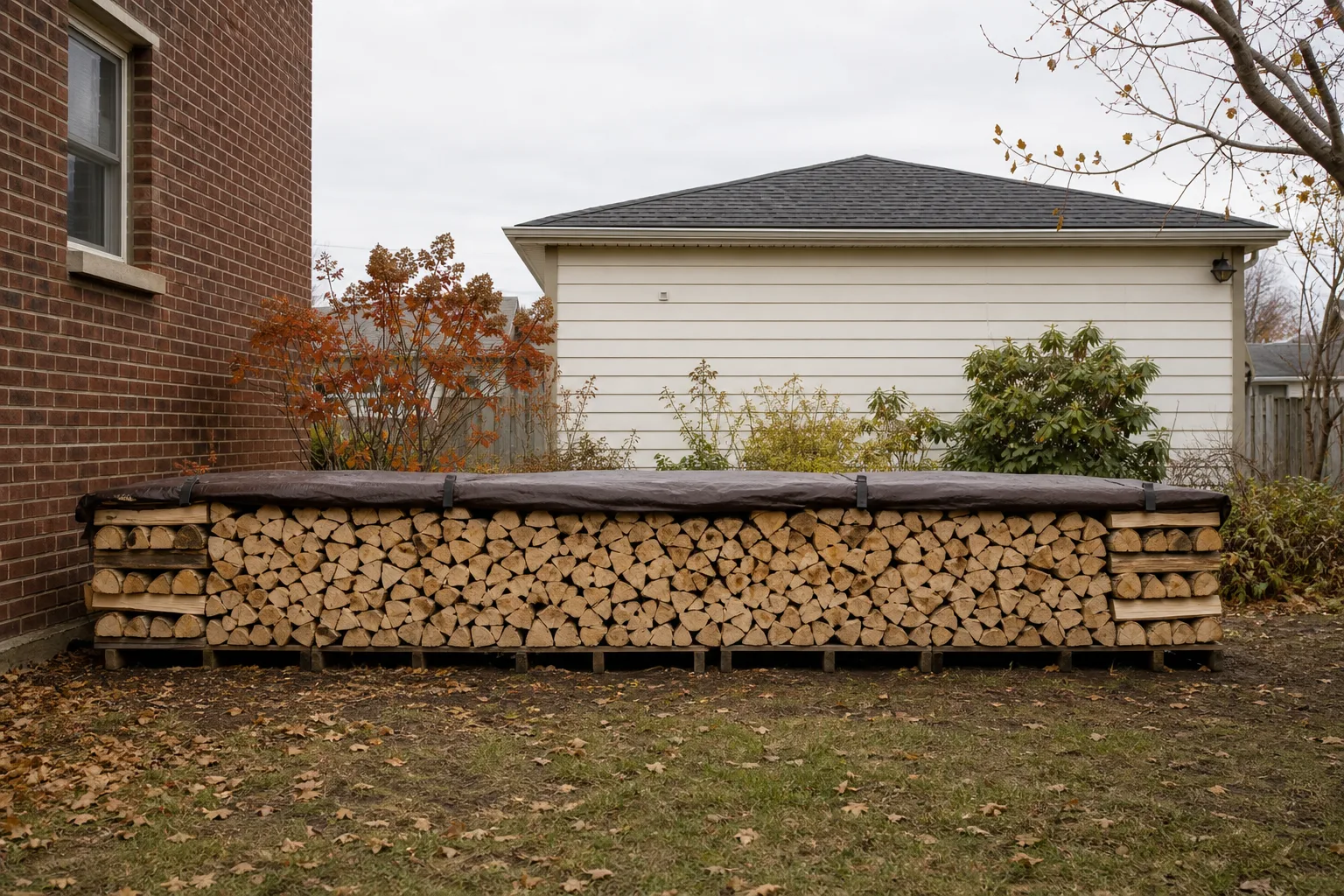
Get the wood off the ground on pallets or rails. Build single or double rows rather than a heap, so wind passes through instead of around. Cross-stack the ends into interlocking squares or brace them against posts.
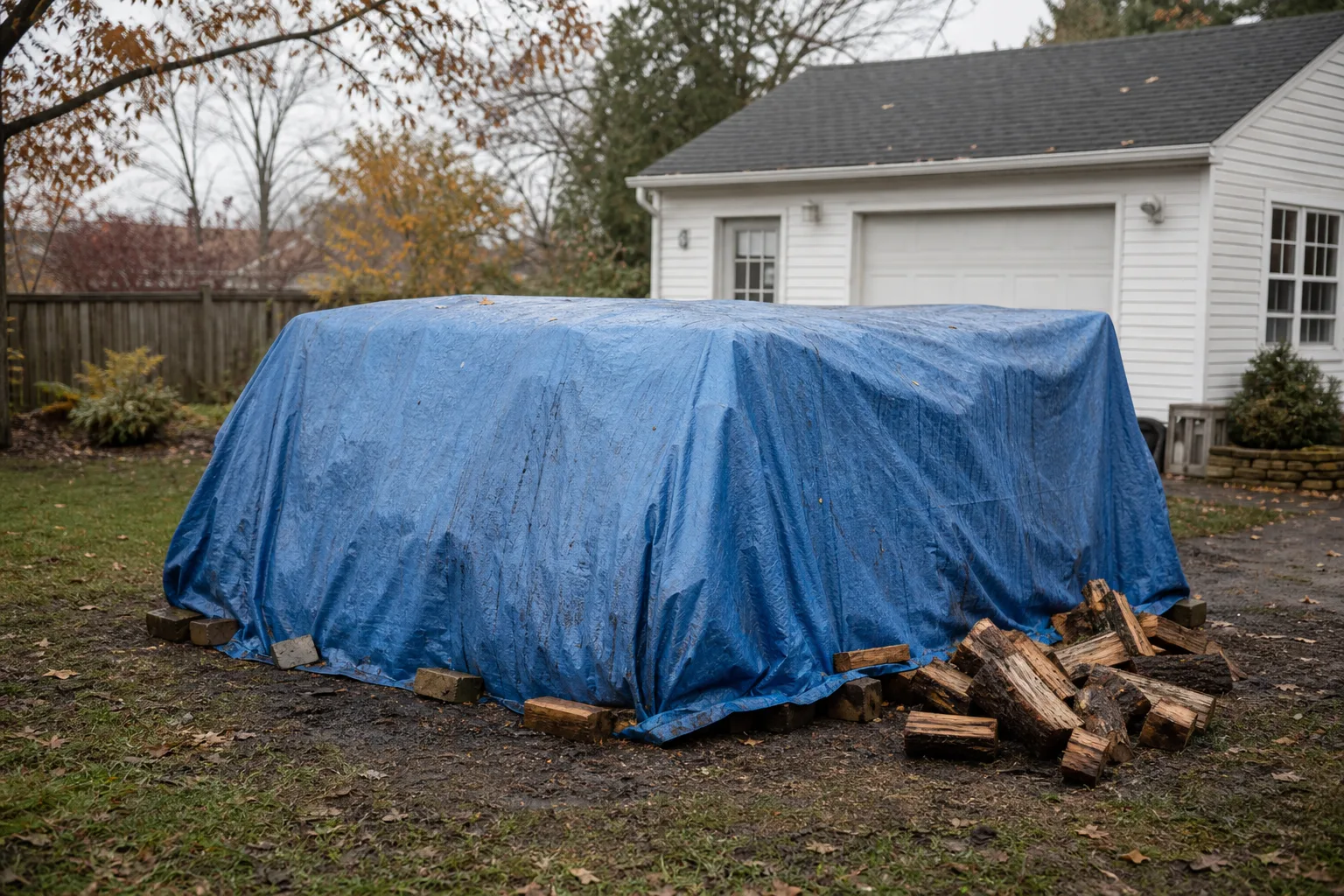
Then cover the top only. A simple metal roof, a board, a tarp weighted over the top course.
The sides stay open. This is the part people get backward: a stack shrink-wrapped in a blue tarp down to the ground is a terrarium. The moisture has nowhere to go, and by February the bottom rows can be wetter than when you covered them.
Split smaller, and respect the species
Water leaves through the exposed face, so more faces means faster drying. Splitting a wet round into quarters instead of halves is the most effective thing you can do to a stack this season.
Species sets the ceiling on your patience. The EPA's Burn Wise guidance is to split, stack, cover and store your firewood well ahead of the season you intend to burn it. How long that actually takes depends on the species, how small you split it, your climate and how you stack it, and oak is famously slower than most. It does not care about your calendar.
So take the calendar honestly. EPA's guidance is at least six months of seasoning for softwood and a year or more for hardwood, so softwood split in late summer is racing the clock for this winter, and hardwood split now is next winter's wood. Knowing that in August beats discovering it in December, and your firewood moisture meter is what settles the question either way.
Pro tip: Get next winter's wood split and stacked in spring, and this problem stops happening to you. The meter turns into a confirmation you glance at rather than a verdict you dread.
How VIO Helps With What the Firewood Moisture Meter Cannot Measure
You can now grade your own fuel. Split a log, read the fresh face, sort the stack, and decide what burns this winter. That is a genuinely useful skill and most people who heat with wood never acquire it.
The seasons before you owned a firewood moisture meter are a different matter. Whatever those fires deposited is still up there, and no reading on a screen will describe it. Somebody has to look.
That is where we come in, and it is worth being precise about what we are. VIO is a matching service. We connect homeowners with independent local chimney companies, and those companies do the work. A professional from an independent local chimney company you connect with can inspect the flue, identify which degree of deposit is present, and lay out what removing it would involve for your specific setup.
On money, so there are no surprises: we ask every company in the network to put its estimate in writing before any work starts, and you should insist on exactly that. Ask the company for its license and insurance details, too, and check them yourself before anyone gets on the roof.
On timing, the standards are clear enough to quote. CSIA recommends an annual chimney inspection for every fireplace, wood stove and venting system. NFPA 211 calls for a Level 2 inspection on sale or transfer of the property, on the addition or removal of an appliance or a change in the fuel type or in the shape or material of the flue, after a malfunction or an external event likely to have caused damage to the chimney, and after a chimney fire.
From the field: The place a drier woodpile shows itself first is the firebox — clearer glass, easier lighting, a fire that holds without constant attention. That is also what makes people start wondering what the previous winters did upstairs.
You have handled the fuel. Now handle the flue.
A firewood moisture meter tells you what you are about to burn. It cannot tell you what is coating the inside of your chimney, and that is the part that matters for safety.
VIO connects you with independent local chimney companies in your area for inspection and cleaning. Ask whichever company you choose for its license and insurance details and verify them yourself. We ask every company in the network to put its estimate in writing before any work starts, and you should insist on exactly that.
Call (513) 655-6702 or request service and we will get you connected.
Symptom checker
What is your chimney doing?
Tap the closest match for an honest first answer.