



On this pageWhat a Creosote Log Actually Is7 sections+6
- What a Creosote Log Actually Is
- The Three Kinds of Creosote, and Which One You Have
- What a Creosote Log Actually Does When You Burn It
- What a Creosote Log Cannot Do
- Log, Powder, Spray, or a Professional Treatment: How the Options Compare
- How to Use a Creosote Log Correctly (If You're Going to Use One)
- How VIO Helps With This
Quick answer
A creosote log is a wax and sawdust log packed with metallic salt catalysts that ride up the flue with the smoke and make creosote deposits drier and more brittle, so they release from the wall more easily. It removes nothing by itself, it leaves the loosened debris inside your chimney, and it cannot inspect the flue for cracks or blockages. It works best as a supplement between professional cleanings.
A creosote log is a real maintenance aid and a false substitute. Burn one and it can make certain deposits in your flue drier and easier to remove later. It does not remove anything from your chimney by itself, and it cannot inspect a single inch of the structure it just treated. That is the whole verdict, delivered in the first sixty words so you can stop reading if it is all you came for.
But there is a second half to this product that the packaging does not discuss, and it is the half that decides whether burning one helped you or quietly cost you a season. We will get there.
What a Creosote Log Actually Is
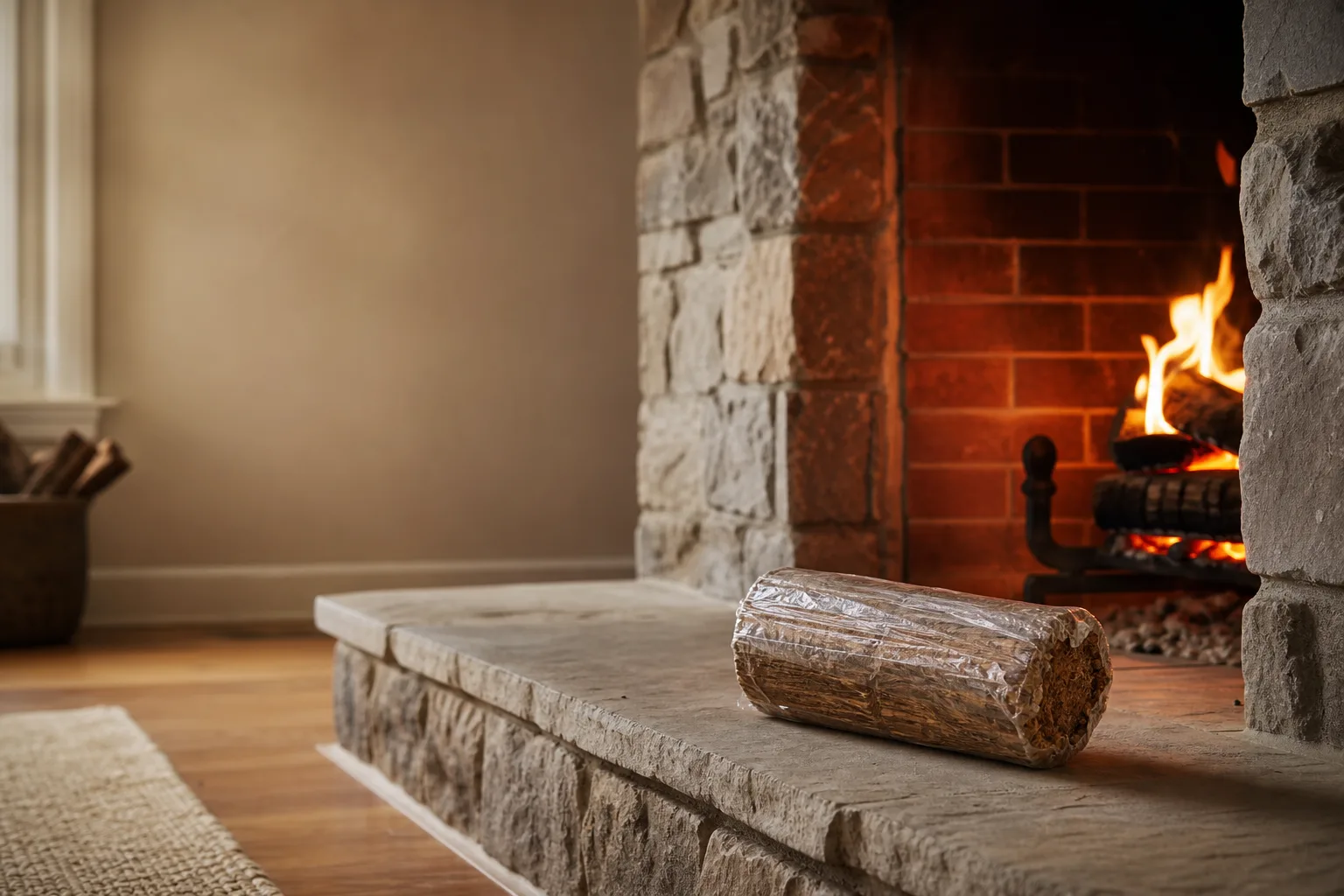
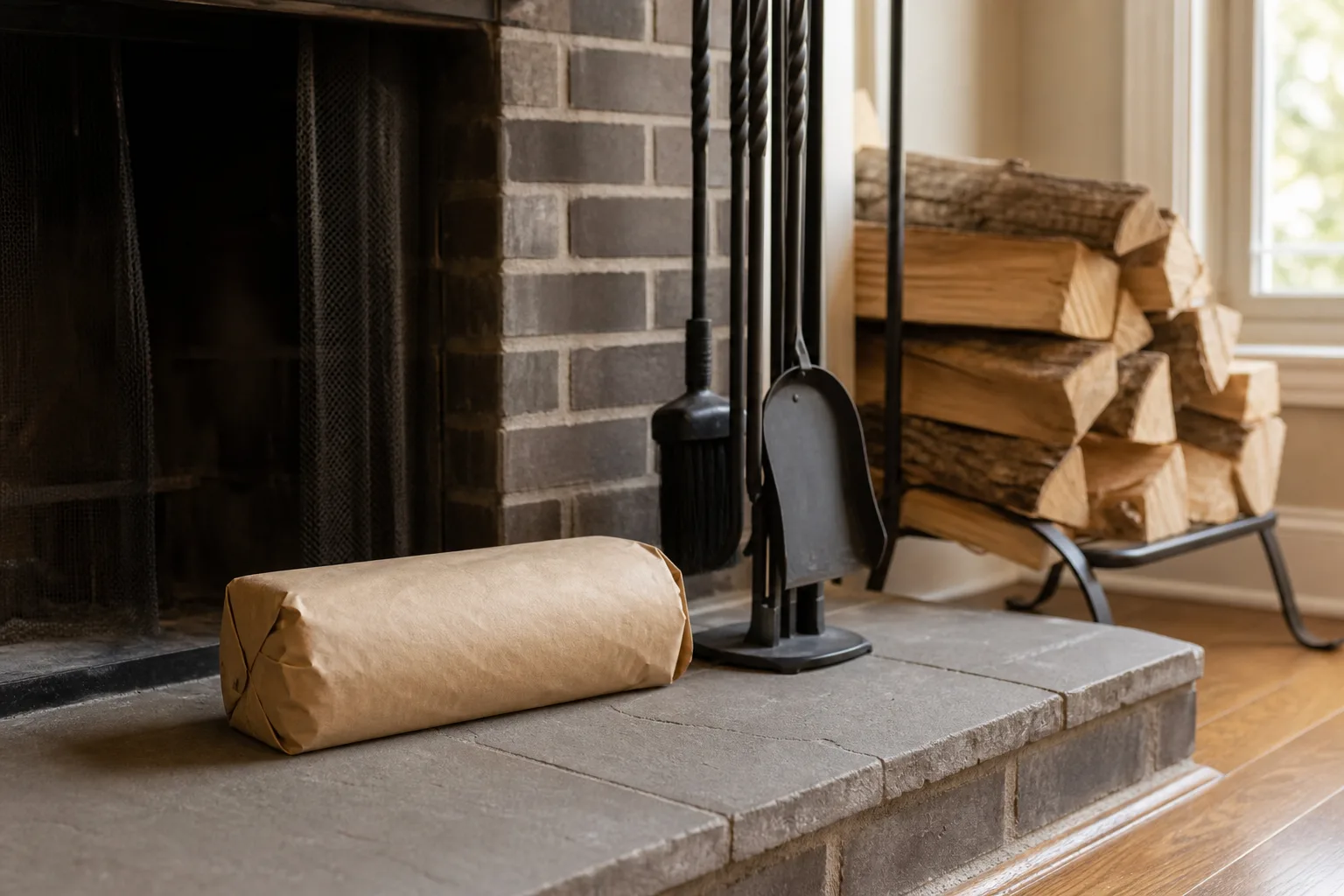
Pick one up and it feels like a fire log, because it mostly is one. The body is a wax and sawdust carrier, the same kind of thing you would buy to get a fire going on a wet November evening. What makes it different is what is mixed into that carrier: metallic salt catalysts that vaporize as the log burns and ride up the flue with the smoke.
That is the entire delivery system. Heat, smoke, and a chemical hitchhiker.
What the catalysts do on the flue wall
Creosote is condensed wood smoke, and the short version of how creosote forms in a chimney explains why the log exists at all. When a fire burns cool, or the wood is wet, or the flue is oversized for the appliance, the volatile gases in the smoke cool before they exit and stick to the flue wall as tar. Over a season that tar hardens, layer on layer.
The catalysts in the log land on those deposits and change their chemistry so they hold less moisture and lose some of their grip. The deposit does not dissolve. It does not burn off. It becomes drier, more brittle, more like a crust than a glue.
That is a genuinely useful thing to do to a chimney. It is also a much smaller thing than most people picture when they read the words on the wrapper.
Why "cleaning log" is a misleading name
The category is sold under a few names: creosote log, creosote sweeping log, chimney cleaning log. Two of those three imply that something gets swept or cleaned. Nothing does. No bristles touch your flue. Nothing gets carried out of your house. The product modifies a deposit and then it is done, and everything after that is still your problem or a professional's.
I have no quarrel with the chemistry. My quarrel is with the verb.
Good to know: the product acts on the deposit. It never acts on the chimney. A flue tile that cracked last winter is exactly as cracked after the log burns as it was before.
The Three Kinds of Creosote, and Which One You Have
Here is the part almost nobody tells homeowners, and it is the thing that makes every other decision on this page easy. "Creosote" is not one substance. Sweeps sort it into three stages, and they behave nothing alike.
Stage one is dusty, sooty, flaky. It brushes off. It is what a chimney looks like when the appliance is being run well: dry wood, hot fires, good draft.
Stage two is crunchy. Shiny black flakes, sometimes with hard tar beads in them, like burnt sugar that cooled. It usually means fires have been running cooler than they should, or the wood has been wetter than it should.
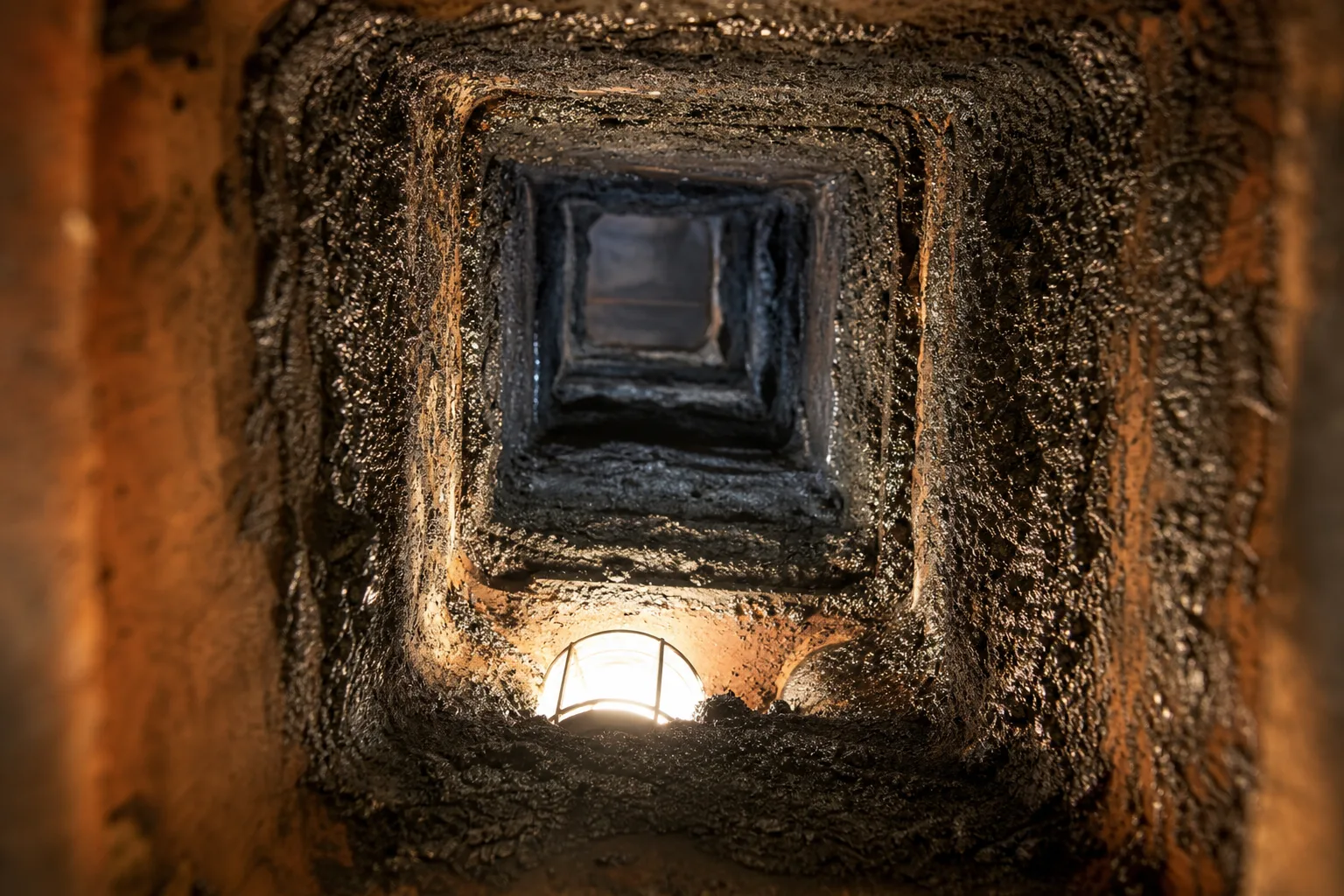
Stage three is glazed. Hard, shiny, tar-like, fused to the flue wall in a sheet. This is the dangerous one. It is highly flammable, it is very difficult to remove, and it usually means something about the system has been wrong for a while.
The flashlight check you can do tonight
You can find out which one you have in about sixty seconds, and I would rather you did that than read another paragraph of theory.
Wait until the fireplace is stone cold. Open the damper all the way. Put on a glove and safety glasses, get a decent flashlight, and look up past the damper at the flue wall. If you can reach a spot safely, scratch it lightly with a fireplace poker or a screwdriver. One honest limit: this shows you what is near the damper, not what the rest of the flue looks like. Only a camera sees the full run.
Dusty black powder that comes off on the tool: stage one. A crunchy layer that flakes off in chips: stage two. A hard, shiny, slightly sticky surface that does not want to come off at all: stage three.
If you cannot see anything, or the view is blocked, or you are not comfortable with any part of that, stop. That is not a failure, it is information. A blocked view is itself worth a phone call.
Safety note: if what you see is shiny and hard, do not burn anything at all, including the creosote log. Glazed creosote is fuel sitting in the path of your fire. Get eyes on the flue before the next burn.
What each stage means for the product's chances
Against stage one, the log has very little to do, because stage one is already easy to remove. Against stage two, it is at its most useful, drying out the deposit so it releases from the wall more readily. Against stage three, it is closest to useless, and worse, it is the situation where reaching for a log instead of a phone is an actual mistake.
So the honest summary is that the product works best against the middle stage, which happens to be the stage a homeowner is least equipped to judge from the living room floor.
What a Creosote Log Actually Does When You Burn It
You burn it the way its label says: some products go on an established fire, others are made to burn alone or after the fire dies down. It burns for an hour or two. Smoke carries the catalysts up. Over the following days, the deposits above the firebox begin to change character.
And then here is the part nobody puts on the box.
Here is what nobody tells you: it falls
If the product does exactly what it is designed to do, the creosote does not vanish. It loosens. And loose material in a vertical shaft obeys gravity like everything else.
It comes down. Onto the smoke shelf, that ledge behind the damper where debris has been collecting since the house was built. Onto the damper plate itself. Where it lands in a system with an insert depends on how the insert is connected: with a full, properly sealed liner it stays inside the liner, and material landing on top of the unit is a sign the connection deserves a look. In a stove with a stainless chimney liner, down to the base of the liner and the tee at the bottom.
Somebody still has to carry that material out of your house. The log does not. That is the second half of the product, and it is why the directions that come with these things address clearing out debris at all. Read yours.
Where the debris lands in different systems
In an open masonry fireplace, most of it lands on the smoke shelf and in the damper area, where an ash vacuum built for the job and a lot of patience can reach some of it, and where a sweep reaches all of it.
In a fireplace with an insert, the loosened material collects inside the liner, and on top of the insert if the connection lets it through. Either way, this is the setup where people are most likely to burn a log, feel good about it, and have created a small pile of flammable debris in a place they will never look. If you heat with a fireplace insert, plan the cleanout, do not assume it.
In a freestanding stove with a liner, it drops to the cleanout tee, which is at least designed to be opened, though it still has to actually be opened.
From the field: the follow-up cleanout is the step homeowners skip. People remember to burn the log because burning it is easy and satisfying. Nobody feels like opening a damper and vacuuming a shelf two weeks later, and that is the step that turns the product from a gesture into maintenance.
What a Creosote Log Cannot Do
Everything above is about deposits. Now the harder subject, which is the chimney itself.
You think you are buying a cleaning. You are buying a look.
A creosote log cannot see. That sounds obvious written down, but it is the entire reason this product cannot stand in for a professional visit. Chemistry has no opinion about any of the following, all of which are things that turn a working chimney into a hazard:
- A cracked or spalled flue tile, which lets heat and gases reach framing lumber
- An open joint or a gap in a liner
- A nest, a squirrel, or a dead bird blocking the flue
- A missing or damaged chimney cap letting rain and animals straight in
- A crown that has cracked and is feeding water into the masonry
- Rusted or failed damper hardware
- The scorch marks and puffed, honeycombed deposits that say the chimney has already had a fire and nobody noticed
Not one of those things is affected by what you burn. Several of them are more dangerous than the creosote you were worried about.
Brushing versus looking, the two jobs of a chimney professional
When you book a chimney sweep, you are paying for two separate services that happen to arrive in the same van.
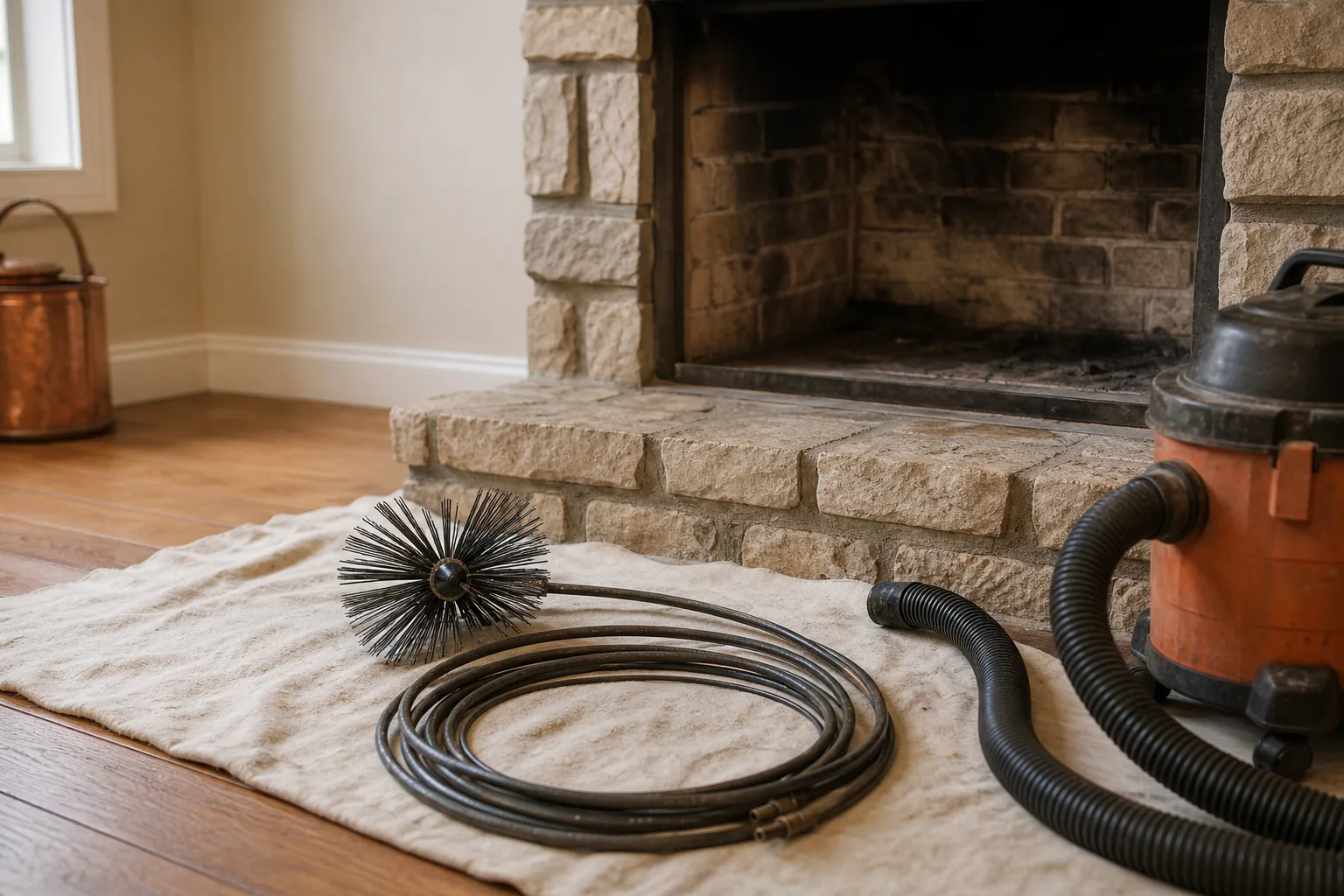
The first is mechanical: brushes, rods, rotary heads, a vacuum, and the physical removal of deposits from the flue. That is the job the creosote log partially assists with, in the middle stage, in the sense of making the material easier to move.
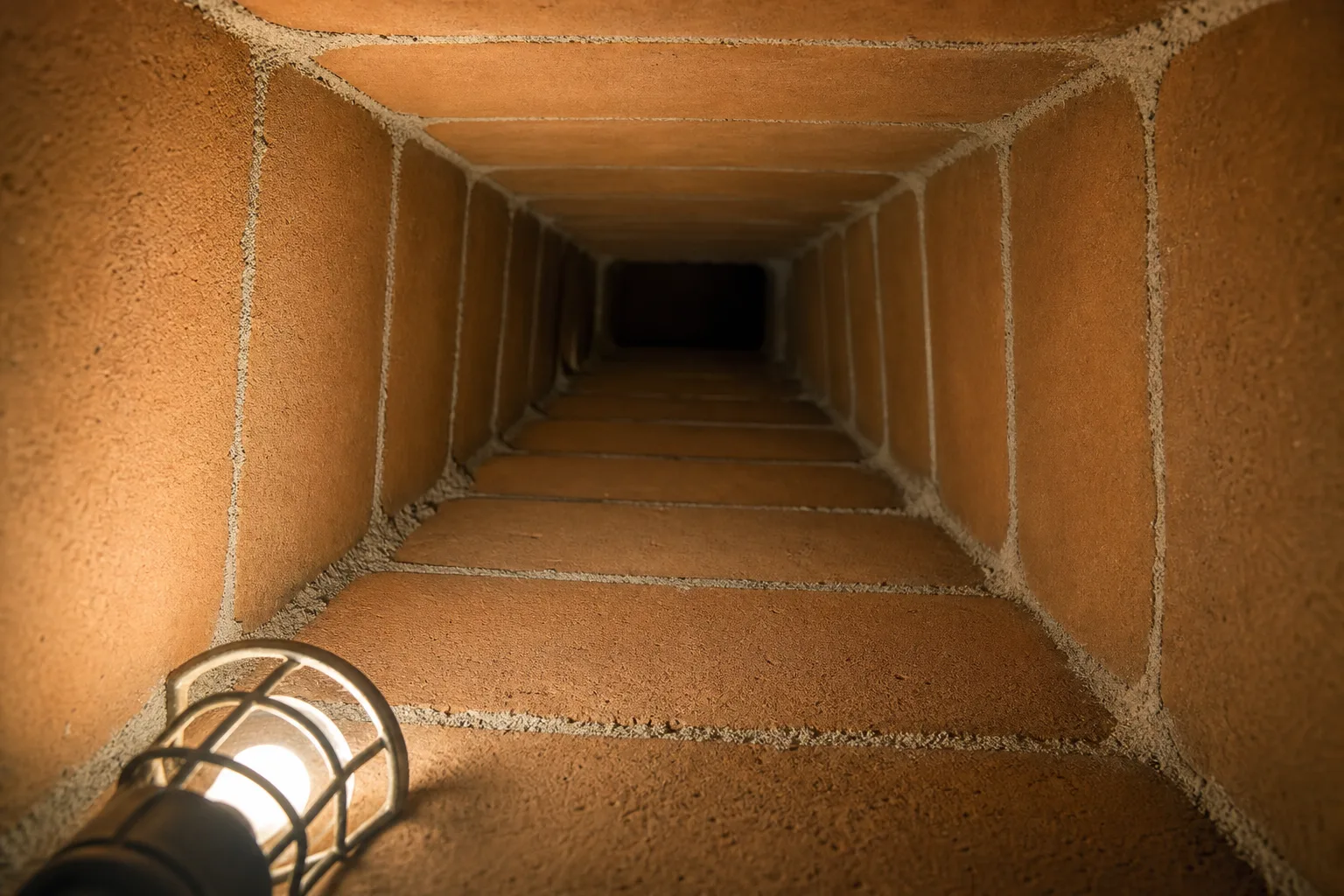
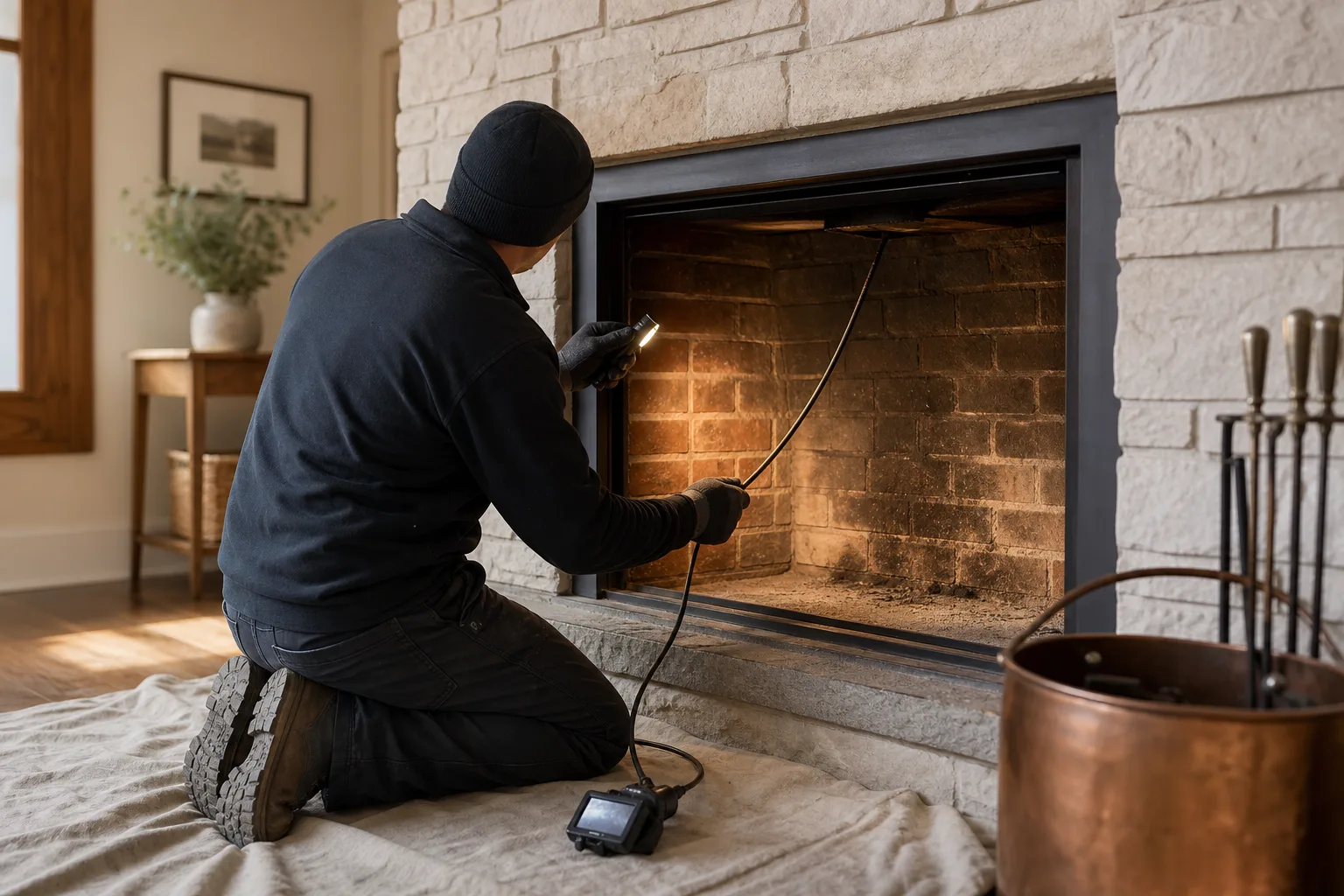
The second is diagnostic. Somebody with a light and a camera looks at the inside of a structure you cannot otherwise see, and tells you whether it is sound. That job has no chemical equivalent and never will.
Most homeowners have only ever thought about the first one. The second is the one that finds the problem.
The moments the standard calls for an inspection regardless
NFPA 211, the standard that governs chimneys and venting in the US, sets out when a Level 2 inspection is required. It is not a suggestion tied to how dirty things look. A Level 2 inspection is required:
- Upon sale or transfer of the property
- When the system is changed, including a new appliance, a fuel change, or a change in flue shape or material
- After a malfunction or an event that could have damaged the chimney
- After a chimney fire
- After an external event likely to have damaged the chimney, such as a severe storm, a lightning strike, or an earthquake
In every one of those situations, burning a creosote log is not a response. If you have just bought a house with a fireplace, or you have just put a stove insert into an old fireplace, or a storm took part of your roof, the log is irrelevant to what the standard is asking of you. Book the chimney inspection.
Myth vs. fact: "one log a season and I'm covered." This is an easy belief to hold, because the product is designed to feel like a completed task. Fact: burning it addresses one stage of one kind of buildup, leaves the debris in your chimney, and answers nothing about the condition of the flue. It is a reasonable habit. It is not coverage.
Not sure what is actually in your flue?
A creosote log will not tell you whether your deposits are flaky, crunchy, or glazed, and it will not tell you whether the flue behind them is sound. An inspection will. VIO connects you with screened independent chimney companies in your area, and we ask the companies in our network to put an estimate in writing before any work begins.
Call (513) 655-6702, or request service online.
Log, Powder, Spray, or a Professional Treatment: How the Options Compare
Most people who search for a creosote log do not realize it belongs to a family of products, and that the family has a professional wing they were never shown. Here is the whole landscape in one place.
| Option | What it is | What it acts on | What it still leaves undone | Best used when |
|---|---|---|---|---|
| Creosote log | Wax and sawdust carrier with metallic salt catalysts, burned whole | Stage two deposits above the firebox, some stage one | Removal of any material, and the entire condition of the flue | You burn wood regularly and want a supplement between cleanings |
| Powder or granule additive | Loose treatment sprinkled onto an active fire, usually over several burns | The same deposits, applied in smaller doses more often | Removal, inspection, and anything below the firebox | You want the same effect spread across a season instead of one event |
| Spray-on treatment | Liquid applied to fuel or into the firebox before burning | Surface deposits within reach of the treated smoke path | Removal, inspection, glazed layers | You prefer dosing per fire and you already have a cleaning schedule |
| Mechanical sweeping | Brushes, rods, rotary heads, and a vacuum, done by hand | Physical removal of stage one and stage two deposits, and stage three where it will release | Glazed deposits that will not release by brushing, which may need a treatment applied first | Paired with the inspection schedule the standard sets, with cleaning done as the inspection finds it necessary |
| Professional chemical treatment | Industrial-strength products applied directly to the flue wall by a technician, then swept out | Glazed stage three deposits that brushing alone will not release | Structural repairs, which it may reveal the need for | A sweep has identified glazed creosote that ordinary sweeping cannot remove |
Why the pro-applied products are a different category
The consumer products all work the same way, by riding smoke upward. A professional treatment for glazed creosote is applied directly onto the deposit, left to work, and then removed mechanically, often with a rotary chain or a specialized head. In many cases it is a two-visit process.
This matters because it is the honest answer for anyone whose flashlight check found stage three. The over-the-counter log is not a weaker version of that treatment. It is a different thing pointed at a different problem.
Pro tip: every chemical option in that table, the log included, is a supplement to a cleaning schedule. None of them is a replacement for one. If a product's marketing implies otherwise, that is the marketing talking, not the chemistry.
How to Use a Creosote Log Correctly (If You're Going to Use One)
Buy it. Burn it. It is not a scam, and I would rather you used one than did nothing at all between professional chimney cleanings. What follows is how to make it count instead of making it a ritual.
Before
- Do the flashlight check first. If the deposit is glazed, stop here and call somebody.
- Confirm the damper opens fully and that the appliance has been drafting normally.
- Read the directions on the actual product. They vary, and the burn requirements are not all the same.
- Plan the cleanout now, while you are still motivated. Put it on a calendar.
During
- Burn it exactly the way the label says. Products differ: some want an established fire, some burn alone or after the fire subsides, and the label, not a habit, decides.
- Give it the full burn time the directions call for. Do not smother it or damp the fire down halfway through.
- Do not make it your only fire of the season. It works on deposits that are already there, in a chimney that is already warm from use.
After
- If your product calls for a follow-up burn, wait the interval it specifies.
- Then do the cleanout, only once everything is confirmed cold. Gloves, eye protection, an ash vacuum built for the job (a regular shop vacuum is not), and a look at the smoke shelf and the damper.
- If you have an insert or a lined stove, the cleanout means the top of the insert or the cleanout tee, not just the firebox.
- Look again with the flashlight. If the deposit changed, the product did its job. If it looks identical, you learned something useful.
The follow-up burn and the follow-up cleanout
Some of these products call for a second log later in the season, and where they do, the reason is not sales. The chemistry works over days, on the deposits it actually reached, and a second application catches material the first pass changed only partway. If you are going to skip one of the two steps, skip the second log and keep the cleanout. Removal is worth more than treatment.
When burning one is the wrong next move
There are four situations where reaching for a creosote log is the wrong instinct, and in all four the right move is a phone call.
Your flashlight check found glazed, shiny deposits. Your fire has started behaving differently, smoking into the room, drafting poorly, smelling wrong. You hear or see something living in the flue, which calls for bird and animal removal and not chemistry. Or you have had a chimney fire, whether it was dramatic or just a roaring sound and a hot spot you talked yourself out of, in which case NFPA 211 asks for a Level 2 inspection and nothing you burn substitutes for that.
Safety note: a creosote log is not a response to a chimney fire, a blocked flue, or the smell of smoke inside the house. Those are all reasons to stop using the appliance until somebody has looked at it.
How VIO Helps With This
Plainly: VIO does not sweep your chimney. VIO is a referral service. We maintain a network of screened independent chimney companies and we connect you with one near you. That company, not VIO, does the inspection and any work, and we ask the companies in our network to put an estimate in writing before any work begins. That is the whole arrangement, and we would rather state it than have you discover it on the doorstep.
What that gets you in this particular situation is the one thing the log cannot provide: somebody looking. The independent company we match you with can tell you which stage of creosote you have, whether the flue tiles and the liner are intact, whether the cap and the crown are doing their jobs, and whether burning a log is a sensible habit for your system or a distraction from a repair that should happen first.
If you want that visit to be useful, have three things ready when you call. What you burn, and how dry it is. How often you run the appliance, and whether you tend to burn hot and fast or low and long. And what your flashlight check showed, in your own words, even if the words are "I could not see anything." That last one is genuinely helpful, because a view that is blocked tells a sweep something.
If the visit turns up more than deposits, and sometimes it does, you will hear about the chimney repair options in writing before anyone picks up a tool.
Good to know: an inspection report is what tells you whether a creosote log is a reasonable supplement for your chimney or a distraction from something structural. Until somebody has looked, you are guessing, and so is the product.
Burn the log if you want. Then let someone look.
The honest sequence is simple: use the product as a supplement, and put eyes on the chimney on the schedule the standard sets. Tell us what you burn and how often, and we will match you with an independent local company that inspects first, and we ask for the quote in writing.
Call (513) 655-6702, or request service.
Symptom checker
What is your chimney doing?
Tap the closest match for an honest first answer.