



On this pageThe stain on your ceiling is probably not where the leak is8 sections+7
- The stain on your ceiling is probably not where the leak is
- What flashing around chimney joints actually is
- Four ways flashing around chimney joints fails
- Three checks you can do without getting on the roof
- The one repair that makes everything worse
- Roofer or chimney company: who actually fixes this
- What a real flashing around chimney repair includes
- How VIO helps with flashing around chimney problems
Quick answer
Flashing around chimney joints is the layered sheet metal that waterproofs the seam where a roof meets the masonry. It has two parts: step flashing woven into the shingle courses, and counterflashing set at least an inch into the chimney's mortar joints and folded down over it. It is among the most common sources of chimney-area roof leaks. The correct fix is replacing the metal as a system, not sealing over it.
It starts with a brown ring on a bedroom ceiling, usually after the first hard rain of the fall. You look up at it, then over at the wall where the chimney runs, and you start typing. Somewhere in the results, or from a roofer standing in your driveway, you picked up a phrase you had never needed before: flashing around chimney.
Flashing around chimney joints is the metal that keeps water out of the seam where your roof meets your masonry. When it fails, that ceiling stain is what you get.
Here is the first thing worth knowing, and almost nobody says it out loud: the stain is probably not underneath the leak. There is also one common repair for this problem that leaves you worse off than doing nothing, and you need to recognize it before someone sells it to you.
The stain on your ceiling is probably not where the leak is
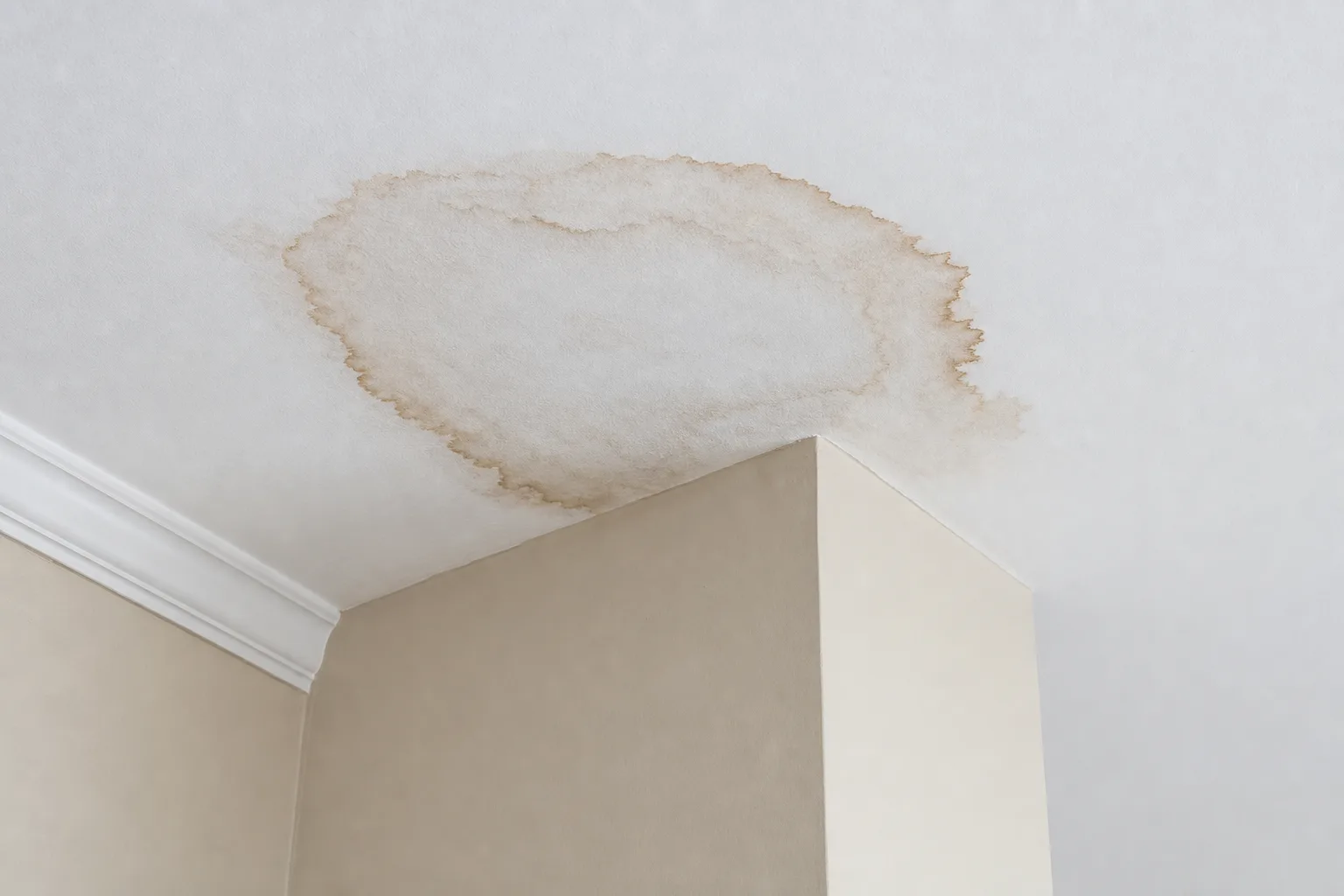
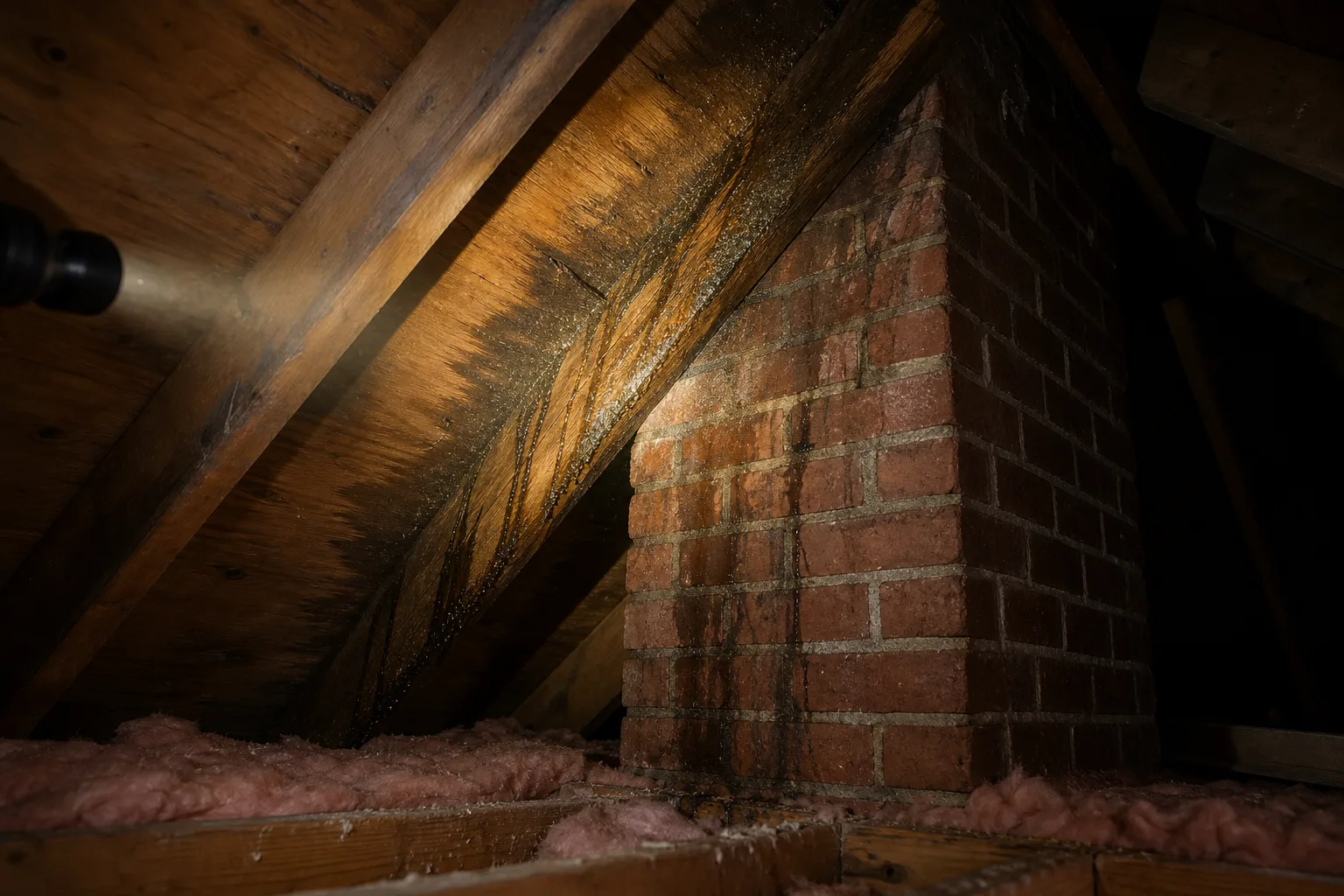
Water that gets past chimney flashing does not fall straight down. It lands on the roof sheathing, runs along the underside until it finds a rafter, then travels that rafter until something stops it.
By the time it soaks through drywall and announces itself, it may be several feet from where it came in. This is why homeowners chase phantom leaks around a roof for a season and get nowhere.
Good to know: A stain six feet from the chimney does not mean the chimney is innocent. Water follows framing, not gravity alone. The entry point is often uphill of the stain rather than directly above it.
The chimney is worth suspecting for a simple reason. It is a big rigid box punched through a roof plane, and everything punched through a roof has to be sealed by hand. Vents, skylights, chimneys.
Those hand-sealed penetrations are where roofs tend to give trouble, and on most houses the chimney is the largest of them.
What flashing around chimney joints actually is
Most explanations of flashing around chimney sides go wrong in the first sentence. They call it "the metal seal around your chimney," which makes it sound like a gasket, or worse, like caulk.
It is not a seal. It is a set of overlapping metal pieces arranged so water runs down and out, the way shingles do. Nothing about it depends on one thing sticking to another.
That distinction is the whole reason a tube of sealant cannot substitute for it.
Step flashing, the staircase under your shingles
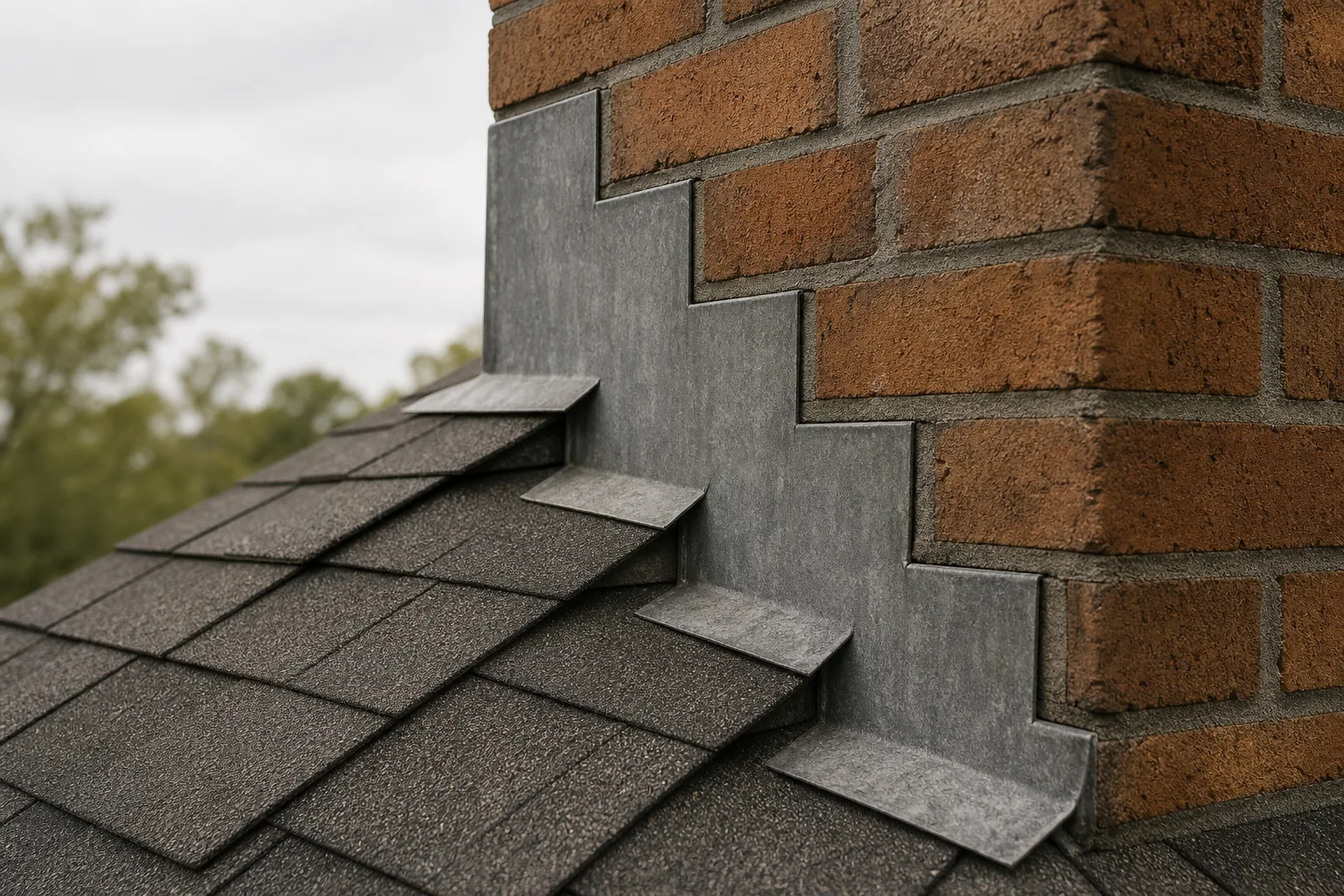
Along the two sides of the chimney that run up the slope, the roofer installs step flashing: small L-shaped pieces of metal, each bent ninety degrees, roughly the size of your hand.
One goes in with every course of shingles, each lapping over the one below, marching up the chimney side like a staircase.
You mostly cannot see them, which is the point. When someone says flashing was "installed properly," this is largely what they mean: woven in, one per course, integrated with the roof rather than laid on top of it.
Counterflashing, the layer set into the mortar
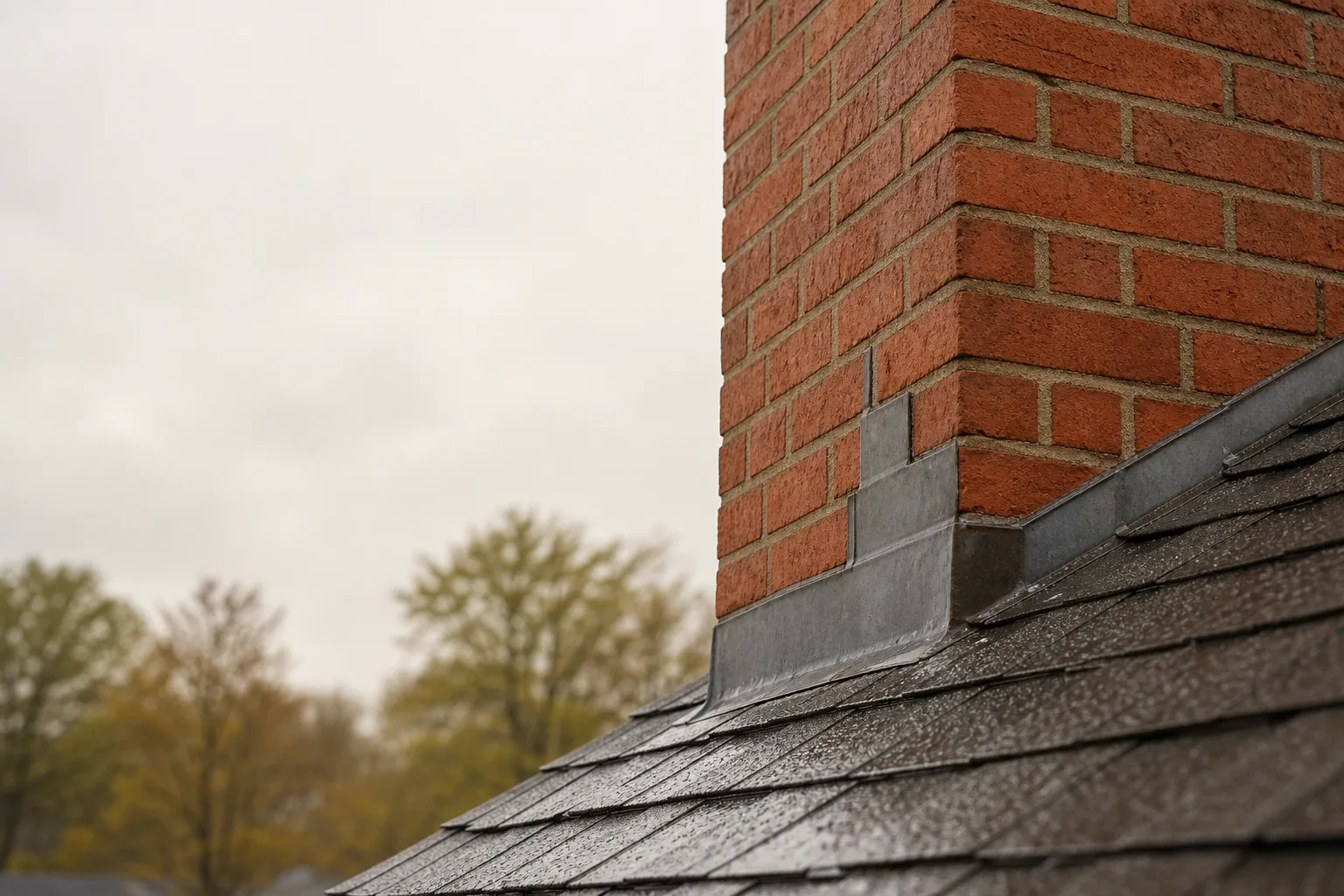
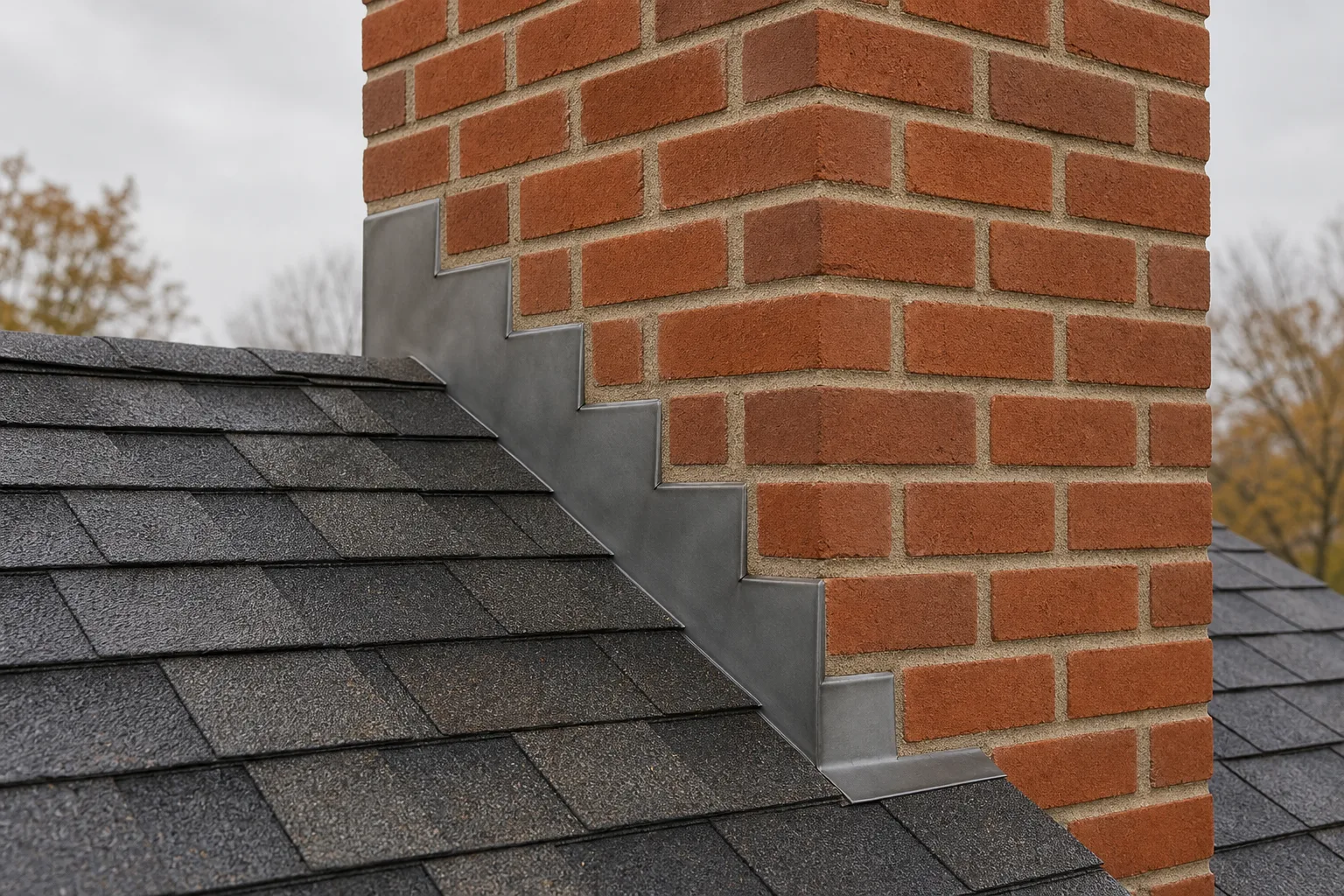
The second layer is counterflashing: metal let into the chimney's mortar joints, at least an inch deep, then bent outward and folded down over the tops of the step flashing.
From the ground you can spot it as a band of metal running up the chimney side in a stepped line, its top edge vanishing into a thin dark horizontal line in the brickwork.
Why two layers? Because your roof and your chimney move differently. The roof deck flexes with temperature and load. The masonry mass barely moves at all.
Counterflashing covers the step flashing without being fastened to it, so the two can shift independently without opening a path for water. Bridge those layers with something rigid and you have built yourself a crack.
The apron and the cricket
The downhill face gets an apron, one wider piece of bent metal lying over the shingles, carrying water away from the base.
The uphill face is the hard one. It collects everything the roof sends down at it, plus leaves, plus snow that sits for weeks and melts from below.
A narrow chimney can get by with a rear pan. A wide one needs a cricket, a small peaked structure built against the chimney like a tiny gable and shingled to match the roof, which splits the water and sends it around both sides.
The model code is specific, and flashing around chimney crickets is written into it directly. Under the 2024 International Residential Code, a cricket is required on the uphill side of any chimney thirty inches or wider, measured perpendicular to the roof slope. The same code calls for flashing and counterflashing to a height of at least six inches.
Pro tip: Go outside with a tape measure and read the width of your chimney where it comes through the roof. If it is thirty inches or wider and there is nothing peaked on the uphill side, you have learned something real about your own house in sixty seconds. Code adoption varies and your local code official is the authority on your specific home, but a wide chimney with nothing behind it and a leak that keeps returning is a strong lead.
Four ways flashing around chimney joints fails
Every article on this subject treats damaged flashing as one condition. It is four. They are not equally serious, they do not cost the same, and they do not get fixed the same way.
Find yours in the table, then read the section that matches.
| What is failing | What you see | What it means | What the repair involves |
|---|---|---|---|
| Sealant at the counterflashing joint | Cracked, hardened, or pulled-away caulk along the top edge of the metal | The metal is likely fine, the joint has opened | Cut out the old material, address the mortar joint, reset the counterflashing |
| Step flashing never woven in | One long piece of metal sitting on top of the shingles instead of under them | The system was never built right, and sealant is doing metal's job | Shingles come off, real step flashing goes in course by course |
| Rust holes and thinned metal | Orange-brown staining down the brick, pitting, visible holes, lifted edges | The metal is at the end of its service life | Full replacement of the affected metal, usually the whole system |
| No cricket on a wide chimney | A flat pan against the uphill face of a chimney thirty inches or wider, debris collecting there | Water and debris have nowhere to go except into the joint | A cricket gets built and flashed, which is carpentry plus roofing |
Failed sealant at the counterflashing joint
Usually the least alarming of the four. Sealant along the counterflashing degrades under sun and freeze-thaw cycling, hardens, cracks, and pulls back from the masonry.
Often the mortar joint has deteriorated along with it, which is what lets water in behind the metal rather than in front of it.
Caught early, this is the smallest job on the list.
Step flashing that was never woven in
This is the one that makes experienced people wince. Someone flashed the chimney with a single continuous piece of metal laid along the side and stuck down, instead of individual pieces woven into the shingle courses.
It looks tidy from the ground. It is a sealant joint pretending to be a flashing system, depending entirely on adhesive holding across a moving seam, which adhesive does not do for long.
You cannot patch your way out of this one. The shingles have to come up.
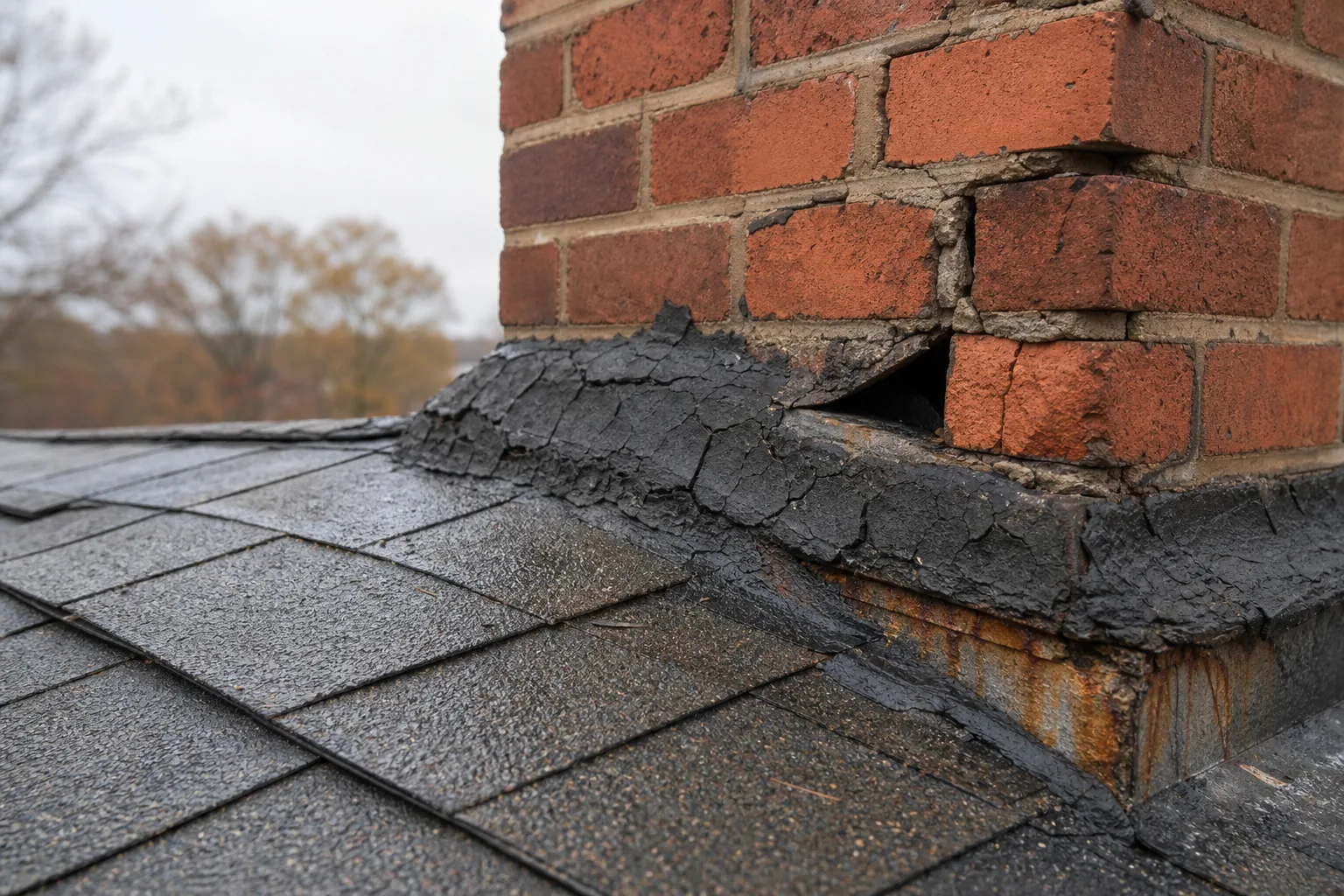
From the field: The first thing a good pro looks for on a leaking chimney is a band of black roof cement along the flashing line. Not because the tar is the emergency, but because it says the joint already failed once and somebody chose to hide it. What is under the tar is the actual story.
Rust holes and thinned metal
Galvanized steel is protected by a zinc coating, and that coating can crack at the bends where the metal was formed. Rust starts at those bends and at fastener points, then works outward.
The tell is staining. Orange-brown streaks running down the brick suggest the metal is giving up, and once you can see holes, that metal is no longer keeping water out.
A missing cricket on a wide chimney
If your chimney is wide and sits partway down a slope, its uphill face is a dam. Water piles against it, debris packs in behind it, snow sits and melts from underneath.
Building a cricket is a different scope of work than replacing metal, because someone has to frame and shingle a small roof to do it.
Three checks you can do without getting on the roof
Most of what you need to know about the flashing around chimney joints on your own house can be learned without a ladder, and it belongs in the same habit as your routine chimney maintenance. You need a flashlight, a rainstorm, and twenty minutes.
Safety note: Do not climb onto the roof to inspect this yourself. A fall from a roof is a serious injury, and not one of the checks below requires you to risk one. All three happen from inside the house or from the yard.
The attic during a rainstorm
This is the single most useful free thing available to you, and hardly anyone does it.
While it is actively raining, go into the attic with a good flashlight and find where the chimney passes through. On most houses the brick face is visible right there.
Look at the framing and the underside of the sheathing on all four sides. You are hunting for dark tracks running down the wood, damp spots, or moving water.
Then note which side it comes from, because that narrows the list rather than settling it. Water at the uphill face points you toward the rear pan or a missing cricket. Water at a side points toward step flashing or counterflashing. Water at the downhill face points toward the apron.
None of that is a diagnosis, and water can travel before it drips. But it is more than you knew twenty minutes earlier, and it cost you nothing.
What you can read from the ground
Stand back in the yard and use binoculars or your phone camera zoomed all the way in. Then walk around and look from two or three more angles, because a defect that hides from one direction shows from another.
Here is your list:
- A black band along the flashing line. Lumpy, dull, cracked. That is roof cement, and somebody has been here before you.
- Metal lifted away from the brick. A dark gap between the counterflashing and the masonry, worst at the corners.
- Rust streaks on the brick running down from where the metal sits.
- Crumbling mortar where the counterflashing tucks in, or a stripe of brighter mortar where somebody repointed.
- One long piece instead of a staircase, which means surface-mounted flashing.
- Nothing peaked on the uphill side of a chimney thirty inches or wider.
- Debris packed against the uphill face, or a wet patch there that stays dark long after the rest of the roof dries.
Reading the stain itself
Inside, the shape may tell you something. A sharp-edged ring that grows after every rain and then dries out suggests the leak is still active. A soft, evenly brown patch with no defined edge that never changes could be an old leak somebody already fixed, though nothing settles that except opening it up.
So test it instead of guessing. Photograph the stain with something in frame for scale, then photograph it again after the next storm. If the edge moved, treat it as active.
The one repair that makes everything worse
Somewhere in America right now, someone is climbing a ladder with a five-gallon bucket of black roof cement and a trowel, headed for a chimney.
Roof cement over flashing around chimney joints is the wrong repair, and it is an easy one to sell. It is cheap, it is fast, and at first it looks like it worked.
Then it hardens. Roof cement is not flexible, and it bridges a joint between two things that move at different rates, so it cracks. Now the cracks are hidden inside an opaque black layer instead of being a visible gap you could have diagnosed.
The worse part is underneath. That thick band traps water behind it, so instead of a leak that drains back out you have a dam holding moisture against the roof deck, and sheathing rots faster than if the joint had been left alone.
It also makes the real repair harder. Whoever opens it up has to chip cured cement off masonry and metal before they can see what they are dealing with.
Myth vs. fact: "A tube of caulk will hold it until spring." Sealant and roof cement are not flashing and cannot do flashing's job, because they work by sticking to two surfaces that are moving relative to each other. A joint depending on adhesive instead of layered metal fails early, and every season it stays hidden is another season of water in your framing.
Roofer or chimney company: who actually fixes this
This is the question you came here with, and it is the one every other page ducks.
Why the two trades split this job
Look at where the parts live. Step flashing and the apron sit in the roof plane, woven into shingles, which is roofing work. Counterflashing sits in the mortar joints, which is masonry work. A cricket is framing and shingling, which is roofing again.
Failures in flashing around chimney assemblies happen constantly at the seam between those two trades. The seam between two trades is exactly where responsibility gets dropped.
A roofer may reset the counterflashing without touching a deteriorated mortar joint. A mason may repoint beautifully and leave the step flashing as wrong as it always was. Both did their piece. The chimney still leaks.
So the answer is not "roofer" or "chimney company." It is whoever will look at the entire joint and either work both sides of that line or bring in the trade they do not do.
A company that does full chimney service often wins this by default, because roof-to-chimney work is their daily bread. But a roofer who does masonry-set counterflashing is just as good an answer. You are screening for scope, not job title.
Pro tip: Here is the sentence to say when you call anyone. "I want the flashing replaced as a system, step flashing, counterflashing, and apron, not sealed over. Can you address the mortar joint too, or bring in someone who can?" How they answer tells you almost everything.
If your roof is getting replaced soon
This changes the math, so work out where you stand before spending anything.
If a full roof replacement is close, the flashing should be part of that job, and you should be explicit in writing when you sign. Here is what nobody tells homeowners: a brand-new roof can leak at the chimney.
It happens when the crew reuses the old metal. Old galvanized has already started to rust, old aluminum has been reacting with mortar for years, and old flashing rarely integrates cleanly with new shingle courses.
The line item you want is new flashing around chimney work, spelled out. Not "reflash chimney," which can mean almost anything, and definitely not silence.
Not sure whether the flashing around your chimney is a roofing job or a masonry job? That is exactly the call we are built for. Tell us what you are seeing, the stain, the rust, the tar, and we point you toward a local company that works both sides of that line. Call (513) 655-6702, or request service online and describe the leak.
What a real flashing around chimney repair includes
You are going to get a bid, maybe two. Here is how to read them.
A correct repair on a failed system is not a patch. The old metal comes out. The shingles around it usually come up to allow that, which is normal and not a sign of somebody padding the job.
The mortar joint gets addressed if it has deteriorated, because setting new counterflashing into crumbling mortar just schedules the next leak. Then new step flashing goes in course by course, new counterflashing goes into the joint at least an inch deep, and a new apron crosses the downhill face, each piece overlapping so water sheds outward at every lap.
Sealant does appear in a correct repair, but only in a supporting role. Never as the thing holding the system together.
Materials, and what actually lasts
Copper is the most durable and the most expensive. It will not rust, its seams get soldered rather than sealed, and it ages to brown and then green.
Galvanized steel is strong and common, and its weakness is specific: the zinc coating can crack at the bends, and rust starts there.
Aluminum is inexpensive, easy to work, and will not rust. Its weakness is specific too.
Good to know: Aluminum reacts with lime in mortar over time, which makes aluminum counterflashing set directly into a masonry joint a known weak point rather than a theoretical one. If someone proposes it, ask how they are isolating the metal. There is no single right answer for how long any of this lasts, because climate, roof pitch, and installation quality move that number more than the choice of metal does.
Questions to ask before you sign off on flashing around chimney work
Ask whether the bid includes removing the existing metal or covering it. Ask whether shingles are being lifted, or whether the work happens on top of them.
Ask what happens to the mortar joint. Ask what the metal is, and how it meets the masonry. Ask whether a cricket is called for at your chimney's width.
And ask for the whole thing in writing before anybody starts.
How VIO helps with flashing around chimney problems
VIO is a referral service. We do not do the work ourselves. We connect you with independent local companies that handle chimney repair services, and that matters here because of the trade seam we just spent a section on.
Tell us what you are seeing, the stain, the rust streaks, the black tar band, the wide chimney with nothing peaked behind it, and we can point you toward a company equipped to evaluate the entire roof-to-chimney joint instead of one trade's half of it.
We ask every company in the network to put its estimate in writing before any work starts, and you should insist on exactly that, whoever you hire.
The flashing around chimney work you are weighing is not urgent in the sense of danger tonight. It is urgent in the sense that water has been moving through wood since the last rain, and freeze-thaw season does not wait politely for spring.
Get the flashing around your chimney looked at before the freeze. We will match you with a local company that inspects the whole roof-to-chimney joint, not just the part you can see from the ground. Call (513) 655-6702, or request service and we will take it from there.
Go look in your attic during the next storm. Then make the call.
Symptom checker
What is your chimney doing?
Tap the closest match for an honest first answer.