



On this pageWhat Chimney Repair Services Actually Include7 sections+6
- What Chimney Repair Services Actually Include
- Start With What You Can See: What to Have Checked First
- The Repair Scale: Small Jobs, Medium Jobs, and the Big One
- Inspection Levels: The Vocabulary That Decides Your Scope
- How to Tell a Real Diagnosis From an Upsell
- What to Do Before Anyone Comes Out
- How VIO Helps With Chimney Repair Services
Quick answer
Chimney repair services cover three separate systems: the masonry structure (brick, mortar joints, crown, firebox), the venting path (liner, flue, damper, cap), and water management (flashing, chase cover, caps, sealants). Which repairs you need is determined by an inspection. NFPA 211 defines three inspection levels, and a Level 2, which adds a video scan of the flue interior, is required at property sale, after a chimney fire, and when the system changes.
There is a moment that sends people looking for chimney repair services, and it is rarely dramatic. It is a brown ring on the ceiling drywall next to the chimney breast. Or a handful of orange brick crumbs sitting in the gutter that were not there last spring. Or a sweep standing in the living room saying the flue needs relining, and naming a number that lands wrong.
If that is where you are, you are not looking for a hobby project. You are trying to see the menu before somebody else orders for you. That is what chimney repair services means to a homeowner: a category of work you never had to understand until this week.
So let us make the category legible.
This guide covers what the work includes, how to match what you are looking at to what to have checked, and how the different repairs compare in scale. Near the end there are four questions worth asking any company before agreeing to work, and they are the reason to keep reading, because they are the difference between a diagnosis and a sales pitch.
You do not need to become an expert on chimney repair services. You need enough footing to have one good conversation.
What Chimney Repair Services Actually Include
Here is the part that gets skipped. A chimney is not one system. It is three, stacked into the same column of brick, and they fail in completely different ways for completely different reasons.
Once you see the three, estimates stop looking random.
The structure
This is the masonry itself. The bricks, the mortar joints holding them together, the crown on top, and the firebox inside where the fire actually burns.
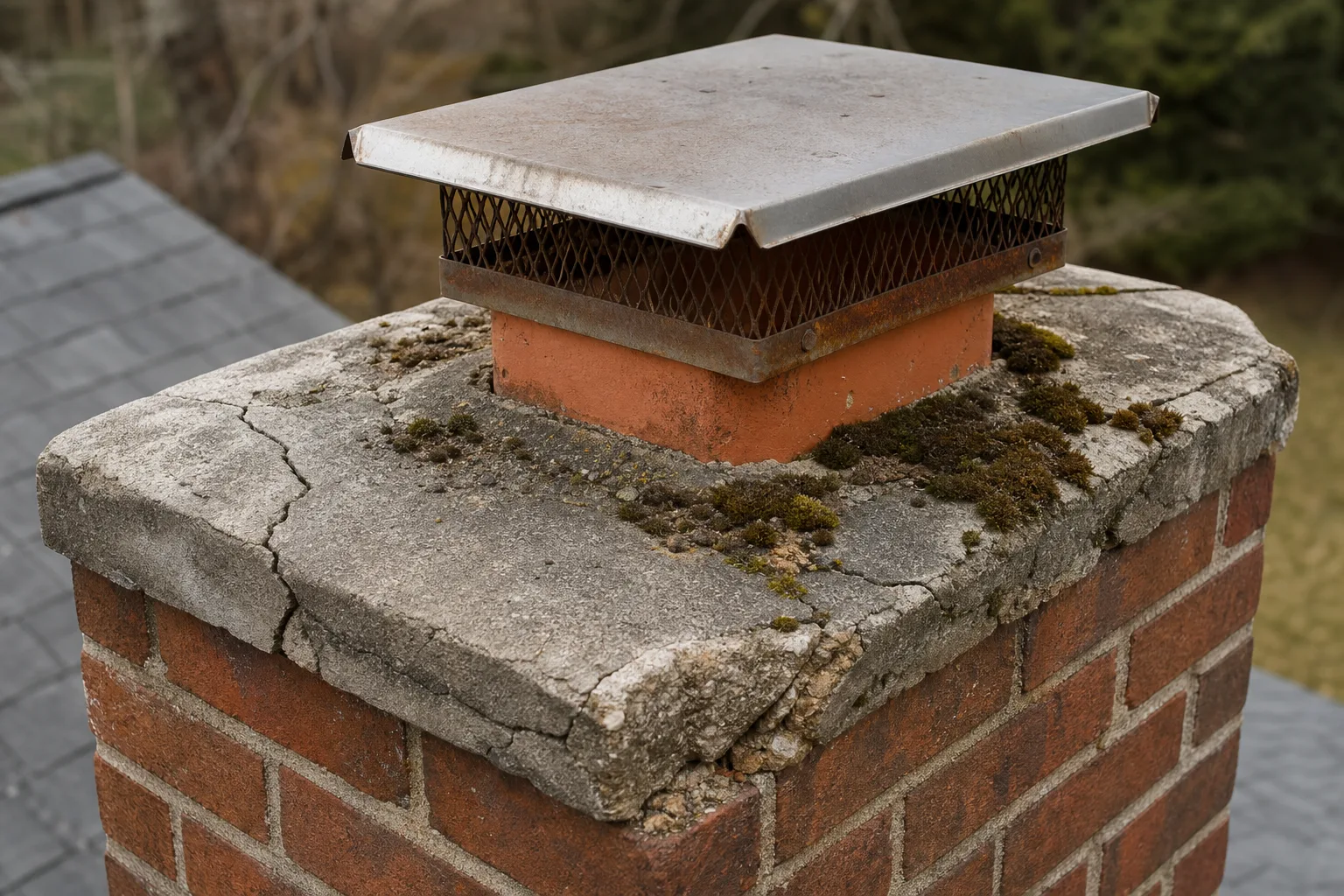
Structural chimney repair services deal with things that can be visible from the ground: joints gone sandy and recessed, brick faces popped off, a crown with cracks running across it, firebrick inside the firebox that has split.
Repointing and tuckpointing live here. So does crown rebuilding, and partial or full rebuilds of a stack that has moved.
The venting path
This is the inside. The flue, the liner that protects it, the damper that opens and closes, and the cap at the top.
The venting path carries combustion gases out of your house. When it fails, it can fail where nobody can see it, which is the whole reason a camera exists in this trade.
Relining, chimney flue liner repair, fireplace damper replacement, and cap installation all belong to this group.
Water management: the quiet half of chimney repair services
Water is what this entire branch exists to keep out, and it is the reason a chimney that looks fine from the street can be quietly coming apart.
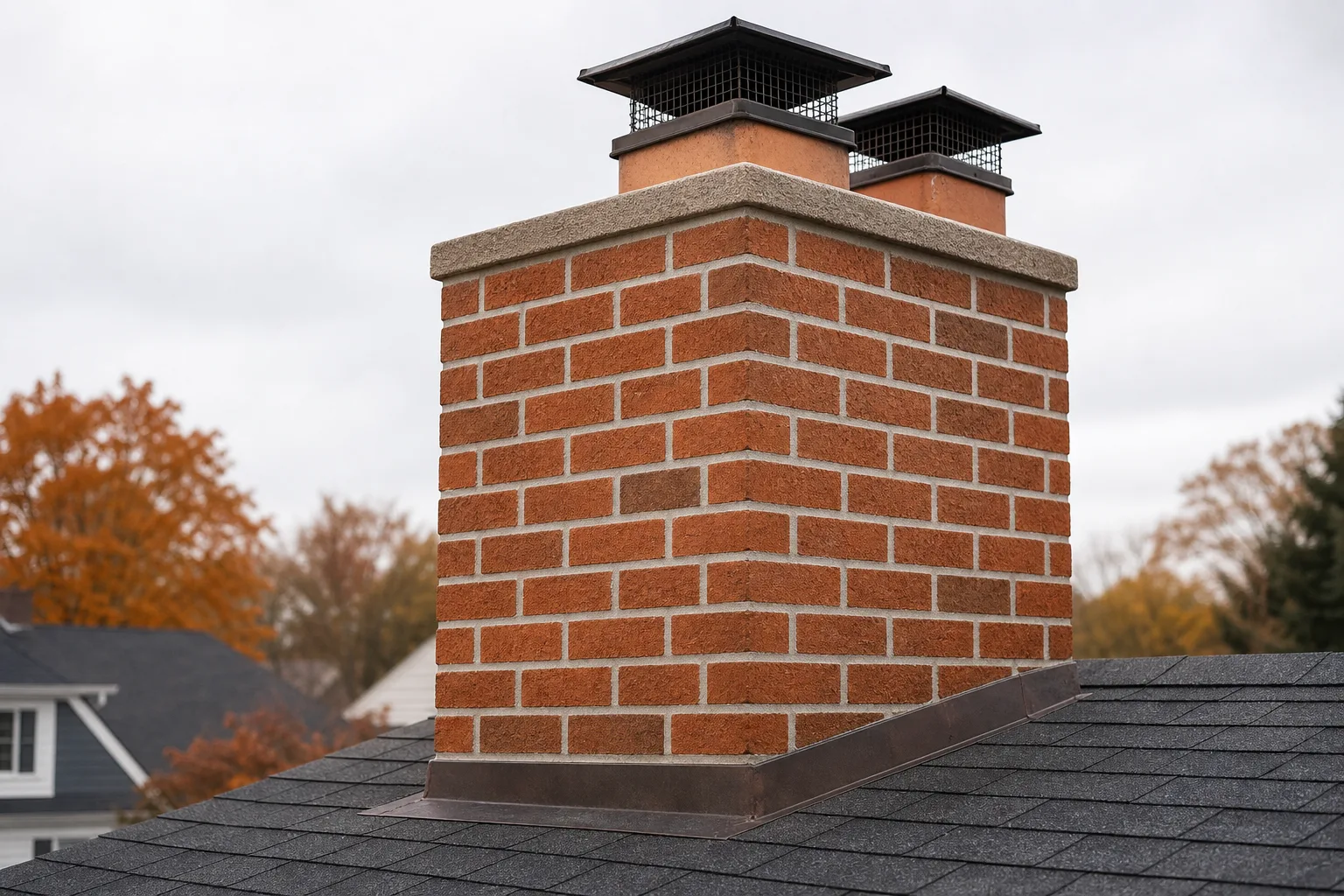
That means flashing where the stack passes through the roof, the cap that keeps rain out of the flue, the chase cover on a factory-built system, the crown that sheds water off the top, and sometimes a breathable masonry sealant on the brick face.
Good to know: when a written estimate has line items you do not recognize, ask which of the three systems each one belongs to. Structure, venting, or water. Line items get a lot more readable once they are sorted that way.
So which one is yours? You can narrow it down without leaving the ground.
Start With What You Can See: What to Have Checked First
A chimney problem can announce itself somewhere you can actually look. Not in the flue, where you cannot see anything, but on the ceiling, in the gutter, or in the room.
Find yours below. Treat these as what to have looked at, not as a diagnosis. Only somebody who gets eyes on the chimney can tell you which one it turned out to be.
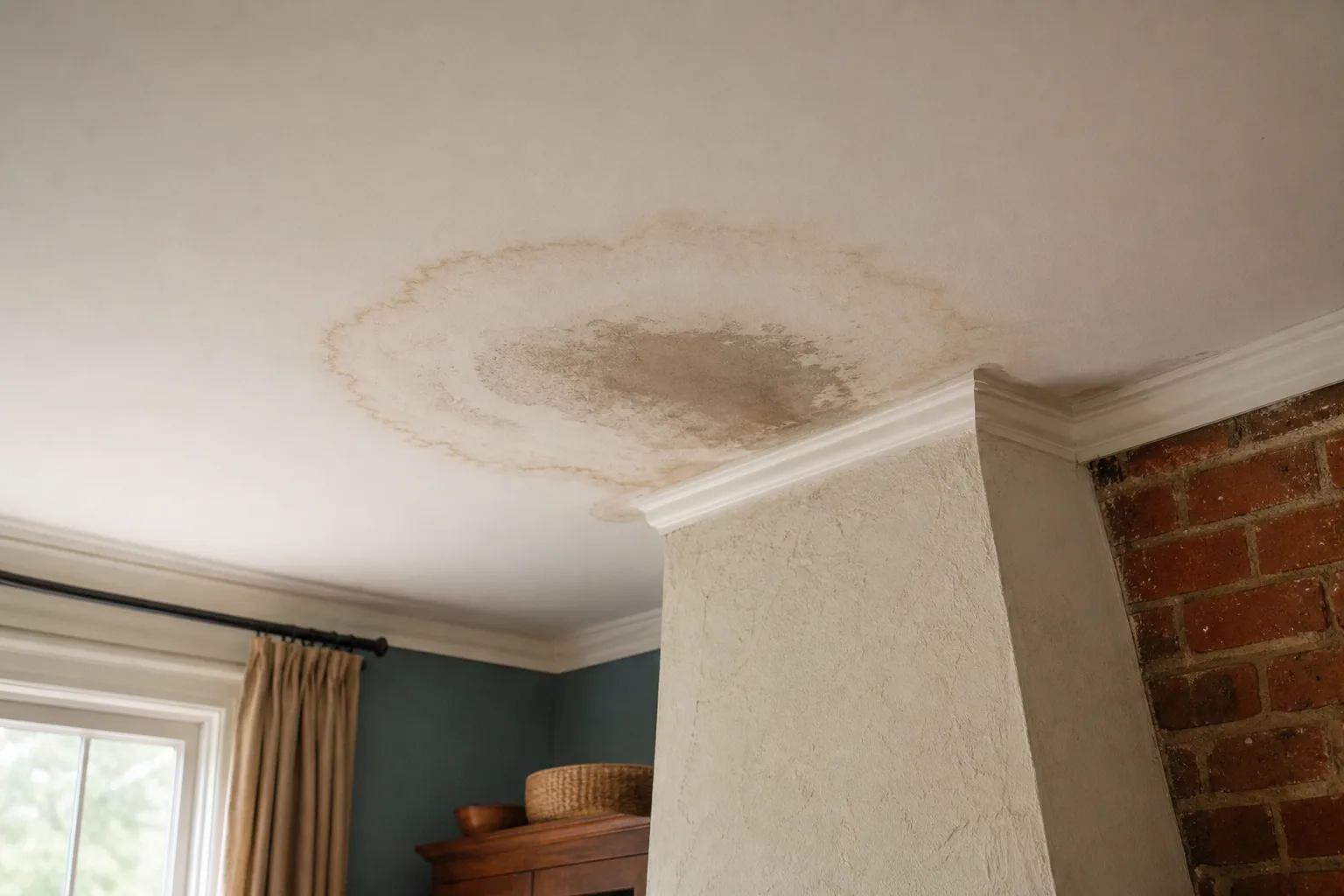
A brown stain on the ceiling beside the chimney
Water is getting into the structure and traveling. The question is where it entered, and there is more than one candidate.
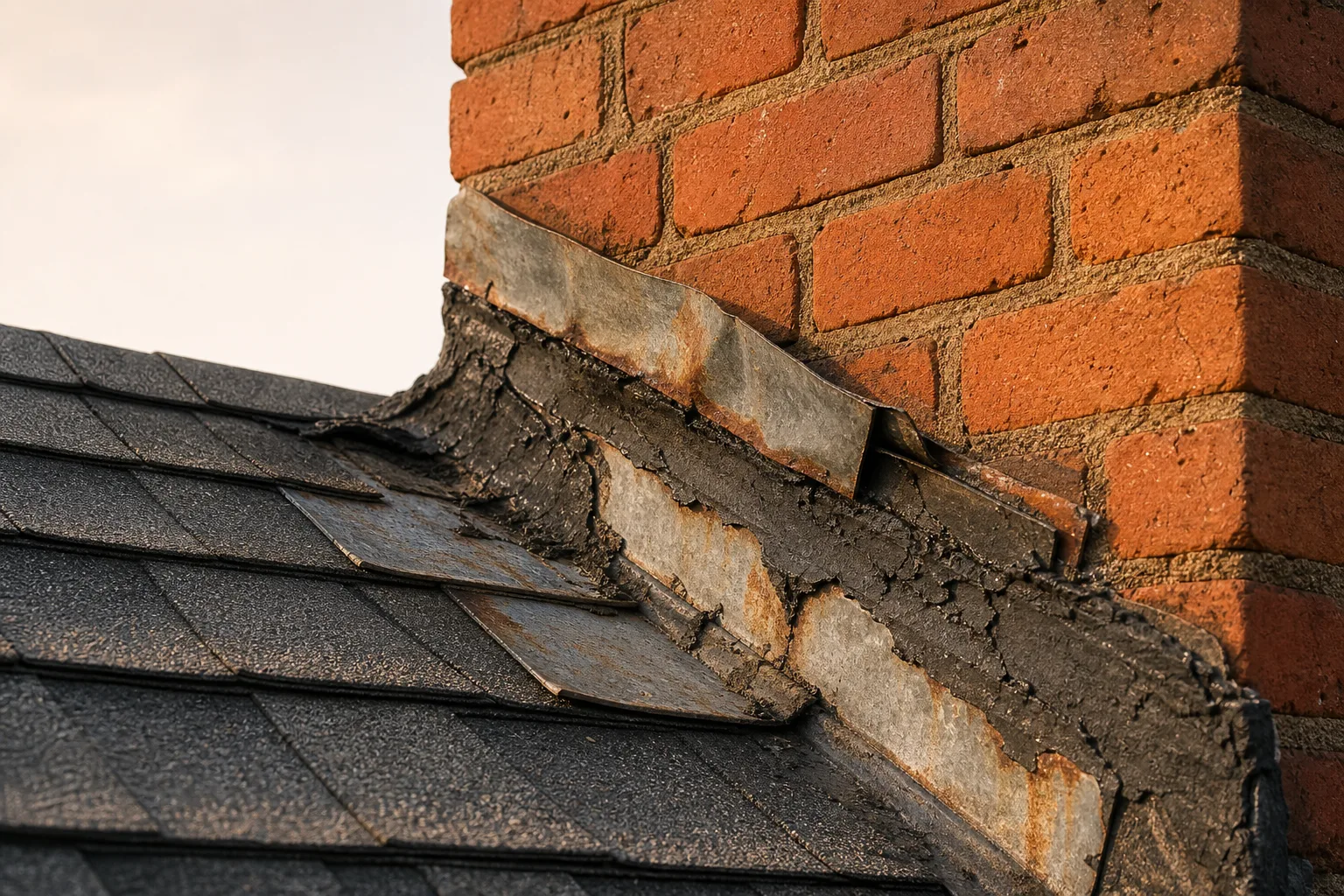
It can be the flashing, the metal that seals the seam where the chimney passes through the roof. When flashing lifts or rusts or pulls away, wind-driven rain and melting snow can run down the side of the stack and into the framing.
But flashing is not the only path.
Myth vs. fact: "Water near the chimney means the roof is leaking." Not necessarily. Mortar joints degrade over decades, and once a joint cracks or recedes, water can enter through the brick face directly. Flashing repair cannot stop water that is coming in through the masonry itself. Same stain, different repair.
So a company that looks only at your roofline has not finished looking. Ask what else was ruled out.
Brick crumbs and flakes in the gutter
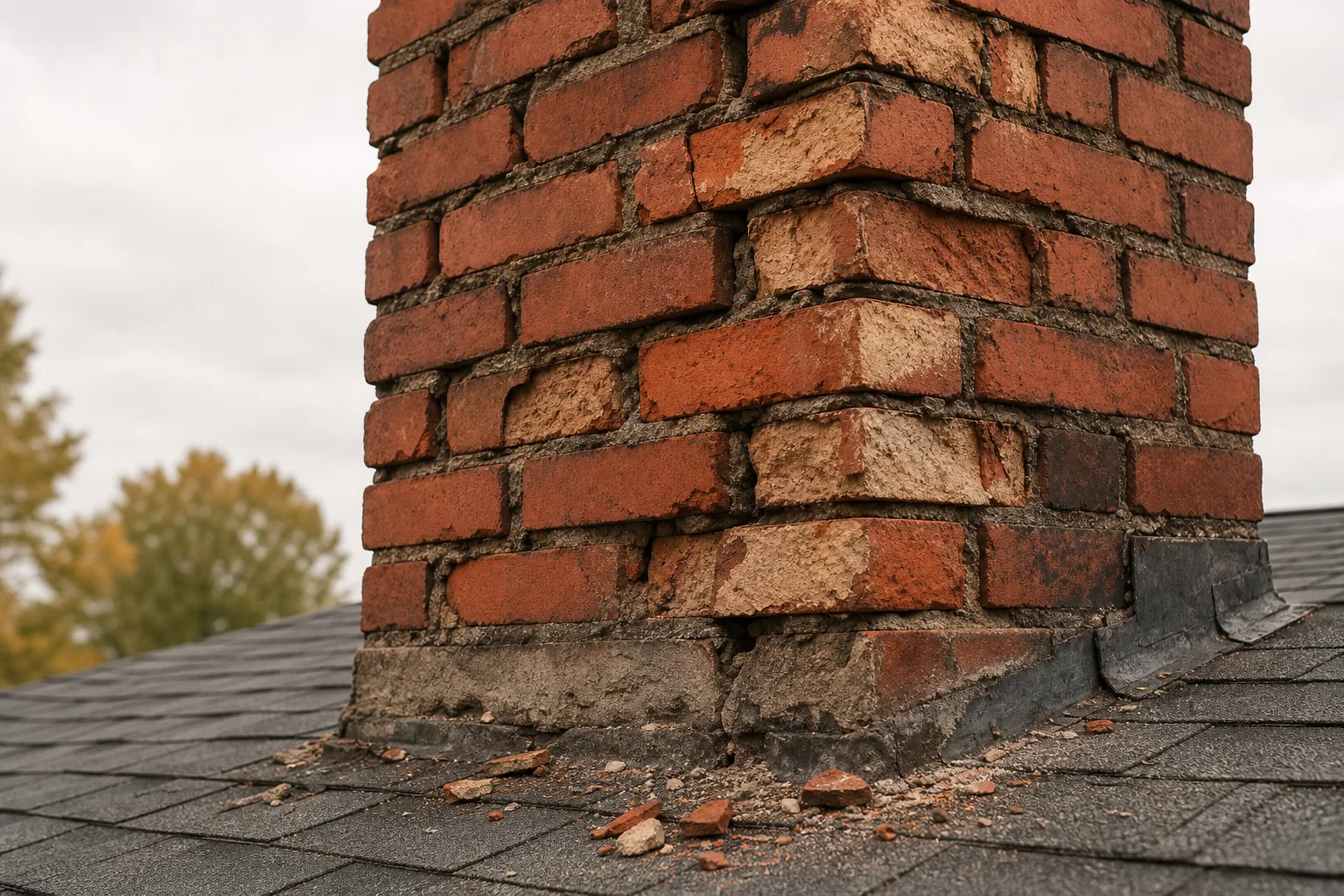
Those are worth having checked for spalling. Brick absorbs water, the water freezes, it expands, and the face of the brick can pop off, leaving a lighter and sandier surface behind.
It is a moisture failure wearing a cosmetic disguise. The exposed interior of the brick soaks up water faster than the face did, so it is not a problem that sits still.
Spalling and deteriorated mortar joints can turn up together, and the repair can cover both.
A smoky smell, or smoke coming into the room
Something in the venting path is not doing its job. A blocked flue, a damper that will not open fully, a liner defect, or a draft problem are all on the list, and chimney flue repair may or may not be where it lands.
Treat this one differently from the others. Combustion gases in living space is a safety question, not a maintenance question, and it belongs in front of a professional now rather than on a spring to-do list.
Debris in the firebox, or noise up the flue
Falling mortar and clay fragments point upward, toward the liner or the crown. Scratching and rustling point toward an animal, and bird removal from a chimney is its own kind of visit.
If you have been finding twigs in the firebox, have somebody check whether the cap at the top is still there and still intact.
Not sure which repair yours needs?
You do not have to figure it out from the driveway. Tell us what you are seeing and we will match you with a local chimney repair company that can get eyes on it, inside and out.
Get matched with a local pro. Call (513) 655-6702.
The Repair Scale: Small Jobs, Medium Jobs, and the Big One
I am not going to publish dollar figures, and you should be skeptical of anyone who quotes your chimney without seeing it. Regional labor, access difficulty, stack height, and how far the damage has traveled move the number too much for a published range to mean anything.
Scale is different. Scale is honest, and it is the thing you actually need before an estimate arrives.
Here is how the common chimney repair services line up against each other.
| Repair | What can fail | What the work can involve | Relative scale | What can prompt it |
|---|---|---|---|---|
| Chimney cap | Cap missing, rusted, or crushed over the flue | Sizing and installing a new cap on the flue tile | Smallest of the group | Animals, rain in the flue, debris in the firebox |
| Damper repair or replacement | Damper stuck, warped, or not sealing | Freeing or replacing the damper assembly | Small | Draft complaints, cold air, odor in warm weather |
| Chase cover | Chase cover rusted, loose, or holding standing water | Fabricating and fitting a new cover | Small to medium | Rust streaks running down a prefab chase |
| Flashing | Flashing lifted, rusted, or tarred over | Removing old material, resetting step and counter-flashing | Medium | Ceiling stain near the chimney |
| Tuckpointing and repointing | Mortar joints sandy, cracked, or recessed | Grinding out failed joints, packing fresh mortar | Medium, scales with the area involved | Brick crumbs, spalling, water through the face |
| Crown repair or rebuild | Crown slab cracked or crumbling | Patching, or removing and recasting the crown | Medium | Cracks visible on top, debris in the firebox |
| Firebox repair | Firebrick cracked, joints failed inside | Replacing firebrick and repairing joints | Medium to large | Visible cracks and gaps inside the firebox |
| Relining | Liner cracked, gapped, deteriorated, or absent | Installing a new liner through the full flue | Largest of the group | Camera findings, chimney fire, appliance change |
Notice what sits at the bottom of that table. Chimney liner installation is the largest job on the list, and it is the one that can land in an estimate a homeowner was not braced for.
That is not a reason to assume it is wrong. Liners do fail, and a failed liner is a real hazard, which is exactly why the recommendation deserves to rest on more than a look up the fireplace with a flashlight.
Pro tip: before you ask for a number, ask which category the repair falls in. "Is this a water repair, a masonry repair, or a venting repair?" A company that answers that cleanly is a company that has actually diagnosed something.
Inspection Levels: The Vocabulary That Decides Your Scope
An inspection is what shapes a chimney estimate, and there are three defined kinds. NFPA 211 sets out Levels 1, 2 and 3, and each level includes everything in the level below it.
Learn these three words. They are the fastest way to sound informed when you call about chimney repair services, and you can use them on the phone today.
Level 1: the annual baseline
This is the standard inspection for a system staying in continued service with no changes and no known problems. Same appliance, same fuel, same use as last year.
The technician examines the readily accessible parts of the chimney inside and out, plus the accessible parts of the appliance and the connection, checking the basic soundness of the structure and the flue.
Worth knowing what it is not. A Level 1 does not require a camera, and rooftop access is not within its scope. It is a baseline, not a deep look. If you want either of those, say so when you book.
Level 2: the one with the camera
Level 2 includes everything in a Level 1 and adds a video scan that records the inside of the flue. No demolition, but real eyes on surfaces nobody can otherwise see.
Safety note: under NFPA 211, a Level 2 inspection is required at the sale or transfer of a property, when the system changes (fuel, appliance, relining, shape, or material), after a malfunction, after a chimney fire, and after an external event likely to have damaged the chimney. Those are not upsell situations. That is the standard.
If you are buying or selling a house with a fireplace, this is the inspection the standard points you to.
Level 3: only when something is hidden
Level 3 is for suspected concealed hazards that a Level 1 or Level 2 cannot properly evaluate. It can involve opening or removing portions of the chimney or the building, but only as much as is needed to investigate that specific concern.
Note the trigger. It is the suspicion of a concealed hazard, on its own terms. If someone proposes a Level 3, they owe you a clear account of what they suspect and why a camera could not settle it.
How to Tell a Real Diagnosis From an Upsell
Here are the four questions I promised you.
I want to be careful about the framing, because the honest position is not that companies selling chimney repair services are out to get you. The certification that exists in this field is real. CSIA certifies chimney sweeps, and its curriculum prescribes specific methods.
The point is narrower. You cannot see the inside of your own flue, which means you are being asked to buy something you cannot inspect. These four questions close that gap.
1. "Can you show me?"
A camera scan produces footage. A crown crack photographs. Spalling photographs. A gap in a liner joint shows up on video.
Anyone recommending significant chimney repair services should be able to put something on a screen and point at it. Not a diagram of a generic chimney. Yours.
If the answer is a verbal description and nothing else, you have not been shown a problem. You have been told about one.
2. "Which inspection level was this?"
Now you know why this matters. A Level 1 does not require a camera, so if a recommendation turns on the condition of the flue interior, ask what documented that condition.
That is not an accusation. It is asking for the evidence to catch up to the recommendation before the money does.
From the field: the useful move is yours, not theirs. Ask for the footage or the photographs before you ask for the number. Putting the evidence first changes the conversation you are about to have.
3. "What happens if I do nothing for a year?"
This question separates urgency from theater, and it does it fast.
A good answer is specific and calm. "Water keeps entering through those joints, and the freeze cycle this winter can take more brick faces off." A bad answer is vague and loud.
Some chimney problems genuinely cannot wait. Combustion gases entering living space cannot wait. A damaged liner on an appliance you are actively burning cannot wait. For masonry work, ask for the timeline in plain terms, and expect a professional to be able to give you one.
4. "What is the smaller version of this repair, and why is it not enough?"
Ask whether a lighter version of the repair exists. Crown patch instead of crown rebuild. Partial repointing instead of full. Liner repair instead of full relining.
Sometimes the lighter version is genuinely inadequate, and a company that explains exactly why has just earned your trust. Sometimes it was never mentioned because nobody asked.
Ask.
What to Do Before Anyone Comes Out
You can make the visit substantially more useful with about twenty minutes of work, none of which involves a ladder.
- Photograph the chimney from the ground on every side you can reach, and zoom in on the top of the stack.
- Photograph the stain, crack, or debris that made you start looking, with something in frame for scale.
- Check the gutters and the roof edge for brick flakes and mortar crumbs.
- Note when the problem shows up. After rain? During a specific wind direction? Only when you burn?
- Gather any paperwork from previous chimney repair services, inspections, chimney maintenance, or roof work, including anything from a home inspection.
- Know your setup before the call: open fireplace, insert, wood stove, gas log, or a furnace venting into the same chimney.
- Write down the four questions above so you are not improvising while somebody is standing in your living room.
- Do not get on the roof. Ask the company what its inspection covers instead, since rooftop access is not within Level 1 scope, and say so when you book if you want the top of the stack looked at.
Good to know: ground-level photographs are worth the twenty minutes on both ends. They give a company something concrete to react to before a truck is scheduled, and they give you a dated record of what the chimney looked like before anybody touched it.
How VIO Helps With Chimney Repair Services
VIO is not a chimney company. We do not own trucks and we do not employ sweeps, and being straight about that is the whole basis of this article.
What we do is match homeowners with independent local companies that handle chimney repair services in their area. You describe what you are seeing, and we route it to a company that does that category of work near you.
Because we are the referral layer and not the contractor, we are not quoting the chimney repair services we recommend. That is why the section above could be written honestly. We have no reline to sell you.
The company we match you with is an independent local business, and its license, its insurance, and its certifications are yours to ask for and yours to verify. Ask for all three, and check them.
On estimates, the move is yours: insist on a written estimate before any work starts, and do not let work begin without one in your hands. A written scope is what turns four good questions into four answers you can hold somebody to.
Get your chimney looked at before the first fire
Late summer sits ahead of the heating season, which makes it a sensible time to have the chimney looked at rather than during the months you want to be burning in it.
Tell us what is going on and we will connect you with an independent chimney repair company near you.
Request service. Call (513) 655-6702.
Symptom checker
What is your chimney doing?
Tap the closest match for an honest first answer.