



On this pageWhat people mean by chimney parts, and why there are two different lists8 sections+7
- What people mean by chimney parts, and why there are two different lists
- Chimney parts at the bottom of the system
- The transition zone: damper, smoke shelf and smoke chamber
- The flue and the liner, the chimney part you cannot see
- Chimney parts at the top: crown, chase cover, cap and pot
- The masonry, the flashing, and the chimney parts that handle water
- Which chimney parts you can check yourself, and what to say when you call
- How VIO helps with chimney parts
Quick answer
Chimney parts are the components that carry a fire's byproducts safely above the roof: the firebox, the lintel and hearth extension, the damper, the smoke shelf and smoke chamber, the flue and its liner, the masonry stack or the metal chase, the crown or chase cover, the cap, and the flashing where the chimney meets the roof. A masonry chimney and a factory-built chimney do the same jobs with different hardware, so the two parts lists are not interchangeable.
A chimney report comes back with words on it. Crown. Chase cover. Smoke chamber. Flashing. None of them mean anything yet, and the figure at the bottom of the page means even less until they do.
Searching for chimney parts, in that situation, is not curiosity about masonry. It is decoding. And underneath it sits a question that does not fit in a search box: is this real, and is it mine?
So this is not a glossary. It is a map.
We are going to walk up the system, from the floor of the firebox to the cap on top. Every part gets the same four things: what it is, what it does, what it can look like when it is not doing its job, and who can put hands on it.
What people mean by chimney parts, and why there are two different lists
A chimney is a venting system, not a decoration with a hole in it. The chimney parts are the components that take the byproducts of a fire from the place it burns to a point safely above your roof, and keep the heat and the water away from everything else on the way.
Here is the part that changes how you read everything else. There are two different parts lists, and a guide you are reading may be describing a chimney you do not own.
Masonry chimney parts
A masonry chimney is built on site out of brick, block or stone, sitting on its own concrete footing. It is a structure, its parts are things a mason made, and what goes wrong with it is what a mason repairs.
Factory-built chimney parts
A factory-built chimney, sometimes called a prefab fireplace system, is a listed metal assembly. The firebox and the pipe sections are manufactured components, tested and listed together, living inside a framed box clad in siding, stucco or wood. That box is the chase.
The two systems do the same jobs with different hardware, which is why the part names diverge.
| What the job is | On a masonry chimney | On a factory-built chimney |
|---|---|---|
| Seals the top of the structure | Crown, a poured concrete or masonry slab | Chase cover, a sheet metal lid |
| Forms the structure | Brick and mortar on a concrete footing | A framed chase clad in siding, stucco or wood |
| Carries the exhaust | Flue, lined with clay tile, cast-in-place material or stainless steel | Listed metal chimney pipe sections |
| Contains the fire | Firebox built of firebrick and refractory mortar | A listed metal firebox, part of the assembly |
| Covers the flue opening | Chimney cap, sometimes over a clay or metal pot | Chimney cap sized to the pipe |
| What repair can look like | Rebuilding, repointing, recasting, relining | Replacing the component, per the manufacturer |
Good to know: the last row is the real dividing line. A masonry chimney is a structure, so it gets repaired. A factory-built chimney is a listed assembly, so its parts get replaced with what the manufacturer specifies. Mixing parts between systems is not a shortcut, and the product's own instructions govern.
Chimney parts at the bottom of the system
Start where you can see. Everything in this section is visible from a chair in your own living room, which makes it the easiest place to build vocabulary.
The firebox
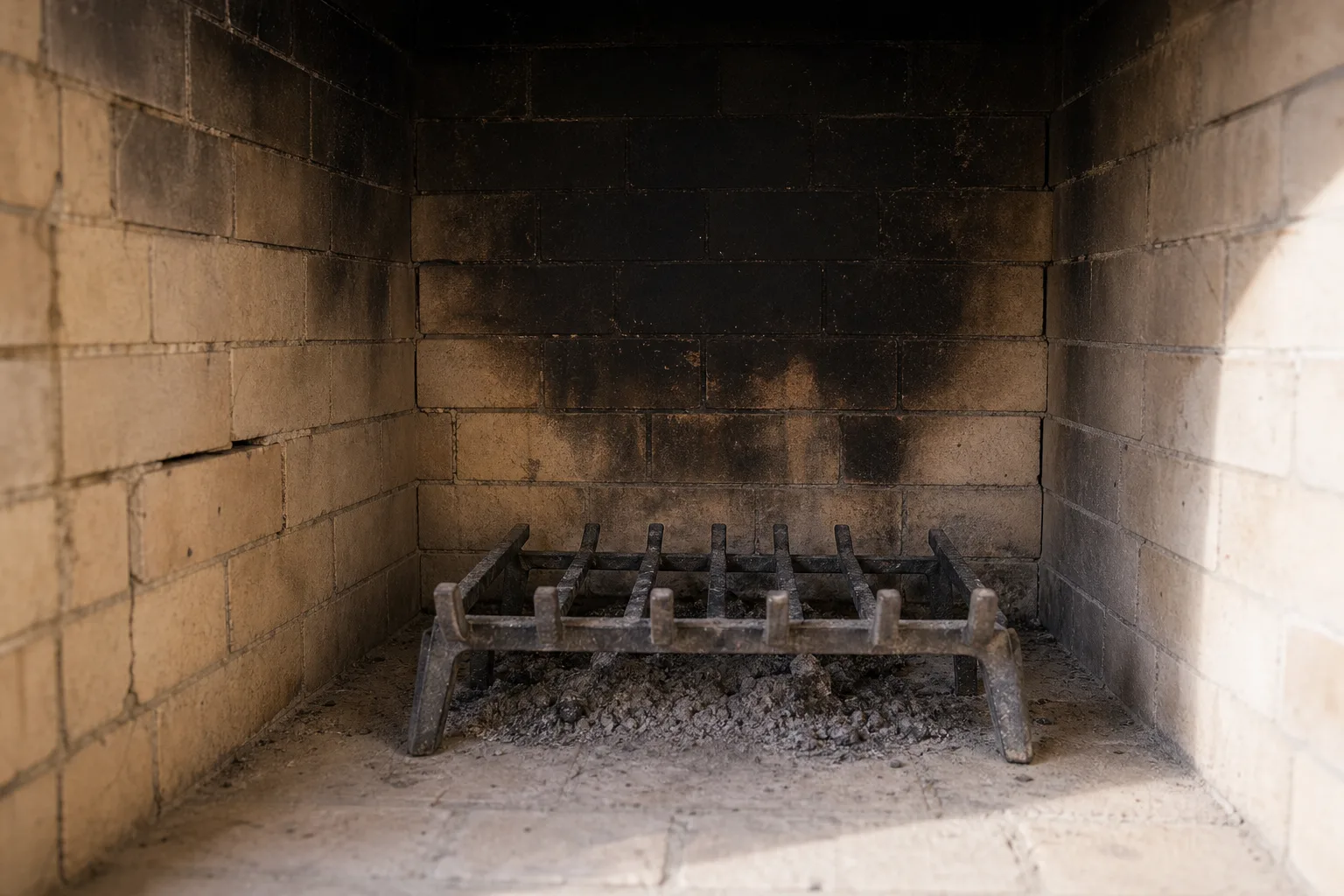
The firebox is the chamber where the fire burns. On a masonry fireplace it is built of firebrick laid in thin joints with refractory mortar, which is mortar rated for high-temperature service.
Real firebrick is pale tan or buff, and after a season of use the back wall and the top are black with soot. Clean and white is what showrooms look like, not what houses look like.
What it can look like when something is wrong: cracked bricks, joints opened into gaps you can slide a coin into, or a back wall where the face of the brick has spalled away. Any of that goes to a professional to evaluate.
The lintel and the hearth extension
The lintel is the steel or masonry beam spanning the top of the firebox opening, carrying the masonry above it. Crouch and look up at the opening to find its front edge.
The hearth extension is the non-combustible floor area in front of the firebox. It is not trim. It keeps embers and radiant heat off your flooring.
Safety note: clearance to combustible materials is one of the things NFPA 211 addresses, and the required dimension depends on the chimney type and the installation. For a listed appliance or chimney system, the label and the manufacturer's instructions govern. If a rug, a mantel shelf or a piece of furniture sits near an opening and you are unsure, ask your building department or the company that inspects the system.
The ash dump and the cleanout door
Some masonry fireplaces have a hatch in the firebox floor that drops ash into a chamber below. That is the ash dump, and what it collects comes out through the cleanout door: a small cast-iron door set low in the brick, outside at the base of the stack or in a basement wall. Rusty, and easy to forget about.
Not every fireplace has this pair. If yours does not, there is nothing missing.
The transition zone: damper, smoke shelf and smoke chamber
Above the firebox opening the system narrows into a throat, then opens back out before it reaches the flue. This middle stretch is where the chimney parts get harder to see and easier to misunderstand.
The damper
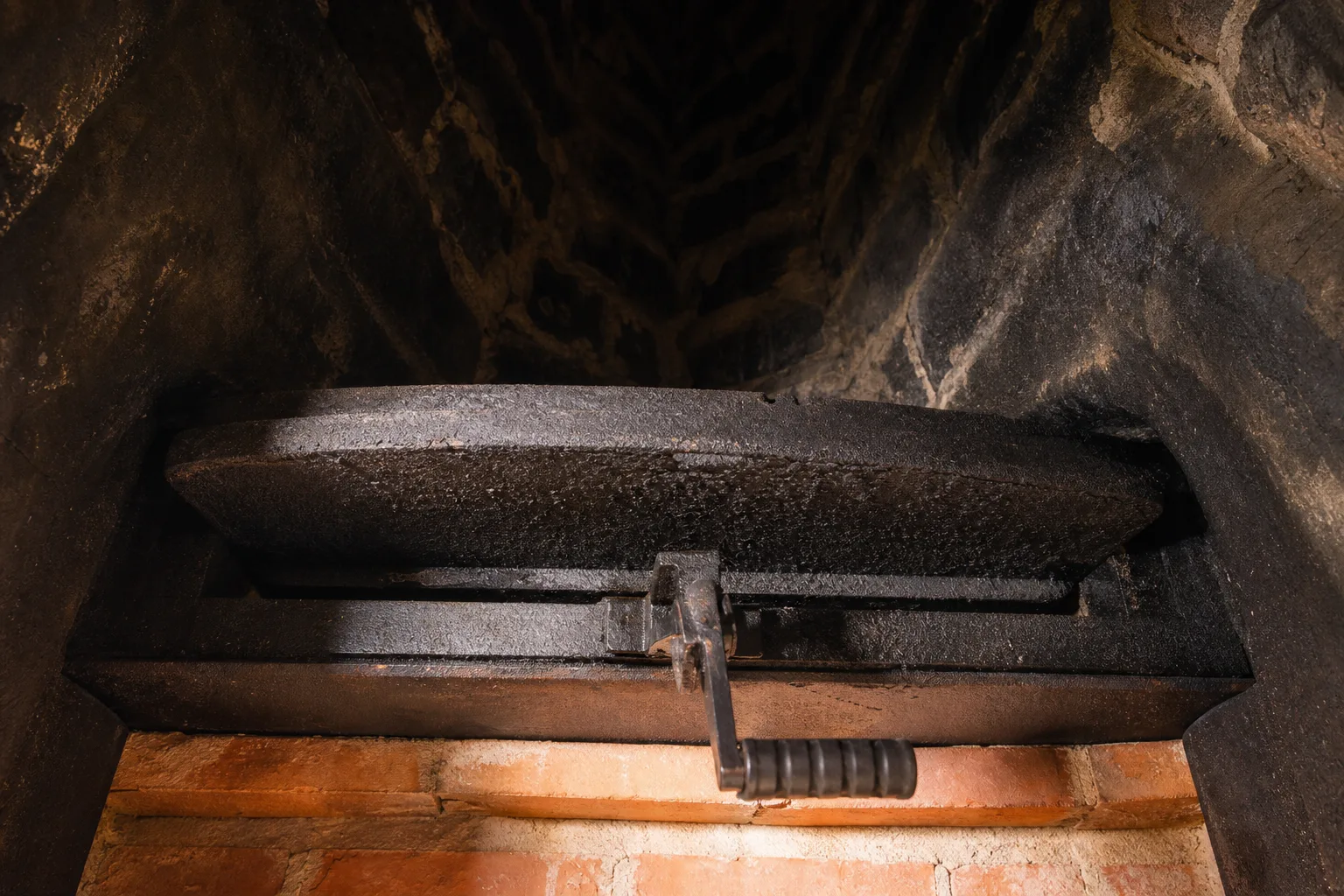
A chimney damper controls the flow of air and smoke in the chimney. The familiar form is a heavy plate sitting in the throat above the firebox opening, worked by a lever, a knob or a ratchet handle.
There is a second form. A top-mount damper, also called a top-sealing damper, sits at the top of the flue with a gasket and closes with a cable running down to the firebox.
What it can look like when something is wrong: a plate that will not swing fully open or fully closed, a handle that moves with no resistance, or a gap you can see daylight through when it is supposed to be shut.
Myth vs. fact: the myth is that every masonry fireplace has a throat damper. Most do, but not all. Some were built without one, some have had a damaged throat damper removed and a top-mount damper fitted instead, and some fireplaces converted to gas have had the damper plate fixed in an open position on purpose. Look before you assume which kind you have.
The smoke shelf and the smoke chamber
Above the damper and below the flue is the smoke chamber, shaped like an inverted funnel. Its job is to take the wide output of the fireplace and gather it into the much narrower flue above. The smoke shelf is the flat area at the bottom of it, behind the damper, and debris coming down the flue tends to land there.
Residential building code limits how sharply the chamber walls can slope, at a maximum of 45 degrees from vertical. The interior surface is supposed to be smooth, and parging is the work of smoothing and sealing that masonry with refractory mortar.
You cannot inspect any of this from your living room. Looking at it properly takes a mirror and a light at minimum.
The flue and the liner, the chimney part you cannot see
The flue is the vertical passage that carries combustion byproducts out of the building. The chimney flue liner is the surface of that passage.
People use the two words interchangeably and they are not the same thing. The flue is the space. The liner is what the space is made of, and among the chimney parts on this page it is one you have almost no chance of ever seeing yourself.
What the liner is there to do
A liner stands between the heat and byproducts of a fire and the chimney structure around it. It also gives the passage a smooth, correctly sized surface for the appliance it serves.
That is a separate question from clearance. Combustible framing near a chimney has to keep the clearance NFPA 211 requires, or, for a listed system, the clearance given in the product's listing and installation instructions. A liner does not make contact between framing and a chimney acceptable.
NFPA 211 treats a suitable liner as standard for a chimney in service. An unlined flue is not a routine maintenance item. It is a condition to be evaluated by a professional before anything gets burned in it.
The three liner materials you will hear named
Clay tile is what older masonry chimneys were commonly built with: terra cotta sections, orange-brown, mortared end to end.
Cast-in-place liners are poured against the inside of the existing flue, forming a new continuous surface.
A stainless steel chimney liner comes as rigid or flexible pipe, often insulated, run down the existing flue. Where one is installed, the manufacturer's instructions and that product's listing govern how it is sized and fitted.
Pro tip: if an inspection report says your flue is unlined, or says the clay tiles are cracked or displaced, stop treating the chimney as available for use and get the evaluation before you get quotes. The order matters. You cannot compare bids on a job that has not been scoped yet.
Not sure which part you are actually looking at?
Describe what you can see, a stain on the wall, a crack, a piece of debris that showed up in the firebox, and we will match you with an independent local chimney company that can get eyes on the parts you cannot reach.
Call (513) 655-6702, or request service online.
Chimney parts at the top: crown, chase cover, cap and pot
The chimney parts up here share one job. Keep water out of a masonry structure, or out of a metal assembly that water will happily destroy from the inside.
The crown, on a masonry chimney
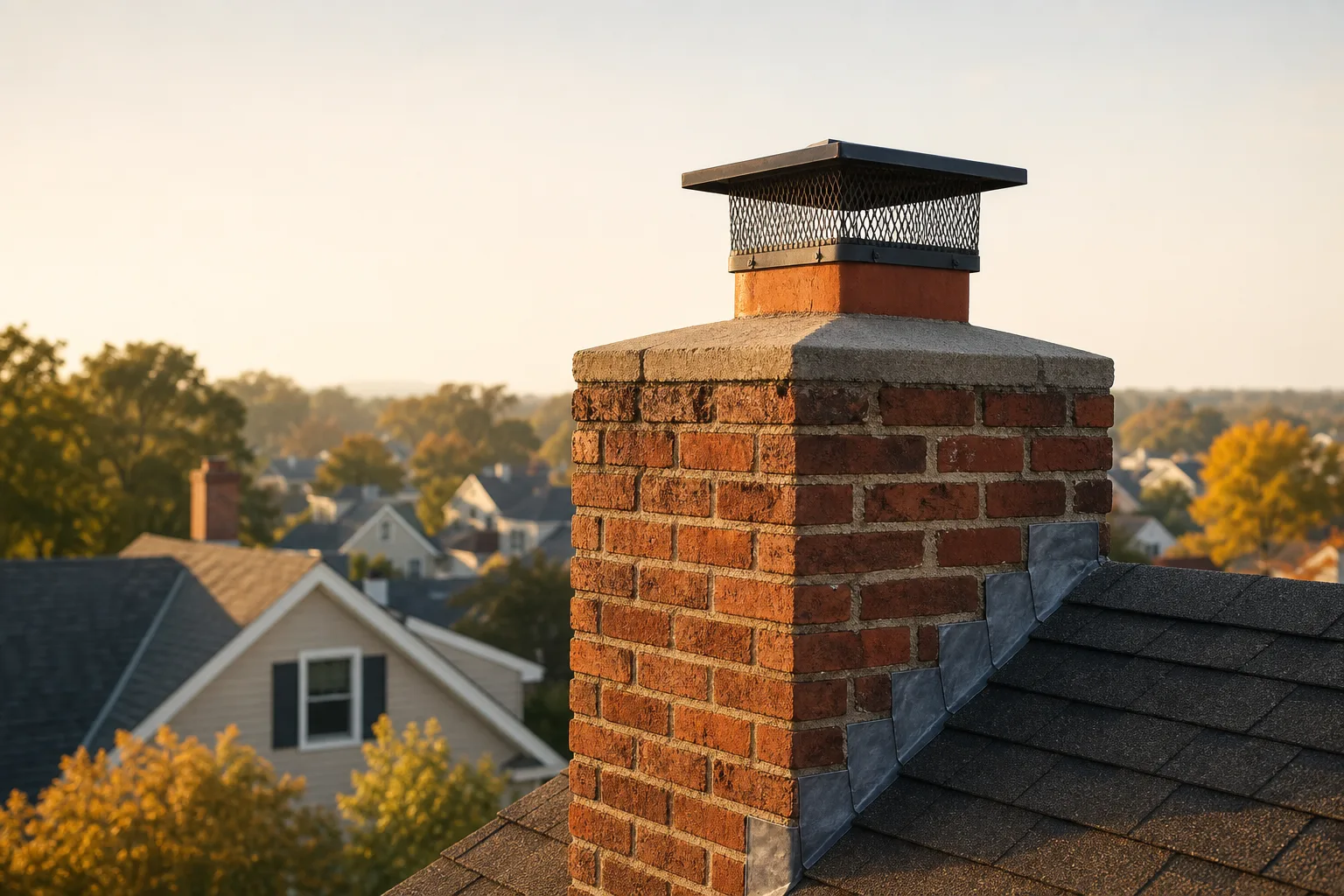
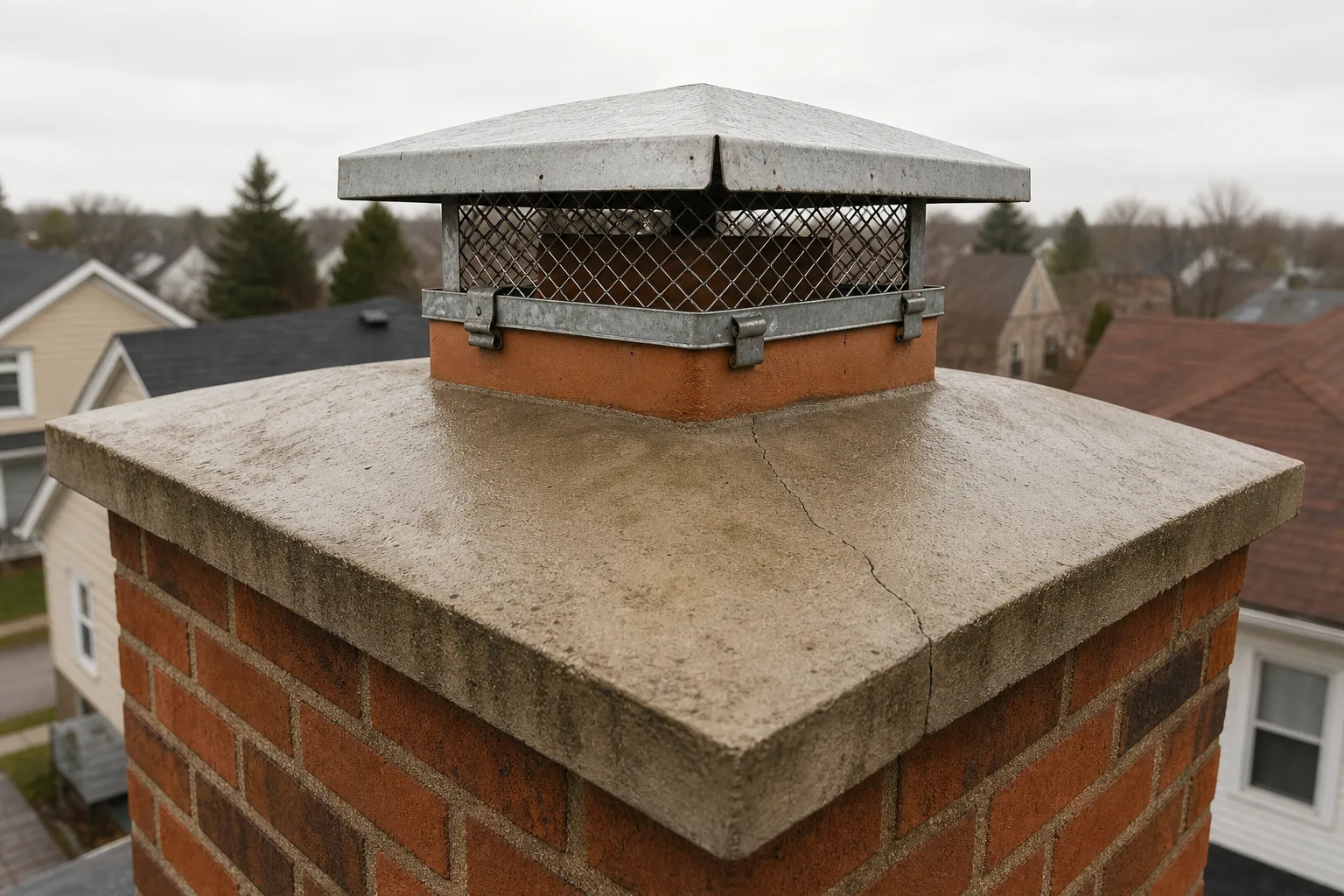
The crown is the concrete or masonry slab that seals the top of a masonry chimney around the flue liner. It is not the cap, and the two names get used for each other.
CSIA recommends that crowns be cast or formed using Portland cement, with a minimum two-inch overhang on all sides of the chimney so that runoff drips clear of the brick instead of down it.
A real crown is grey, sloped away from the flue tile, and washed dirty by rain. What it can look like when something is wrong: hairline cracks radiating across the slab, a section that has broken away at an edge, or no overhang at all, which is a design shortcut rather than a failure.
The chase cover, on a factory-built chimney
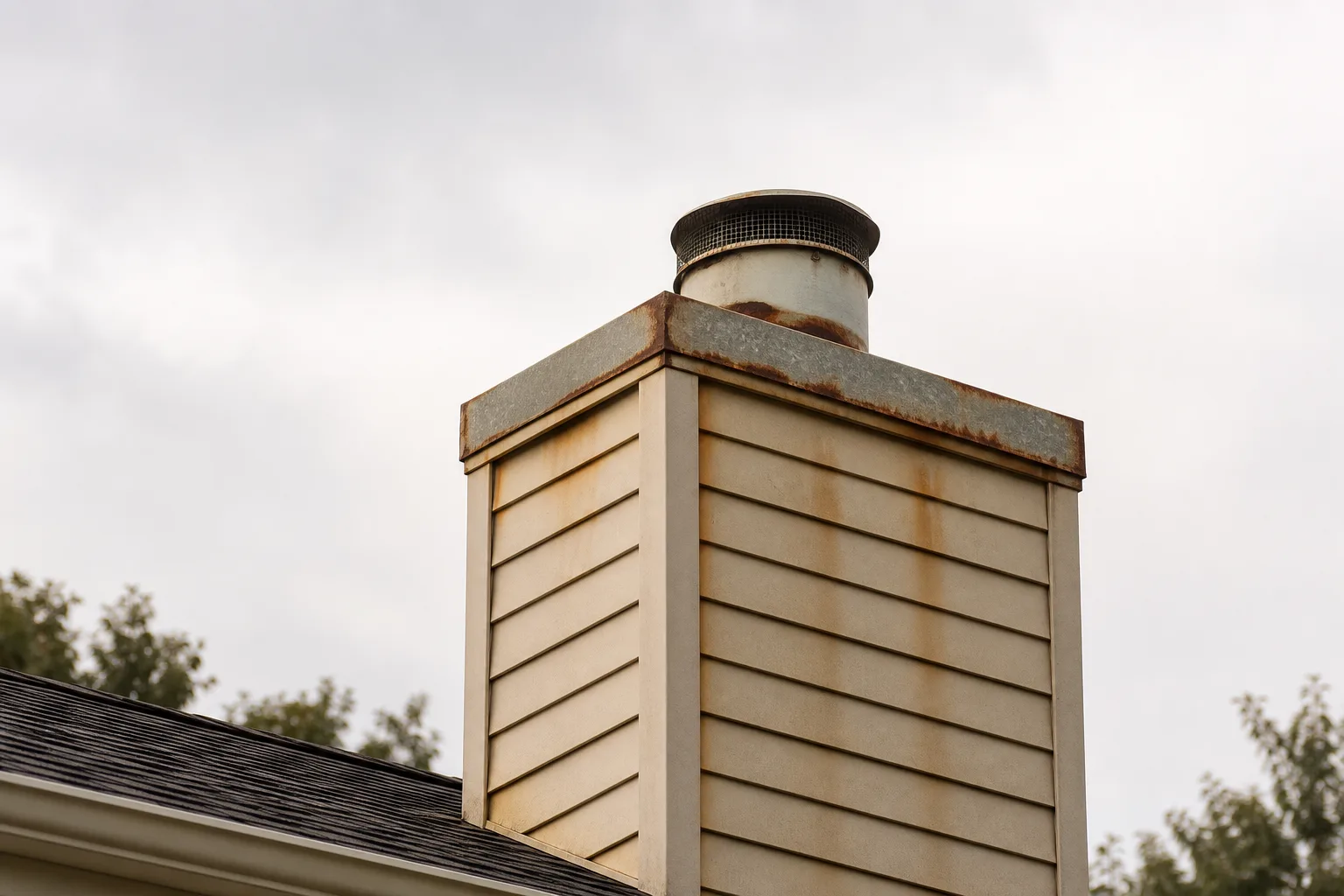
The chase cover does the crown's job on a factory-built chimney. It is a sheet metal lid over the top of the chase with a collar in the middle for the pipe, made of galvanized steel, aluminum, stainless steel or copper.
Galvanized steel is the rust-prone option. Stainless steel and copper are the corrosion-resistant ones. The material your house came with is worth finding out.
What it can look like when something is wrong: a low spot in the middle holding standing water after rain, rust blooming out from the seams, or rust-colored streaks running down the siding underneath it.
From the field: that streak on the siding is something you can check from your own driveway, no ladder involved. Walk out, look up at the four sides of the chase, and look for staining below the metal lid. If you see it, you have something specific to describe when you call, which is worth more than a general worry.
The cap and the chimney pot
The chimney cap sits over the flue opening itself. Its purpose is to prevent rain, animals and debris from entering the flue while letting exhaust out, and it commonly includes a mesh spark arrestor on the sides.
A chimney pot is a clay or metal extension fitted on top of the flue at the crown, more common on older and imported designs. On a traditional masonry chimney a clay pot is bedded in mortar; manufactured metal pots can come with their own fittings, and there the manufacturer's instructions govern.
What a cap can look like when something is wrong: mesh torn or missing, the whole unit sitting crooked, or gone entirely, which you can sometimes tell from the ground.
The masonry, the flashing, and the chimney parts that handle water
Brick, mortar and the wythe
The stack itself is brick or block laid in mortar, and the mortar joints are where weather does its work. Water gets into open joints, freezes, and can take the joint apart a little further each winter.
Repointing is the repair: cutting out the failed mortar and replacing it. It sits next to what tuckpointing is, which is a related mortar-joint operation on the same brickwork. If damage has gone past the joints into the units themselves, that becomes rebuilding.
Inside a chimney serving more than one appliance there can be a wythe, a vertical masonry wall dividing two flues so the systems stay separate.
Step flashing and counter flashing
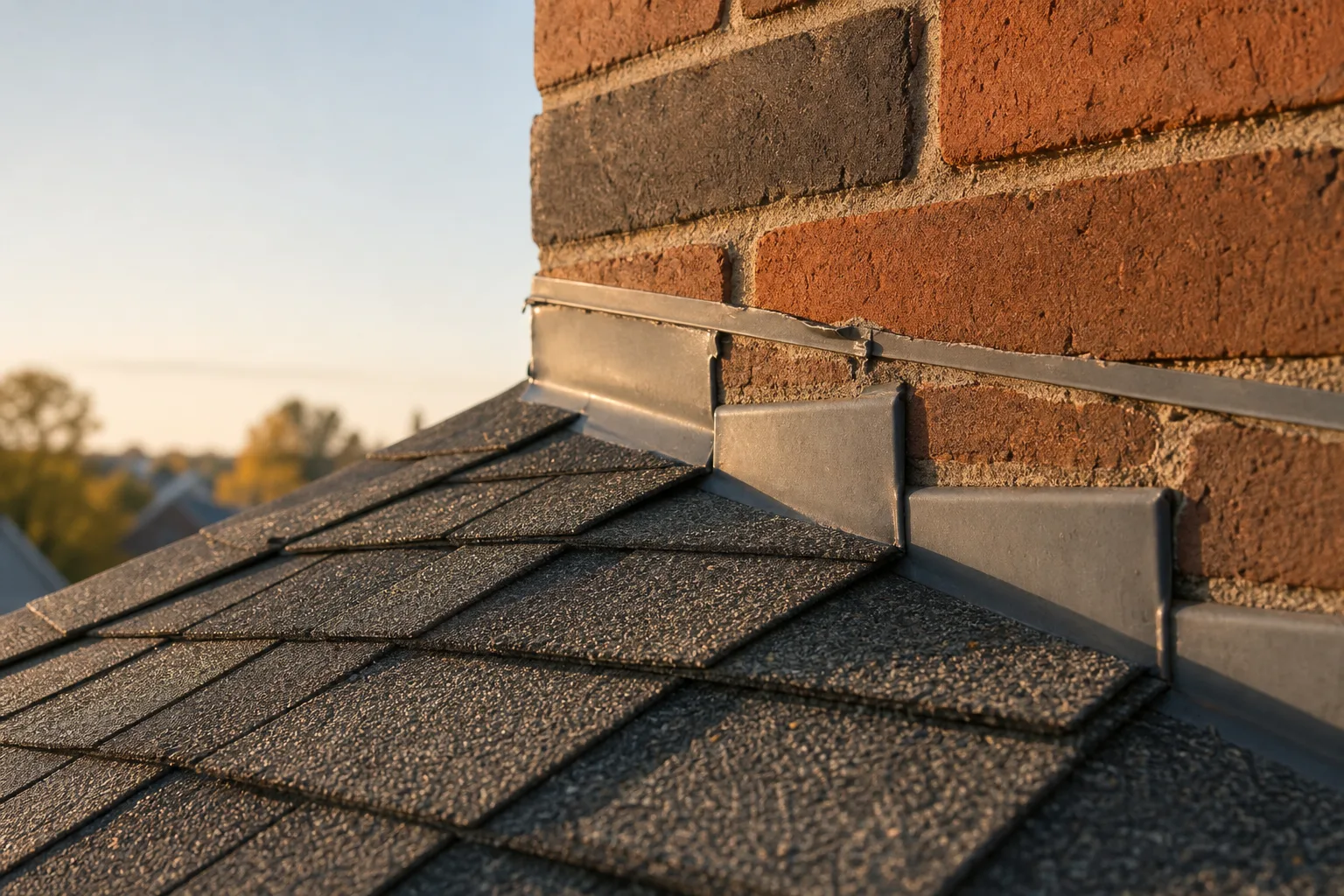
Where the chimney passes through the roof, the joint is closed with sheet metal. In practice it is two layers doing two different jobs.
Step flashing is worked into the roofing courses in a staircase pattern up each side of the chimney. Counter flashing is a second layer let into a cut in the mortar joint above it, lapping over the step flashing so water running down the brick cannot get behind it.
Here is an opinion I will defend. If you learn one detail on this page properly, make it this one, because you can evaluate it from the ground with a pair of binoculars. Sealant smeared across a joint instead of metal let into the brick is visible from the lawn. A hairline crack in a crown is not.
Good to know: chimney height is a code question, not a style question. A chimney is required to extend at least three feet above the roof penetration and at least two feet higher than any part of the structure within ten feet of it. Venting references also set a minimum total height. If a roof addition or a new dormer went up near your chimney, that geometry may have changed.
The parts inside the walls
Firestops block the spread of fire where the chimney passes through floors and ceilings. A thimble is the opening through which an appliance's pipe enters the chimney, and the appliance connector bridges the appliance's flue collar to that thimble.
If a furnace, water heater or stove vents into your chimney, those last two are part of your system, and you will hear them named without ever seeing them.
Which chimney parts you can check yourself, and what to say when you call
Nothing above asks you to climb anything. There is a real line between looking and evaluating, and the useful version of homeowner involvement sits entirely on the looking side, alongside the yearly rhythm of chimney maintenance.
A ground-level walkaround
Do this with your feet on the ground and, if you have them, a pair of binoculars.
- Stand back from the house and look at the top of the chimney. Is a cap there, and is it sitting square?
- On a masonry stack, look at the mortar joints in the upper third, which takes the weather. Look for joints that have receded or opened.
- On a factory-built chase, look for rust streaks on the siding below the metal lid, and for a lid that visibly holds water.
- Look at the roofline where the chimney comes through. Is there stepped metal against the brick, or is there a bead of sealant doing the work?
- Inside, open the damper and look up with a flashlight. Note whether it swings fully and whether you can see obvious debris on the smoke shelf.
- Look at the firebox brick and joints for cracks and gaps.
- Check the wall and ceiling next to the chimney on every floor for staining.
- Find the cleanout door, outside at the base or in the basement, and note whether it opens and closes.
Write down what you saw. That list is what turns a vague call into a specific one.
What to say on the phone
Say what kind of chimney you have, masonry or a factory-built chase, and what appliance uses it. Then read your list.
Then ask three questions. What inspection level are you providing. Does the visit include access to the roof, or is it limited to what is readily accessible from inside. And what are your license and insurance details, so I can check them.
Pro tip: the NFPA 211 inspection levels are worth knowing before you book. Level 1 covers the readily accessible portions of the chimney and the appliance, for a system continuing in service under the same conditions. Level 2 is required when a property is sold or transferred, when the system changes in fuel, appliance, flue shape or material, after a malfunction or a chimney fire, and after an external event likely to have caused damage. Level 3 applies where a concealed hazard is suspected that neither of the other two can evaluate. CSIA recommends yearly inspection for both masonry and prefabricated chimneys.
How VIO helps with chimney parts
VIO is a referral service. We are not the ones who arrive at your house, and we do not employ the people who do.
What we do is connect you with an independent local chimney company in your area. That is the hard part when you are holding a term you learned an hour ago and cannot tell a real line item from an invented one.
You do not need to know which of the chimney parts on this page is your problem before you call. Describing what you saw on the walkaround is enough for a company to know what to look at.
Insist on a written estimate before any work starts, and do not let work begin without one in your hands. Ask the company we match you with for its license and insurance details and check them yourself. Those two habits do more for you than any amount of vocabulary.
Get the parts on your chimney looked at by someone who can reach them
Tell us what you have noticed and what kind of chimney you have, masonry or a factory-built chase, and we will connect you with an independent local chimney company in your area.
Call (513) 655-6702.
Symptom checker
What is your chimney doing?
Tap the closest match for an honest first answer.