



On this pageA Gas Fireplace Keeps Turning Off Because a Safety Device Said No7 sections+6
- A Gas Fireplace Keeps Turning Off Because a Safety Device Said No
- Match What Yours Is Doing to What's Probably Wrong
- The Five-Minute Check You Can Safely Do Yourself
- Thermocouple, Thermopile, and Why a Gas Fireplace Keeps Turning Off
- Which Fireplace Do You Actually Own? It Changes the Answer
- Wind, Draft, and the Rest of Your House
- How VIO Helps When a Gas Fireplace Keeps Turning Off
Quick answer
A gas fireplace keeps turning off when a safety device cuts the gas supply. The usual causes are a weak thermopile or thermocouple that can no longer prove the pilot flame, a dirty pilot orifice, a blocked vent termination, dead remote batteries, or an aging gas valve. The shutdown is the appliance protecting you, not a random fault. Check the batteries and vent clearance yourself, then have a gas technician measure the rest.
The first genuinely cold evening of the season arrives, you press the button, and the fireplace lights exactly the way it always has. Ten minutes later the room is quiet and the glass has gone dark.
You press the button again. Same thing.
If your gas fireplace keeps turning off like that, the useful first thing to understand is that the appliance did not fail. It refused. Somewhere inside that unit, a device whose entire job is to stop the flow of gas decided the conditions were not right, and it did what it was built to do.
That distinction matters, because it changes what you are looking for. You are not hunting for something broken at random. You are asking a more specific question: which safety device said no, and what convinced it?
This guide is organized around the thing you can actually see, which is the pattern. Not the part. You do not know your parts yet. You know that it runs and then quits, or that the pilot lights and drops the moment you let go of the knob, or that it only misbehaves on windy nights. Those patterns narrow the list fast.
A Gas Fireplace Keeps Turning Off Because a Safety Device Said No
A gas fireplace with a standing pilot has to prove, continuously, that its pilot flame is lit. Not "was lit thirty seconds ago." Lit right now.
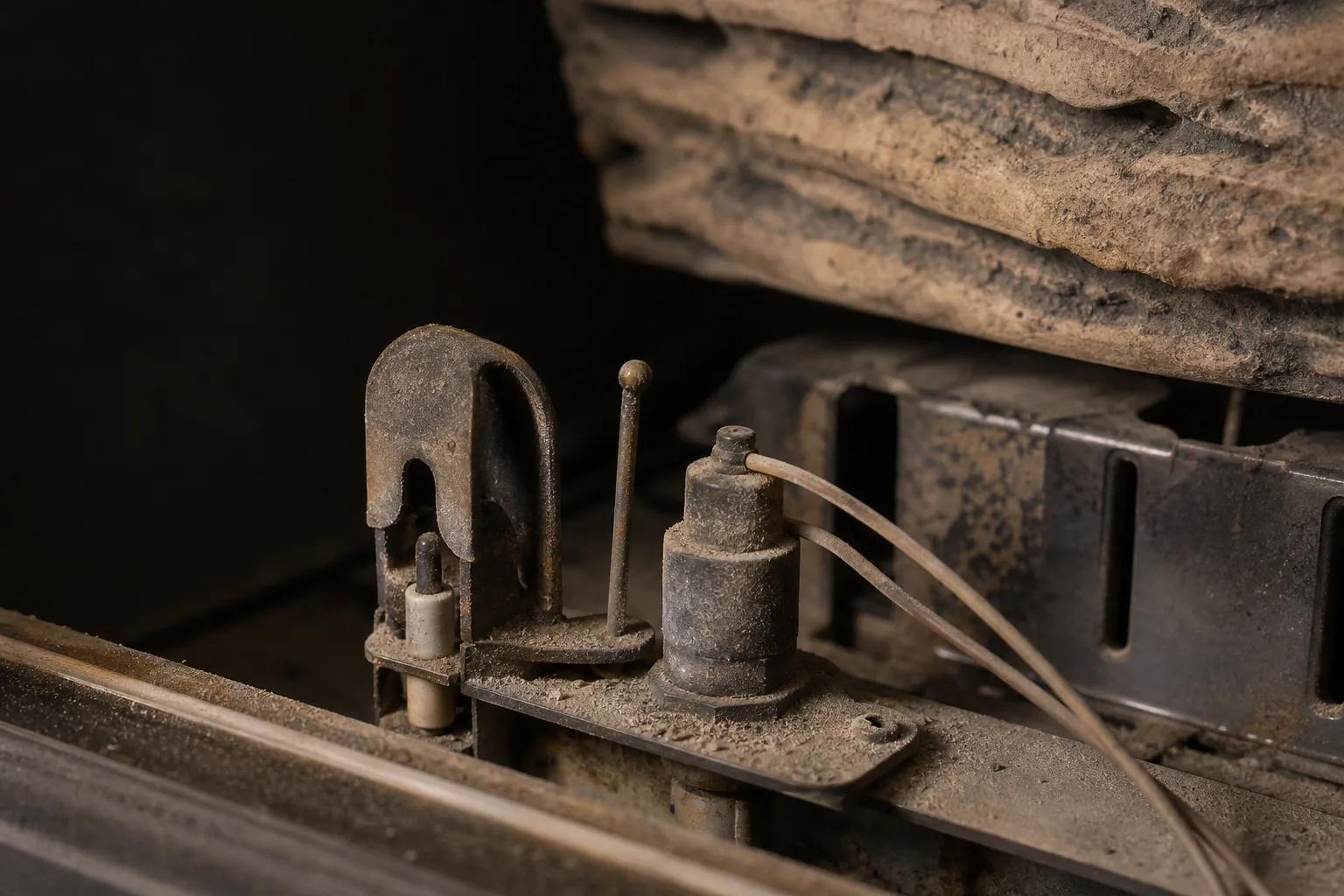
The proof comes from a small sensor sitting directly in the pilot flame. Heat on that sensor generates a tiny electrical current, and on these systems that current is what holds the gas valve open. Take the heat away, the current collapses within seconds, and the valve shuts.
Electronic-ignition units handle the same job differently, with a control board and a flame-sensing circuit instead of a permanently burning pilot, but the principle they share is the one that matters here: no confirmed flame, no gas.
Manufacturer service material describes the behavior plainly. An intermittent shutdown happens when the internal safety shut-off system identifies a potential hazard, and the system exists to stop fuel flow whenever the pilot flame fails or the unit overheats.
So the shutdown is not the malfunction. The shutdown is the response to a malfunction.
Good to know: your fireplace has exactly one way to express six different problems. Weak sensor, dirty pilot, blocked vent, dead battery, tired valve, bad draft, they all come out as the same silence. The appliance is not being unhelpful. It genuinely has no vocabulary beyond "off."
Which is why a cause list alone, the kind you find on most pages about this, only gets you so far. Six candidates and no way to choose between them is not a diagnosis. It is a shrug.
The pattern is how you choose.
Match What Yours Is Doing to What's Probably Wrong
There are really only a handful of reasons a gas fireplace keeps turning off, and each one announces itself a little differently. Find the row that sounds like yours. The right-hand column is the honest part: some of this is yours to fix and some of it is gas work, and it is worth knowing which before you start taking anything apart.
| What you're seeing | Most likely cause | What it usually means | Who can fix it |
|---|---|---|---|
| Runs fine, then quits after several minutes | Weak thermopile | The sensor makes enough current cold but fades as the unit heats | Gas technician |
| Pilot lights, dies the second you release the knob | Failing thermocouple, or the pilot flame is not touching the sensor | The pilot valve never gets the signal to stay open | Gas technician |
| Nothing at all happens at the switch or the remote | Dead batteries, receiver batteries, or a worn wall switch | The call for heat never reaches the valve | You, first |
| Quits only on windy nights | Draft disturbance at the vent termination | Wind is pushing the pilot flame off the sensor | Technician, after you check the cap |
| Quits when the dryer, range hood, or furnace runs | Negative pressure in the house | Another appliance is winning the fight for air | Technician, sometimes a house fix |
| Flame goes lazy and yellow before it quits | Combustion air problem, blocked vent, or dirty burner | The fire is not getting the air it needs | Gas technician |
| Works on a cold start, fails once hot | Weak thermopile, or an overheat limit doing its job | Heat is either killing the signal or tripping a limit | Gas technician |
A few of those rows deserve a sentence more.
The "runs then quits" row and the "works cold, fails hot" row are the same story told twice, and they are worth reading together.
From the field: a fading thermopile has a signature that is easy to recognize once you have seen it. Cold, it generates enough current to satisfy the valve. Hot, it does not. So the fireplace works, briefly, and then does not, and the homeowner concludes it is haunted. It is not haunted. It is marginal.
The "nothing happens at all" row is the one you want to be true. It is the cheapest outcome on the table by a wide margin, and it is the reason the next section exists.
The Five-Minute Check You Can Safely Do Yourself
Nobody wants to pay for a service call that ends with a technician handing them a battery. Do these six things first. All of them are outside the sealed part of the appliance, which is what makes them safe.
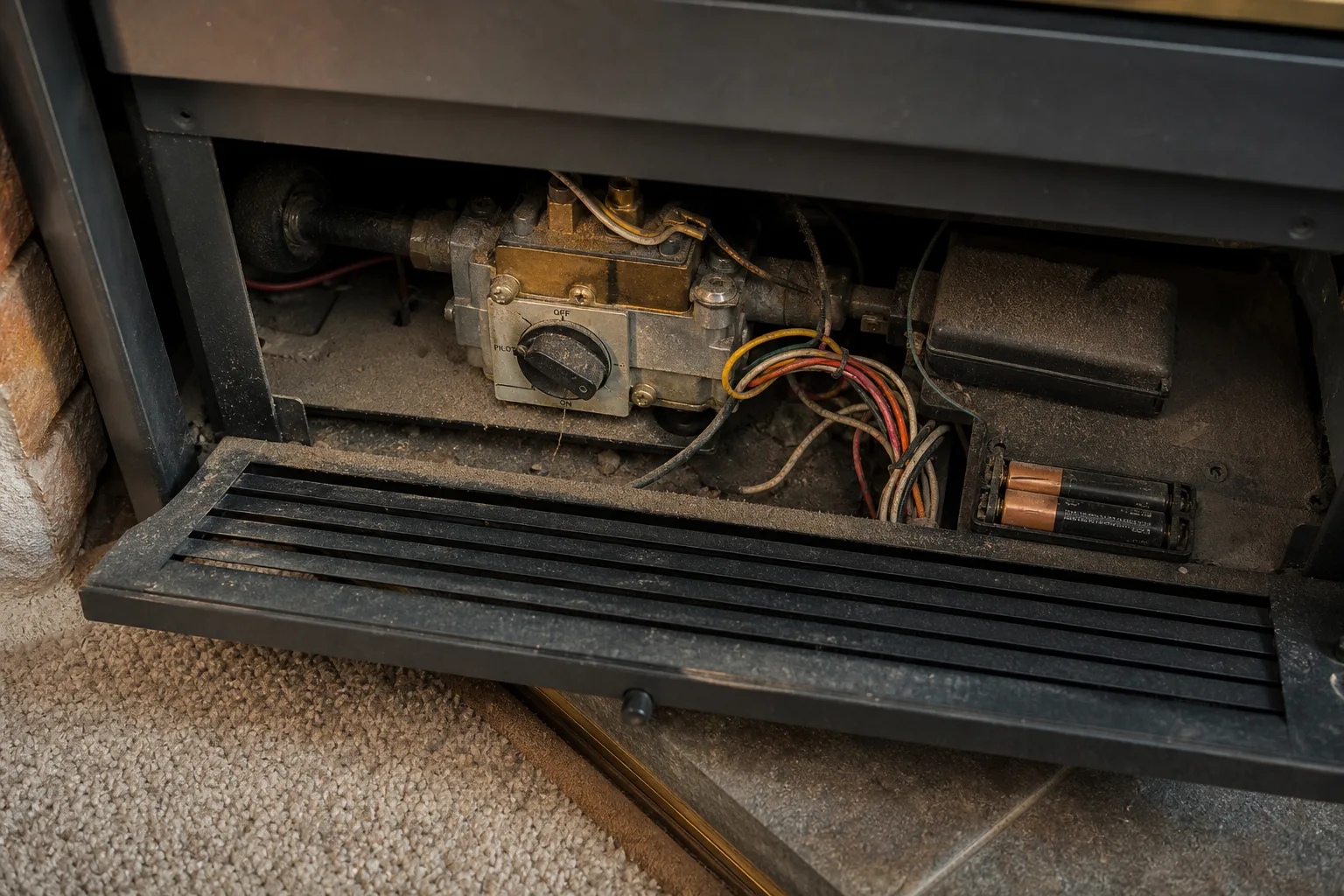
- Change the remote batteries. Then find the receiver box, usually behind the lower louvred panel or the removable front, and change its batteries too. The receiver is the one people forget.
- Check the wall switch and the selector. Many units have an OFF / ON / REMOTE selector down in the control area. If it drifted to the wrong position, the unit will behave strangely or not respond at all.
- Set the call higher. If a thermostat or a remote in thermostat mode is running the show, raise it well above room temperature for the test. A unit satisfying its setpoint looks identical to a unit shutting itself down.
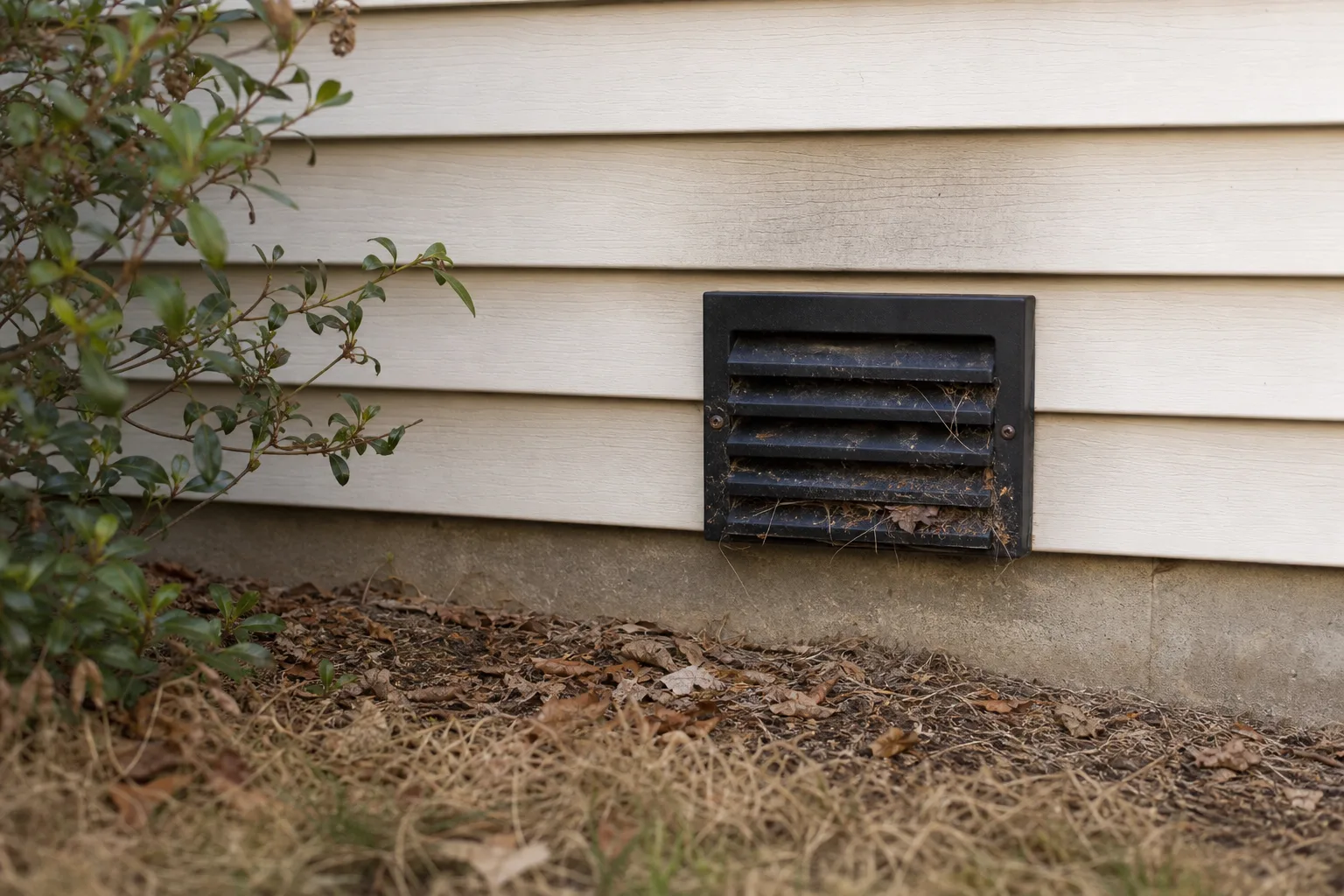
- Go outside and look at the vent termination. On a sealed unit this is a louvred metal cap on an exterior wall, often low, often behind a shrub. Clear the leaves, the cobwebs, the grass clippings, the snow. Debris there is a real cause, not a long shot.
- Clear the front of the fireplace. A rug shoved against the lower louvres or a piece of furniture parked in front of the intake changes how the unit breathes.
- Look at the pilot flame through the glass. A healthy pilot is steady and mostly blue, and it wraps the sensor tips rather than dancing near them. A small, yellow, lazy, or lifting flame tells you something already.
That last one is the most informative thing on the list, and it costs you nothing but a flashlight and a minute of squinting.
Where a homeowner should stop
Here is the line, and it is not a soft one.
Anything behind the glass, anything that involves removing the glass, anything touching the gas valve, the gas line, the pilot assembly, or the sensors themselves is technician work. Not because it is complicated. Because the failure mode is gas.
Do not sand, file, or scrub the thermocouple. That advice circulates widely and it is a bad idea. The sensor tip is not a contact you are polishing, and you can finish off a part that a technician would have simply measured and replaced.
Manufacturer troubleshooting guidance says the same thing in fewer words. Thermocouple and thermopile problems should be diagnosed and repaired by a certified fireplace service technician.
Checked the easy things and it still shuts off?
That's the point where it stops being a homeowner job. Tell us what your fireplace is doing and we'll match you with a local company that services gas fireplaces in your area.
Request service, or call (513) 655-6702.
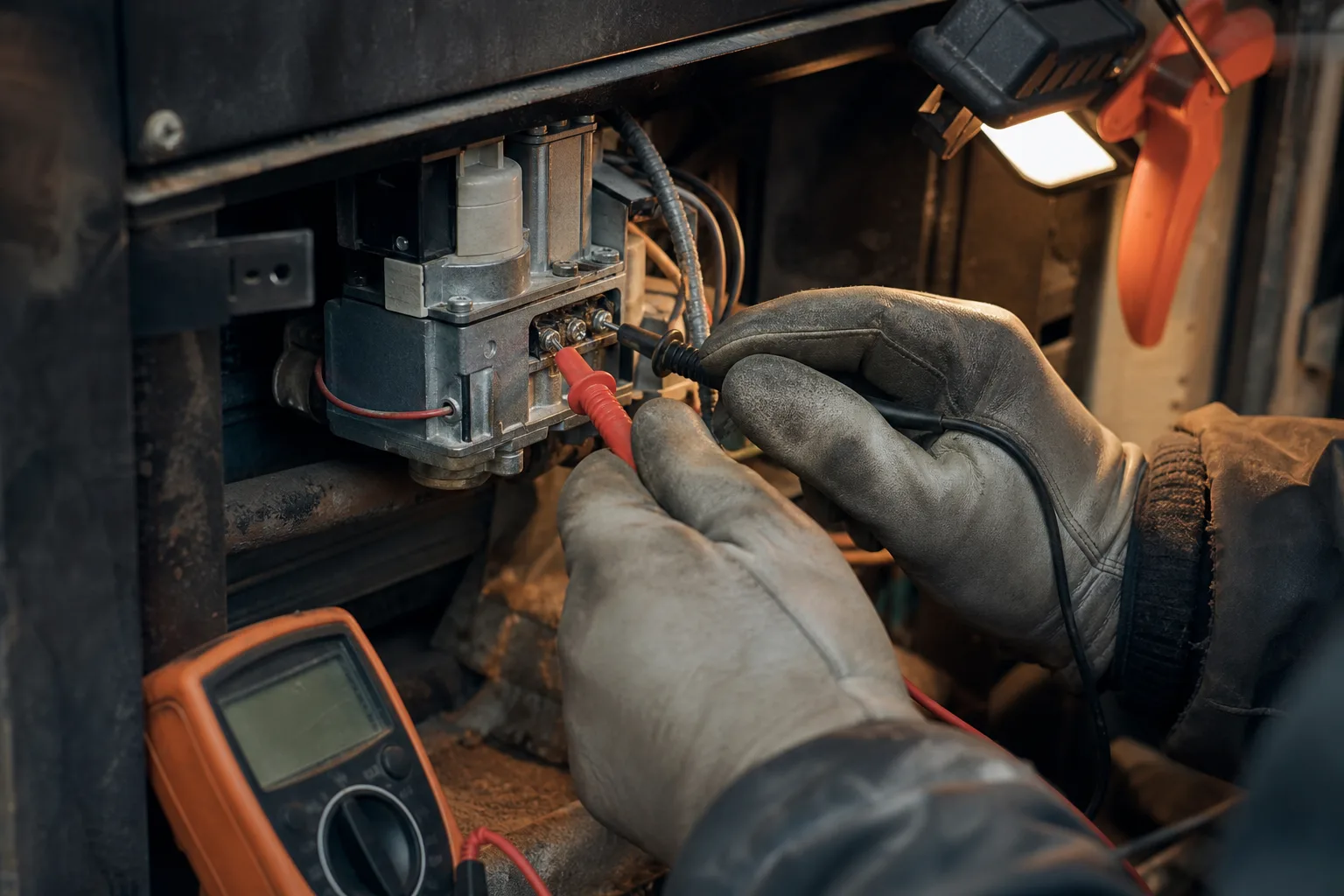
Thermocouple, Thermopile, and Why a Gas Fireplace Keeps Turning Off
Two parts, similar names, different jobs. Learning which is which is the difference between calling a company and saying "my fireplace is broken" and saying "I think my thermopile is weak." The second call goes better.
What a thermocouple does
A thermocouple is a thin metal rod, roughly the thickness of a pencil lead, with a rounded tip that sits directly in the pilot flame. Heat it and it produces a very small voltage. That voltage holds the pilot valve open.
Service thresholds cited across the trade put a healthy thermocouple at somewhere around 25 millivolts and up, with 15 to 30 millivolts described as the normal working band. Below about 25 millivolts it is usually called finished and replaced. Your manufacturer's spec is the one that actually governs, so treat those numbers as the neighborhood rather than the rule.
When a thermocouple gives up, the symptom is specific. The pilot lights while you hold the knob down, and dies within seconds of releasing it.
What a thermopile does, and why a gas fireplace keeps turning off when it weakens
A thermopile is the bigger cousin. It sits in the same pilot flame and generates considerably more voltage, enough to actually power the main gas valve.
That is why it turns up on millivolt units operated by a wall switch or a remote. Something has to supply the electricity that opens the burner valve, and on a millivolt system the pilot flame itself is the power plant. Other control designs power that job from the house supply or a control board instead, so not every fireplace with a switch has one.
Commonly cited service numbers put a healthy thermopile at roughly 300 millivolts or better, and published documentation for millivolt gas valves calls for a minimum around 325 millivolts from the thermopile, measured open circuit and again across the valve's TP and TP/TH terminals. Under that, it gets called weak.
A weak thermopile is the classic answer when a gas fireplace keeps turning off after running for a while. Cold, it clears the bar. Hot, it sags under load and stops clearing it, and the valve closes.
The gas valve, the pilot orifice, and plain dirt
Not everything is a sensor.
The pilot orifice is a tiny opening, and a summer of dust, spider webbing, or combustion residue can restrict it enough to shrink the flame. A shrunken pilot flame no longer bathes the sensor tips properly, so a perfectly healthy thermocouple reads low and the valve closes. Same symptom, different part entirely.
Clogged burner ports do something similar to the main flame. And a gas valve can simply age out, when the internal magnet that holds against the sensor's current gets tired and stops holding.
Pro tip: when a technician comes out, ask them to read the millivolts in front of you and say the number out loud. A number is a diagnosis you can write down and compare next season. "It's the sensor" is a guess wearing a uniform.
Which Fireplace Do You Actually Own? It Changes the Answer
Before you go further, you need to know which kind of gas fireplace is sitting in your wall, because two of them fail for reasons the other one cannot have.
Most homeowners have never been told there is a difference. There is, and it matters here more than almost anywhere else.
Direct-vent, the sealed kind
A direct-vent unit is a closed system. It pulls combustion air from outdoors and pushes exhaust back outdoors through a coaxial pipe, one pipe inside the other, and the glass on the front is not decorative. It is part of the seal. These are listed to ANSI Z21.88 or Z21.50.
Units framed into a wall chase rather than set inside old brickwork are zero clearance gas fireplaces. The rating label inside the control cavity states the vent type, and that label is the reliable way to know which kind you own.
The practical consequence: this fireplace breathes entirely through that one termination outside. Pack the louvres with leaves or let a shrub grow into it, and you have choked the appliance's only airway.
When a gas fireplace keeps turning off and the owner has a sealed unit, the termination cap is worth walking outside to look at before anything else.
Vent-free, the kind with an oxygen sensor
A vent-free unit burns into the room. To make that acceptable, it carries an oxygen depletion sensor, an ODS, which watches the oxygen level in the space and cuts the gas when it drops.
Trade and manufacturer sources generally describe ODS shutdown happening somewhere around 18 to 18.5 percent oxygen.
Read that carefully, because it adds a possibility the other fireplace types do not have. If a vent-free unit runs happily with a door open and quits in a closed-up room, an ODS responding to the air in that room is one explanation worth putting on the list.
It is not the only one, and it does not close the case. An ODS that keeps tripping still warrants a professional look, because a combustion problem inside the appliance can drive the same behavior.
A gas insert or log set in an old masonry chimney
This is the third case, and the one where the chimney itself joins the conversation. A gas appliance vented into a masonry flue depends on that flue being intact, correctly sized, and drafting, which in practice usually means it depends on a sound chimney liner.
An oversized or deteriorated flue is a genuine cause of erratic gas appliance behavior, which is why how a chimney works belongs in this conversation at all.
Myth vs. fact: timing is not a diagnosis. Pages will tell you that shutting off "after ten minutes" means one specific part. It does not. Timing narrows the list, sometimes usefully, but no source supports a universal timing rule. Treat the clock as a clue and nothing more.
Wind, Draft, and the Rest of Your House
Here is the cause that almost nobody writes about and that homeowners describe constantly in forums: the fireplace is fine, and the house is the problem.
Modern houses are tight. That is good for heating bills and awkward for combustion appliances, because every exhaust fan in the building is pulling air out of a box that does not want to let new air in.
Run a powerful range hood. Start the clothes dryer. Fire up the furnace. Each one lowers the pressure inside the house slightly, and a gas fireplace running on a marginal draft can lose the argument.
The symptom is oddly specific and very recognizable. When a gas fireplace keeps turning off only while another appliance is running, stop looking at the fireplace and start looking at the house.
Wind does a version of the same thing from outside. A gust across a sidewall termination can briefly push against the exhaust or pull at the intake, and if the pilot flame lifts off the sensor for even a couple of seconds, the valve closes. That is the whole explanation for a fireplace that works beautifully in still weather and sulks in a storm.
Then there is the season, which is why you are probably reading this in the first place.
The first burn after a summer off is when several small things can arrive at once. Dust has settled on the pilot assembly. Something built a web in the termination cap. The remote battery quietly died in July.
So if a gas fireplace keeps turning off on the first cold night of the season, run the five-minute check above before you assume something serious has failed.
Safety note: if you smell gas, see soot marks around the fireplace opening, or a carbon monoxide alarm sounds, stop troubleshooting. Shut off the gas at the appliance valve if you can do it safely, get everyone outside, ventilate, and call your gas utility. Diagnosis comes after that, not during it.
How VIO Helps When a Gas Fireplace Keeps Turning Off
Plainly, so there is no confusion about what we are: VIO is a referral network. We do not send our own crews, because we do not have crews. What we have is a network of independent local companies that service gas fireplaces, and a process for getting you to the right one.
You describe the symptom the way it is actually behaving. Runs for eight minutes and quits. Pilot dies when you let go. Only happens when the dryer is on. That description is worth more than you think, because it lets us match you with a company that handles gas appliance diagnostics rather than one that only sweeps chimneys.
On pricing, one thing we will say about our own conduct: we ask every company in the network to put its estimate in writing before any work starts, and you should insist on exactly that. If you want a sense of the landscape before you call anyone, what gas fireplace repair typically costs is a better starting point than any number we could invent here.
Good to know: NFPA 211 lists malfunction as one of the conditions that calls for a Level 2 inspection, along with sale or transfer of a property, system changes, a chimney fire, and external events like a severe storm. A fireplace shutting itself down repeatedly is a malfunction by any reasonable reading.
That standard also calls for chimneys, vents, and venting systems to be inspected annually, and gas fireplace manufacturers recommend annual service for the same reason. Annual service will not prevent every failure, and we are not going to pretend otherwise. What it does is catch the dusty pilot, the obstructed termination, and the thermopile drifting toward the bottom of its range while all three are still cheap and boring.
Which is, in the end, the whole argument. A gas fireplace keeps turning off because something in a chain of safety devices lost confidence, and every single item in that chain is something a technician can measure. This is a solvable problem with a short list of answers. It only feels mysterious from the outside.
Get your gas fireplace looked at by someone local
Describe the symptom the way it's actually behaving, and we'll connect you with an independent company near you that handles gas fireplace diagnostics. No obligation on your side.
Request service, or call (513) 655-6702.
Symptom checker
What is your chimney doing?
Tap the closest match for an honest first answer.