



On this pageWhat a gas fireplace repair cost actually covers8 sections+7
- What a gas fireplace repair cost actually covers
- Start with the symptom, not the part
- Gas fireplace repair cost, part by part
- Four things that move the number
- Is it safe to leave a gas fireplace that's acting up?
- What you can do yourself, and how to read the quote
- Repair or replace: where the line actually is
- How VIO helps with a gas fireplace repair cost
Quick answer
Gas fireplace repair cost falls into three groups. Small repairs cover batteries, a remote, or relighting a pilot. Middle repairs cover the ignition parts, the thermocouple, thermopile, igniter, plus glass and burner cleaning. The top of the range is the gas valve, the gas line, or venting work. Every bill combines a service call, diagnosis time, and the part, and all three vary by region, unit age, and parts availability.
You flipped the switch on the first cold evening of the year. It clicked, nothing happened, and now you want one number: the gas fireplace repair cost.
Or the pilot came up, held for half a minute, and quietly died. Or the glass has gone grey and you can barely see the flame behind it.
Here is the honest answer, and the reason this guide is built the way it is. A gas fireplace repair cost is not one number, it is three neighborhoods, and which one you land in depends entirely on which part gave up.
There is a small-repair neighborhood, where a probe or an igniter or a set of batteries is the whole story. There is a middle neighborhood, where a real part comes out of a van and an hour or two of labor goes with it. And there is a top neighborhood, short and thankfully rare, where the gas control itself or the venting is involved.
The frustrating part: the cheapest repair on the list and one of the most expensive repairs on the list can produce exactly the same symptom, and from your couch they look identical.
So this guide is organized the way you actually experience the problem. What it is doing, what that usually points to, which neighborhood that usually sits in. If the fireplace in question burns wood rather than gas, the picture diverges enough that our guide to fireplace repair cost in general is the better place to start.
What a gas fireplace repair cost actually covers
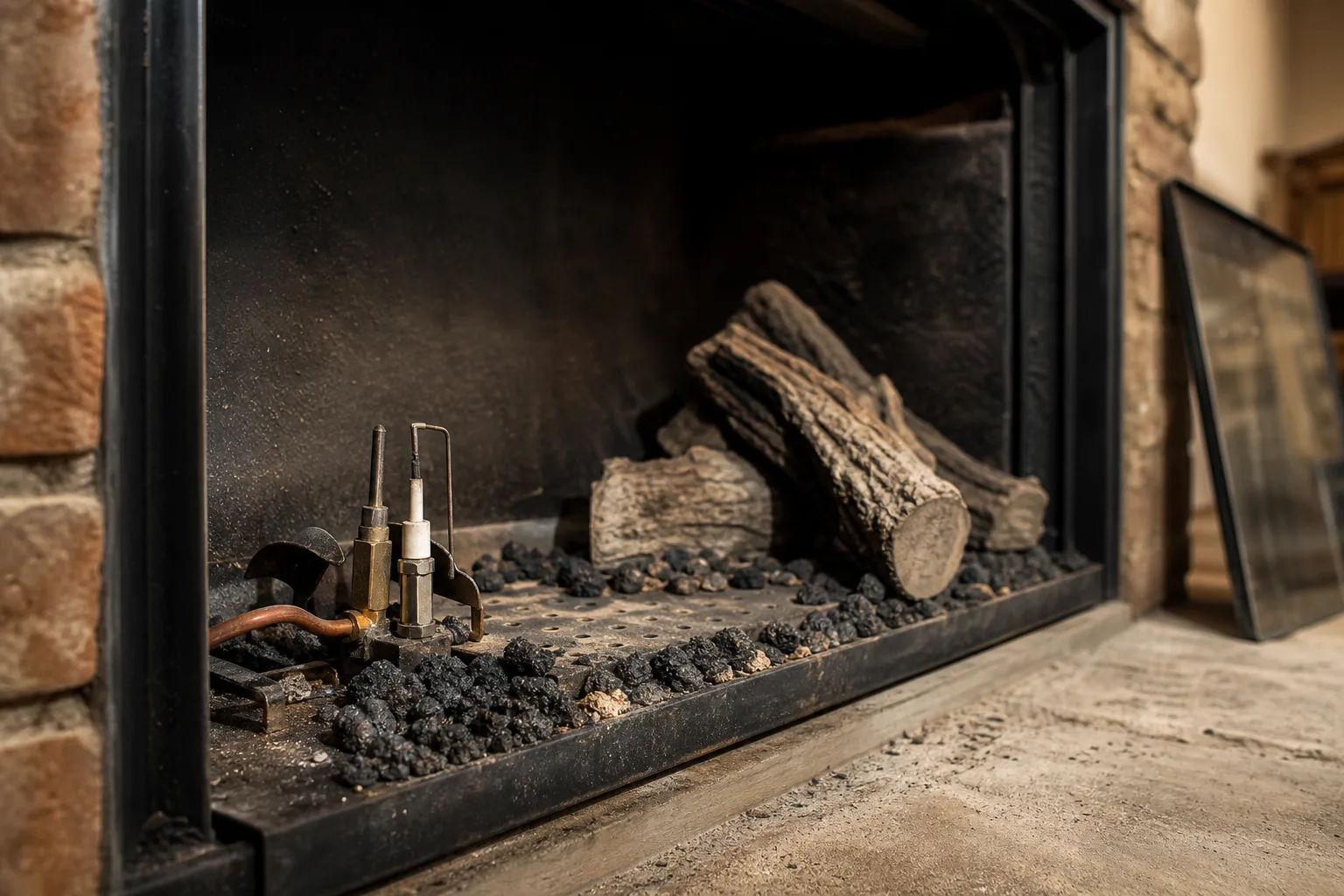
Almost every gas fireplace repair cost breaks into two things stacked on top of each other: somebody's time, and a part.
The time is the bigger surprise for most homeowners. Labor is billed by the hour, and the first hour is usually spent finding out what is wrong rather than fixing it.
The service call, and what it buys you
A service call generally covers the trip, the diagnosis, and simple work done on the spot. Parts come on top of that, and the fee itself varies from company to company and region to region.
What you are buying with it is a trained technician putting a meter on a gas appliance and telling you the truth about it. That has value even when the answer is "nothing is broken, the probes were filthy."
Good to know: some of the parts inside a gas fireplace cost very little at a parts counter, and replacing one can still produce a real bill. That is not a scam. You are paying for the drive, the diagnosis, and the fact that a trained person is taking responsibility for a gas connection in your living room.
What a gas fireplace repair cost does not include
Three things routinely sit outside the quote and surprise people.
Venting work is the first. If the diagnosis turns up a compromised vent path, that is a separate job with separate pricing, and what a gas fireplace actually needs in the way of a chimney decides how big that job gets.
Permits are the second. On extensive work, some jurisdictions require a building permit and an inspector sign-off, and that adds both money and calendar time. It does not apply to swapping a probe.
Emergency and after-hours service is the third. It costs more than a weekday appointment. How much more depends entirely on who you call.
Start with the symptom, not the part
Every other gas fireplace repair cost page you will find today is organized by component. That is backwards, because you do not know which component failed. You know what the fireplace is doing.
Match your symptom to the row below and you will walk into the phone call knowing roughly which neighborhood you are in.
| What it's doing | What it usually points to | Where it usually sits |
|---|---|---|
| Remote or wall switch does nothing | Batteries, receiver, or switch wiring | Small, sometimes free |
| Pilot lights, dies as soon as you release the knob | Thermocouple, dirty or failed | Small to middle |
| Clicks, sparks, no flame at all | Igniter or ignition module, or no gas reaching the pilot | Small to middle |
| Pilot stays lit, main burner won't come on | Thermopile, wall switch, or valve | Middle |
| Flame runs a short while, then shuts down | Thermopile weakening, or a venting or safety switch issue | Middle |
| Glass looks cloudy, grey, or filmed | Glass panel cleaning or replacement | Middle, cosmetic |
| Flames look lazy, yellow, or leave soot | Burner cleaning, log placement, or air mixture | Middle |
| Blower roars, rattles, or does nothing | Blower motor or fan assembly | Widest spread on this list |
| Nothing works and the valve is suspected | Gas valve or gas line | Top of the range |
| You smell gas | Stop reading and see the safety section below | Call the utility first |
Those placements are general, and they move with your region, your model, and who you call. Treat them as the shape of the answer rather than a quote.
Pro tip: before you call anyone, write down exactly what the fireplace does, in order. "Switch on, three clicks, pilot lights, stays lit ten seconds, goes out." Diagnosis is billed by time, and that one sentence can cut it in half.
Gas fireplace repair cost, part by part
Once a technician names the part, you will want to know whether the number attached to it is reasonable. Here is the map.
The ignition side
This is the first place anyone looks when a fireplace will not light, and it sits at the cheap end of the spectrum.
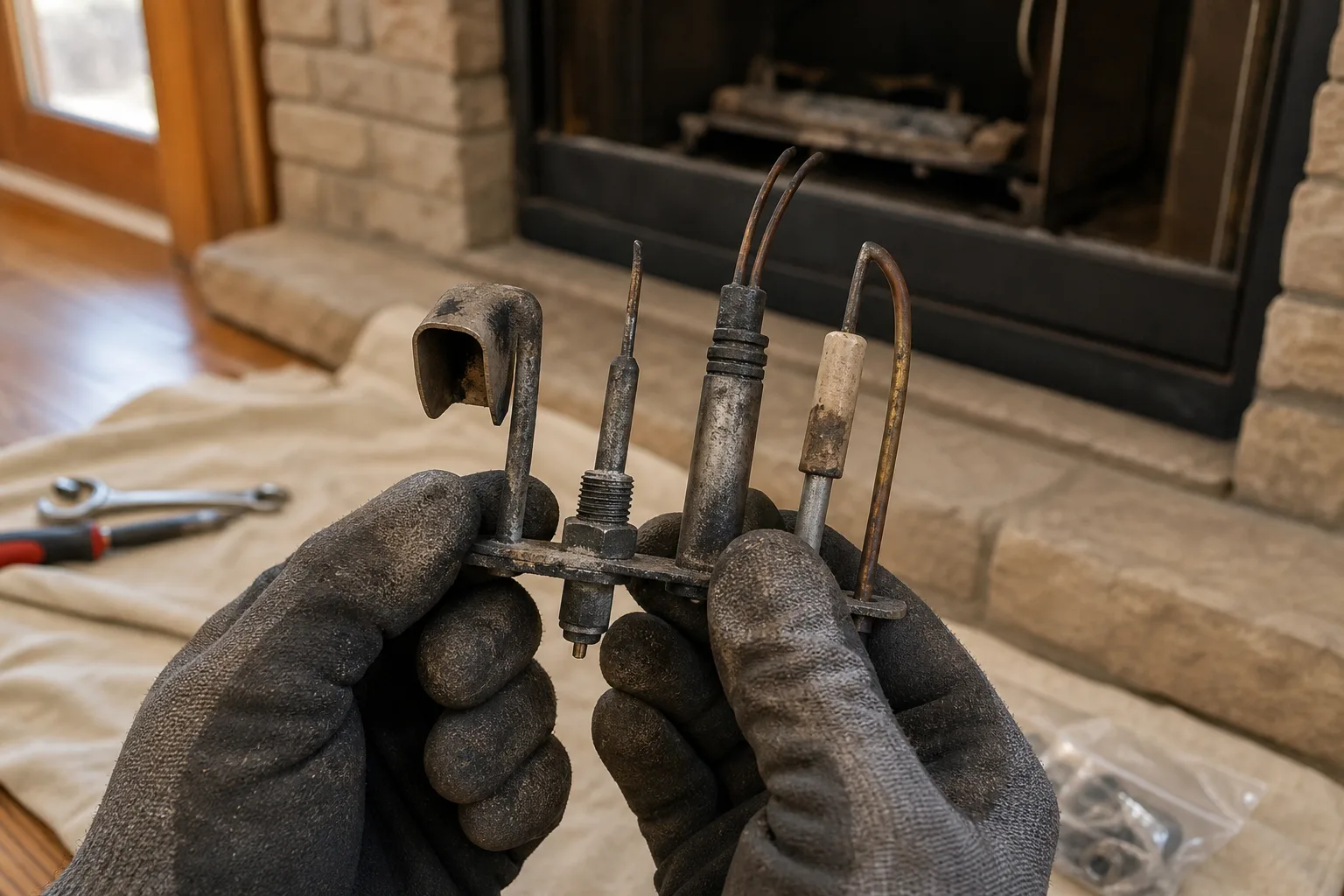
A thermocouple is a thin metal probe that sits in the pilot flame and generates a tiny voltage telling the gas valve to stay open. Replacement is one of the least expensive repairs on this list, and the part itself is a fraction of the bill.
A thermopile does the same trick with more output, and it is what powers the main burner on a standing-pilot unit. Budget about the same as a thermocouple.
A pilot assembly is the whole cluster: pilot hood, supply tube, thermocouple, thermopile, igniter electrode. On many models these are sold together, which is why a quote sometimes jumps from "a probe" to "the assembly." Ask which one you are being charged for.
Igniter replacement sits alongside the probes, a bit higher. Simply relighting a pilot that went out, with no part involved, is the smallest bill in this guide.
From the field: a carbon-coated probe and a dead probe behave identically. The pilot lights, you release the knob, the flame drops. A cleaning is a different line item than a replacement, and a homeowner who knows those are two separate things is much harder to sell the expensive one by default.
The gas control side
This is the expensive neighborhood.
The gas valve is the brass block behind the lower louver with the OFF / PILOT / ON knob on it. Repair or replacement sits at the top of the range for a gas fireplace, and a genuinely failed valve is one of the few situations where the replace-the-whole-unit conversation is legitimate rather than a sales line.
Gas line inspection or repair is its own line item and its own trade skill.
Control modules and receivers on electronic ignition units vary too much to bracket honestly. Ask for the part number and the price before you approve it.
The comfort and cosmetic side
These are the complaints that make a fireplace unpleasant rather than unusable. Two of them come with a caveat, and the caveat matters more than the price.
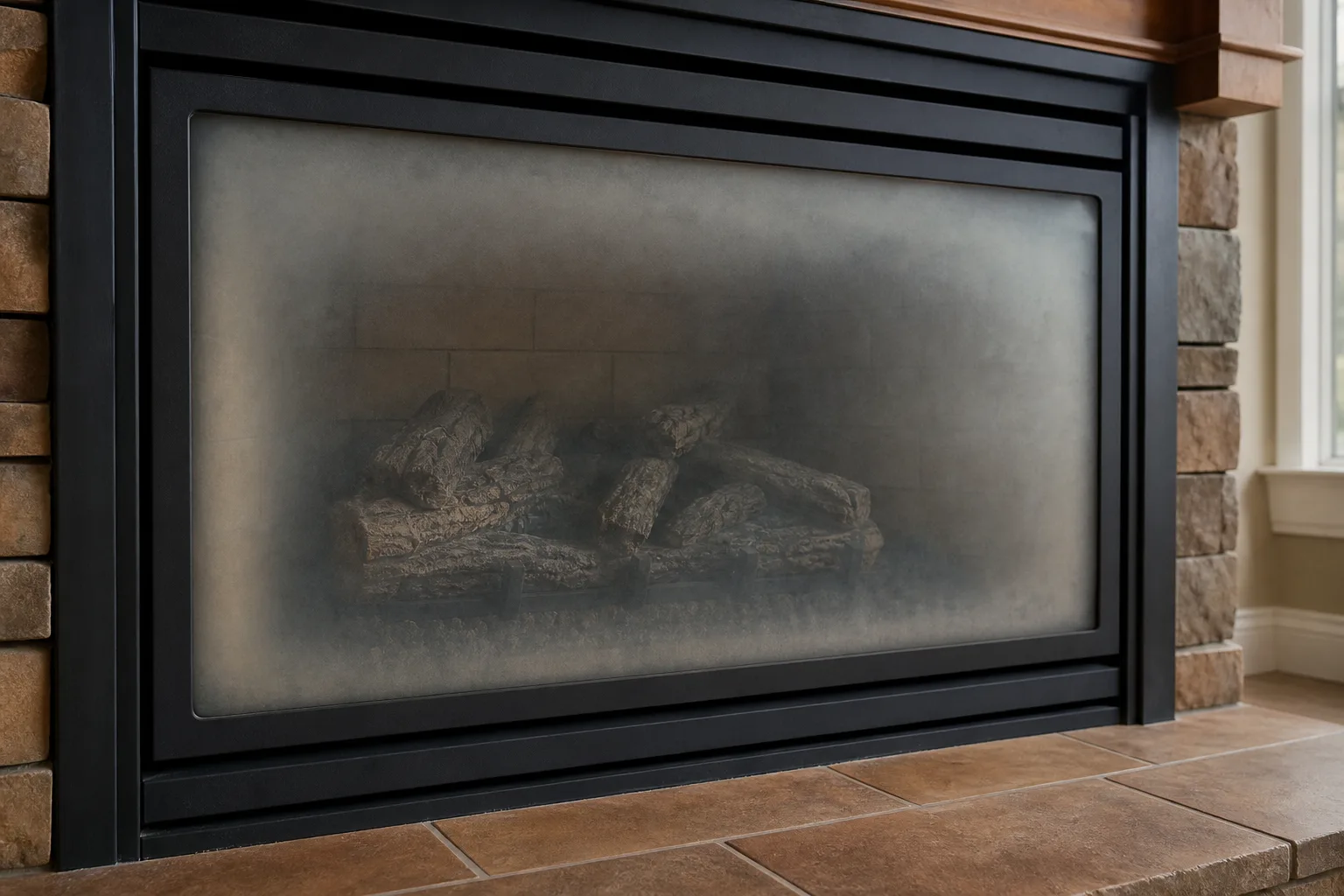
Fogged glass is sometimes a film that cleans off with the right product. If the seal has gone, it is not a window problem: the glass on a direct-vent unit is part of the sealed combustion system, and a compromised panel or seal needs to be looked at rather than lived with. Replacement puts it in the middle neighborhood.
Blower motors have the widest spread of anything here, because a blower on an accessible unit is a twenty-minute swap and a blower buried behind a floor-to-ceiling stone surround is not.
Remote controls are the cheapest thing on the list and the first thing to rule out before anyone opens the firebox.
Soot buildup cleaning on the burner and logs is a maintenance item rather than a repair. Treat the soot itself as a signal, though, not just a mess. Soot and a burner that runs badly can point back to a combustion or venting problem, which is a different conversation from a dirty burner and belongs with the safety section below.
Four things that move the number
The gas fireplace repair cost for two identical units with the same failed part can land a long way apart. Four things drive that gap.
Where you live
Labor rates are regional and the spread is large. The same thermopile swap is not the same bill in rural Ohio and coastal California.
How old the unit is, and whether parts still exist
This is the factor nobody warns you about. A current-production model has parts on a shelf. A twenty-year-old unit from a brand that no longer exists may need a universal part adapted to fit, which is more labor, or may not be serviceable at all.
Ask early: is this part in stock, or is it being ordered?
How the repair is accessed
A fireplace with a removable lower louver and a foot of clearance is a fast job. One framed into a floor-to-ceiling stone surround, with a blower buried behind the firebox, is not. The part costs the same. The hours do not.
When you call
An emergency visit on a Sunday in January costs more than a Tuesday morning in September. That is not price gouging, it is overtime.
Which brings up the one honest piece of scheduling advice in this whole guide: the time to have a gas fireplace looked at is early fall, before the first cold snap sends everyone in your county to the same set of phone numbers. This is an opinion, and I will defend it. Pre-season service is worth more on a gas appliance than any extended warranty you will be offered.
Safety note: if you smell gas, stop. Do not flip switches, do not try to light anything, do not run the blower. Shut off the gas supply if you can do it safely, leave the house, and call your gas utility from outside. The diagnosis can happen after everyone is out.
Not sure which bracket your gas fireplace repair cost lands in?
Tell us what it's doing and we'll match you with an independent local company that works on gas fireplaces, so you're not calling five numbers off a search page. VIO is a referral service. The company we match you with does the work, and you deal with them directly.
We ask every company in the network to put its estimate in writing before any work starts, and you should insist on exactly that.
Request service, or call (513) 655-6702.
Is it safe to leave a gas fireplace that's acting up?
This is the question nobody else on the internet seems willing to answer, so here it is plainly.
All gas combustion produces carbon monoxide. In a properly functioning, properly vented fireplace, that carbon monoxide leaves the house through the vent and nobody ever thinks about it.
The risk appears when the vent path is compromised: a cracked liner, a separated connector, a blockage, a draft problem. Then the byproducts have somewhere else to go.
The things that mean stop now
Smell of gas, at any strength. A carbon monoxide alarm sounding. Soot or black staining appearing on the wall or ceiling above the fireplace. A flame that rolls out of the opening toward the room instead of rising. Anyone in the house getting headaches or feeling sick when the fireplace runs.
If it is the smell of gas, do not operate the switches or the appliance at all. Shut off the gas supply only if you can do that safely, get everyone out of the house, and call your gas utility from outside.
For everything else on that list, turn the fireplace off and leave it off until someone qualified has looked at it, and read through the habits that keep a fireplace out of trouble while you wait.
The things that can wait for a weekday appointment
A pilot that will not stay lit. A dead blower. A fogged glass panel. A remote that stopped working. A burner that looks lazy but produces no soot and no odor.
None of those is an emergency on its own. They are all reasons to book the appointment now rather than push it into the coldest week of the year, which is the worst possible moment to be thinking about a gas fireplace repair cost.
Myth vs. fact: the myth is that a gas fireplace does not need a chimney or vent inspection because it burns clean. NFPA 211 applies to gas venting systems, not just wood, and calls for annual inspection regardless of fuel. The standard also requires a Level 2 inspection at sale or transfer of the property, after any change to the system, after a malfunction, after a chimney fire, and after an external event such as a storm or earthquake.
What you can do yourself, and how to read the quote
The cheapest gas fireplace repair cost is the one you never pay, and some of this you can rule out in ten minutes without touching a tool.
The short list of homeowner-safe checks
Confirm the gas is actually on at the shutoff valve. Change the batteries in the remote and the receiver, which on many units lives behind the lower louver. Check that the wall switch is on and, if there is a breaker feeding the unit, that it has not tripped.
If the pilot is out and your unit has a standing pilot, follow the lighting instructions printed on the label inside the lower door. That label is the manufacturer's, and it is the only lighting procedure you should follow.
Where DIY stops
Anything involving the gas valve, the gas line, the burner orifices, or the venting. Gas work is regulated work, and the credentials required vary by state, by locality, and by the scope of the job, which is why this belongs with chimney specialists rather than a general handyman.
Cleaning the pilot probes sits in a grey zone. It is genuinely simple on some units and it is the first thing a technician will try. It is also the kind of task where getting the pilot hood back in the wrong position produces a new problem.
What to ask before you book
This checklist is worth more than anything else on the page. Read it out loud on the phone.
- Is the diagnostic fee credited toward the repair if I go ahead with the work?
- Will I have the estimate in writing before any work starts?
- What credentials do you hold for gas appliance work in this state?
- Are you replacing the part or cleaning it, and what is each one priced at?
- Is the part in stock, or does it have to be ordered, and what does that do to the timeline?
- If a second problem turns up behind the first one, what happens to the price?
Pro tip: that first question is the highest-value sentence a homeowner can say on the phone. Crediting the diagnostic fee toward the repair is common practice, but it is not automatic and it is not universal. Ask before you book, not after the invoice appears.
Repair or replace: where the line actually is
There is no age at which a gas fireplace becomes disposable, whatever the internet tells you. The decision comes down to what failed and what still exists.
A probe, an igniter, a blower, a glass panel: these are repairs. Worth doing in almost any scenario, and nowhere near the cost of a new appliance.
A failed gas valve on an older unit is the real fork in the road. That repair sits at the top of the gas fireplace repair cost range, and if the model is discontinued and the venting is also questionable, the math starts to favor replacing the appliance with a new insert.
Get the venting assessed as part of that conversation. A new appliance into a bad vent is money spent twice.
Some people reach this point and decide they want live fire back instead, in which case what it takes to convert a gas fireplace to wood is a different budget conversation entirely.
Good to know: whether the model is still in production changes the arithmetic more than the broken part does. A current unit gets a shelf part and an hour of labor. An orphaned one gets a universal part, a fabrication, and an open-ended labor line.
How VIO helps with a gas fireplace repair cost
VIO does not repair fireplaces. We are a referral service, and being straight about that is the whole point.
You describe what the fireplace is doing, once. We match you with an independent local company that works on gas appliances in your area, and from there you deal with that company directly. No calling six numbers on a cold night, no wondering whether the person who answered has ever opened a direct-vent firebox.
The reason that matters for a gas fireplace repair cost specifically is that gas work is a narrower trade than general fireplace work. Plenty of outfits will sweep a chimney. Fewer will put a manometer on a valve.
We ask every company in the network to put its estimate in writing before any work starts, and you should insist on exactly that. Ask for the part, the labor line, the credentials, and the diagnostic-fee policy in the same document.
You know the shape of it now. Here's the next move.
Describe the symptom once and we'll put you in front of a local company that handles gas fireplace work, instead of you sorting through listings on a cold night.
We ask every company in the network to put its estimate in writing before any work starts, and you should insist on exactly that.
Request service, or call (513) 655-6702.
A gas fireplace repair cost is only frightening while it is unknown. Once you can name the symptom, name the likely part, and say out loud which neighborhood you are probably standing in, you are not a homeowner hoping for a fair price. You are a customer with a specific question, and that changes the conversation completely.
Symptom checker
What is your chimney doing?
Tap the closest match for an honest first answer.