



On this pageWhat Is a Chimney Liner? The Plain Answer7 sections+6
- What Is a Chimney Liner? The Plain Answer
- Signs Your Chimney Liner Is Failing
- What Is a Chimney Liner Made Of? The Three Families
- Sizing: The Part That Quietly Decides the Job
- How to Tell a Real Recommendation From a Weak One
- When a Liner Is Required, and When There Isn't One at All
- How VIO Helps When Your Chimney Liner Is in Question
Quick answer
What is a chimney liner? It is the continuous inner surface of the flue, the passage combustion gases travel through on their way from your fireplace or appliance to the outside. The liner routes those gases out of the house, shields the surrounding masonry from heat and acidic byproducts, keeps heat off nearby combustible framing, and sizes the passage so the system drafts properly. Liners are clay tile, cast-in-place cement, or metal.
Picture how this tends to go. A sweep comes down off the ladder and holds out a phone. On the screen is a photo of a cracked orange tile, lit by a work light, somewhere up inside your chimney. Then comes the word: reline.
You nod, because what else do you do. You have never seen the inside of your own chimney and no way to judge whether that photo is a real problem or a sales tool. So you go inside and type what is a chimney liner into your phone.
Here is what the other pages will not tell you. The question you typed is not the question you have. You want to know whether the thing on that screen is dangerous, and whether the person who showed it to you is being straight with you.
This guide answers both. The definition first, because you asked for it, then the part that matters: how to tell a real relining recommendation from a weak one, in words you can use on the phone.
What Is a Chimney Liner? The Plain Answer
A chimney liner is the continuous inner surface of the flue. It is the passage that smoke and combustion gases actually travel through on their way from your fireplace or appliance to the outside air.
The brick you see from the yard is the structure. The liner is the pipe inside the structure, and it is the part doing the work.
So, what is a chimney liner made of and where does it come from? In a masonry chimney that can mean clay tiles built in when the house went up, a metal liner installed later and fed down the existing shaft, or a cast-in-place liner formed inside the flue. Some older stacks have nothing in them at all.
What Is a Chimney Liner Actually Doing Up There?
Four jobs, worth understanding separately, because a liner can fail at one while still looking fine at the others.
It routes combustion products out of the house. That includes carbon monoxide, which is where this stops being a masonry topic and becomes a safety one.
It shields the surrounding masonry from heat and from the acidic byproducts of combustion, which chew at brick and mortar over time.
It keeps heat off any combustible assembly near the chimney: the framing, joists and woodwork inside your walls and attic.
And it gives the system a correctly sized passage, which is what lets a fire draft instead of pushing smoke back into the room.
Good to know: the liner is the one part of your chimney you will never see from inside your house, and the part the whole system depends on. That gap is why this question gets typed into search bars at nine at night.
Where the Liner Sits
Picture the chimney as a shaft. The liner runs up the inside of it, from the smoke chamber above your firebox to the crown, the concrete slab at the top of the stack.
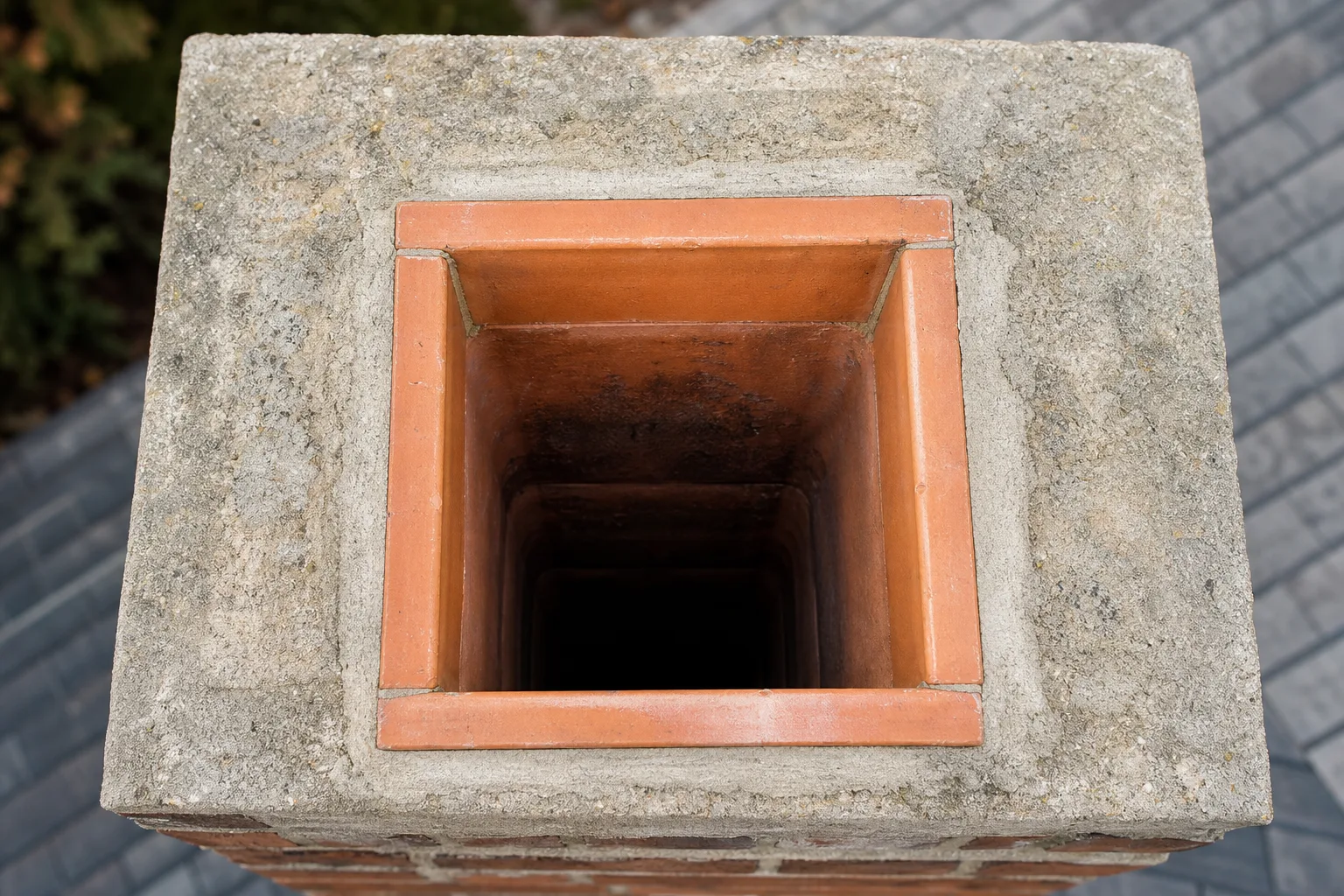
If yours is clay, it is built from tiles roughly two feet long with a mortar joint between each section. Look down a sound clay flue and you see a square terracotta opening inside the grey crown, protruding above it.
If yours is metal, it runs that same path, connected to the appliance at the bottom and secured at the top. Flexible liners go in as one continuous tube, while rigid systems can be assembled from joined sections, and the details follow whatever the listed system calls for.
Signs Your Chimney Liner Is Failing
People who search what is a chimney liner tend to arrive with a second question underneath it: how would I know if mine has gone bad?
There are things you can notice, and things you genuinely cannot. Knowing which is which is the useful part.
What You Can Notice From the Room
Smoke that rolls back into the room instead of going up. Fires that are hard to start or never quite pull.
A smell from the fireplace that was not there before, particularly on damp days.
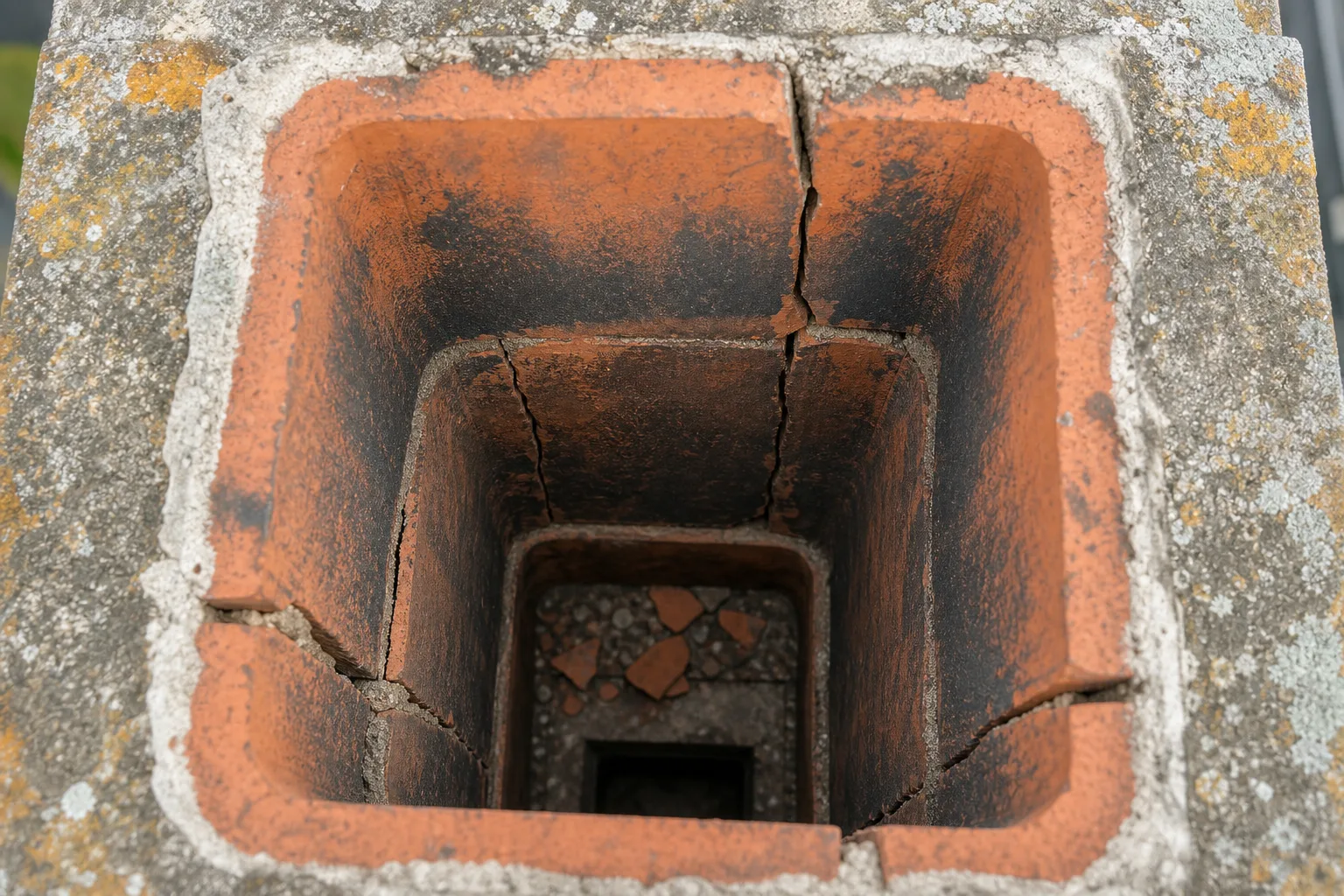
Flakes or shards of terracotta in the firebox or on the smoke shelf. If you have a clay liner, those pieces came from somewhere.
Brick or mortar on the outside of the stack starting to crumble, which can mean heat and moisture are getting where they should not.
Rust or staining around a metal liner connection.
None of these prove the liner has failed. They point at it. A smoky fireplace can also be a draft problem, a cap problem or a closed damper, and a good inspector rules those out before selling you anything.
What Only a Camera Can See
Now the uncomfortable part. The defects that count are invisible from where you stand.
Inspectors flag cracks in the clay, joints that have shifted so the tile edges no longer line up, and mortar missing from between the sections. On the metal side, it is rust, warping and holes. Inspection sources treat cracks beyond roughly an eighth of an inch, offset joints and missing mortar as thresholds of concern under NFPA 211.
Clay tile is hard and non-porous, and poor at absorbing a fast temperature spike. A chimney fire, or even a small hot fast one, can crack it.
And when it cracks, you cannot see it. Not from the firebox, not with the brightest flashlight you own, because you are looking up into a dark, sooty smoke chamber that bends before it reaches the flue.
From the field: the gap between what a homeowner can see from the hearth and what is going on above it is wider than the view suggests. Being unable to judge your own flue from below is not a failure of effort. The geometry is against you.
Safety note: a cracked liner is not a cosmetic issue. The concern is heat transfer to a combustible assembly inside the wall, and combustion gases finding a path into the living space instead of out the top.
Not sure what's actually inside your chimney? Liner condition gets settled by a proper inspection, and looking inside the flue with a camera is how that part gets documented. VIO is a referral service. Tell us what you were told, and we match you with an independent local chimney company that can do exactly that. Call (513) 655-6702 or request service to get a look inside your own flue.
What Is a Chimney Liner Made Of? The Three Families
When a sweep answers what is a chimney liner for your house, the answer lands in one of three material families. Which one you have changes the repair, the cost conversation and the timeline.
| Liner type | Fuels it suits | How it goes in | Service life reported by industry sources | What to watch for |
|---|---|---|---|---|
| Clay tile | Wood, gas, oil | Built into the masonry as the chimney is constructed | Up to about 50 years with maintenance | Cracks, shifted joints, missing mortar between sections |
| Cast-in-place | All fuel types | Cementitious material cast inside the existing flue as one jointless passage | Up to about 50 years with maintenance | Sits among the more expensive options; needs a contractor set up for it |
| Stainless steel, 304 | All fuel types | Flexible or rigid tube fed down the existing shaft | 15 to 20 years | The system's listing may require insulation to achieve its rating |
| Stainless steel, 316Ti | All fuel types, better in acidic service | Same, flexible or rigid | 15 to 20 years | Costs more than 304; confirm the listing covers your fuel |
| Aluminum | Certain gas appliances only, not solid fuel | Fed down the shaft | Around 5 years | Not suitable for wood or solid fuel under any circumstance |
Those service-life figures are what industry sources report, not a promise. What your liner actually does depends on what you burn, how much you burn, and how much moisture gets into the stack.
Clay Tile
The default in traditional masonry chimneys. Tiles come in two-foot sections, kiln-fired above 2,000 degrees until the clay vitrifies into something hard and glass-like. A common residential size runs thirteen by thirteen on the outside with roughly an eleven by eleven opening inside.
Clay is excellent at what it was designed for and poor at one thing: sudden heat. It cannot absorb a fast temperature spike the way metal can, which is why a chimney fire and a cracked clay liner tend to show up in the same report.
It ages quietly, it fails invisibly, and the fix is not a patch. Our guide to the clay flue liner goes deeper on how these tiles behave over time.
Cast-in-Place
A cementitious liner cast inside the existing flue as one continuous passage with no joints at all. It suits all fuel types and can add reinforcement to a chimney losing structural integrity.
It is the option homeowners hear about least, partly because it sits at the expensive end, partly because not every company is set up to do it.
Metal Liners
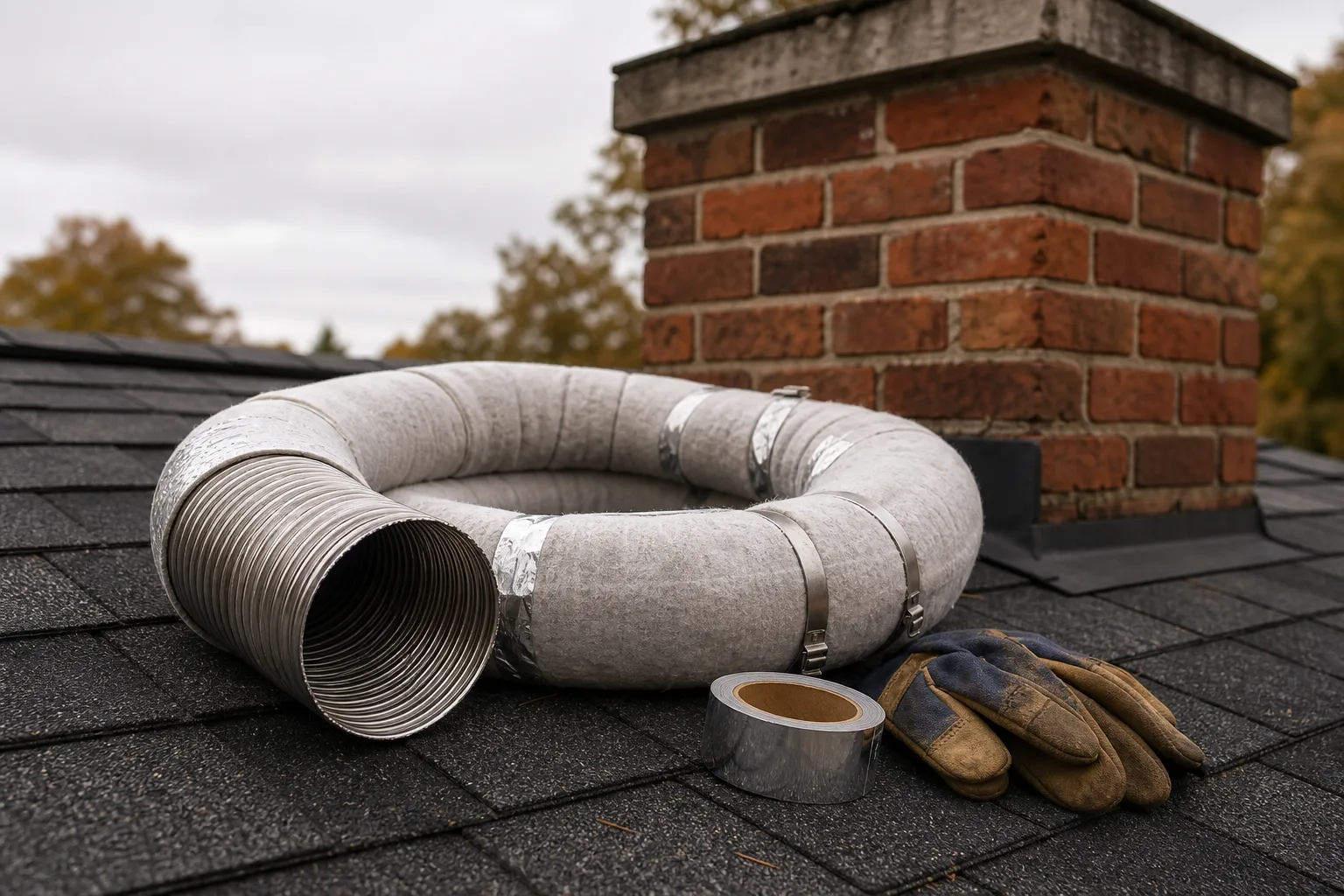
This is what "relining" means in practice. Stainless steel suits all fuel types and is the workhorse of the retrofit world.
The grade matters more than the word "stainless" suggests. Type 304 is the lower-cost stainless. Type 316Ti carries molybdenum, around two percent for the 316 family, which buys real resistance to acidic corrosion. That matters for oil and coal flues and for appliances that produce condensate.
Flexible liner is corrugated and ribbed, used where the flue has offsets to navigate. Rigid liner is smooth-walled and goes in straight runs.
Then there is insulation, which is where quotes diverge. Whether a liner must be insulated comes from that specific system's UL 1777 listing and from the condition of the chimney around it. There is no universal rule here, so put the question to the installer rather than assuming. Our page on chimney insulation covers what that wrap is doing.
Aluminum exists, and it is limited to certain gas applications. It does not belong in a solid fuel chimney.
Myth vs. fact: "stainless is stainless." Not quite. A 304 system and a 316Ti system behave differently against corrosion and can carry different insulation requirements. A quote that just says "stainless liner" is not enough information to compare against anything.
There is one more variable, and it decides more jobs than material does.
Sizing: The Part That Quietly Decides the Job
Here is the follow-up to what is a chimney liner that gets skipped: what size should it be.
NFPA 211 ties flue and connector sizing to the appliance's BTU input and category, and the appliance's own installation manual specifies the flue it requires. Those two documents, not a rule of thumb, decide the answer.
An oversized flue is a real failure mode, and a counterintuitive one. It is easy to assume bigger means better draft. For a modern insert or stove, a flue with far more volume than the appliance can fill means gases cool on the way up, draft suffers, and creosote gets a place to condense.
That is why an insert installation comes with a liner sized to the appliance rather than a shrug at the existing flue, and why switching fuel types means confirming the flue is sized and rated for the new appliance, not just that it exists.
Pro tip: ask what size liner is going in and why. A company that can point to your appliance's manual has done this before. A company that cannot is guessing with your money.
If a stove or insert brought you here, the sizing conversation is inseparable from the install, and our guide to what a fireplace insert installation costs walks through how the two get quoted together.
How to Tell a Real Recommendation From a Weak One
This is the section the intro promised.
You typed what is a chimney liner because somebody told you yours needs replacing and you had no way to evaluate that claim. Here is how.
A legitimate relining recommendation has three things attached. Footage of your flue, specifically: not a stock image, not somebody else's chimney, not a verbal description. A named liner system with a listing. And a reason for the size.
A weak recommendation has a verdict and nothing to look at.
What to ask whoever quoted the work:
- Can I see the camera footage of my flue? Not an example, mine.
- What exactly did you see? Cracks, shifted joints, missing mortar, rust, holes?
- Which liner system are you proposing, and is it UL 1777 listed?
- Is it sized to my appliance, and what are you basing that size on?
- Does this system's listing require insulation for a chimney like mine?
- Will the estimate be in writing before any work starts?
Six questions. A company doing this work properly answers all six without hesitating.
Now the fair part. A sweep who finds real damage and tells you about it is doing the job you hired them to do. Finding it is the entire point of the inspection. The questions above are not an accusation, just a way to tell one kind of conversation from the other.
If the answers feel thin, a second opinion is a normal thing to get on a repair this size, and a company confident in what it found will not be offended. Our directory of chimney specialists in your area is a place to start.
When a Liner Is Required, and When There Isn't One at All
There is a code layer to what is a chimney liner, and it is more local than it first appears. NFPA 211, the standard for chimneys, fireplaces, vents and solid fuel burning appliances, governs how a chimney and liner are installed, the clearances to nearby woodwork, how the system connects to the appliance, and the rule that a relining system be installed according to its own listing.
What NFPA 211 is not is a nationwide law. Which edition applies, and whether it applies at all, depends on what your jurisdiction has adopted. Anyone who tells you a liner is legally required everywhere is oversimplifying.
The Level 2 Inspection Triggers
Far more concrete is when a Level 2 inspection is called for. Under NFPA 211:
- At the sale or transfer of a property
- When the connected appliance changes, or the fuel type changes
- After a malfunction
- After a chimney fire
- After an external event, such as severe weather or an earthquake
- Before relining a flue
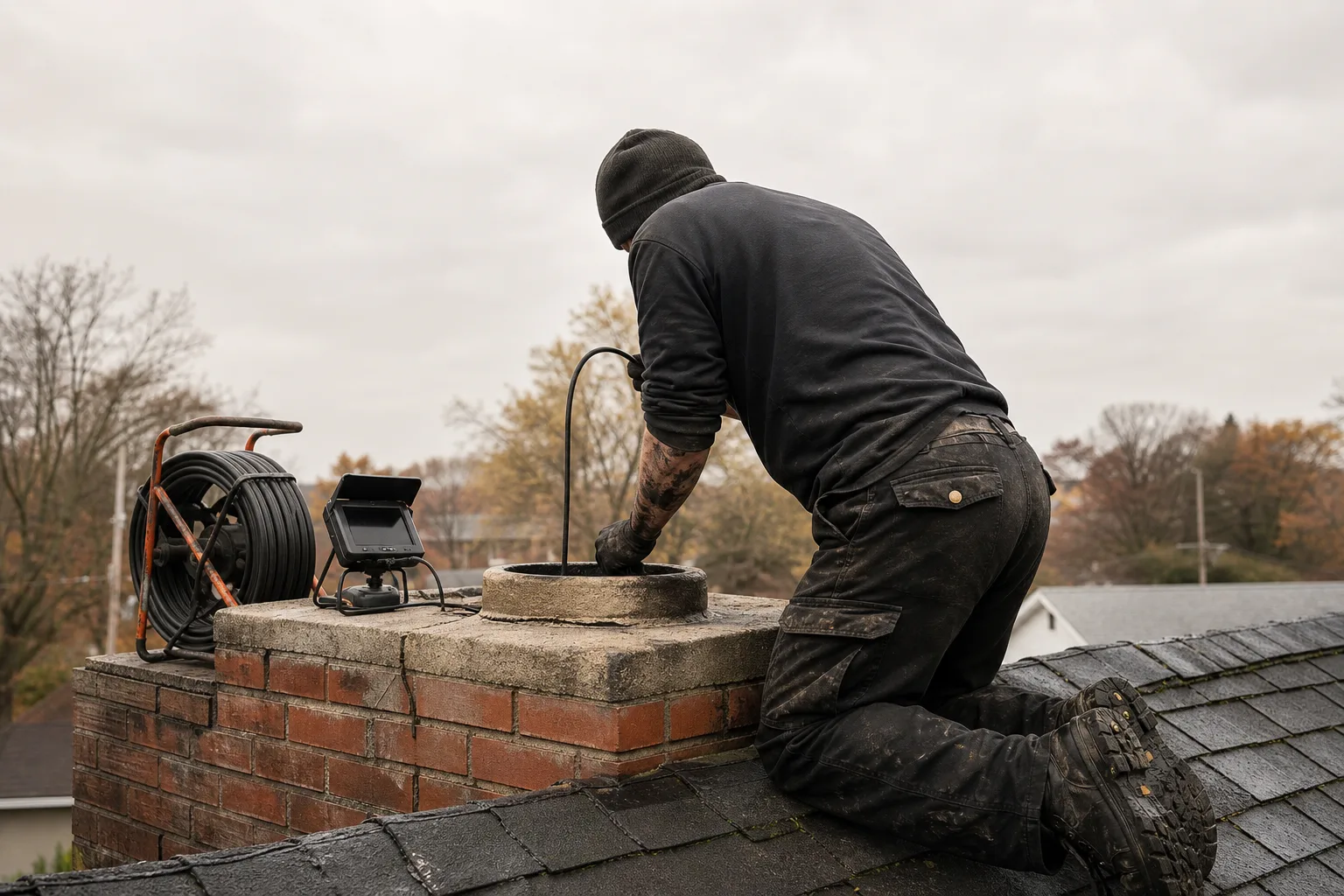
A Level 2 goes past a visual once-over at the hearth. It covers internal surfaces including the flue liner and its joints, the accessible runs through attics, crawl spaces and basements, and the clearances from combustible assemblies. Looking inside the flue is part of the scope, and a camera scan is how that part gets documented.
Buying a house with a fireplace? That first trigger is the one to remember. Finding out what is in the flue is far easier before closing than after.
When the Chimney Has No Liner at All
Some older masonry chimneys were built without a liner. Bare brick, mortar joints, and nothing else between the fire and the structure.
It lands hard when it turns up, because the chimney looks entirely normal from the outside and may have been in use for decades.
NFPA 211 handles it on the appliance side: the existing flue has to be evaluated and, if necessary, relined before a new insert goes in. That is the moment an unlined stack tends to get discovered.
Myth vs. fact: "every chimney has a liner." No. Stacks built before lining became standard construction practice can have none at all, and an unlined flue does not announce itself. Finding out which kind you own means looking inside it.
Ongoing care matters here too, since soot and creosote buildup turns a marginal liner into a failed one. Our guide on how often you should clean your chimney covers the maintenance side.
How VIO Helps When Your Chimney Liner Is in Question
By the time someone calls us, what is a chimney liner has stopped being a definition question and turned into a repair decision they did not plan on.
Here is what we do, plainly. VIO is a referral service. We do not do the work ourselves and we do not send our own people, because we do not have any. You tell us what you were told about your flue, and we match you with an independent local chimney company that can put a camera in it and show you what is there.
By the time what is a chimney liner turns into a written quote, that distinction matters. We have no reason to want the camera to find damage, because we are not the ones quoting the fix.
On the estimate: we ask every company in the network to put its estimate in writing before any work starts, and you should insist on exactly that with whoever you hire. An estimate you can read is one you can compare and question.
If the flue turns out sound, that is a short conversation. If it needs work, you will decide with footage of your own chimney in front of you instead of a sentence someone said in your driveway. Our guide to what fireplace repair costs covers how this kind of work gets scoped.
You now know more about this than the average person getting the quote. Ask to see the footage. Ask for the listed system and the sizing. VIO matches you with an independent local chimney company, and we ask every company in the network to put its estimate in writing before any work starts, and you should insist on exactly that. Call (513) 655-6702 or request service.
So: what is a chimney liner, in the end? The part of your house you will never lay eyes on, sitting between a fire and everything you own. The honest way to learn its condition is a proper inspection, with a camera documenting what is up there.
Go find out what is in yours.
Symptom checker
What is your chimney doing?
Tap the closest match for an honest first answer.