



On this pageHow Does a Chimney Work? It Starts With Draft7 sections+6
- How Does a Chimney Work? It Starts With Draft
- The Parts of the System, Top to Bottom
- What You Are Seeing, and What to Have Looked At
- How Does a Chimney Work When the House Fights It?
- Cold Versus Broken: Two Problems That Look the Same
- Keeping a Chimney Working: Two Clocks, and Your Fuel
- How VIO Helps When Your Chimney Is Not Drawing
Quick answer
How does a chimney work? A chimney works by draft. Hot combustion gas is lighter than the air outside, so it rises up the flue, and that rising column lowers the pressure at the bottom, which pulls replacement air in through the fireplace opening to feed the fire. Draft strength depends on the temperature difference between the flue gas and the outdoors, and on the height of the flue.
A chimney is the one part of a house that does its job entirely out of sight.
You can look at a roof and spot a missing shingle. You can look at a faucet and see the drip. You cannot look up a flue, and neither can anybody else standing in the living room.
So when smoke rolls out of the fireplace opening instead of going where it belongs, you are guessing. People go looking for how does a chimney work for exactly that reason: something happened, and the words to describe it are missing.
Here is the short version, and then the long one.
A chimney is not an exhaust hole. It is a pump with no moving parts, powered by the difference in temperature between the gas inside it and the air outside it. It pushes smoke out the top and pulls air in at the bottom, at the same time, as a single motion.
When a fireplace misbehaves, that loop is where to start looking. This page walks the loop from the fire to the roof, names the parts along the way, and separates the things you can settle from a chair from the things that need somebody with a light and a camera.
How Does a Chimney Work? It Starts With Draft
The word for what a chimney does is draft.
Burning wood produces hot gas. That gas is less dense than the cooler air outdoors, so the column of it inside the flue rises. As the column climbs, it lowers the pressure at the bottom of the flue.
Air in the room moves toward that low pressure. It comes through the fireplace opening, into the fire, and feeds the combustion that made the hot gas in the first place. The fire gets oxygen. The smoke gets an exit. One mechanism does both jobs.
That behavior has a name. It is called the stack effect, and it is the reason a chimney can move a steady river of air through your firebox without a fan anywhere in the building.
That loop is the whole of how does a chimney work. Everything else on this page is detail hanging off it.
Draft Is a Pressure Difference, Not Suction
Nothing up there is pulling on the smoke.
The rising hot column is simply lighter than the outdoor air it is competing against, and the imbalance between the two does the work. Change the imbalance and you change the draft. That is the whole idea, and it is why draft is something a house can weaken without anybody touching the chimney.
Two Things Set How Hard It Pulls
Draft strength comes down to two variables working together.
The first is the temperature difference between the flue gas and the air outdoors. A hot flue pulls. A cold flue does not.
The second is the height of the flue. A taller column of hot gas produces more draft than a short one, which is why chimney height shows up in code and not just in architecture.
Good to know: everything in this section describes a natural-draft chimney serving a fireplace or a solid fuel appliance. Other appliances use powered venting, where a blower moves the flue gas instead of temperature doing it, and sealed-combustion appliances draw their air from outdoors rather than from the room. Arrangements vary by design, and the listing and manual for a given appliance are what govern there.
The Parts of the System, Top to Bottom
Once you have the physics, the anatomy stops being trivia. The answer to how does a chimney work lives in these parts, taken one at a time, and each of them is either helping the column stay hot, helping the air get in, or keeping water and animals out of the path.
The Cap and the Crown
These two sit at the very top of the chimney, they get confused for each other constantly, and they are not the same object.
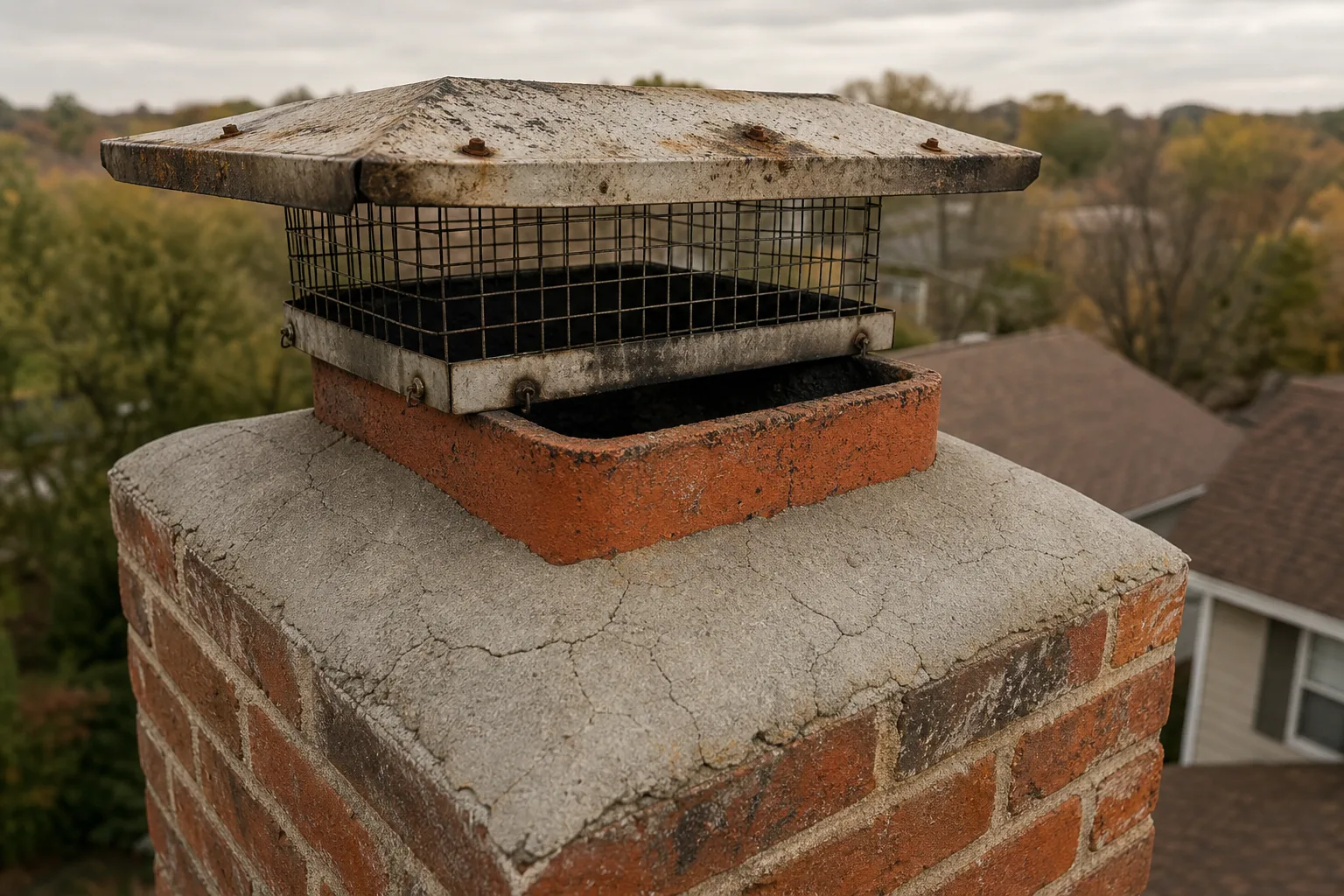
The crown is the slab across the top of the stack. It seals off everything except the flue openings and it keeps water off the brick and mortar below. On an older chimney it is grey, sloped away from the flue, and frequently cracked.
The cap is the metal lid above the flue opening. It lets smoke out while keeping rain, animals and debris from dropping straight down the flue, and on a screened cap the mesh in the sides does that work.
Pro tip: if somebody on the phone says your crown is failing and you picture the metal thing, you are picturing the cap. Ask which one. It is a masonry repair or a metal part, and they are not remotely the same conversation.
The Flue and Its Liner
The flue is the passage itself, running from the firebox to the top of the stack. The liner is what the inside of that passage is made of.
Clay flue tile is the most common material used to line masonry chimneys when they are built. Stainless steel liners, aluminum liners for gas appliances, and poured-in-place masonry are the other materials in use.
The liner stands between the fire and the chimney structure. Separately from that, combustible framing has to keep the clearance NFPA 211 requires, or the clearance the listed product's own instructions and listing call for. A liner does not make framing contact acceptable.
The Throat, the Damper, the Smoke Shelf and the Smoke Chamber
Look up from inside the firebox and the opening narrows. That narrow spot is the throat.
On a masonry fireplace with a throat damper, a cast iron or steel plate sits right there, black with soot, worked by a lever or a knob just inside the top of the firebox opening. Its job is to close the flue when there is no fire, which keeps conditioned air in and keeps moisture, debris and animals out. Top-mounted dampers that close at the flue opening are another arrangement, and what is actually installed on a given chimney is what governs there.
Above the throat the passage opens back out into the smoke chamber, a tapered space shaped like an upside-down funnel that gathers the smoke and hands it to the flue. Its surfaces have to be smooth to move smoke efficiently. In older homes it was built of corbelled brick and the inside is stepped rather than smooth.
The smoke shelf is the flat area at the base of that chamber, behind the damper. It sits out of sight, and it is easy to forget it is there at all.
The Firebox, the Cleanout and the Flashing
The firebox is the room the fire lives in, built of firebrick, blackened, sometimes with cracks running through the joints.
Below it, some chimneys have an ash dump feeding a cleanout door at the base of the stack.
The flashing is the one to keep straight, because it does not live at the top with the crown and the cap. It sits lower down, where the chimney passes through the roof plane. It is thin metal in two layers: step flashing tucked under the shingle courses, and counter-flashing set into a cut mortar joint. When a chimney leaks, this junction is one of the places to have looked at.
What You Are Seeing, and What to Have Looked At
Now the useful part. You came here with something you noticed, and the anatomy above turns that into a question somebody can actually answer. This is where how does a chimney work stops being a diagram and starts being your fireplace.
Read the table as a translation, not as a verdict. It converts what you saw into what to have looked at. It does not tell you what is wrong with your chimney, because nothing visible from inside a room establishes the condition of a flue you cannot see up.
| What you are seeing | What can be involved | What to have looked at |
|---|---|---|
| Smoke into the room in the first minutes, then it settles | The flue can be cold and holding a dense air column; the damper can be partly closed | The damper's travel, and whether the flue is clear before the season starts |
| Smoke into the room mid-burn, once the fire is going | Replacement air can be restricted; another exhaust in the house can be competing; the termination height can be in play | The flue's condition, the termination height, and what else in the house moves air |
| A sharp smell from the fireplace in warm, humid weather | Deposits on the flue walls can carry odor when humidity rises; the damper can be open | The flue's interior condition, and whether the damper seats |
| The fire will not stay lit without constant tending | Draft can be weak; the fuel can be wet; the air path can be restricted | The fuel's moisture, and the flue's condition and sizing |
| A dark stain spreading on the wall above the fireplace opening | Smoke can be escaping the opening rather than entering the throat | The throat, the damper and the smoke chamber |
| Water, rust or a stain inside the firebox | Water can be entering at the crown, the cap, the flashing or through the masonry | The top of the stack and the flashing at the roof plane |
If something on that list matches your house, you have gained exactly one thing: a better phone call. That is not nothing. It is the difference between saying "my fireplace is weird" and saying "it smokes for the first two minutes and then clears."
Safety note: this table is for the non-emergency case. If a fire is burning in the chimney itself, if you hear a roaring or rumbling from the flue, or if you see flames or heavy sparks at the top of the stack, skip every item above. Get everybody out of the house and call 911 from outside. Do not stay inside to adjust an appliance, open windows or manage anything.
You cannot see the part that decides this
Everything above happens inside a flue you have no way to look up from where you are sitting. Tell us what you are seeing and how you burn, and we will connect you with an independent local chimney company that can inspect it and tell you where your chimney stands going into this season.
Call (513) 655-6702.
How Does a Chimney Work When the House Fights It?
Here is the piece the diagrams leave out, and it is the part of how does a chimney work that decides whether yours does. The chimney is not the whole system. Your house is part of it.
Go back to the loop. Gas goes up the flue, and an equal volume of air has to come into the house to replace it. A fireplace cannot exhaust air that it is not allowed to replace. That replacement air is not optional and it is not a detail.
How Does a Chimney Work in a Tight, Modern House?
Older houses leaked. Air came in around window sashes, under doors, through outlet boxes and out of gaps that nothing in the design ever accounted for, and the fireplace helped itself to whatever it needed.
Build the same fireplace into a house that has been sealed, insulated and weatherstripped, and the replacement air has fewer ways in. The physics did not change. The supply did.
This is why a fireplace can behave differently after a round of energy work, with nothing about the chimney itself altered. Whether that is what is happening in your house is something to have evaluated on site.
The Other Stacks Inside Your House
Your chimney is not the only thing in the building moving air out of it.
A range hood pulls air out. A bathroom fan pulls air out. A clothes dryer pulls air out. Run any of them while a fire is burning and they can be competing with the fireplace for the same finite supply of replacement air.
The house itself can compete too. Warm air wants the highest exit in the building envelope, and if a tall stairwell or an upper floor makes a better path than the flue, the chimney can end up on the losing side of that contest.
Height, the Roof and the 3-2-10 Rule
Outside, geometry takes over. NFPA 211 gives the height requirement known as the 3-2-10 rule: a chimney has to extend at least 3 feet above the highest point where it passes through the roof, and at least 2 feet higher than any portion of the building, structure or obstruction within a 10-foot horizontal radius.
Whether and how your town has adopted that requirement is a question for your building department, not something to read off this page.
The reason it exists is the one you can feel indoors. Where a chimney terminates below a nearby roofline, warm air can prefer that higher point, and smoke can be drawn back toward the house instead of leaving it.
Myth vs. fact: the myth is that a taller chimney is automatically a better chimney. Height is one of the two variables that set draft, and the code figure is a minimum to meet, not a dial to turn up. A chimney can be tall and still draft poorly if the flue is obstructed, badly sized, or starved of replacement air at the bottom.
Cold Versus Broken: Two Problems That Look the Same
Ask how does a chimney work on a September evening and you have picked the right month to ask, because the first fire of the season is where two completely different situations produce the same living room full of smoke.
A Cold Flue at Startup
A chimney that has not been lit since spring is masonry at outdoor temperature. Inside it sits a column of cold, dense air, and cold dense air presses down rather than drawing up.
Light a fire under that and the smoke meets resistance on its way out. It takes the other available exit, which is the room you are standing in.
The long-standing remedy is priming: with the damper open, roll up a sheet of newspaper, light one end, and hold it up into the damper opening until the column reverses and the flue starts pulling. Then start the fire.
That is a startup condition, not a defect. How does a chimney work differently once it is warm? It does not, exactly. The temperature difference that drives the whole loop simply has to exist before the loop can run.
When It Is Not the Cold
The trouble is that a blocked flue and a cold flue introduce themselves the same way.
A flue that sat unused through summer is also where nesting material, leaves and debris collect. A liner can be cracked or missing sections. A flue can be unlined entirely, which is not an ordinary maintenance situation and goes for professional evaluation rather than for advice from a page.
And there is creosote, the byproduct of combustion that deposits on the flue walls. Creosote is combustible in every form it takes, so a deposit is not something to rank as safe or unsafe. It is something to have looked at.
From the field: a flue that is merely cold and a flue that is obstructed present identically from a chair in the living room. Both smoke on lighting. Nothing about the way the smoke behaves in the room settles which one it is, which is why the first cold-start problem of the season is the one to get eyes on rather than the one to experiment with.
Keeping a Chimney Working: Two Clocks, and Your Fuel
So how does a chimney work six seasons from now, after a few hundred fires? That depends less on the chimney than on what got done between them.
The Inspection Clock and the Cleaning Clock
These are two separate clocks and they run on different things.
NFPA 211 §14.2.1 provides for inspection of chimneys, fireplaces and vents at least once a year. The calendar governs that one.
The standard's stated trigger for cleaning is different: a deposit accumulation of one-eighth inch. That is what governs the sweeping. Neither one replaces the other, and neither is contingent on the other.
NFPA 211 also defines three inspection levels, and each has its own trigger. Level 1 is the routine check of readily accessible portions. Level 2 is required at sale or transfer of the property, on a change to the system, after a malfunction, after a chimney fire, and after an external event likely to have caused damage. Level 3 applies where a concealed hazard is suspected that the other levels cannot evaluate.
Whether any of those apply to your chimney is worth raising when you book rather than deciding from this page.
Wet Wood Is a Draft Problem
Fuel belongs in this section because fuel feeds the temperature difference that runs the whole system. It is the one input to how does a chimney work that you handle with your own hands, every time you load the firebox.
Wet or unseasoned wood burns cooler. A cooler fire produces a cooler flue gas column, which means less draft, which means more smoke looking for somewhere to go.
Before the first fire of the season:
- From the ground, look at the top of the stack. Is the cap in place and intact? Is the crown visibly cracked?
- Look at the roofline around the chimney. Is anything within ten feet of it standing taller?
- Indoors, work the damper through its full travel and confirm it moves and seats.
- Shine a flashlight up into the throat and look for nesting material, leaves or debris.
- Check the firebox for cracked joints, rust and water staining.
- Split a piece of your firewood and feel the fresh face.
- Test your smoke alarms and your carbon monoxide alarms. That one is monthly, all year, not a seasonal task.
- Book the inspection, and ask what it covers.
Pro tip: when you book, ask specifically whether the top of the stack gets looked at. Rooftop access is not within Level 1 scope, so if you want the crown, the cap and the flashing assessed, say so when you make the appointment rather than assuming it is included.
How VIO Helps When Your Chimney Is Not Drawing
VIO is a referral service. We do not do chimney work ourselves. What we do is connect homeowners with independent local chimney companies, and each of those companies is its own business that sets its own crews and its own pricing.
For this particular situation, that matters in a specific way. What this page keeps arriving at is a single wall: the flue is not visible from anywhere you can stand. The parts you can judge from your driveway are the cap, the crown and the roofline geometry. The interior condition, the liner, the sizing and the smoke chamber take a camera and somebody in the firebox.
So the useful move is narrow. Tell us what you are seeing, what you burn and how the fireplace behaves, and we will connect you with an independent local chimney company that can inspect the system and document what it finds.
Its license, its insurance and its certifications are yours to ask for and yours to verify. Ask for them.
One thing to insist on for yourself, whoever you end up hiring: get the estimate in writing before any work starts, and do not let work begin without one in your hands.
Late summer and early fall sit ahead of the heating season, which makes this a sensible stretch to have the chimney looked at rather than during the months you want to be burning in it.
Asking how does a chimney work is the part of this you can finish tonight, from a chair, with a cup of coffee. You now know the loop, the parts and the difference between a cold flue and a compromised one. What you cannot do from that chair is see up your own flue, and that is the only piece left.
Get eyes on the part you cannot reach
Understanding how a chimney works is the part you can do from a chair. The rest takes somebody inside the firebox and on the roof. Tell us what you can see from the ground and we will connect you with an independent local chimney company that can look at the rest.
Call (513) 655-6702.
Symptom checker
What is your chimney doing?
Tap the closest match for an honest first answer.