



On this pageStart here: Is the gas fireplace safe to operate?7 sections+6
- Start here: Is the gas fireplace safe to operate?
- A symptom first guide to gas fireplace repair
- Safe checks you can make before calling
- How the ignition system changes the diagnosis
- What a technician tests and repairs
- When repair makes sense and when replacement should be discussed
- What to expect from a repair appointment
Quick answer
Gas fireplace repair should begin with the symptom, such as a pilot that will not stay lit, clicking without ignition, a dead blower, recurring soot, or a gas odor. Homeowners can check normal controls, accessible batteries, and the breaker, but gas valves, burner adjustments, sealed glass, internal wiring, and pressure testing require a trained technician.
Start here: Is the gas fireplace safe to operate?
No, a gas fireplace is not safe to operate when you smell gas, see soot that keeps returning, hear delayed ignition or a small boom, notice cracked or loose glass, or have a carbon monoxide alarm activate. Stop the unit and arrange gas fireplace repair rather than trying it again.
If you smell gas, leave the area without operating lights, switches, appliances, phones, or anything else that could create a spark. Keep flames and smoking materials away, then contact the gas utility or emergency services from a safe location. Do not return until the responding authority says the area is safe.
An odor that appears only at startup or shutdown still deserves prompt attention. Brief operating changes can expose a leaking fitting, delayed burner ignition, failed valve, or venting problem that is not obvious while the fireplace is off.
Safety note: Never search for a suspected gas leak with a match, lighter, or household flame. Do not keep restarting the fireplace to see whether the odor returns.
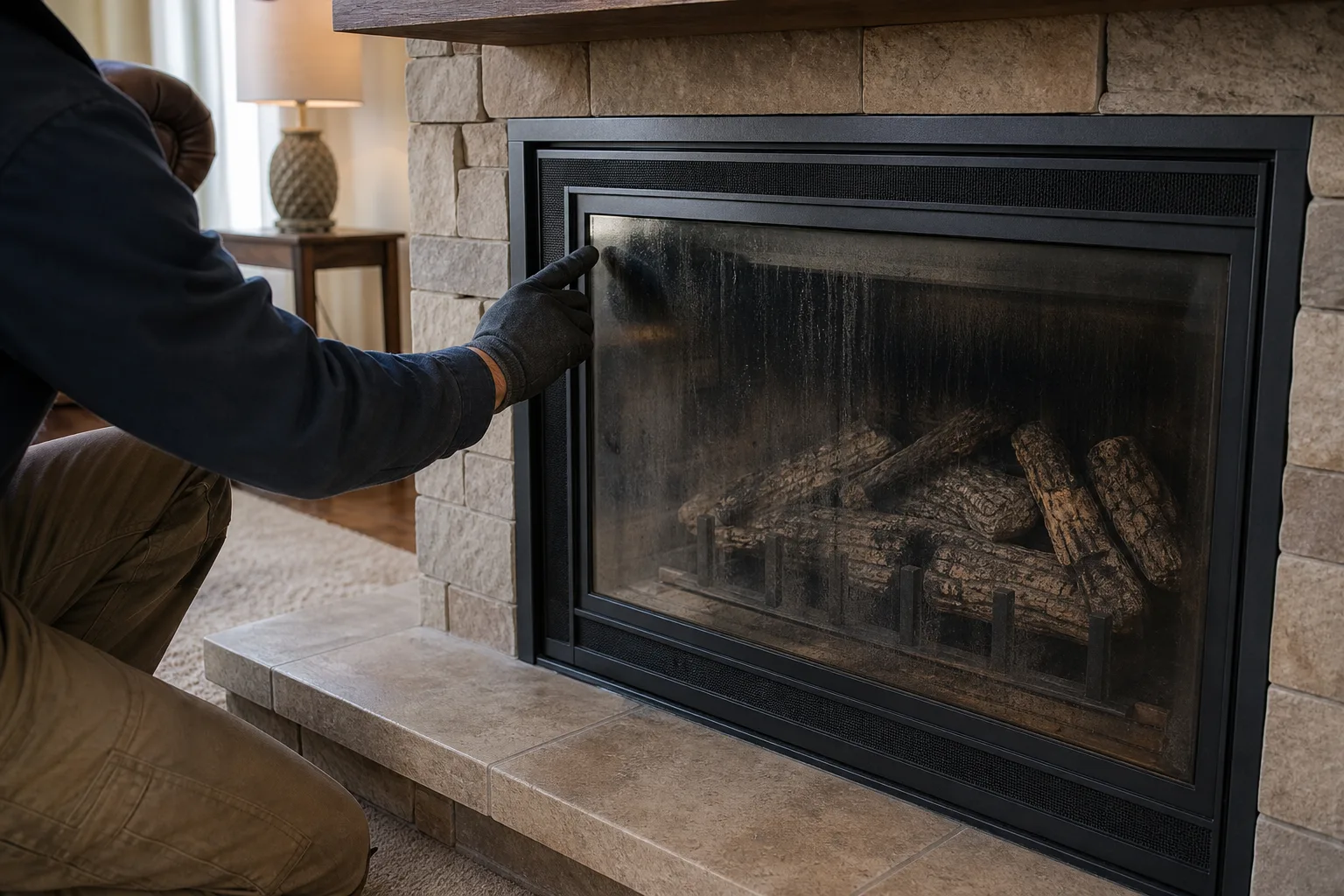
Persistent black soot is another stop signal. Soot on the glass, logs, wall, mantel, or ceiling can mean the burner is not receiving the right air mixture, the media is misplaced, or combustion gases are not moving through the vent correctly. Carbon monoxide cannot be identified by color or smell, so a carbon monoxide alarm must always be treated as a real warning.
Damaged glass also changes the safety of the appliance. Many direct vent fireplaces use a sealed glass assembly as part of the combustion and venting system, not merely as a decorative screen. Cracked glass, loose latches, a damaged gasket, or a panel that will not sit correctly requires professional evaluation before operation.
Homeowner checks should stop at controls, accessible batteries, the electrical panel, and observations made without dismantling the unit, with deeper inspections reserved for professional gas fireplace maintenance. Gas lines, valves, burner adjustments, sealed glass, internal wiring, and electrical testing belong to a trained technician who can test the fireplace after reassembly.
A symptom first guide to gas fireplace repair
Effective gas fireplace repair starts with the exact symptom, because a weak pilot sensor, failed control module, blower problem, and venting fault can all make the same appliance seem unreliable. What the fireplace does before, during, and after the failure often points the technician toward the right component.
| What you notice | Possible causes | What a technician checks |
|---|---|---|
| Pilot lights but will not stay lit | Dirty pilot assembly, weak thermocouple, weak thermopile, interrupted gas supply, failing gas valve | Pilot flame contact, sensor output, wiring, gas supply, and valve operation |
| Repeated clicking without ignition | Electrode, wiring, batteries, IPI module, gas supply, gas valve | Spark location, control signals, flame sensing, and fuel delivery |
| Blower is dead or noisy | Power loss, wall control, thermal switch, speed control, loose wiring, debris, worn motor | Voltage, switches, connections, blower wheel, and motor condition |
| Black soot or uneven flames | Blocked burner ports, misplaced logs, air setting, gas pressure, venting | Burner setup, media placement, combustion, pressure, and vent path |
| Gas odor | Leak, delayed ignition, valve trouble, incomplete combustion | Leak testing and safe operation before any restart |
The pilot will not stay lit
A pilot that goes out when you release the control may have a dirty pilot assembly or a flame that is not reaching the safety sensor correctly. A weak thermocouple can fail to prove that the pilot flame exists, causing the gas valve to close as designed. On some systems, a weak thermopile can light the pilot but fail to generate enough power for dependable main burner operation.
A technician watches the pilot flame, confirms that it contacts the sensor correctly, and measures sensor output rather than replacing parts by appearance. The technician also checks the gas supply, connections, control circuit, and valve response. A gas valve should not be blamed simply because the burner will not open.
The fireplace clicks but does not ignite
Repeated clicking usually means the ignition system is trying to create a spark but is not establishing a flame. The cause may be depleted batteries, a damaged electrode, poor spark positioning, loose wiring, an IPI control module fault, interrupted gas supply, or a valve that is not receiving or following the command to open.
Listen for whether the clicks are steady, stop after a few seconds, or continue through several ignition attempts. A technician checks whether the spark reaches the intended ignition point, whether gas arrives at the burner, and whether the module receives a valid flame signal after ignition.
From the field: A fireplace that clicks often receives a new ignition module too quickly. Technicians commonly find weak batteries, corroded battery contacts, loose wiring, or a spark jumping to the wrong metal surface instead.
The blower is dead, weak, or noisy
A dead blower does not always mean the motor has failed. Many fireplace blowers wait for a thermal switch to sense heat before turning on, so a short test from a cold start can make a working fan appear dead. Loss of household power, a wall control setting, a failed speed control, loose wiring, or a faulty thermal switch can also stop it.
Grinding, rattling, or scraping points more often toward debris, a loose blower wheel, worn bearings, or a motor nearing failure. Blower components may sit in a hot, cramped compartment near live wiring, so internal testing and removal are technician work.
The glass or surrounding area develops black soot
Black soot, tall yellow flames, uneven flame patterns, and staining around the firebox can indicate blocked burner ports, incorrect burner placement, misplaced logs or media, an improper air shutter setting, incorrect gas pressure, or a venting restriction. Ceramic logs are designed for specific positions, and a small shift can redirect flame against a surface that should not be struck continuously.
Do not wash the glass and assume the problem is solved. Cleaning removes the evidence, not the combustion fault, and continued use can worsen staining or conceal a venting problem.
You smell gas during startup or shutdown
Any gas odor is a safety issue, even if it lasts only during ignition or after the flame turns off. Delayed ignition can allow unburned gas to collect before lighting, while valve or fitting problems may become noticeable only as the system changes state.
Leave the area and follow the emergency steps described earlier rather than attempting to identify the source. Odor timing is useful information for the responding professional, but it is not an invitation to keep operating the fireplace.
Need the cause confirmed? Request a professional service visit or call (513) 655-6702 for help with recurring ignition, blower, soot, or odor symptoms.
Safe checks you can make before calling
A few low risk checks can rule out simple control and power problems without opening the fireplace. Work only from the normal user controls and accessible areas described in the appliance instructions, and stop if you smell gas, see damaged glass, or encounter burned wiring.
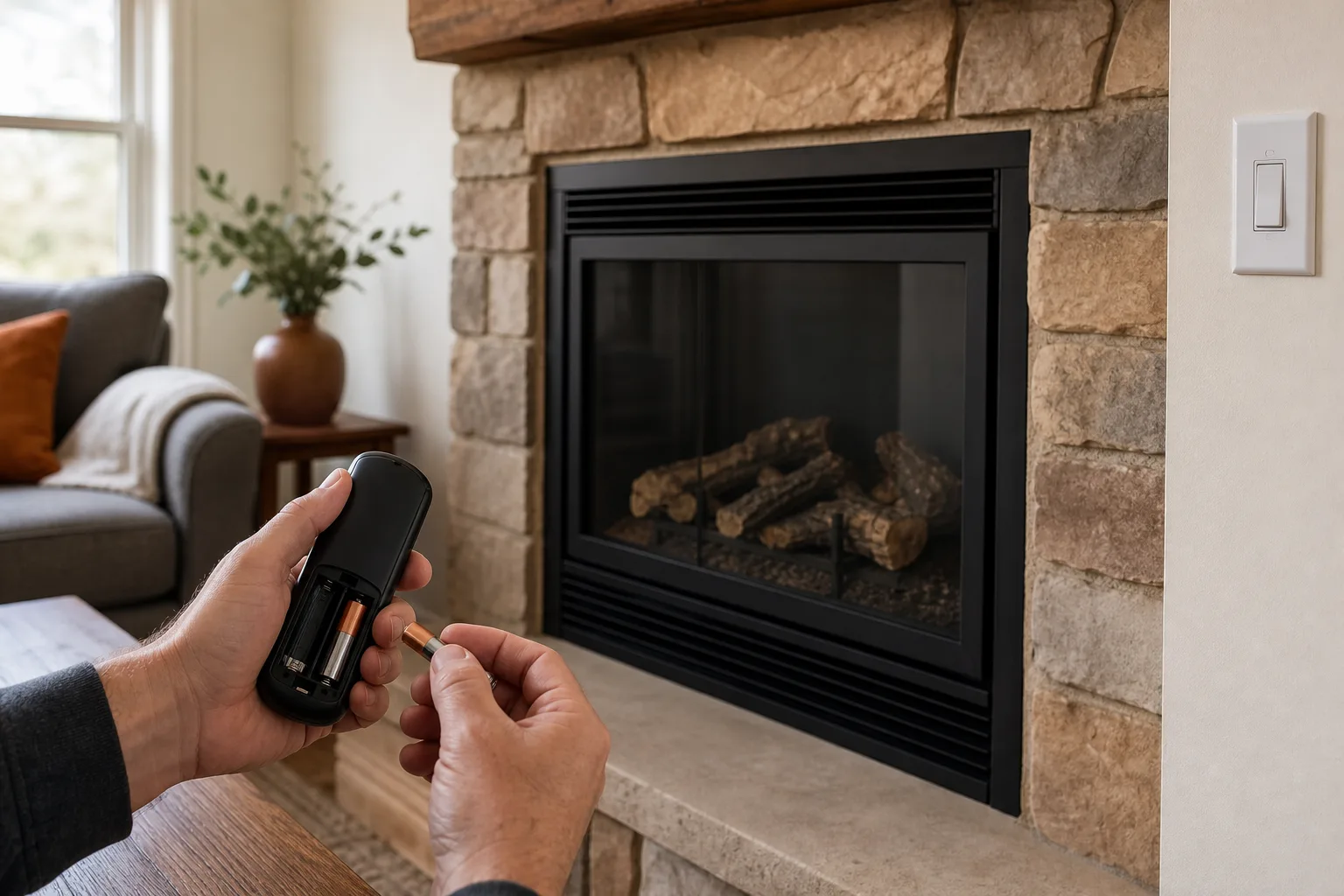
Start with the wall switch or remote setting. Confirm that the fireplace is set to the intended operating mode, replace accessible remote or receiver batteries with the specified type, and look for corrosion in a battery holder without reaching into the appliance. Check the household breaker once, but do not repeatedly reset a breaker that trips again.
Review the labels on the fireplace controls and the operating instructions if they are available. Some units have separate settings for the main burner, pilot mode, flame height, and blower. After an outage or battery replacement, an electronic control may also require its normal pairing or startup procedure.
Pro tip: Replace all batteries in an accessible battery pack at the same time. Mixed old and new batteries can produce enough power for lights or clicking while failing when the ignition system demands more current.
You can make a visual check of accessible air openings and the exterior vent termination without taking the appliance apart. Stay on the ground or another safe walking surface, and do not climb onto a roof or use a ladder in poor conditions.
- Check visible air openings. Look for household items, dust buildup, pet hair, or stored materials blocking openings around the fireplace, but do not insert tools or remove fixed covers.
- View the exterior termination. From a safe location, look for leaves, nests, snow, vegetation, or damage around the vent cap.
- Keep the termination clear. Move loose outdoor objects away only when you can do so without touching or dismantling the vent components.
- Inspect the glass from the room. Note cracks, loose corners, failed latches, gasket gaps, or soot patterns without removing the glass.
- Leave the firebox intact. Do not shift logs, stones, glass media, burner parts, or internal panels to get a better look.
A clear description of the failure can shorten the diagnostic process. Record whether the pilot lights, how long the clicking lasts, where the spark appears if it is safely visible, and whether the main burner lights evenly. Note any error lights or display messages exactly as shown.
Also record when an odor occurs, how the flames behave, whether the blower starts after the unit warms up, and whether the symptom changes between a cold start and a warm restart. A short video can help with intermittent noises or flame behavior, provided you can record it without approaching an unsafe appliance.
Good to know: A blower that waits several minutes after ignition may be operating normally because its thermal switch has not warmed. A blower that never starts after the fireplace is fully warm, or one that makes scraping sounds, needs further diagnosis.
Do not bypass a safety switch, bridge electrical terminals, probe live components, or attempt to measure sensor voltage unless you are trained and equipped for that work. Never clean a pilot opening with wire or a needle, adjust an air shutter, test gas pressure, disconnect a gas fitting, or loosen sealed glass to troubleshoot an ignition problem.
How the ignition system changes the diagnosis
The diagnosis changes according to whether the fireplace has a standing pilot or intermittent pilot ignition, commonly called IPI. A standing pilot keeps a small flame burning and often relies on flame heated sensors, while an IPI system creates a pilot flame only when heat is requested and depends more heavily on batteries or household power, wiring, flame sensing, and an electronic module.
You can sometimes identify a standing pilot by a small flame that remains on when the main burner is off. An IPI fireplace normally has no continuous pilot in its standard mode, though some models offer a selectable continuous pilot setting. The model information and wiring diagram give the technician a firmer answer than appearance alone.
Standing pilot systems
The thermocouple and thermopile serve different purposes, even though both sit in or near the pilot flame. A thermocouple typically proves that the pilot is burning so the safety portion of the gas valve can remain open. If it cannot generate the required signal, the valve shuts off pilot gas.
A thermopile may generate power for the main burner circuit, including the wall switch and gas valve. A weak thermopile can therefore allow the pilot to stay lit while the main burner responds slowly, works intermittently, or does not open. Not every fireplace uses these parts in exactly the same arrangement, so testing must follow the appliance design.
Myth vs. fact: The myth is that a pilot flame proves the entire gas valve is good. The reality is that the pilot, sensors, switch circuit, valve sections, and gas supply perform separate jobs, and each must be checked under operating conditions.
Intermittent pilot ignition systems
An IPI system begins an ignition sequence when the wall control, remote, or thermostat calls for flame. The control module sends power to the ignition electrode, creates a spark, opens the appropriate valve circuit, and looks for proof that the pilot flame has formed. If flame sensing fails, the module may close the valve and try again or enter a lockout state.
Weak batteries can produce clicking without dependable ignition, particularly when the battery pack has corroded contacts. Household power loss, damaged electrode insulation, poor grounding, loose wiring, an incorrect spark gap, failed flame sensing, or a control module fault can produce similar symptoms. The sequence must be observed step by step before selecting a replacement part.
Why the gas valve is tested last, not guessed first
A gas valve should be replaced only after the technician confirms the pilot condition, thermocouple or thermopile output where fitted, electrical controls, wiring, incoming gas supply, and operating signals. On an IPI unit, that also includes confirming that the module actually commands the valve to open and that flame sensing behaves correctly.
Replacing a valve without those checks can leave the original fault untouched. It can also disturb gas connections unnecessarily, which is why valve diagnosis, replacement, pressure testing, and leak testing belong to a qualified professional.
Want a safe diagnosis instead of a parts guess? Book a fireplace service appointment or call (513) 655-6702.
What a technician tests and repairs
A sound gas fireplace repair begins with the symptom you observed, not with a guess about which part should be replaced. The technician should record the model information, identify whether the unit has a standing pilot or intermittent pilot ignition, inspect its visible condition, and review when the trouble occurs. That first pass also covers the vent system, gas supply, glass, burner area, and any signs of overheating, corrosion, soot, or previous alteration.
The reported symptom determines the next tests. A pilot that goes out leads toward the pilot assembly, thermocouple, thermopile, gas supply, and valve signals, while clicking without ignition shifts attention to the electrode, wiring, batteries, ignition module, and fuel delivery. A blower complaint follows a separate path through power, controls, switches, wiring, debris, and the motor itself.
| Reported symptom | What the technician tests | Repairs that may follow |
|---|---|---|
| Pilot will not stay lit | Pilot flame contact, sensor output, gas flow, thermocouple or thermopile connections | Clean the pilot, correct flame contact, repair a connection, or replace a failed sensor |
| Clicking with no flame | Spark location, electrode condition, wiring, battery voltage, module output, gas supply | Reposition or replace the electrode, repair wiring, restore power, or replace a failed module |
| Main burner will not open | Thermopile output, wall switch circuit, control signal, gas pressure, valve response | Repair the control circuit, replace a weak sensor, or replace the valve after other causes are ruled out |
| Blower is dead or noisy | Power, thermal switch, speed control, loose wiring, debris, motor bearings | Restore the circuit, secure wiring, clean the blower area, or service the motor |
| Soot or uneven flames | Burner ports, log or media placement, air setting, pressure, venting | Clean and reposition components, correct combustion settings, or repair the vent system |
From the field: A part that appears defective can be reacting to another fault. A weak pilot flame, for example, may keep a healthy thermocouple from getting hot enough, so replacing the sensor without correcting the pilot leaves the original problem in place.
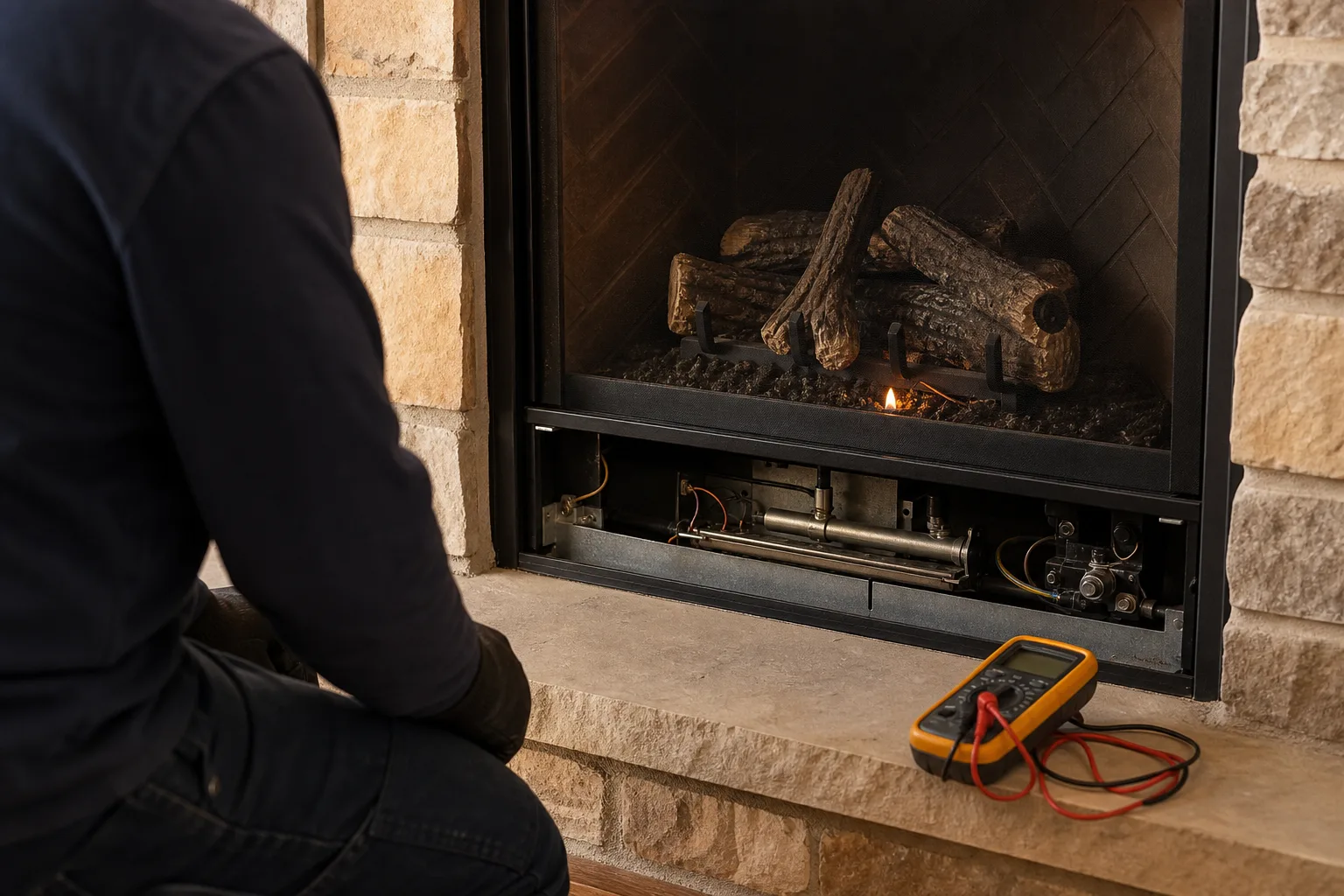
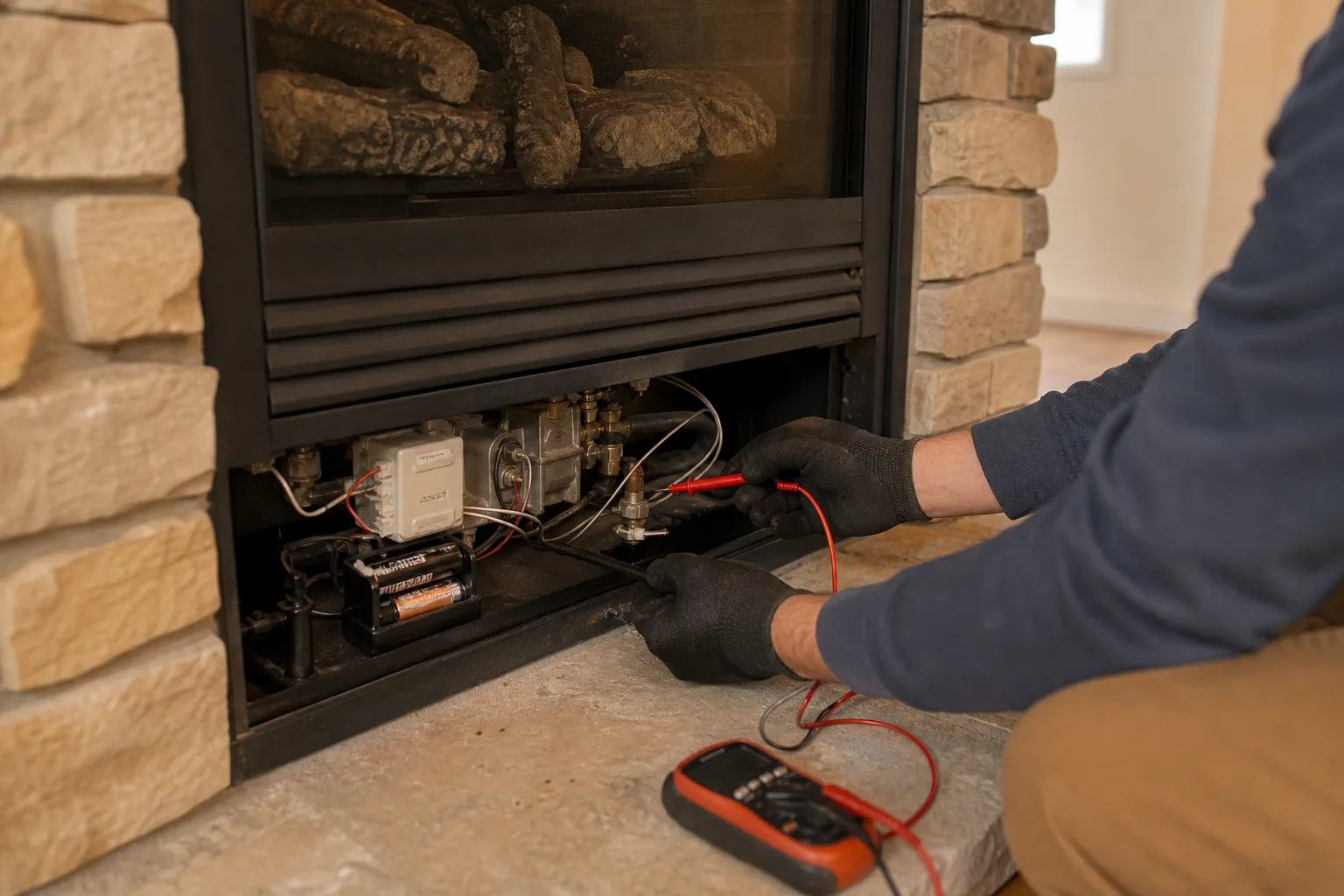
Gas testing is performed with the appliance off and running, as appropriate to the model. The technician may check fittings for leaks, confirm inlet and manifold gas pressure against the appliance specifications, measure thermocouple or thermopile output, and verify continuity through switches and wiring. On an intermittent pilot system, the work also includes observing the spark, flame-sensing signal, module commands, and gas valve response in the correct sequence.
The vent deserves the same attention as the ignition system. A blocked termination, disconnected section, damaged liner, poor draft, or incorrect vent configuration can affect flame quality and allow combustion products to enter the room. Testing methods depend on whether the fireplace is direct vent, natural draft, or another listed configuration, and any repair must follow the appliance instructions and applicable requirements such as NFPA 211.
Safety note: Gas pressure adjustments, valve testing, sealed-glass removal, burner work, and live electrical measurements belong in trained hands. Do not loosen a fitting or bypass a switch to see whether the fireplace starts, since that can defeat the exact safeguards the technician needs to verify.
Once the cause is established, service may include cleaning the pilot and burner, clearing burner ports using the approved method, correcting log or media placement, securing damaged wiring, or replacing a failed sensor, module, switch, or blower component. Combustion adjustments are made only where the appliance design permits them and only with the proper operating measurements. A gas valve should be replaced only after the technician confirms that gas supply, sensors, wiring, controls, and command signals are correct.
The repair is not finished when the flame first appears, since a complete gas fireplace service also includes operational and safety checks. The technician should cycle the appliance through ignition and shutdown, confirm a stable flame, observe the burner as the unit warms, and verify that the blower starts and responds properly. Final checks also include leak testing disturbed connections, confirming safe venting, and making sure the safety controls stop gas flow when required.
Ready for a clear diagnosis? Request professional service or call (513) 655-6702 to have the ignition, gas, venting, and control systems checked before parts are replaced.
When repair makes sense and when replacement should be discussed
Gas fireplace repair usually makes sense when the firebox, burner, glass, and venting remain sound, the installed system is safe, and compatible parts are still available. A failed sensor, ignition module, switch, blower, or wiring connection does not automatically mean the whole fireplace has reached the end of its service life. The recommendation should come from testing and overall condition, not from one visible symptom.
Repair becomes less attractive when failures keep returning or several major components are deteriorating together. Extensive corrosion, a compromised firebox, damaged sealed glass, unsafe or damaged venting, and obsolete parts can turn an otherwise ordinary service call into a larger system problem. Replacement may also be the safer path when previous alterations prevent the unit from operating as it was listed and installed, and any fireplace insert installation should begin with an evaluation of the existing chimney or venting system.
| Condition found | Repair is more likely | Replacement deserves discussion |
|---|---|---|
| Ignition fault | One confirmed component has failed and a compatible part is available | Controls and valve parts are unavailable or several components have failed |
| Firebox and burner | Metal is sound with only serviceable dirt or surface wear | There is extensive corrosion, cracking, distortion, or other structural damage |
| Glass and seals | Listed replacement seals or glass are available | The glass system is damaged and approved parts cannot be obtained |
| Venting | The vent is intact or can be corrected safely | The vent is extensively damaged, incompatible, or inaccessible for a sound repair |
| Service history | The trouble is isolated and the unit has otherwise operated reliably | Failures recur despite correct diagnosis and prior repairs |
Myth vs. fact: Myth: A fireplace that will not ignite needs to be replaced. Fact: Many no-ignition complaints trace to batteries, wiring, flame sensing, a pilot assembly, or a control component, but testing is needed before anyone can say which repair is justified.
Age alone is a poor decision tool. An older unit with a sound body, safe venting, and supported components may be a reasonable repair candidate, while a newer appliance with severe corrosion or damaged venting may not be. The useful questions are whether the fireplace can be repaired to its listed configuration, whether parts support exists, and whether the rest of the system is in condition to justify the work.
A diagnosis also prevents the opposite mistake, replacing the easiest visible part and hoping for the best. Soot on the glass may come from misplaced logs rather than a failed valve, while a weak pilot may result from restricted flow rather than a bad thermocouple. Ask for the confirmed fault, the condition of the connected systems, and any concerns that would remain after repair.
Need help weighing repair against replacement? Schedule an on-site assessment or call (513) 655-6702 for a recommendation based on safety, parts availability, and the condition of the installed fireplace.
What to expect from a repair appointment
A productive appointment starts with a precise description of what the fireplace does and when it does it. Tell the technician whether the pilot goes out, the igniter clicks without lighting, the burner shuts down after warming, the blower stays silent, soot returns, or an odor appears during startup or shutdown. Mention any recent power outage, battery change, renovation, cleaning, or earlier service, since timing can point toward the affected circuit or condition.
Provide the model and serial information if you can read it without removing secured panels or sealed glass. The rating plate may be behind an accessible control cover or near the lower control compartment, but its location varies by unit. A clear photo of the plate can help with parts research, as long as you can take it without disturbing burner components or gas fittings.
Use this short checklist before the visit:
- Record the symptom. Note what you see, hear, and smell, including the timing and how long the fireplace runs before the problem appears.
- Photograph the controls. Capture error lights, switch positions, remote displays, and the rating plate when each is safely accessible.
- List recent changes. Write down battery replacement, electrical outages, remodeling dust, furniture changes near air openings, and previous repair work.
- Clear the hearth area. Move decorations, screens that are not attached, furniture, and other belongings so the technician has reasonable working room.
- Leave installed parts alone. Keep logs, media, glass, panels, vent pieces, and gas fittings exactly where they are.
- Keep the exterior termination visible. From the ground, move only loose items that block access around the area, without climbing or taking the termination apart.
Pro tip: Do not clean the burner or rearrange logs before the appointment. Their position, soot pattern, and debris can show where ignition or combustion is going wrong, and a freshly altered firebox may hide the evidence.
The technician will usually begin by confirming the complaint before taking components apart. If the failure is intermittent, your notes about sounds, flame behavior, odor timing, error lights, and warm-up time may be the only reliable trail. A phone video recorded from a safe distance can also be useful, but never operate a fireplace that smells of gas, produces persistent soot, has damaged glass, or has triggered a carbon monoxide alarm.
Reasonable access helps, but disassembly is not preparation. Do not remove sealed glass, pull out logs, open gas connections, or expose wiring to save appointment time. Those parts may require a specific removal sequence, new seals, leak testing, or inspection before the appliance can be operated again.
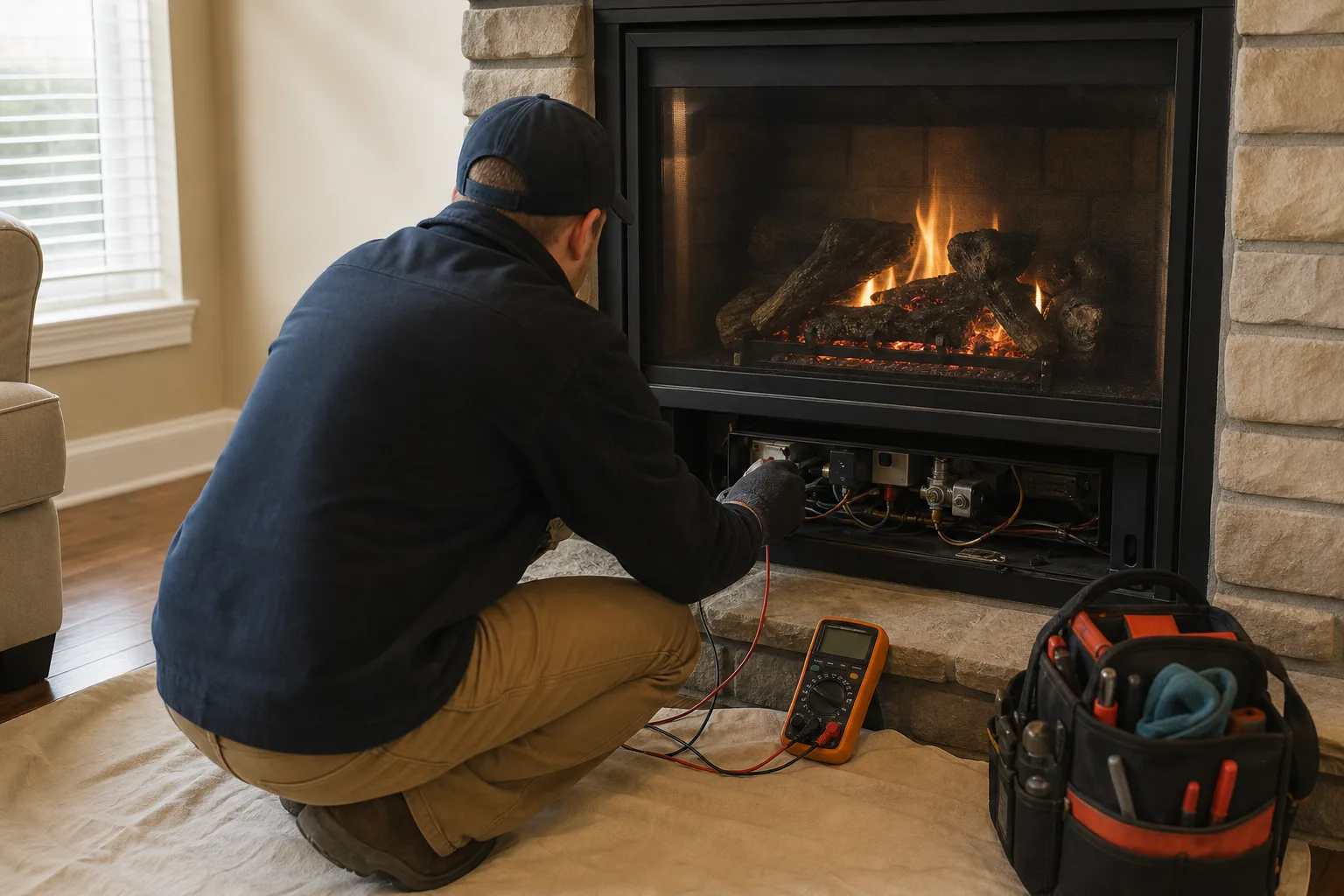
A sound visit should end with a plain explanation of the cause, the tests that confirmed it, and the work performed. You should also be told about any unresolved concerns, unavailable parts, venting defects, or conditions that could make continued use unsafe. Before the technician leaves, the fireplace should be operated through ignition, warm-up, blower response, and shutdown when the condition of the unit allows it.
Operating instructions matter after the repair. Ask which batteries serve the remote or ignition backup, what normal startup sounds like, when the blower should begin, and which flame or odor changes require shutdown. If the appliance must remain off while a part is ordered or another defect is corrected, the technician should identify that restriction clearly.
For recurring ignition, blower, soot, or odor problems, request a gas fireplace service appointment or call (513) 655-6702. Describe the symptom when booking so the technician can arrive prepared to diagnose the system rather than guess at a replacement part.
Symptom checker
What is your chimney doing?
Tap the closest match for an honest first answer.