



On this pageIs it actually chimney repointing near me, or something else?7 sections+6
Quick answer
Repointing means grinding out failed mortar between your bricks to about twice the joint's width and packing in fresh mortar. You need it when joints are receding, crumbling under a screwdriver, or shedding grit onto the roof while the bricks themselves stay sound. If brick faces are flaking, if cracks run diagonally through brick, or if the crown is split, repointing alone will not fix it. Have the whole chimney assessed before you buy a scope.
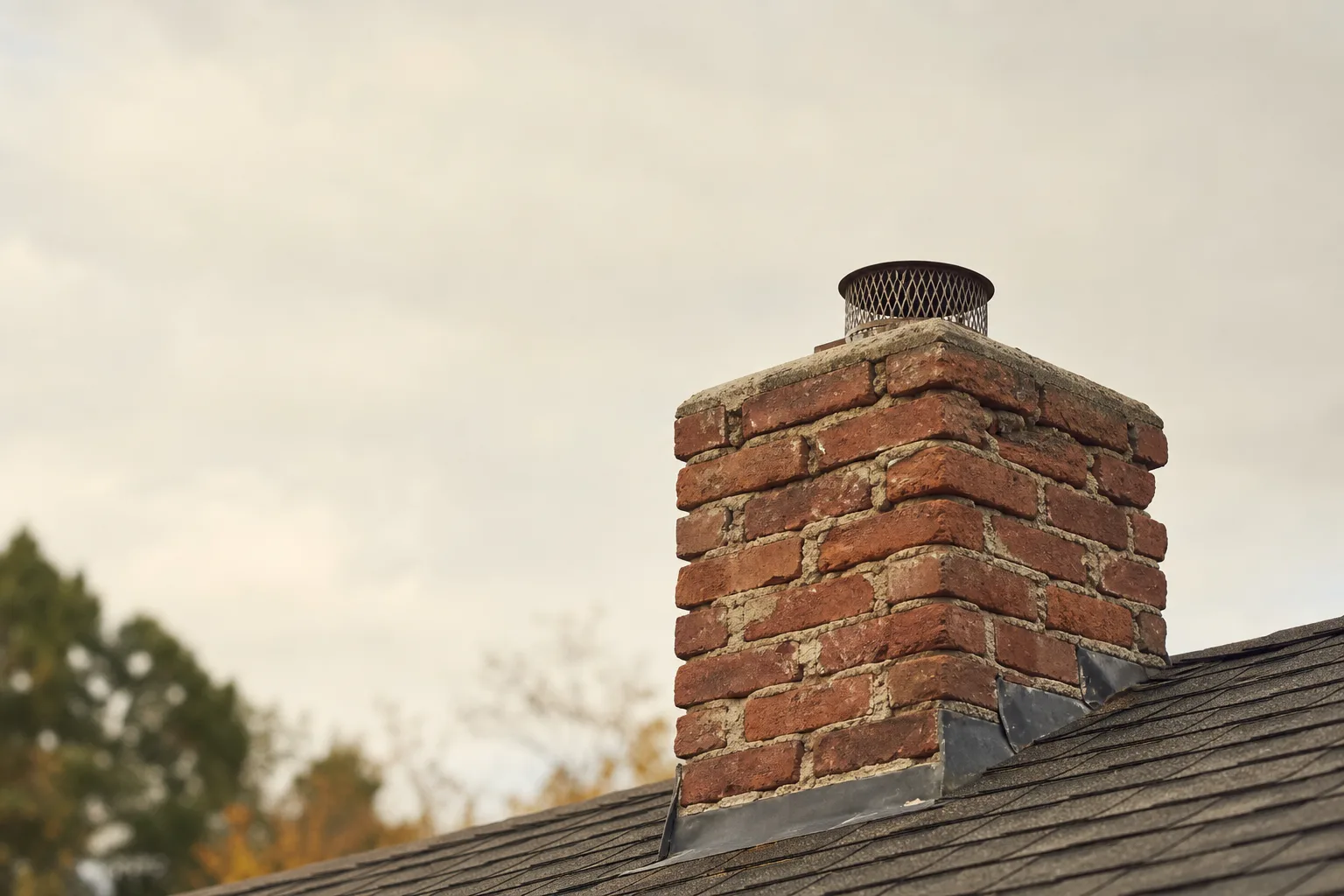
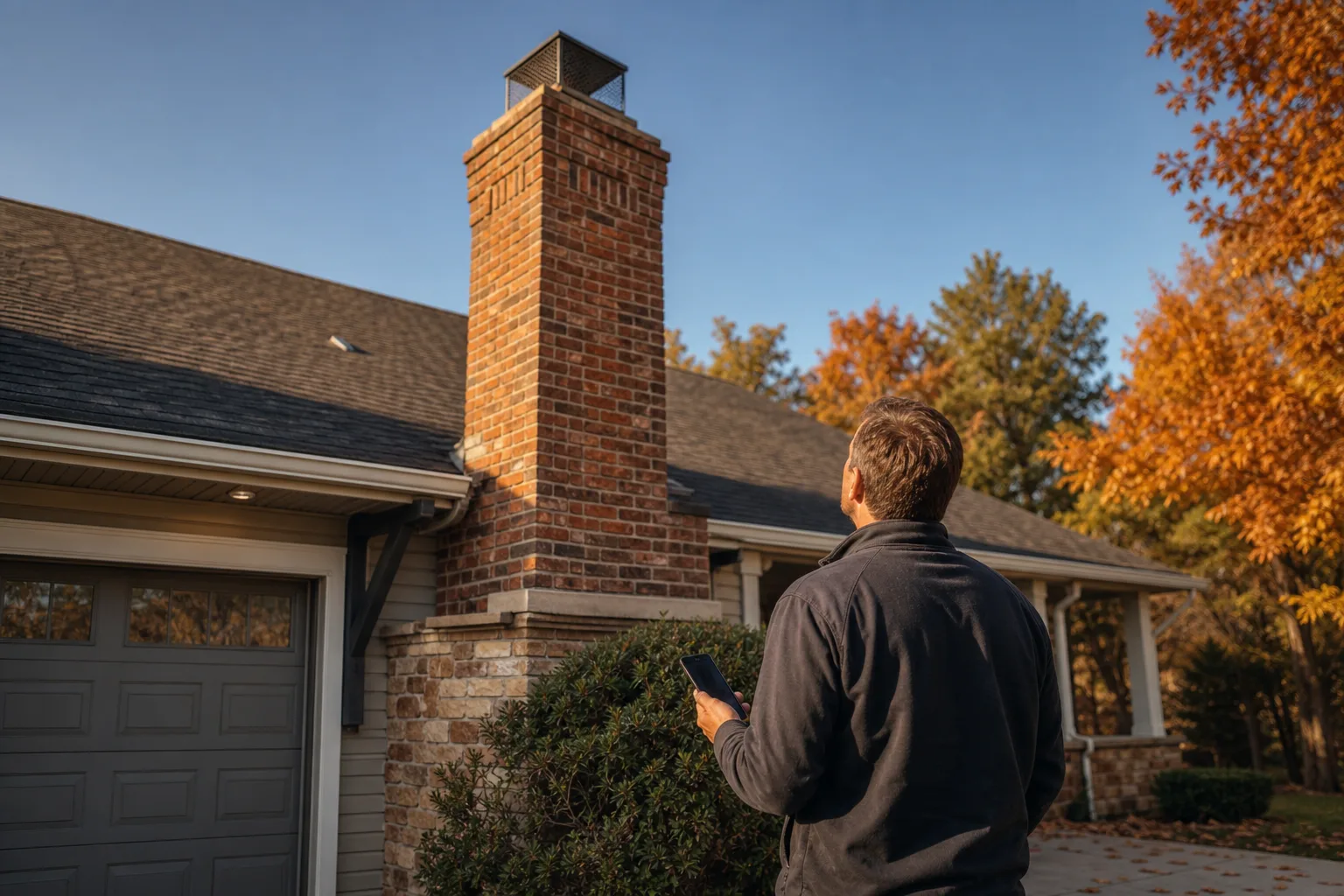
You're standing in the driveway with your head tilted back, and something about the chimney looks wrong. The bricks are fine; the bricks are always fine. It's the gray lines between the bricks: some have gone soft and crumbly, a few have receded into shadow, and there's a pile of what looks like coarse sand on the shingles below. So you type chimney repointing near me into your phone and end up here, trying to work out whether this is a one-day fix or the opening move in something much larger.
Short answer. Repointing means grinding out the failed mortar between your bricks to a controlled depth and packing in fresh mortar. Done at the right time, it's the cheapest serious thing you will ever do for a chimney. Done too late, after water has been running through open joints for years, it stops being repointing and becomes rebuilding. The whole game is catching it in the window between those two.
Good to know: Repointing, tuckpointing, and pointing get used interchangeably by nearly everyone in the trade, including me. Purists will tell you tuckpointing is a decorative technique using two mortar colors. In practice, ask three masons for tuckpointing quotes and three for repointing quotes and you'll get six quotes for the same work.
Is it actually chimney repointing near me, or something else?
A lot of people searching chimney repointing near me are looking at a problem repointing won't solve. That's nobody's fault. From thirty feet below, most chimney failures look identical.
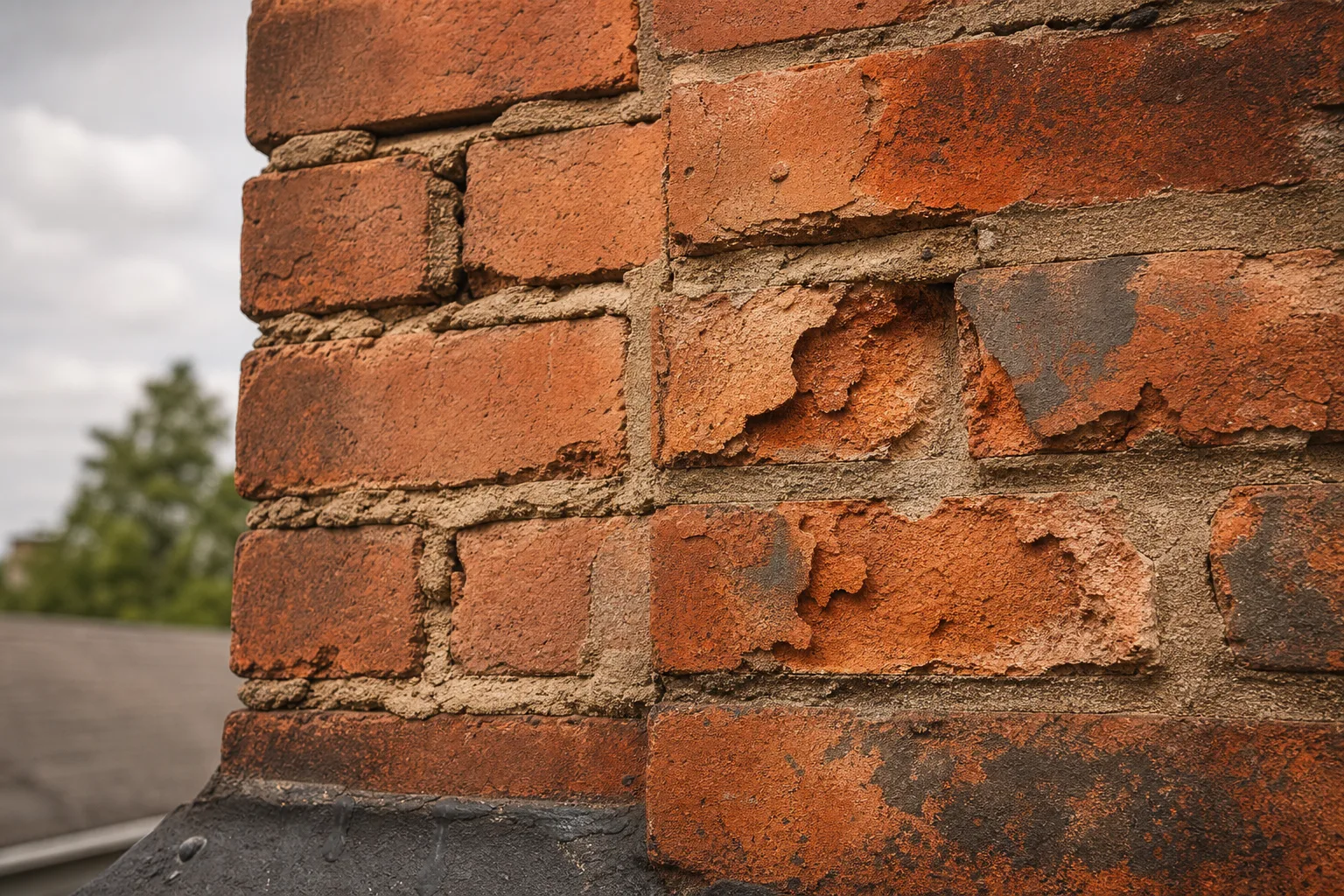
Mortar joint failure is what repointing fixes. Joints have receded behind the face of the brick, you can scratch them out with a key, hairline cracks run along the mortar lines rather than through the brick, and sandy grit collects at the base or on the roof. The bricks themselves are still square and solid.
Spalling brick is a different animal. The face of the brick pops off or flakes away, leaving a pitted, chewed-up surface: water got in, froze, and blew the face apart from the inside. You cannot repoint your way out of that. Those units have to be cut out and replaced.
Structural movement shows as stair-step cracking climbing diagonally through both brick and mortar, a stack leaning away from the house, or a gap opening between chimney and siding. That's a support problem wearing a masonry costume.
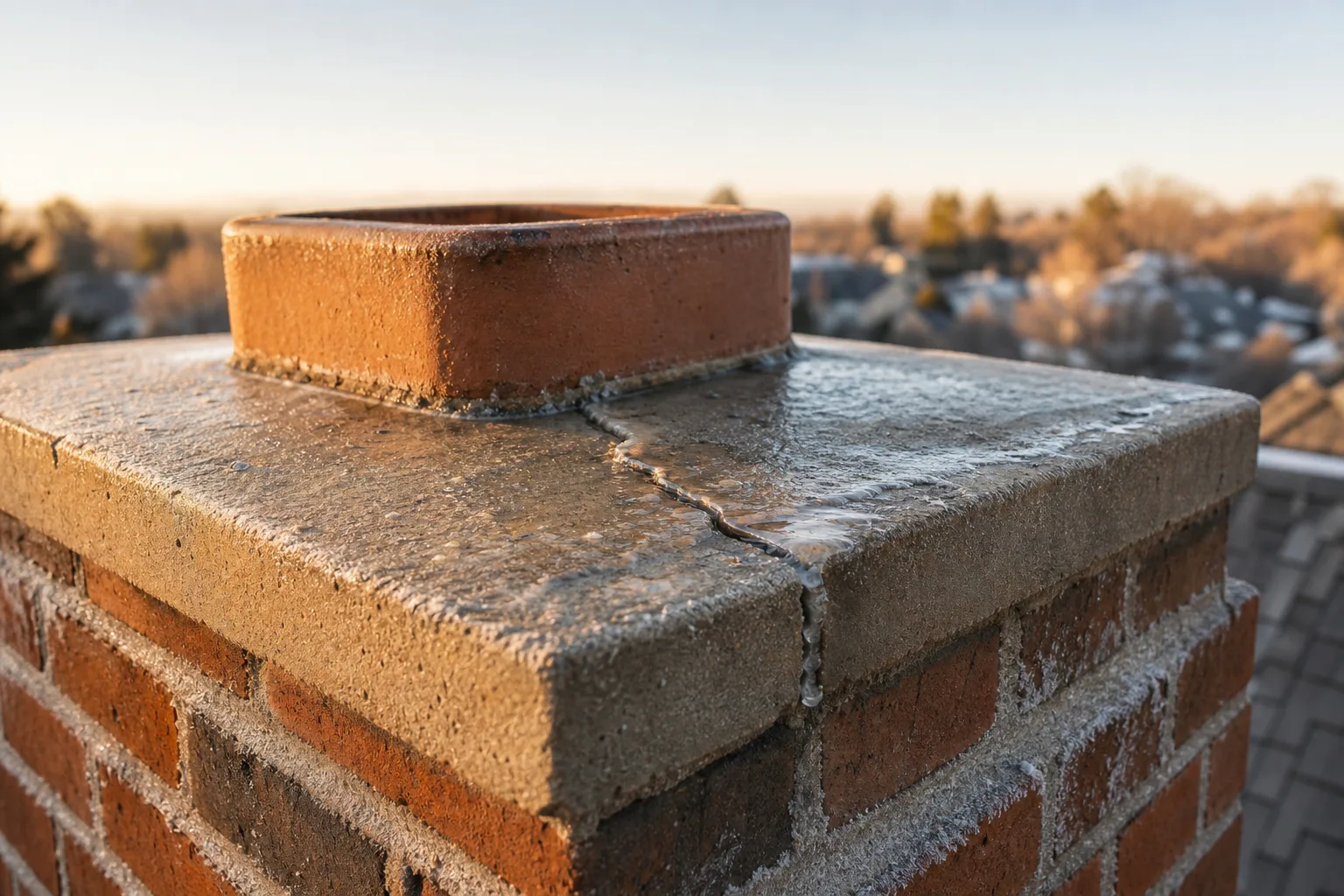
Crown failure is the one homeowners miss most. The crown is the concrete slab at the very top that sheds water off the chimney's shoulders. When it cracks, water pours into the masonry core and the joints fail from the inside out. Repoint the exterior without addressing it and you'll watch the same joints go again.
| What you're seeing | What it usually is | What actually fixes it |
|---|---|---|
| Sandy grit on the roof, receded gray lines | Mortar joint erosion | Repointing |
| Brick faces flaking, popping, or pitted | Freeze-thaw spalling | Brick replacement, then repointing |
| Diagonal stair-step cracks through brick | Structural movement or settling | Structural evaluation first |
| Cracked slab at the top, water stains below | Crown failure | Crown repair or rebuild |
| Stains on the ceiling near the chimney | Flashing or cap failure | Chimney flashing repair or a new cap |
| White chalky bloom on the brick face | Efflorescence: water is moving through | Find the water source, then repoint |
That last row matters. Efflorescence isn't damage — it's a receipt. Salt left behind by water passing through masonry, telling you where the water came out.
Myth vs. fact: Myth: spraying waterproofer over the outside buys you years instead of repointing. Fact: masonry sealers are vapor-permeable for a reason. Put a film-forming sealer over open, failing joints and you trap moisture inside the masonry instead of letting it breathe out. Sealing comes after the joints are sound, not instead of it.
Why chimneys lose mortar before the rest of the house
Your walls at ground level might be a century old and perfectly tight while the chimney twenty feet up falls apart. That isn't bad luck.
A stack above the roofline is exposed on all four sides, taking wind-driven rain from every direction with nothing shielding it and no interior heat bleeding through to dry it out. It's also thermally violent: light a fire and the inside heats while the outside stays at whatever the weather is doing, with the flue expanding at a different rate than the brick around it. Repeat that through a burning season and joints work loose.
Then there's freeze-thaw, the real destroyer. Water gets into a hairline crack, freezes overnight, expands about nine percent, and widens the crack. Tomorrow it thaws, more water gets in, and it freezes into a bigger space. Any single cycle is microscopic. The damage is cumulative, which is why it stays invisible until it isn't. Climates that swing through a freeze and a thaw in the same day chew mortar faster than places that simply stay cold. Our Cleveland freeze-thaw masonry guide covers what that pattern does over time.
Flue gas plays a part too. Combustion byproducts are acidic, and in an unlined or failing chimney they attack mortar from the inside. That's part of why a chimney liner isn't merely a code item: it keeps the exhaust stream from eating the structure containing it.
From the field: The chimneys that surprise me are rarely the oldest ones. They're the ones on houses where the fireplace stopped being used at some point and nobody looked up again. An unused chimney doesn't stop weathering. It just stops having anyone with a reason to notice.
When it's urgent and when it can wait
Not every soft joint is an emergency, and I'd rather say so than sell a rush job.
Handle it now if you can see daylight through a joint, if mortar is missing to a depth greater than the joint is wide, if you're getting water stains on interior walls near the chimney chase, if bricks are visibly loose, or if you've had a chimney fire. That last one matters for a separate reason: a chimney fire thermally shocks the structure and can open joints and crack a liner where you can't see.
Plan it for the next dry season if joints are receded but still firm under a screwdriver probe, or if grit is accumulating while the joint profile stays largely intact. This is the good window; the work is contained and straightforward here.
Watch it if you have hairline crazing in sound mortar or light efflorescence with no other symptoms. Photograph it, date the photo, and look again after winter. Masonry moves slowly enough that a year of observation costs little and tells you the rate of change.
Weather matters more than people expect. Mortar cures through a chemical reaction that stalls in cold and rushes in heat. Mortar that freezes before it cures is permanently weakened: the water in the mix disrupts the structure as it sets. Mortar placed in blazing sun and wind dries before it cures, which sounds the same but isn't; it comes out chalky. Mild conditions with no freeze forecast for a few days afterward is what you want, and a mason who declines the wrong conditions is protecting your job.
Safety note: Don't get on the roof to check this yourself. Chimney work happens at the steepest, least forgiving part of a house, and the reason to be up there, deteriorating masonry, is exactly what makes handholds untrustworthy. Binoculars from the ground and a zoomed photo from an upstairs window will tell you nearly everything you need for an intelligent phone call.
Not sure what you're looking at?
You don't have to diagnose this from the driveway. Send us up to look at the joints, the crown, the cap and the flashing, and we'll tell you plainly whether it's repointing, a spot repair, or something bigger, and in what order it needs doing. No pressure to book on the spot.
Call VIO Chimney at (513) 655-6702, or request service online if you'd rather not pick up the phone.
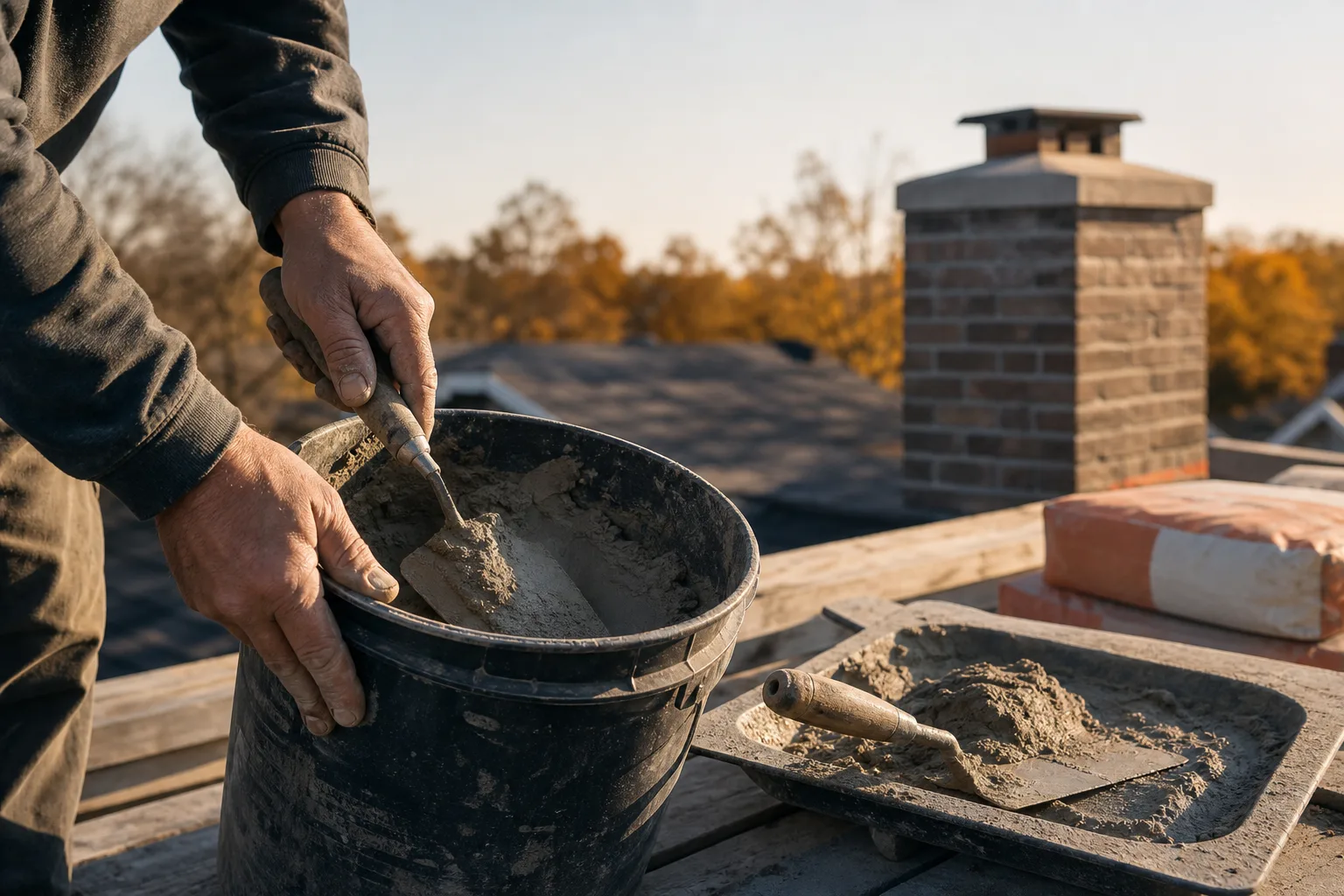
The mortar question almost nobody asks
If you take one technical thing from this guide, make it this. Mortar is supposed to be the weak component. That sounds backwards, but it's the whole design philosophy of masonry: brick is expensive and permanent, mortar is cheap and sacrificial. Every wall moves. You want that stress to relieve itself by cracking the mortar, which can be replaced, rather than the brick, which can't be. Not without cutting out and rebuilding.
Modern Portland-heavy mortars are stronger than a lot of older brick. Put a rigid, high-strength mortar between soft historic bricks and the next time the wall expands, the mortar wins and the brick faces spall off. You'll have made the chimney look beautiful while permanently damaging the units underneath.
Practically: mortar comes in types (N, S, M, O). Type N is the general-purpose exterior mix and suits most residential chimney work above grade. Type S is stronger and belongs where there's structural or lateral load. Type M is stronger still and rarely right for a chimney stack. Type O is soft and low-strength, often the correct answer on genuinely old, soft-fired brick.
The right choice depends on your brick, not on what's already in the truck. A mason who asks the age of the house, looks closely at the existing brick, and talks about matching the existing mortar's strength is doing the job properly. One who says "we use S, it's stronger" is optimizing for the wrong variable.
Pro tip: Ask this exact question: "What mortar type are you using, and why that one for my brick?" You don't need to evaluate the answer technically. You need to hear whether there is one. "Type N, because your brick is standard modern extruded" is a professional response. "Whatever we've got mixed" tells you something else.
Color and profile are where sloppy work announces itself from the sidewalk. Fresh mortar rarely matches aged mortar out of the bag, so a good mason cures a test batch against the existing first. And the profile should match: concave sheds water, while a raked joint holds it, which is why it doesn't belong on an exposed chimney.
What good repointing actually looks like
Knowing the sequence lets you tell whether the work on your roof is the work you paid for.
It starts with a real look at the whole system: joints, brick, crown, cap, flashing, flue, and then proper access. A ladder leaned against a chimney is not a work platform, and masonry done one-handed from a ladder is masonry done badly.
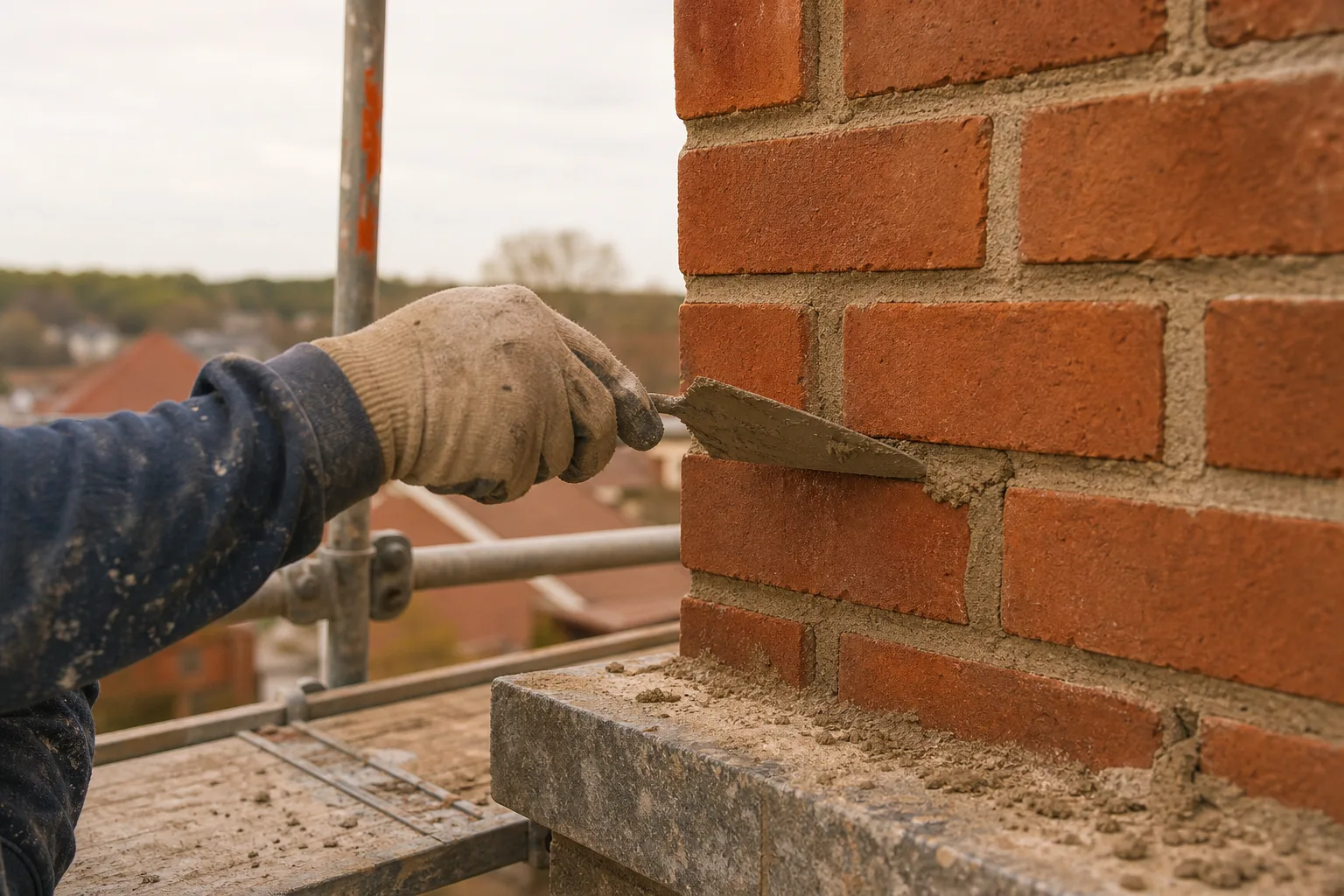
Then the old mortar comes out, ground and chiseled to roughly twice the joint's width in depth: for a standard three-eighths-inch joint, about three-quarters of an inch. Shallower and the new mortar has nothing to key into; it works loose and pops out like a bad filling. This is the step that disappears when a price looks too good, because removal is the slow, dirty part and troweling in fresh mortar is the fast part.
The joints get cleaned, since leftover dust acts as a bond breaker. They get lightly dampened, because dry brick wicks water straight out of fresh mortar and starves the curing reaction. Damp, not saturated. A feel thing experienced hands get right.
New mortar goes in packed in layers and compacted with each pass rather than filled in one shot. Compaction is what makes a joint dense and water-resistant; loose-filled joints look identical on day one and fail early. Once the mortar reaches thumbprint firmness it's tooled to its final profile. Too wet and it smears, too dry and it won't compact. That window is real and part of what you're paying for.
Then curing, misting or covering as conditions require, mortar smears cleaned off the brick faces before they set, and debris off your roof and out of your gutters. Grinding a chimney produces a startling amount of grit and it all has to go somewhere.
Good to know: Repointing doesn't have to mean the whole chimney. Deterioration is usually worst on the weather-facing side and the top courses. Spot repointing of failed areas is legitimate and often correct. What you want to avoid is a contractor who only ever quotes the entire stack, and equally one who patches a visibly failing chimney a little at a time on repeat visits.
How to vet whoever shows up
Masonry is a trade where quality stays invisible for a long time and then becomes extremely visible. You can't inspect joint depth once the mortar is in, so the vetting happens beforehand, through questions.
Start with insurance and credentials. You want current liability coverage and workers' compensation, and you want to see them rather than hear about them. For chimney work, certification from the Chimney Safety Institute of America signals someone who treats this as a trade with standards rather than a side offering. Ask directly; anyone legitimate is used to the question.
Then ask about the inspection. Repointing quoted from the ground, with nobody's eyes on the crown or the flue, is a guess. Honestly, a chimney inspection near me search is a better first move than searching for repointing: the inspection tells you what you need, and then you're shopping a defined scope.
NFPA 211, the standard for chimneys and venting systems, is worth knowing here. It defines inspection levels, and a Level 2 inspection is required in specific circumstances: when a property is sold or transferred, when the system is changed (new appliance, fuel change, new liner), when it has malfunctioned, after a chimney fire, and after an external event that could have damaged the chimney, such as a severe storm or an earthquake. A Level 2 includes video scanning of the flue interior.
Get the scope in writing. "Repoint chimney, $X" is not a scope. A quote naming the areas being repointed, the grinding depth, the mortar type, the joint profile, whether crown and cap are included or excluded, and how cleanup is handled. That's a document you can hold someone to.
Pro tip: Ask what happens if they find spalled brick or a cracked crown once the scaffolding is up. You want a process (we stop, photograph it, show you, and price it separately before proceeding), not a shrug. That answer predicts your whole experience with the contractor, because on an old chimney they probably will find something.
Slow down if a quote arrives without anyone leaving the truck, if you're pressured to sign today, if mortar type is brushed aside, if the diagnosis comes with alarm language but no photographs, or if a bid sits dramatically below every other one. Masonry has no secret cheap method. Much lower means less work, and the less work is the part you can't see. It's fair to ask for addresses they've repointed nearby, too. Good repointing is quiet; you have to hunt for it from the sidewalk.
If the conversation turns out to involve a liner, a rebuild above the roofline, or firebox work, that's a broader fireplace chimney repair discussion, and the same logic applies. Searches like chimney repair near me surface the same names; your questions are what separate them.
Your ten-minute pre-call checklist
- Photograph the chimney from the ground at maximum zoom: every visible side, plus a wide shot against the roofline
- Photograph anything on the roof or at the base: grit, fallen mortar, brick fragments
- Check ceilings and walls nearest the chimney chase for staining, and photograph what you find
- Sight up the corner of the house to see whether the stack is straight
- Find out roughly when the house was built; it drives the mortar decision
- Note what the chimney serves: open fireplace, insert, wood stove, furnace, water heater, or nothing
- Write down when it was last swept or inspected, even if the answer is "never that I know of"
- Note anything that changed recently: new appliance, new roof, a storm, a fire
- Write down your three questions: mortar type and why, grinding depth, what's included beyond the joints
From the field: The homeowners happiest with masonry work are the ones who asked the most questions before it started, not the ones who supervised hardest while it happened. Once the grinder is running, the decisions have already been made.
Since access is the expensive part of any chimney job, think about the rest of the system while the scaffolding is up. That's the moment for a chimney cap replacement if yours is rusted or missing, for crown repair, and for a sweep if the flue needs one. A chimney sweep near me search will find someone for the interior work, and if you burn wood regularly it's worth understanding what creosote is and why the flue side needs its own attention.
Repointing is unglamorous. Nobody photographs their new mortar joints. But it's the repair that keeps water out of the structure, and water is what turns a chimney from a fixture into a project.
You know what to ask now. Ask us.
Mortar type and why. Grinding depth. What's included beyond the joints. What happens if we find spalled brick up there. Put those questions to us: we'll look at the joints, the crown, the cap and the flashing, tell you what's actually failing and what isn't, and put the scope in writing before anyone mixes a bag of mortar.
VIO Chimney: call (513) 655-6702 or request service online and we'll come take a look.
Symptom checker
What is your chimney doing?
Tap the closest match for an honest first answer.