



On this pageThe Moment You Find Out Something Is Wrong7 sections+6
- The Moment You Find Out Something Is Wrong
- What Chimney Flue Repair Actually Means
- Read Your Own Diagnosis: Symptom, Cause, Repair Class
- The Four Real Repair Paths, and What Each One Does Not Fix
- Water First: The Order of Operations Nobody Tells You
- How to Grade the Quote You Were Handed
- How VIO Helps With Chimney Flue Repair
Quick answer
Chimney flue repair fixes the lining of the passage that carries smoke out of a house, usually cracked clay tiles, washed-out mortar joints, or a failed metal liner. The four common approaches are replacing individual tiles, resurfacing the flue from inside, relining with a stainless steel liner, and rebuilding the top section. A camera inspection determines which applies. Independent local chimney companies perform the work.
The Moment You Find Out Something Is Wrong
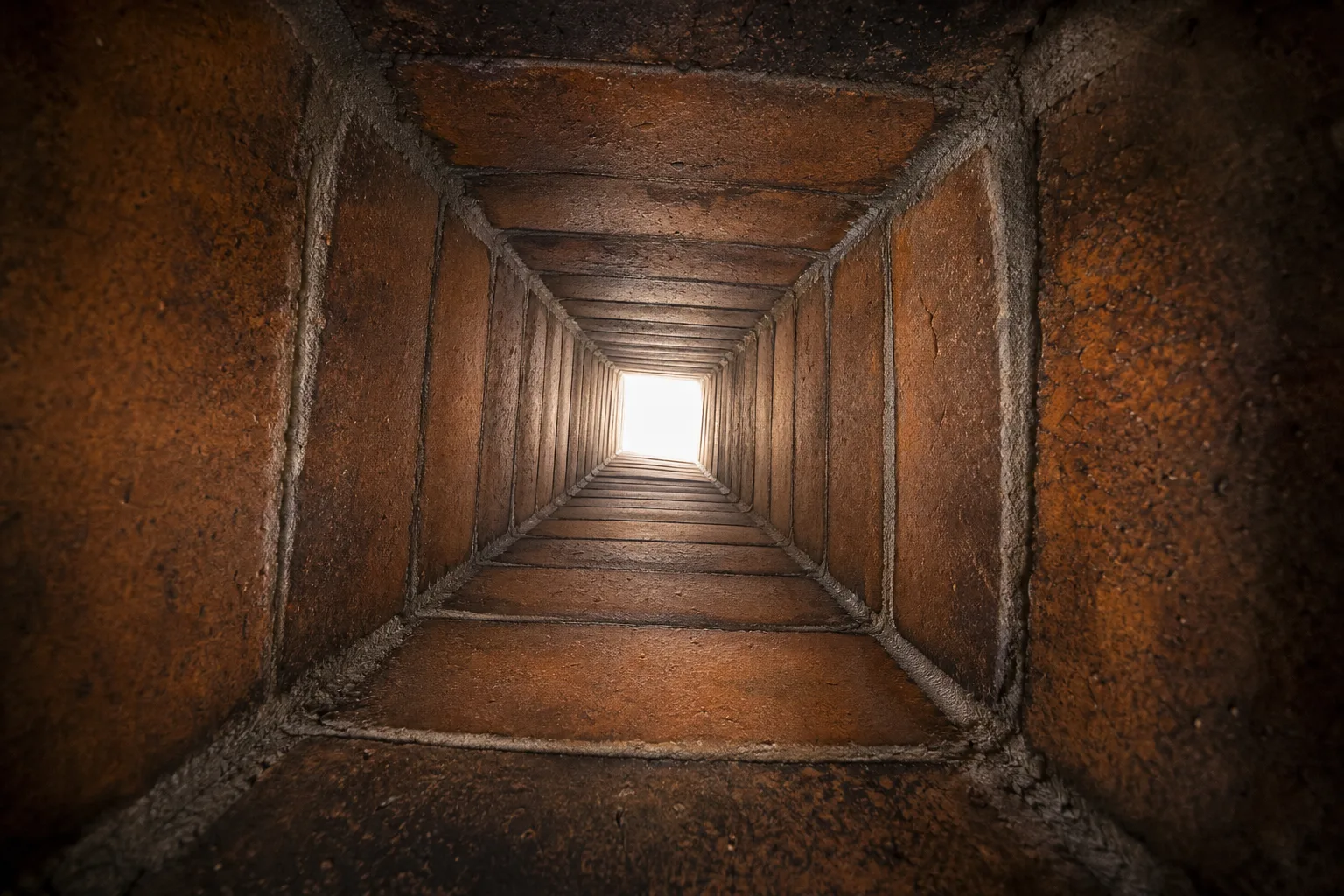
The technician comes down the ladder holding a tablet. He turns it toward you and there is a still frame on the screen: a dim orange square, a hairline running diagonally across it, a dark seam where mortar used to be. He says the tiles are cracked, and then he pauses, the way people pause before a number, and tells you what chimney flue repair is going to involve.
You nod. You have no idea whether any of that is true.
That is the honest position most people are in, and there is no shame in it. The flue is a sealed shaft running up the middle of a masonry column. You will never look at it with your own eyes. Every decision you make about it rests on a stranger's camera footage and a stranger's judgment, which is a strange thing to spend real money on.
So let me answer the question you actually came here with.
Can you light a fire tonight? No. If a professional has told you the flue is cracked, gapped, or unlined, stop using that appliance until it has been repaired or cleared. A crack is a path for flue gases, and flue gases carry carbon monoxide. It is also a path for heat to reach the wood framing alongside the chimney chase. Keeping hot, toxic exhaust inside a sealed channel until it clears the roof is the entire job of a flue. Space heaters are cheap. Wait.
Now the useful part. This page is not going to define a chimney for you and then advise you to call a professional. You already have a professional. What you do not have is the ability to read what he told you and judge whether the repair he proposed is the proportionate one.
One more thing before we start. There is a single question you should ask before approving any flue repair, and most homeowners never think to ask it. It is near the bottom of this page, and I will flag it when we get there.
What Chimney Flue Repair Actually Means
Half the confusion here comes from four words people use interchangeably that mean four different things.
Flue, liner, chimney: three words for three different things
The chimney is the whole structure: the brick column, the crown on top, the cap, the flashing where it meets the roof.
The flue is the passage inside it, the vertical channel the smoke travels up. A chimney can hold more than one, which surprises people. A single stack often carries one flue for the fireplace and a smaller one for the furnace.
The liner forms the walls of that passage. In most masonry chimneys built since the 1940s it is a stack of clay tiles, each about two feet tall, mortared to the one below. In newer or repaired chimneys it may be a stainless steel tube. In older houses there may be nothing at all, just the inner face of the brick.
The flue pipe, or connector, is the metal pipe running from the back of a stove into the chimney. It is not the flue. If you are dealing with a freestanding stove rather than a masonry fireplace, chimney pipe is a different repair conversation.
Good to know: When a technician says "your flue is cracked", he almost always means the clay tile liner inside the flue has cracked. The passage itself cannot crack. That is why "flue repair" and "liner repair" get used as synonyms, and why the wording on two quotes can look inconsistent when both are describing the same job.
How flues actually fail
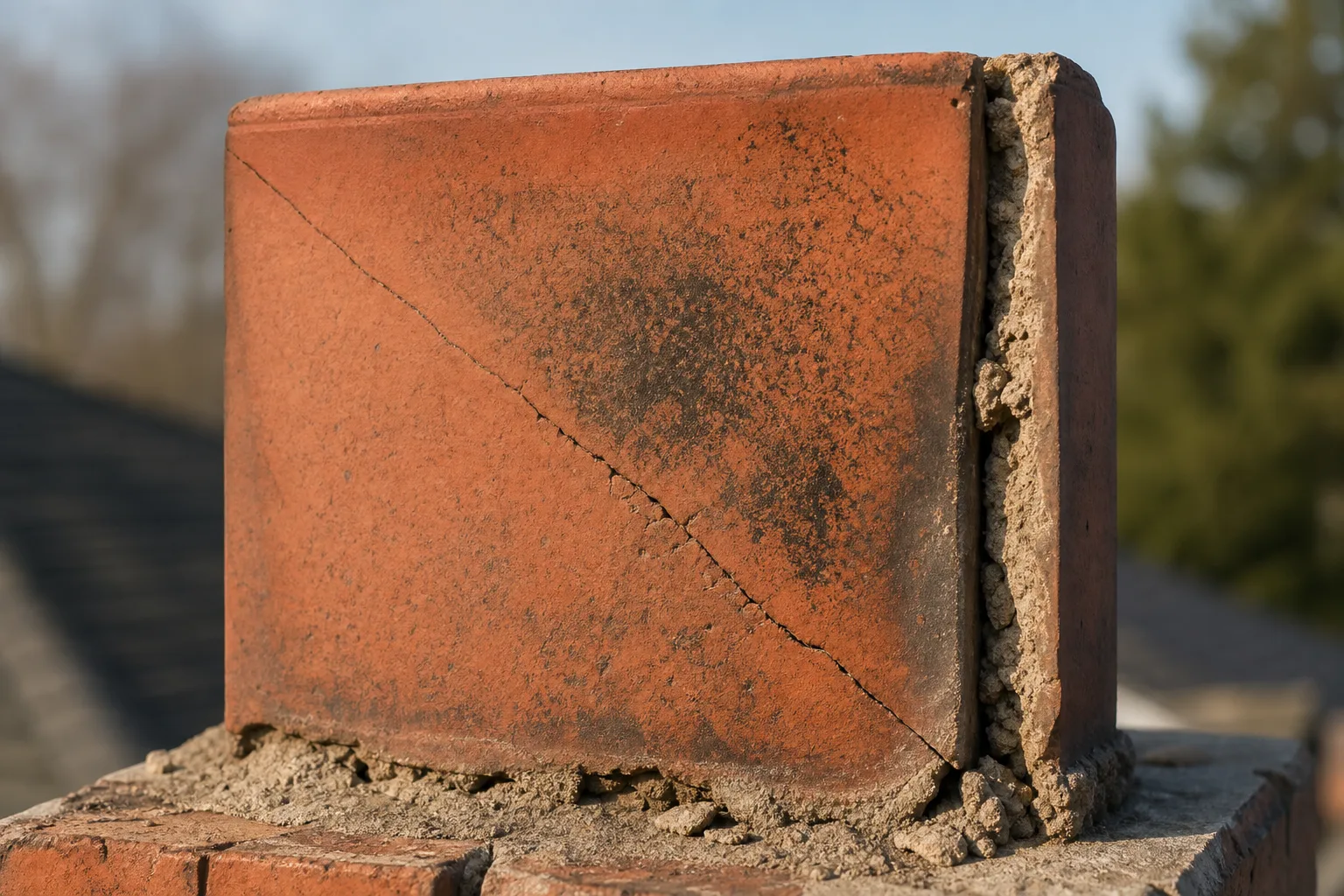
Cracked clay tiles. Clay handles heat well and handles sudden, uneven heat badly. A chimney fire can crack tiles straight across the face. Water freezing in a joint does it more slowly.
Deteriorated mortar joints. Each tile is bedded to the next with a thin joint, and those joints wash out over decades, worst in the upper section. The tiles can be in fine shape and the flue still be failed, because the gaps between them are open to the masonry.
Gaps and offsets. Tiles shifted out of alignment by settling. You get ledges where creosote collects and a passage that is no longer a continuous surface.
An unlined stack. Common in older homes: brick and porous mortar, nothing more. These chimneys often worked for decades and then failed the first inspection anyone actually performed, usually at a sale.
A corroded or separated metal liner. Stainless is durable, not immortal. Venting the wrong appliance into a liner not specified for it produces acidic condensate that eats metal, and poorly supported sections can pull apart at the joints.
Post-chimney-fire damage. Its own category. A chimney fire can crack every tile in the stack at once, and plenty of homeowners have had one without knowing it.
Why a crack matters more than it looks like it should
Two risks, stated once and plainly.
Carbon monoxide, which has no smell and no color, and whose early symptoms are indistinguishable from a mild flu. A breach lets flue gas into the masonry and from there into the wall cavity, the basement, or the room.
Fire. The clearance between a masonry chimney and the framing around it is small by design and assumes the flue is intact. A breach is one of the ways a chimney fire reaches the structure around it.
Neither is a reason to panic. Both are why this is not a repair to defer.
Read Your Own Diagnosis: Symptom, Cause, Repair Class
Here is the part nobody writes for you. You have a symptom, or a sentence a technician said, and what you need is the bridge from that to the category of repair that fits. Not the exact scope, which takes a camera, but the category, so you can tell whether the number you were quoted is in the right neighborhood of work.
| What you are seeing or were told | Most likely cause | Repair class this points to | How urgent |
|---|---|---|---|
| Orange chunks of ceramic in the firebox or on the smoke shelf | Clay tiles spalling or cracking apart above | Tile replacement or relining, after a camera scan | Stop using it now |
| Smoke rolling back into the room on a normal burn | Blockage, a collapsed tile, a broken damper, or a draft problem | Anything from a sweep and chimney damper work to structural flue repair | Stop using it, get it scanned |
| Brown stain on the ceiling or wall beside the chimney | Water entering at the crown, cap, or flashing and traveling down | Water-path repair first, then assess the flue | Not urgent, but progressive |
| White chalky residue on the exterior brick | Moisture moving through the masonry from inside | Water-path repair, possible masonry restoration | Weeks, not months |
| "Your tiles are cracked" after a camera inspection | Heat shock, a past chimney fire, or freeze-thaw | Tile replacement, resurfacing, or relining depending on extent | Stop using it now |
| "The mortar joints between the tiles are gone" | Decades of moisture in the upper flue | Resurfacing or relining, sometimes only the top section | Stop using it now |
| "This chimney is unlined" | The house predates liner requirements | Relining, and not optional if you intend to burn | Stop using it now |
| "You had a chimney fire" | Creosote ignition, often unnoticed | Level 2 inspection first, then usually relining | Stop using it now |
| Campfire smell on humid days, no visible damage | Creosote buildup, sometimes with a moisture path | Sweep first, then reassess. Not automatically a repair | Low |
Use that to narrow the field, not to reach a verdict. A cracked tile at the top of a stack and a cracked tile fifteen feet down are the same sentence on a quote and two different jobs. Only a camera run up the full length settles it, with footage you get to see.
Myth vs. fact: "He shone a flashlight up from the firebox and said it looked fine." A flashlight from below shows you the first several feet of a passage that may run thirty. Tiles crack at joints, on the sides, and in the sections you cannot get an angle on. A clean view from the bottom is not evidence of a sound flue. It is evidence that the bottom of the flue looks clean.
Not sure the quote matches the damage?
Describe what you were told and what you have seen, and we will match you with a local chimney company that can put a camera up the flue and give you the scope in writing. Independent local companies do the work. VIO makes the match.
Talk to someone about your flue. Call (513) 655-6702, or request service online and we will reach out.
The Four Real Repair Paths, and What Each One Does Not Fix
Almost every legitimate quote is a version of one of these four, or a combination. Here is what each is good at and, more usefully, what it will not solve.
Replacing individual flue tiles
Damaged tiles come out, new ones go in. On a masonry chimney that usually means opening the stack from the outside to reach the tile, which is why it is less simple than it sounds.
Suits: a small number of damaged tiles in a defined section, usually near the top, in a flue that is otherwise sound.
Does not fix: widespread joint deterioration, damage spread along the length of the flue, or an unlined chimney. It also does nothing about whatever caused the damage.
Wrong tool when: the camera shows problems at several heights. You are then paying for repeated masonry access on a stack that needs a continuous solution anyway.
Resurfacing and sealing the flue from inside
A cementitious material is applied to the inner surface of the existing flue, filling washed-out joints and bridging cracks to form a continuous new surface. It goes on from inside, so the masonry stays closed.
Suits: deteriorated mortar joints, hairline cracking, minor gaps, in a flue whose tiles are still present and roughly aligned.
Does not fix: missing tiles, significant offsets, a collapsed section, or an unlined stack. It restores a surface. It cannot create structure that is not there.
Wrong tool when: the flue has to be resized for a new appliance. Resurfacing preserves the existing dimensions, and dimensions matter, which brings us to the next one.
Relining with a stainless steel liner
A stainless liner is fed down the flue as a continuous tube, insulated, and connected at both ends. It becomes the new passage and the old tiles become the shaft it lives inside. Done properly this is the most definitive fix available, and for some situations it is the only correct one. Sizing and material selection are worth understanding before you approve one, and they are covered in depth under chimney liner installation.
Suits: extensive cracking, collapsed or missing tiles, unlined chimneys, post-chimney-fire damage, and any case where a flue is being resized for a new stove or insert.
Does not fix: a failed crown, bad flashing, or a missing cap. Say that one loudly, because a homeowner who has just paid for a full reline reasonably assumes the chimney is now handled. The liner protects the passage. It does not protect the structure around it.
Wrong tool when: the damage is genuinely localized and the flue is otherwise in good shape. Not every cracked tile is a relining job, and I would want a second opinion before accepting that it is.
Rebuilding the top section of the flue
Sometimes damage is concentrated in the top few feet, where water and freeze-thaw do their worst work, and the upper stack and its tiles get taken down and rebuilt.
Suits: deterioration confined to the crown area and the tiles just below it, often alongside crown replacement.
Does not fix: anything below the rebuilt section. A problem at fifteen feet goes untouched.
Wrong tool when: the upper damage is a symptom of a water problem nobody has diagnosed. Rebuild the top, leave the crown cracked, and you will be back.
Safety note: Two situations remove the judgment call entirely. An unlined chimney serving a fuel-burning appliance needs a liner, full stop. And after a chimney fire, the flue needs a Level 2 inspection before anyone decides anything, because that damage is frequently invisible from both ends and can run the length of the stack.
So which is yours? That depends on footage neither of us has seen. What I can tell you is that both directions of error are real. Some homeowners are quoted a full reline for damage a resurfacing would have handled. Others patch around a flue that needed replacing two winters ago and spend more in the end. You do not avoid both by guessing harder. You avoid them by insisting on a diagnosis you can see, and by asking the question two sections from now.
Water First: The Order of Operations Nobody Tells You
Here is the thing that should change how you read every quote in your inbox.
Water damages flues, and it works slowly enough that nobody notices until a camera goes up the chimney. It gets into the masonry from above, sits in the joints, freezes, expands, and pries the assembly apart a fraction of a millimeter at a time. Run that through enough freeze-thaw cycles and tile joints wash out, mortar crumbles, brick faces pop off.
Which means: repair the flue, leave the water path open, and you have bought the repair twice. The second invoice is just delayed.
Where the water is actually getting in
The crown, the slab on top that sheds water away from the flue and the brick. Crowns crack, and when they do the water runs straight down into the space between the liner and the masonry, which is exactly where you least want it. A cracked crown is the first thing I would look for behind flue damage.
The cap, the metal hood over the flue opening. Missing or damaged caps let rain fall directly down the flue, a remarkably efficient way to destroy a liner from the inside, and they are also what keeps animals out. Cap work is usually straightforward, and chimney cap replacement is one of the less involved things you can do for a chimney.
The flashing, the metal sealing the joint where the chimney passes through the roof. When it fails you get the ceiling stain, and often water tracking down the outside of the chimney inside the wall, which puts chimney flashing repair in the same conversation as the flue work.
The masonry itself. Spalling brick and open mortar joints absorb water like a sponge. Repointing those joints restores the shedding surface, and on an older stack chimney repointing often matters more than anything happening inside the flue.
What belongs in the same visit
If a camera scan finds flue damage and a visual inspection finds a cracked crown, those two items belong on the same scope of work. Not for convenience. Because doing the flue alone means the new work starts absorbing water the week it is finished.
You do not need to be an expert to raise this. You need one sentence, and it is coming up.
From the field: Crowns are the quiet culprit in this trade. They sit where nobody looks, they fail in ways invisible from the ground, and their failure tends to surface as a problem somewhere else entirely, usually inside the flue where it costs more to fix. When a chimney has a flue problem, it is worth turning attention to what is sitting on top of it before concluding the flue simply wore out on its own.
How to Grade the Quote You Were Handed
You are allowed to do this. It needs saying, because plenty of people feel rude asking a tradesperson to justify a diagnosis, and that discomfort costs homeowners real money. Asking for footage and reasoning is not an accusation. Good chimney professionals expect it, and most are glad to walk you through what they saw, because the diagnosis is the product of actual skill and they would like you to see that.
Here is the checklist. Every line is written to be read aloud on a phone call.
- "Can you show me the camera footage of the damage?" If a flue was diagnosed without a camera scan, you do not have a diagnosis. You have an opinion.
- "Where in the flue is the damage, and how far does it extend?" The answer should be specific. Near the top. The first six feet. Around the offset. Vagueness here is the warning sign.
- "What level of inspection did you perform?" Level 1 is basic and visual. Level 2 includes a camera scan of the internal surfaces, and that is what a repair decision should rest on.
- "What is letting water into this chimney, and is stopping it part of this scope?" This is the question I promised you at the top. Almost nobody asks it, and it is the difference between a repair that lasts and a repair that resets the clock. If the answer is "we are only doing the flue", ask what happens to the new work when the crown keeps leaking.
- "Is there a smaller repair that would address this, and why is it not the right call here?" You are not talking anyone down. You are asking them to show their reasoning, and a confident professional will explain exactly why the smaller fix does not apply.
- "Can I have the scope in writing before any work starts?" Plain language, listing what is being done and to which parts of the chimney.
- "What certifications do you or the people doing the work hold?" Ask. Write the answer down.
Pro tip: Ask for the footage as a file, not just a look at a tablet on your porch. Another company can review the same footage and tell you whether the reading holds up, which is faster and cheaper than booking a second inspection. If a company will not share footage of your own chimney, that tells you something on its own.
A second opinion is normal in any trade where the customer cannot see the thing being repaired.
Good to know: NFPA 211 calls for a Level 2 inspection in specific circumstances, and they are worth knowing because they are the moments when a full internal scan is not optional. Level 2 is required upon sale or transfer of the property, when there is a change to the system such as a new appliance or a different fuel, after a malfunction, after a chimney fire, and after an external event that could have damaged the chimney, such as a storm, a building fire, or an earthquake. If you are in one of those situations and someone offers a basic visual look, ask for the level that applies.
If what you need is a starting point rather than a repair decision, booking a chimney inspection is a legitimate first move and often the cheapest clarity you will buy all year.
How VIO Helps With Chimney Flue Repair
Let me be exact about what VIO is, because the trust of this page depends on it.
VIO is a referral network. We do not perform chimney flue repair. The work is done by independent local chimney companies, and when you contact us we match you with one that serves your area and handles the kind of work your situation calls for. The company that shows up is its own business, with its own technicians and its own reputation to protect.
What that is worth to you here is a shorter path to a second set of eyes. You have a diagnosis you cannot verify and a quote you cannot benchmark. Finding another qualified company alone means an evening of searching, a handful of voicemails, and no reliable way to tell the careful operators from the larger ad budgets. Telling us what you were told, and what you have seen yourself, gets you to a company that can put a camera up your flue and describe what is actually there.
Two things we hold the network to. We ask every company in the network to put its estimate in writing before any work starts, and you should insist on exactly that, from us or from anyone else you call. And we ask that the scope describe the chimney in plain language, so the words "flue repair" on a page you are about to sign mean something specific rather than something flexible.
We also do not send anyone to your house until you ask us to. Getting matched is not a commitment to buy anything.
Get the flue looked at before the next fire
Tell us what the chimney is doing. We will connect you with a local company in the VIO network for a camera inspection and a written scope of the work. No obligation, and nobody shows up until you say so.
Request a chimney inspection. Call (513) 655-6702, and have your symptoms and any existing quote in front of you when you do.
Symptom checker
What is your chimney doing?
Tap the closest match for an honest first answer.