



On this pageWhat Chimney Mortar Repair Actually Involves7 sections+6
- What Chimney Mortar Repair Actually Involves
- The Part Nobody Tells You: Mortar Is Supposed to Fail
- Reading Your Own Chimney From the Ground
- Which Mortar Type, and Why It Matters More Than Anything Else
- Repointing or Rebuilding: The Fork That Decides the Cost
- Fix the Water, Not Just the Joints
- How VIO CHIMNEY Helps With Chimney Mortar Repair
Quick answer
Chimney mortar repair, also called repointing or tuckpointing, means cutting deteriorated mortar out of the joints between the bricks and packing in fresh mortar. It is needed when joints are recessed behind the brick face, crumbling to sand, or missing. The mortar type must be matched to the chimney's age, since mortar harder than the brick will spall the brick. Badly degraded stacks need partial rebuilding instead.
Chimney Mortar Repair: How to Tell What Your Chimney Actually Needs
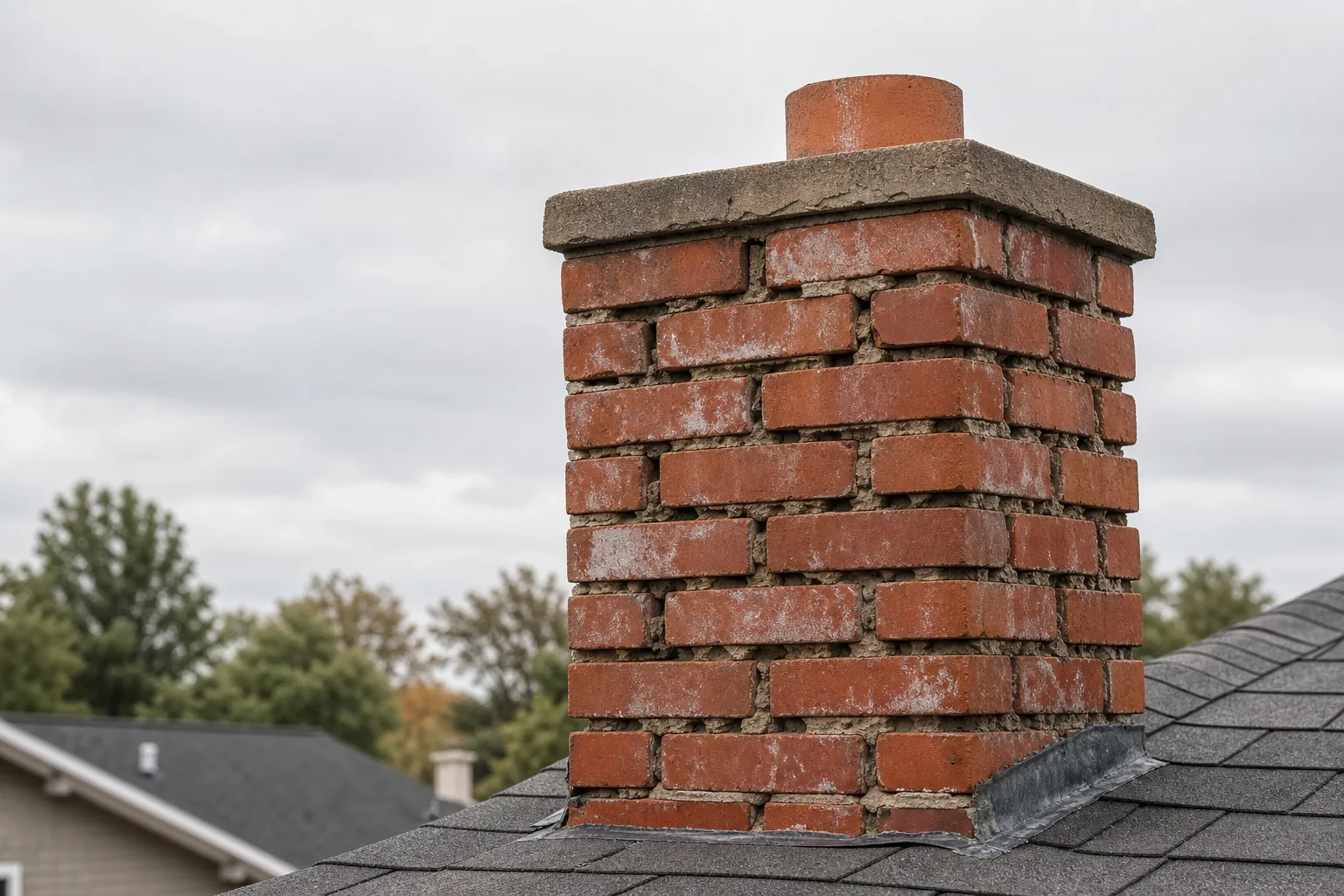
The first sign is almost never dramatic. A little pile of grey sand in the gutter. Gritty crumbs on the shingles at the base of the stack. A line on a pre-sale inspection report that reads "deteriorated mortar joints, recommend evaluation." Then you look up and notice that the bricks have started to stand out individually, each one outlined, because the material between them has retreated. That is the moment most people start searching for chimney mortar repair.
Here is what nobody warns you about before you start calling companies. The most expensive mistake in this job is not waiting a season too long. It is repairing with the wrong mortar.
That single decision, made by whoever shows up with a bucket and a trowel, separates a repair that protects your brick from one that slowly destroys it. We will get to exactly why, and to the one question you should ask every company that quotes the work.
What Chimney Mortar Repair Actually Involves
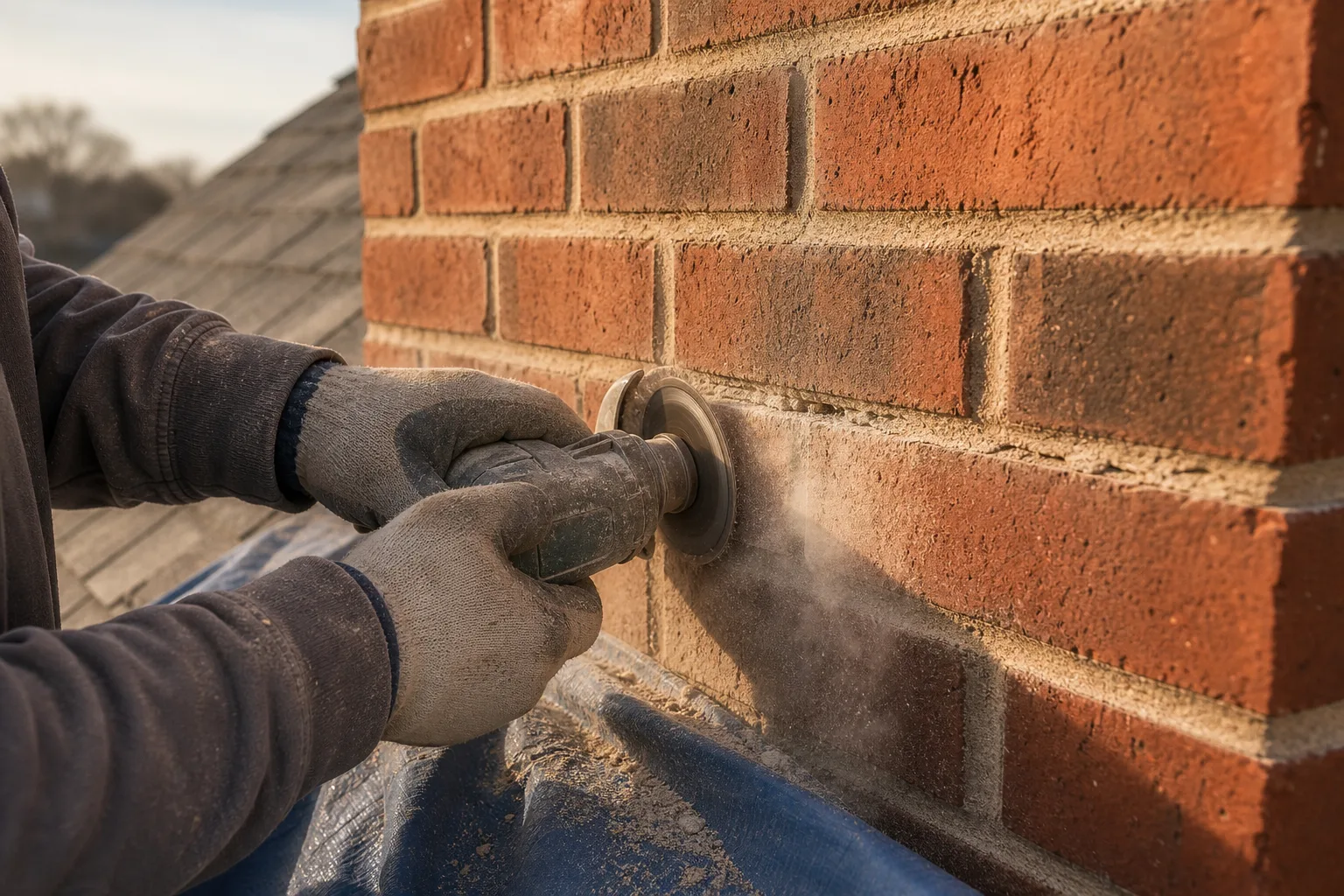
Chimney mortar repair means cutting the failed mortar out of the joints between the bricks and packing fresh mortar back in. That is the whole idea. The bricks themselves usually stay where they are.
The trade calls this repointing. Some companies call it tuckpointing. On a chimney it starts with the exposed stack above the roofline, because that is the part taking weather from every direction with no wall behind it.
Repointing, Tuckpointing, and Why the Words Get Mixed Up
If you have spent an hour searching, you have already hit this confusion. Two words, apparently the same job, used by different companies with total confidence.
Myth vs. fact: Some articles insist tuckpointing and repointing are completely different services. Historically, tuckpointing did mean something specific: a decorative technique using mortar in a contrasting color to fake the look of very fine joints. That distinction is real, but it is a preservation-craft detail, not a pricing one. In everyday American trade usage the two words describe the same work, so do not read anything into which one a company picked.
What Proper Chimney Mortar Repair Looks Like, Step by Step
Worth knowing in order, because you can hear it in how a company describes its own process. One that skips straight to "we'll patch it up" is telling you something.
- The joint gets raked out, not skimmed over. Failed mortar is ground or chiseled out to a depth of two to two and a half times the joint's width, or deeper if the mortar behind is still soft.
- Removal continues until sound original mortar is reached. New mortar has to bond to something solid. Leave the crumbly material in place and the patch is bonded to failure.
- The cavity gets cleaned out. Dust is blown or flushed away, because mortar will not bond to a dusty joint.
- The joint is dampened, then packed in layers. Dry brick pulls water out of fresh mortar too fast. The joint is filled in lifts and compacted, not buttered over the opening.
- The joint is tooled. A jointer compresses the surface into a profile that sheds water instead of holding it.
- The work cures at the right temperature. More on that below, because it decides whether your job happens this month or next spring.
Poor bonding between old and new mortar is a documented cause of repointing that falls out within a few years. When it happens, the homeowner usually blames the weather. It was the prep.
The Part Nobody Tells You: Mortar Is Supposed to Fail
Mortar is the designed weak link. Not a manufacturing compromise, the engineering intent. In a masonry assembly, mortar is meant to be softer than the brick around it so that thermal movement, settlement, and freeze-thaw stress land in the joint rather than in the brick.
The joint is the sacrificial part. It takes the abuse so the brick does not.
Good to know: A crumbling mortar joint can be cut out and replaced for a fraction of what dealing with damaged brick costs. A spalled brick face is a different category of problem. So a chimney with worn joints and sound bricks is a system that has been doing its job: the mortar absorbed decades of freezing and moving, and the brick came through it.
Which means crumbling joints are not automatically a sign your house is coming apart. They are a sign the sacrificial layer has spent itself.
The problem is what happens next. Once joints are deeply recessed or open, they stop keeping water out of the masonry. That is where normal wear turns into active damage, and that is the point worth catching.
Reading Your Own Chimney From the Ground
You can learn a surprising amount with binoculars, a phone camera at full zoom, or a look from an upstairs window. You cannot learn everything, and I will be clear about where the line falls.
Signs That Point to Normal Weathering
Joints slightly recessed but still hard. Color faded unevenly across the stack. Minor surface roughness. Old patchwork in a different shade of grey from a repair done years ago.
None of that, on its own, is an emergency. A chimney is exposed masonry standing above a roof. It is supposed to look weathered.
Signs That Point to Real Deterioration
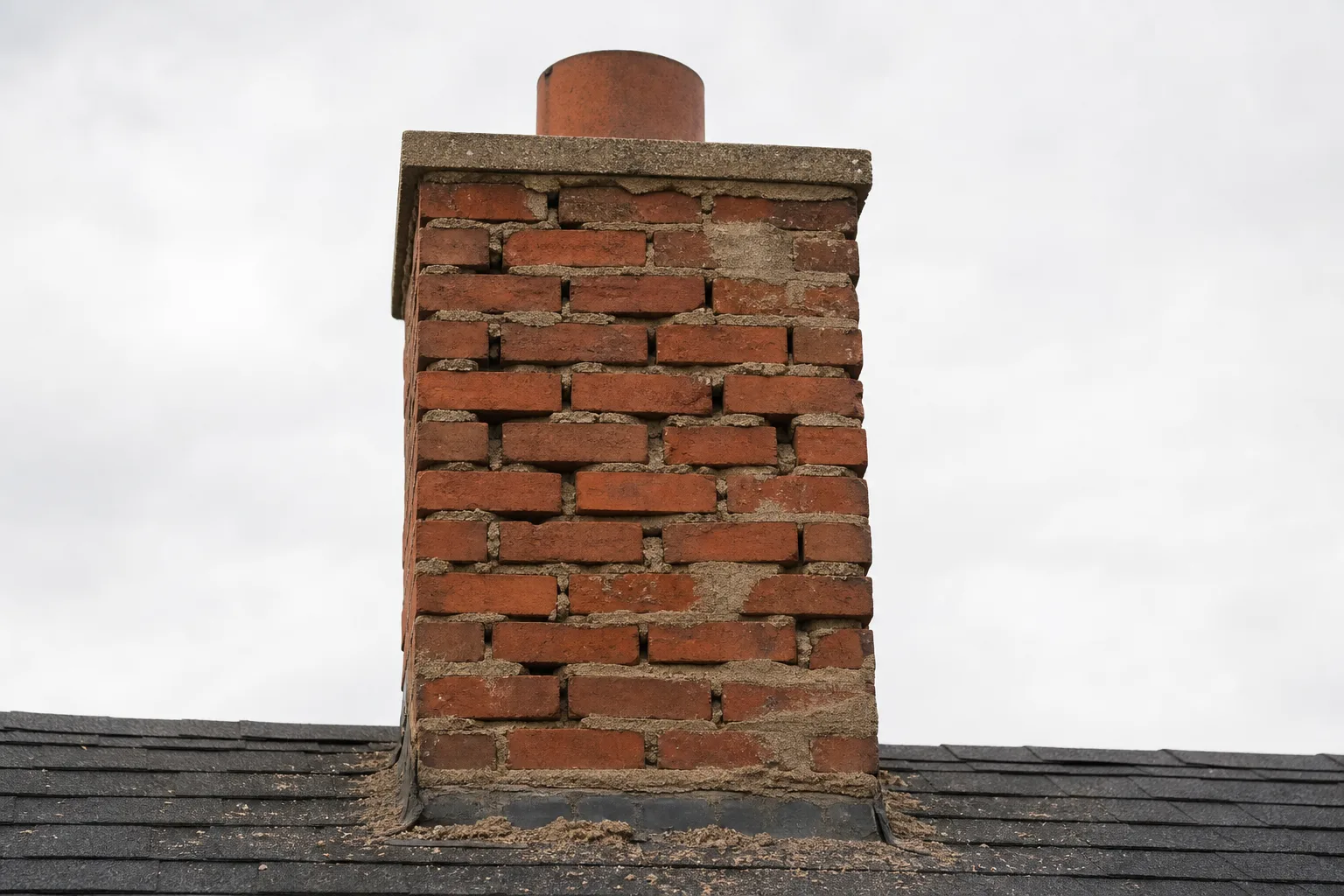
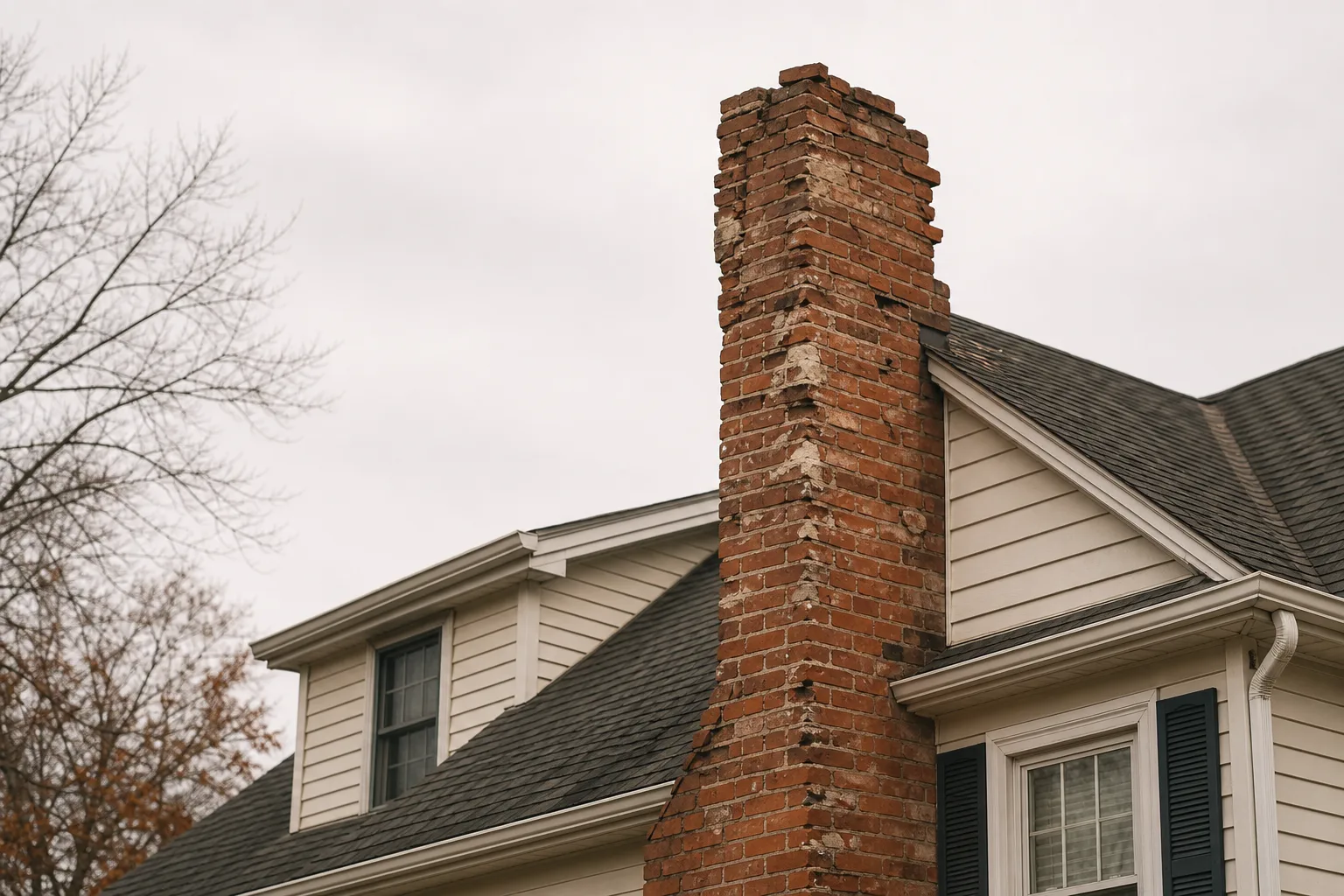
- Joints recessed well behind the brick face, deep enough that the stack reads as stacked blocks rather than a wall.
- Open gaps and voids where mortar is simply gone, sometimes deep enough to show shadow.
- Sandy residue and mortar crumbs on the shingles below the stack, in the gutter, or on the ground at the base. That is the joint disassembling itself.
- Stepped cracks running through the joint lines, up and across the stack.
- White, chalky efflorescence blooming on the brick. That powder is mineral salt carried out of the masonry by water moving through it, which tells you water is getting in.
- Spalled brick faces, where the face has popped or flaked off to expose a rougher, lighter interior. This one matters because the damage is in the brick, not between bricks. If you are seeing it across much of the stack, you are into brick chimney repair territory, a different scope of work.
The Key Test, and What It Cannot Tell You
If you can safely reach a joint, from a second-floor window, a deck, or the lower part of the stack, drag a key or a screwdriver tip firmly across it.
Sound mortar resists. You scratch it, maybe leave a light mark, and that is all. Failing mortar gives way: it crumbles into sand under moderate pressure, or the tool sinks in.
Pro tip: That test covers exactly one joint at one height. It says nothing about the weather side you cannot reach, nothing about the crown on top, and nothing about how deep the mortar loss runs into the stack. A chimney can read as fine from the driveway and still carry open joints on the face pointing away from the house. Use the test to confirm a suspicion, never to rule anything out.
That is the honest boundary of ground-level diagnosis. From where you stand you can tell whether something is wrong. You cannot tell how far in it goes, and neither can anyone else without hands on the joints.
Which Mortar Type, and Why It Matters More Than Anything Else
This is the section that matters most, and the one almost no page about chimney mortar repair will hand you straight.
Mortar is not one product. Under the ASTM C270 standard it is classified into types, commonly M, S, N, and O, with Type K also appearing in historic work. They differ in compressive strength, which comes down to how much portland cement is in the mix versus how much lime.
Type N is the medium-strength general-purpose type, around 750 psi. Type O is the low-strength, lime-heavy type, around 350 psi.
Now hold that against what you just read about the joint being the sacrificial part.
If the new mortar is harder than the brick around it, the roles invert. The joint stops yielding, every bit of movement and freeze-thaw pressure goes into the brick instead, and the brick face spalls. A repair meant to protect the chimney starts breaking it from the inside out.
Safety note: This is why portland-heavy mortar on soft, older brick is a documented cause of brick failure. The mortar wins, the brick loses, and that damage is not reversible with a bucket of mortar. It is also why the honest answer to "which mortar should I use" is never a single product name. On top of that, the work happens at roof height, on a slope, with an angle grinder throwing masonry dust. The material question and the fall-protection question are both real reasons this is not a casual Saturday project.
| Mortar type | Approximate strength | Typically specified for | Risk if misapplied |
|---|---|---|---|
| Type M | Highest of the four | Foundations, below grade, heavy load | Can be hard enough to stress the brick it is set against |
| Type S | High | Structural masonry, high wind, seismic | Can be too hard for soft or historic brick |
| Type N | Around 750 psi | General above-grade masonry, newer construction | Sources conflict on older chimneys |
| Type O | Around 350 psi | Historic and soft masonry, lime-heavy | Not for use where real strength is required |
Notice what that table does not do. It does not tell you which one your chimney needs.
That is deliberate. Reputable sources genuinely disagree about where the line falls. Some recommend Type N for repointing chimneys on pre-1950 homes, reasoning that its lime content gives enough flexibility. Others hold that soft brick from before the 1920s, and especially before the 1880s, needs Type O or Type K, and that Type N on that brick will spall it.
Both positions are held by people who do this for a living. Which means the right answer depends on your chimney: the age of the brick, how hard it actually is, and what the original mortar was.
The Question to Ask Every Company That Quotes the Job
You do not need to become a mortar expert. You need one question.
"Which mortar type are you going to use, and why that one for a chimney of this age?"
A company that does this properly answers immediately and specifically. They mention the age of your house, the hardness of the brick, maybe matching the original mortar's color and sand. A company that says "standard mortar" or "the good stuff," or that looks briefly annoyed, has told you what you needed to know.
That one question, asked out loud in your driveway, protects you more than any amount of reading.
Not sure whether your joints need repointing or your stack needs rebuilding?
That is the one question you cannot answer from the ground, and it decides everything else. VIO CHIMNEY connects you with independent, local chimney and masonry companies that handle chimney mortar repair in your area, so you can get a real set of eyes on the joints and a written scope before you commit to anything.
Call (513) 655-6702 or request service online.
Repointing or Rebuilding: The Fork That Decides the Cost
Two companies can look at the same chimney and quote wildly different jobs without either being dishonest. They may be pricing two genuinely different repairs.
Understanding that fork is the difference between reading your quotes and just comparing the bottom numbers.
When Repointing Is the Right Repair
Repointing works when the bricks are sound and the joints are not.
If the brick faces are intact, the stack is plumb, and mortar loss is confined to the joints and a moderate depth behind them, cutting out and replacing the mortar restores the assembly. The bricks never move. This is ordinary chimney mortar repair, and it is the outcome you are hoping for.
When a Partial Rebuild Is the Honest Answer
Past a certain point there is not enough joint material left for repointing to mean anything.
When mortar has washed out deep into the stack, when courses have shifted or the stack is out of plumb, when a number of brick faces have spalled away, the repair becomes a take-down and rebuild from a sound course upward. The mason removes the compromised brickwork and lays it back up, salvaging brick where it is still good.
Picture a homeowner with a 1920s brick stack where the top four courses have lost most of their mortar and two bricks can be rocked by hand. Repointing that section would mean packing new mortar around bricks with nothing holding them. The honest scope is rebuilding those courses and repointing below them.
A rebuild quote is not automatically an upsell. Ask to see photos of what they found, and ask what specifically rules out repointing. A real answer exists.
What Drives the Cost Up or Down
I will not give you a number, because any number printed on a page is a guess about a chimney nobody has looked at. The variables, though, are knowable.
- How much of the stack needs work. A few feet of the weather side is a different job from four faces top to bottom.
- Access. A low-slope ranch roof you can reach off a ladder is not a steep three-story slate roof that needs staging. Access moves a quote more than the masonry does.
- Height and setup. Roof jacks and planks, versus scaffolding, versus a lift.
- Whether the mortar has to be matched. Color, sand, and texture matching on a visible historic stack is skilled work and it takes time.
- What else is failing. Crown or flashing work often has to happen with the same setup.
- Season. Work waiting on a temperature window competes for a shorter calendar.
- Repointing versus rebuild. The largest single variable, which is why the fork matters.
And some of these chimneys do not need repointing at all. They need the water stopped.
Fix the Water, Not Just the Joints
Age alone is not what takes a joint apart. Mortar joints absorb thermal movement and settlement as part of their job, and in a climate that crosses freezing, water is the stress that tends to finish them.
Water soaks into porous mortar, expands as it turns to ice, and can open the joint a little wider. The wider joint takes on more water. Repeat that over enough winters and the joint gives way to sand. Freeze-thaw runs every year anywhere temperatures cross freezing, which is why water management and joint condition are the same conversation.
Here is the consequence people miss. If water is entering from above or from the roof junction, new mortar in the joints does not stop the cycle. It gives the water fresh material to work on.
The usual sources, roughly in the order they show up:
- The crown, the concrete slab cast on top of the stack. Cracks radiating out from the flue tile feed water straight down into the masonry.
- A missing or failed cap. With no lid on the flue, rain goes down the chimney. If yours is gone or rusted through, replacing it is a small job next to masonry, and the range of metal chimney caps available will cover almost any flue.
- The flashing where the chimney meets the roof plane, which handles much of the water running down the slope. Failed flashing around the chimney leaks into the structure and into the base of the stack at once.
- A deteriorated chase cover, which does the crown's job on a prefab chimney. Chimney chase covers rust through from the inside and start ponding water once they lose their slope.
Pro tip: When a repointing job fails early, look at the water source before blaming the mortar. New mortar packed into a joint while the crown above it is still letting water through simply gives that water fresh material to work on. A chimney with bad-looking joints and a sound crown, cap and flashing is in better shape than one with passable joints and a crack across the crown, because the second one is changing where you cannot see it. Ask anyone quoting joint work what they found at the top of the stack. If they have no answer, they did not look.
That is the argument for treating chimney mortar repair as one item in an inspection rather than a standalone purchase. Whoever goes up is already up there, so if you are unsure how often you should clean your chimney either, settle it in the same visit.
Timing, Temperature, and the Curing Window
Mortar needs warmth to cure, which makes this one of the few home repairs with a real seasonal gate.
Specifications for the work generally call for air temperature between roughly 40 and 95 degrees Fahrenheit, held in that range for at least 48 hours after the work is finished. Some cold-weather specifications want above 40 degrees for a minimum of seven days.
Good to know: That window is why chimney mortar repair gets scheduled around the forecast rather than the calendar. Where the cutoff falls depends on your local weather, not on a date, so there is no universal last week of the year for this work. Heading into a freezing season with open joints, the useful question is not "can you fit me in" but "is there enough of a window left to cure this properly, and if not, what should I do in the meantime."
Sometimes the answer is that the masonry waits and the water gets managed first, with a cap or a crown repair, so the joints do not lose another winter's worth of material. That is a legitimate sequence, not a stall.
How VIO CHIMNEY Helps With Chimney Mortar Repair
Here is the plain version of what we do.
VIO CHIMNEY is a referral service. We do not perform the work. We match homeowners with independent local chimney and masonry companies, and those companies do the repointing, the rebuilding, the crown work, and the caps.
For your situation, the value is getting past the wall you hit earlier on this page. You cannot tell from the ground whether your chimney needs repointing or partial rebuilding, and that question governs the scope, the cost, and the timeline. Tell us what you are seeing and we will connect you with an independent local company that can get up there and answer it.
What to hold any company to, ours included:
- Insist on the estimate in writing before any work starts. A written scope naming the sections of the stack, the mortar type, and the access method is what lets you compare two quotes.
- Ask the mortar-type question. It is the single best filter on this page.
- Get more than one quote, especially if anyone has raised a rebuild. Two opinions on that fork are worth the extra phone call.
One more thing worth knowing while someone is out. Under NFPA 211, a Level 2 chimney inspection is required at the sale or transfer of a property, when the system is changed, after a malfunction, after a chimney fire, and after an external event such as a storm or an earthquake. If a pre-sale inspection report is what sent you looking into chimney mortar repair in the first place, you are already in Level 2 territory, and the inspection should cover the flue and not only the joints you can see. To start instead with a general assessment of the whole structure, our overview of chimney service walks through what that visit covers.
Go back outside and look at the joints again with all of this in your head. Recession behind the brick face, open voids, sand on the shingles, white bloom, any brick face that has popped. Photograph the worst section at full zoom.
Then get somebody on the roof who can tell you how deep it goes, and ask which mortar they plan to use. Good chimney mortar repair is not complicated work, but it is specific work, and the specificity is what you are paying for.
Start with a look, not a guess.
Tell us what you are seeing, the crumbling joints, the sand in the gutter, the line on the inspection report, and VIO CHIMNEY will match you with an independent local company that does chimney mortar repair. Ask for the estimate in writing before any work begins, and ask which mortar type they plan to use and why it suits your chimney's age. A good company will have a ready answer to both.
Call (513) 655-6702 or request service online.
Symptom checker
What is your chimney doing?
Tap the closest match for an honest first answer.