



On this pageWhat Metal Chimney Caps Do, and the Damage They Stop8 sections+7
- What Metal Chimney Caps Do, and the Damage They Stop
- Start at the Top of Your Chimney, Not in the Catalog
- How to Measure for Metal Chimney Caps Before You Order
- Mount Types: Flue Mount, Side Mount, Top Mount
- The Four Metals, Side by Side
- Mesh, Spark Arresters, and What the Code Actually Says
- What to Check Before You Buy
- How VIO Helps You Get Metal Chimney Caps Installed
Quick answer
Metal chimney caps come in four materials: stainless steel, galvanized steel, copper, and aluminum. Stainless is the usual balance of cost and durability, copper is the premium pick, galvanized is the cheapest and rusts soonest, and aluminum is the softest. Choose the material last. First identify your chimney top, measure the outside dimensions of the flue tile, and let that decide whether you need a flue mount, side mount, or top mount cap.
Metal Chimney Caps: How to Pick the Right One (and Measure It Right the First Time)
People tend to go shopping for metal chimney caps in the fall, somewhere between the first cold snap and the first fire of the season. The trigger is rarely the cap itself. It is a dark stain creeping down the firebox wall, or a smell like wet leaves every time the air handler kicks on, and somebody finally climbing up on a ladder to look.
What waits at the top is sometimes nothing at all. An open flue. Or the bent remains of a cap that gave up a few winters ago.
Metal chimney caps are the cheapest piece of chimney hardware you will ever buy and the one that quietly protects everything underneath it. The problem is that buying one is not a single decision. It is four decisions stacked on top of each other, and most guides hand you the last one first.
Here is the order they actually happen in: what your chimney top looks like, how you measure it, how the cap attaches, and only then which metal you want.
And there is one measurement in the middle of that sequence that decides whether the cap you order fits or goes back in the box. Almost nobody tells you which one it is. We will get there.
What Metal Chimney Caps Do, and the Damage They Stop
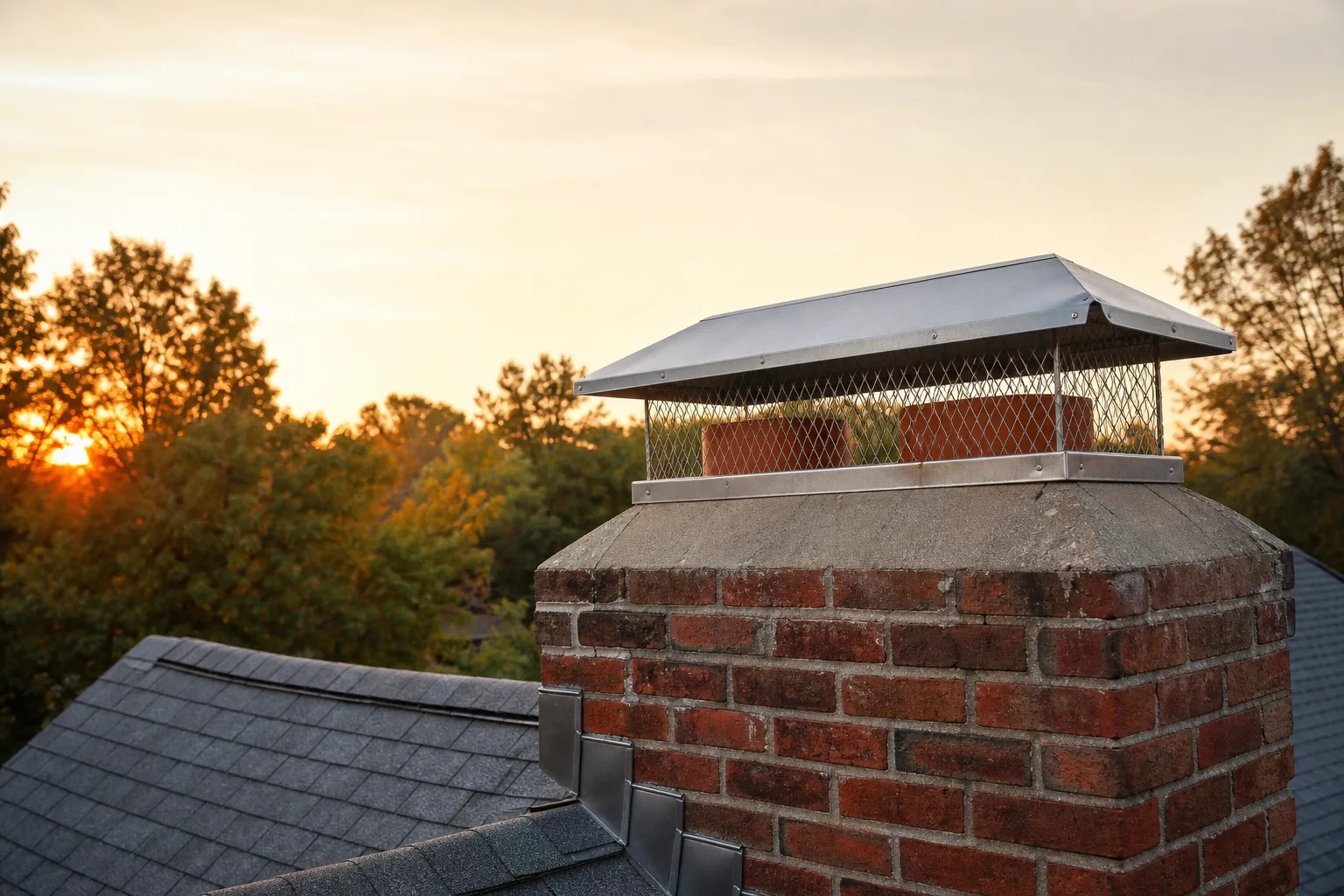
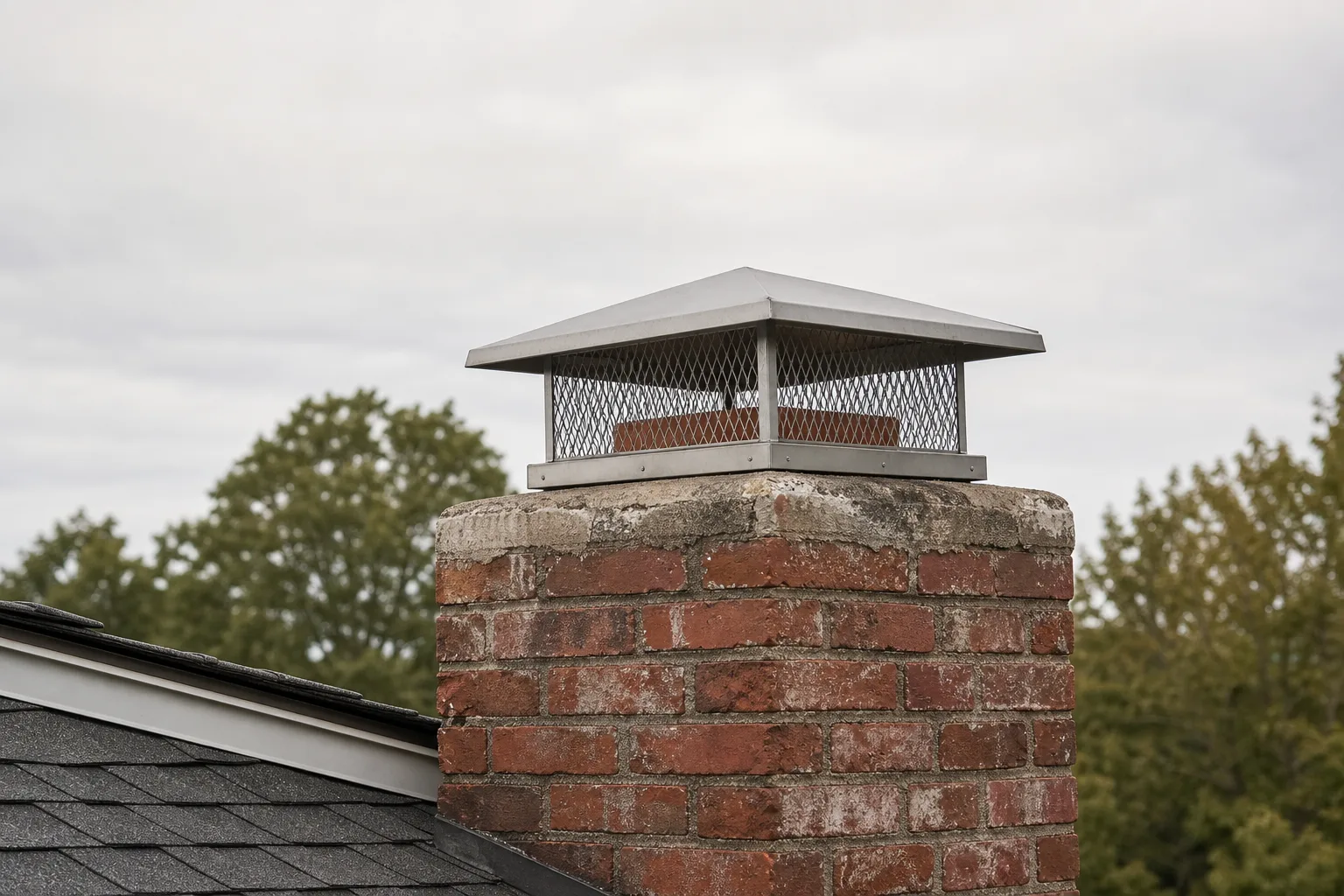
A chimney cap is a lid on legs. Metal roof, open sides screened with mesh, four or more straps holding it above the flue opening so smoke still leaves.
That is the whole design. Everything it protects against comes from that shape.
Water is the expensive one
An uncapped flue is a drain pointed at your house. Rain goes straight down the tile, soaks the smoke chamber, and sits on the damper.
Then autumn turns into winter. Water that has worked its way into the masonry freezes, expands, and pushes the material apart from the inside. That is the freeze and thaw cycle, and it is why an uncapped chimney degrades fastest in the months nobody is looking at it.
The repair bill for water is never the cap. It is the liner, the damper, the smoke chamber, the drywall on the ceiling below.
Good to know: if the top of your chimney is a flat sheet of metal covering an entire framed box rather than a masonry crown with tiles poking through it, you are looking at a chase cover, not a cap. Different part, different failure mode, and the two get confused constantly.
Animals, nests, and the smell you cannot place
A warm vertical shaft with rough walls is excellent habitat. Birds nest in it, squirrels fall down it, raccoons raise young in it.
Mesh sides stop all of that. This is the single most reliable thing a cap does, and the reason a homeowner who has had one animal problem never goes uncapped again.
Embers, sparks, and the neighbors' roof
If you burn wood, the mesh doubles as a spark arrestor for the chimney. Hot embers ride the draft up the flue and land on whatever is downwind.
Spark arresters are required for solid fuel equipment in a great many jurisdictions, and where they are required the standard sets a real specification: the screen's net free area has to be at least three times the net free area of the chimney outlet. That is why a proper cap looks so open. Choke it down and you choke the draft.
Downdraft, and the myth attached to it
Myth vs. fact: the myth is that a cap cures a smoky fireplace. The fact is that a cap can help with wind-driven downdraft in some configurations, and can make draft worse in others. A lid set too low over the flue, or a mesh packed with creosote and soot, restricts the exhaust path. If your fireplace smokes, diagnose the draft before you blame or credit the cap, and work through the basic fireplace safety tips while you are at it.
Start at the Top of Your Chimney, Not in the Catalog
Open any supplier site and the first thing you see is a grid of metal chimney caps sorted by material. That sorting is backwards. The metal is the last thing that matters, because a beautiful copper cap in the wrong configuration is still the wrong cap.
Go look at your chimney top first, from a photo if that is the safe option. You are identifying which of three situations you have.
Flue tiles that stick up above the crown
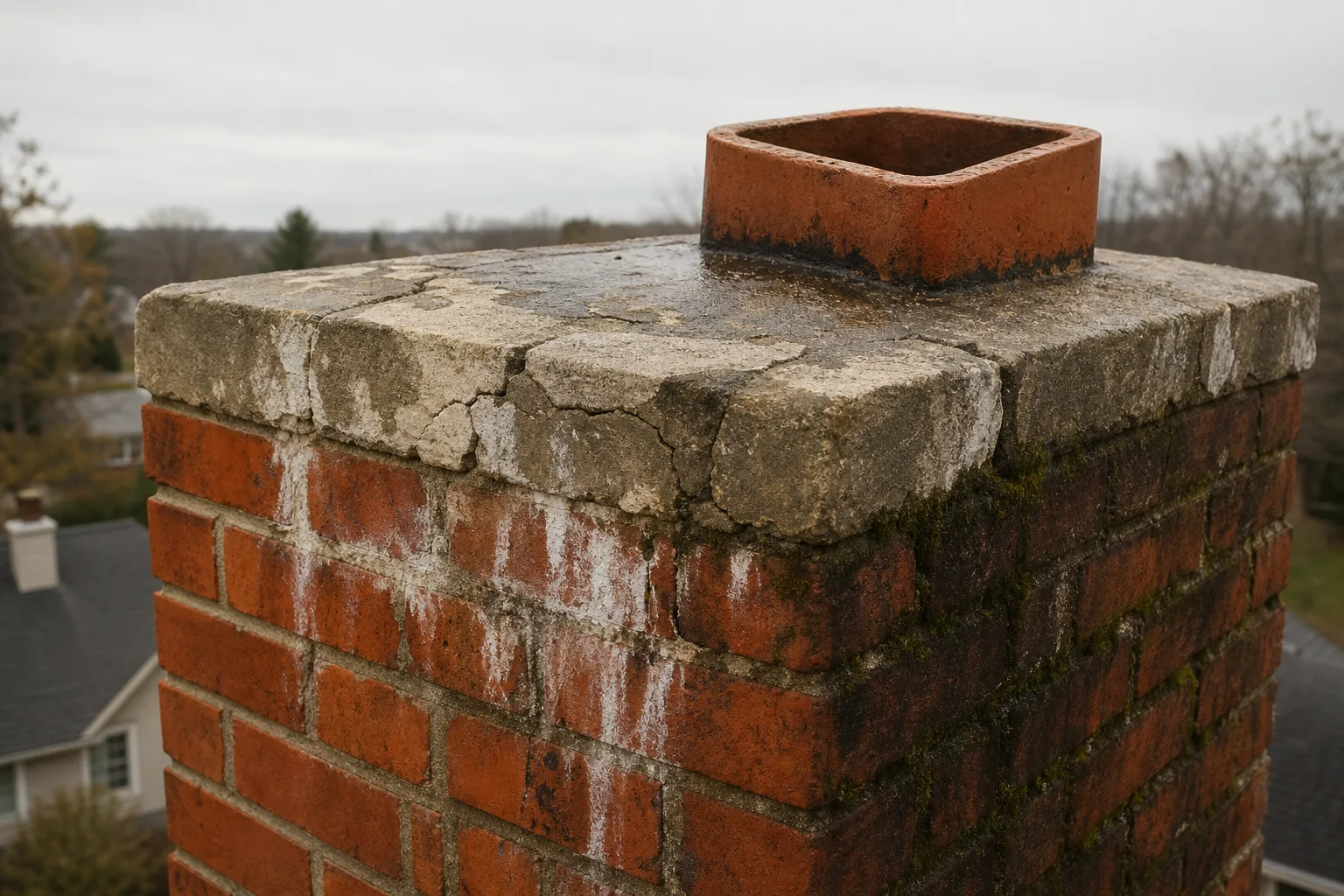
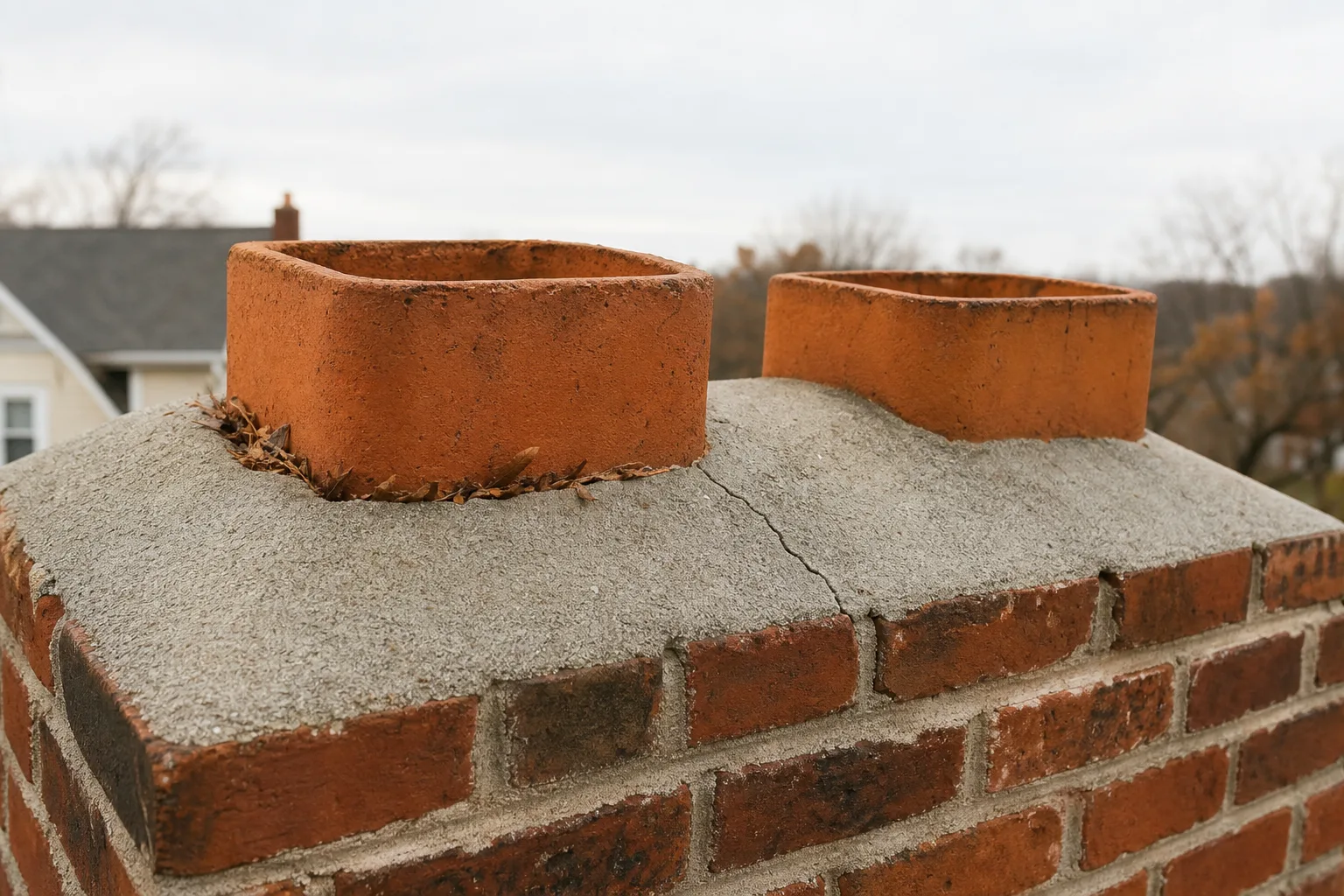
Look for orange-tan clay tiles, square or round, protruding a few inches above the sloped concrete wash at the very top. This is a standard masonry configuration, and if it is what you have, you are in luck.
A protruding tile gives a cap something to grip. If you have one tile, a single-flue cap clamps right onto it. If you have two or three tiles up there, you can cap each one individually or cover the whole crown with one lid.
A crown with the tiles flush or barely proud
Sometimes the tiles end level with the crown, or stand less than an inch above it. There is nothing to clamp to.
That pushes you toward a cap that mounts on the crown itself rather than on the tile. Worth knowing before you order, because a clamp-on cap with nothing to clamp will sit in your garage.
A framed chase with a metal chase cover
Prefabricated fireplaces often vent through a wood-framed box clad in siding. The top is a flat metal pan, and if that pan is rusting or holding standing water you are dealing with chimney chase covers rather than caps. What sits on the round pipe coming through that pan is usually a manufacturer-specific storm collar and cap assembly, and swapping it for a generic masonry cap is not a straight substitution. Check the appliance's listing.
How to Measure for Metal Chimney Caps Before You Order
Here is the payoff on the open loop from the top of this page.
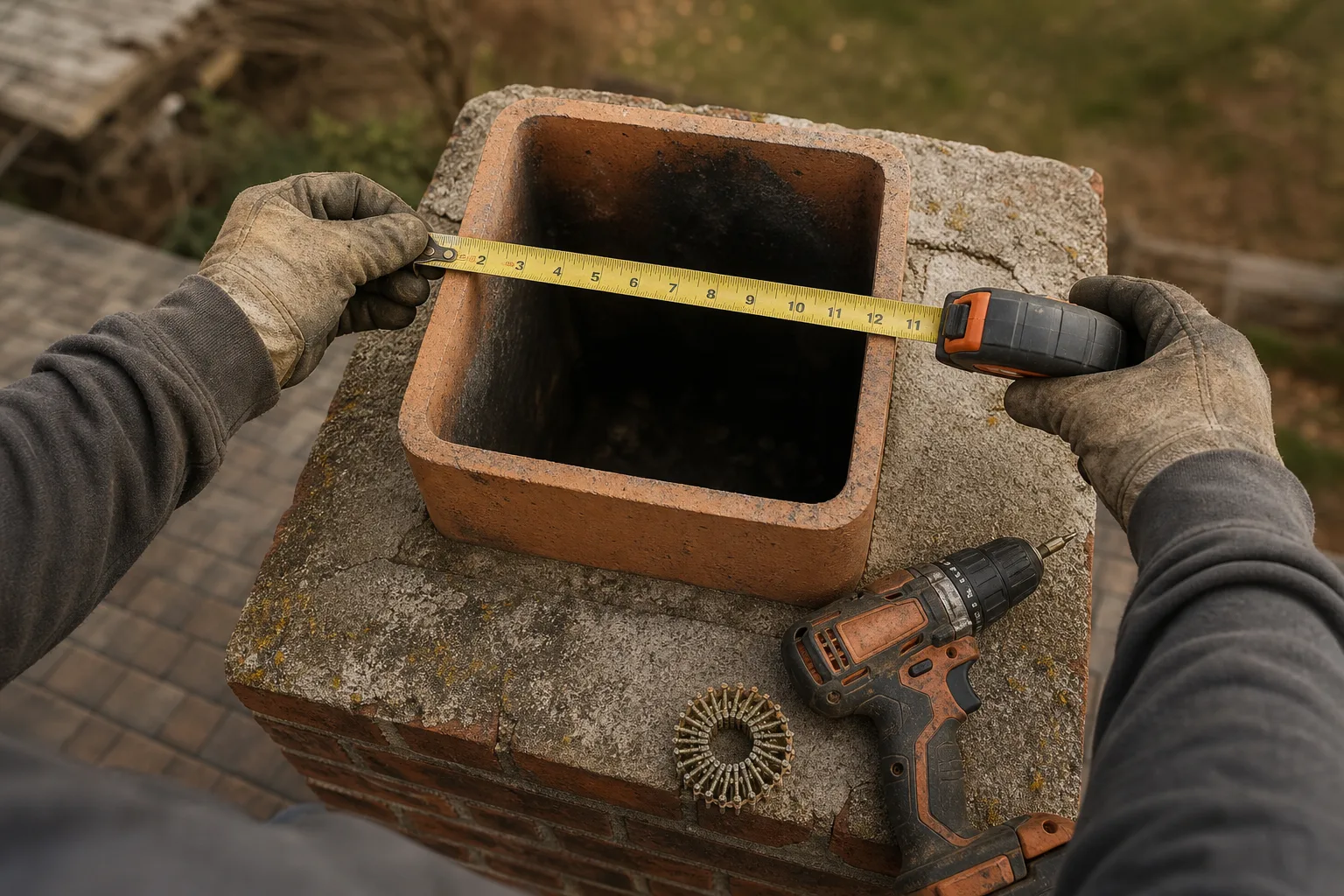
The measurement that decides the order is not the flue's inside opening. It is the outside dimensions of the flue tile, and the reason is that a single-flue cap slips over the tile like a cuff over a wrist. It has to clear the outside of the tile, not the hole in the middle.
It is easy to measure the hole instead, because the hole is what you can see from below. Then the cap arrives too small in both directions.
Single flue: measure the tile, outside to outside
Measure the outside width and the outside length of the protruding tile at its widest point, including any lip or flare at the top edge. Round tile, measure the outside diameter.
Write both numbers down. Round up to the nearest catalog size, never down.
Multi-flue: measure the crown, then subtract nothing
A multi-flue cap is an umbrella over the entire chimney top. Measure the outside width and length of the crown at its widest, which usually means brick face to brick face.
The cap should overhang that footprint, not sit flush with it. Overhang is what throws water clear of the brick instead of letting it run down the face.
The height measurement that is easy to forget
Measure how far the tallest flue tile stands above the crown, and if you have multiple tiles of different heights, measure the tallest one.
Multi-flue caps are sold in fixed heights, and each manufacturer publishes its own size families. One major manufacturer's catalog, for example, lists multi-flue black galvanized and stainless caps in eight, ten, and fourteen inch heights, with copper in nine, twelve, and fourteen. Look up the families for whichever cap you are buying, because they are not interchangeable. The cap's lid has to clear the tallest tile with room for the exhaust to leave sideways. Order a lid that sits down on the tile and you have built a very expensive plug.
Pro tip: photograph the tape measure in place, on every dimension, with the tile in frame. When the cap arrives and something looks off, that photo settles the argument in ten seconds instead of ten days of email with a supplier. It also means you only go up on the roof once.
Not comfortable measuring from the roof?
Getting the flue dimensions right is the whole ballgame on a metal chimney cap, and it is not a measurement worth taking off a ladder you are not sure about. Tell us where you are and we will match you with a local chimney company that measures, quotes, and installs.
Call (513) 655-6702
Mount Types: Flue Mount, Side Mount, Top Mount
Metal chimney caps attach in three ways. The one you can use is decided by what you found in the last two sections, which is why we did them in that order.
Flue mount
The cap's base slides down inside or directly over the flue opening and is held by tension or by set screws bearing on the tile.
Cheap, fast, and the type most likely to end up in the yard after a storm. It relies on friction against clay, and clay wears.
Side mount
A vertical skirt wraps the outside of the protruding tile and is clamped or screwed to it. The gripping surface is much larger and the load is spread around the tile rather than concentrated on two screw points.
Trade sources describe side mount as the ideal way to mount a cap in most instances, and I agree with them without reservation. If your tile sticks up far enough to take a side mount, that is your default and you should need a reason not to use it.
Top mount (crown mount)
The cap's flange rests on the crown itself and is bonded with masonry adhesive and fastened with masonry screws driven into the crown or the brick.
This is the answer when tiles are flush, when there are several flues to cover at once, or when the tiles are too damaged to clamp anything to. It also happens to be the mount that covers the most crown surface, which is a side benefit worth having.
Safety note: everything described in this section happens on a roof, usually a pitched one, usually next to the highest point of the house. A cap is a small part. A fall is not a small event. If the roof is steep, wet, brittle with age, or higher than one story, this is the part of the job to hand off, and hiring it out costs less than most people assume.
The Four Metals, Side by Side
Now the part you came for. Four metals cover essentially the whole residential market for metal chimney caps, and they sort themselves cleanly by what they cost relative to each other and how long they last.
One note on price before the table: nobody can quote you a real dollar figure that holds across sizes, regions, and configurations. What the manufacturers do publish is the ratio, and the ratio is stable. Copper runs roughly twice the cost of a comparable stainless cap and roughly four times a black galvanized one.
| Metal | Relative cost | Durability | Looks like | Best for |
|---|---|---|---|---|
| Stainless steel | Baseline | Resists rust and corrosion, stands up to weather and animals | Dull silver grey, not mirror bright | The default choice for most houses |
| Black galvanized | Lowest, about a quarter of copper | Lowest of the four, prone to rust | Matte black paint over grey steel | Tight budgets, dry climates, short holds |
| Copper | About twice stainless, four times galvanized | Highest, suppliers describe service life on the order of a century | Salmon bright, then brown, then blue green patina | Visible chimneys and houses where the cap is architecture |
| Aluminum | Low | Softest of the four, vulnerable to animals | Light silver grey | Rain protection where animal pressure is low |
Stainless steel
Most chimney professionals land on stainless, and the reason is not romance. It is the balance point: real corrosion resistance at a price that does not make a homeowner flinch, in the widest range of stock sizes, and it cleans without tarnishing.
Note the phrasing on corrosion. Stainless resists rust. It does not have a magic exemption from it, and in coastal air with salt in it you can still get surface staining and pitting over time.
Black galvanized steel
The cheapest cap on the shelf, and the one that asks you to accept a shorter service life in exchange.
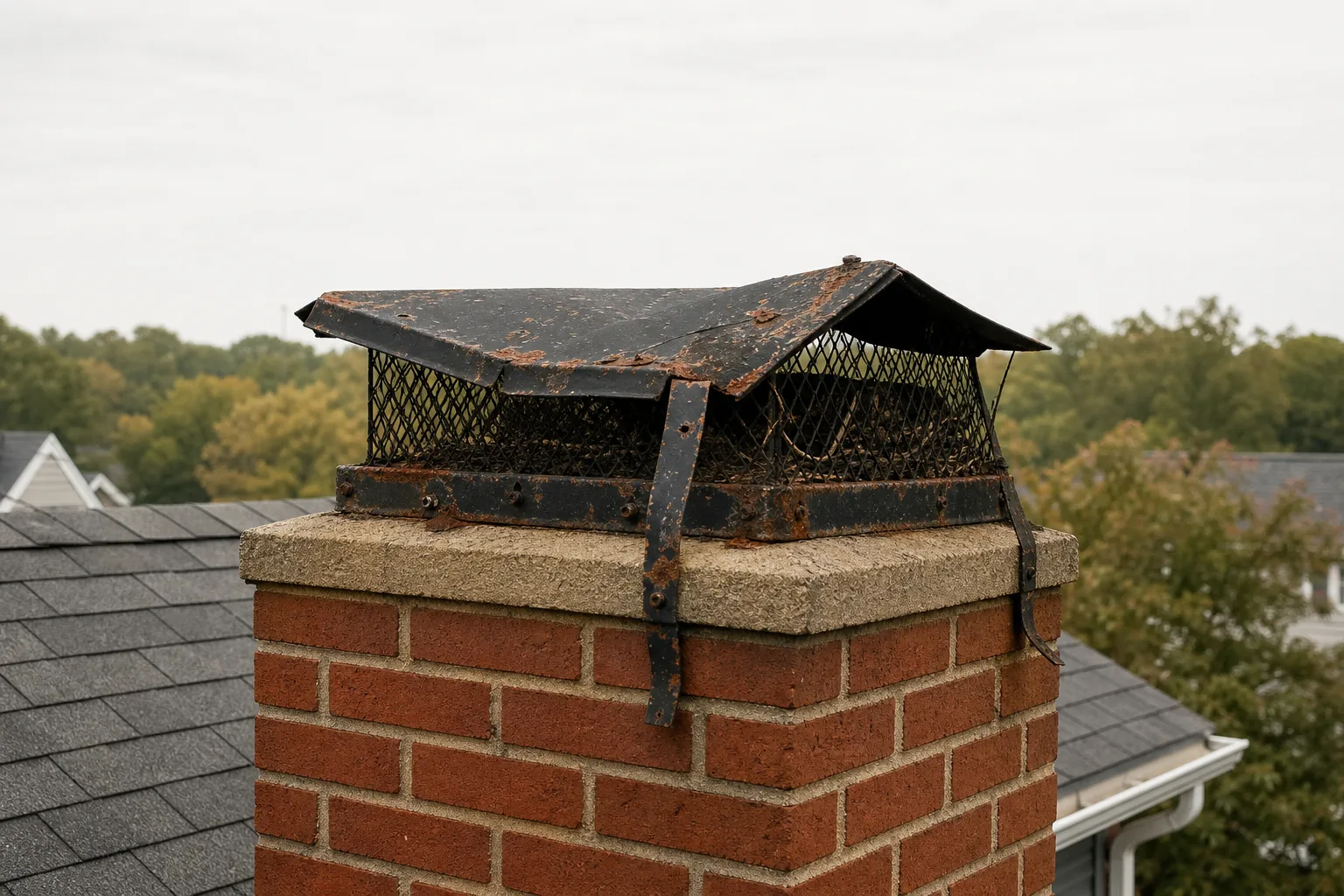
From the field: what you are actually buying on a black galvanized cap is the paint. The zinc coating and the paint layer are the whole defense, and the first place they surrender is the seams, the folded edges, and the screw heads, where orange bleeds through black and spreads outward from there. Once you see that pattern starting, the clock is running.
I am not against galvanized in every case. If the chimney is coming down next year, or the house is on the market and the budget is spoken for, it is a rational purchase. Just buy it knowing what it is.
Copper
Copper chimney caps are the ones people photograph. Copper arrives bright salmon, darkens toward brown as it weathers, and eventually turns the chalky blue green that everyone actually wants.
That patina is not just decoration, it is a protective layer, which is a large part of why suppliers talk about copper caps in terms of a century rather than a decade.
The catch is stock sizes. Copper comes in noticeably fewer standard dimensions than stainless or galvanized, so odd flue sizes push you toward custom chimney caps fabricated to your measurements.
Aluminum
The softest metal in the group. Aluminum sheds rain, sleet, and snow perfectly well, and it will not rust.
What it will not do is argue with a determined raccoon. If you live where animals test the roof, put aluminum at the bottom of your list.
Which Metal Chimney Caps Hold Up Best in a Wet Climate
If you get real winters, real rain, or salt air, the question narrows fast. Stainless and copper are the two that belong in the conversation, and between them it is a budget and appearance decision rather than a performance one.
The features that matter for wet climates are not exotic. Suppliers point to three: a pitched lid instead of a flat one, an extended drip edge that throws water clear of the masonry, and stainless construction. Get those three together on any cap and you have handled rain about as well as the category allows.
Skip them and you get the classic result: a cap that keeps water out of the flue while quietly directing it down the face of your brick.
Mesh, Spark Arresters, and What the Code Actually Says
The mesh on metal chimney caps is where most articles state a number with total confidence. I am not going to, because the sources genuinely disagree.
Some trade sources recommend three quarter inch diamond mesh as the general default and note that certain jurisdictions require a tighter five eighths. Code summaries of NFPA 211 describe a narrower opening range than that. California's fire marshal rules are stricter than the general case. All of those can be true at once, in different places.
What is not in dispute:
- The cap has to be made of heat resistant and corrosion resistant material.
- It has to be designed to keep rain, snow, and animals out of the chimney.
- It has to be removable or otherwise accessible so the flue can be cleaned.
- Where a spark arrester is required for solid fuel equipment, its net free area must be at least three times the net free area of the chimney outlet.
So: ask your local authority, or ask the company doing the install, what mesh spacing your jurisdiction requires. That is the only answer that counts. The inspector and the authority having jurisdiction decide the spacing, not the catalog and not an article.
NFPA 211 also governs when the whole system needs a real look rather than a glance. A Level 2 inspection is required at sale or transfer of the property, on any change to the system such as a new appliance or a different fuel or a change in flue size or material, after a malfunction, after a chimney fire, and after an external event like a severe storm or an earthquake. Buying a house with a fireplace is the common one people miss.
What to Check Before You Buy
Run this list before the order goes in. It takes ten minutes and it catches almost everything that goes wrong when people buy metal chimney caps.
- Outside dimensions of the flue tile, width and length, measured at the widest point.
- Tile height above the crown, tallest tile if there are several.
- Crown footprint, brick face to brick face, if you are going multi-flue.
- Which mount type your chimney top can actually accept.
- Condition of the crown itself, which we are about to get to.
- Mesh spacing that satisfies your local code, confirmed with somebody local.
- Whether the lid can be removed for sweeping without dismantling the whole assembly.
- Fastener material. Stainless cap, stainless hardware. Mixed metals in weather corrode at the joint.
- The warranty terms in writing, since coverage varies wildly between manufacturers.
The crown under the cap
Before you order anything, look at the concrete or mortar wash the cap is going to sit on.
From the field: a cracked crown is one way a brand new cap gets blamed for a leak it had nothing to do with. Water walks in through the fissure in the crown, runs down between the tile and the brick, and shows up inside the house exactly the way a missing cap would. The homeowner just paid for a cap and is now angrier than before.
If the crown has open cracks, gaps where the tile passes through, or spalling edges, treat it as brick chimney repair and fix it first, or at least at the same visit. It is a question worth asking directly whenever somebody is already up there.
Fasteners, warranty, and removability
Removability deserves a second mention because it is the one people discover later. A cap that is riveted shut or sealed down with adhesive on every flange turns every future sweep into a demolition job.
You want a lid you can take off. Whoever handles your chimney service wants it more than you do.
How VIO Helps You Get Metal Chimney Caps Installed
Plain version, because you should know exactly who you are dealing with.
VIO is a referral service. We do not climb your roof and we do not sell you a cap. What we do is take your request for service, understand the situation, and match you with an independent local chimney company that handles cap sizing and installation in your area. The work is done by that company, not by us.
For a cap job specifically, that means the company we match you with measures the flue and the crown in person, tells you which mount type your chimney top can take, and quotes the cap and the installation together so you are not guessing at the difference between a part and a finished job.
We ask every company in the network to put its estimate in writing before any work starts, and you should insist on exactly that. It is a reasonable thing to ask for and a bad sign when somebody resists it.
Metal chimney caps are a small enough job that some homeowners handle the whole thing themselves, and that is a legitimate choice if the roof is safe and the measurements are solid. If either of those is in question, this is the kind of work an independent local chimney company handles as part of its ordinary trade.
Get your metal chimney cap handled by someone local
One call, and we match you with an independent local chimney company that sizes and installs caps. Ask them to put the estimate in writing, every time.
Call (513) 655-6702
The short version of everything above: look at your chimney top, measure the outside of the tile, let that decide the mount, and then pick your metal. Do it in that order and metal chimney caps stop being confusing and start being the easiest problem on your house.
Symptom checker
What is your chimney doing?
Tap the closest match for an honest first answer.