



On this pageFirst question: is it safe to use the fireplace right now?8 sections+7
- First question: is it safe to use the fireplace right now?
- What a damper is, and which of the two you have
- The symptoms that send people looking for damper repair
- The ten-minute damper repair check you can run yourself
- Repair or replace: where the line actually falls
- What really killed it: the water above your damper
- What to ask before anyone starts work
- How VIO helps with damper repair
Quick answer
Damper repair covers freeing or replacing the parts that open and close the metal plate above your firebox. A stuck handle, a sheared cotter pin, a tab out of its slot, or debris on the smoke shelf can be corrected without a new assembly. A plate that has warped or rusted through gets replaced, and where the frame and its slots are still sound the frame can stay in place.
Pull the handle on a fireplace you have not touched since March and one of three things happens. Something swings, and you hear a heavy plate drop open above your head. Something moves, and nothing happens at all. Or nothing moves.
Only the first one is a good morning.
Damper repair is the work of getting that plate operating again, and the range packed inside those two words is wide. Some of it is a fifteen second correction with a gloved hand. Some of it means pulling a cast iron assembly out of a masonry throat. To be clear which damper this page means: the one above your firebox, inside the chimney, not the duct damper in a heating system.
What follows is the same sequence a chimney tech runs, in the order they run it.
Keep one question in the back of your mind while you read. If the metal has corroded, something put water on it, and that something is not the damper.
First question: is it safe to use the fireplace right now?
Start here, because it is the question sitting underneath the search.
If the damper will not open, or opens partway and stops, do not light a fire. That plate is a lid over the only exit your combustion gases have. Smoke into the room is the visible half. Carbon monoxide comes with it and you will not see or smell it.
Opening a window does not solve that. Wait until the plate moves through its full travel.
Safety note: A partially open damper is the more dangerous of the two failures, because a fire can draw well enough at first to seem normal. The room loads up slowly, after you have stopped paying attention. If you cannot confirm the plate is fully open, treat it as closed.
The other direction is uncomfortable rather than hazardous. A damper stuck open does not stop you using the fireplace. It means the flue stays an open channel to the outside whenever there is no fire in the box, so cold air falls down it and heated air leaves through it.
You feel it as a draft at the hearth and a cold zone around it. That costs you comfort and it costs you on the heating side, but it is not a combustion hazard.
Stuck closed, stop. Stuck open, you have time to do this properly.
What a damper is, and which of the two you have
A damper is a metal plate that closes the flue when there is no fire and opens it when there is. Closed, it keeps heated air from walking up the chimney. Open, it gives smoke a route out and lets the chimney pull the way it is designed to. That is the whole job.
Two designs do it, and they fail in completely different ways, so working out which one you own is the first real step.
The throat damper
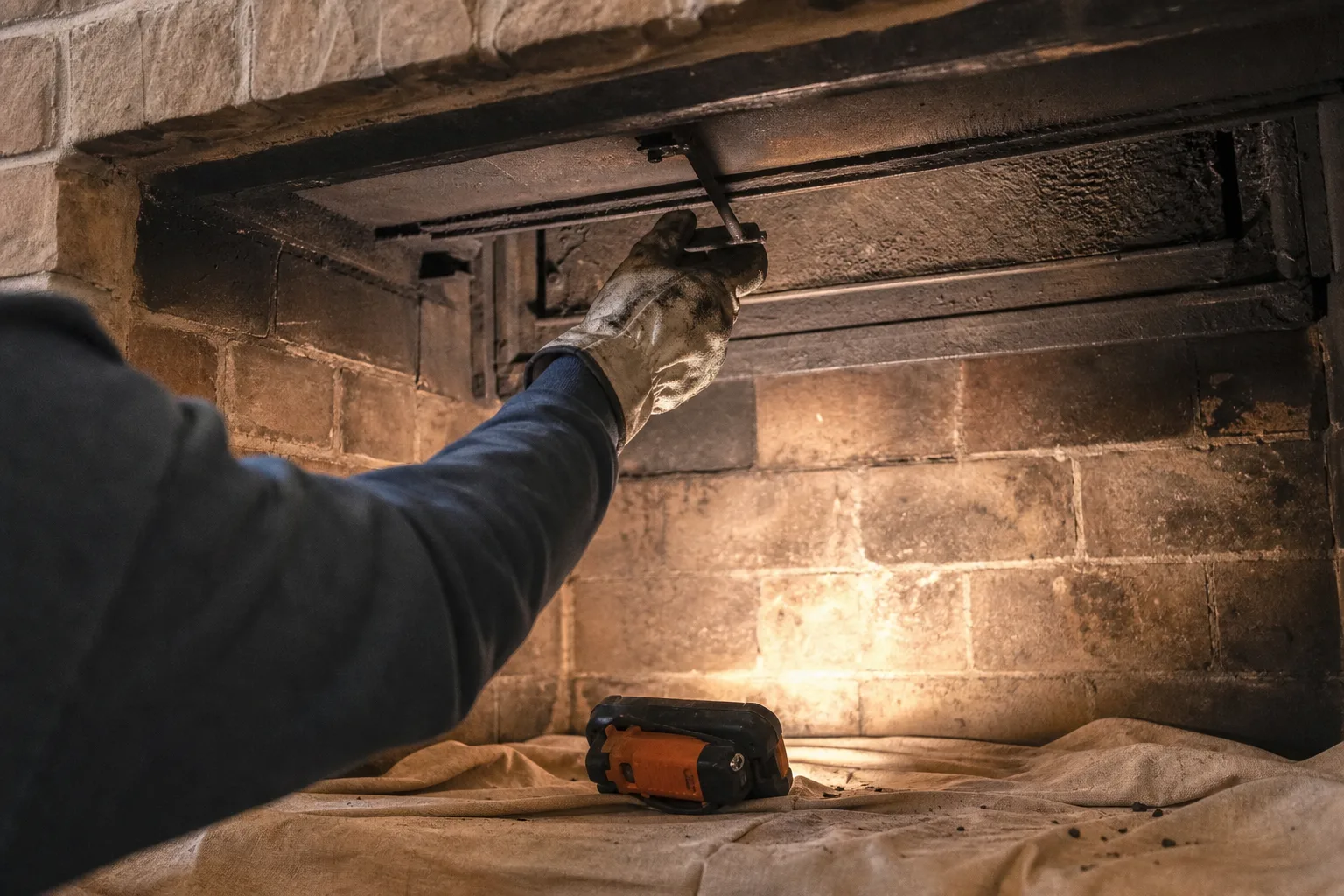
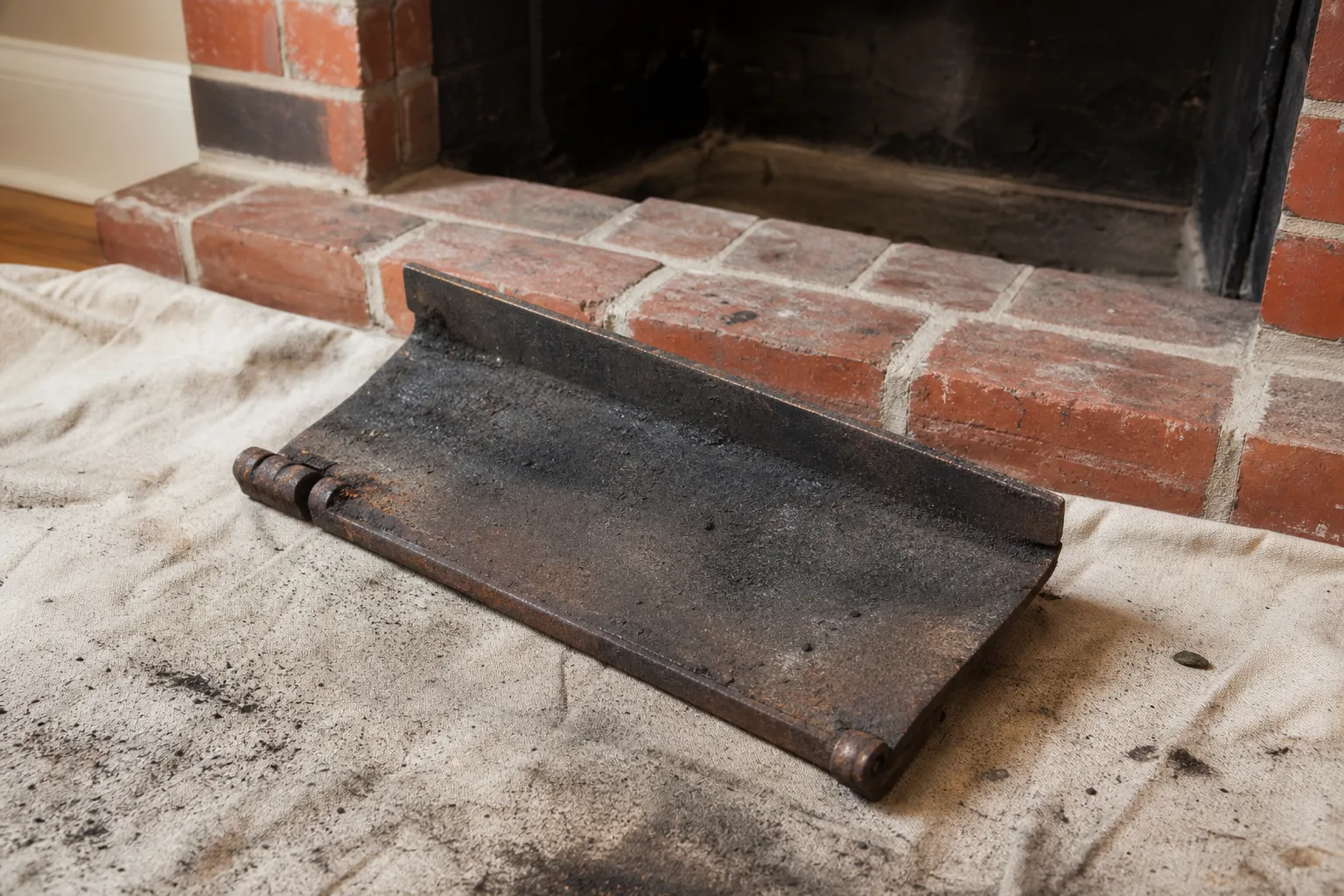
This is the design in an older masonry fireplace. Look up into the firebox with a light and you are looking straight at it: a cast iron plate spanning the throat just above the opening, seated in a cast iron frame, with the smoke shelf behind and above it.
It hinges on tabs cast into one edge of the plate, and those tabs rest in slots in the frame. No pin, no bearing. They simply sit there.
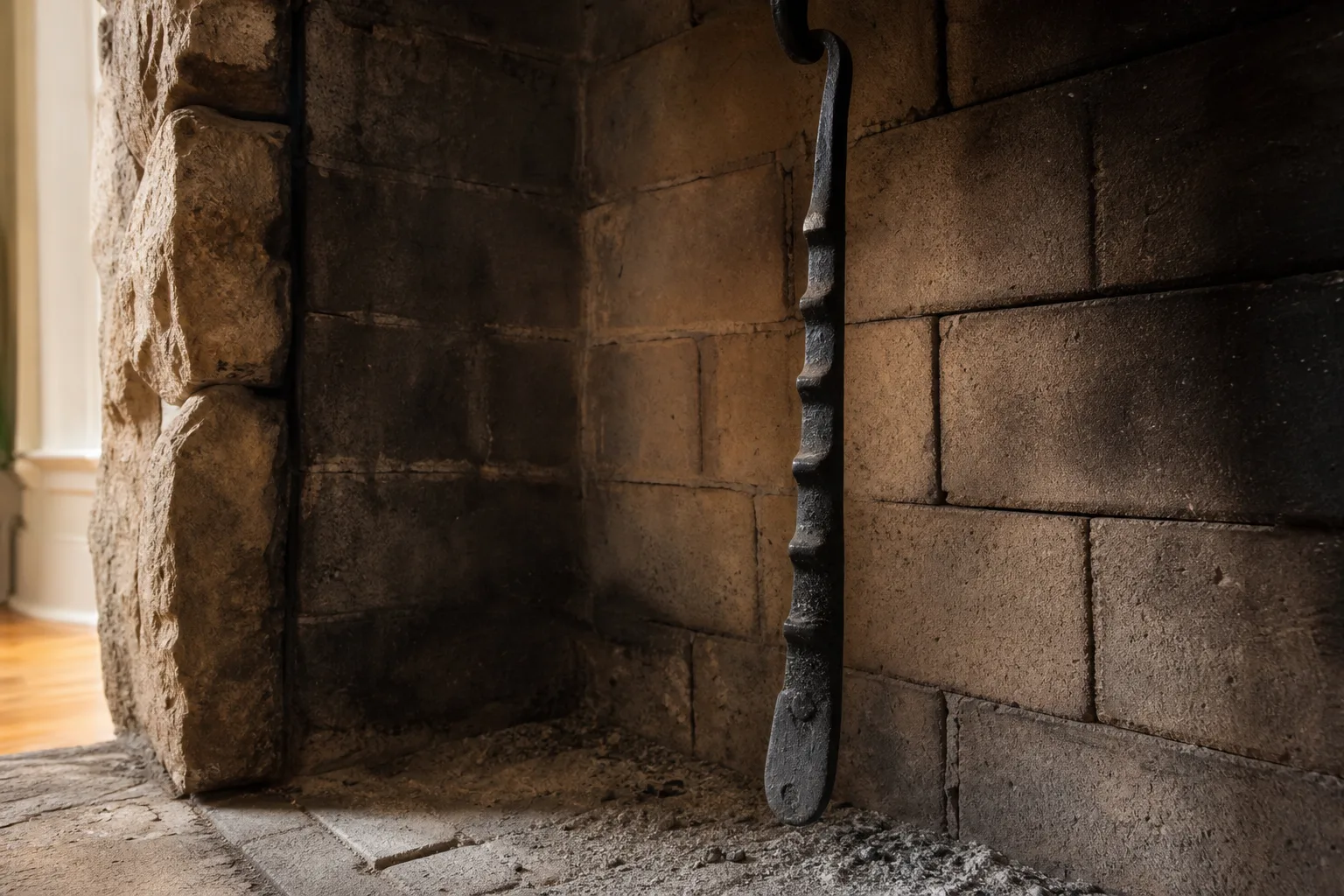
Two control styles are worth knowing. A poker control is a long curved arm hanging into the firebox with steps cast along its length, and it earns its nickname, the banana handle. Push it up and the steps prop the plate at whatever height you want. A rotary control is a small key or shaft through the firebox face, turning a worm gear above that walks the plate open and shut.
Good to know: Tabs resting in slots is exactly why a throat damper can look catastrophically broken and be nothing of the sort. Take a knock, or let debris shift under the plate, and a tab can jump its slot. The plate then sits crooked and binds on one side. Nothing has actually failed. It has come out of its seat.
The top-sealing damper
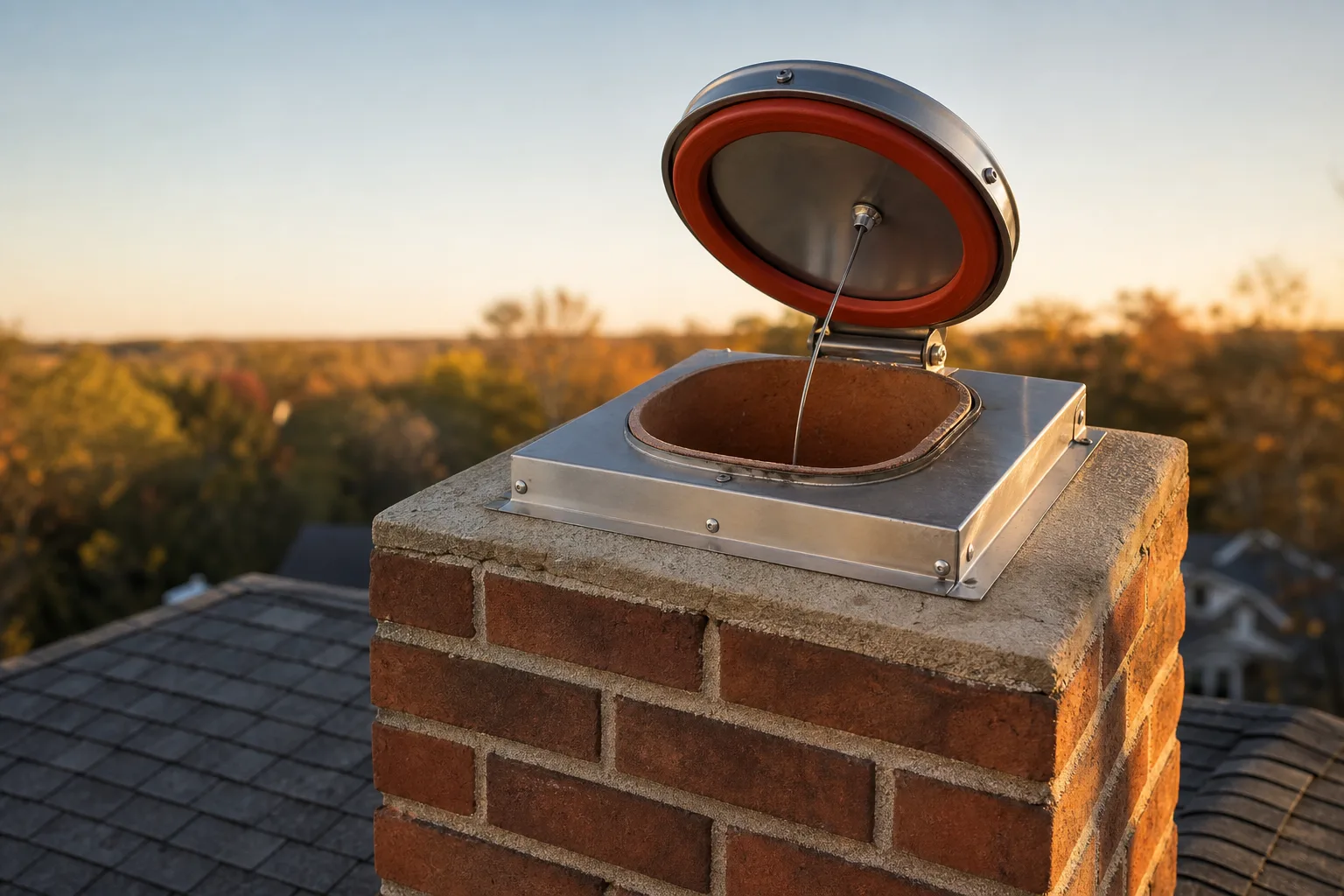
This one lives at the opposite end of the chimney, mounted on the crown. It is a stainless steel or cast aluminum housing with a hinged lid, and a high temperature silicone gasket runs around that lid so it seals against the housing when shut.
A stainless cable runs from the unit down inside the flue and ends at a small handle or spring loaded lever on the firebox wall, up near the top on one side.
So: look up. See a plate, you have a throat damper. See a cable running down to a lever on the wall, you have a top-sealing unit. That one distinction shapes every damper repair decision that follows.
The symptoms that send people looking for damper repair
People arrive at damper repair through a short list of symptoms, and each one points at a different part of the assembly. Reading yours properly before anyone touches anything is worth two minutes.
- The handle will not move at all. Corrosion inside the control, the plate seized in its frame, or debris packed under the plate on the smoke shelf.
- The handle moves freely and nothing happens. The connection between control and plate has let go. On a poker control, look first at the cotter pin at the plate end. On a rotary control, the worm gear may have stripped. On a top-sealing damper, the cable may have parted.
- The plate opens partway and stops. A tab out of its slot, so the plate binds on one side. Or the arc is fouled by creosote and fallen masonry grit.
- The plate will not close fully. Warping. Cast iron that has been through enough heating and cooling cycles can lose its flatness, and a throat damper has no gasket to take up the gap.
- Smoke rolls into the room when you light a fire. Could be the damper, could be the flue above it. If the plate is confirmed fully open and the fireplace still smokes, the problem is higher up, somewhere in the flue and its liner.
- A rattle or whistle in wind. A loose plate sitting in its frame, or a top-sealing lid no longer pulling down against its gasket.
Two of those, the free-spinning handle and the tab out of its slot, sit among the smallest problems on the list and among the most alarming to look at. Worth knowing before you pick up the phone.
The ten-minute damper repair check you can run yourself
You can answer a surprising amount of this from the hearth rug, and every answer you get makes the conversation with a chimney company shorter and more useful.
What you need before you start
A flashlight, work gloves, eye protection, and a drop cloth or an old towel to kneel on. Soot comes down when you move things around up there, and it goes where it wants.
The firebox has to be cold. Not cool, cold. If you burned anything in the last day, stop and come back tomorrow.
Step one: find the control and follow it to the plate
This is the fifteen seconds that decides everything else, and it is the step that gets skipped.
Do not test the handle yet. Light it up and trace it. On a poker control, follow the curved arm from where your hand goes all the way up to where it meets the plate, and look hard at that connection point. There is a cotter pin there doing the entire job.
On a rotary control, find the shaft coming off the key and where the gear engages. On a top-sealing damper, follow the cable up from the lever and check that it runs taut into the flue rather than hanging slack.
Pro tip: If the cotter pin is missing, sheared, or the arm is sitting loose off the plate, you have found your problem and it is one of the smallest on the list. The handle will feel completely dead, and the plate itself may be in fine shape.
Step two: test the travel
Now work the control, slowly, paying attention to what you feel rather than how far it travels.
A hard stop partway through the arc is mechanical, something out of place or in the way. A soft stop, like something packed in behind the plate, is debris. Full range with no resistance and no plate movement is a disconnected linkage.
Step three: read the blade and the frame
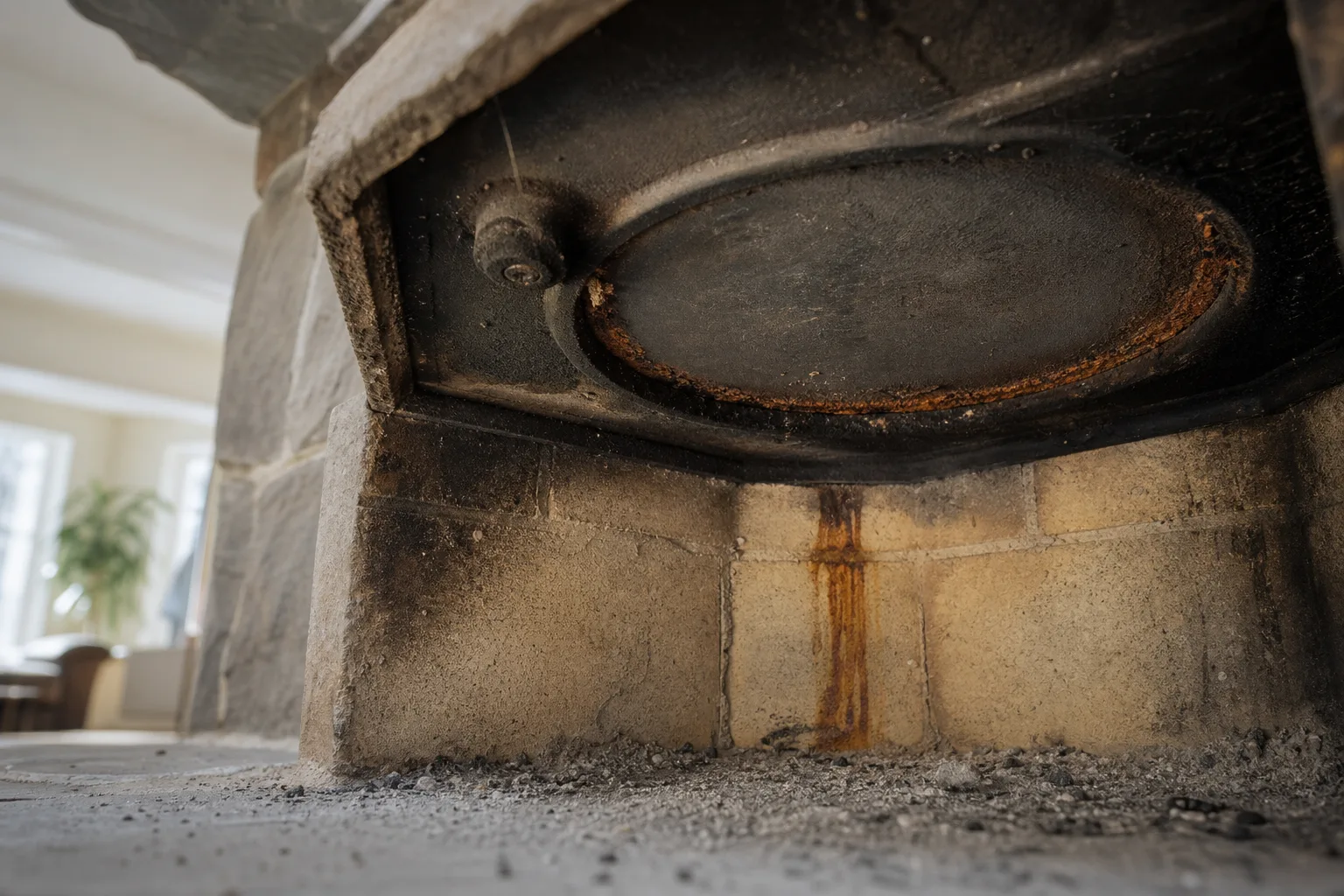
Light up the plate and read the surface. Matte black soot everywhere is normal and tells you nothing. Orange-brown rust bloom along the plate edges and running down the frame tells you water has been coming through.
Then the edges, where plate meets frame. Are the tabs sitting in their slots on both sides, or has one jumped out? Is the plate flat in its frame, or does a corner stand proud?
Last, the smoke shelf behind the plate, if you can get an angle on it. Leaves, grit, chunks of mortar, a nest. Any of that stops a plate dead without a single part having failed.
Write down what you saw. That list is the most useful thing you can hand to whoever comes out.
Repair or replace: where the line actually falls
This is the part that gets waved past. A damper can be repaired, a damper can be replaced, now call somebody. What is missing is the criterion.
The criterion is simple. A damper is three things: a plate, a frame, and a control. Those three fail separately, and only one of them is expected to be replaced as a unit.
When damper repair is the right call
If the plate is still flat, and the frame still holds its tabs, then what failed is downstream of the metal that matters, and damper repair rather than replacement is the reasonable path.
That covers a sheared cotter pin, a stripped or seized control, a tab knocked out of its slot, debris packed on the smoke shelf, and surface corrosion that has not eaten through anything. None of it calls for a new assembly.
When the assembly is past repair
If the plate has warped so it no longer lies flat in its frame, the calculation changes. A throat damper has no gasket. It seals by metal sitting on metal, and a warped plate cannot do that no matter how well the control works.
A plate rusted through is also past saving, but that does not automatically mean a whole new assembly. Where the frame and its slots are still sound, the plate is the part that gets replaced and the frame stays where it is.
The frame is the piece that decides it. Once a slot has broken away, the hinge geometry is gone and there is nothing left to seat a plate into.
| What you are seeing | What it points to | What that implies for the work |
|---|---|---|
| Handle moves freely, plate does not | The control has separated from the plate | Control and linkage work rather than a new assembly |
| Plate moves, then stops hard partway | A tab out of its slot, or something in the arc | Reseating and clearing, if the plate is still flat |
| Plate closes but daylight shows at the edge | The plate is not seating, which can be warping, debris on the seat, or misalignment | Find out which of those it is first, because a throat damper has no gasket to cover a gap |
| Surface rust, plate flat, slots intact | Corrosion that has not gone through the metal | Cleaning and freeing the moving parts |
| Rust through the plate, frame and slots still sound | The plate has failed and the frame has not | Plate replacement, with the frame left where it is |
| A frame slot broken away or missing | The hinge geometry is gone | The frame, and with it the assembly, is what gets replaced |
| Slack or parted cable on a top-sealing unit | The cable or its anchor has failed | Cable work at the crown, which means roof access |
Myth vs. fact: The myth is that a stuck damper means a new damper. The fact is that a damper is an assembly, and the control holds the most moving pieces and the least metal. A control can be replaced while the plate and frame stay where they are. Find out what failed before agreeing to replace the whole thing.
The third option: sealing at the top instead
There is a third path, and it deserves to be framed as a choice rather than a fallback.
When a throat damper is past repair, one route is a new throat damper in the same frame position. The other is to leave the old plate alone, or take it out, and seal at the crown with a top-sealing damper instead.
A top-sealing unit closes on a silicone gasket rather than metal on metal, and because it sits at the top of the stack, a closed one is designed to hold heated air in while keeping rain, downdraft and animals out of the flue.
The trade is access. Anything that goes wrong with it goes wrong on the roof, and the cable down the flue is a part that can fail on its own. If roof access on your house is awkward, that belongs in the decision.
No universally better answer exists here, only the one that fits your chimney, your roof, and what you use the fireplace for.
Not sure which side of the line your damper is on?
Describe what the lever does, or does not do, and we will match you with an independent chimney company near you that works on dampers. We ask every company in the network to put its estimate in writing before any work starts, and you should insist on exactly that.
Call (513) 655-6702, or request service online.
What really killed it: the water above your damper
Time to pay off the line from the top of this page.
A damper has several ways to fail. A control can shear, a tab can jump its slot, debris can pack in behind the plate, and repeated heating and cooling can warp cast iron on its own. None of those involve water.
Corrosion is the one that does. Rust needs moisture, and in a chimney the route worth checking first is rain coming in at the top of the stack.
From the field: A rust trail running down the outside of a damper frame, with staining on the firebrick beneath it, is evidence that points upward rather than downward. Something delivered that water past the top of the stack, and the plate is simply where it stopped.
The crown
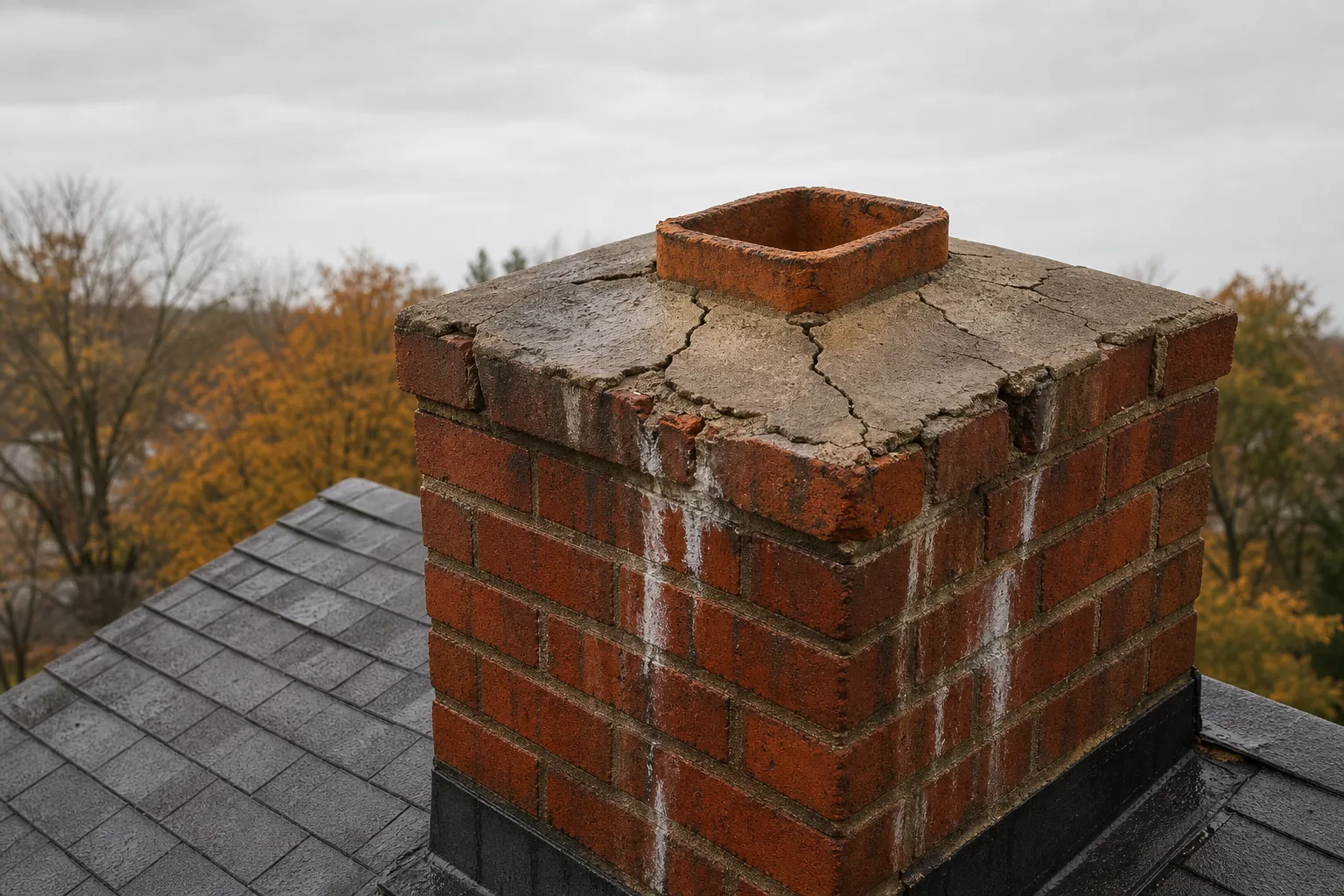
The crown is the sloped wash of concrete or mortar on top of the chimney, the part that sheds rain off the stack and away from the brick. It is not the cap and it is not decorative.
When a crown cracks, and the cracks radiate out from the flue tile, water gets in behind it and runs down inside the masonry. Spalled edges and dark staining on the brick below are what that looks like from the ground.
The cap
The cap sits over the flue opening itself. No cap, or a cap rusted through or blown crooked, and rain goes straight down the open clay tile into the flue.
Nothing sits between that opening and your damper. The plate is the first horizontal surface the water meets.
This is why, when corrosion is what took the plate out, a damper repair that stops at the damper leaves something undone. Put a new plate into a flue that is still taking rain, and the new plate starts the same clock the old one ran out.
A sheared cotter pin or a tab out of its slot is a different story, and fixing it is the whole job. The rust cases are the ones where it is worth asking what is above the damper. That is a two minute question during a visit somebody is already making.
What to ask before anyone starts work
The flashlight check was worth running because it changes what you can ask. Five questions, in order.
Which damper type do I have, and what specifically failed? You should get a part name back. Plate, frame, control, cable, gasket. "The damper is shot" is not an answer.
Is the plate flat, and is the frame holding its tabs? The repair-or-replace line from earlier, and it has a visual answer.
What is the condition of the crown and the cap above it? The whole point of the previous section.
Does what you found call for a Level 2 inspection here? Worth asking plainly, and worth knowing what you are asking.
Good to know: NFPA 211, the standard covering chimneys, fireplaces, vents, and solid fuel burning appliances, calls for a Level 2 inspection upon sale or transfer of the property, when changes are made to the system, and after an operating malfunction or a potentially damaging external event such as a building or chimney fire, a seismic event, or a weather event. Whether a particular failed damper counts as an operating malfunction under that language is a judgement for the person inspecting your chimney. It is a fair question to put to them directly.
Can I have the estimate in writing before anything starts? Ask it out loud, before the work, not after.
One more thing worth knowing before any damper repair starts. A damper sits inside a combustible assembly, at the point where the firebox meets the flue, and work there is not cosmetic. Clearance and construction requirements for a combustible assembly vary by jurisdiction and by what your fireplace actually is, so the person doing the work should be the one confirming what applies to yours.
How VIO helps with damper repair
VIO does not do damper repair. We are a referral service, with no technicians, crews, or trucks, because that is not what we are.
What we do is match you with an independent chimney company working in your area.
Here is how that runs. You tell us what the lever does or does not do, what you saw with a flashlight up in the firebox, and where you are. We connect you with a local company that handles damper repair. The work is done by that company, and your agreement for it is with them.
On estimates, we ask every company in the network to put its estimate in writing before any work starts, and you should insist on exactly that. Not only with a company we match you with. With anyone you call about your chimney.
The flashlight check at the top of this page is what makes the rest easier. It turns your call from "my damper is broken" into "the poker control has come off the plate and there is rust running down the frame," and that is a different conversation.
Get a damper repair quote from a local chimney company
Tell us what is happening at your fireplace and we will connect you with an independent chimney company in your area. VIO is a referral service, and the work is done by the company we match you with. We ask every company in the network to put its estimate in writing before any work starts, and you should insist on exactly that, no matter who you call.
Call (513) 655-6702, or request service online.
Symptom checker
What is your chimney doing?
Tap the closest match for an honest first answer.