



On this pageWhat Is a Chimney Cap, Exactly?7 sections+6
Quick answer
What is a chimney cap? It is the metal covering installed at the top of a chimney, directly over the flue opening, held a few inches above the flue tile by legs or a band, with a screen filling the gap. The lid keeps rain out of the flue. The screen keeps birds, squirrels and raccoons out and helps contain sparks. It differs from a chimney crown, which is the concrete slab covering the chimney's whole top surface.
What is a chimney cap? It is the metal covering installed at the top of your chimney, over the opening of the flue, and its job is to let smoke and exhaust out while keeping rain, animals and windblown debris from dropping straight down into the flue.
That is the whole definition, and most people who search for it already suspected something like that. Here is the part that actually matters.
The thing people point at and call a chimney cap is frequently not a chimney cap. It might be the crown. It might be a chase cover. Those are three different parts, made of different materials and doing different jobs, and they fail in different ways and for different money.
So when someone asks what is a chimney cap, the useful first move is figuring out which of those three parts they are actually looking at. If a sweep or an inspector used the phrase at you and put a number next to it, nail that down before anything else.
This guide gives you that, and then it gives you something better: a way to stand in your own driveway, look up, and read the top of your chimney yourself.
What Is a Chimney Cap, Exactly?
Picture the top of a masonry chimney from the ground up.
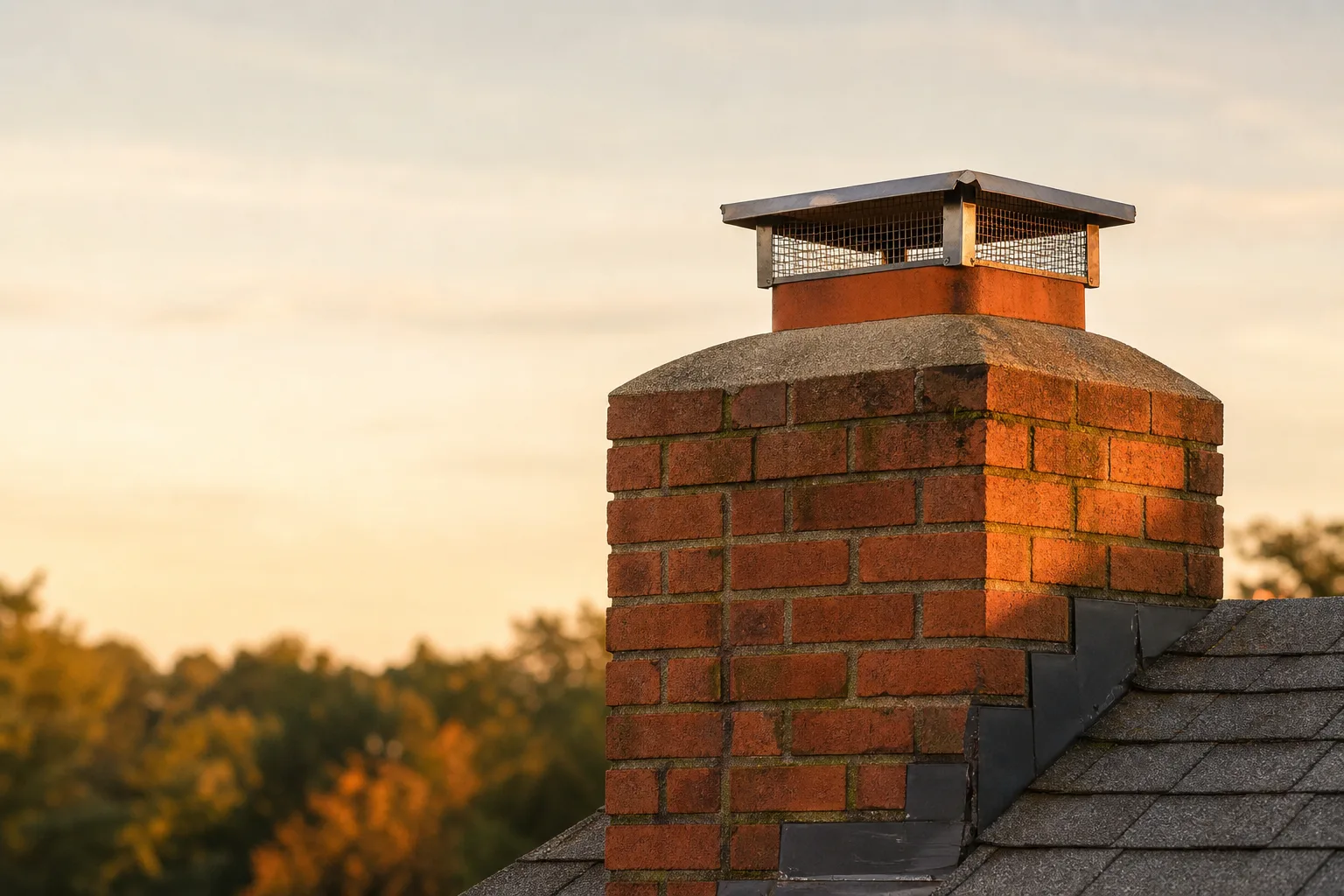
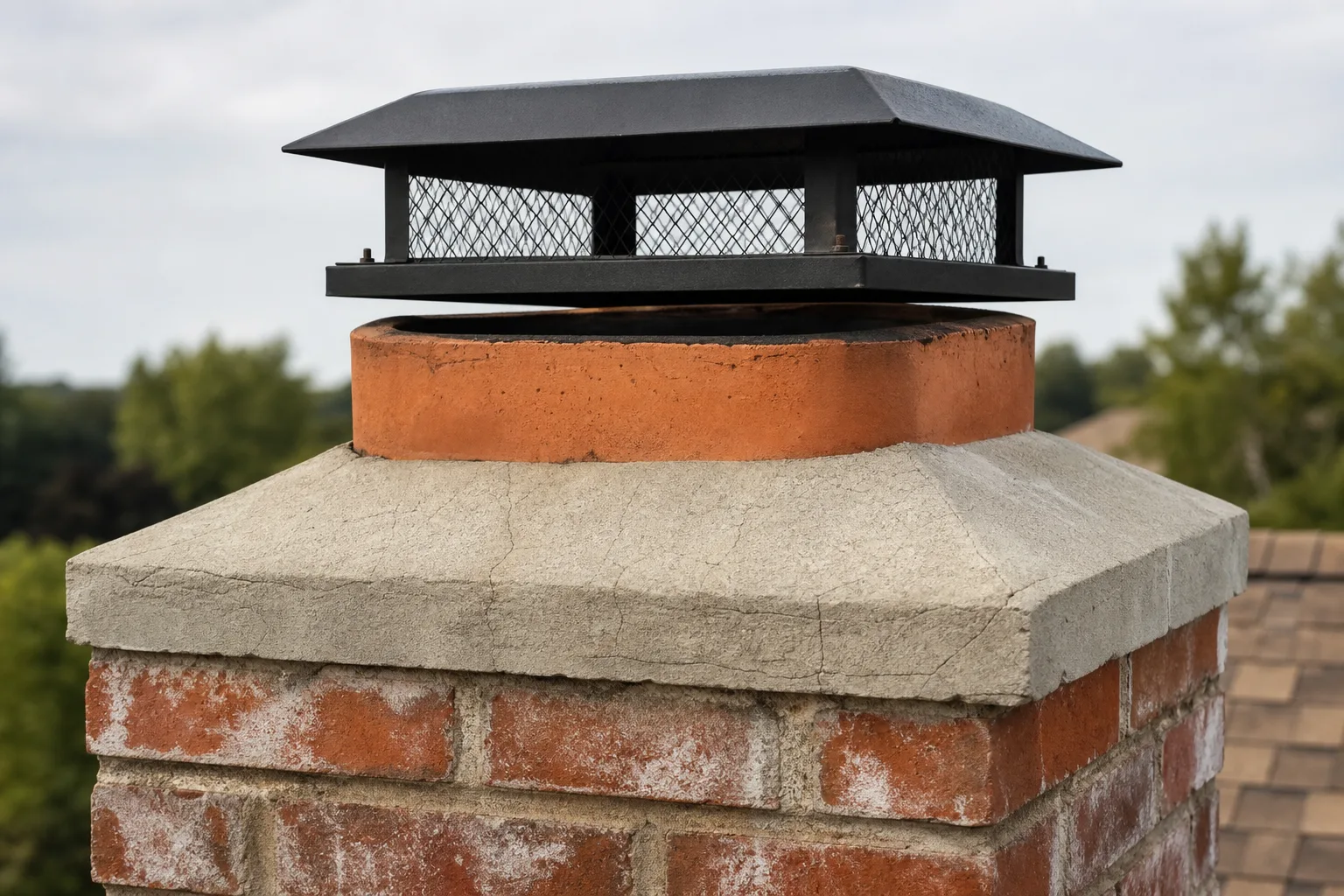
There is the brick stack. On top of the brick there is a sloped slab of concrete or mortar, called the crown, which sheds water off the chimney's top surface. Through that crown, one or more clay flue tiles poke up a few inches. Those tiles are usually terracotta orange, sometimes charcoal grey, and they are the liner: the stacked clay sections that form the flue, which is the passage the smoke travels up.
The chimney cap sits above the flue tiles.
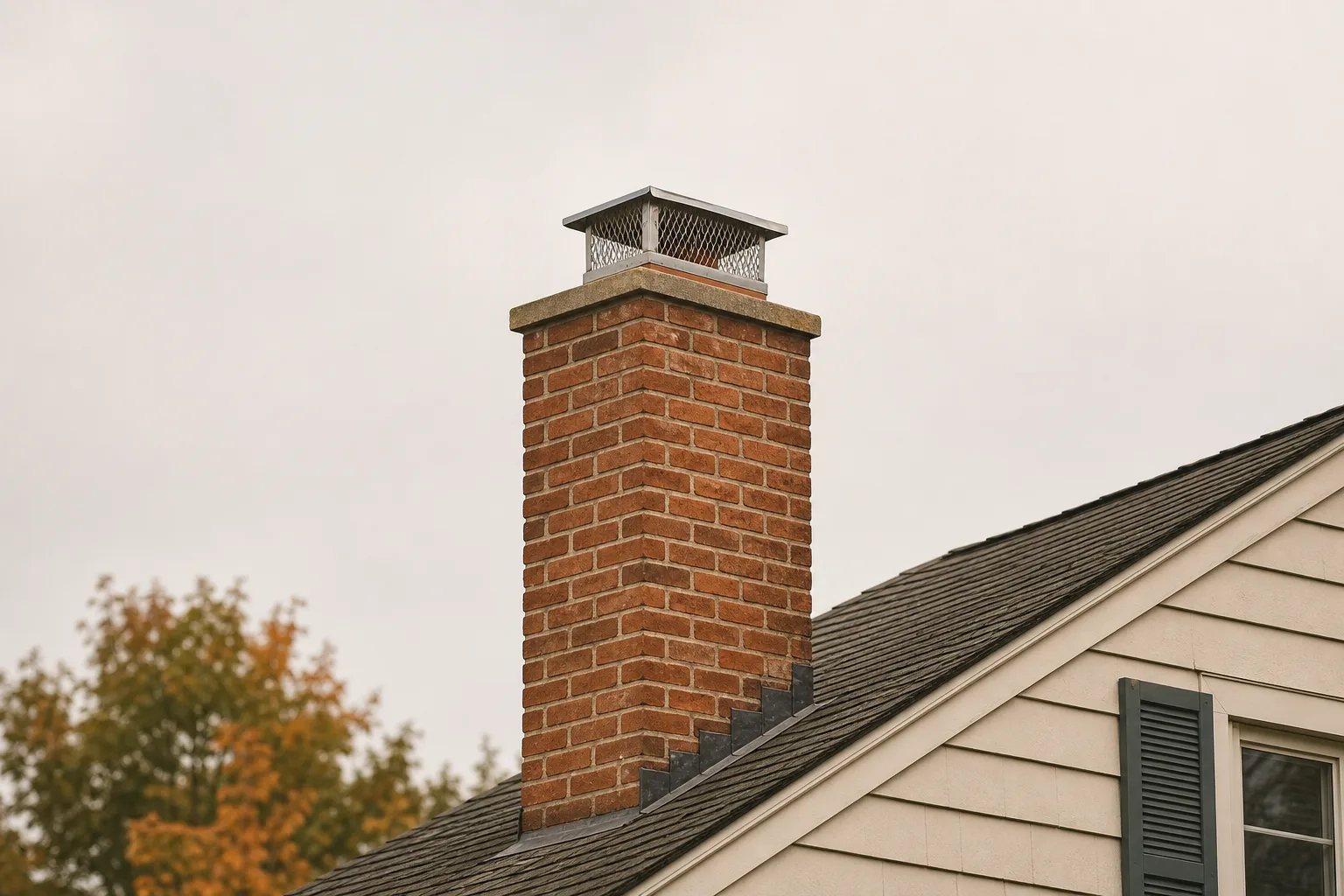
On a basic single-flue cap you will see a flat or slightly peaked metal lid, held three or four inches above the tile by corner legs, with a screen filling the gap between the lid and the tile. The lid handles rain. The screen handles everything else. That is it. That is the whole machine.
Good to know: the screen is not decorative, and its holes are not arbitrary. NFPA 211 specifies that a spark arrestor's screen openings be no smaller than 3/8 inch and no larger than 1/2 inch. The lower bound keeps soot from clogging the mesh and choking the draft, and the upper bound is small enough to stop embers getting out. That range is why every cap screen you have ever seen looks roughly the same.
What Is a Chimney Cap Actually Doing Up There?
Four jobs. They are worth spelling out with the actual scene attached, because "protects your chimney" is the kind of sentence that slides past a person without leaving anything behind.
It keeps the rain out of the flue. Without a cap, an open flue is a vertical pipe pointed at the sky. Rain goes in. It lands in the smoke chamber and the firebox, it soaks into the masonry, and in a cold climate it freezes there and expands, which is how water works its way into brick and mortar and pushes them apart over successive winters.
It keeps animals out. The named regulars are birds, squirrels, raccoons and snakes, and an uncapped flue is an unusually attractive piece of real estate: dry, sheltered, warm, and with a ledge. The screen is the part doing this work, which is why a screen torn open on one side is worth taking seriously. The lid above it still sheds most of the rain, but the opening is an invitation, and an animal only needs one way in.
It contains sparks. A cap with a spark arrestor screen limits burning fragments from leaving the flue and landing on your roof or in the yard, which is why spark control shows up on every list of fireplace safety basics. NFPA 211 calls spark arrestors out specifically for chimneys serving solid fuel, which covers wood, pellets and coal.
It manages downdraft. Wind moving across a roofline can push air down a flue instead of letting it draw up. That is the windy night when the fire sulks and smoke rolls out into the room, and a cap is one of the things that interrupts it.
Where the Cap Sits, and Why That Matters
Read the stack from bottom to top and you get brick, then crown, then flue tile, then cap. Four layers, three of which can fail independently.
That ordering is the reason a cap conversation so often turns into a different conversation. The cap is the part you can see, so it is the part that gets named. The crown is underneath it and harder to see. Water that gets past either one ends up in the same place.
Chimney Cap vs. Chimney Crown vs. Chase Cover
Three words, constantly used as if they were one word, including by people who should know better. This is the point where what is a chimney cap stops being a simple question and starts being a useful one.
Here is the difference in one line each. The crown is the slab covering the entire top of a masonry chimney. The cap is the metal lid covering the flue opening. The chase cover is the metal sheet covering the top of a factory-built chimney's wood-framed enclosure.
| Part | Where it sits | Typically made of | What it protects | What failure looks like |
|---|---|---|---|---|
| Chimney crown | The full top surface of a masonry chimney, around the flue tiles | Concrete or mortar, sometimes cast stone | The brick and the mortar joints below it | Cracks radiating across the slab, chunks missing at the edge, water tracking down the brick |
| Chimney cap | Above the flue opening, on or around the tile | Stainless steel, copper, galvanized steel, painted steel | The inside of the flue | Rust streaks on the brick below, torn or missing screen, a lid sitting crooked |
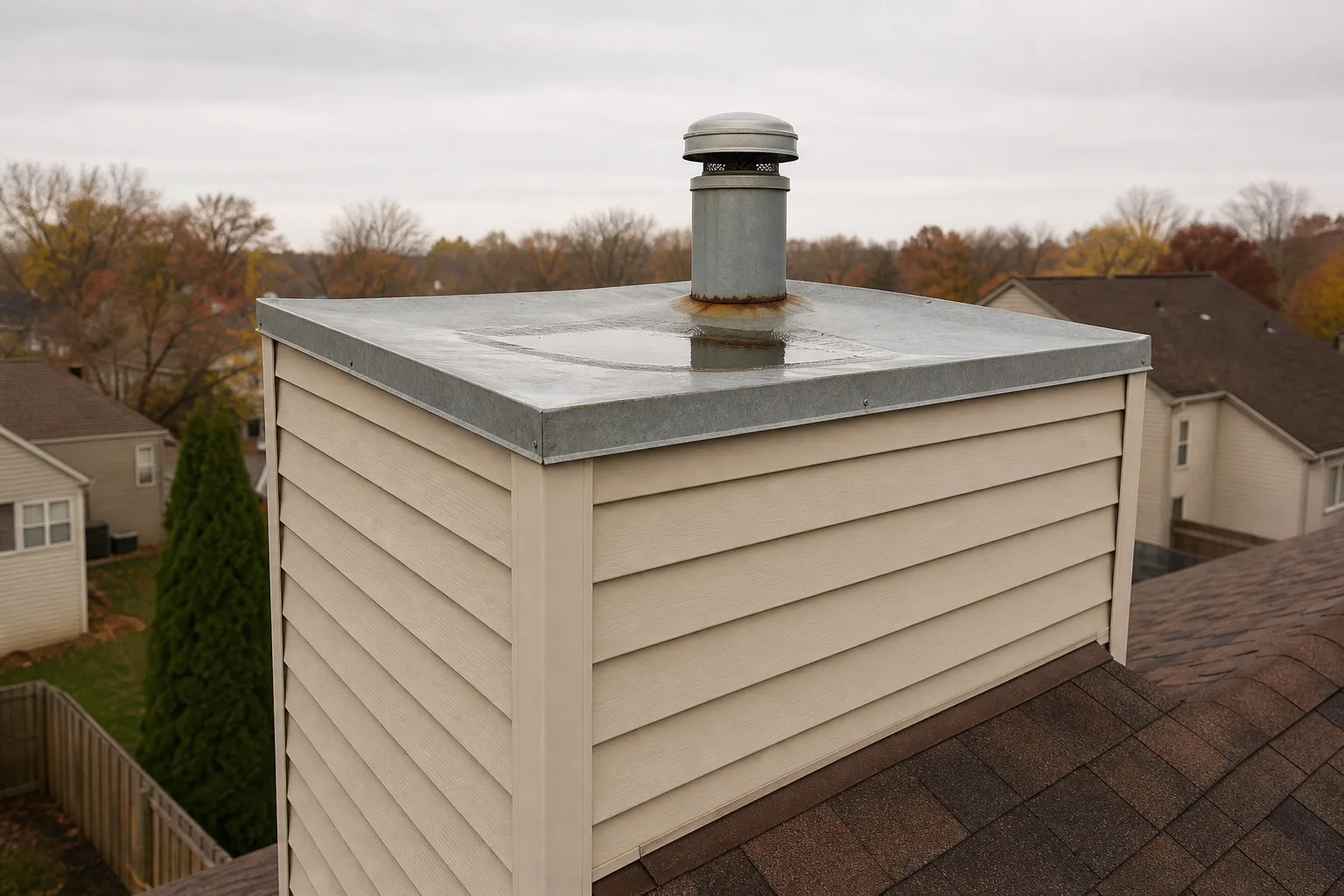
| Chase cover | The full top of a factory-built chimney's framed chase | Sheet metal: stainless, copper or galvanized | The wood framing and the pipes inside the chase | A dished center holding standing water, rust blooming around the pipe collar, brown streaks down the siding |
Myth vs. fact: the myth is that "cap," "cover" and "crown" are three names for the same thing. The fact is that they are three separate parts protecting three different things, and that the crown and the chase cover are not even found on the same kind of chimney. A quote for one of them tells you almost nothing about the condition of the others.
How to Tell Which One You Have From the Ground
This takes about fifteen seconds and no equipment.
Look at the chimney from the yard. If it is brick or stone all the way up, with a visible mortar or concrete slab at the top and clay tiles sticking out of it, you have a masonry chimney. Crown plus cap.
If it is a rectangular box clad in siding, vinyl or wood or stucco, matching the rest of the house and standing off the roof, you have a factory-built chimney inside a chase. Chase cover plus a cap on the pipe collar.
That single distinction changes which part is likely to be the real problem, and it is the answer to a question a lot of homeowners never think to ask.
How to Tell If Your Chimney Cap Is Failing
Go outside. Seriously, now, before you keep reading. Stand where you can see the whole chimney, and if you have binoculars or a phone with a decent zoom, bring them.
Most people who search what is a chimney cap are really asking a second question underneath the first one: is mine still doing its job? You can answer a surprising amount of that from your own driveway.
What Is a Chimney Cap Supposed to Look Like From the Ground?
A cap in decent shape reads as a clean geometric object. A flat or peaked lid, level, with an even gap of screen underneath it, sitting square on the tile or the crown. Dull silver if it is stainless, matte charcoal if it is painted steel, brown or green if it is older copper.
Anything that reads as crooked, ragged, streaked or absent is worth a closer look. Here is the full checklist.
Work through it once and you will have a better answer to what is a chimney cap on your own house than any general definition can give you.
From the ground, looking up:
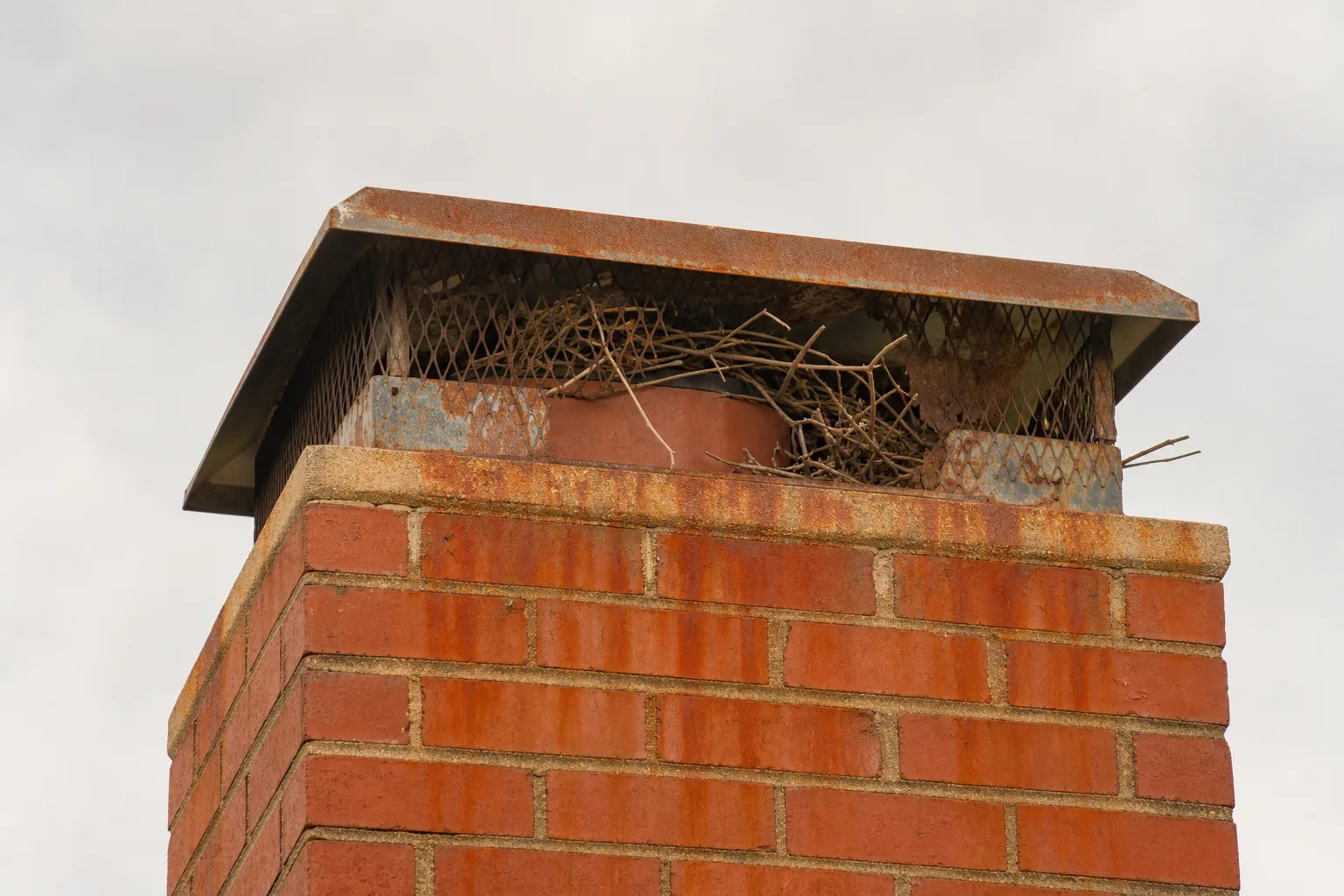
- Reddish-brown streaks running vertically down the brick or the siding below the cap. This is rust from the metal above, carried down by rain.
- Screen torn open on one face, or missing entirely from one side.
- Twigs, straw or nesting material visible in the gap between lid and tile.
- The lid sitting visibly crooked, or lifted at one corner.
- No cap at all: a bare clay flue tile, open to the sky, reading as a dark rectangular hole in the top of the stack.
- On a chase: a cover that looks dished or shallow in the middle rather than flat or peaked, which means it is holding water instead of shedding it.
From inside, at the firebox:
- Leaves, twigs or nesting material in the grate, especially in a fireplace nobody has lit for months.
- Flakes of rust on the smoke shelf or in the firebox.
- Standing water, or a dark stain, after a heavy rain.
- A musty smell that gets stronger in wet weather.
From the field: the sign homeowners almost never read correctly is the rust streak. People look at brown staining on their brick and file it under "the chimney is getting old," when it is actually a message from the metal above: the coating has failed and the cap is corroding. It is one of the few chimney problems that announces itself in plain sight, and it is routinely ignored for years.
Safety note: everything above is a from-the-ground inspection. Binoculars and a zoom lens only. Chimney tops sit at the steepest, highest, least forgiving part of a roof, and a homeowner going up a ladder to check a cap is trading a small problem for a much larger one.
Not sure what you are looking at up there?
You can spot rust streaks and a torn screen from the driveway. What you cannot see from the ground is whether the crown underneath is cracked, or whether the cap was ever sized right for the flue. Tell us what you noticed and we will match you with an independent chimney company near you that can get on the roof and look.
Call (513) 655-6702, or request service and we will route it to a company in your area.
Types of Chimney Caps, and How They Attach
Now that you know whether yours is in trouble, the vocabulary becomes useful instead of abstract. Most people who ask what is a chimney cap walk away with one generic picture in their head, and there are really several shapes of answer.
Caps get sorted by size and shape in most catalogs, but the more honest way to sort them is by how they hold on, because that is what determines whether one fits your chimney at all.
Single-Flue Caps
These cover one flue tile, and there are three common ways they attach.
Slip-in caps have legs that slide down inside the flue tile and grip by friction or by a set screw. They are the simplest of the group to fit.
Bolt-on, or adjustable, caps use four L-shaped braces with slotted arms and U-shaped brackets that slide along the slots. The slots are the point: one cap covers a range of tile sizes, which is why they are the workhorse choice when the flue is an odd dimension.
Band-around caps wrap around the outside of the tile or the brick and clamp down, rather than bolting through. The clamping band seals against weather around the whole perimeter instead of at four points.
Multi-Flue and Top-Mount Caps
A lot of older masonry chimneys carry two or even three flues in one stack. A fireplace and a furnace. Two fireplaces on two floors.
Here is what nobody tells you about that: it is not one decision, it is a choice between two designs. You can put a small individual cap on each tile, or you can put one large cap over the whole top.
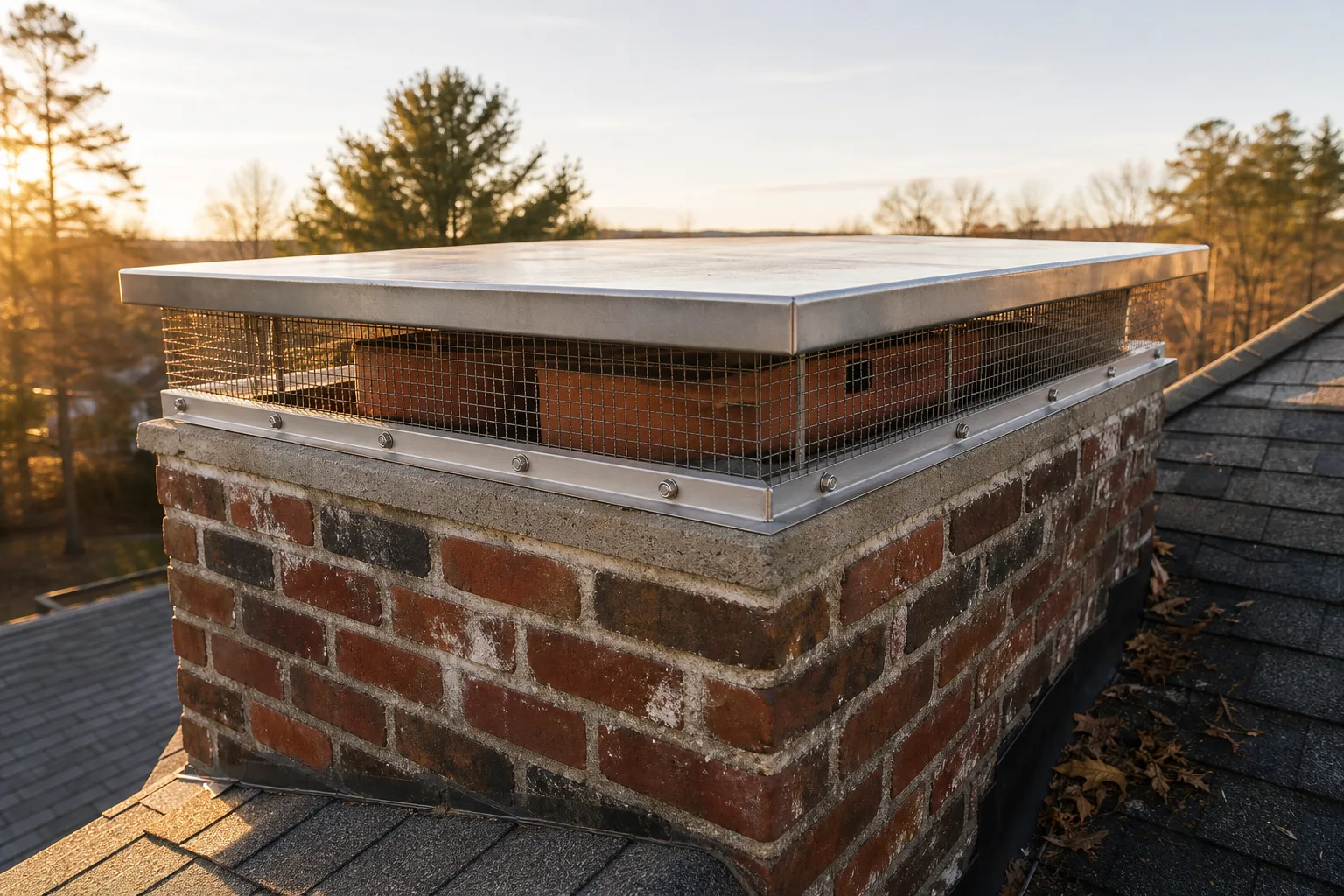
A multi-flue cap is that large one. It spans the entire top of the chimney, covers every tile at once, and bolts down through flanges into the concrete crown. Because it overhangs the whole stack, it also shelters the crown from direct rain, which is a real second benefit and the reason many chimney companies push toward it.
Top-mount caps work the same way on a single-flue chimney: they mount to the crown rather than to the tile. That is the answer when the flue does not project above the crown at all, or when the crown has minor cracking that would benefit from being kept out of the weather.
Individual caps are less material and keep each flue independent. One big cap protects more, and it is one thing to maintain instead of three, though an odd-shaped stack often pushes you toward custom chimney caps built to its dimensions. Neither answer is wrong, and anyone who tells you there is only one option is describing their inventory rather than your chimney.
Specialty Caps
A few exist for specific problems. Wind-directional caps rotate or bear off with the wind to fight persistent downdraft on an exposed site. Draft-inducing caps add a powered fan, which is a real solution to a real problem and also a powered device living on your roof. Weather-shield caps extend the overhang for heavy exposure.
These are not defaults. If a chimney cap conversation starts at one of them, ask what problem it is solving before you agree to it.
Pro tip: NFPA 211 requires that a cap be accessible for cleaning and removable for flue maintenance. A cap that has been sealed on, welded, or fastened in a way that fights removal is a problem you will not discover until the next sweeping, when someone has to damage it to get into your flue.
What Is a Chimney Cap Made Of?
Ask what is a chimney cap made of and you get four answers that cover almost everything on American roofs.
Stainless steel is the default on quality caps, and it reads as a dull silver-grey rather than a shine. Copper is the expensive-looking one, bright orange when new, weathering to brown and eventually to green patina. Galvanized steel is zinc-coated mild steel. Painted steel, usually black, is galvanized or mild steel with a coating on top.
Ranked by how long they hold up in weather, the metal chimney caps you will be choosing between sort out easily: stainless and copper sit clearly above galvanized. That is the honest comparison, and it is where the comparison should stop. Anyone quoting you a specific number of years is guessing.
Good to know: stainless is the most durable of the common options, but nothing here is rust-proof. In a wet climate, near salt air, or on a chimney that stays damp, stainless can corrode too. Treat "stainless" as a good bet rather than a permanent solution.
Why Galvanized Caps Streak Rust Down the Brick
This is the mechanism behind the single most common failure sign, so it is worth understanding.
Galvanizing is a zinc layer over steel. The zinc corrodes first and protects the steel underneath, which works well until the zinc is used up. After that, the steel is exposed, and steel on a roof in the rain does exactly what you expect.
The rust does not stay put. Rain carries it down the outside of the chimney, which is how a corroding cap writes its condition on your brick in brown vertical lines. Chase covers do the same thing onto siding, usually starting around the pipe collar where water pools.
A rusting cap also gets brittle. That matters more than it sounds: a corroded cap is easy to break, and an animal that could not have gotten through sound metal can push through a weakened screen and nest inside.
When a New Chimney Cap Is the Wrong Fix
Sometimes it is. This is the part a company selling caps has a hard time saying out loud, and it is the reason what is a chimney cap is worth answering carefully before you buy one.
If the crown underneath is cracked through, a new cap sits on top of an ongoing leak, and the real job is repairing the masonry first. If a chase cover is dished and holding standing water, replacing the small cap on the pipe collar does nothing about the pond above your framing. If the flue liner itself is cracked or missing, the cap is not the part that needs attention first. In each of those cases the cap is the visible thing, not the failing thing.
There is a quieter version of this too. A cap can look perfect from the ground and still be the wrong cap, because the two things that actually determine whether it performs are invisible at that distance: whether it fits the tile properly, and whether it has enough open area not to choke the draft. NFPA 211 addresses the second one directly, requiring a spark arrestor's net free area to be at least three times the area of the chimney outlet. You cannot evaluate that from sixty feet below.
Safety note: a spark arrestor limits sparks leaving the top of the flue, which protects your roof and your yard. It does not prevent a creosote fire inside the flue. Plenty of pages blur those two together. They are different risks with different solutions, and only regular sweeping addresses the second one.
Worth knowing on timing: NFPA 211 calls for a Level 2 inspection at the sale or transfer of a property, when the system changes (new appliance, new fuel, a relined flue), after a malfunction, after a chimney fire, and after an external event such as a storm or an earthquake. If any of those describe your situation, the cap question gets folded into a larger look at the system, which is the right order to do it in.
How VIO Helps When You Need a Chimney Cap
Here is the situation most readers are actually in. Somebody was on your roof, they said the words chimney cap, they wrote a number down, and you came here to find out whether that was fair. Now you know what is a chimney cap, what it does, and which parts around it can fail instead of it.
The reasonable next move is to have one of the local chimney specialists look at it who is not the person who wrote that quote.
That is what VIO does. We are a referral service, not a chimney company. We match homeowners with independent local companies that do the actual work, and the company we send is not the one that already quoted you. On estimates, we ask every company in the network to put its estimate in writing before any work starts, and you should insist on exactly that, from us or from anyone else.
If nobody has quoted you yet and you simply found rust streaks on your brick while reading this, that works too. Tell us what you saw and we will route it to a company nearby.
Get a second opinion before you say yes
If somebody already quoted you a chimney cap, you are allowed to have another set of eyes on it first. VIO is a referral service, not the company doing the work, so the company we match you with is not the one that wrote the quote in your inbox.
Call (513) 655-6702 to get matched with a local chimney company.
The last thing worth saying about what is a chimney cap: it is one of the smallest parts of the whole system and one of the few that protects everything below it. Knowing what yours looks like, and being able to tell when it stops working, puts you ahead of most homeowners standing in their driveway looking up.
Symptom checker
What is your chimney doing?
Tap the closest match for an honest first answer.