



On this pageStuck or Finished: the Five-Minute Check Before You Buy Anything6 sections+5
- Stuck or Finished: the Five-Minute Check Before You Buy Anything
- Fireplace Damper Replacement Comes Down to One Fork
- Four Situations That Change the Answer
- What the Work Involves, and Whether You Can Do It Yourself
- What Belongs in the Estimate, and What to Say When You Call
- How VIO Helps With a Fireplace Damper Replacement
Quick answer
A fireplace damper replacement takes one of two forms: a new damper set in the throat above the firebox, or a top-sealing damper mounted at the chimney crown and worked by a cable that runs down the flue. Which one fits depends mainly on whether the existing throat frame is still sound, because that frame is usually built into the masonry. A damper seized by soot may need cleaning rather than replacing.
The first fire of the season is where most of these stories start. Paper, kindling, a match, and then instead of drawing up the flue the smoke rolls out over the lintel and into the room. Somebody opens a window. Somebody else stands in the fireplace with a phone flashlight, looking up, and finds a rusted plate that will not budge.
If that was your evening, or if your problem is the opposite one, a plate that will not close while cold air pours down all winter, you have probably already decided that a fireplace damper replacement is in your future. Maybe a sweep told you. Maybe an inspector wrote "damper inoperable" on a report during a sale.
This page helps you choose between the two very different jobs that share the name replacement. It starts one step earlier, because a fair number of people who arrive here certain their damper is finished are looking at a plate that is merely stuck.
Stuck or Finished: the Five-Minute Check Before You Buy Anything
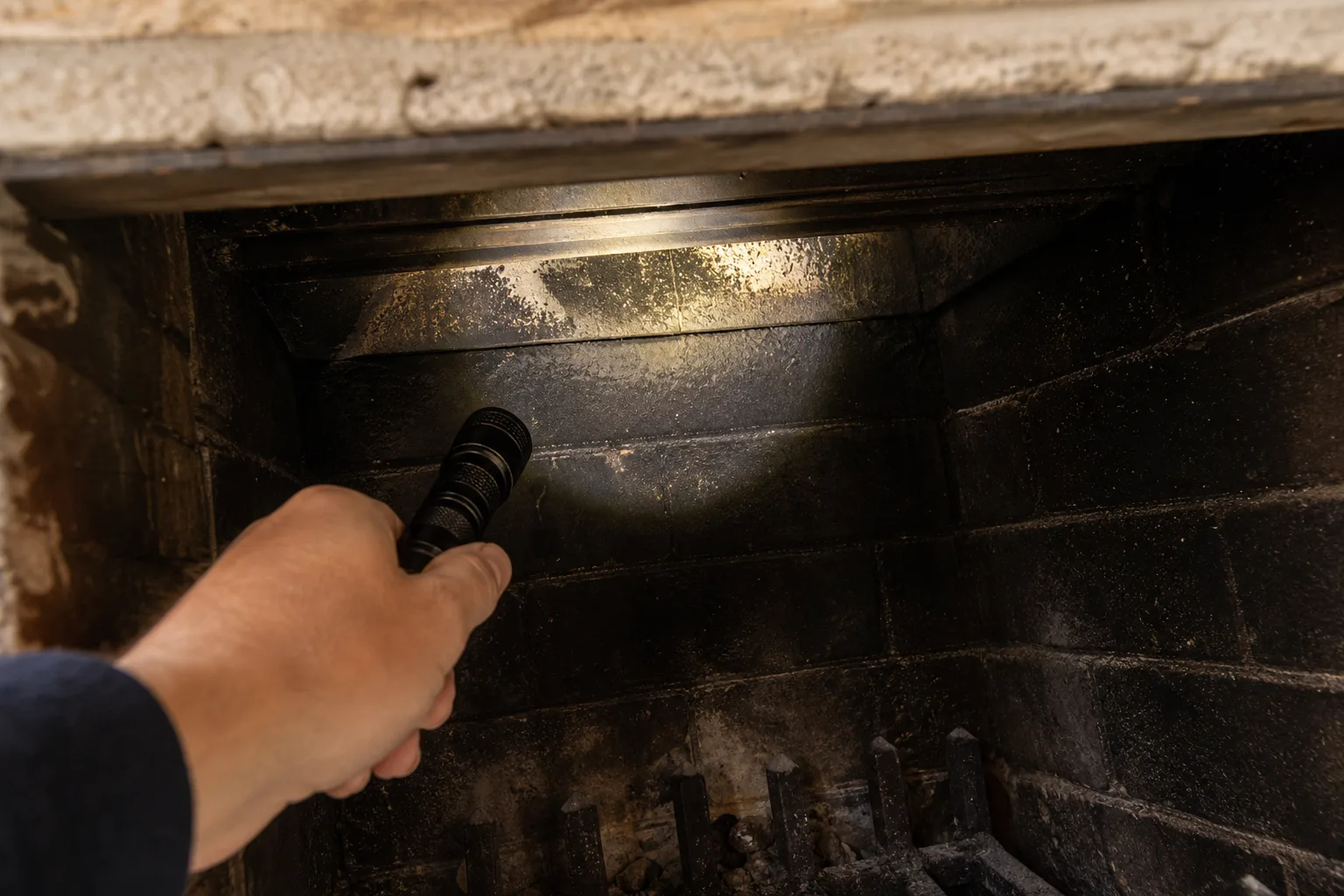
Do this cold. Not this evening after a fire, not tomorrow morning if there were embers overnight. A firebox holds heat far longer than it looks like it does.
What to look for with a flashlight
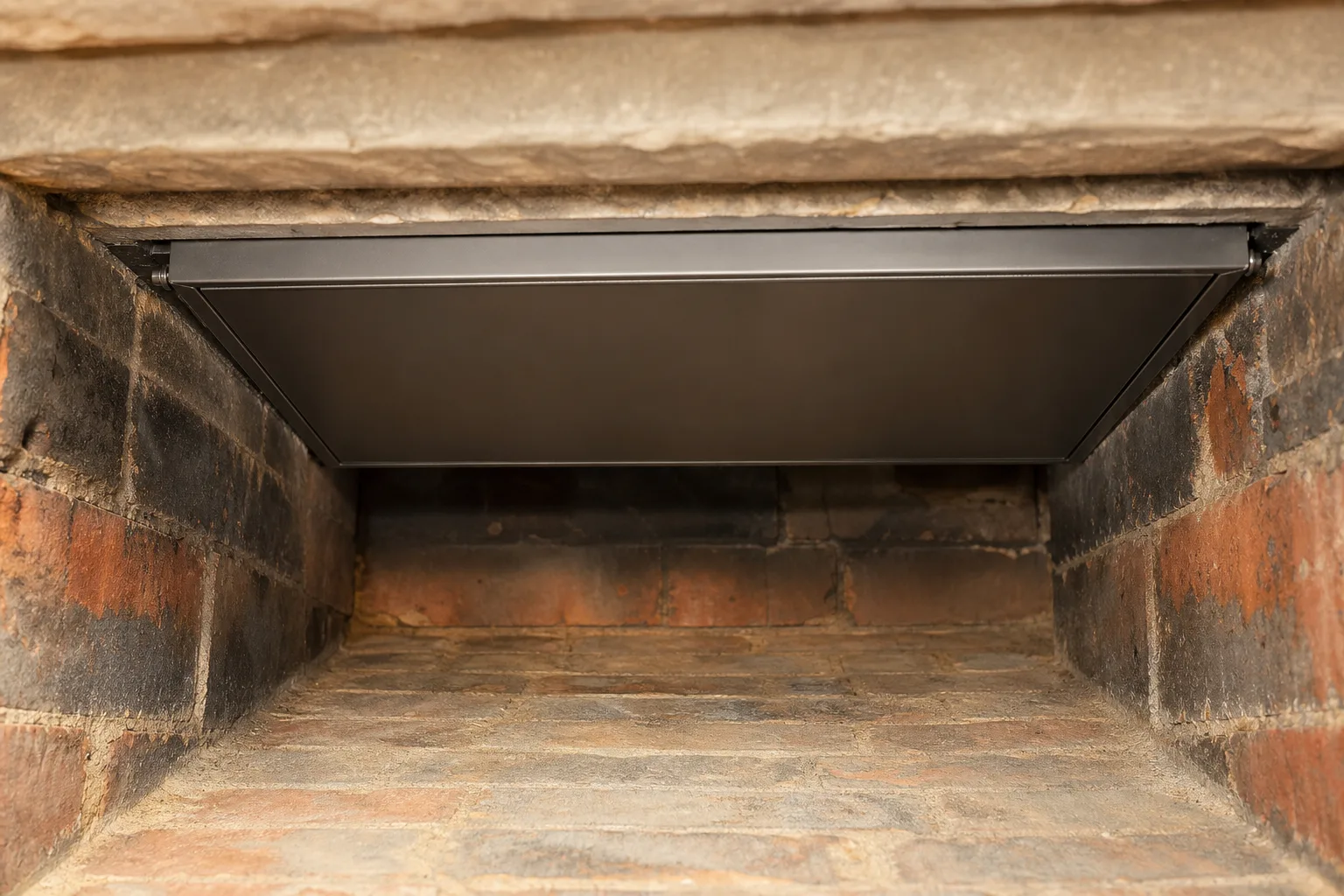
Put your head far enough in to see straight up into the throat, the narrowing space above the fire. On most masonry fireplaces built for wood there is a metal plate set in a metal frame, with a handle, lever, or turning rod reaching down where you can get at it.
Check three things. The plate: flat, or dished, warped, curled at an edge. The frame it seats against: continuous metal, or places rusted thin, flaked, or opened into a gap you could put a pencil through. And the seat, the line where plate meets frame. On a healthy throat damper those surfaces meet along their whole length. On a failing one they touch in two places and stand apart everywhere else.
Then work the handle, gently. If the plate moves with it, the mechanism is alive whatever else is wrong. If the handle moves and nothing happens above it, the linkage has failed. If nothing moves at all, stop pushing.
A plate that is seized versus a plate that is done
These look identical from the sofa and they are not the same job.
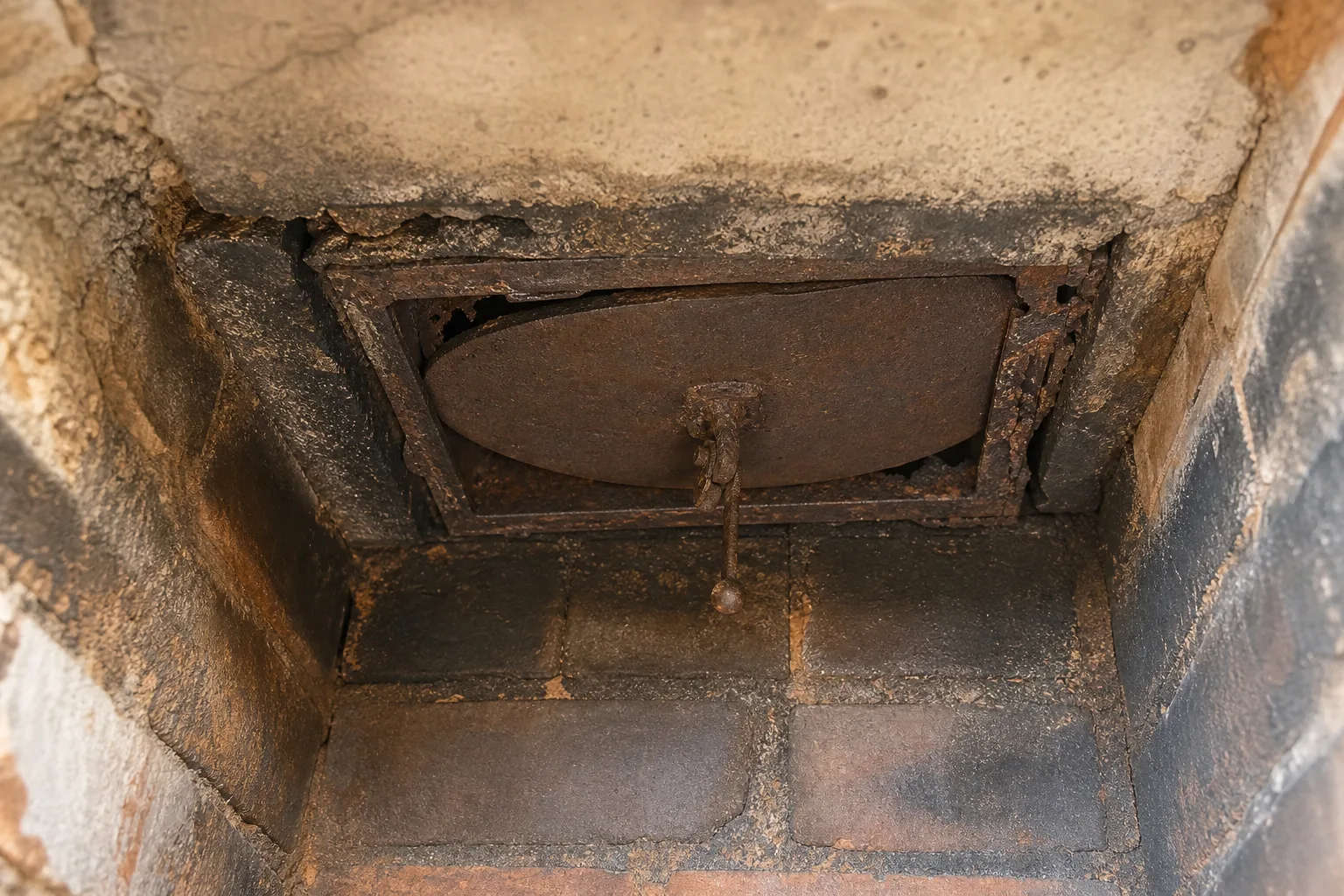
A seized plate is structurally fine and physically stuck. Creosote and soot build along the seat and in the hinge, get damp, get baked, and glue the plate into its frame. The tell is the deposit: crusty, shiny, or tarry, following the edges of the plate and the hinge pin, with metal that still looks like metal underneath. A seized damper often frees up during a routine sweep, when the deposit holding it comes off with everything else.
A finished plate is a different picture. The metal itself has gone. Rust has eaten through the plate or, more often, the frame at the corners where water sits. You see pinholes of daylight, or an edge crumbles when touched, or the plate has warped and no longer has a flat line to sit on.
A third picture fools people: a plate that is intact and mobile but does not seal, because the frame has shifted or the seat has worn to a rounded, pitted line. Metal on metal is not a gasket even when both parts are new, so a good throat damper still leaks a little. A worn one leaks enough that you feel it in the room in January.
When the handle is the only thing that failed
Rotary dampers use a threaded rod and a screw handle, poker dampers use a rod you push, and both linkages fail on their own while the plate above them stays in decent shape. If your handle came away in your hand and the plate looks flat and the frame sound, you may have a repair rather than a replacement.
Pro tip: Do the inspection stone cold, and take a photograph while you are down there. You will want it on the phone later, and nobody remembers what the frame looked like once they have stood back up.
Fireplace Damper Replacement Comes Down to One Fork
Every fireplace damper replacement resolves into one of two jobs, different enough that the word replacement is nearly unhelpful. You either put a new damper in the throat where the old one lives, or you give up on that spot and seal the chimney at the top. The choice is not a matter of taste. It is usually decided by one thing the homeowner cannot see.
Replacing the damper where it sits, in the throat
Sometimes this is the simple swap everyone hopes for. Some throat dampers are a plate and hinge riding in a frame, so the plate lifts out and a replacement drops in without touching anything structural. If your frame is sound and only the plate, hinge pin, or linkage failed, this is a modest job and you should not be talked out of it.
The trouble is the frame. On a great many masonry fireplaces the throat damper frame is not fastened in place, it is built in. The mason set it during construction, laid brick around and above it, and the smoke chamber sits on top. Getting it out means taking apart the masonry holding it, and putting a new one in means rebuilding that masonry so the smoke chamber still works. That is why a rusted-through frame turns a small-sounding job into a large one.
So the question that decides this fork is not whether your damper is broken. It is whether the frame holding it is still good.
Moving the seal to the top of the flue
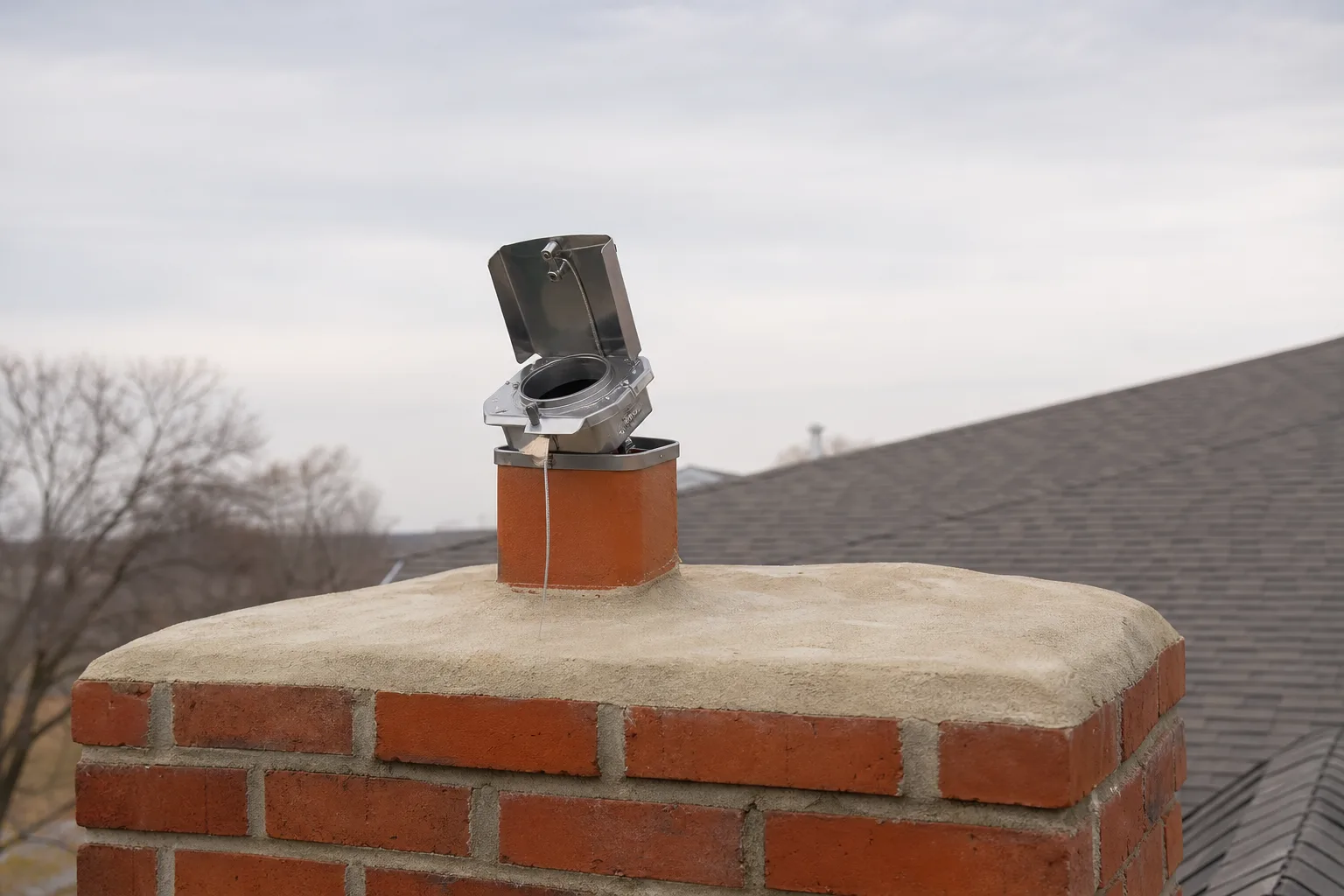
The other path skips the throat. A top-mounted damper, often called a top-sealing damper, is a hinged lid fastened to the top of the flue at the crown, sealing against a gasket rather than metal. A stainless cable runs down inside the flue to a bracket in the firebox, where you pull to open and release to close.
Two things follow. It seals more completely than a throat damper in good condition ever did, which is why people with a merely worn one sometimes choose this route. And because it sits on top, it covers the flue opening, so rain, leaves, and animals stop coming down, a job a chimney cap normally does. The catch is that it is a roof job, on a crown sound enough to mount to, operated from a bracket instead of a familiar handle.
How to tell which fork is yours
Read this as a path. Frame sound, plate or linkage failed: replace in the throat. Frame rusted through or cracked: the top-mounted route usually becomes the sensible answer, because it solves the sealing problem without disturbing masonry. Cap failing too: same direction, since one piece of hardware then does both jobs. Crown cracked or flue tile damaged: that has to be handled regardless and may need to come first. Vented gas appliance in the fireplace: neither path applies in the ordinary way, which is the next section.
| Throat damper | Top-sealing damper | |
|---|---|---|
| Where it sits | In the throat above the firebox | On the flue at the chimney crown |
| How it seals | Metal plate against a metal seat | Lid against a gasket |
| How you operate it | Handle, lever, or rod in the firebox | Cable down the flue to a bracket |
| Access needed | From inside the firebox | From the roof |
| What else it does | Nothing beyond the damper job | Also closes the flue to rain and animals |
| What usually rules it out | A failed frame built into the masonry | A crown or flue tile in poor condition |
| What the install disturbs | Possibly the masonry around the throat | Nothing indoors except the bracket |
From the field: Homeowners call about the plate. Professionals look at the frame. The plate is the part that fails visibly, but the frame decides whether this is an afternoon or a masonry project, and reading it takes a light, a mirror, and somebody who has looked at a lot of them.
Not sure which fork is yours? The condition of the frame in the throat decides it, and that is the one part you cannot judge from the hearth. VIO matches you with an independent local chimney company in your area that can look at it in person and tell you which replacement your fireplace actually needs. Call (513) 655-6702 or request service online.
Four Situations That Change the Answer
The fork above covers the ordinary case. Four situations sit outside it.
There is no damper up there at all
Some people look up and find nothing. A previous owner had a failing damper removed rather than replaced, or the fireplace was built without one, as some older and some purpose-built fireplaces were. The word replacement is then technically wrong and practically right. You still want a damper, because an open flue is a hole in the house running in both directions, and it does not stop being one in July. With no frame to salvage, the top-mounted route is often the straightforward answer, provided the crown is sound.
The fireplace has a vented gas log set
Read this one carefully. A vented gas log set is designed to burn with the flue open, and the damper on a fireplace serving one has to be held permanently open so it cannot be closed against the running appliance. That is the job of a damper clamp, sometimes called a damper stop. A tight-sealing damper here is not an upgrade, it is potentially the wrong product. If you have vented gas logs, or you are not certain whether your set is vented or vent-free, the appliance manufacturer's instructions control what is permitted on that flue, and the answer needs confirming in person by somebody who can identify the appliance and read its listing.
The cap is failing too
Look at the top of your chimney from the ground, zoomed in. If the cap is rusted, crushed, missing its mesh, or gone, that is a second problem worth solving in the same conversation. Water coming down an uncapped flue is a large part of why throat damper frames rust out, so a new damper under an open flue is a repair with an expiry date on it.
There has been a chimney fire or a storm event
If the damper stopped working after a chimney fire, a lightning strike, or a tree on the roof, the damper is a symptom rather than the story. Under NFPA 211 a Level 2 inspection is called for after a chimney fire, after a malfunction, after changes to the system such as a different fuel or appliance, at the sale or transfer of the property, and after an external event likely to have caused damage. Fix the damper, but not before you know what else moved.
Safety note: With a vented gas log set, the damper must be held open by a clamp or stop so it cannot be closed while the appliance runs. No hardware removes the need to follow the appliance manufacturer's instructions and have the arrangement checked in person.
Good to know: A top-mounted damper closes the flue against rain, leaves, and animals as well as against airflow. If your damper is dead and your cap is rusted through, those are one decision rather than two service calls.
What the Work Involves, and Whether You Can Do It Yourself
People ask what the visit looks like more often than they ask what it costs.
A throat damper job, start to finish
Everything happens from inside the firebox: drop cloths down, somebody kneeling with their head where the fire goes. The old plate and hinge come out, then the frame gets cleaned back and assessed, which is often the first moment anybody knows for certain which job this is. If the frame is good, a new plate and mechanism go in and get adjusted so the plate seats along its whole length. If it is not, a company doing this honestly stops and tells you rather than pressing on, because rebuilding a throat with masonry set around the old frame is a different scope and should be re-quoted rather than absorbed.
A top-mount job, start to finish
Most of this happens on the roof, which is the part homeowners underestimate. The crown gets looked at, the flue tile measured, the mounting surface cleaned, and the damper fastened and sealed. Then the cable comes down inside the flue, the bracket goes up out of sight in the firebox, and the whole thing gets tested from the hearth. The roof portion depends on pitch, height, and weather, which is why this job gets rescheduled when it rains.
Where do-it-yourself is reasonable, and where it stops
There is a real answer here and it is not always call a professional. Replacing a failed handle or linkage on an otherwise sound throat damper is within reach of a competent homeowner with a wire brush, penetrating oil, and the right part. So is carefully freeing a seized plate when the deposit is light and the metal underneath is sound.
It stops at three points. The roof, where the failure mode is not a bad seal. The frame, because if masonry has to come apart and go back together, the smoke chamber above it affects whether your fireplace draws at all. And anything involving a gas appliance, where the appliance instructions and local requirements govern rather than general advice. If the flue turns out to have no suitable liner, this stops being a damper conversation altogether, and an unlined flue needs evaluating before anything is burned in it.
Can you block the flue until the work happens?
The question people are slightly embarrassed to type, and it deserves an answer rather than a lecture. Inflatable flue seals and rigid plugs are temporary hardware made for the purpose, and the good ones carry a warning tag that hangs into the firebox. What makes them work is not the material, it is the discipline: anything sealing a flue comes out before anything is lit, every time, and that duty sits with the people in the house rather than with the product. Do not improvise with household materials, and put nothing in a flue serving a gas appliance.
Myth vs. fact: The myth is that a damper is just a metal plate, so how hard can it be. The fact is that the plate is the easy part. The frame it seats in, and the masonry built around that frame, decides whether this is an afternoon with a wire brush or a project.
What Belongs in the Estimate, and What to Say When You Call
We are not putting numbers on this page, because a figure written before seeing your chimney is a guess wearing a suit. What we can do is show you how the number is built.
What actually drives the number
Which fork you are on, throat or top, because they are different jobs. The condition of the frame, and whether masonry has to be opened and rebuilt. The size of the flue, since top-mounted hardware is sized to the tile. Roof access, meaning height, pitch, and whether a truck can get near the house. Whether other work happens at the same time, most often a cap or crown repair. And whether an inspection is included or billed on its own.
A quote that is one line and one number tells you nothing about any of that. A quote separating hardware, labor, masonry, and inspection lets you compare two companies honestly, and shows you which one actually looked.
The measurements and photos to have ready
- What the damper is doing: will not open, will not close, will not seal, handle failed, or nothing up there at all
- Which type you have: a handle or rod in the firebox, or a cable coming down from above
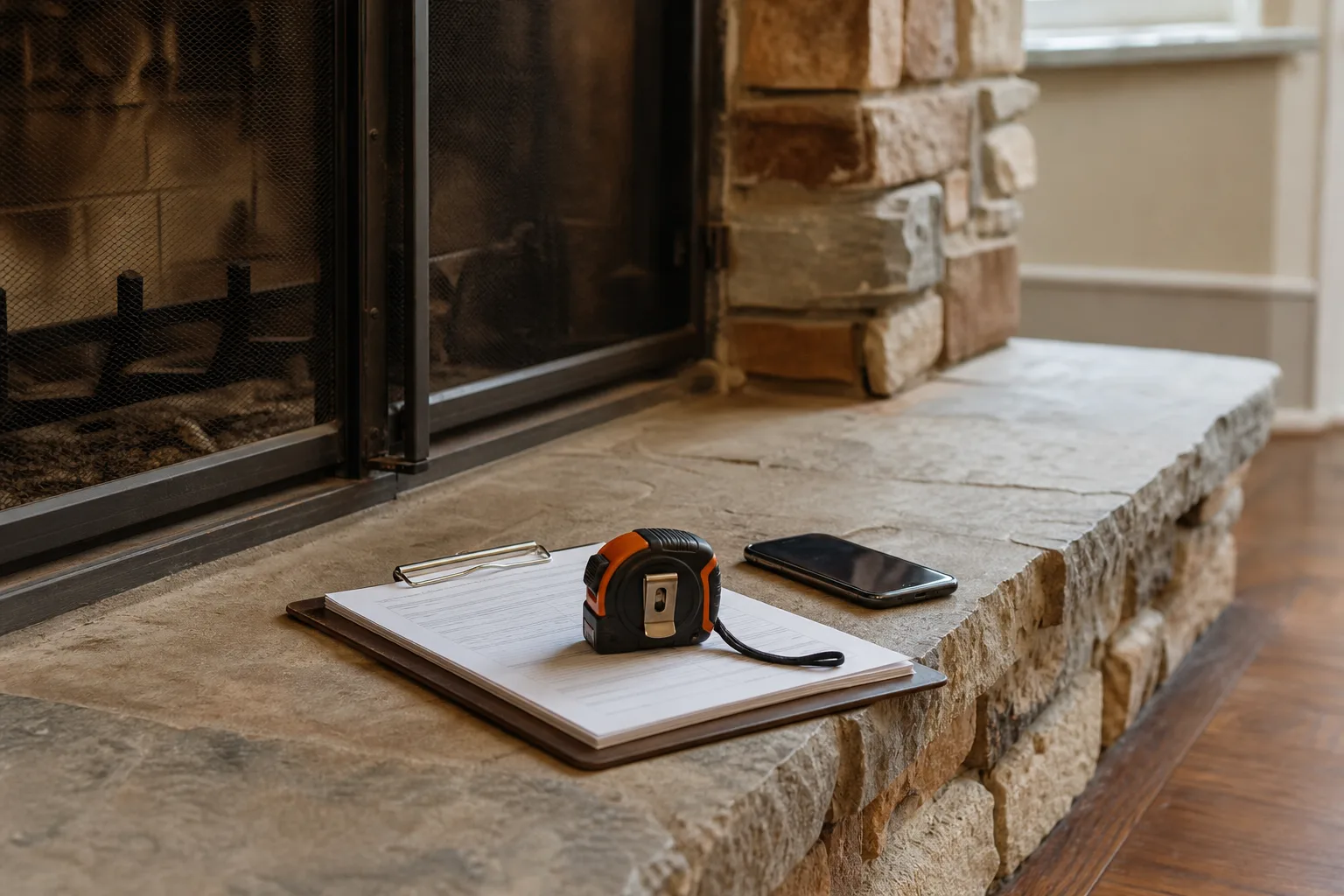
- The width and depth of the firebox opening, measured at the front
- The rough age of the house or the fireplace
- What you burn: wood, a wood insert, a vented gas log set, a vent-free set, or nothing at present
- Whether the chimney has a cap, and its condition from the ground
- Whether there has been a chimney fire, a water leak, a smoke problem, or a storm event
- Stories, roof pitch, and whether there is clear access around the house
Questions worth asking before you agree to anything
Ask whether the frame was assessed or only the plate, and what they saw. Ask which fork they recommend and why. Ask what happens to the price if the frame is worse than it looked from the hearth, since that is the usual way a small job becomes a big one. Ask whether the cap and crown were checked while somebody was up there. And ask for the estimate in writing before any work begins.
Pro tip: Take two photographs before you call. One from inside the firebox with the flash on, aimed straight up at the damper. One of the chimney top from the ground, zoomed in as far as your phone will go. Those two answer more in ten seconds than five minutes of description.
How VIO Helps With a Fireplace Damper Replacement
Here is what VIO is, plainly. VIO is a referral service. We do not employ chimney technicians and we do not send crews to houses. We match you with an independent local chimney company that works in your area and handles the kind of work you described.
For a fireplace damper replacement that matters, because the whole decision on this page turns on an in-person read of a frame neither you nor we can see from here. What you want is somebody local who will get into the firebox with a light and a mirror, look at the frame rather than the plate, check the crown and cap while they are up there, and tell you which of the two jobs your fireplace needs.
Two things about how this goes. We ask every company in the network to put its estimate in writing before any work starts, and you should insist on exactly that, from us or from anybody else you call. And before work begins, ask the company we match you with for its license and insurance details and check them yourself.
Ready to get it looked at? Tell us what your damper is doing and VIO will match you with an independent local chimney company near you. We ask every company in the network to put its estimate in writing before any work starts, and you should insist on exactly that. Ask for the company's license and insurance details and check them yourself before work begins. Call (513) 655-6702.
Symptom checker
What is your chimney doing?
Tap the closest match for an honest first answer.