



On this pageWhat fireplace refractory panels actually are7 sections+6
- What fireplace refractory panels actually are
- Why the panels crack in the first place
- The 1/16-inch rule: when fireplace refractory panels need replacing
- Four ways fireplace refractory panels fail, and only one is a crack
- Repair or replace: the honest line on refractory cement
- Replacing fireplace refractory panels without voiding your listing
- How VIO helps with fireplace refractory panels
Quick answer
Fireplace refractory panels are the molded, cement-like boards lining the back and sides of a factory-built firebox, shielding the sheet-metal shell from the fire. CSIA guidance calls for replacement when a crack is wider than 1/16 of an inch, when multiple cracks are present, or when the panel face has eroded more than a quarter inch. Stand a dime or a nickel on edge against the crack: if the coin fits, replace the panel.
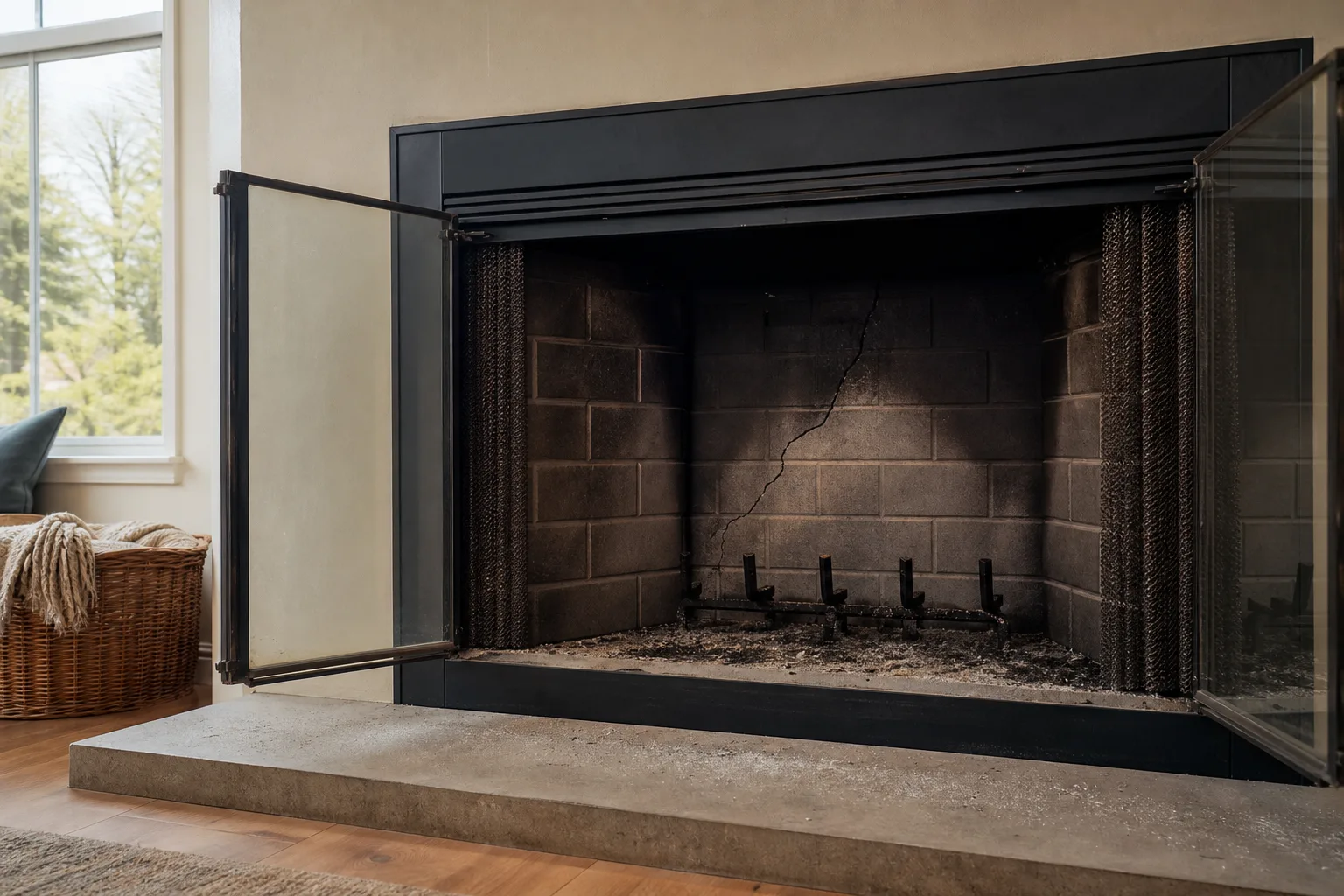
The first cold morning of the year is when most people meet their fireplace refractory panels for the first time. You open the glass doors, point a flashlight at the back of the firebox, and there it is: a dark line running down the pale grey wall that you are almost certain was not there in April.
Now you want one answer. Is that crack the kind you can live with, or the kind that means no fire until somebody fixes it?
There is a real threshold for this, and you can test it yourself in about a minute with a coin from your pocket. I will give you that test below.
But first, a warning that shapes everything else on this page: cracking is only one of four ways these panels fail, and it is the one people actually notice. The other three get missed for years.
What fireplace refractory panels actually are
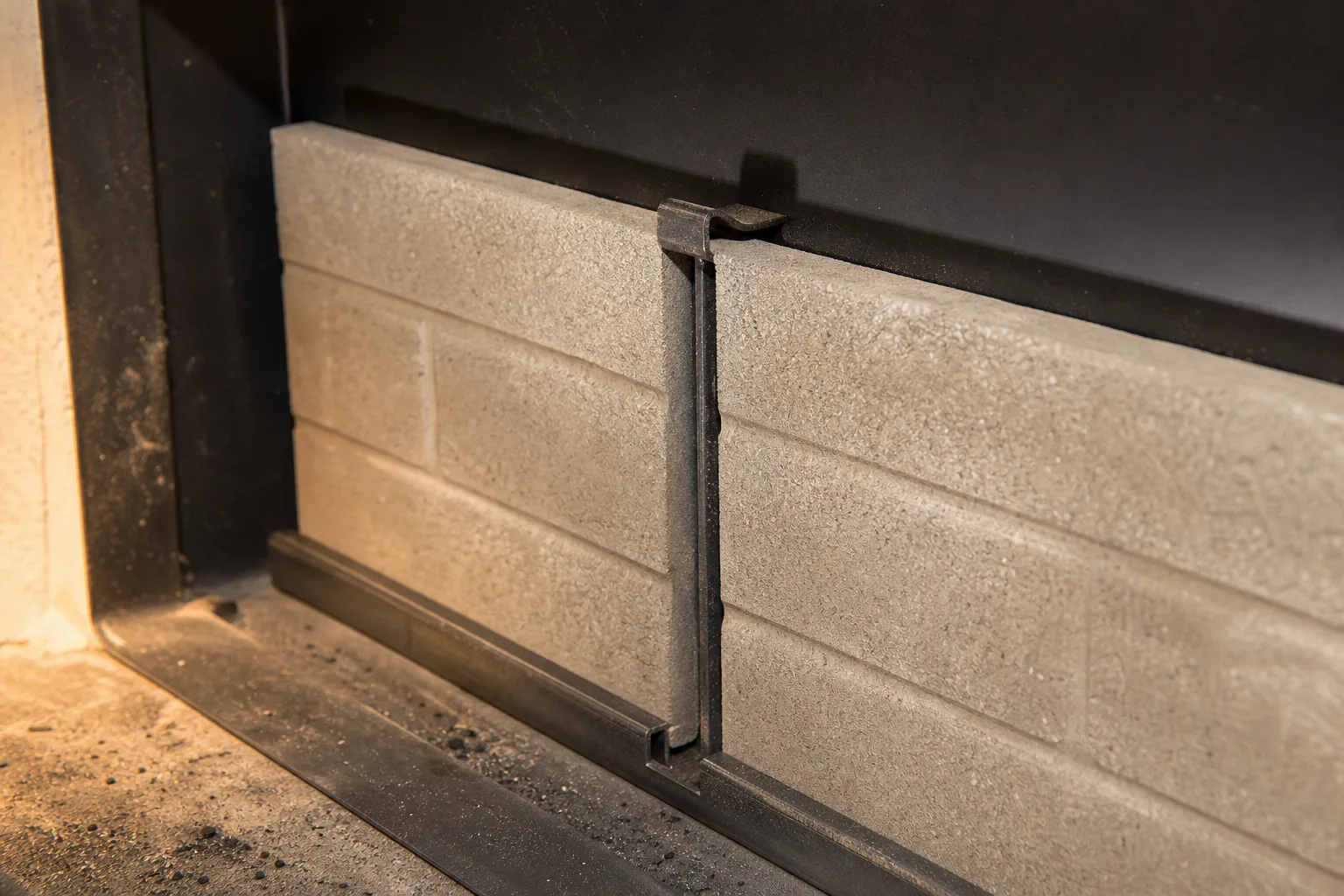
A refractory panel is a molded, cement-like board that lines the inside of a factory-built fireplace. Many factory-built fireplaces have them on the back wall and both side walls, and some have them on the floor of the firebox too.
Behind those panels is a sheet-metal shell. That is the whole point of the panel: it takes the heat of the fire so the metal box, and the wood framing around the metal box, does not.
Good to know: the panels are not decoration and they are not a liner in the chimney sense. They are the heat barrier between your fire and the sheet metal that your fireplace is actually built out of. When a panel thins or opens up, the shell starts absorbing heat it was not designed to take.
Vermiculite panels vs. refractory-type panels
Replacement panels come in two families, and knowing which one you own changes how the job goes.
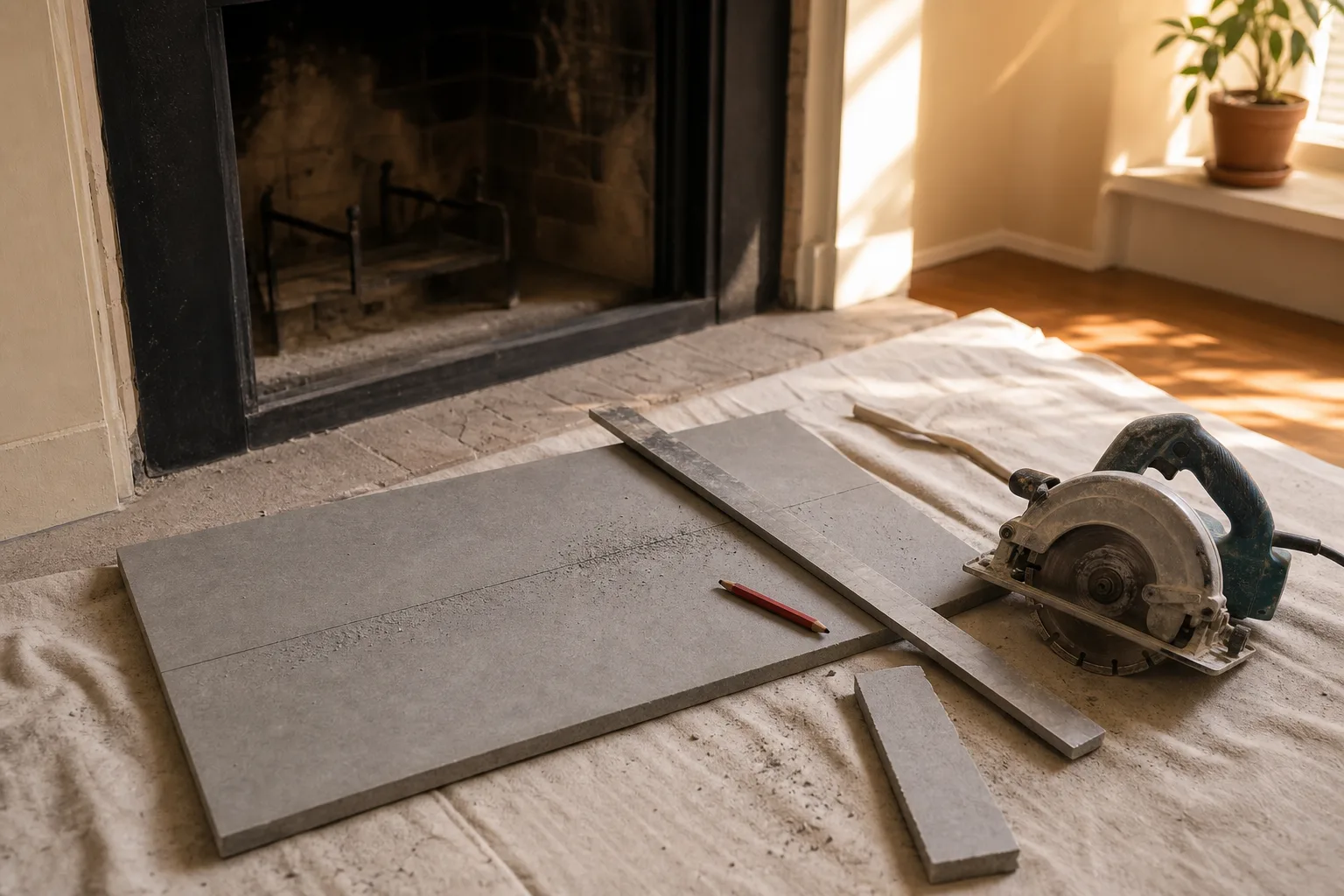
Vermiculite panels are the lighter of the two. They are pale beige, noticeably light in the hand, and soft enough that they can be cut with a circular saw, a jigsaw, or in some cases a utility knife.
Refractory-type panels, sometimes sold as firebrick panels, are denser and heavier. Cutting them takes a masonry blade.
Both are commonly about an inch thick, though some universal panels are sold at three quarters of an inch. Many are molded with a faux brick pattern, usually in a 3 by 8 or 4 by 8 course, with shallow mortar lines pressed into the face.
Panels or firebrick? How to tell in thirty seconds
This is the step almost every article skips, and it is decision number one.
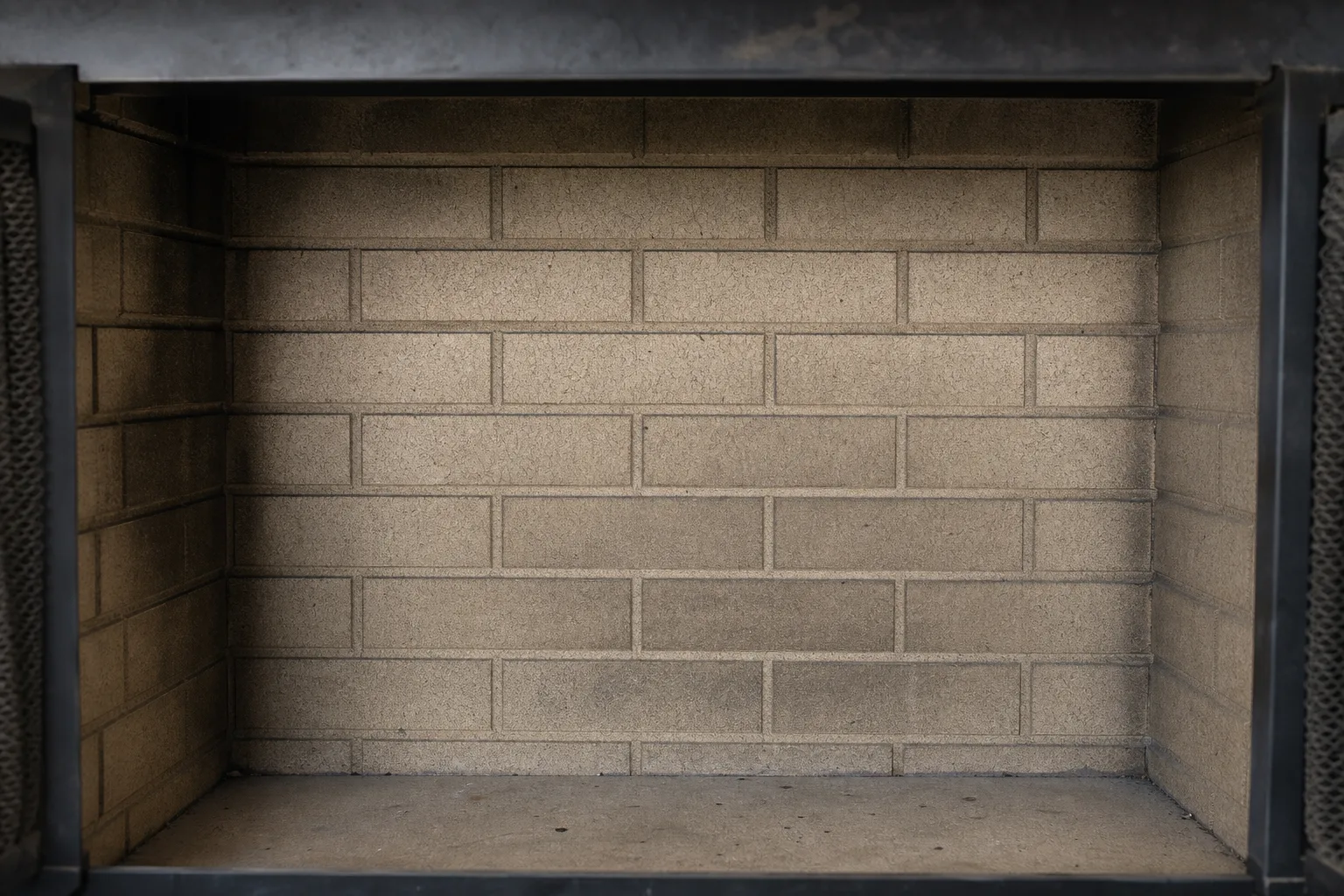
Look at the back wall of your firebox. If you see large flat slabs meeting at visible seams, with a molded brick pattern that repeats too perfectly, you have panels. If you see individually laid bricks with real mortar joints of slightly uneven width, often in a herringbone pattern, you have a masonry firebox and this article is about somebody else's fireplace.
The other tell is the shell. Reach up past the top of the opening with your flashlight. Black sheet metal means factory-built. Brick and mortar all the way up means masonry.
Masonry fireboxes are repaired brick by brick, not with fireplace refractory panels, so if that is what you have, your path starts with brick chimney repair instead.
| Molded refractory panels | Vermiculite panels | Masonry firebrick | |
|---|---|---|---|
| Found in | Many factory-built fireplaces | Many factory-built fireplaces | Site-built masonry fireplaces |
| Looks like | Flat slabs, seams, molded brick pattern | Flat slabs, pale beige, light | Individual bricks, real mortar joints |
| Typical thickness | About 1 inch | About 1 inch, some 3/4 inch | Full brick |
| Cutting | Masonry blade | Circular saw, jigsaw, sometimes a knife | Not applicable, bricks are replaced individually |
| Behind it | Sheet-metal firebox shell | Sheet-metal firebox shell | More masonry |
| Replacement rule | Match the make and model | Match the make and model | Rebuild in kind |
If you are still not sure what you are looking at, the chimney parts guide walks through the pieces of a fireplace system and where each one sits.
Why the panels crack in the first place
Refractory takes heat well. What it does not love is being heated fast, cooled fast, and heated fast again, week after week, for years.
Every fire expands the face of the panel while the back stays cooler. Every burnout contracts it again. Fine surface crazing from that cycle is normal and is not what we are talking about.
Impact is the second cause, and it is the avoidable one. A split log dropped into the back of the firebox from waist height hits the panel with real force. Do that a few hundred times and the panel tells you about it.
Water is the third and the quietest. If the chimney chase or the cap above is letting rain in, moisture reaches the firebox, soaks into the refractory, and then flashes to steam the next time you burn. That is what makes a panel spall, meaning the face flakes off in patches and leaves a paler, rougher crater behind. A leak upstream shows up as damage downstream, which is why panel damage and a bad chimney chase cover so often arrive together.
Chase that water down before you spend a dollar on panels. A rusted cap, a failed seal at the top, and worn flashing around chimney where the stack passes through the roof all end in the same place, which is moisture sitting in your firebox.
From the field: the back panel is usually the one that goes first. It sits directly behind the fire, it takes the log impacts, and it is the panel people look at least because the grate is in the way.
Age does the rest. Nobody can tell you how many years a panel lasts, because it depends entirely on how hard the fireplace has been run, and any source that gives you a number is guessing.
The 1/16-inch rule: when fireplace refractory panels need replacing
Here is the threshold you came for.
The Chimney Safety Institute of America advises replacing refractory panels when a crack is wider than 1/16 of an inch, or when there are multiple cracks present. Surface abrasion of more than a quarter inch is also a replacement condition.
That is the whole rule, and it is a width measurement. Fine surface crazing is not it. A crack measuring wider than 1/16 of an inch is, and so is a panel carrying several cracks at once.
The coin test
One sixteenth of an inch is hard to eyeball, so the trade turned it into a coin test. Take a coin, stand it on edge, and try to slide it into the crack.
If it goes in, the crack is past the threshold and the panel needs replacing.
Sources in the trade disagree slightly on which coin to use. Some say a dime, some say a nickel on end. Use either, and if the coin fits, treat it as a replacement condition rather than arguing about the coin.
Safety note: this threshold comes from CSIA guidance for the chimney trade. It is not a line in the building code and it is not out of NFPA 211, so do not let anyone tell you a code inspector will bless a wider crack. It is the trade's working standard for when a panel has stopped doing its job.
The quarter-inch erosion rule
Cracks get the attention. Thinning does not, and it is the same problem in slow motion.
Run a straightedge across the face of the back panel. If the surface has worn away, pitted, or flaked back more than about a quarter inch from where the panel face should be, that panel is done, cracked or not.
This is the failure mode that a quick glance never catches, because a worn panel looks like a dirty panel until you put something straight against it.
Not sure if that crack crosses the line? A dime-width crack is easy to argue with when you are the one holding the flashlight. If you would rather have a trained set of eyes on it before the first fire of the season, tell us your fireplace make and model and what you are seeing. VIO CHIMNEY matches you with an independent chimney company in your area that inspects factory-built fireboxes. Call (513) 655-6702 or send us the details.
Four ways fireplace refractory panels fail, and only one is a crack
Here is the loop I opened at the top. Cracking is the failure everyone sees. These are the four to actually look for, and three of them hide in plain sight.
1. Cracks past the width threshold
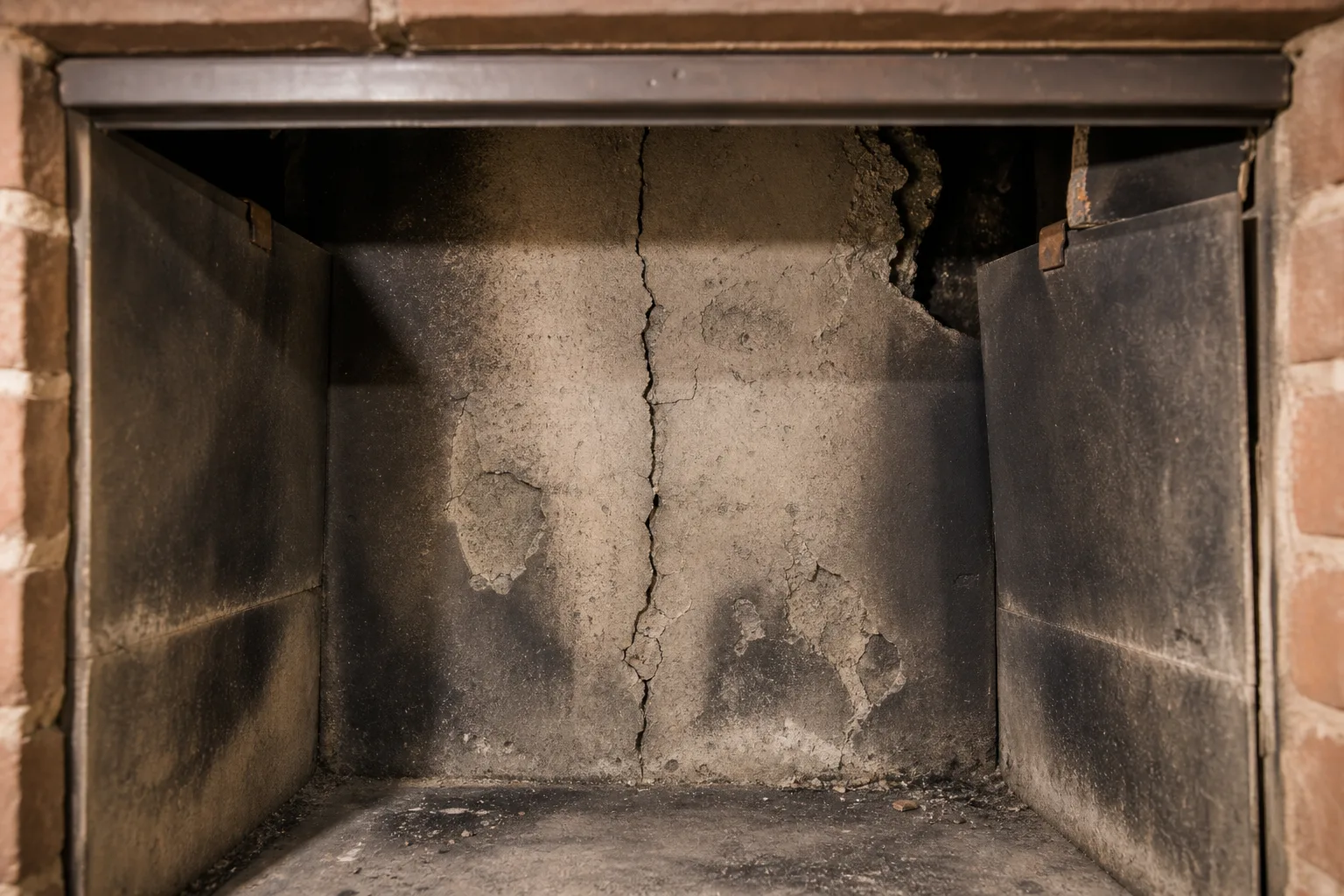
The coin test measures how wide a crack is, not how deep it goes. You cannot tell from the face of a panel whether a crack runs all the way through, and that is exactly why the trade uses width as the trigger instead.
So the rule stands on its own: a crack wider than 1/16 of an inch, or several cracks on one panel, is a replacement condition. What lies behind that crack is the sheet-metal shell, and neither you nor I can see how close the crack has come to it.
2. Spalling and erosion
The face flakes away in patches, leaving craters that are paler and rougher than the surface around them. Usually water damage, sometimes just age. Measured against the quarter-inch rule, not the coin.
3. Gaps and shifting at the seams
Look at the vertical corner where the back panel meets a side panel. That seam should be tight.
If it has opened up, or if one panel has slid out of line with its neighbor, you have a gap straight through to the shell even though neither panel is cracked.
This one gets missed constantly, because people inspect the middle of panels and not the joints between them.
4. Metal showing through
The end of the road. Any point where you can see black sheet metal through, behind, or around a panel means that part of the firebox is running unprotected. Stop burning and get it looked at before the next fire.
The five-minute firebox check. Cold fireplace, flashlight, a coin, a straightedge:
- Pull the grate and vacuum the loose ash so you can see actual surfaces. If a gas log set sits in the firebox, shut off the gas supply to the appliance first and follow the manufacturer's instructions for removing and replacing the logs, or leave that part to a qualified gas technician. A log set that goes back in the wrong position, or a burner disturbed by hand, is its own hazard.
- Run the flashlight beam across each panel at a low angle. Raking light shows cracks that straight-on light hides.
- Coin test every crack you find, back panel first.
- Straightedge across each panel face, checking for more than a quarter inch of wear.
- Press a fingertip along both vertical corner seams, feeling for gaps or misalignment.
- Look for any black metal visible through or around a panel.
- Check the floor panel if your unit has one, and the spots right behind the grate legs.
- Photograph anything you find, with the coin held against it for scale.
Do that once in September and once in March and your fireplace refractory panels will never surprise you.
Repair or replace: the honest line on refractory cement
You have seen the tubes at the hardware store. Refractory cement, refractory caulk, firebox mortar. They are cheap, they are right there, and the packaging suggests they solve this.
Sometimes they do. Often they do not, and the line between those two cases is not where the packaging puts it.
Myth vs. fact: Myth, a tube of refractory cement fixes a cracked panel. Fact, CSIA does not recommend repairing refractory panels once cracks reach that magnitude, and recommends replacing them with original manufacturer panels instead, because repairs at that scale are not dependable and leave the firebox at risk.
Where patching is reasonable
Fine surface crazing, the spiderweb of hairlines that shows up on any heated refractory, does not need anything done to it at all.
Small edge chips, shallow surface pitting, and cracks that fail the coin test, meaning the coin will not go in, are the cases where a manufacturer-approved refractory patching product, used according to its own instructions, is legitimate maintenance.
Read your owner's manual first. Some fireplace manufacturers name a specific product, and some prohibit field patching entirely.
Where patching is a band-aid
Anything the coin fits into. Anything that goes through the panel. Anything at a seam, because a seam moves and cement in a moving joint fails fast. Anything on a panel already thinned past a quarter inch.
Filling a through-crack with cement hides the symptom and does nothing about the thing that matters, which is whether there is still a full inch of intact refractory between the fire and the metal.
That is the whole argument against patching damaged fireplace refractory panels, and it has nothing to do with the quality of the cement.
Replacing fireplace refractory panels without voiding your listing
This is the part nobody tells homeowners, and it may be the most useful paragraph on this page.
A factory-built fireplace is not a pile of masonry. It is a listed appliance, tested and certified as a complete assembly under UL 127, the standard for factory-built fireplaces, currently in its 10th edition published in November 2024. Your unit was certified with its own components, panels included.
Why your fireplace refractory panels have to match the model
Trade sources are consistent here. Cracked panels should be replaced with the manufacturer's panels, and aftermarket parts, the ones sold as universal panels, non-factory parts, or cut-to-fit panels, may void the UL listing on a prefab system. Substituting non-OEM components in a UL 127 listed fireplace is described as removing that unit's code compliance.
That lands in three places. Your insurance carrier after a claim. Your buyer's home inspector when you sell. Any building official who looks at the unit after work is done.
Universal panels exist and they are sold openly. If you go that route, go knowing what you are trading away, not because a product page never mentioned it.
Finding the rating plate
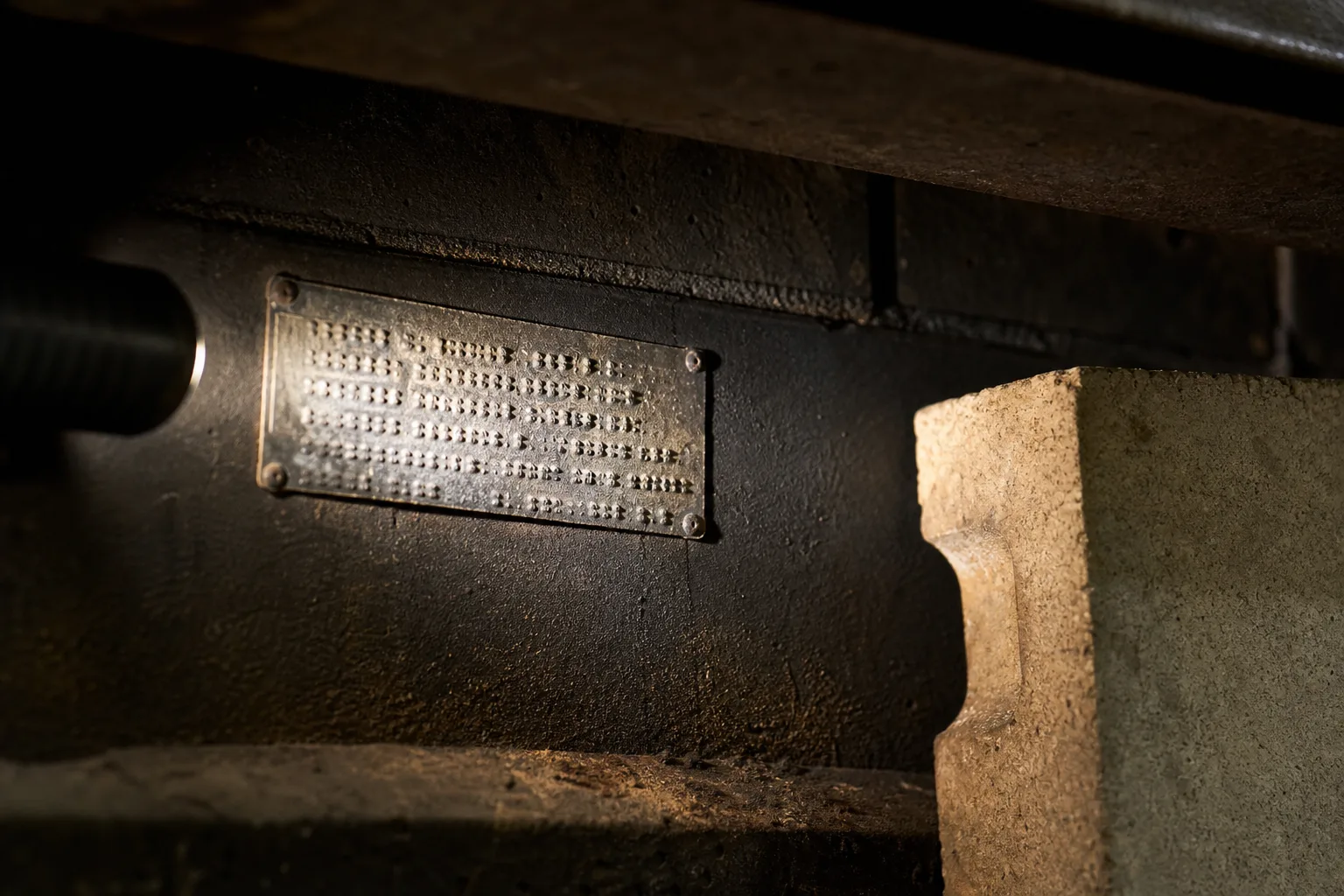
Every listed unit carries a metal rating plate. Usually inside the firebox opening near the top, on a side wall, or behind the lower grille or louver.
It gives the manufacturer, the model number, and the listing information. That model number is what makes fireplace refractory panels orderable at all. Without it you are guessing at dimensions, and panels that are close but not right leave gaps at the seams.
Pro tip: before you shop for anything, take two photos. One of the rating plate, close enough to read the model number. One of the damage, with a coin held flat against the crack for scale. Those two pictures answer most of what a supplier or a chimney company will ask you.
DIY or call someone
Cutting and setting a vermiculite panel is genuinely within reach for a careful homeowner with a saw, a vacuum, and patience.
What is not a homeowner judgment call is the assessment around it. Whether the shell behind the panel took heat damage. Whether the damper, the floor, and the surround are still sound. Whether the reason the panel spalled is a leak that is still leaking.
That assessment is why plenty of people who could physically do the swap book a chimney service visit first, and it is money well spent when the fireplace refractory panels turn out to be the visible half of a bigger problem.
Good to know: NFPA 211 calls for a Level 2 inspection on the sale or transfer of a property, on changes to the system, after a malfunction, after a chimney fire, and after an external event such as a storm or an earthquake. If you are selling, or if the damage followed a chimney fire, that inspection is coming regardless of what you decide about the panels.
How VIO helps with fireplace refractory panels
VIO CHIMNEY is a referral service, not a chimney company. We do not do the work ourselves.
What we do for this situation is short to describe. You tell us the make and model off the rating plate, roughly how old the fireplace is, and what you are seeing on the panels. We match you with an independent local chimney company that works on factory-built fireboxes, and that company inspects, quotes, and does the work. You can request service with those details in about two minutes.
We ask every company in the network to put its estimate in writing before any work starts, and you should insist on exactly that. A firebox job on a listed appliance should not begin on a verbal number.
When you talk to the pro we send, ask two things. Whether the replacement fireplace refractory panels are the manufacturer's parts for your model, and whether anyone checked the shell and the chase above for the water that may have caused the damage in the first place.
Your fireplace refractory panels are the one part of the system standing between a fire and a sheet-metal box in a wood-framed wall. A coin and five minutes is a cheap way to know where yours stand.
Get the panels looked at before you light it. Tell us your fireplace make and model, roughly how old it is, and what the panels look like. VIO CHIMNEY passes that to an independent chimney company near you that works on factory-built fireplaces. We ask every company in the network to put its estimate in writing before any work starts, and you should insist on exactly that. Call (513) 655-6702.
Symptom checker
What is your chimney doing?
Tap the closest match for an honest first answer.