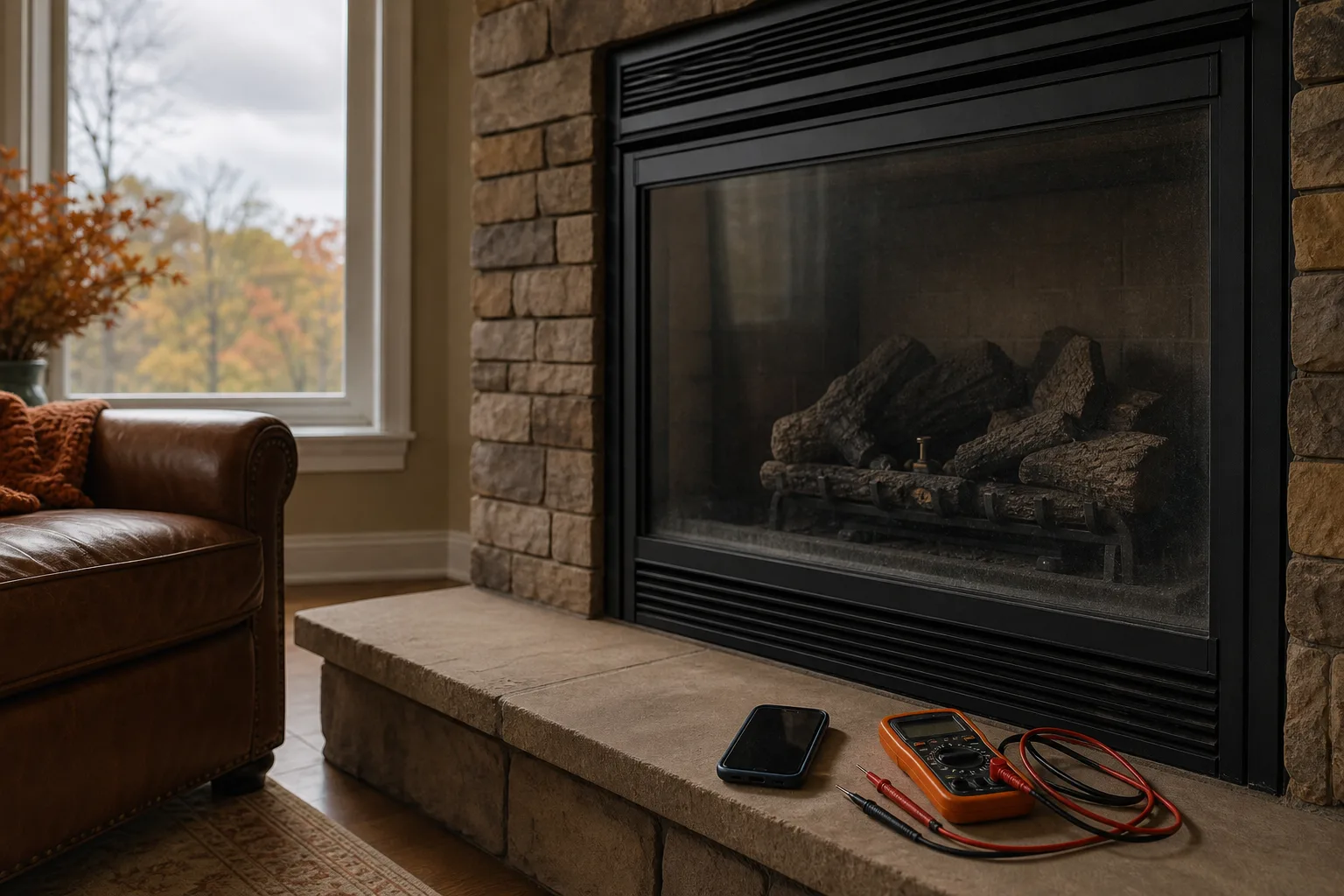




On this pageThe timing is the clue, and most advice throws it away8 sections+7
- The timing is the clue, and most advice throws it away
- First question: does your gas fireplace vent to the outside?
- Why a gas fireplace shuts off after 30 minutes and not at startup
- The thermopile test almost everybody does wrong
- The parts nobody mentions: the high-limit switch and the vent
- Where the line is: what to check and what to hand over
- How VIO helps when your gas fireplace shuts off after 30 minutes
- What to do tonight when your gas fireplace shuts off after 30 minutes
Quick answer
When a gas fireplace shuts off after 30 minutes, a condition that was not present at ignition has crossed a limit during the burn. Common causes include a thermopile whose millivolt output sags under sustained load, a high-limit switch tripping from heat buildup, a restricted vent termination, or an oxygen depletion sensor on a vent-free unit responding to room air. A delayed shutoff is a different fault from a fireplace that never stays lit.
Your fireplace lit normally. It ran, it threw real heat, and then it went dark. You relit it, and half an hour later it did the same thing again.
If your gas fireplace shuts off after 30 minutes, the most useful thing you have is the one almost every troubleshooting article throws away: the clock.
Nobody types a duration into a search box unless they watched one. That number is evidence, and it narrows the field before you touch a single part.
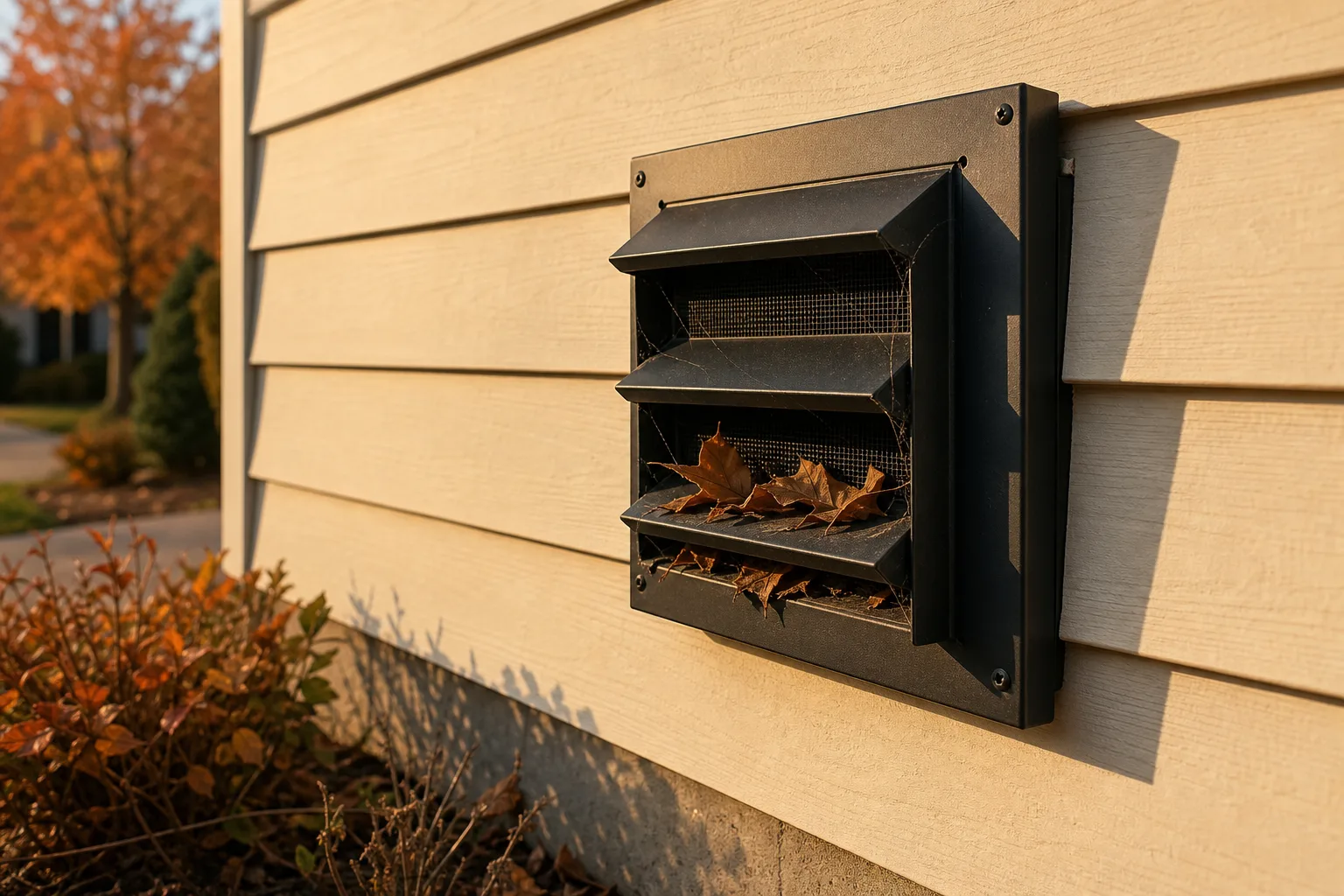
The timing is the clue, and most advice throws it away
Here is what should have been the first line of every page you opened tonight. A fireplace that will not stay lit at startup and a fireplace that runs happily for half an hour and then quits are two different problems.
The first is a pilot problem. Something is failing to prove to the gas valve that there is a flame, and it fails immediately, because that proof is required immediately. If that is closer to what you are seeing, read what to do when a gas fireplace keeps turning off right after you light it instead.
The second is not. There, the proof worked: the burner came on, the firebox heated, the room got warm.
Everything succeeded. Then something crossed a threshold.
That is the entire distinction, and it changes where you look. A delayed shutoff means hunting a condition that builds, and nothing that builds exists in the first two minutes of a burn.
There are really only four families of cause behind a delayed shutoff, and one question about your fireplace plus the number of minutes on your clock will usually get you down to one or two of them. The question comes next.
Safety note: If you smell gas, stop reading, leave the house, and call your gas utility from outside. That is a different emergency. And if there is no working carbon monoxide alarm on the same floor as the fireplace, get one before you run the unit again. An appliance that keeps shutting itself down is not proof of a carbon monoxide problem, but it is a good reason to own the alarm that would tell you.
First question: does your gas fireplace vent to the outside?
Answer this before anything else, because when a gas fireplace shuts off after 30 minutes the two answers point at different causes and different people to call.
Walk outside to the wall behind your fireplace, or look up at the roof above it. A metal cap or louvered box on the wall, or a flue at the roof, means your unit vents. Nothing out there, ceramic logs, no pipe anywhere, and you probably have a vent-free unit.
Direct vent and B-vent units
A direct vent fireplace is a sealed system. One co-axial pipe runs from the firebox to a single termination outside: the outer duct pulls combustion air in, the inner duct pushes exhaust out. The firebox never touches the air in your living room.
That shared opening is why a direct vent unit is so sensitive to a restriction out there. Block it and you degrade both halves at once.
A B-vent unit instead draws room air and exhausts up a flue. If you are not sure which you have, this walkthrough of whether gas fireplaces need a chimney sorts out the venting types. Either way, the thermopile section and the vent section below are written for you.
Vent-free units
A vent-free gas log set has no vent at all. Its exhaust goes into your room, which is legal because it burns clean enough to be certified for it and because it must carry a safety device vented units do not have.
That device is an oxygen depletion sensor, the ODS pilot. Every vent-free set certified to ANSI Z21.11.2 has one, and its job is to shut the burner off before room oxygen drops below roughly 18 percent, against a normal reading near 20.9 percent.
It works by geometry: the pilot flame physically lifts away from the sensor as oxygen falls, the millivolt signal dies, the valve closes. Hold onto that, because it produces a shutdown that looks exactly like a malfunction and is not one.
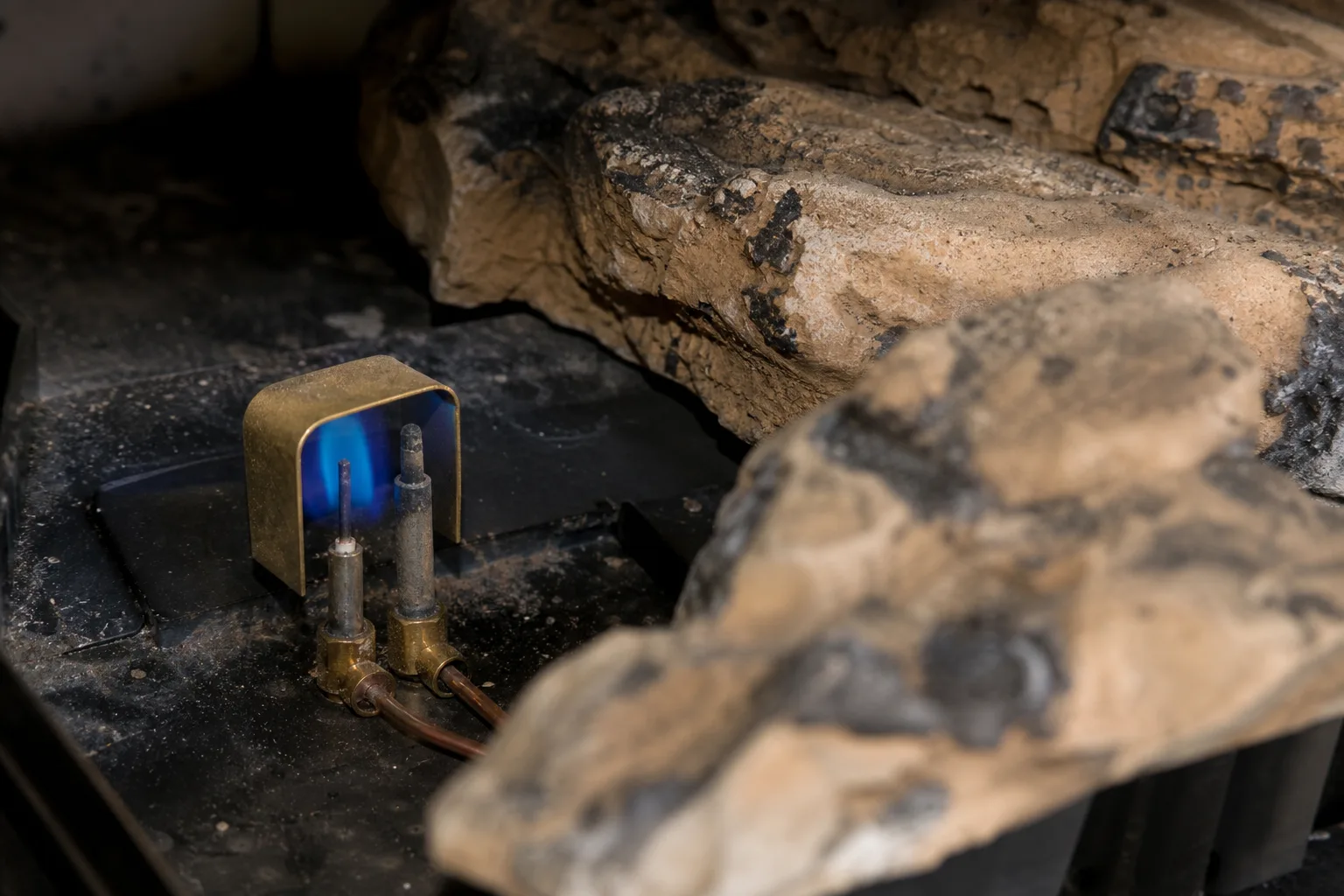
Why a gas fireplace shuts off after 30 minutes and not at startup
A delayed shutoff points at a condition that develops while the unit runs rather than one present at ignition. How long that takes varies by unit, by fault and by room, and the table further down shows how wide those ranges are, so treat "about thirty minutes" as your own observation rather than a rule.
The four families of delayed shutoff
A voltage that sags. On a millivolt system the pilot flame generates the electricity that holds the main gas valve open, and that output is not constant. It can be healthy at ignition and fall as the assembly heats and the burner draws on it. Past the valve's holding threshold, the valve closes. This is a leading suspect when a gas fireplace shuts off after 30 minutes, and it is the one section four shows you how to test.
Heat that accumulates. A high-limit switch cuts the unit when the cabinet runs hotter than design, and half an hour at full output is exactly when it speaks up.
Air that cannot move. A restricted vent starves combustion. Early in a burn there is margin to get away with it. Thirty minutes in, there is not.
A room that has changed. Vent-free only. See below.
When a gas fireplace shuts off after 30 minutes on a vent-free unit
If you have a vent-free set, put this at the top of your list.
An ODS trip depends on room volume and air exchange, which is exactly why it presents as a delayed shutoff. A small den with the door closed reaches the trip point; the same set in an open great room may never get there. Nobody can tell you how many minutes that takes in your room, and any page giving you a number is guessing.
So the first test is behavioral, not electrical. Run it again with the room door open and a window cracked an inch. If it runs noticeably longer, or does not quit at all, room air is likely part of the picture.
Likely, not proven. A contaminated ODS pilot, a flame sitting wrong on the sensor, or an adjustment that has drifted can produce similar behavior, and so can other faults, which is why a vent-free set that keeps shutting down still deserves a look from someone who services them.
What it does not mean is that anything should be bypassed. If the room genuinely needs more air, or the set is oversized for the space, those are the things to fix.
Myth vs. fact: Many people arrive here half-convinced their fireplace has a built-in thirty minute safety timer. There is no standard thirty minute timer in residential gas fireplaces. What does exist is an optional timer function on some remotes, wall controls and thermostats, and on some commercial units. Check your own remote and its manual, because if you find a timer setting this whole article is moot. But do not assume one is there by default. If nobody set a timer, nothing is counting down.
Here is the whole field on one page.
| What failed | Typical runtime before shutoff | What you notice | Can you check it yourself |
|---|---|---|---|
| Thermopile output sagging under load | 5 to 45 minutes, often inconsistent | Burner dies, pilot may also drop, sometimes a faint click | Yes, with a multimeter, two readings |
| High-limit switch tripping | 20 to 60 minutes, fairly repeatable | Dies at about the same time every burn, cabinet very hot, blower may be silent | Partly, you can check louvers and blower |
| Restricted vent termination | 15 to 45 minutes | Lazy or yellow-tipping flame late in the burn, sooting on glass | Yes, visually, from outside |
| ODS pilot trip, vent-free only | Varies widely with room size | Only happens in a closed room, fine with a window open | Yes, behaviorally |
| Loose or dirty thermopile connection | Anywhere from seconds to an hour, erratic | Random, sometimes triggered by a bump or vibration | Visually yes, repairs no |
| Gas valve or supply pressure fault | Inconsistent | Other gas appliances may also act up | No, this one is a pro call |
Two rows in that table are yours. The rest belong to someone with a manometer and a license, which is where gas fireplace repair starts and homeowner troubleshooting stops.
The thermopile test almost everybody does wrong
This section is the reason this page exists. The standard advice is to put a multimeter on the thermopile and compare the reading to a threshold. That is not wrong, it is just incomplete in the one way that matters when a gas fireplace shuts off after 30 minutes.
Thermocouple versus thermopile
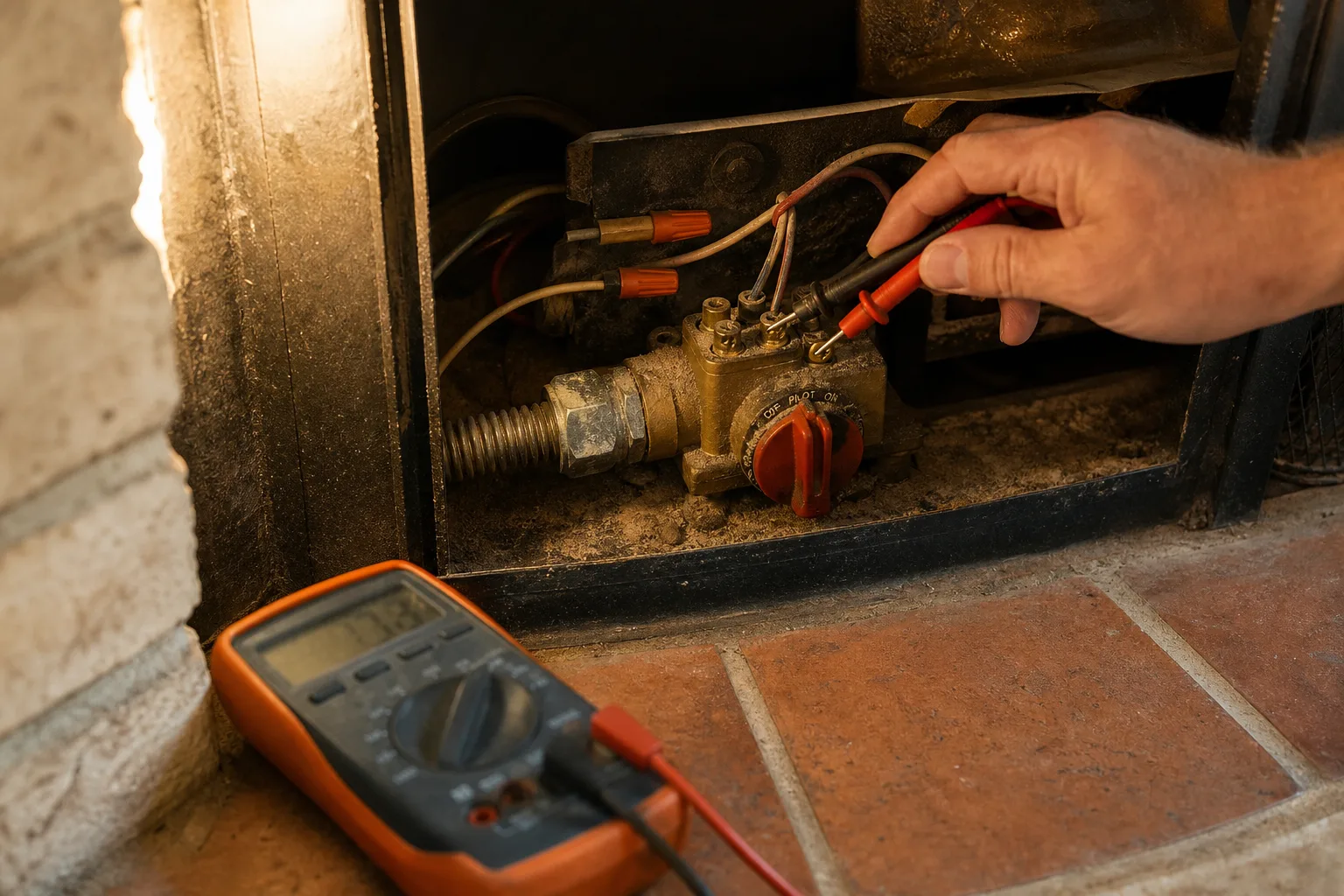
Open the lower panel below your firebox and find the gas valve: a cast brass or aluminum block about the size of your fist, with a knob marked OFF, PILOT and ON. Two thin wires land on small terminal screws there, and they come from two different parts sitting in your pilot flame.
The thermocouple is the thinner rod, about an eighth of an inch. It makes 25 to 30 millivolts and its entire job is proving the pilot is lit. If it fails, you lose the pilot immediately.
The thermopile is the thicker rod, about three sixteenths. It is a stack of junctions making hundreds of millivolts, and it powers the main valve and your wall switch. If it weakens, you lose the main burner while the pilot stays put.
Read that last sentence again, because it is the whole diagnosis. A weakening thermopile produces a fireplace that lights fine and then loses its fire.
From the field: This symptom gets misdiagnosed as a thermocouple again and again. The two parts sit side by side in the same flame, they look nearly identical to anyone who has not handled both, and only one of them is famous. Somebody reads "replace the thermocouple," buys it, installs it carefully, and nothing changes, because the failing part was the one next to it.
Taking two readings twenty minutes apart
Here is the part nobody publishes.
Set your multimeter to DC millivolts and read the thermopile with only the pilot lit. Write the number down with the time beside it. Then turn the fireplace on, let it run, and read it again at fifteen or twenty minutes with the burner going.
You are not looking for a number. You are looking for a slope.
A publicly logged case on a hearth industry forum shows the pattern on a direct vent unit: 455 to 470 millivolts on pilot only, which looks perfectly acceptable. At burner startup, 140 to 183. After five to twenty minutes, 45 to 113, then shutdown. A single cold reading would have cleared that thermopile.
What the numbers mean
Treat these as typical service targets, not gospel. Check your own manual, because specs differ by valve and model and sources disagree on the under-load floor.
One point of caution before the numbers, because it is easy to compare unlike things. The widely published 325 millivolt minimum is an OPEN CIRCUIT figure, meaning the thermopile measured with its leads off the valve. That is a technician's measurement, not something to attempt with the leads connected, and a pilot-only reading taken at the terminals is not the same thing.
So published millivolt valve documentation calls for at least 325 millivolts open circuit, with a healthy thermopile often quoted at 650 to 850 open circuit. Under load, service literature points at roughly 325 as the target and near 110 as the bare floor for holding the main burner on. Those are the figures the tech will work against.
What YOU are after is the slope between your own two readings, taken the same way at the same terminals. A reading that looks healthy on pilot and then collapses while the burner runs is the signature of a gas fireplace that shuts off after 30 minutes, and that comparison holds even if neither of your numbers lines up with a published spec.
While the panel is open, check two more things. Is the pilot flame blue, steady, and actually wrapping both rod tips? A flame that has drifted off the thermopile starves it no matter how good the part is.
And are the wire connections tight at the valve? In that same forum case, bumping the thermopile lead shut the unit down on the spot.
Pro tip: Write both readings down with clock times beside them, plus how many minutes the unit ran. Two numbers and a duration tell a gas fireplace tech more in ten seconds than a paragraph of description does.
Not comfortable pulling the panel, or the readings came back low? That is the normal answer on a gas appliance, not a failure of nerve. VIO passes your situation to an independent local company that services gas fireplaces and works on millivolt systems, rather than a general handyman. Mention your runtime numbers when you call; they shorten the visit. Call (513) 655-6702 or send the details through our service request form.
The parts nobody mentions: the high-limit switch and the vent
If the thermopile checks out, these two are next. Neither appears on most of the pages answering why a gas fireplace shuts off after 30 minutes, which is strange, because one of them exists purely to shut an appliance down after it has been running hot for a while.
The high-limit switch
Somewhere on the top plate of your firebox or near the convection plenum sits a switch about the diameter of a quarter, with two wires on it. It looks like nothing. It has veto power over the whole appliance.
Its only function is to cut the unit when the cabinet runs hotter than design. So a fireplace that dies at close to the same time every burn, with a very hot cabinet and a silent blower, is describing a limit switch almost word for word.
Check that the louvers above and below the firebox are clear, that nothing is stacked against the cabinet, and that the blower spins up once the unit is hot. A dead blower removes the airflow the design counts on, and the switch does what it was installed to do.
What you should not do is bypass it. That switch is the reason the wall behind your fireplace is not a problem.
A restricted vent termination
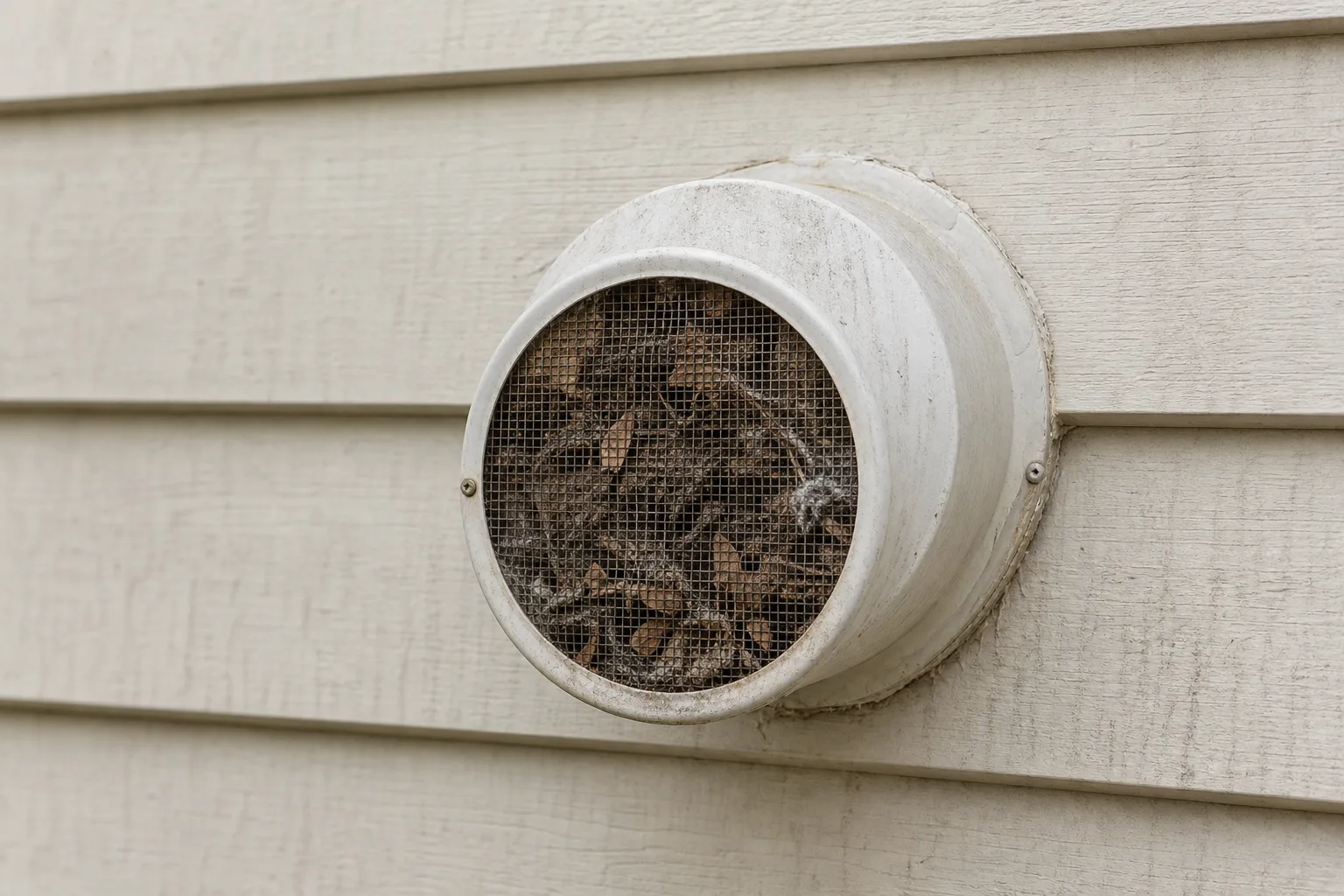
Go look at your termination from outside: the box or cap on the exterior wall, a foot or two across, factory-painted flat black or brown, louvered or screened.
Now look at the bottom of it, where things collect.
Good to know: Heating season opens with a wave of exactly this complaint. A unit idle from spring until now often has summer dust on the burner and sensors, spider webbing in the pilot orifice (the orifice is tiny, and this one is common), and leaf litter or wasp nest material packed into the bottom louvers of a horizontal termination. First fire of the season is when all of it announces itself.
Most of that is what an annual gas fireplace service visit exists to catch before the first cold night.
A season of routine gas fireplace maintenance also asks less of you than a season of relighting.
A restriction here is a slow squeeze, not a hard stop. The burn starts fine, then combustion air falls short, the flame goes lazy and tips yellow, and soot films the glass.
Clearing leaves and cobwebs off the outside of a termination is homeowner work. Anything inside the vent run, or a termination that looks crushed, disconnected or wrongly sized, is not.
Where the line is: what to check and what to hand over
You deserve a straight answer, not a disclaimer buried at the bottom. When a gas fireplace shuts off after 30 minutes, some of the useful diagnostic work is safe for a homeowner and some is not. The line is whether you are touching gas under pressure.
Safe to check yourself
Start by filling this in, because it is the most valuable thing you can produce tonight:
- Attempt 1: minutes it ran, and what the pilot did when the burner quit (stayed lit, or went out too).
- Attempt 2: same two notes.
- Attempt 3: same two notes, this time with the room door open and a window cracked.
Then work through the rest:
- Is a timer set on the remote, wall control or thermostat?
- Is the pilot flame blue, steady, and touching both sensor rods?
- Are the thermopile wires tight at the valve terminals?
- Are the louvers clear, and does the blower spin up when hot?
- Is the outside termination clear of leaves, webs and nesting material?
- Are the ceramic logs in factory position, none leaning into the pilot?
- Two thermopile readings, cold and at twenty minutes, written down.
Stop and call someone
Everything on this side touches the gas train, the valve, or the vent interior: measuring or adjusting supply pressure, replacing a thermopile or pilot assembly, servicing the gas valve, cleaning burner ports, adjusting an ODS pilot, and any work inside the vent run.
Safety note: Never adjust the gas valve, the regulator, or supply pressure yourself, and never bypass a limit switch or an ODS pilot to keep a fireplace running. Those parts are the appliance's judgment about its own safety. Defeating one converts an inconvenience into a hazard.
Worth knowing while you decide: NFPA 211, the national standard for chimneys, fireplaces and vents, treats a malfunction as one of the triggers for a Level 2 chimney inspection, and a fireplace that keeps shutting itself down is a malfunction by any reasonable reading.
How VIO helps when your gas fireplace shuts off after 30 minutes
Plainly: VIO is a referral service, not a repair company. We employ no technicians and send no crews of our own, because we have none. We match you with an independent local company that works on gas fireplaces, and the company at your door works for itself.
Here the matching matters more than usual. A gas fireplace shuts off after 30 minutes for reasons living inside a millivolt control system, a narrower skill than general fireplace work. We pass along your symptom and your runtime numbers, so whoever arrives knows they are walking into a delayed-shutoff diagnosis with a multimeter in hand.
On money: we ask every company in the network to put its estimate in writing before any work starts, and you should insist on exactly that. If someone wants to begin without one, that is your signal. It also helps to know roughly what gas fireplace repair tends to cost before the conversation starts.
What to do tonight when your gas fireplace shuts off after 30 minutes
You are in one of two situations, and the runtime log tells you which.
If the shutoff time moves around and the millivolt reading falls while the unit runs, you are looking at a thermopile, a connection, or the valve it feeds. If your gas fireplace shuts off after 30 minutes at almost the same moment every burn, look at heat and airflow first: the limit switch, the blower, the louvers, the termination.
And if you have a vent-free set that behaves perfectly with a window open, the appliance already answered you.
Either way, stop relighting it to see what happens.
The clock did most of the diagnostic work for you. Write the numbers down and hand them to someone who can finish it.
Ready to get it looked at? A gas fireplace shutting itself down repeatedly is a malfunction, and under NFPA 211 a malfunction is one of the triggers for a Level 2 inspection. VIO will match you with an independent local company that services gas fireplaces in your area, and your runtime log gives them a head start. Call (513) 655-6702 or tell us what your fireplace is doing.
Symptom checker
What is your chimney doing?
Tap the closest match for an honest first answer.