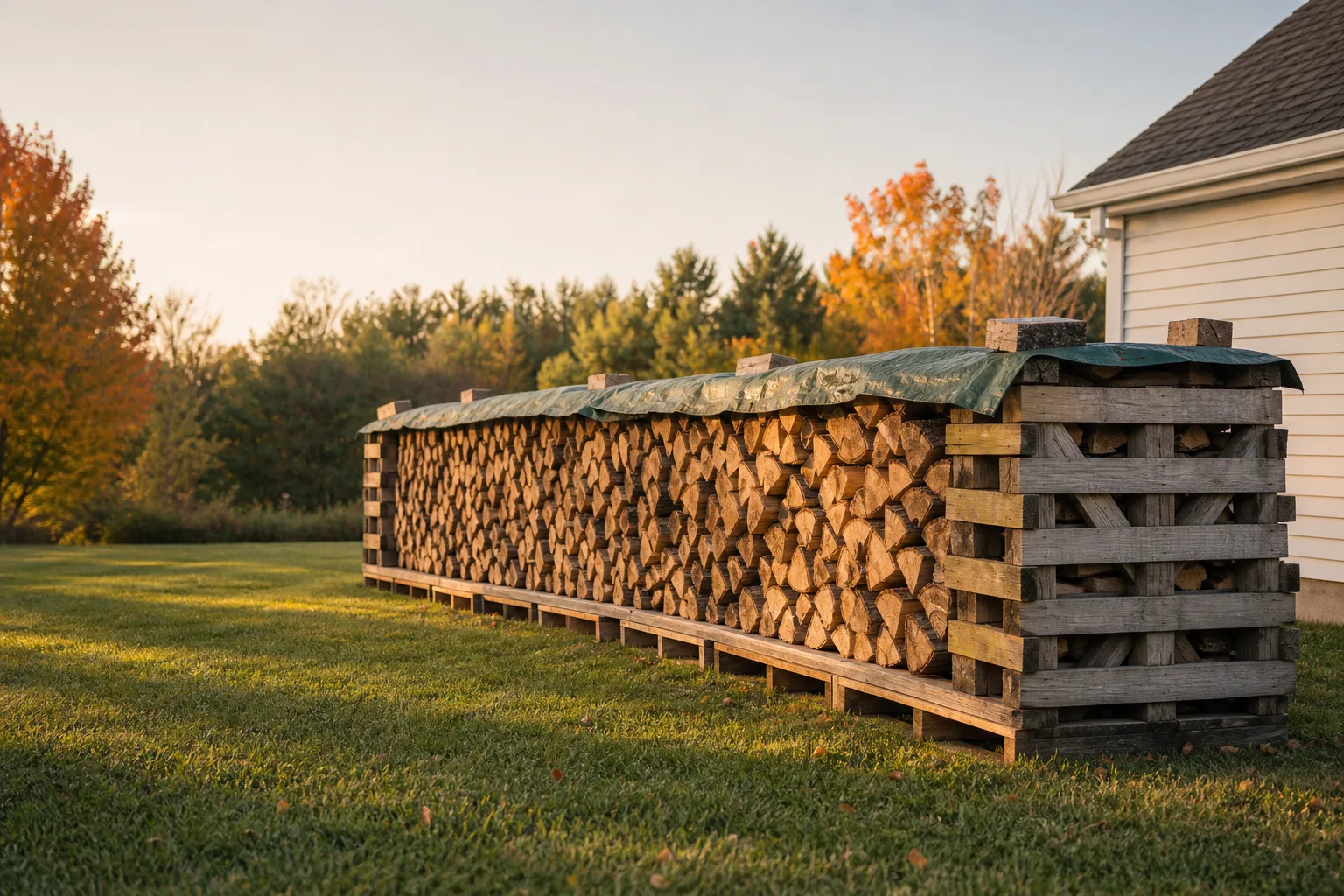




On this pageHow to Season Firewood: The Six Steps, In Order7 sections+6
- How to Season Firewood: The Six Steps, In Order
- How Long Seasoning Takes, Species by Species
- What Burning Wet Wood Does to Your Chimney
- How to Tell When Your Firewood Is Actually Dry
- How to Season Firewood Fast When You Are Already Behind
- Storage, Pests, and the Mistakes That Ruin a Good Stack
- How VIO Helps When the Wood Was Not Dry
Quick answer
How to season firewood: cut it to stove length, split it into pieces four to six inches across, and stack it one row deep on pallets with the top covered and all four sides open to the wind. Softwood needs at least six months, hardwood at least a year. It is ready when a moisture meter reads under 20 percent on a freshly split face.
Here is the part nobody tells you when you go looking for how to season firewood: this is a calendar problem before it is a technique problem. Wood you split this week is committed to a date, and that date is mostly out of your hands.
Cut a red oak in September and it will not be ready for a good fire in December. It will not be ready in February either.
That sounds discouraging. It is the most useful thing on this page, because once you know the real timeline you stop guessing and start planning. And if your wood is already behind, there is a way through this winter, in the triage section further down.
The rest of this guide is how to season firewood as a process: what to do with a log, in what order, and how to prove the wood is dry instead of hoping it is.
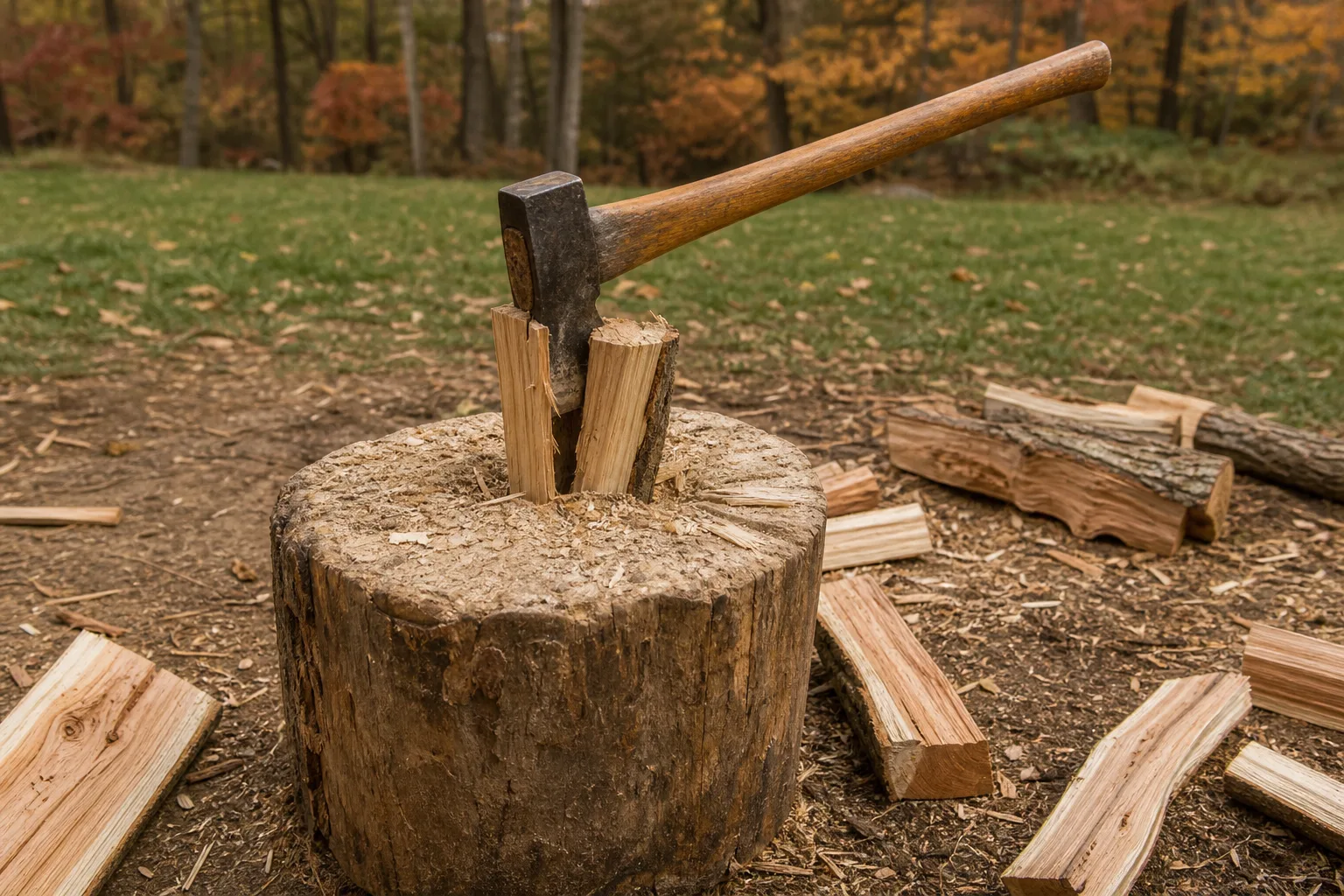
How to Season Firewood: The Six Steps, In Order
Every step in how to season firewood exists to do one thing, which is to get water out of wood. Roughly half the weight of a freshly felled tree is water.
Cut to length before you do anything else
Sixteen inches is the working default in North America. Measure your firebox before you commit a whole tree to a length, because an inch too long means every piece goes back on the saw, usually in January.
Cut ends are where water leaves fastest. A long log has very little end for its volume, which is exactly why rounds sitting in a pile do not dry.
Split it, and split it smaller than feels necessary
This is the step people skip, and skipping it is why a pile can sit for two years and still be wet inside.
An unsplit round is wrapped in bark, and bark is the tree's own weatherproofing. It works just as well after the tree is down. Split the round and you open the wet interior to air on two or three faces at once.
Aim for four to six inches across the wide face. If you are behind schedule, go smaller. A three inch split dries meaningfully faster than a six inch one, and you can always burn small.
Get the stack off the ground
Bare soil pushes moisture up into the bottom course all year. Those pieces stay wet, then they rot, and you lose them.
Pallets are the cheap answer and they are everywhere. Two parallel pressure treated 4x4s work. A steel rack works. What matters is air underneath.
Stack for air, not for looks
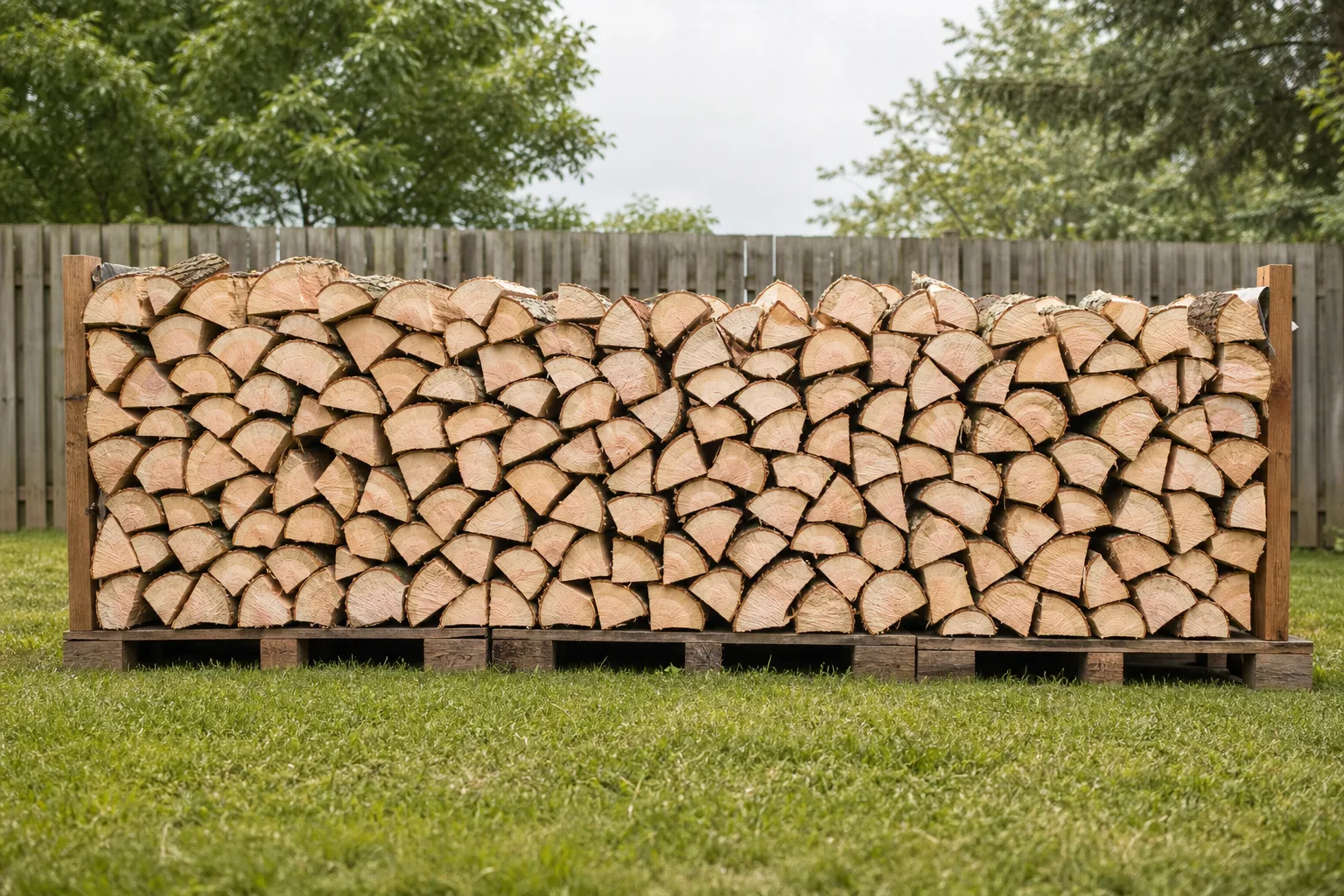
One row deep. That is the rule that matters most and the one most people break.
A single row exposes both faces of every piece to moving air. Stack two or three rows tight against each other and you have built an insulated block with a wet core.
Orient the row broadside to the prevailing wind and put it where it gets sun. Wind does more of the drying than sun does, though you want both.
Pro tip: Instead of driving posts at the ends of a row, crib the ends. Lay four or five pieces flat one way, then the next course crosswise on top, alternating up like a log cabin corner. The ends hold themselves, they let air through, and they will still be standing in March when a post has heaved out of the ground.
Cover the top, leave the sides wide open
The EPA's own instruction for firewood is to split, stack, cover and store it. That word "cover" gets misread constantly.
Cover means the top. A tarp over the top, weighted with a few splits or a couple of cinder blocks, is doing the whole job.
A tarp pulled down over the sides and staked to the ground is worse than no tarp at all. You have built a greenhouse. Ground moisture rises, sun heats the tarp, and the water that evaporates off the wood condenses right back onto it because it has nowhere to go.
Leave all four sides open. A sheet of corrugated metal across the top of the row beats a tarp and lasts longer.
Write the date on the stack
Two years from now you will not remember which row is which. Nobody does.
A scrap of board with a month and a year on it, wired to the end of the row, settles every argument you will have with yourself about whether the oak is ready. Write the species on it too.
How Long Seasoning Takes, Species by Species
The question underneath how to season firewood is always the same one. How long?
The EPA's guidance is the honest baseline: at least six months for softwood, at least a full year for hardwood. That is the floor, not the finish line. Density drives the number, because dense wood holds more water in a tighter structure and gives it up slowly.
| Wood | Roughly how long to season | Heat per cord | Notes |
|---|---|---|---|
| Pine, spruce, fir | 6 months | Low | Splits easily, lights fast, burns quick |
| Poplar, cottonwood, willow | 12 months | Low | Light hardwoods, shoulder season wood |
| Ash | 12 months | High | Starts drier than most, splits clean, forgiving |
| Birch | 12 months | Medium-high | Split the bark or it holds water in |
| Soft maple, box elder | 12 months | Medium | Decent, unremarkable |
| Cherry | 12 months | Medium | Smells better than it heats |
| Sugar maple | 12 to 18 months | High | Excellent stove wood |
| Beech | 12 to 18 months | High | Slow to dry, worth the wait |
| Red oak | 12 to 24 months | Very high | Easy to mistake for seasoned before it is |
| White oak | 18 to 24 months | Very high | Dense enough that two years is realistic |
| Hickory | 12 to 24 months | Very high | Long burning, hard to split |
| Black locust | 12 to 18 months | Very high | Rot resistant, stringy to split, superb heat |
| Elm | 12 to 24 months | Medium | Splits like rope, more trouble than it returns |
Those windows assume you did the six steps. Rounds left in a heap under a tree fit none of them.
The fast woods
Softwoods are the only category with a genuinely short clock. Pine, spruce and fir sit at the EPA's six month minimum, which is half what any hardwood asks for.
Ash still deserves its reputation among the hardwoods. It comes off the stump at a lower moisture content than most of them and it splits clean, so it tends to arrive at the one year mark in better shape than beech or oak.
Softwoods carry less heat per volume, and that difference is real. A cord of oak carries close to twice the heat of a cord of pine, and the gap shows up most clearly in a high efficiency wood stove, which is engineered around fuel that is genuinely dry.
Good to know: A full cord is a stacked pile 4 feet high, 4 feet wide and 8 feet long, which is 128 cubic feet. A "face cord" or a "rick" is one row of that stack, and its volume depends entirely on how long the pieces are. When someone quotes you a face cord, ask for the piece length before anything else.
The slow woods
Oak, hickory, beech and locust are the wood you want in a stove at two in the morning in February. They are also the wood that punishes impatience.
Red oak is the classic trap. It is heavy, it feels substantial, it looks seasoned by the end of one summer, and inside it is still wet. Plan on two years, give it its own row, and be pleasantly surprised.
Reading the calendar backward from your first fire
Work from the fire, not from the woodpile.
Pick the date you want to light the first fire of next season. Count back twelve months for hardwood and six for softwood. That is your split-and-stack deadline, and it is almost always earlier than feels reasonable.
For most of the country that means next winter's wood should be stacked by this coming spring, so that it has the warm months in front of it. Warm, dry, moving air is what drives water out of wood, which is why a stack wants to go up before summer rather than partway through it.
Which is the other half of the problem: it is September now. Wood split this month gets a few good drying weeks and then the weather closes in.
What Burning Wet Wood Does to Your Chimney
This is the part of how to season firewood that gets left out of most guides, and it is the part that costs money.
Where all that water actually goes
Water in a log has to be evaporated, and the energy for that comes out of the fire itself. Evaporation and combustion happen at the same time, so the fire is not stopped by the water, it is cooled by it.
So the firebox runs cooler. You feel it as a fire that will not take hold, glass that sooties over in twenty minutes, and a stove that never quite heats the room.
How creosote builds in the flue
Wood does not burn as a solid. Heat drives gases out of it, and those gases are what you see as flame. Burn them hot enough and they oxidize completely.
Above roughly 20 percent moisture content, flame temperature in a residential stove is not high enough to finish that job. Partially combusted gases, including carbon monoxide and a family of compounds called polycyclic aromatic hydrocarbons, leave the firebox unburned.
They travel up a flue that is now cooler than it should be, cool further, and condense on the flue wall as creosote.
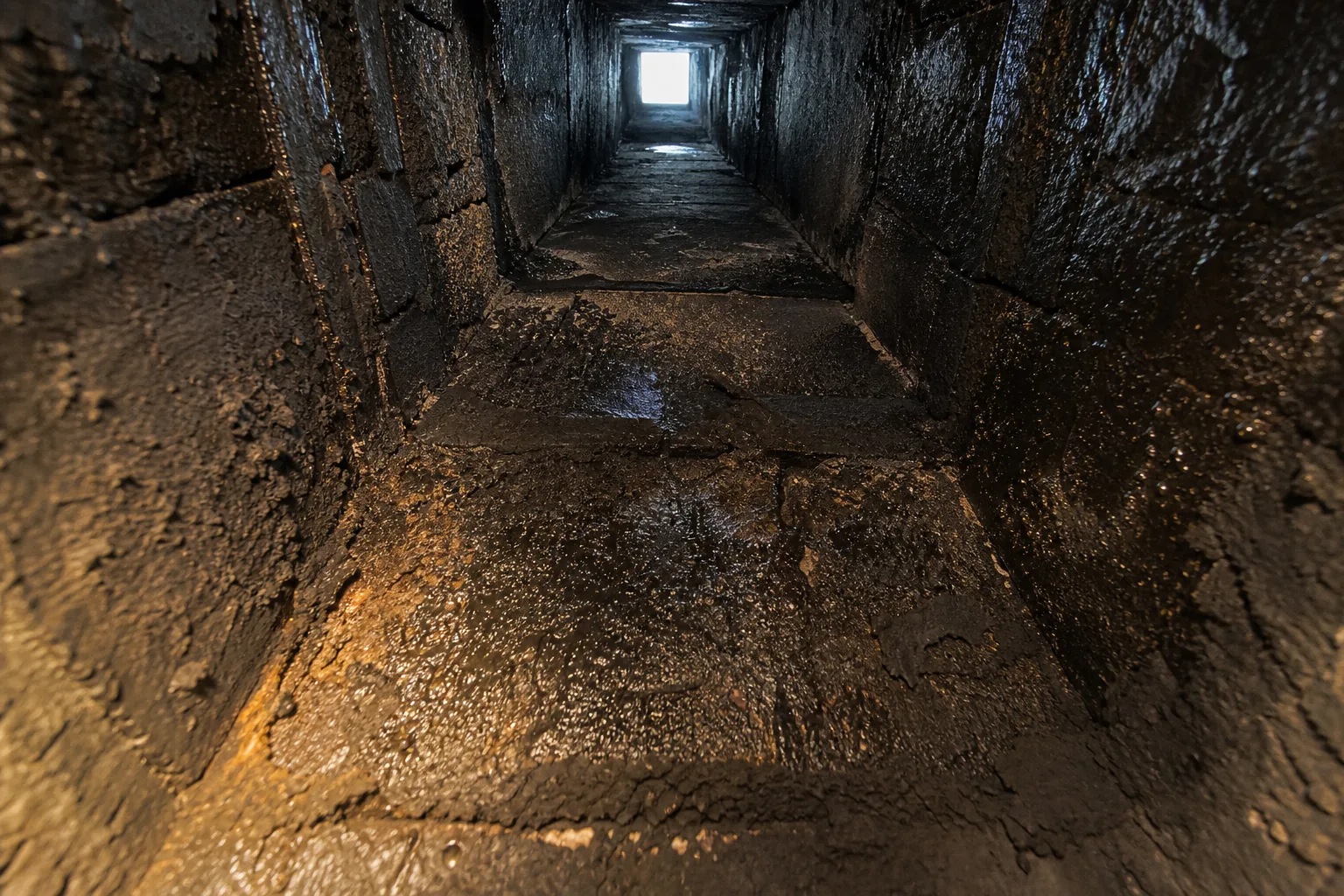
Creosote starts as a light flaky soot. Left to build, it hardens, and in its worst form it glazes into a black tarry coating that is itself fuel and that resists the brushes ordinary chimney cleaning services run.
That is the chain. Wet wood, cool fire, unburned gases, cool flue, deposits. None of it is dramatic. It just accumulates.
Safety note: Creosote is the fuel a chimney fire runs on, which is why fuel moisture is a safety question and not only an efficiency one. Separately, NFPA 211 calls for a Level 2 inspection at specific triggers: sale or transfer of the property, changes to the system, a malfunction, a chimney fire, or an external event such as a severe storm or an earthquake. Seasoning firewood is not one of those triggers.
What that means for the seasons you already burned
Most people find this page because of the wood in the yard right now. The harder question is behind them.
If you have burned wood you never measured, for two or three winters, you do not actually know what is on the inside of your flue. Neither does anyone else, until someone looks. That is not a reason to panic. It is a reason to look before the first fire of the season rather than after something goes wrong.
Fixing the fuel is half of it.
You can control what you burn from here on. What you cannot see is what the last few winters of unmeasured wood left on the inside of your flue.
VIO Chimney connects you with independent chimney companies in your area for an inspection and, if it is called for, a sweep. Call (513) 655-6702, or request service online.
How to Tell When Your Firewood Is Actually Dry
Do not trust the calendar alone. A stack in a shaded, still corner behind a garage can miss its date by six months.
Learning how to season firewood properly is half the job. Verifying it is the other half, and it takes five minutes once you know what seasoned firewood is supposed to look like in the hand.
The moisture meter test, done right
A pin type moisture meter is an inexpensive tool, about the size of a TV remote, with two steel pins at one end.
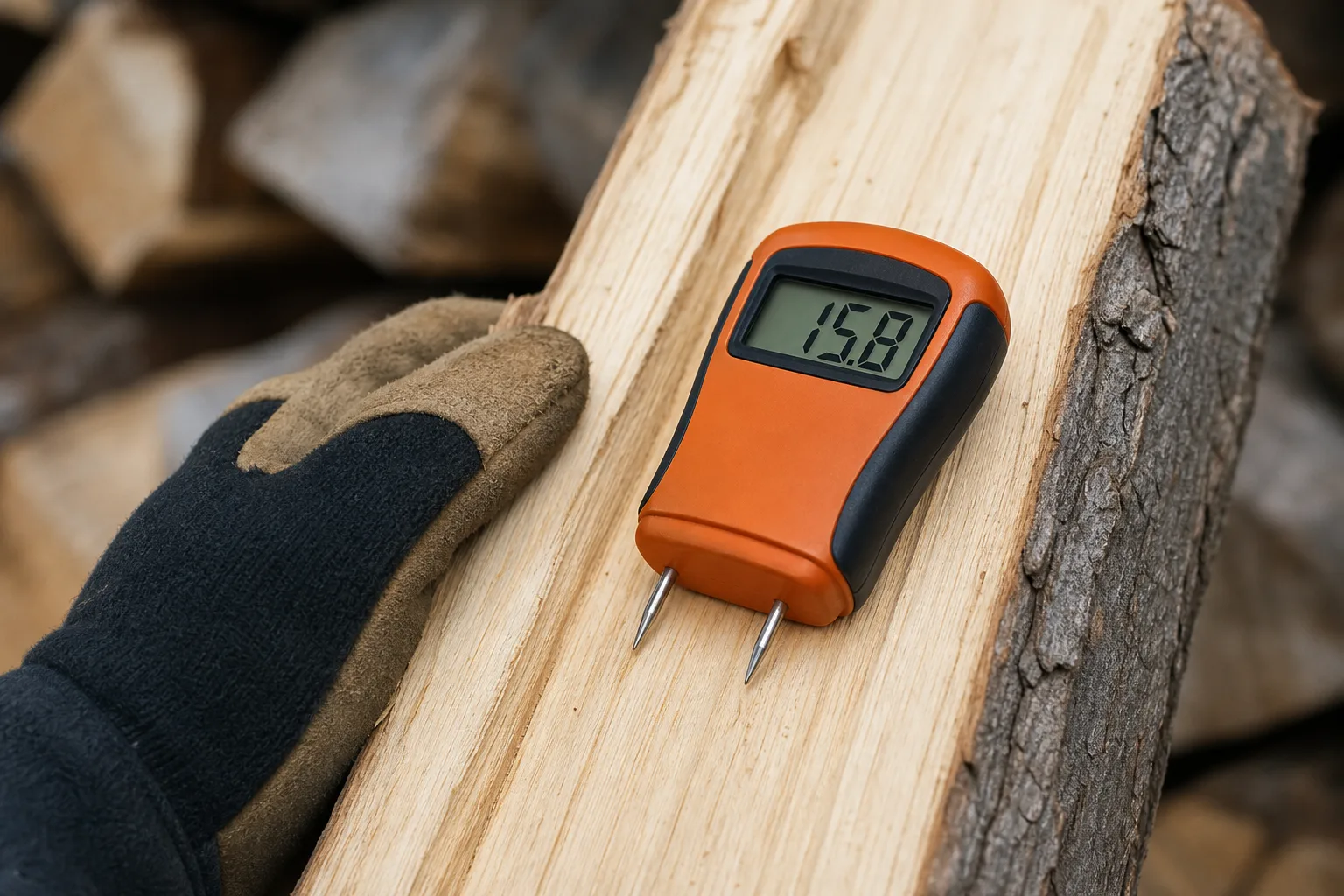
The test only works one way. Split a piece right there at the stack and press the pins into the freshly exposed interior end grain. Reading the weathered outside of a log tells you about last week's weather.
You are looking for under 20 percent, the number the EPA's Burn Wise program points to. If you get 25 or 30, restack it, note the date, and come back in a few months.
Four field checks when you do not have a meter
Run these together. Any one of them alone can lie to you.
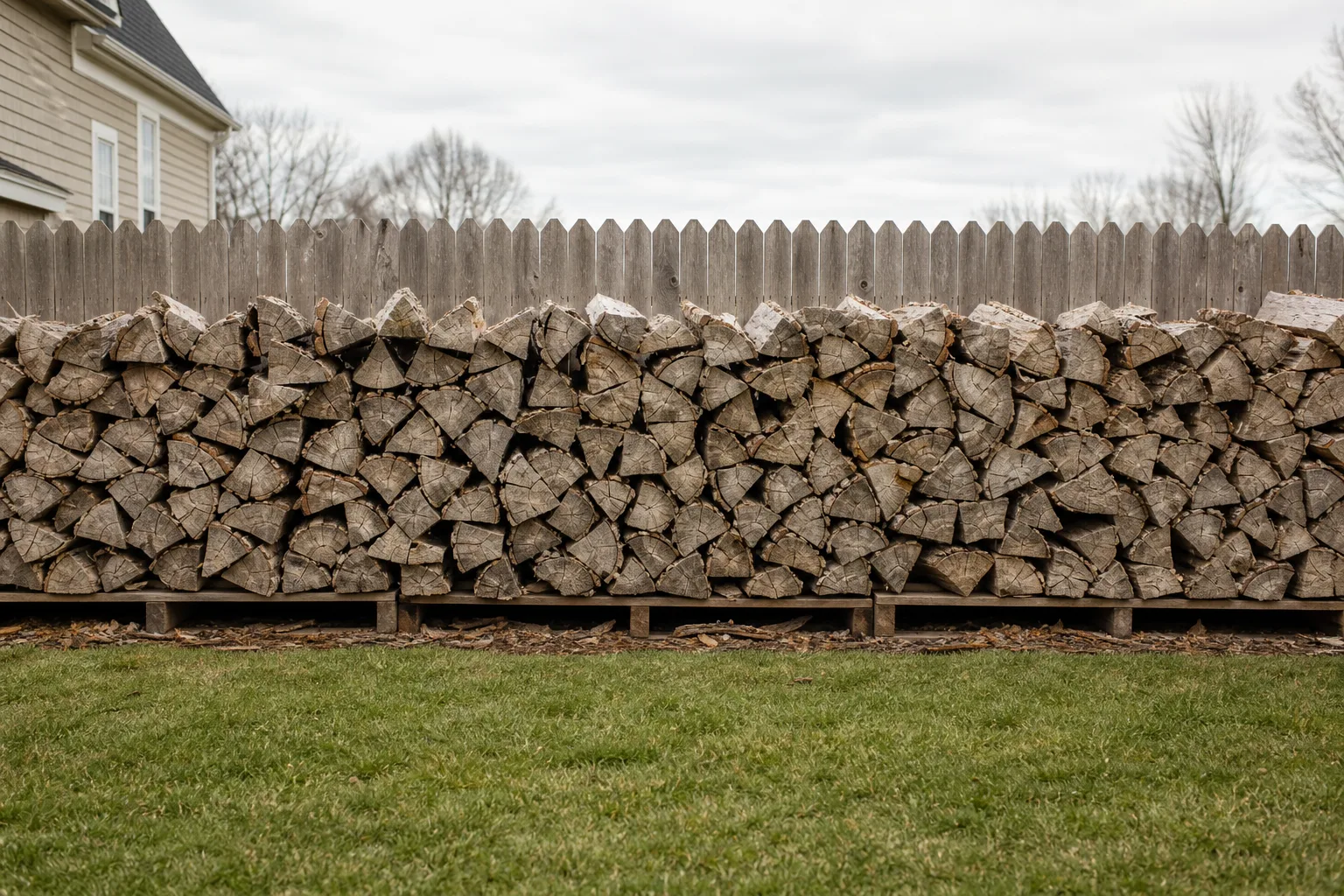
- Look at the ends. Seasoned splits develop radial cracks running out from the center like spokes. Green ends are smooth and damp looking.
- Knock two pieces together. Dry wood gives a sharp hollow crack. Wet wood gives a dull thud.
- Pick it up. A seasoned split is noticeably lighter than a green one of the same species and size.
- Check the bark. On most species it loosens and starts falling off as the wood dries underneath it.
Add a fifth if you want certainty. Split a piece and put your palm on the fresh face. Wet wood feels cool and slightly damp. Dry wood feels like a dry board.
Myth vs. fact: Grey wood is dry wood. It is not. Grey is weathering, which is what sun and rain do to the outside of a split within a few months. A piece can be silver grey on every visible face and still read 30 percent an inch inside. That is why the meter goes on a fresh split and not on the surface.
How to Season Firewood Fast When You Are Already Behind
Here is the payoff I promised at the top. Most people arrive at this topic late, in autumn, with wood that is not ready and a heating season starting anyway.
You cannot compress two years into two months. You can do considerably better than doing nothing.
How to season firewood when the clock is short
Start with the species. Softwoods carry the shorter minimum, six months against a year or more for anything hardwood, so pine, spruce and fir are the wood to prioritize when time is the constraint.
Split small, three to four inches across the face instead of six. More surface, less distance for water to travel out.
Go one row deep, in full sun, broadside to the wind, on pallets, top covered only. And split it in March, not in June, so the warm months are ahead of the stack rather than half spent.
What none of this does is beat the clock on hardwood. A summer of good conditions puts oak in better shape than a summer of sitting in rounds, and it still is not seasoned firewood at the end of it.
Myth vs. fact: Pine clogs your chimney. It does not. The driver of creosote is fuel moisture and flue temperature, not resin. Dry softwood burns clean. It burns fast and gives you less heat per cord, so you refill the stove more often, but a well seasoned pine fire is not a chimney hazard. Wet oak is.
Triage what is already in your yard
Go out with a meter and sort the pile. This is the most useful hour you will spend this month.
Anything reading under 20 percent goes in the burn now pile. That is the whole of it. Under 20 is fuel, and everything else is not yet.
Anything at 20 percent or above gets restacked properly, in the best sun and wind you have, and taken off this winter's list. Burning it will cost you heat and load your flue, and there is no reading above 20 that is worth that trade.
Then take the wet material and split it down small. This is how to season firewood under pressure, and it does work within limits: small splits in a good spot can still gain ground in October.
When buying dry wood is the right call
Sometimes the answer is to buy your way out of the gap, and there is no shame in it.
Kiln dried wood is heat dried rather than air dried. It is ready in days rather than months and typically comes in drier than air dried wood, often in the single digits to low teens. It costs more. The trade is money for time.
If you are short the whole winter, buy properly seasoned cordwood from a local supplier and meter it before you accept delivery. Ask for the moisture content and the species. A supplier who cannot answer either question is selling you weight, not heat.
Storage, Pests, and the Mistakes That Ruin a Good Stack
You can do everything in this guide on how to season firewood correctly and still lose the pile to where you put it.
Where to put the stack, and how far from the house
Not against the house wall. It is the convenient spot and it is the wrong one.
Wood stacked against siding traps moisture against the wall, blocks airflow on one whole face of the row, and gives insects a bridge from the pile into the structure.
Twenty feet of clearance is a reasonable target, in open ground with sun and wind. Bring only a day or two indoors at a time, because wood warmed to room temperature wakes up whatever is living in it.
From the field: The most common woodpile mistake is the fully wrapped tarp, staked down to the ground. It looks careful and responsible. It works against you, because the wrap traps ground moisture and evaporated water inside the stack instead of letting it leave. Cover the top so rain runs off, and leave the sides open so the water you are trying to remove has somewhere to go.
Why you should not haul firewood across state lines
Firewood moves insects. That is not a slogan, it is the mechanism by which several tree killing pests have spread across the country.
The emerald ash borer can survive inside cut wood and emerge somewhere new. So can the Asian longhorned beetle, the spotted lanternfly and the spongy moth, depending on where you are.
States regulate this. California prohibits out of state firewood originating in an area infested with a listed pest, and Washington's quarantine requires firewood imported into the state to be heat treated to a core temperature of 71 degrees Celsius, or 160 Fahrenheit, held for at least 60 minutes, or to receive an approved equivalent treatment.
The practical rule from every state agriculture program is the same. Buy it where you burn it.
What seasoning cannot fix
Time does not improve every log. Punky, spongy wood that has started to rot has lost its fuel value and will never get it back, so anything that crumbles under a thumbnail goes in the brush pile.
Painted, stained, pressure treated or glued wood does not belong in a fireplace at any moisture content. Neither do pallets, which are often treated, nor driftwood, which carries salt.
Seasoning is a moisture process. It cannot undo rot, and it cannot make treated wood safe to burn indoors.
How VIO Helps When the Wood Was Not Dry
Now that you know how to season firewood properly, the wood going into your stove from here on is a solved problem. The flue is the open question.
VIO Chimney is a referral service. We do not do the work ourselves. We connect homeowners with independent, local chimney companies, and those companies are separate businesses that run their own crews and carry their own credentials.
For the situation this article describes, the useful visit is an inspection. Someone who has burned unmeasured wood wants to know what is on the flue wall before the first fire, and whether a sweep is called for.
The company we match you with can tell you what stage the buildup is at, whether the liner is sound, and what the cap and crown look like from the roof, including whether the chimney spark arrestor screen is clear.
On money, here is our own conduct. We ask every company in the network to put its estimate in writing before any work starts, and you should insist on exactly that, from us or from anyone else who quotes you.
You handle the fuel. The independent chimney company we connect you with handles the flue.
Before the first fire, not after the first problem.
You have a plan for the woodpile now. Get the chimney checked while the weather still lets someone up on the roof.
Call VIO Chimney at (513) 655-6702, and we will connect you with an independent chimney company near you.
That is how to season firewood, start to finish. It rewards planning and punishes optimism. Split it small, stack it one row deep on pallets, cover the top and only the top, write the date on the end, and put a meter on a fresh split before you believe any of it.
Go do one thing right now. Walk out to the pile, split a piece, and look at the face. You will know more in thirty seconds than a year of guessing has told you.
Symptom checker
What is your chimney doing?
Tap the closest match for an honest first answer.