



On this pageWhat "high efficiency" actually measures8 sections+7
- What "high efficiency" actually measures
- EPA certification and what changed in 2020
- Catalytic, non-catalytic, or hybrid
- Your chimney decides whether a high efficiency wood stove delivers
- Sizing and fuel, the two things that undo a good stove
- What an underperforming stove looks like, and the checklist to buy by
- The federal tax credit question in 2026
- How VIO helps you install a high efficiency wood stove
Quick answer
A high efficiency wood stove is one the EPA certifies at roughly 75 percent or better on a Higher Heating Value basis, the measurement used on the EPA's certified stove list. Catalytic models average about 78 percent HHV, non-catalytic about 71 percent. Manufacturer figures quoted on the European LHV basis look higher, so always ask which basis a percentage uses before comparing two stoves.
Open a tab on a stove retailer's site and you will be told the model in front of you is highly efficient, with a percentage attached. Open the next tab and a comparable stove carries a noticeably different figure. A third page is higher still. The federal database, the one with no product to sell, comes in lower than any of them.
All of those numbers can be technically true at the same time.
That is not a typo and nobody is lying to you. It is a measurement problem, and until somebody explains it, shopping for a high efficiency wood stove is guesswork wearing the costume of research.
So here it is in order. What the number measures, what separates a genuinely efficient stove from one with a good marketing department, and the part that decides whether any of it reaches your room: the chimney already attached to your house gets a vote in whether you ever see the efficiency you paid for.
What "high efficiency" actually measures
Efficiency here is one ratio. How much of the energy stored in the wood you load ends up as heat in your room, rather than going up the flue as hot gas and unburned smoke.
An open masonry fireplace is dreadful at this, often running at a net loss because it pulls more heated household air up the chimney than it returns to the room.
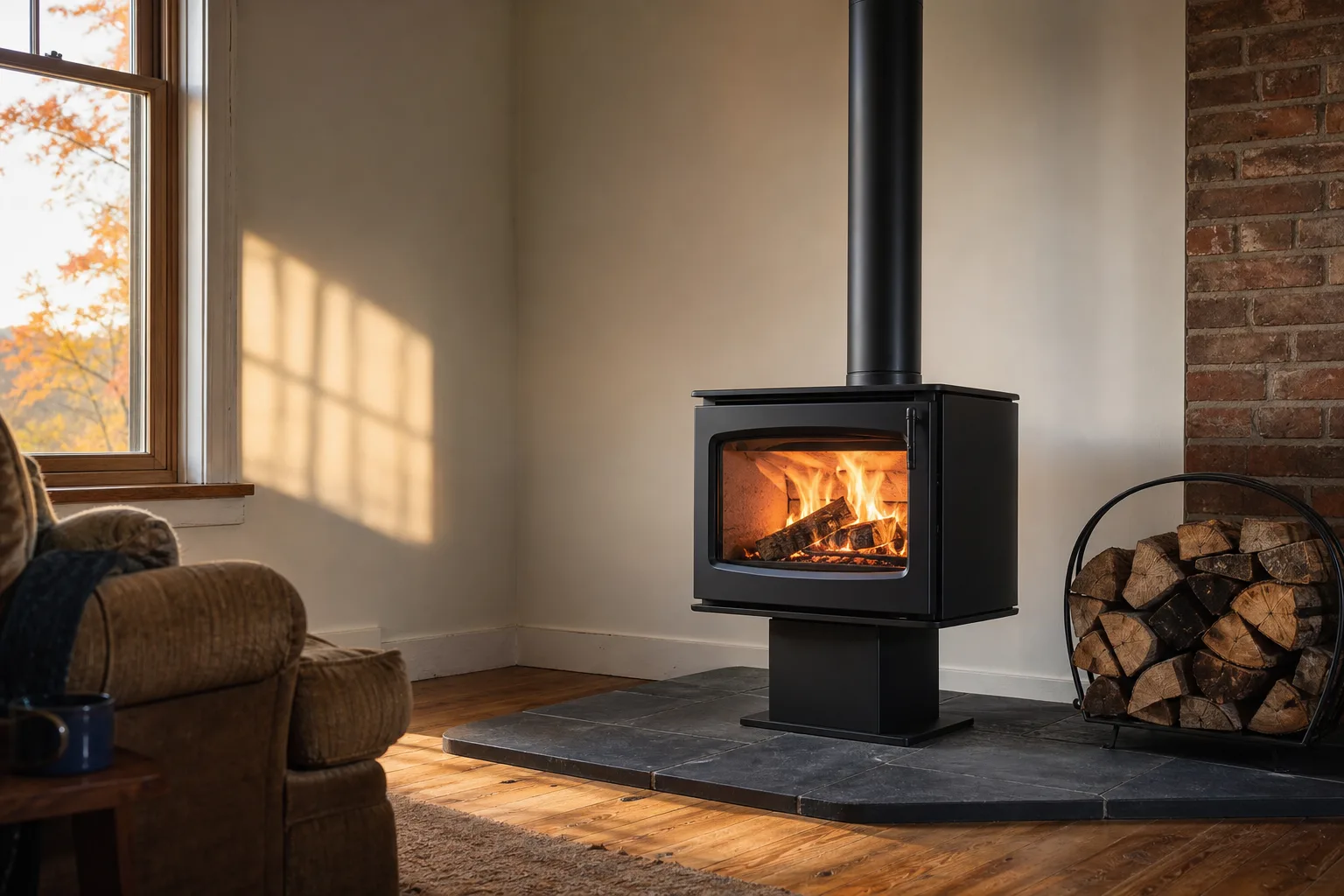
A high efficiency wood stove is a different machine entirely. It burns the smoke, not just the wood.
HHV and LHV, the reason the numbers disagree
Here is the payoff on those contradictory percentages.
There are two ways to define the energy you started with. Higher Heating Value counts every BTU in the wood as input. Lower Heating Value ignores the energy spent boiling off the moisture the wood carries and counts only what is left.
Same stove, same test, two denominators. LHV always produces the friendlier number.
The EPA uses HHV on its certified list, as does nearly every other heating appliance rating in North America. Your furnace's AFUE is an HHV figure. Many stove manufacturers publish the European LHV number instead, because it looks better on a spec sheet.
The gap is not small. A stove advertised at 75 percent LHV works out to roughly 66 percent HHV once the wood is at 20 percent moisture, according to the Alliance for Green Heat.
That one conversion is where the confusion starts.
Myth vs. fact: You will find stoves marketed with efficiency figures well above anything on the EPA's certified list. Those come from manufacturers' own proprietary metrics rather than the EPA's HHV measurement, and they are not comparable to it. When a percentage is quoted without naming its basis, treat it as marketing.
So what number is actually good?
Seventy-five percent HHV is the line worth knowing. It was the qualifying threshold for the federal tax credit while that existed, and the industry still treats it as the boundary of the category.
Above that you have a high efficiency wood stove that genuinely earns the name. In the low sixties you have an appliance still far better than an open fireplace, sitting at the bottom of the modern field.
Ask for the HHV figure specifically. If the salesperson cannot tell you which basis their number uses, that itself is information.
EPA certification and what changed in 2020
Every wood stove sold new in the United States has to be EPA certified, and the bar moved recently enough that it matters to what you are buying.
Under the older Step 1 rules a stove could emit up to 4.5 grams of particulate per hour. Step 2 took effect in May 2020 and cut that to 2.0 grams per hour on the crib wood test method, or 2.5 grams per hour for stoves certified on the cord wood method.
That is not only an air quality story. Smoke is unburned fuel, so a high efficiency wood stove that emits less of it is, by definition, extracting more of the energy you paid for.
The EPA publishes a database of certified wood heaters listing each model's emissions and verified efficiency. It is the only place to compare two stoves on the same basis, from a source with nothing to sell. Use it.
Good to know: This applies to stoves sold new. One already in the house, or bought secondhand, may be Step 1 or predate certification entirely. That is why an upgrade is a real change and not a marginal one.
Catalytic, non-catalytic, or hybrid
Every modern stove has to solve the same problem. Wood smoke is fuel, it will only ignite above roughly 1,000 degrees Fahrenheit, and the inside of a firebox spends a lot of its time cooler than that. There are two engineering answers, and one that uses both.
Catalytic stoves
A coated ceramic honeycomb sits in the flue path. Smoke passing through it ignites at a much lower temperature than it otherwise would, which lets the stove hold a long slow burn without dumping smoke up the chimney.
The trade is a wear part. The combustor degrades over years of use and eventually needs replacing, and there is a bypass lever to learn: open on startup and reloading, closed once the stove is up to temperature.
If you heat overnight and want long burns from one load, this is the design built for you.
Non-catalytic stoves
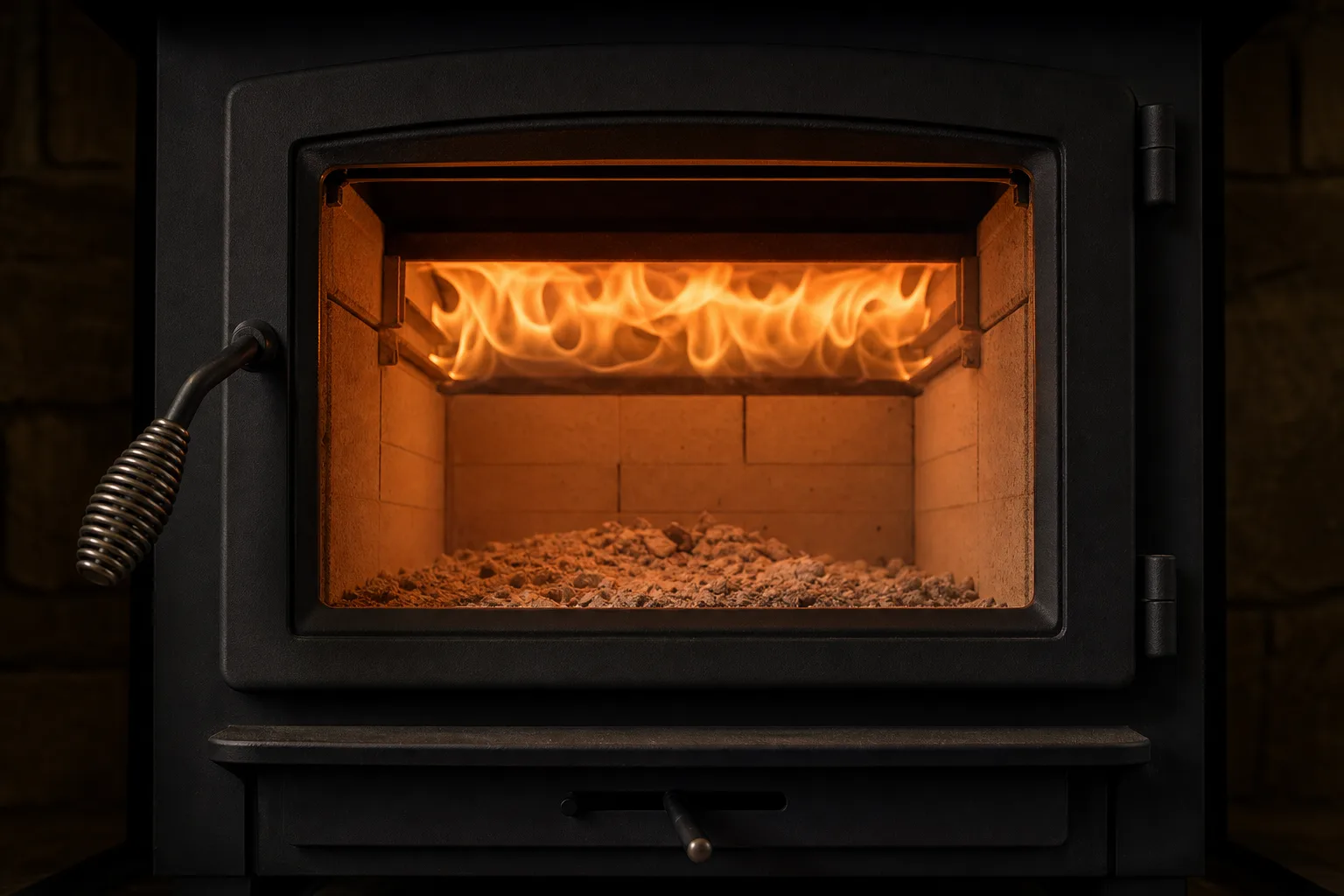
Instead of a catalyst, stainless tubes across the top of the firebox inject preheated air into the smoke, and an insulated baffle holds heat in long enough for it to light. On a well-run non-catalytic stove you can watch it happen. Flames roll along the ceiling of the firebox with no wood touching them.
Simpler, fewer consumable parts, more forgiving of a distracted operator. It wants to run a little hotter to stay clean, which means shorter burn cycles.
Hybrid stoves, and which high efficiency wood stove fits which house
A hybrid runs secondary air tubes and a catalyst together, cutting emissions at both the high burn rates where tube stoves shine and the low ones where they struggle. More parts to maintain, and the widest usable burn range of the three.
| Type | Typical efficiency (HHV) | How it burns the smoke | Maintenance reality | Suits |
|---|---|---|---|---|
| Catalytic | About 78% average, roughly 63 to 84% | Ceramic combustor ignites smoke at low temperature | Combustor is a wear part, replaced periodically; bypass lever to operate | Long overnight burns, cold climates, primary heat |
| Non-catalytic | About 71% average, roughly 60 to 80% | Secondary air tubes and a baffle reburn the smoke | Baffle and air tubes last years; nothing routine to replace | Evening and weekend heating, simplest operation |
| Hybrid | Overlaps the top of both ranges | Both, working at different points in the burn | Catalyst maintenance plus tube stove upkeep | Long burns with the widest usable output range |
Figures are HHV category averages and ranges from EPA-verified data compiled by the Alliance for Green Heat. Models vary within these bands, so check the specific unit.
Notice how much those ranges overlap. A good non-catalytic stove beats a mediocre catalytic one. Category alone does not make a high efficiency wood stove, which is exactly why the certified list exists.
Pro tip: Pick the design around how you actually heat, not the highest number on the page. Somebody loading at ten at night and wanting coals at six has a different requirement from somebody lighting a fire on Friday evening. The wrong style for your routine costs more real efficiency than the few points between two well-built stoves.
Your chimney decides whether a high efficiency wood stove delivers
This is the section the rest of the internet skips, and the one that can change what you buy.
A stove's efficiency number is measured on a test stand, burning fuel of a specified moisture content, venting into a flue of a specified size. Two of those three conditions live at your house, not at the lab.
Why an efficient stove runs a cooler flue
Heat that stays in your room is heat that did not go up the chimney. So the better the stove, the cooler its exhaust.
An old smoke dragon sent a column of very hot gas up the flue, which kept the flue hot, which kept the moisture and tar in that smoke moving as vapor until it exited the top.
A high efficiency wood stove sends up gas that is meaningfully cooler. If that gas enters a large, cold, uninsulated masonry flue, it loses the rest of its heat fast and the tar condenses on the walls. That is creosote, and creosote is the fuel of a chimney fire.
The stove got better. The chimney did not, and now the pairing is worse than what it replaced.
Liner size, and the NFPA 211 rule
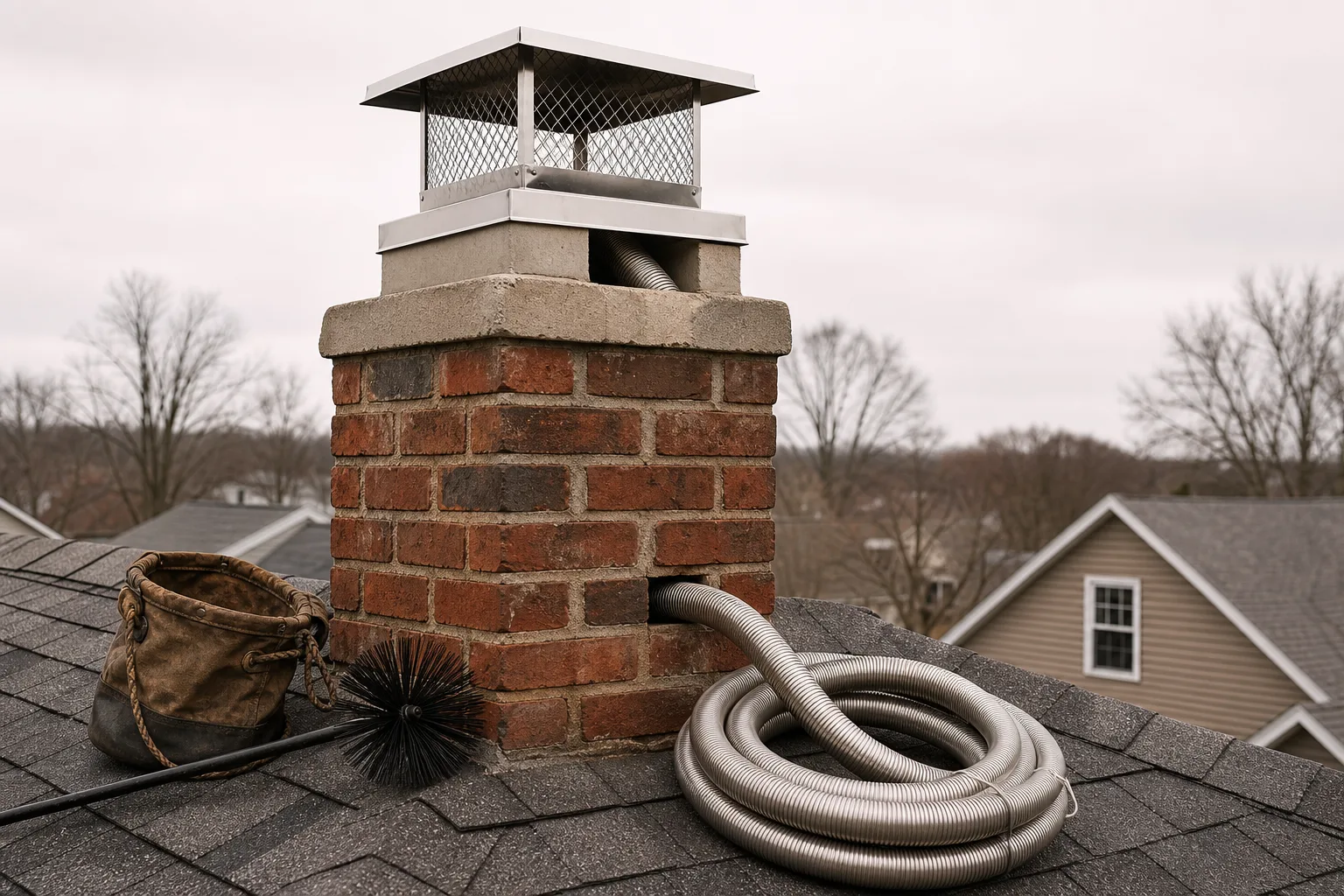
Most masonry chimneys in American houses were built for an open fireplace, which needs an enormous flue. Most stoves have a 6 inch flue collar. Connect the two directly and you have given your stove a chimney several times larger than it can keep warm.
The fix is a stainless steel liner running the full height of the flue, usually insulated, sized to the appliance.
NFPA 211 sets the boundaries. The liner's cross-sectional area should be at least equal to the stove's flue collar area, and generally not more than three times that area for a chimney exiting through the roof. Most residential installations land on a 6 inch liner, with 8 inch on higher-output appliances.
Your stove's installation manual is the controlling document. It is listed and tested as a system with a particular vent configuration, and where the manual is stricter, the manual wins.
Masonry chimneys versus Class A pipe
If there is no masonry chimney, or the existing one is not worth lining, the alternative is insulated Class A chimney pipe running from a ceiling support box or wall thimble up through the structure and above the roof.
Often that is the better outcome, not the consolation prize. Insulated stainless holds flue temperature better than a masonry chase on an exterior wall ever will, and it lets you put the stove where you want it rather than where a mason put a chimney in 1948.
Safety note: NFPA 211 requires a Level 2 inspection at specific moments, and putting a new appliance on an existing chimney is one of them. The list: sale or transfer of the property, any system change including a new appliance or a change in fuel or flue size, a malfunction, a chimney fire, and external events such as weather or seismic events. Level 2 includes video scanning inside the flue, the only way to see cracks, gaps and old fire damage.
The stove is the easy half
You can compare fireboxes from your kitchen table. What you cannot check from there is whether the flue already in your house suits the stove you are looking at, what size liner it needs, and what shape it is in.
A chimney company can look at all three, before you spend anything on the appliance.
Call VIO at (513) 655-6702 and we will match you with a local company that handles wood stove venting.
Sizing and fuel, the two things that undo a good stove
You can buy correctly, vent correctly, and still give back much of the efficiency you paid for. Two ways it happens.
Buying too much stove
The instinct is to size up. More firebox, more heat, more margin for the coldest night of the year.
It backfires. A stove too large for its space overheats the room at any honest burn rate, so the owner chokes the air down and lets it smolder. Smoldering is where every efficiency claim collapses: secondary combustion stops, the catalyst stalls below its light-off temperature, and the smoke that should be fuel goes up the flue to condense as creosote.
Treat manufacturer square footage ratings as a rough class indicator, not a promise. A tight new build and a drafty 1920s farmhouse of identical square footage are not the same heating problem.
The 20 percent moisture line
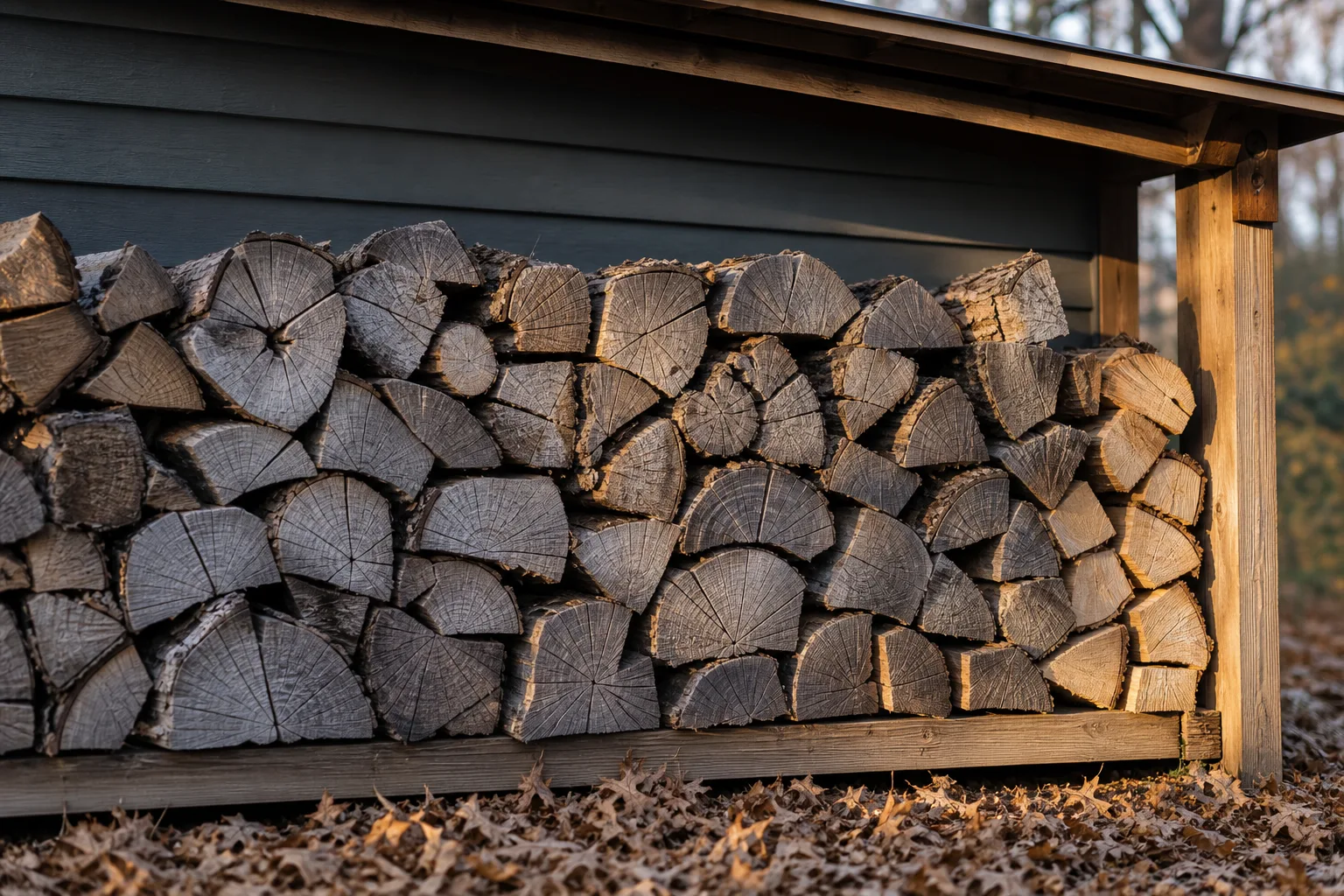
Every efficiency figure the EPA publishes for a high efficiency wood stove assumes properly seasoned firewood, meaning wood at or below roughly 20 percent moisture content.
Burn wetter wood and the stove spends its energy boiling water out of the fuel before it can pull heat from it. Firebox temperature stays low, secondary combustion never gets going, and the appliance underperforms for reasons unrelated to its design.
Dry wood looks like something. Split faces go grey, cracks radiate from the center of the end grain, the bark loosens, and it feels light. A handheld firewood moisture meter on a fresh split settles the question in seconds.
From the field: When a brand new stove disappoints, fuel is the first thing worth checking, before anyone questions the appliance. Wood sold as "seasoned" is not always dry, and a stack left outside uncovered through a wet year can read far higher than you would guess. Least glamorous variable in the subject, and an easy one to skip past.
What an underperforming stove looks like, and the checklist to buy by
Percentages are abstract. Symptoms are not.
The warning signs
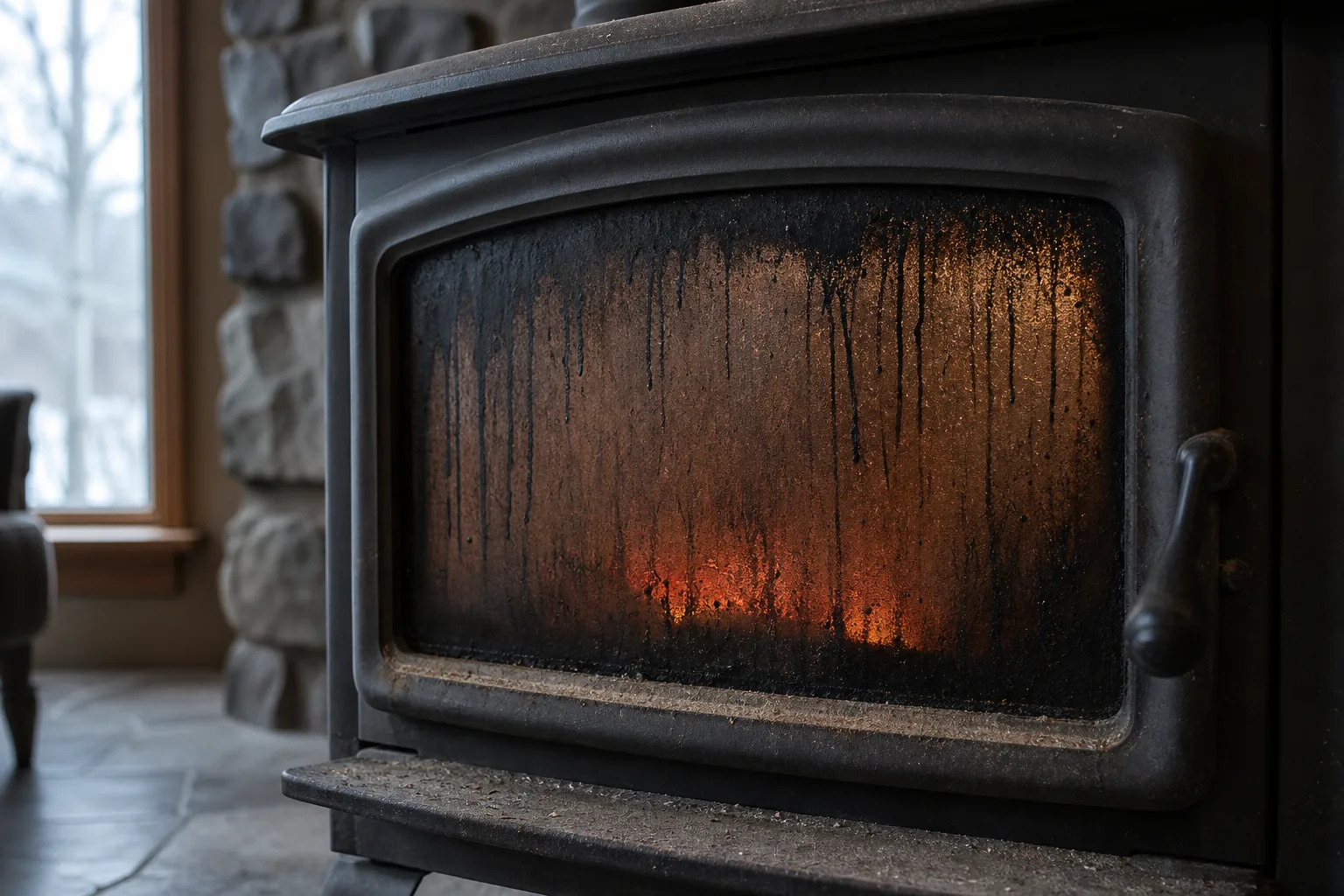
Blackened glass is the first and clearest one. A high efficiency wood stove uses an air wash across the inside of the glass to keep it clear, and on a properly burning fire it stays clear. Glass that fogs to brown and then to opaque black is telling you the fire runs too cool or the fuel is too wet.
Look at the chimney top from outside once the fire is established. You should see a shimmer of heat and little else. A dark or grey plume that hangs in the air suggests unburned fuel leaving the building. A white plume in very cold weather may be nothing more than condensed water vapor, so read that sign on a milder day.
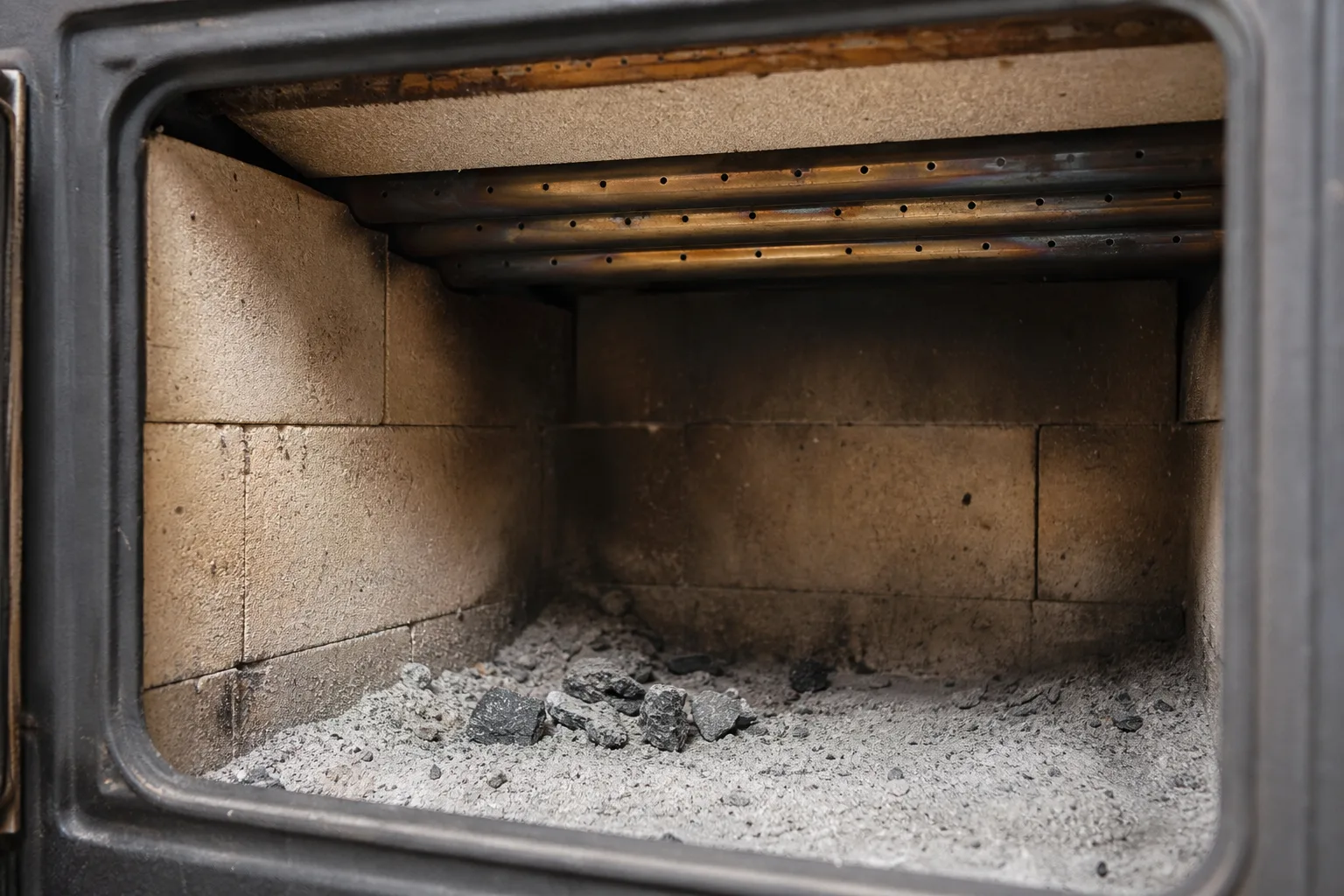
Inside, unburned charcoal piling up in the ash bed means the stove is not finishing what it starts. On the liner, shiny black tar rather than dry flaky soot is worth describing when you book. Creosote is combustible in every form it takes, so a deposit is not something to rank as safe or unsafe. It is something to have looked at.
What to settle before you buy
Work through this before money changes hands, not after.
- Efficiency on an HHV basis, confirmed on the EPA certified list, not the sales page
- The emissions figure and which test produced it, crib wood or cord wood
- The flue collar size and the vent configuration the manual requires
- Whether your chimney can be lined to that size, or whether Class A pipe is the better route
- Flue condition, established by a Level 2 inspection with a camera, not a glance from the roof, which is standard chimney service work
- Clearances to combustibles and the hearth pad the manual specifies
- Whether the output suits the space, honestly assessed, including the oversizing risk
- What your building department requires for permit and inspection
Pro tip: Ask for two documents before you commit to a high efficiency wood stove. The EPA certification for the exact model, and the page of the installation manual specifying the venting. Any dealer worth buying from hands both over without hesitating, and having them means the chimney work gets quoted against the real requirement rather than a guess.
The federal tax credit question in 2026
You will still see a 30 percent tax credit advertised as a reason to buy. Worth being clear about, because a lot of pages have not updated.
The Energy Efficient Home Improvement Credit under Section 25C, which covered qualifying biomass stoves at a percentage of purchase and installation up to an annual cap, expired on December 31, 2025. It was terminated early by the 2025 budget reconciliation act, seven years ahead of its original 2032 sunset.
There is no federal credit for a new high efficiency wood stove bought in 2026.
If you purchased and installed a qualifying unit on or before December 31, 2025, you may still claim it on the return covering that year. Talk to whoever does your taxes.
State and utility incentives are separate, and some are real. They vary by location and they change, so check your state energy office and your utility directly rather than trusting a national list.
Myth vs. fact: Buying guides published with "2026" in the title are still promoting the 30 percent federal credit. The credit ended at the close of 2025. If a page is advertising it now, that page has not been touched in a year, which is worth remembering when you weigh the rest of its advice.
How VIO helps you install a high efficiency wood stove
VIO is a referral service. We do not sell stoves and we do not do the work ourselves. We match homeowners with independent local chimney and venting companies, and the company that shows up is the one doing the job.
Here that means someone who can look at the chimney you already have, run a camera down it, and tell you what the stove you are considering would require. Liner size and material, insulation, condition of the masonry, whether Class A pipe makes more sense, and what the manual demands. That conversation is more useful before you buy than after.
On money: wood stove installation cost varies with the venting a house turns out to need, which is why we ask every company in the network to put its estimate in writing before any work starts, and you should insist on exactly that. If anything changes mid-job, ask for the change in writing too.
The appliance is the part that gets shopped. The venting is the part that decides what the appliance can do. If the budget is fixed and something has to give, my advice is to take it out of the appliance and put it into the chimney. A mid-range high efficiency wood stove on correct venting beats a premium one on a flue that fights it, every winter, for as long as you own the house.
Before you buy, find out what your chimney needs
Tell us what stove you are considering and where you are. We will connect you with an independent local company that can look at your flue and tell you what the install would actually involve.
VIO, (513) 655-6702
Symptom checker
What is your chimney doing?
Tap the closest match for an honest first answer.