



On this pageWhat seasoned firewood actually is9 sections+8
- What seasoned firewood actually is
- Seasoned, green, and kiln-dried: the three things you will be offered
- The ninety-second driveway test
- The moisture meter settles the argument
- What burning unseasoned wood does to your chimney
- Buying seasoned firewood without getting burned
- Storing it so it stays seasoned (or gets there)
- How VIO helps when your seasoned firewood turned out not to be
- The short version
Quick answer
Seasoned firewood is wood that has been cut, split, and air-dried until its moisture content falls below 20 percent, the level the EPA identifies as best for burning. Air-drying takes at least six months, and dense hardwoods like oak often need a year or more. Seasoned wood looks darker on the split face, weighs noticeably less, and sounds hollow when two pieces are knocked together.
There is no inspector who certifies seasoned firewood. There is no grading standard behind the word and no certification you can ask to see. A seller can call a load seasoned because it sat behind the barn since spring, and there is no fixed definition to measure that against. General advertising and consumer-protection rules still apply to how wood is sold, but "seasoned" on its own is not a specification.
That is the first thing worth knowing, and almost nobody selling you wood is going to lead with it.
The good news is that you do not need anybody's word for it. Wet wood and dry wood look different, weigh different, and sound different, and you can tell them apart in your own driveway with the delivery truck still running. It takes about ninety seconds. By the end of this page you will know how, and you will know what to do about the load you already bought if the answer comes back wrong.
What seasoned firewood actually is
Seasoned firewood is wood that has been cut, split, and left to air-dry long enough for most of the water in it to leave. That is the whole concept. A living tree is heavy with water, and that water is what a wet fire spends its heat on instead of the room.
The number that matters is 20 percent. The EPA's Burn Wise guidance puts it plainly: wood burns best at a moisture content of less than 20 percent. Above that line you are spending the fire's heat boiling water instead of warming the room.
Why 20 percent is the number that matters
Water does not burn. It absorbs energy, turns to steam, and leaves up the flue carrying unburned smoke particles with it.
A fire fed on wet wood runs cooler, because a share of its output goes into evaporation rather than heat. Cooler smoke is the problem, and we will get to what it does to your chimney further down.
You will hear it, too. Wet splits hiss and bubble at the ends. Dry wood does not.
The word "seasoned" has no legal definition
Good to know: There is no grading standard and no certification behind the word "seasoned" in firewood sales. Kiln-dried wood at least describes a process. "Seasoned" describes an intention. Treat it as a starting point for a conversation, not as a specification.
This is not an accusation against sellers. A seller who bought a truckload from a logger in July genuinely believes it is seasoned, because that is what they were told.
The chain of belief is long and nobody in it has a meter.
Seasoned, green, and kiln-dried: the three things you will be offered
You will hear three words used as though they were grades on a scale. Green and seasoned describe the same wood at different stages of drying. Kiln-dried is a different route to the same destination.
Green wood
Green wood is freshly cut, sometimes still holding as much water by weight as it holds wood. It is heavy, the split faces are pale and damp, and the bark is on tight.
It is not useless. It is just not ready by the weekend.
Seasoned wood
Seasoned firewood has spent months split and stacked in moving air. The moisture has come down below that 20 percent line, the ends have opened up, and the weight has dropped noticeably.
Kiln-dried wood
Kiln-dried wood was dried in a heated chamber rather than by weather and patience. It gets to market faster and it is generally very dry when it leaves the kiln.
Two honest caveats. Residual moisture depends on the kiln schedule, so the label is not a single number. And a pallet of kiln-dried wood left uncovered in an October rain is wet wood with a receipt.
| Typical moisture | How it gets there | How it burns | Watch for | |
|---|---|---|---|---|
| Green | Well above 20% | Nothing yet, it was recently a tree | Hard to light, hisses, smokes heavily, low heat | Bright damp split faces, tight bark, heavy for its size |
| Seasoned | Below 20% when truly ready | Split and stacked in open air for months | Lights readily, burns hot and steady, little smoke | The word on the invoice without a meter behind it |
| Kiln-dried | Low, varies by kiln | Heat-dried in a chamber | Lights fast, burns hot, very consistent | Storage after the kiln. Rain undoes it |
Myth vs. fact: The myth is that softwoods like pine cause creosote and hardwoods do not. The fact is that creosote comes from cool, smoky, incomplete combustion. Wet wood and damped-down smoldering fires drive it. Dry pine burned hot in a properly sized appliance is cleaner than wet oak choked down overnight. Species affects how long a load lasts and how much heat a cord carries. Moisture and burn temperature drive the deposits.
The ninety-second driveway test
Here is the part I promised. None of it requires a tool, and all of it can be done while the driver is still doing paperwork.
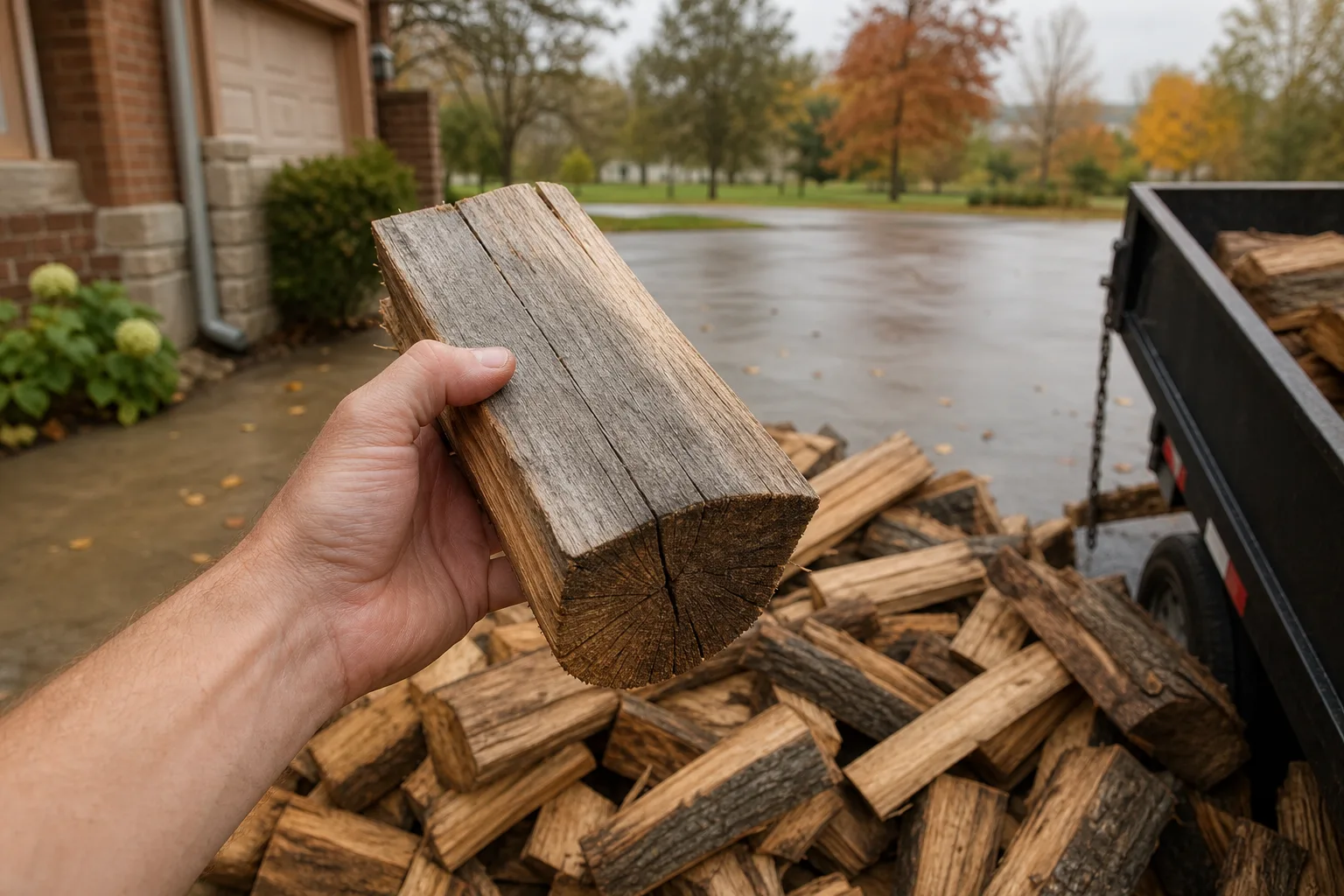
The EPA gives three field signs for seasoned firewood: it is darker, it weighs less, and it sounds hollow when struck against another piece. Those three plus one more will tell you most of what you need.
Look at the split face, not the bark
Bark tells you almost nothing. It weathers on the outside of the pile no matter what the inside of the wood is doing.
Turn a piece so the split face is up. On dry wood that face has gone gray or dull tan, the color leached out of it, and the bark is often loose or already gone. On green wood the split face is still bright, cream or pale yellow, sometimes with a wet sheen at the ends.
Pick it up
Weight is the most underrated check in the pile. Water is heavy, and a split that has lost its water announces it the moment you lift it.
Grab two pieces of similar size from different parts of the load. If one feels dense and cold and the other feels like it wants to float, you have a mixed load, and mixed loads are common.
What seasoned firewood sounds like when you knock it
Take two splits, one in each hand, and crack them together like a pair of blocks.
Dry wood gives you a sharp, ringing, hollow knock. Wet wood gives you a dull thud that stops dead. Once you have heard both back to back you will never confuse them again, and this is the single fastest check on the list.
Read the ends, but do not trust them alone
Radial cracks running out from the center of the end grain, like spokes, are the sign everybody knows.
From the field: End checking is the check that fools the most people. Wood dries from the outside in, so the ends can open up handsomely while the middle of the split is still holding water. When a homeowner is surprised by a bad meter reading, it is very often because the ends looked textbook. Cracks are supporting evidence. They are not proof.
Run all four and you will have a real opinion in ninety seconds. If two or more come back wrong, say so before the truck leaves, while you still have room to push back.
The driveway checklist:
- Split faces gray and dull, not bright and damp. Bark loose or shedding.
- Weight noticeably light for the size of the piece, sampled from two spots in the load.
- Knock test sharp and hollow, not a dull thud.
- End grain cracked in radial lines, treated as supporting evidence only.
- Sample size three or four pieces at least, pulled from different parts of the load rather than off the top.
- Consistency if the load reads mixed, say so before the truck leaves.
The moisture meter settles the argument
Your hands will get you to a confident guess. A moisture meter gets you to a number, and a number ends the debate.
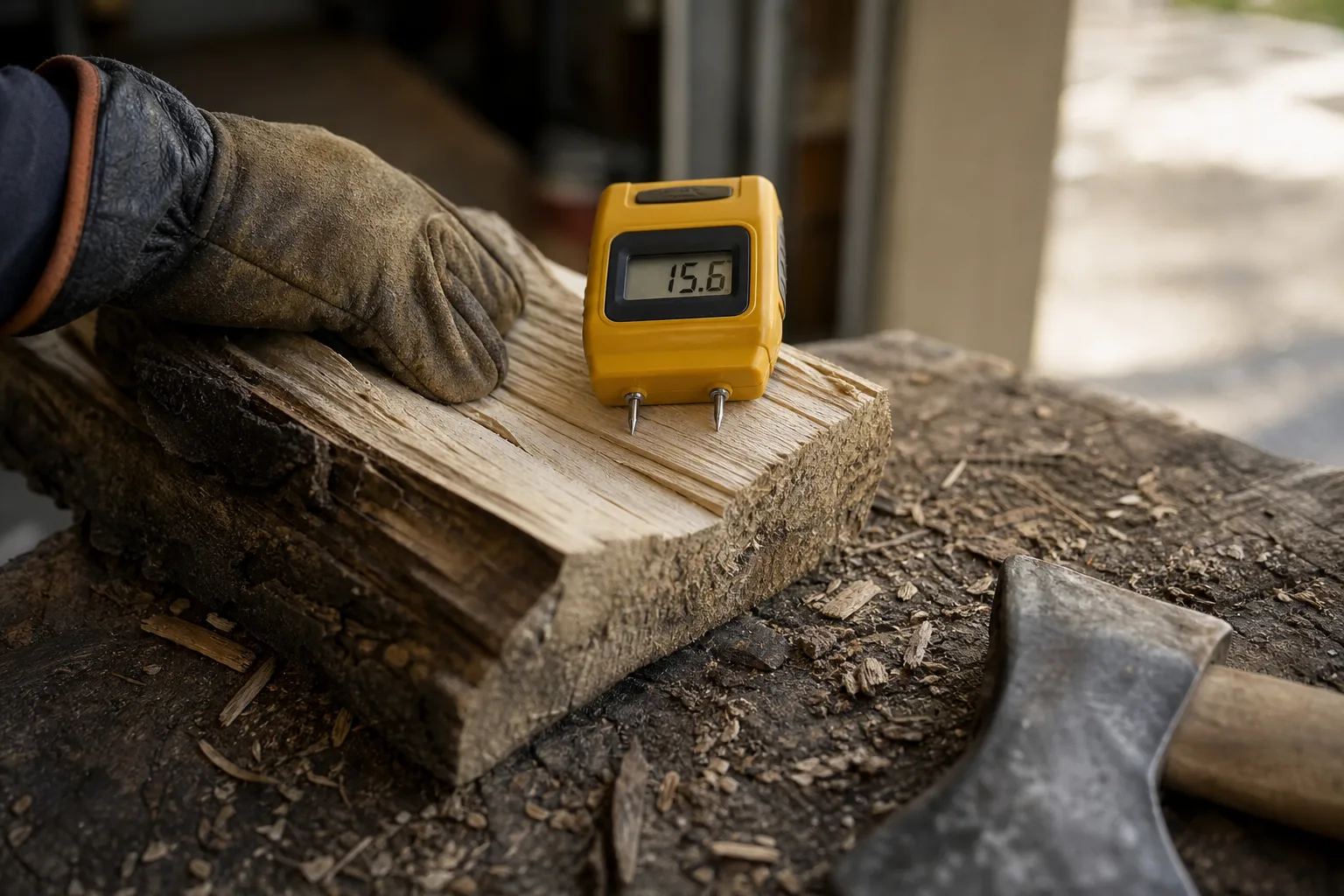
These are inexpensive handheld tools, palm sized, with two short steel pins at one end and a small screen. The EPA recommends testing wood with a moisture meter before burning it, which is about as clear an endorsement as a federal agency gives to an inexpensive gadget.
The technique matters more than people expect. Common practice, and what most meter makers tell you in the instructions, is to split a piece open and press the pins into the fresh interior face rather than the weathered outside. The middle is the part that has been keeping secrets.
A frozen split reads oddly, so bring the test piece inside for an hour first.
What a reading over 20 percent is telling you
A reading in the teens is what you want. Right around 20 is workable. Mid twenties and up means the wood is not ready, whatever the invoice says.
A reading in the thirties or higher on a load sold to you as dry is a conversation to have with the seller, and it is much easier to have that conversation with a number in your hand than with an opinion. If you burn wood in any quantity, a firewood moisture meter pays for itself the first time it saves you from a bad cord.
Test three or four pieces from different parts of the stack. One good reading proves one good piece.
What burning unseasoned wood does to your chimney
This is where the wood stops being a wood problem.
Every fire sends unburned material up the flue as smoke. When that smoke is hot and the fire is running clean, most of it exits. When the smoke is cool and heavy with steam, which is exactly what wet wood produces, it condenses on the inside of the chimney on its way out.
That condensed residue is creosote. The Chimney Safety Institute of America identifies it as a principal cause of chimney fires, for the simple reason that creosote is itself fuel. You are lining the inside of your flue with something flammable, one damp fire at a time.
You can usually see it coming before anyone tells you. The stove glass that used to stay clear now fogs brown and opaque within an evening. The fire takes three tries to catch and never really settles. On a cold morning the smoke coming off the chimney is thick and pale gray and hangs in the air instead of shimmering away.
The three degrees of creosote
CSIA sorts creosote into three degrees, and the difference between them is the difference between a routine sweep and a serious bill.
Degree one is light and dusty, black and soot-like, and a pass with a chimney brush takes it off without drama. This is what a well-run wood fire leaves behind.
Degree two is flaky and crumbly, sometimes tar-like, clinging to the flue wall in black scales. It comes off, but it takes more work and the right tools.
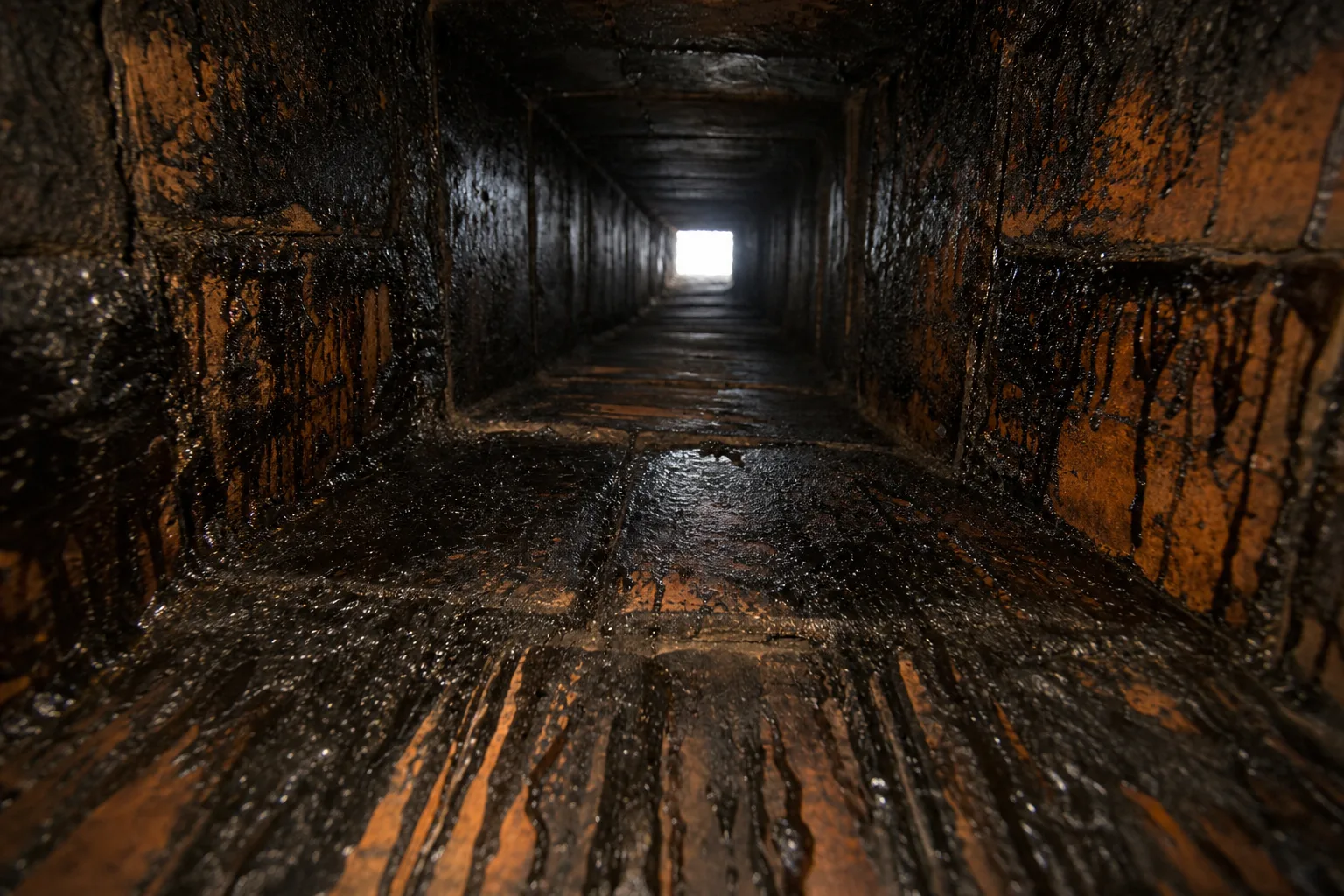
Degree three is the one nobody wants. It is glazed: hard, shiny, and dark, coating the tile like thick varnish and sometimes running in drips. A standard brush will not touch it. Removing it takes specialized methods, and until it is gone it sits there as a continuous layer of fuel.
Safety note: Glazed creosote is the condition most associated with serious chimney fires, and it is the condition most associated with a season of burning unseasoned wood on slow, damped-down fires. If your glass is going black fast and your fires are hard to start, that combination deserves a look inside the flue before the next cold snap, not after.
When an inspection stops being optional
NFPA 211 calls for chimneys, fireplaces and vents to be inspected annually, with sweeping done according to what the inspection finds rather than on a fixed schedule. That is the baseline for anyone who burns.
The standard also names situations where a Level 2 inspection is required rather than advisable: at the sale or transfer of a property, when the system is changed (a new appliance, a different fuel, a change of flue shape or material), after a malfunction, after a chimney fire, and after an external event such as a building fire, an earthquake or severe weather. If you are moving into a house with a fireplace you have never seen used, that first bullet is you. General chimney maintenance runs on that annual rhythm, and wet-wood seasons are exactly what pushes a chimney off it.
Burned wet wood last season?
One inspection tells you which degree of creosote you are dealing with, and whether it brushes out or has to come off the hard way. VIO matches you with an independent chimney company near you, and we ask every company in the network to put its estimate in writing before any work starts. Insist on exactly that.
Call (513) 655-6702 or request service online.
Buying seasoned firewood without getting burned
Now the commercial side, where the other half of the trouble lives. Buying seasoned firewood well is mostly a matter of knowing the units and asking two or three questions that a careless seller will not enjoy.
A full cord is a defined quantity: 128 cubic feet, conventionally stacked four feet high, eight feet long, and four feet deep. That definition is not a custom, it is the measure that state consumer-protection agencies require firewood to be advertised and sold by.
A "face cord" or a "rick" is not a standard volume. It describes a stack four feet high and eight feet long at whatever depth the pieces happen to be cut, which might be sixteen inches or might be twelve. Two sellers quoting a face cord can be quoting quantities that differ by a third.
Pro tip: A loose-dumped pile always looks like more wood than it is. Tumbled splits carry a lot of air. If the quantity matters to you, stack it before you settle up, or agree in advance that the delivery will be stacked. Nobody can judge a cord from a heap on the driveway, including the person who delivered it.
Ask when it was cut and split, not whether it is seasoned. The first question has a date for an answer and the second has a sales word for an answer. Ask the species, since a cord of mixed hardwood and a cord of oak have very different drying histories.
And buy close to where you will burn. Firewood moves insects, and state agriculture departments across the country make the same request: buy local, or buy heat-treated wood, because the tree that became your firewood may well have died of something still alive in it.
The September problem
There is a timing trap that catches people every year, and this is the month it catches them.
Wood ordered in September to burn in November has essentially no time to dry. Air-drying takes months, not weeks. If the load is not dry when it lands in your driveway, it will not be dry by the first cold night.
Which leaves two honest options. Buy seasoned firewood now and verify it yourself with the four checks and a meter, or buy green wood cheap, stack it properly, and hold it for a future season while you burn something dry this one. The people who never have a wet wood problem are running at least a year ahead, permanently.
Storing it so it stays seasoned (or gets there)
Seasoning is a storage question more than a purchase question. You can buy perfect wood and ruin it in six weeks, and you can buy green wood and, given a proper stack and enough time, end up with genuinely seasoned firewood. Much of the difference is in how the pile is built.
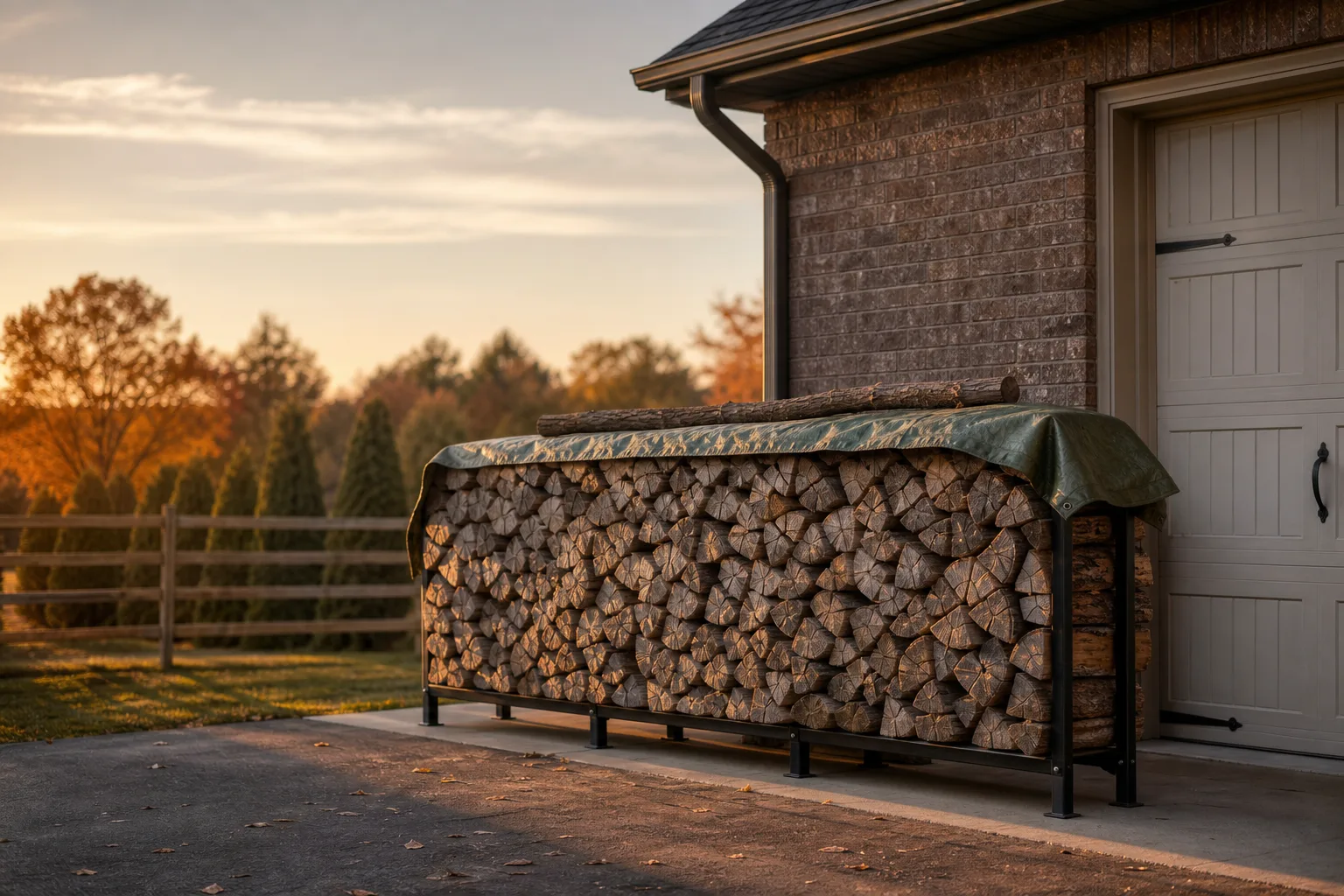
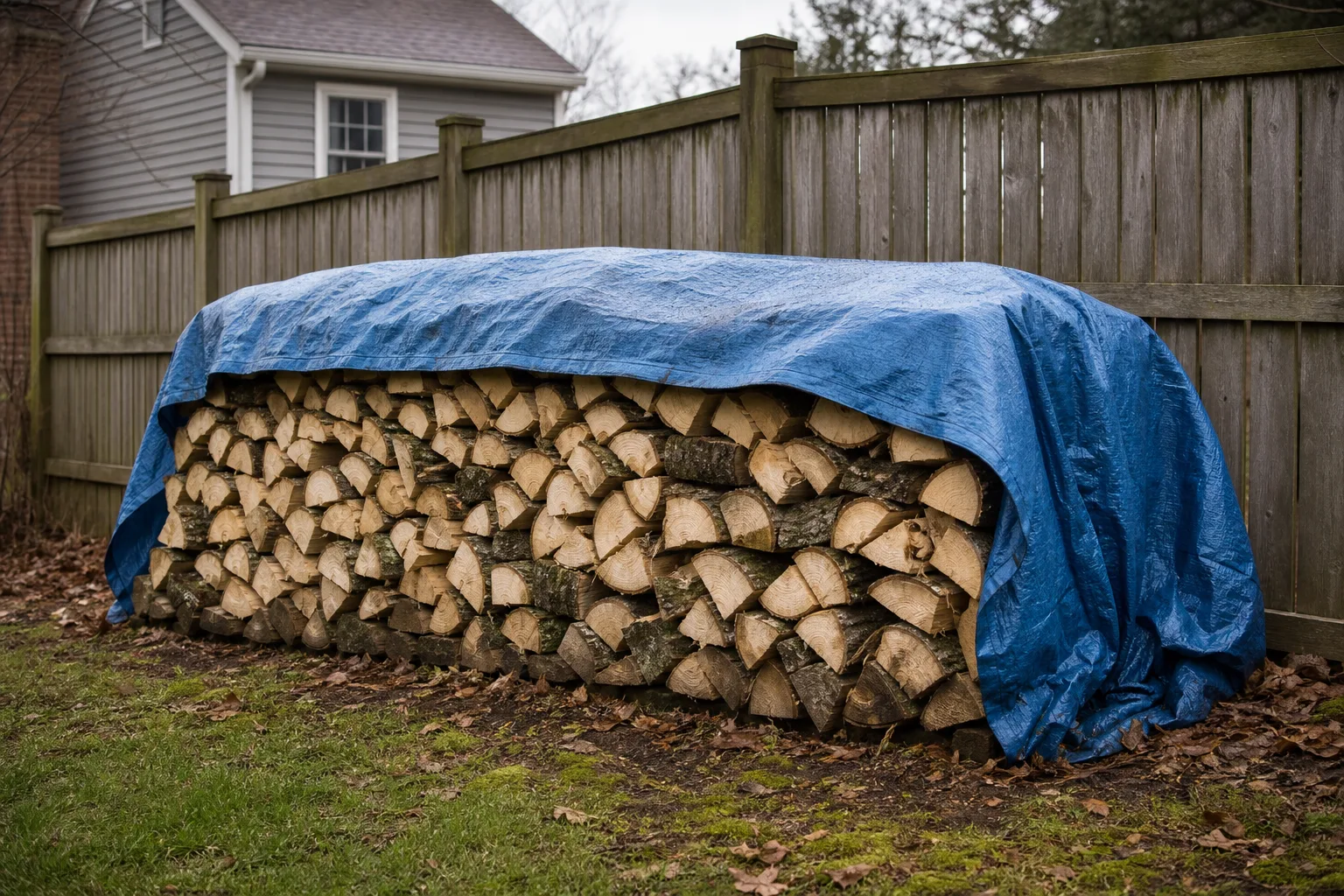
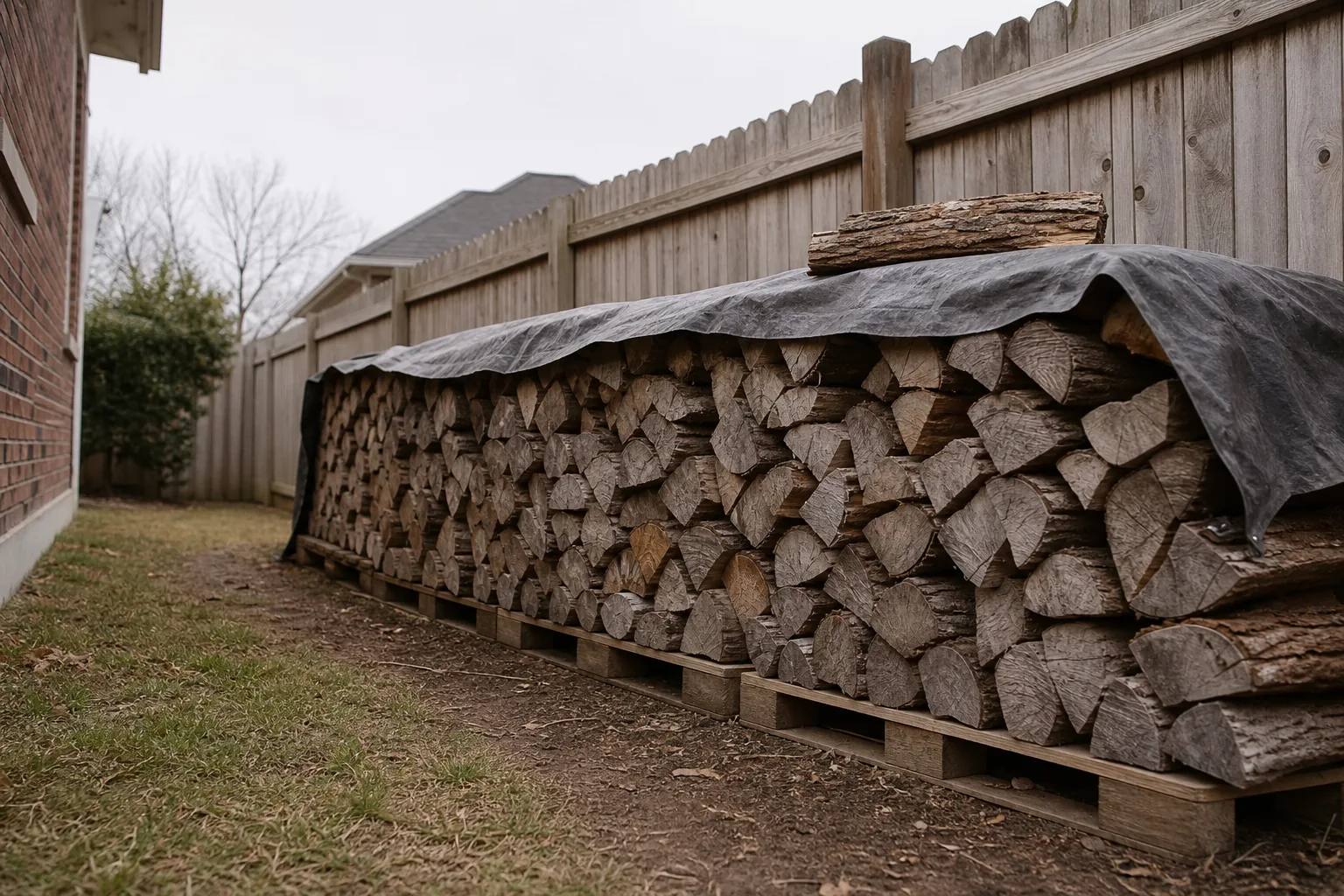
The EPA's storage guidance is one sentence and it settles most arguments: store wood outdoors, off the ground, with only the top covered, because covering the sides traps in moisture.
That last clause is the one people get wrong.
Good to know: The tarp goes over the top of the stack only, like a roof, weighted down and not reaching the ground. A tarp wrapped around the sides of a woodpile turns it into a greenhouse. The wood sweats, the air cannot move, and the stack you thought you were protecting from rain is now holding its own humidity against itself.
The stack itself
Split before you stack. Round logs dry at a fraction of the rate, because bark is the tree's own waterproofing and it is still doing its job.
Get the wood off the soil on pallets, scrap lumber or a metal rack. Ground contact wicks moisture straight back into the bottom row and invites rot and insects.
Build one or two rows deep rather than a wide block, and orient the stack so the wind runs through it. Sun helps. Moving air helps more.
Then leave it alone. The EPA's floor is six months, and that is a floor rather than a target. Lighter woods can sometimes get there in one good summer, depending on split size and climate. Oak is the slowest of the common species by a wide margin, and dense hardwoods are commonly reported to need somewhere in the range of twelve to twenty-four months. The meter decides, not the calendar.
If the seasoned firewood you bought turns out to be wet
This is the section for the reader who ran the checks, got a bad answer, and already paid.
You have more room to fix it than you think, though not on a two-week timeline.
Resplit the larger pieces. Cutting a fat split in half doubles the exposed surface and opens a fresh path for water to leave, and it is the single most effective thing you can do to a stubborn pile.
Restack it properly: off the ground, single rows, top-covered, sides wide open, in the sunniest and windiest spot you have. Then buy enough genuinely dry wood to get through the season you are in, and treat the wet load as a future season's supply.
The one thing not to do is burn it anyway on slow, damped-down overnight fires. That combination is the fastest route to glazed creosote there is, and the repair costs more than the wood ever did. The EPA lists wet wood among the materials not to burn at all, so the answer here is not a technique, it is dry wood. If last season ran on questionable wood, have a sweep look at the chimney flue liner and tell you what is actually accumulating up there.
How VIO helps when your seasoned firewood turned out not to be
If you have spent a season burning seasoned firewood that was not as dry as it was sold to be, the useful next step is not another article. It is having somebody put eyes and a camera inside your flue and tell you which degree of creosote you are dealing with, because degree one brushes out on a routine visit and degree three does not.
Here is what VIO is, plainly. We are not a chimney company. We do not sweep flues, we do not reline them, and we do not send our own trucks anywhere, because we do not have any.
What we do is match homeowners with independent chimney companies working in their area. You tell us the problem when you request service, and we hand it to a company that covers your zip code. The pro who shows up works for that company, not for us.
On the money side, we ask every company in the network to put its estimate in writing before any work starts, and you should insist on exactly that, from anyone you call. A verbal number for chimney work is how surprises happen.
Tell us what you have been burning, what the glass looks like, and how the fires have been starting. That is usually enough for the company we match you with to know whether they are coming out for a routine chimney cleaning service or something that needs a closer look first.
If the inspection turns up masonry trouble hiding behind the creosote, chimney repair services come through the same referral. One call, not three.
Get it looked at before the first fire
NFPA 211 calls for an annual inspection. Tell us where you are and what you have been burning, and we will match you with an independent chimney company in your area. We ask every company in the network to put its estimate in writing before any work starts, and you should insist on exactly that.
Call (513) 655-6702 or request service online.
The short version
Seasoned firewood is wood below 20 percent moisture, and the word on the invoice is not evidence of it.
Check the split faces, lift a couple of pieces, knock two together, glance at the ends without believing them, and buy a meter if you burn more than a few fires a winter. Buy by the cord, buy local, and ask when it was cut instead of asking whether it is seasoned.
Do that and the fires light on the first match, the glass stays clear, and the inside of your chimney stays boring. Skip it for a winter and the wood turns out to have been the cheap part.
Symptom checker
What is your chimney doing?
Tap the closest match for an honest first answer.