



On this pageWhy a northeastern masonry & chimney comes apart the way it does7 sections+6
- Why a northeastern masonry & chimney comes apart the way it does
- The damage, named: what you are looking at from the driveway
- Masonry, flue, or crown: which problem do you have, and how you find out
- The repair options, side by side
- Why the calendar matters for northeastern masonry & chimney work right now
- How to vet a northeastern masonry & chimney contractor
- How VIO helps with northeastern masonry & chimney work
Quick answer
Northeastern masonry & chimney problems fall into three groups: masonry damage such as spalled brick and open mortar joints, flue damage inside the liner, and crown or cap failure at the top of the stack. Freeze-thaw cycling drives this damage, because water expands by roughly nine percent when it freezes inside brick, mortar and concrete. Which group you are in decides which trade you should call.
You find it on the ground first.
Orange-red grit on the roof shingles. A few flakes of brick face in the gutter. Something grey and chalky on the lawn below the stack that was not there in June.
That is the moment people start typing northeastern masonry & chimney into a search bar, and it is also the moment the wrong assumption gets made.
Here is what gets missed. A chimney is not one structure weathering at one rate. The section above your roofline and the section below it live in two different climates on the same house, and which one is failing decides what repair you are shopping for.
So read this before you call anybody. It names the damage, forks the problem into the three trades it could belong to, and explains why this week's overnight low matters.
Why a northeastern masonry & chimney comes apart the way it does
Brick is not waterproof. Neither is mortar, and neither is the concrete slab on top of the stack: all three absorb water and give it back slowly.
In a warm climate that is a nuisance. In a northeastern masonry & chimney, it is the whole story of how the thing comes apart.
Water expands about nine percent, and your brick is in the way
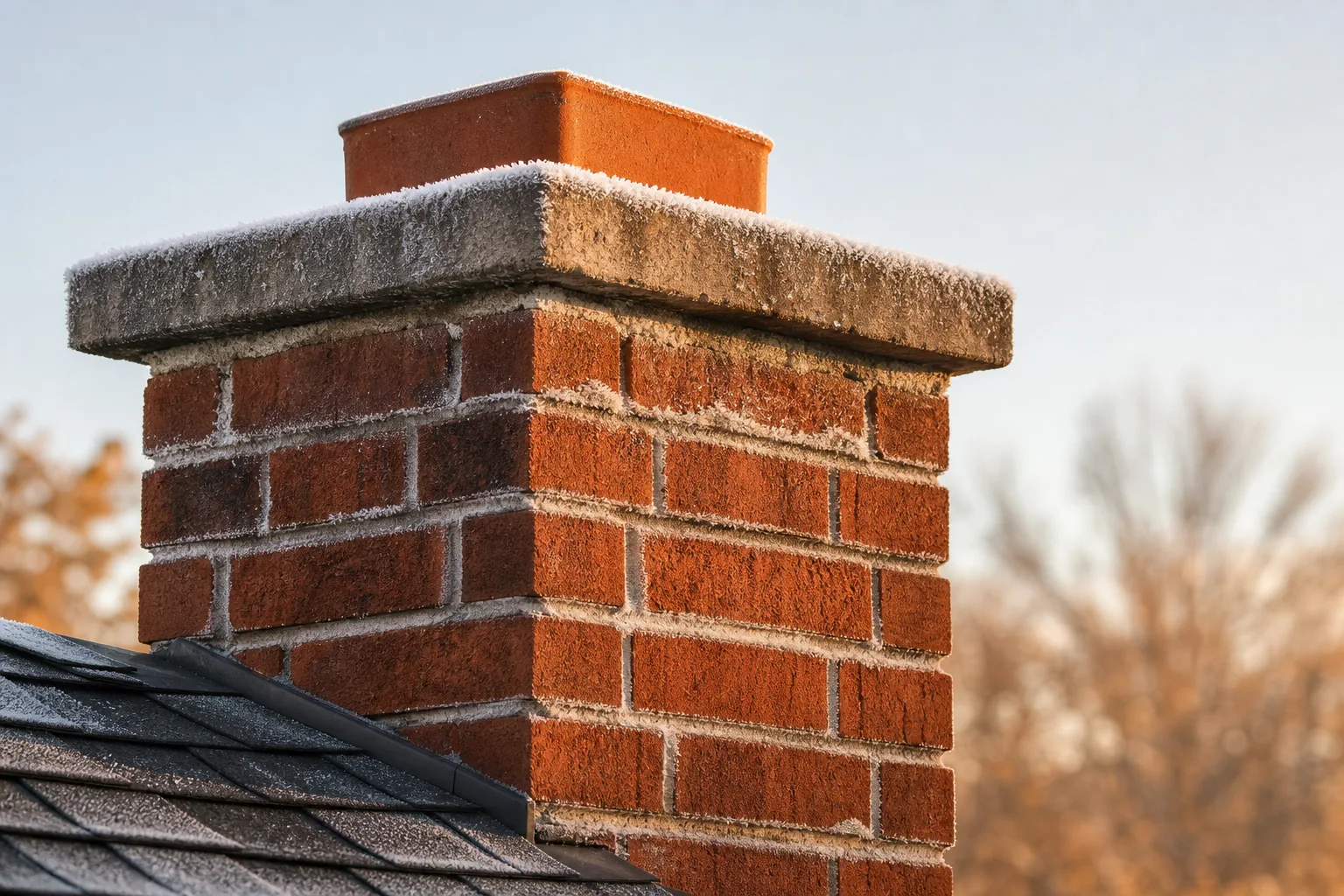
When water freezes it expands by roughly nine percent, and it does that inside the brick, inside the mortar joint, inside the crown, in a space that cannot get any bigger.
So the material gives instead: a hairline crack opens, or the face of a brick separates from the brick behind it.
The damage is cumulative. Every freeze widens the crack a little, and a wider crack holds more water for the next one. The chimney is not wearing down evenly. It is being pried apart from the inside, one cold night at a time.
A winter that hovers beats a winter that stays cold
Repeated cycling across the freezing point does more damage to chimney masonry than sustained cold does. Deep, stable cold locks the water up as ice and leaves it there. A week of forty-degree afternoons and twenty-five-degree nights runs the freeze, expand, thaw, refill sequence over and over.
A January thaw is not a break for your chimney. It is another turn of the screw.
Above the roofline and below it are two different chimneys
Below the roof, the stack is shaded, sheltered on at least one side, and warmed a little by the house it passes through. Above the roof it takes wind, rain, ice and snow with nothing in between.
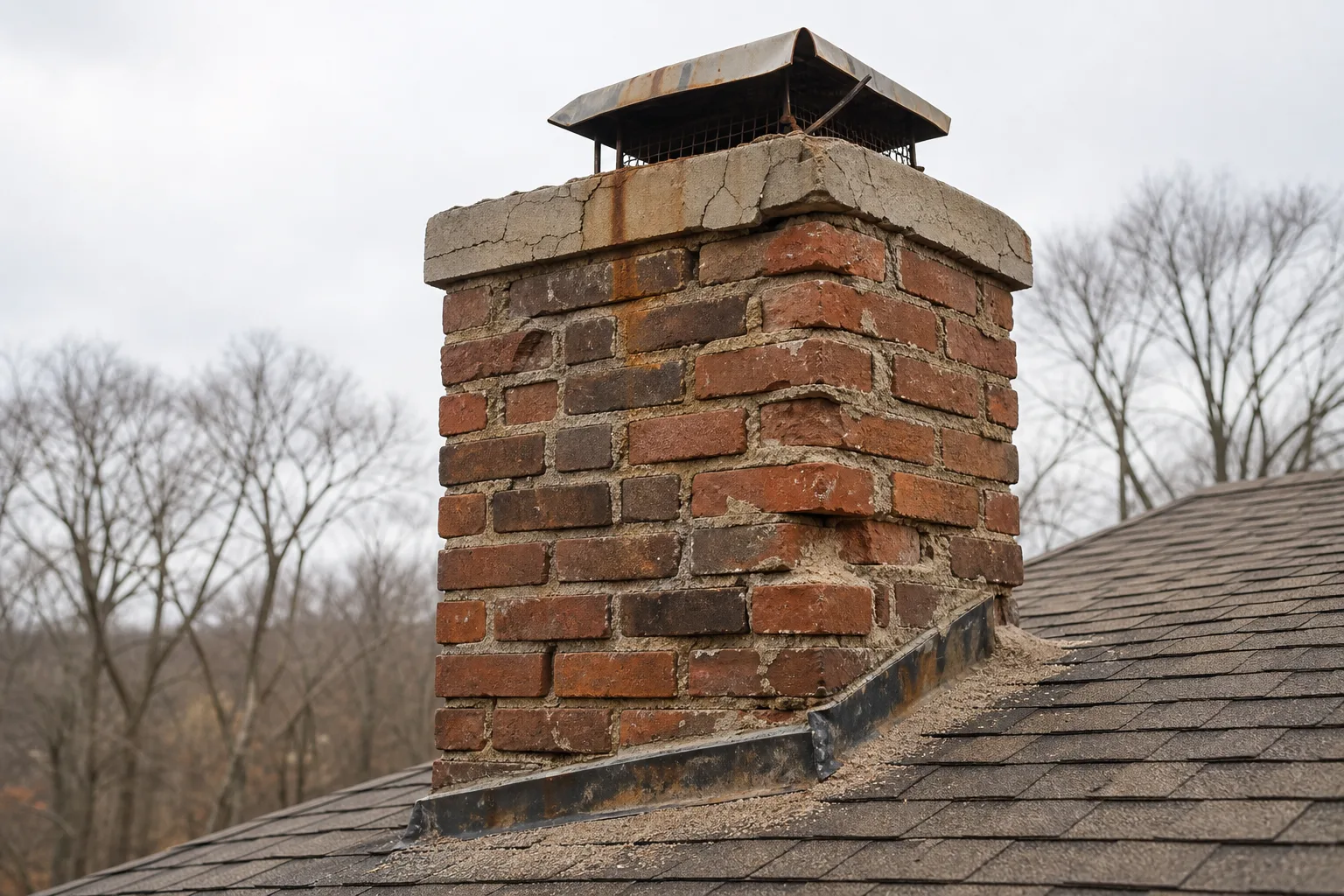
Those halves deteriorate at different rates, which is why the mortar joints above the roofline are the first place a good mason looks. Where an inspection finds that the damage on a northeastern masonry & chimney stops at that line, the repair can be scoped from the roofline up.
Good to know: When you describe your chimney on the phone, say whether what you see is above the roofline or below it. That one detail shapes the conversation more than anything else you can offer.
The damage, named: what you are looking at from the driveway
You do not need to diagnose your own chimney. You do need the vocabulary, because "it looks bad" gets you a different phone call than "the faces are popping off the brick above the roofline."
Spalled brick faces
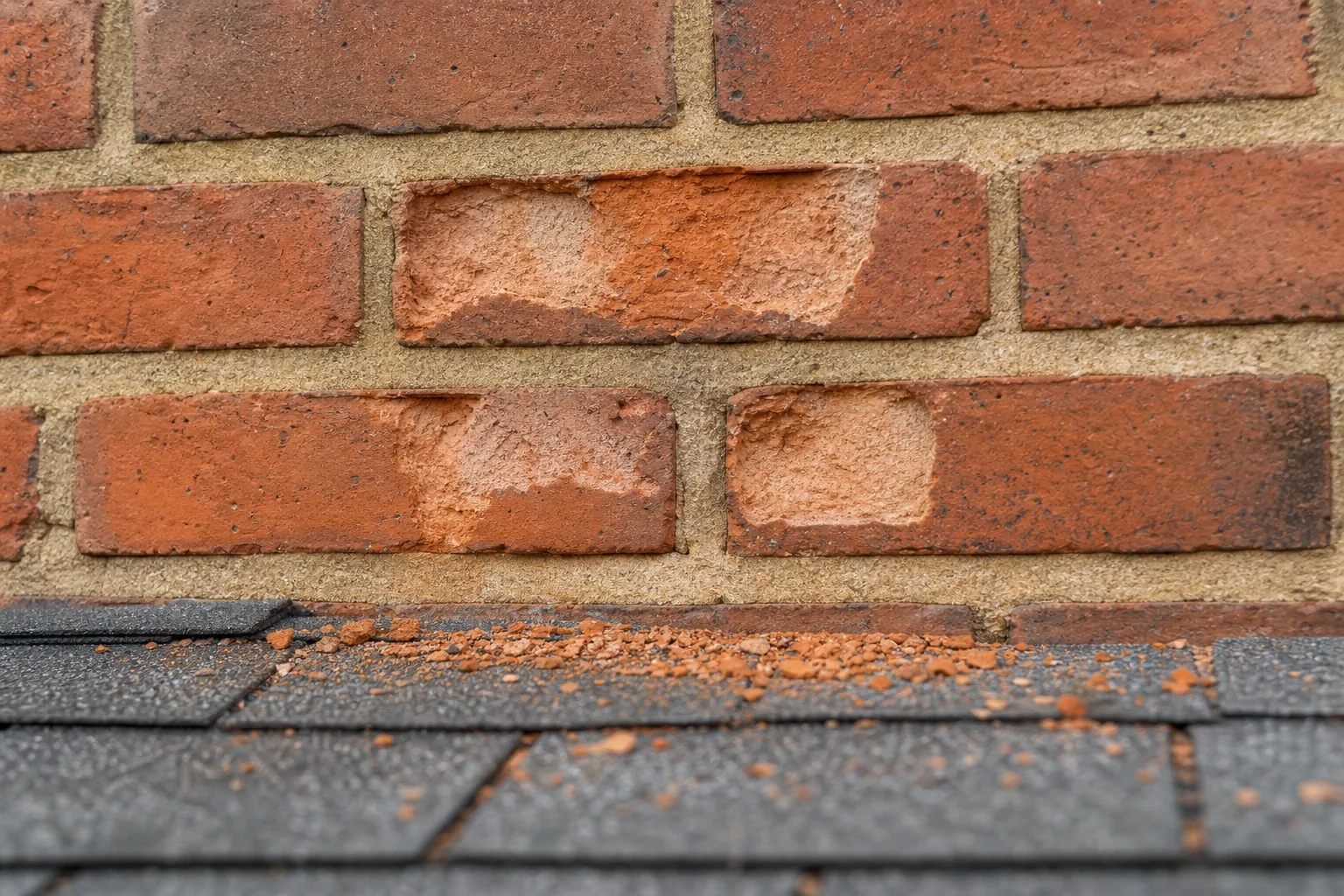
Spalling is the face of the brick breaking off, leaving a lighter, rougher, slightly recessed patch where the smooth surface used to be. The exposed faces of the stack are the ones to look at, and the fragments end up on the shingles and in the gutter.
Open and crumbling mortar joints
Sound joints are hard and continuous. Failing joints have receded into shadow, crumbled to something you can rake out with a fingernail, or gone missing in sections, with sand and mortar crumbs collecting on the flashing. Check the ones above the roofline first.
A cracked crown
The crown is the slab at the very top, sloped down and away from the flue toward the outer edges. It is shaped to shed water off the top of the chimney instead of letting it sit.
A failing crown shows map-pattern cracking, fine cracks radiating from the flue tile, broken-off corners, or moss in the gaps.
Once it is cracked, water reaches the masonry underneath, where the freeze-thaw sequence goes to work somewhere you cannot see from the ground.
Myth vs. fact: A cap and a crown are not the same object. The crown is the concrete slab at the top of the stack. The cap is the metal cover fitted above the flue opening to keep rain and animals out. People swap the words on the phone, and it garbles the call: one is a mason's work, the other is not.
Masonry, flue, or crown: which problem do you have, and how you find out
Chimney trouble in this region lands in one of three buckets, and they are three different phone calls.
Signs that point at the masonry
Spalled faces, open joints, brick that looks displaced, loose debris on the roof, or a stack that reads as leaning when you sight up the corner against something straight like a downspout.
Signs that point at the flue
The flue is the liner inside the chimney, the passage the smoke and combustion gases travel through. On a lined masonry chimney it is often clay tile, terracotta orange-tan, and you may see the top few inches above the crown.
The signs are quieter: pieces of clay tile in the firebox or at the cleanout, a smoky smell indoors, smoke spilling into the room instead of drawing, rust on the damper. On a stove flue, some of this overlaps with ordinary wood stove upkeep.
A liner that is no longer continuous is a combustion safety issue, not a cosmetic one, and it belongs to whoever handles chimney flue liner installation rather than to a general mason.
Signs that point at the crown or the cap
Cracking or broken corners on the slab. Rust streaks running down from the metal cap that sits over the flue opening. A lid that is missing, bent or crooked. Torn screen. Nesting material at the top.
Water stains on the ceiling or wall beside the chimney chase, with no roof leak anybody can find, are worth tracing back to the top of the stack. Water travels down, and it does not say where it came in.
How you find out for sure
The trade does not eyeball this. NFPA 211 defines three inspection levels, and knowing which one applies to you is real leverage on a phone call.
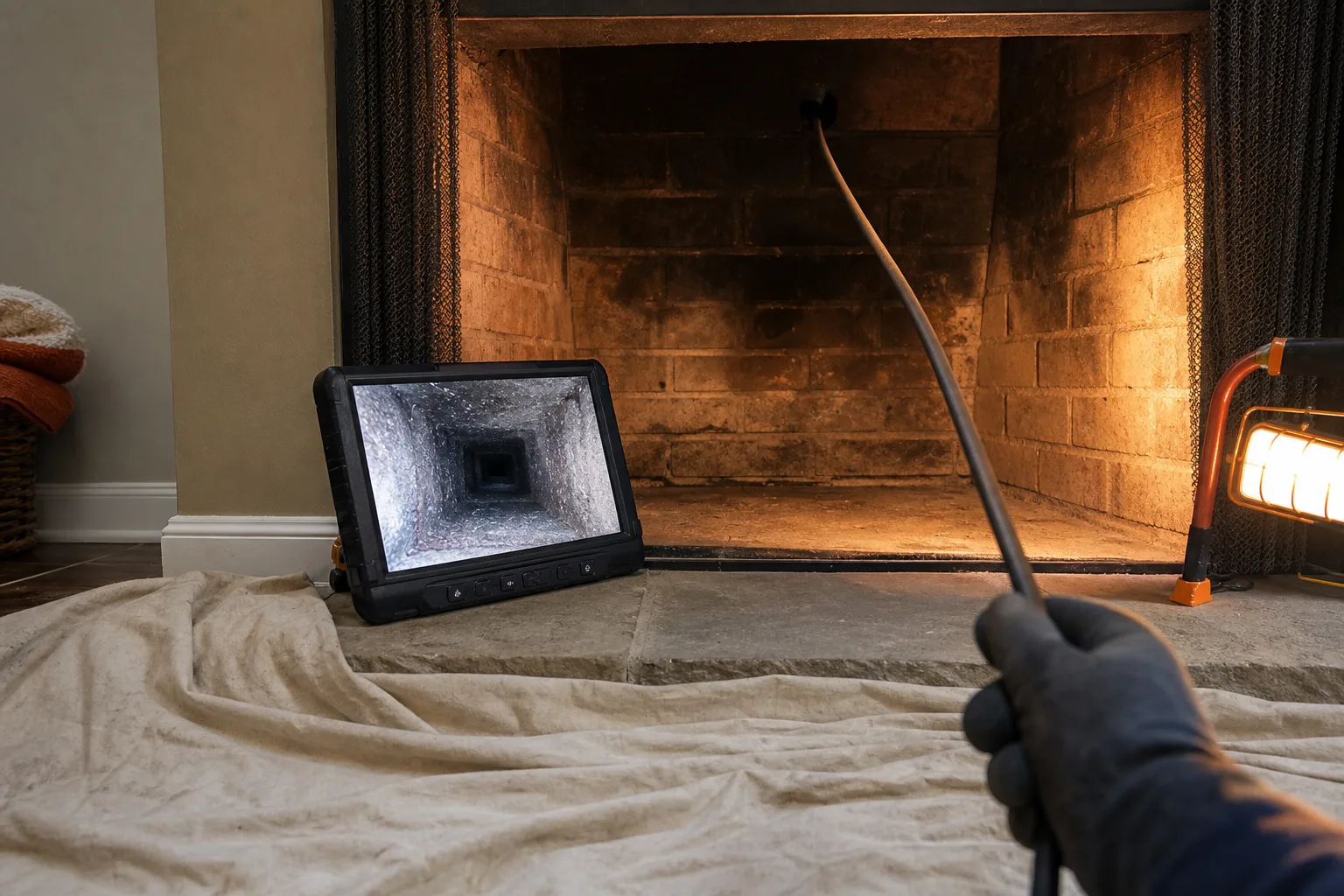
Level 1 is for a system that has not changed and will be used as it has been. The technician examines the readily accessible portions of the chimney exterior and interior, plus the accessible portions of the appliance and the chimney connection, looking for basic soundness of the structure and flue and basic appliance installation and connection. A camera is not required at Level 1, and rooftop access is not within its scope.
Level 2 is required, not suggested, in specific situations: upon sale or transfer of the property, on changes to the system (a change of fuel, a change in the shape or material of the flue, or adding an appliance of a different type, input rating or efficiency), after a malfunction or an event likely to have caused damage to the chimney, after a chimney fire, and after a "potentially damaging external event such as" a building or chimney fire, a seismic event, or a weather event.
It includes everything in Level 1 and adds a video scan that records the interior of the flue along its full length. That scan is how cracks, gaps, collapse or blockage get found when they cannot be seen from either end.
Level 3 is the highest level, reserved for cases where there is reason to suspect concealed hazards that cannot be evaluated at Level 1 or Level 2. It can involve removing or opening portions of the building or chimney structure, but only as necessary to investigate the specific area of concern.
The levels stack: Level 2 contains Level 1, Level 3 contains both.
If you are buying or selling, you are on the list quoted above. So is anyone whose chimney has been through a fire or a genuinely damaging weather event. Ask for Level 2 by name.
Safety note: An annual Level 1 inspection is not the same thing as an annual sweeping, and sweeping frequency depends on the fuel and how much you burn. Separately: if a carbon monoxide alarm activates at all, get everyone out into fresh air and call the fire department from outside.
Not sure which trade you need? Describe what you are seeing once and let VIO sort it out. We match you with an independent local company that does that specific kind of northeastern masonry & chimney work, so you are not making three phone calls just to find out whose job it is.
Call (513) 655-6702 or tell us what you are seeing.
The repair options, side by side
These are the four repairs to understand before an estimate lands, and they are not interchangeable.
| Repair | What it addresses | Where on the chimney | What decides whether it is the right call |
|---|---|---|---|
| Repointing | Joints that have receded, crumbled or gone missing, while the brick is still sound | Wherever joints have failed, including above the roofline | Whether the brick around them is solid enough to work against, and how deep the failure runs |
| Roofline-and-up rebuild | Masonry that has moved or spalled through, or joints too far gone for pointing to hold | The stack from the roof plane up, rebuilt course by course | How far down the damage goes. The rebuilt section follows state and local building code |
| Crown repair or rebuild | A cracked or broken crown letting water into the masonry underneath | The slab at the top, around the flue tile | Whether the slab can carry a repair or has to be recast |
| Relining | A flue liner that is cracked, gapped, offset or no longer continuous | Inside the chimney, the full height of the flue | What the recorded video scan shows, and which appliance and fuel the flue serves |
Repointing
Repointing is not smearing new mortar over old joints. The deteriorated material is cut out to an appropriate depth first, and then new mortar goes in. Done before the freeze, it closes a path water has been using.
One question tells you a lot about who you hired: how did you choose the mortar mix. That depends on the age and hardness of the brick already in the wall, and it is a judgment call, not a default.
A roofline-and-up rebuild
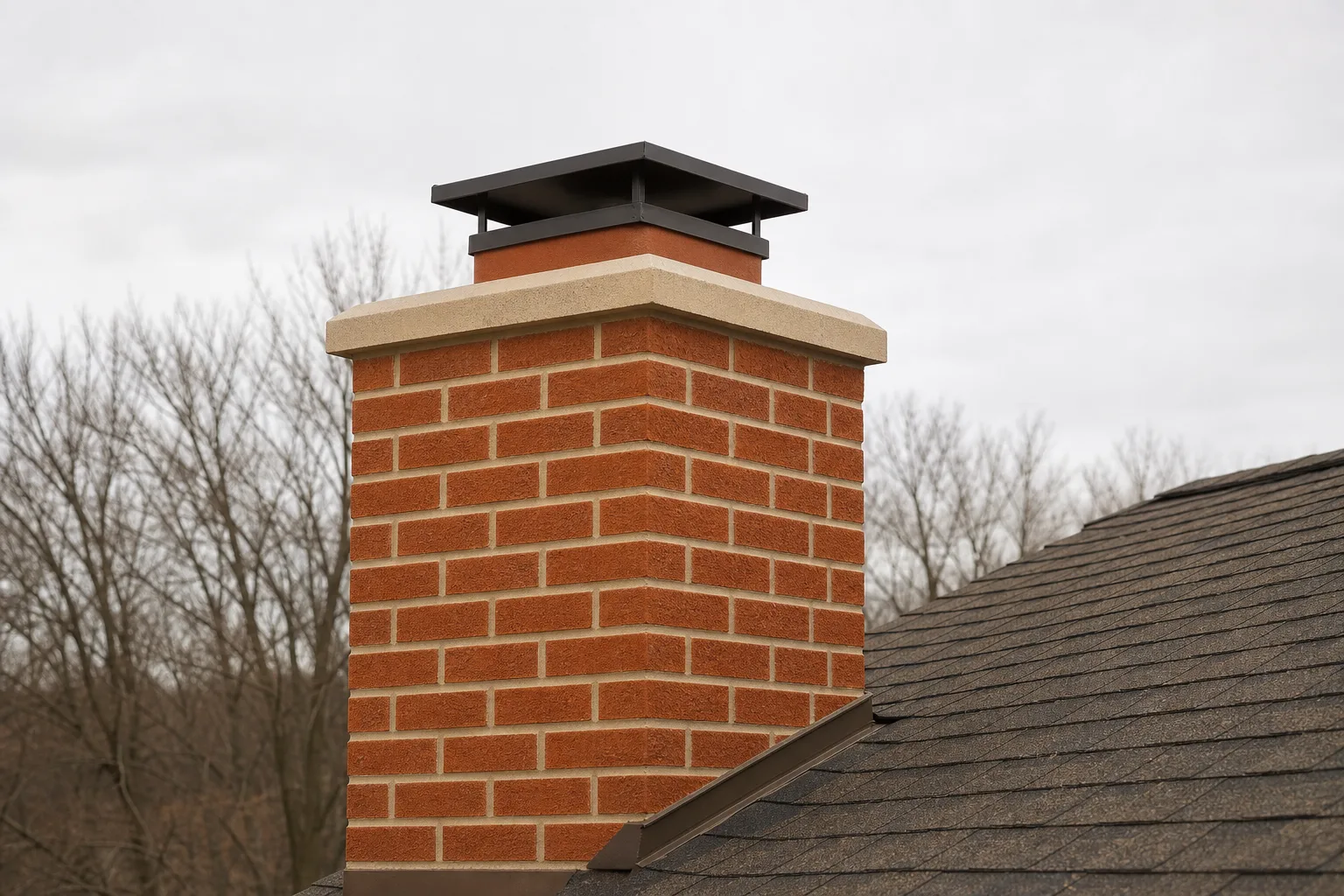
Where deterioration on a northeastern masonry & chimney is confined to the upper section, this is the recognized repair: the damaged masonry is taken down to the roofline and rebuilt brick by brick, to state and local building code.
It sounds drastic. Whether it is depends on how far down the damage goes, because the half of the stack that took the weather is the half that needs rebuilding.
Pro tip: Ask which course the rebuild starts at, and why that course. A mason who has actually looked will tell you what they found at that line. A vague answer is information too.
Crown repair and crown rebuild
Sometimes the slab can be repaired. Sometimes it comes off and gets recast, and a rebuild is the chance to correct the details that matter: how far the crown projects past the face of the brick, whether there is a drip edge under that projection, how the top surface is sloped, and whether it is separated from the flue liner rather than bonded tight to it.
Those four details are what separate a crown shaped to shed water from a slab of concrete sitting on a chimney.
Relining
Relining is flue work, decided by what the camera found rather than by how the outside of the stack looks. If the term is new to you, it helps to know what a chimney liner actually is before the estimate conversation starts.
From the field: A stack can read as sound from the driveway and be soaked at the top. The view from a ladder at the roofline is a different view from the one you get on the lawn, which is why a ground-level photo is a start to the conversation and not the end of it.
Why the calendar matters for northeastern masonry & chimney work right now
What cold does to fresh mortar
Masonry work has a range it likes. Roughly forty to ninety degrees Fahrenheit is treated as normal conditions, and below about forty, cold-weather preparation and protection measures come into play.
Below thirty-two, mortar and cementitious patching material can freeze before they set. Freezing fresh mortar is not a delay. It is a compromised joint.
A working rule cited across the trade: look for a forecast holding above thirty-two degrees for thirty-six hours or more after the material goes in.
Good to know: That thirty-six hour window is worth saying out loud when you schedule. Ask what the plan is if the overnight lows drop while the mortar is curing, and you learn whether you are talking to someone who thinks about this climate.
When waiting for spring is better, and when it is not
If the masonry is worn but water is not reaching anywhere it can do damage, spring gives the work a wider, kinder window.
Waiting is a mistake when water is already getting in. A cracked crown, an open joint above the roofline, or a missing cap lid means the freeze-thaw sequence has an open invitation for the whole winter, and that damage is cumulative.
So the question is not "can this wait." It is "where is the water going right now." Put that to whoever climbs the ladder, and let the answer shape the timing of any northeastern masonry & chimney repair you are weighing.
How to vet a northeastern masonry & chimney contractor
Work through this before you commit to anybody.
The northeastern masonry & chimney checklist
- Somebody physically got to the roofline or above it, rather than assessing from the lawn.
- You were shown photographs of your own chimney, not a gallery of other people's.
- The inspection level was named, and if you are on the required list above, "Level 2" came out of their mouth without prompting.
- CSIA certification, a tested credential the trade itself points to, was stated and can be checked.
- Licensing and insurance were offered in writing, not described verbally.
- Permits were addressed. Requirements vary by state and municipality, so the question is whether this scope needs one in your town and who pulls it.
- The payment schedule was explained up front and tied to stages of the work.
What the estimate itself has to spell out
The vague estimate is the real risk here. Not the work, the description of the work. A northeastern masonry & chimney estimate you can compare against another one names:
- Scope by location: which elevations, above or below the roofline.
- Access: ladder, roof jacks or scaffold, and who sets it up.
- The flue: whether the liner is touched, protected or left alone.
- Exclusions: what is not in the number.
The questions to ask out loud
- What did you see above the roofline, specifically?
- Is this a masonry problem, a flue problem, or both?
- Which inspection level are you performing, and why that one?
- Did you scan the flue, and can I see the recording?
- Where does the water appear to be getting in?
- How did you choose the mortar mix for my brick?
Specific answers mean you are in good hands. General ones mean keep calling. Once the structural work is settled, keeping the brickwork clean is a separate conversation.
How VIO helps with northeastern masonry & chimney work
The plain version: VIO is a referral service, not a contractor. We do not climb your chimney and we do not lay brick.
What we do is take the three-phone-calls problem off your plate. You describe once what you are seeing, the grit in the gutter, the cracked slab on top, the stain beside the chase, and we match you with an independent local company that does that specific kind of work in your area.
The fork earlier in this article is real, and finding the right specialty by cold-calling is how people lose a week of a narrowing season.
On estimates, our position is simple: we ask every company in the network to put its estimate in writing before any work starts, and you should insist on exactly that.
Your chimney is two chimneys, and only one of them has been taking the winter. Go look at the gutter, look at the slab on top, note whether what bothers you sits above the roofline or below it, and make that the first sentence you say to whoever you call about northeastern masonry & chimney repair. A better question gets a better answer.
Nights are getting colder. If water is getting into your masonry right now, the window for mortar work is narrowing. Tell us what you found and we will match you with an independent local company that handles it.
Call (513) 655-6702 or request service online.
Symptom checker
What is your chimney doing?
Tap the closest match for an honest first answer.