



On this pageWhat Wood Stove Maintenance Actually Covers10 sections+9
- What Wood Stove Maintenance Actually Covers
- The Wood Stove Maintenance Order of Operations
- Your Firewood Decides Your Maintenance Load
- The Weekly Rhythm: Ash, Glass, and What They Tell You
- The Parts You Inspect by Hand
- Creosote, the Flue, and the Annual Inspection
- Wood Stove Maintenance Troubleshooting: Symptom to Cause
- Where DIY Wood Stove Maintenance Stops
- How VIO Helps With Wood Stove Maintenance
- One Last Thing Before You Light It
Quick answer
Wood stove maintenance has three layers. While you burn, ash comes out every two to three days and the glass stays clear. Before the season, you inspect the door gasket, firebrick, baffle and secondary air tubes by hand. Once a year, a certified professional inspects the chimney and venting, which NFPA 211 calls for at least annually. Burning wood at 20 percent moisture or less makes all three layers easier.
The first cold Saturday of the season is when the search happens. Someone walks past the stove, thinks about lighting it, and goes looking for a wood stove maintenance checklist.
There are plenty of those. What is harder to find is the order.
Order matters more than the list does. Test your door gasket before the flue gets swept and you have learned very little, because sweeping changes the surfaces you were reading. Buy green wood in October and, depending on the species, the split size and how you store it, you may still be burning it wet in January.
So here is the sequence, start to finish, with the piece the checklists leave out: a clear line in every section between the work that belongs to you and the moment a job stops being maintenance and turns into a repair.
You can do more of this yourself than you probably expect. You should also know exactly where to put the tools down.
What Wood Stove Maintenance Actually Covers
Think of it as three layers. You own two of them outright.
The first is the rhythm while you are burning. Ash, glass, a look at how the fire is behaving. Minutes, not hours, repeated all winter.
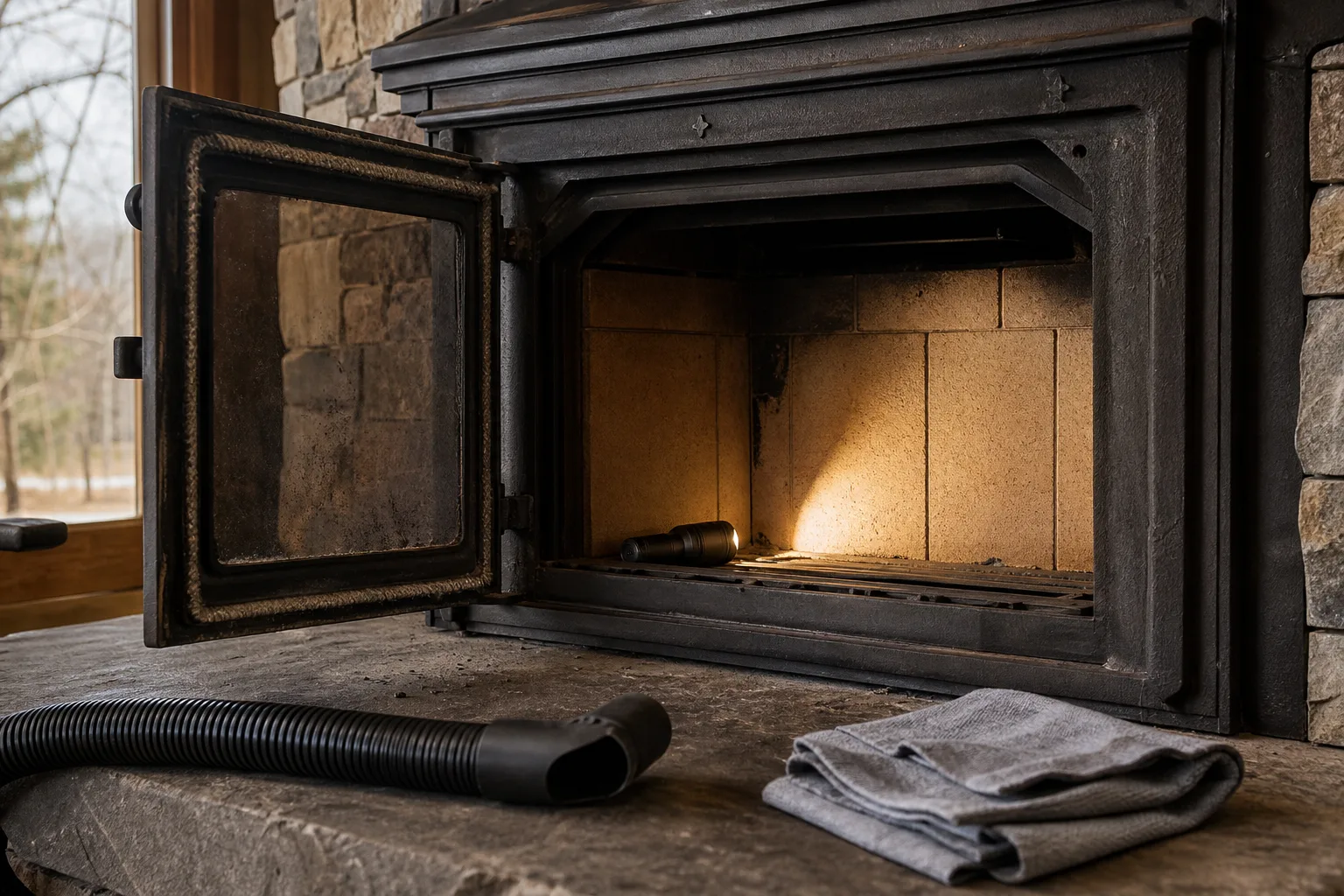
The second is the hands-on inspection before the first fire, and again when you shut the stove down in spring. Door gasket, firebrick, baffle, secondary air tubes, the latch and the hinges. Call it a morning with a flashlight, a shop vacuum and a rag.
The third layer is the annual inspection of the venting system by a certified chimney professional. That one is not yours, and this guide will not pretend otherwise.
Good to know: the stove and the chimney are one system. A stove in perfect shape venting into a neglected flue is still a problem, and a freshly swept flue sitting above a stove with a failed door seal will load up again faster than it should.
The Wood Stove Maintenance Order of Operations
The sequence below exists because each step changes what the next step can tell you. Skip around and you will still do the work, you just will not learn anything from it.
Wood stove maintenance before the first fire
Start with fuel, because fuel takes months and everything else takes hours. If your wood is not already split, stacked and seasoning under cover, that is the emergency, not the gasket.
Then the flue. Get the annual inspection done, and whatever sweeping it calls for, before you touch the stove itself. A sweep sends fine soot down the connector and into the firebox, and you do not want to do your careful parts inspection twice.
Then the stove. Ash out, firebox empty, flashlight on, and work through the checklist further down this page.
Last, a test fire on a mild day with the windows cracked. First fires smell like cooking paint and dust burning off the stove top, and you want to meet that smell in October, not in a January cold snap.
Pro tip: test the door gasket after the flue work, not before. Sweeping drops grit into the door channel and onto the sealing face, and a gasket that seals fine can fail a test taken through a film of soot.
The weeks you are actually burning
Ash on a cycle. Glass when it bothers you. A weekly glance at the connector pipe and the stove top for anything that has changed color, loosened, or started weeping rust.
That is genuinely it. The burning season is not when you rebuild things.
When you shut it down in spring
Clean it out completely, because ash holds moisture and moisture plus ash plus a steel firebox all summer is how a stove rusts from the inside.
Leave the air control open and the door cracked so the firebox can breathe. Then write down anything you noticed over the winter, because you will not remember it in September. You never do.
Your Firewood Decides Your Maintenance Load
Everything downstream of the fire is set by what you put in it. Wet wood is the origin of the blackened glass, the sluggish heat, the creosote, and the wood stove maintenance headaches that get blamed on bad luck.
The 20 percent rule, and the meter that settles it
The EPA's Burn Wise program puts the number at 20 percent moisture content or less, and manufacturers of EPA-certified stoves commonly aim their guidance at the 15 to 20 percent range.
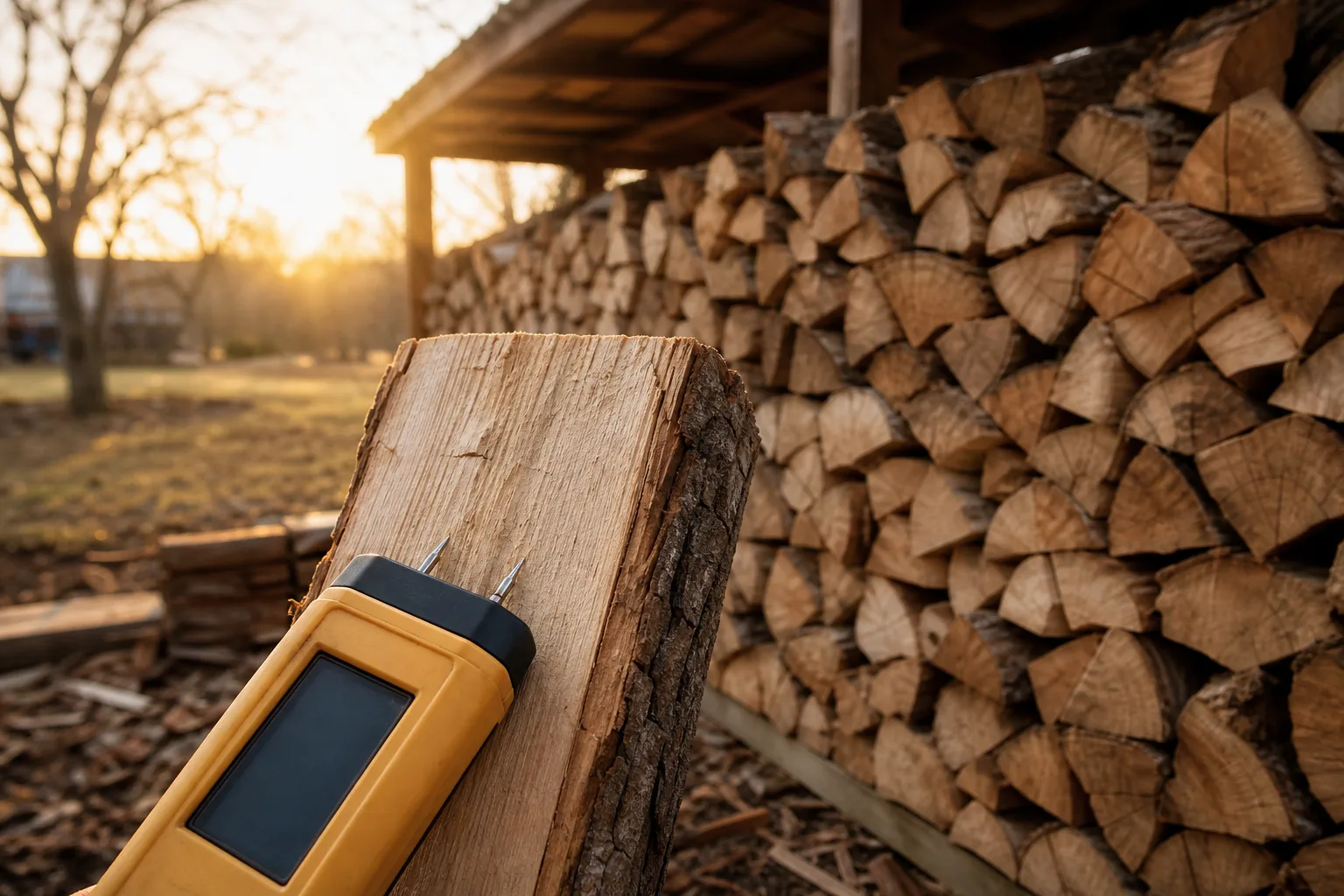
You cannot judge that by eye or by heft. A pin-type moisture meter ends the argument in about four seconds.
Read it right: split a piece open, press the pins into the fresh face, across the grain. Reading the weathered outside of a split tells you about the weather, not the wood.
The other tells are free. Seasoned hardwood shows checking, those radial cracks in the end grain. It rings rather than thuds when two pieces knock together, and the bark tends to loosen or drop off.
What never goes in the stove
Driftwood, painted or stained lumber, pressure-treated wood, trash, plastics, and anything containing zinc, sulfur or lead. Salt and chemical content attack stove internals, and they will ruin a catalytic combustor outright.
Safety note: this list is not about air quality etiquette. Burning treated or salt-laden wood puts corrosive compounds through your flue and your stove's internals, and the damage shows up later as a repair you did not connect to the fire you lit in November.
The Weekly Rhythm: Ash, Glass, and What They Tell You
This is the layer of wood stove maintenance that gets either over-thought or skipped entirely.
Ash, and the bed you leave behind
Ash comes out of the firebox roughly every two to three days of full-time heating. Not every morning.
Leave an inch or so behind. A shallow ash bed insulates the coal bed and helps the fire relight off yesterday's embers, which is the difference between a match and a whole rebuild every morning.
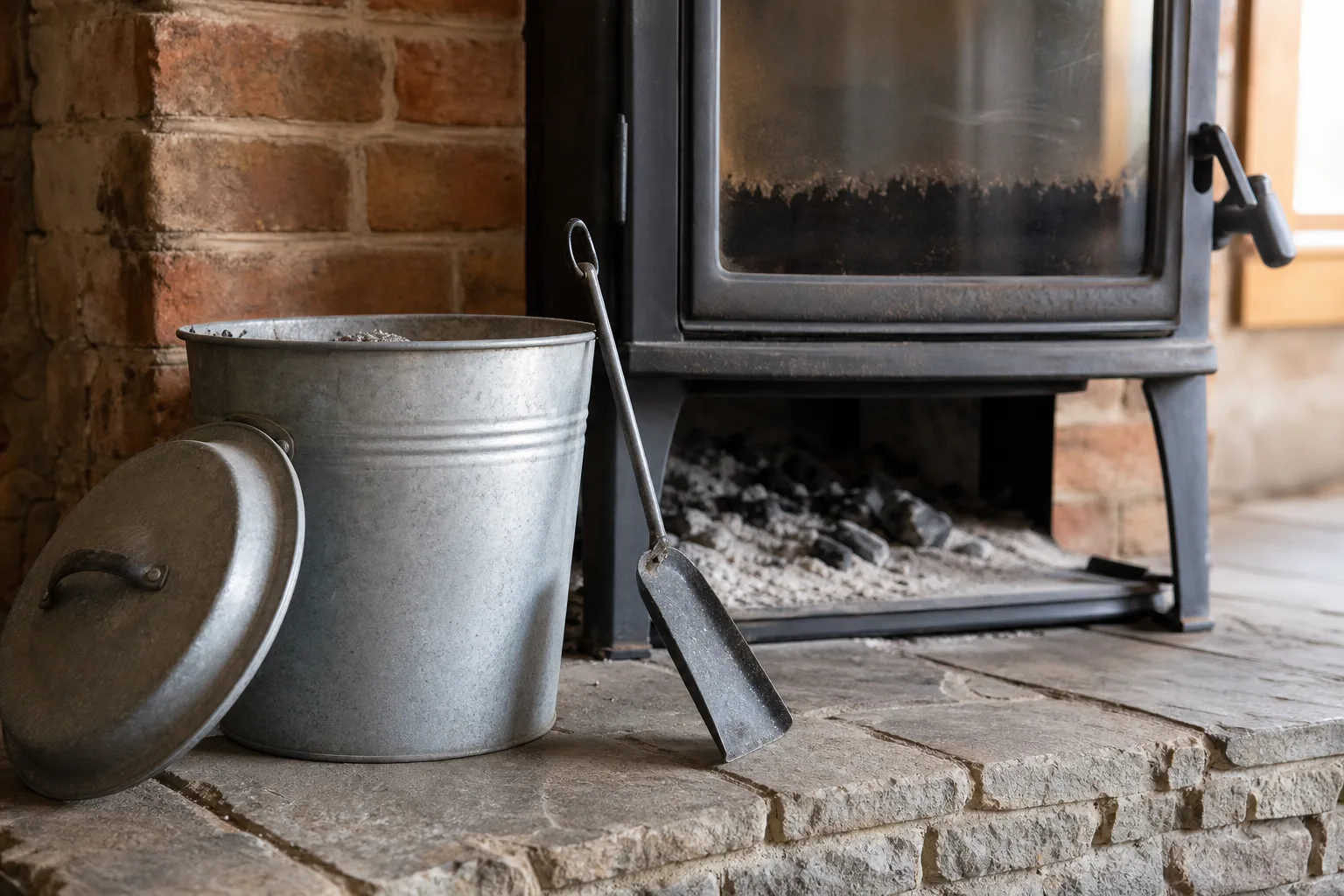
Carry it out in a metal pail with a lid, set on a non-combustible surface, and leave it there for days before it goes anywhere near the trash. Coals hide in ash far longer than seems reasonable. A cardboard box or a household shop vacuum is not an option here, ever.
Glass is a diagnostic instrument
Clean glass is not vanity. It is a gauge you already own.
Glass that stays reasonably clear through an evening is telling you the airwash is working and the fire is hot enough to burn its own smoke. Glass that goes black in a single burn is telling you something is wrong upstream, and the usual suspects are wet wood and an air control choked down too far, too early.
From the field: the stove tells you before any instrument does. If the glass hazes over within an hour of lighting, the fire has already answered the question you were about to ask about your wood. The glass is reading the fuel.
To clean it, use a damp rag dipped in cold wood ash. It is mildly abrasive, it is free, and it is sitting right there in the firebox.
The Parts You Inspect by Hand
This is the morning with the flashlight. Cold stove, empty firebox, good light, and no hurry.
The door gasket and the dollar bill
The test is old and it still works. Close the door on a dollar bill so half of it is inside, then pull. Drag means the seal is alive. If the bill slides out clean, the seal is gone.
Run it at four or five points around the door, not just at the latch. Gaskets fail unevenly, and the hinge side is worth checking first.
A worn rope gasket looks the part: flattened where it should be round, blackened, sometimes fraying out of its channel.
Myth vs. fact: the dollar bill test tells you the seal failed. It does not tell you why. A flattened gasket and a door that has warped out of plane fail the same test and need completely different answers, which is why a stove that still leaks air after a fresh gasket is a different conversation.
Firebrick
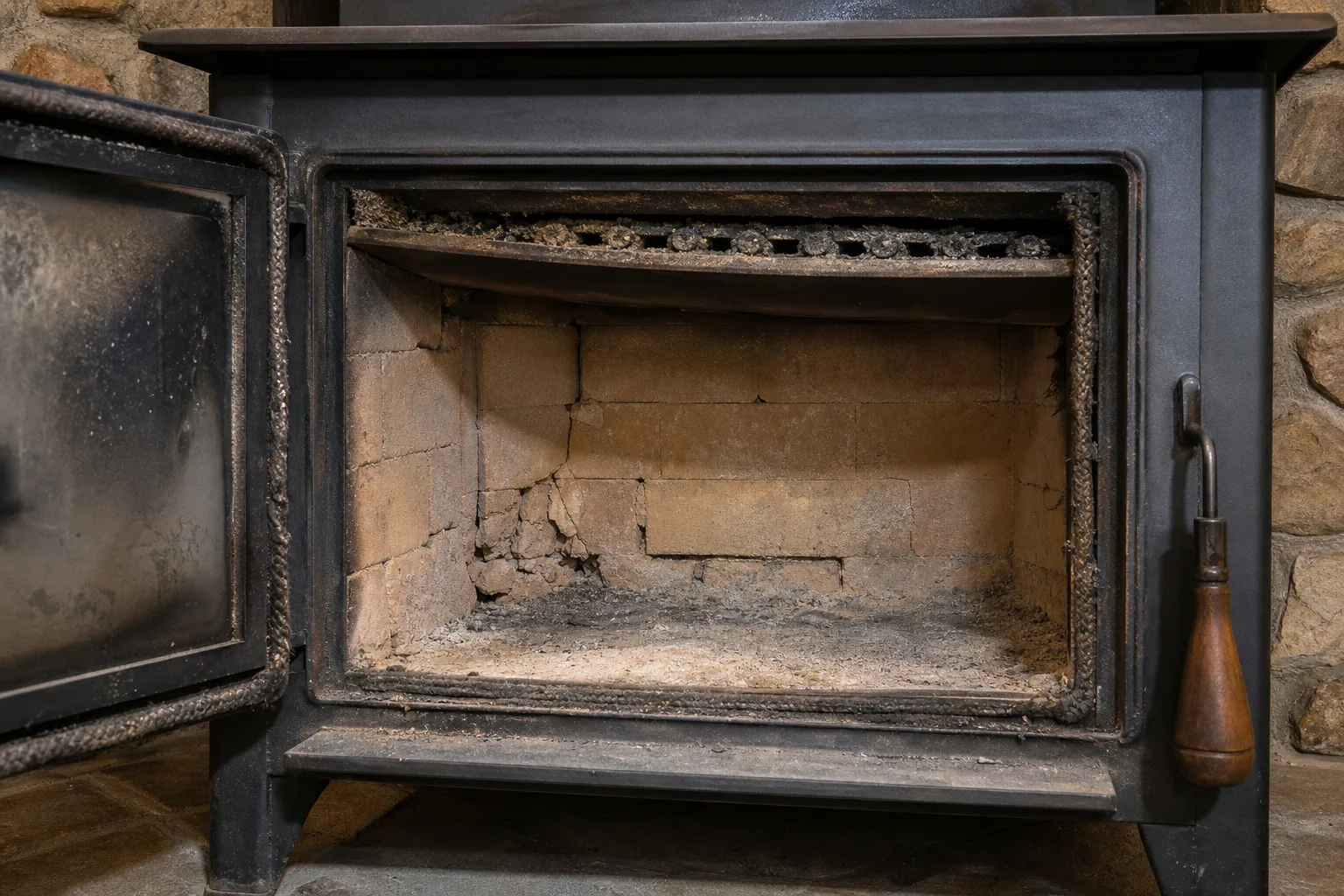
Look at the side and rear walls. Firebrick is a refractory lining that throws heat back into the fire and shields the stove body from it, so the bricks are supposed to take a beating.
Hairline surface cracks are normal. What matters is a brick that has broken through, crumbles when you press it, or has shifted enough to leave steel exposed behind it.
Individual bricks are replaceable, and the swap is within reach of a careful homeowner working from the manual for that stove.
The baffle and the secondary air tubes
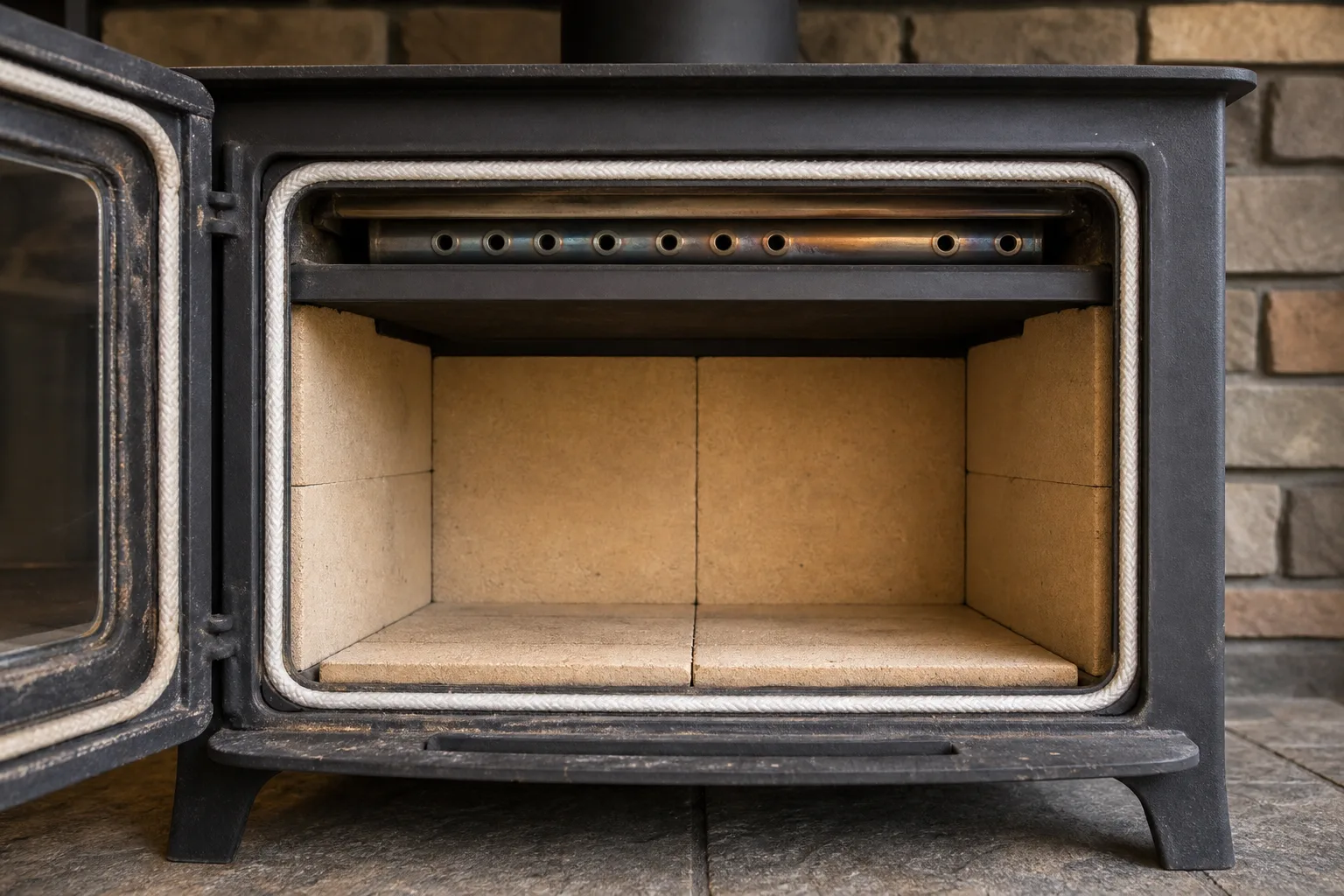
Look up inside the firebox. The baffle is the plate across the ceiling that holds combustion gases in longer so they can burn instead of leaving as smoke. Depending on the stove, it is steel or a light ceramic board.
Under or above it sit the secondary air tubes, a row of stainless tubes drilled with small holes, discolored to straw gold and blue from heat.
Look for sag, warping, burned-through spots, cracked ceramic board, and holes blocked with fly ash. A vacuum with a brush attachment clears the holes. A sagging baffle or a tube burned through is a parts order. This is the easiest item on the whole wood stove maintenance list to miss, because you have to duck your head to see it at all.
If you have a catalytic stove
Catalytic combustors are vacuumed cold and brushed gently with a soft brush, following the manual for your specific stove. The bypass damper and its gasket get checked at the same time.
Combustor service life is measured in hours of burn time rather than years, and the honest answer for your stove is in your owner's manual. If yours has crumbled, plugged, or lost its ability to light off, that is a replacement rather than a cleaning.
The pre-season hands-on checklist
- Door gasket tested at four or five points, latch adjusted if the door is loose
- Glass inspected for chips and cracks, gasket around the glass intact
- Firebrick checked for through-cracks, crumbling and gaps
- Baffle checked for sag, warping and burn-through
- Secondary air tubes clear, holes vacuumed out
- Ash pan and grate clean and seated properly
- Hinges and latch moving freely, hardware tight
- Air control moving through its full travel without binding
- Connector pipe joints tight, screws present, no soft spots or rust perforation
- Catalytic combustor vacuumed and inspected, bypass damper working
- Stove sitting square on the hearth pad, clearances unchanged since last season
Creosote, the Flue, and the Annual Inspection
Creosote is what unburned smoke leaves behind on a cool flue wall, and it is the reason wood stove maintenance has a professional layer at all.
The Chimney Safety Institute of America sorts it into three degrees. Degree one is a light, dusty soot that brushes off easily. Degree two is flaky or tar-like, the black cornflakes look. Degree three is hardened and glazed, a shiny black coating that looks like the flue was painted with tar and then baked.
That third one is the problem. It resists ordinary mechanical sweeping and it carries the highest fire risk in the flue.
Safety note: degree three glaze does not come out with a brush. If a light goes up your flue and comes back showing a hard shiny black surface, stop planning a DIY sweep and get a professional opinion on what it will take to remove it.
NFPA 211, the standard covering chimneys, fireplaces, vents and solid fuel burning appliances, calls for chimneys and vents to be inspected at least annually for soundness, freedom from deposits, and correct clearances.
Notice what that does and does not say. The inspection is annual. How often a chimney actually needs cleaning depends on what the inspection finds, with roughly an eighth of an inch of accumulation as the common trigger point. Cleaning on a fixed calendar, regardless of condition, is not what the standard asks for.
NFPA 211 also names the situations that call for a Level 2 inspection: sale or transfer of the property, a change to the system such as a new appliance or a new liner, a malfunction, a chimney fire, and external events like a building fire, an earthquake or severe weather.
One more thing worth knowing while you are looking at your own setup. Single-wall black stovepipe is a connector, and it belongs in the room with the stove. Where the venting passes through a combustible assembly, a wall, a ceiling, a floor or a roof, that is where listed Class A chimney pipe and a listed thimble or support box take over. If your connector disappears into a combustible assembly with no listed component visible at the transition, flag it for the inspector.
Found something you can't brush out? Glazed creosote, a cracked liner, or a transition you cannot identify is past the point of routine wood stove maintenance. VIO is a free referral service that matches you with an independent local chimney company near you. Call (513) 655-6702 or tell us what you found.
Wood Stove Maintenance Troubleshooting: Symptom to Cause
Every guide organizes itself by component. You arrive with a symptom. Here is the translation, plus the part that matters most, whether it is yours or theirs.
| What you notice | Likely causes | Yours or theirs |
|---|---|---|
| Glass blackens within one evening | Wet wood, air choked down too early, airwash holes blocked with ash | Yours |
| Less heat than last season | Wet or poorly stored wood, leaking door gasket, sagging baffle, plugged combustor | Yours to diagnose, parts may follow |
| Smoke rolls into the room on lighting | Cold flue and reversed draft, blocked cap or flue, competing exhaust fan in the house | Yours to test, theirs if the flue is blocked |
| Fire will not hold overnight | Softwood or wet wood, failed door seal, air leak at a pipe joint | Yours |
| Smell from the stove when it is cold and idle | Creosote deposits in the flue, negative pressure pulling flue air into the room | Theirs |
| Rust weeping or white staining on the connector | Moisture in the flue, condensation from burning wet wood, a failing chimney cap or flashing | Start yours, finish theirs |
| Ticking or popping that is new this season | Normal expansion as the metal heats, but worth a look if it comes with a visible gap or movement | Yours to watch |
Where DIY Wood Stove Maintenance Stops
Competence includes knowing the edge of it. Five things end the DIY portion of wood stove maintenance, and none of them are a failure on your part.
Glazed degree three creosote, because brushing will not move it and the methods that do move it are specialized.
A crack you can see through, in the firebox, the stove body, or a flue liner. Daylight where daylight does not belong is a structural finding.
A connector entering a combustible assembly without a listed thimble or support box that you can identify. Clearances are set by the appliance listing and local code, not by what looks reasonable.
Smoke that keeps coming into the room after you have ruled out wet wood, the air setting, and a cold flue. At that point you are troubleshooting draft, and draft involves the whole house.
Anything on NFPA 211's Level 2 list. Bought or sold the house, changed the appliance or the liner, had a malfunction, had a chimney fire, or came through a potentially damaging external event such as a building fire, an earthquake or severe weather. Those are named for a reason.
Pro tip: when a job needs the flue opened at the top of the house, the ladder is the risk, not the chimney. Roof work and steep pitches send people to the emergency room over maintenance that could have been scheduled.
How VIO Helps With Wood Stove Maintenance
Straight answer about what VIO is: a free referral service, not a chimney company. VIO does not sweep flues, sell stoves, or send out crews. When you tell us what is going on, VIO matches you with an independent local chimney company in your area, and what happens from there is between you and that company.
We ask every company in the network to put its estimate in writing before any work starts, and you should insist on exactly that. Get the scope and the price on paper, in your hands, before anyone opens a flue.
That matters on the findings that come out of an annual inspection, where scope can drift. A written estimate keeps the conversation anchored to what was actually found.
Get the annual inspection on the calendar. The inspection is the part of wood stove maintenance that is not yours to do, and booking it ahead of the cold is easier than booking it during. Call (513) 655-6702 or ask for an inspection near you.
One Last Thing Before You Light It
Go stand in front of the stove with a flashlight. Open the door, look up at the baffle, close the door on a dollar bill, and see what you find.
Ten minutes of honest looking in September answers more questions than any amount of reading in January. The wood stove maintenance that keeps a stove running well is not complicated work, it is just work that has to happen in the right order, before the cold makes the decision for you.
Symptom checker
What is your chimney doing?
Tap the closest match for an honest first answer.