



On this pageHow to Tell If You Have a Prefab Fireplace7 sections+6
- How to Tell If You Have a Prefab Fireplace
- Prefab Fireplace vs. Masonry: The Difference That Costs You Something
- The One Rule That Governs Every Prefab Fireplace Repair
- What Goes Wrong on a Prefab Fireplace
- Cracked Panels or a Worn-Out Unit: Your Real Options
- Inspection, and the Moments NFPA 211 Asks for More
- How VIO Helps With a Prefab Fireplace
Quick answer
A prefab fireplace, also called a factory-built fireplace, is a metal firebox and matching metal chimney made in a plant and assembled on site, not laid up in brick. Identify one by the flat cast refractory panels in the firebox, the metal surround at the opening, and round metal pipe above the damper. Because it was tested as one listed assembly, repairs use the manufacturer's parts.
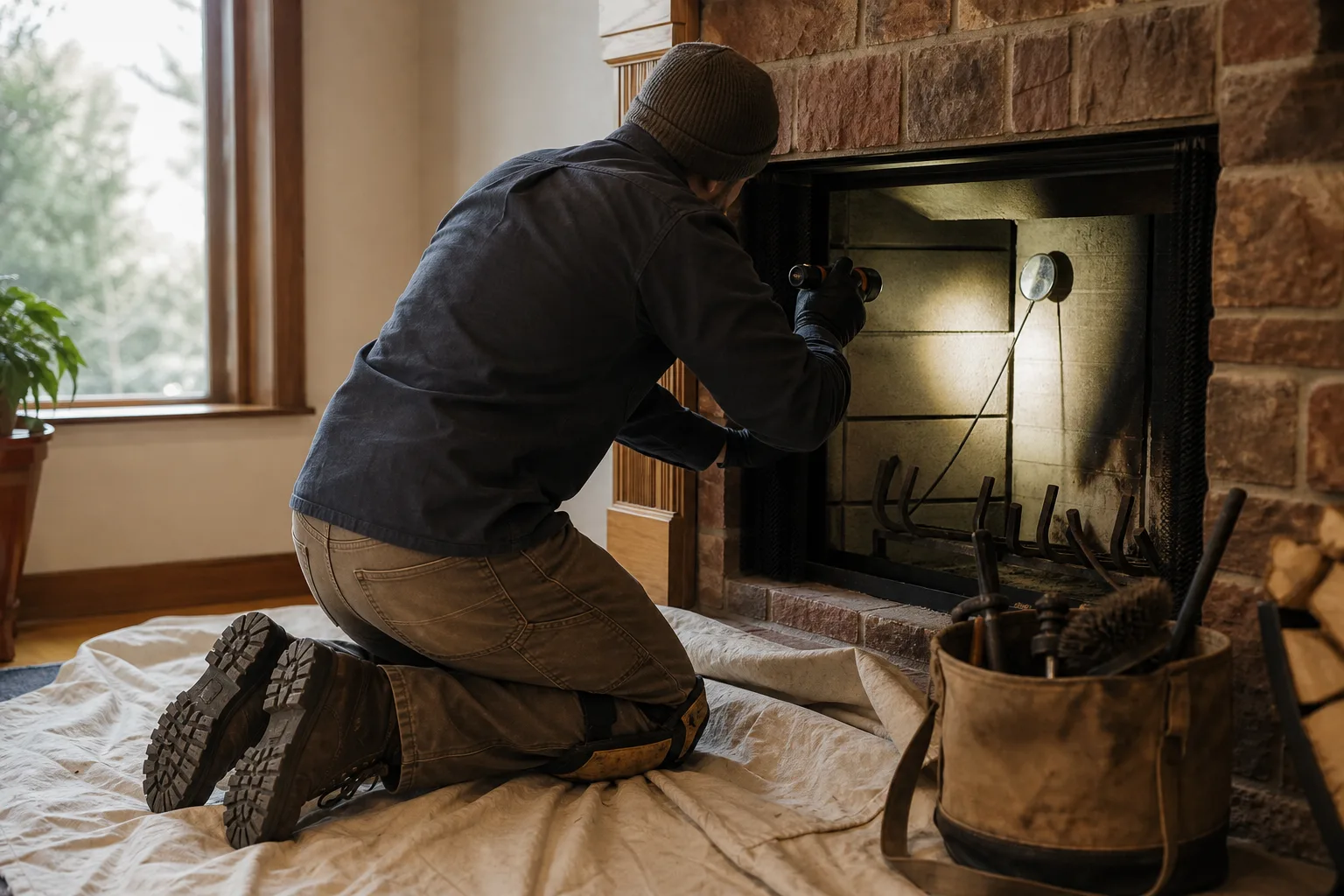
Most people learn the words "prefab fireplace" on a bad day. A chimney professional kneels at the hearth, shines a light across the back wall of the firebox, and says something like: this is a prefab, and those panels are cracked, so I can't sign off on it.
And then you are standing in your own living room holding a word you have never used before, attached to news you did not want.
Here is the thing nobody says in that moment. A prefab fireplace is not a defective fireplace. It is a different kind of object than the brick one you were picturing, and almost every confusing thing about owning one follows from that single difference.
So let's start where you can start: with a flashlight, tonight, in front of your own firebox. Ten minutes from now you will know what you have, what the metal tag inside it unlocks, and what your options are if something in there is cracked.
How to Tell If You Have a Prefab Fireplace
A prefab fireplace is a factory-built fireplace: a metal firebox and its matching metal chimney, manufactured in a plant and assembled on site. A masonry fireplace is laid up on site, brick by brick, by a mason. The term "prefab" is the everyday name for the whole category of factory-built units, which also includes the zero clearance fireplace style built to sit close to framing. It is a category, not the name of any one maker.
From across the room, the two can look nearly identical. Six inches away, they look nothing alike.
Look at the walls of the firebox
This is the test that settles it, and it takes about thirty seconds.
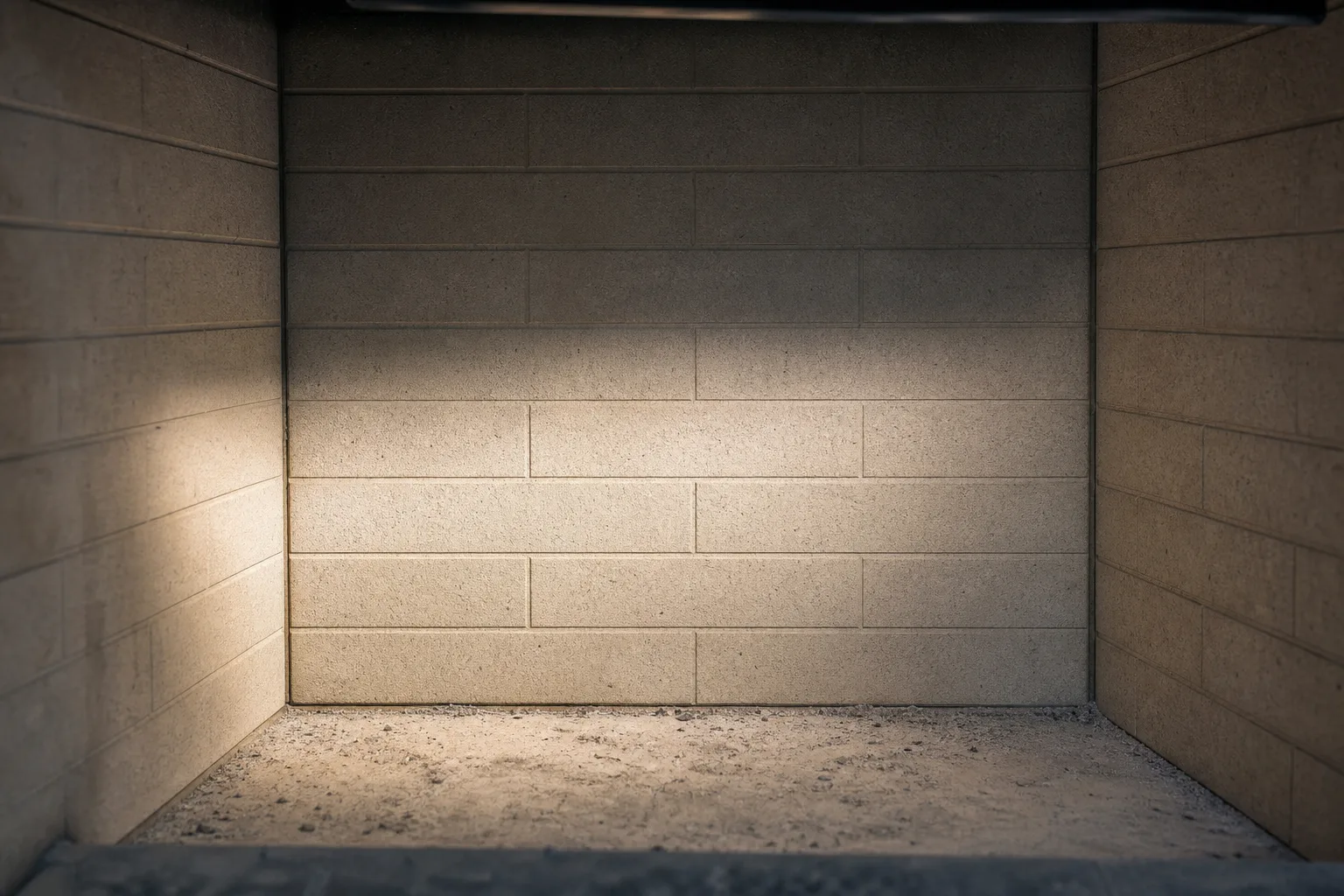
Shine a flashlight at the back wall and the two side walls. In a masonry firebox you see individual firebricks with mortar joints that wander, no two quite the same width, and brick faces with small chips and color variation.
In a factory-built firebox you see large cast panels, usually three of them, one back and two sides. They are molded with a brick pattern, but the pattern repeats exactly and the mortar lines are perfectly even. The "bricks" line up too well to be real ones.
Then look at the corners. Cast panels meet in a straight vertical seam running floor to top. Real masonry turns a corner in brick.
Look up past the damper
Open the damper, get your light up into the throat, and look.
Above a masonry firebox is brick and mortar, a sloped chamber narrowing toward the flue. Above a factory-built firebox is round metal chimney pipe, sometimes with a visible collar where sections join, unmistakably manufactured rather than built.
Wear eye protection for this one and expect loose soot. Look, do not poke.
Find the metal tag on your prefab fireplace
Every factory-built unit carries a metal identification plate somewhere inside it, listing the manufacturer and the model number. On many wood-burning units it is on the metal frame around or above the firebox opening. On gas units it may sit behind the decorative front, at the bottom of the firebox behind an access panel, or inside the control compartment on a side wall.
That tag is the most valuable thing in your fireplace, and it is worth more than a photograph of the cracked panel.
The model and serial numbers are how replacement parts get matched to your unit, and how manufacturers track recalls and mandatory upgrades, which are issued by serial range.
Pro tip: Photograph the tag with your phone now, before you need it. Get the whole plate in frame and readable, then take a second shot from farther back showing where it sits. That picture is the first thing anyone helping you will ask for, and it is easier to take on a clean summer afternoon than in December with the house cold.
What the age of your house does not tell you
You will read that homes built after a certain year almost certainly have factory-built fireplaces. Treat that as trivia, not as an answer.
Both kinds have gone into both old and new houses. Older homes get remodeled and get factory-built units added, and newer homes get masonry fireplaces when someone wanted one and paid for it.
The firebox tells you. The build year only suggests.
Myth vs. fact: "My house is from the 1950s, so it must be masonry." The year the house went up says nothing about what was installed during a renovation, an addition, or a basement finish. Run the flashlight test instead. It costs you thirty seconds and it is not a guess.
The thirty-second identification checklist
Work down this list with a flashlight. Answer each one before you move on.
- Are the firebox walls flat cast panels with a repeating brick pattern, or individual bricks with uneven mortar joints?
- Do the walls meet in a straight vertical seam at the corners?
- Is there visible metal in the room around the firebox opening, such as a surround, trim strip, or louvered vent grille?
- Looking up past the open damper, do you see round metal pipe or brick and mortar?
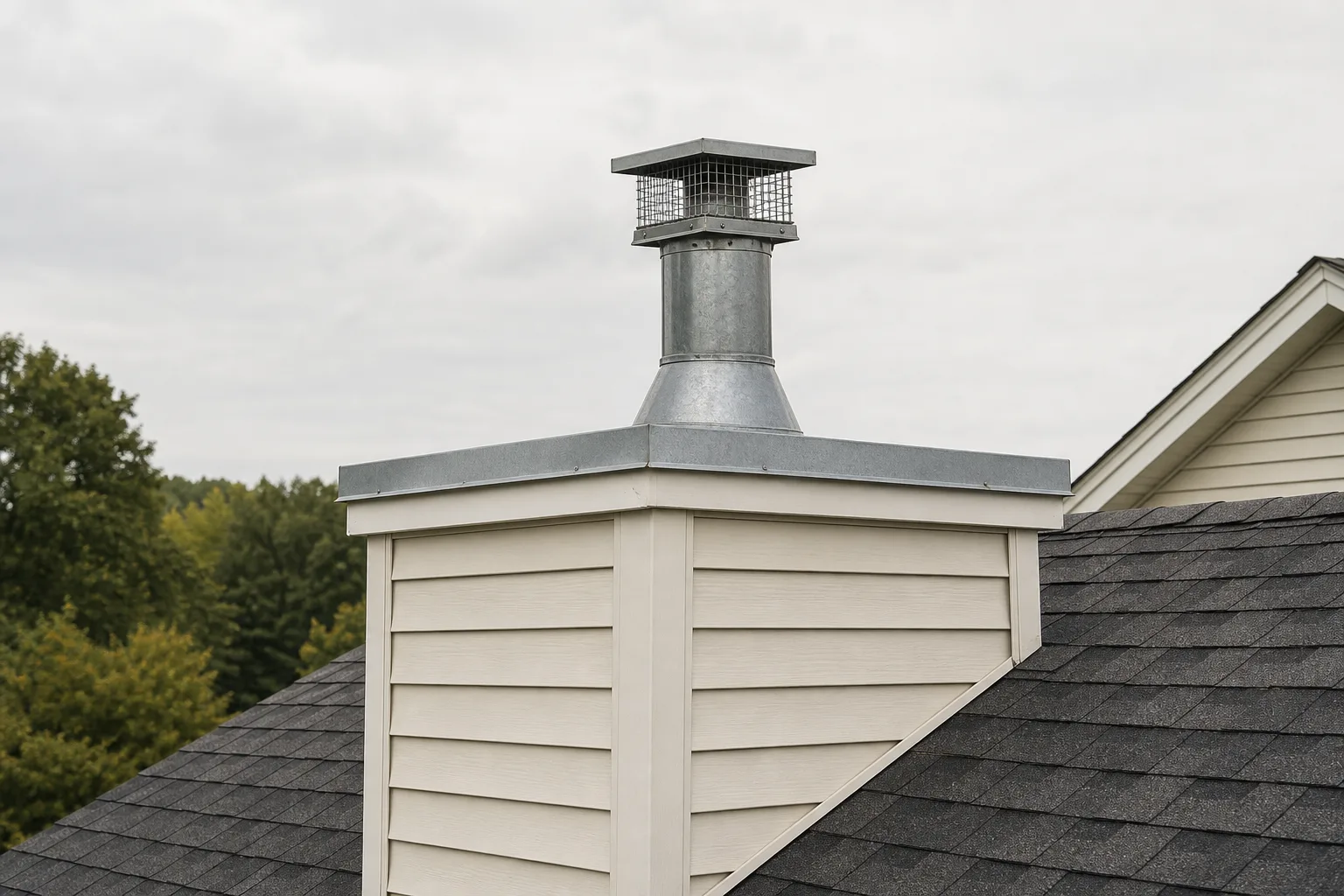
- On the roof, is there a brick or stone stack, or a boxed-in structure clad in the same siding as the house?
- Have you found the metal tag, and photographed it?
Cast panels, a metal surround, round pipe above the damper, a sided box on the roof: that is a prefab fireplace. Firebrick, mortar, a brick chamber above the damper, a brick stack on the roof: that is masonry.
Prefab Fireplace vs. Masonry: The Difference That Costs You Something
This comparison usually gets framed as better versus worse. That framing is useless to you, because you already own whichever one you own.
What matters is what each one is, in the eyes of everyone who will ever work on it.
A masonry chimney is a structure, and structures get repaired. A mason can cut out failed brick, rebuild a crown, repoint joints and reline a flue, and the result is still your chimney. Repairs are judged by workmanship.
A prefab fireplace is a manufactured appliance. Appliances get serviced with their own parts, and eventually they get replaced. Repairs are judged against the manufacturer's instructions for that model.
That one distinction drives everything below.
| Prefab fireplace (factory-built) | Masonry fireplace | |
|---|---|---|
| What it is | A tested appliance assembly | A built structure |
| Firebox walls | Cast refractory panels | Individual firebrick and mortar |
| Chimney above | Round metal pipe, often inside a framed chase | Brick or stone stack |
| Who works on it | A chimney professional working to the model's instructions | A chimney professional or a mason |
| How repairs are judged | Against the manufacturer's specifications for that unit | Against masonry workmanship and code |
| Replacement parts | The manufacturer's parts for that model | Generic masonry materials |
| When it is worn out | The unit is replaced | The structure is repaired |
| Weight and footprint | Light enough for standard framing | Needs its own foundation |
Notice what is not in that table: a lifespan number. You will find plenty of them online, and none of them can see your unit.
A sound masonry chimney is something you maintain and repair over a long time. A factory-built fireplace is a product with a service life, and at some point the honest answer stops being "repair it" and becomes "replace it." An inspection tells you where yours sits on that line.
Good to know: Neither type is inherently the safer one. A listed factory-built fireplace, installed to its instructions, used as designed and inspected on schedule, is a tested assembly doing its job. A neglected masonry fireplace with a failed liner is not safe because it is made of brick. Condition, installation and use decide safety, in both cases.
The One Rule That Governs Every Prefab Fireplace Repair
Here is the idea that reorganizes everything, and it is missing from almost every page you will read on this subject.
Your factory-built fireplace was not certified as a pile of parts. It was tested and listed as one complete assembly by a recognized testing laboratory: this firebox, with these panels, this damper, this pipe, this cap, installed these specific ways.
Which means an off-brand replacement part is not a cheaper version of the correct part.
It is a different appliance.
Swap in a panel the manufacturer did not make for your model, or a damper from another unit, or the wrong vent pipe, and the assembly that was tested no longer exists. The listing does not cover what you now have, and neither does code compliance.
Why "it's just a piece of concrete" is the expensive mistake
The refractory panels look like the simplest thing in your house. Flat slabs, molded texture, no moving parts. It is a natural thought that a similar slab would do the same job.
The panels are not there for looks. They are the layer between the fire and the metal shell of the firebox, and they were designed and tested as part of that specific unit.
This is why a cracked panel gets replaced with the manufacturer's panel for your model, and why manufacturers generally say a cracked panel is not repaired or patched. It is also why the tag matters. Without the model number, nobody can tell you which panel is the right one.
Safety note: Do not let anyone rebuild a factory-built firebox with firebrick and mortar, and do not patch a cracked panel with refractory cement as a season-long fix. Both are exactly the kind of modification that takes the unit outside what was tested and listed. If a contractor offers either one, that is your signal to get a second opinion from someone who works on factory-built units specifically.
Not sure what you have, or whether it is safe to burn? Tell us what your firebox looks like and where you are, and we will match you with an independent local chimney company that inspects factory-built fireplaces and works from the manufacturer's instructions for your unit. Call (513) 655-6702, or request service online.
What Goes Wrong on a Prefab Fireplace
Three parts of the system are worth knowing by name, because they fail in ways you can partly see for yourself.
The refractory panels
Panels crack. They take direct flame and thermal cycling every time you use the fireplace, and a very large or very hot fire puts more stress on them than they were built for.
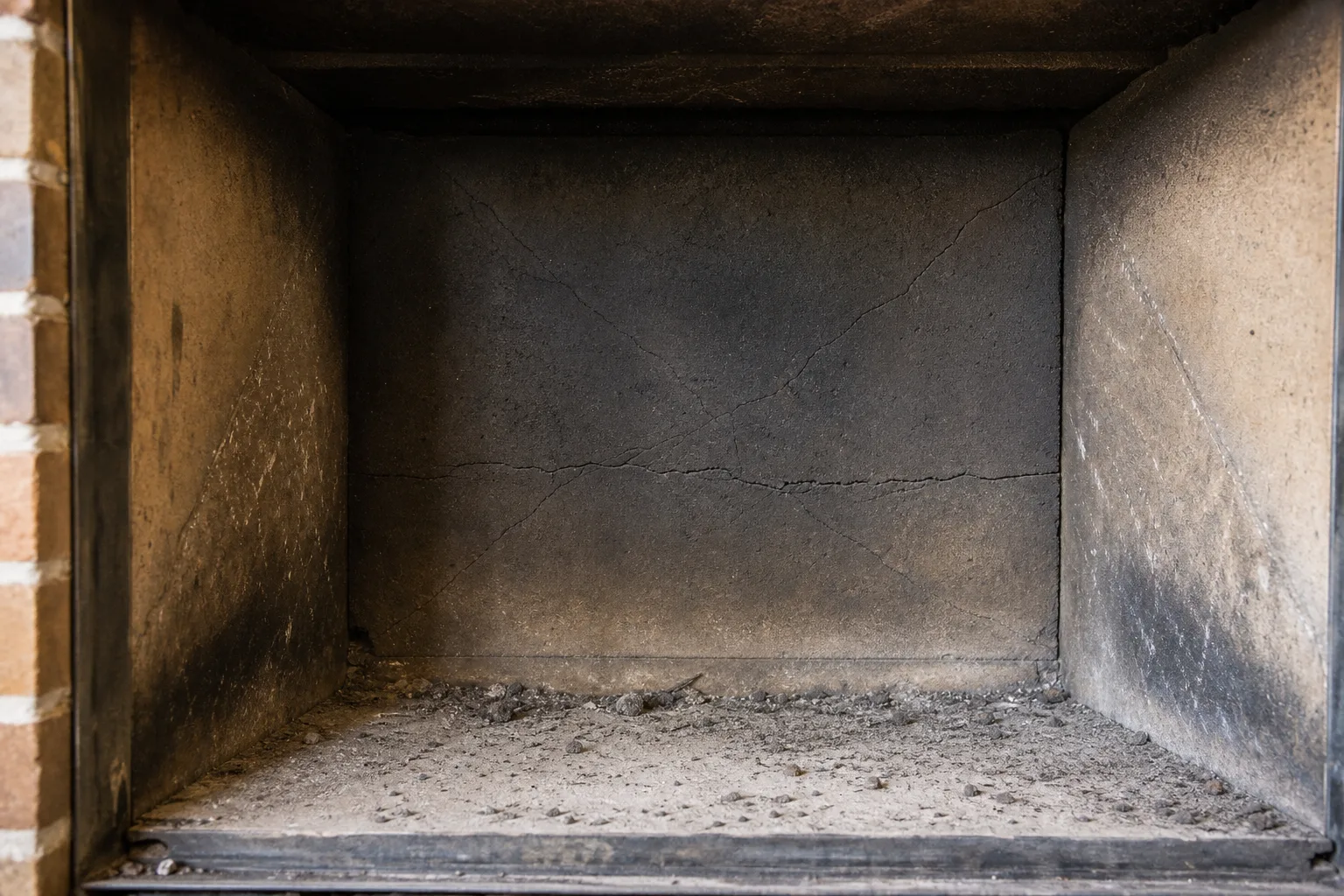
Cracks show up as thin dark hairlines across a panel face, often corner to corner or straight across the back. Soot hides them, which is one reason a sooty firebox is worth cleaning before you judge its condition.
What you cannot do is decide from the crack whether the unit is still usable. Manufacturers set their own criteria for when a panel must come out, specific to the model. An inspection judges your panels against the standard your manufacturer wrote, which is why a width you measure with a tape does not answer the question by itself.
The chase cover, the storm collar and the cap
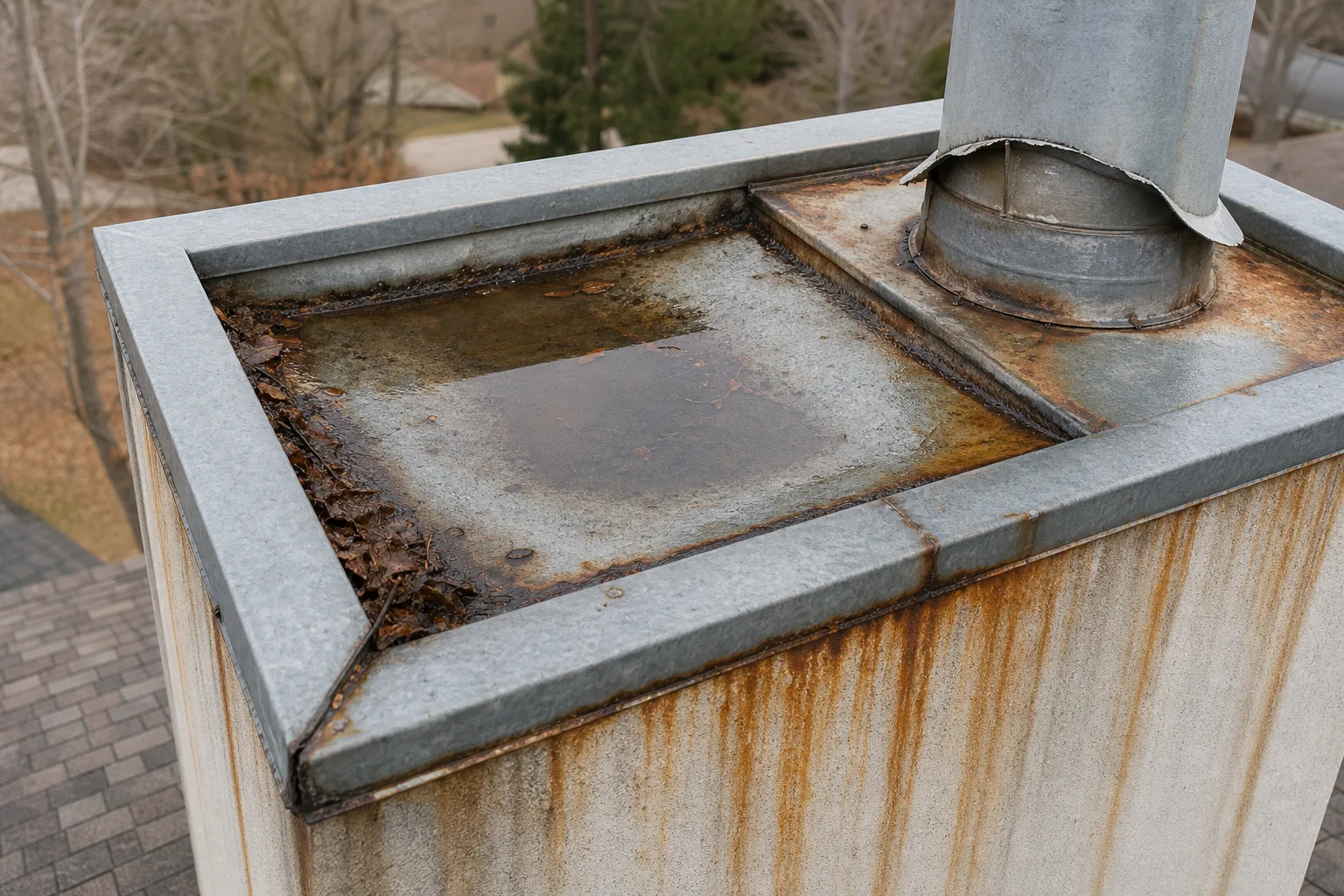
Look at the top of the boxed structure on your roof. That flat metal lid is the chase cover.
A galvanized cover that sits flat, or nearly flat, holds rainwater. Held water rusts steel, and rust eventually opens a hole. Water that gets through a failed cover lands inside the chase, where it can reach the top of the firebox and the outside of the pipe.
Around the pipe where it comes through the cover sits a cone-shaped storm collar, whose only job is to seal that gap. On top of the pipe sits the cap, which keeps rain out of the flue, keeps animals and debris out, and acts as a spark arrestor. A chimney cap replacement and a stainless cover are the usual answers when either one has gone.
Good to know: Ceiling and wall stains near a fireplace are often a roof problem wearing a fireplace costume. From the ground, look for orange streaks down the sides of the chase, standing water on the lid after rain, or a sagging center. Those are worth a call whether or not anything looks wrong indoors.
The damper, the doors, the blower
Factory-built units have their own damper hardware, often a plate or a rotary mechanism specific to the model rather than the cast throat damper of a masonry fireplace. When one stops sealing or stops moving, the replacement comes from the manufacturer's parts list. Our guide to fireplace damper replacement covers what that job involves.
Glass doors on these units are also listed components matched to the model, and older sets get warped hinges, cracked glass and failed gaskets. If yours has a blower, it is a service item like any other motor.
Cracked Panels or a Worn-Out Unit: Your Real Options
This is the part the internet leaves you hanging on. You have a cracked panel and an inspection report. What actually happens next?
There are four paths, and they run roughly in this order.
1. Replace the panels with the manufacturer's panels
If your model is still supported and panels are still made for it, this is the straightforward path. You need the model and serial numbers, which is the whole reason for photographing the tag.
Panels are ordered for that specific unit and installed to the instructions that come with them.
2. Install an insert, if your unit allows it
A wood fireplace insert is a sealed firebox that sits inside the existing opening with its own liner running up the flue. It is a real option for some factory-built fireplaces and not for others.
Two things have to line up. The insert has to be listed for installation in a factory-built fireplace, and your fireplace manufacturer's instructions have to permit it for your model. Both, not either.
Do not let anyone tell you an insert drops into any firebox. The answer lives in those two documents.
3. Replace the whole unit
When panels are no longer made, or when the metal shell itself has corroded, replacement becomes the honest recommendation.
Expect a bigger job than it sounds. A new unit's opening dimensions may not match the old one, and in most cases the facade has to come off to get the old firebox out. That is why replacement conversations turn into remodel conversations.
4. Stop using it
If the unit fails inspection and you are not ready to repair or replace, the safe answer is to stop burning in it until the work is done. A chimney balloon or a proper seal can stop the draft loss in the meantime, and nothing says you have to decide everything in one week.
From the field: The conversation changes once someone has the model number in hand. Without it, every question gets a general answer, because nobody can look up a part for a fireplace they cannot identify. With it, a parts question becomes a specific yes or no.
Inspection, and the Moments NFPA 211 Asks for More
Under NFPA 211, chimneys, fireplaces and vents are inspected annually. That yearly look is a Level 1 inspection: the readily accessible portions of the chimney exterior and interior, and the accessible portions of the appliance and the connection.
A Level 2 inspection has its own triggers, and they are specific. It is required upon sale or transfer of the property; when changes are made to the system, such as a change of fuel, a change in the flue's shape or material, or the addition or replacement of an appliance; after a malfunction or an external event likely to have caused damage; and after a chimney fire. It includes video scanning of the flue interior.
A Level 3 inspection has its own trigger too: a suspected concealed hazard that a Level 1 or Level 2 inspection cannot evaluate. It involves removing parts of the structure or the finish to reach the concealed area.
For a prefab fireplace, the sale-or-transfer trigger matters, because these questions so often start with a real estate transaction. Buying or selling a house with a factory-built fireplace is a Level 2 moment by the standard itself.
Your annual visit is also the time to raise the chase cover and the cap. Ask whether the inspection will include a look at the top of the chase, and say so when you book, because access to the roof is not part of every visit by default. Our guide on how to clean a chimney covers the sweeping side of that visit.
Safety note: Test your smoke alarms and carbon monoxide alarms monthly, all year, not just during the months you burn. Fuel-burning appliances and attached garages do not take the summer off.
How VIO Helps With a Prefab Fireplace
VIO is a referral service. We do not perform chimney work. We connect homeowners with independent local chimney companies, and those companies do the work under their own names.
For this situation, that means we can pass along what you already know before anyone shows up: the photograph of your tag, what the panels look like, whether there is a stain on the ceiling, whether a sale is in motion. A visit that starts with the model number is a different visit than one that starts from scratch.
Insist on a written estimate before any work starts, and do not let work begin without one in your hands. Ask the company for its license and insurance details as well, and check them yourself before work begins.
When you call, have three photos ready if you can: the identification tag, the firebox walls, and the top of the chase from the ground. Those three answer most of what anyone would ask you about a prefab fireplace over the phone.
Get your prefab fireplace looked at before the first fire. Tell us what you found: the tag, the panels, the chase cover, the flue. We connect you with independent local chimney companies in your area and pass along what you describe, so the visit starts informed. VIO is a referral service, not the company that performs the work. Call (513) 655-6702, or request service online.
Symptom checker
What is your chimney doing?
Tap the closest match for an honest first answer.