



On this pageWhat a wood fireplace insert actually does to your fireplace7 sections+6
- What a wood fireplace insert actually does to your fireplace
- Who should install wood fireplace inserts, and who shouldn't
- Insert, open fireplace, or freestanding stove
- The measurements that decide everything
- The liner is not optional, and it's where jobs go wrong
- What installation day actually looks like
- Living with an insert: fuel, habits, and upkeep
Quick answer
A wood fireplace insert is a sealed wood stove built to slide into an existing masonry fireplace, converting it from a decorative heat leak into a real heat source. Fit depends on the firebox opening, rear width, depth and damper throat. A correct installation runs a stainless liner sized to the insert all the way to the chimney top, sealed with a top plate and cap.
Most people who end up disappointed with wood fireplace inserts didn't buy the wrong unit. They bought a unit that was never going to fit the hole in their wall, or they dropped a good stove into a chimney that couldn't support it. An insert is a sealed, firebox-shaped wood stove engineered to slide into your existing masonry fireplace and turn it from a decorative heat leak into a real heat source. That's the whole promise. Whether it works out for you comes down to three things: the exact dimensions of your firebox, the condition of the chimney above it, and whether the installation includes a properly sized liner running all the way to the top.
If you take one thing from this guide, take that last one. The liner is where corners get cut, and it's the difference between an insert that draws beautifully for twenty years and one that smokes back into the living room every time the wind shifts.
What a wood fireplace insert actually does to your fireplace
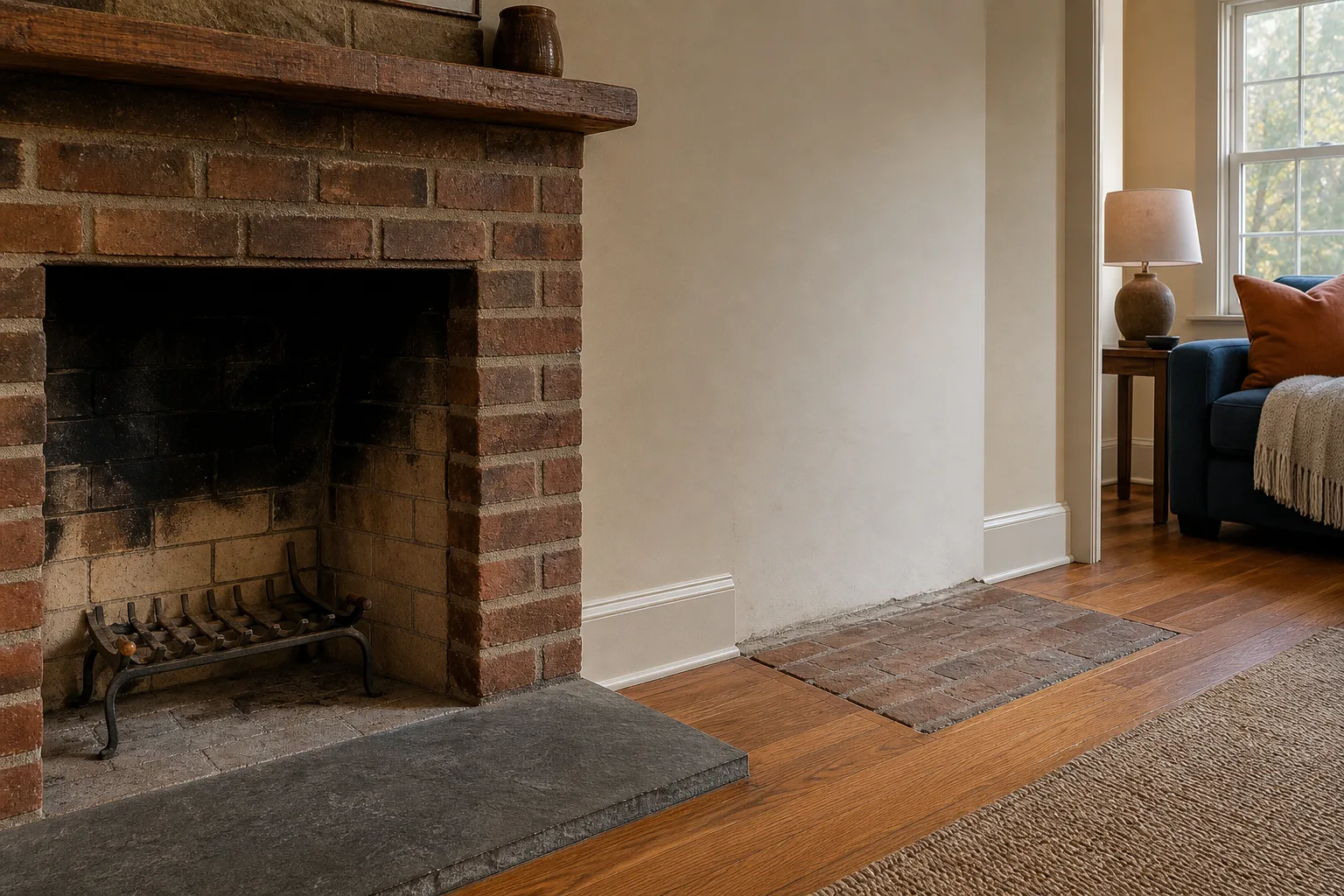
A traditional open masonry fireplace is a wonderful thing to look at and a mediocre thing to heat with. It pulls heated room air up the flue by the cubic foot, and on a cold night a lot of homes lose more warmth through the chimney than the fire puts back. You feel warm sitting three feet from it because you're being radiated at directly. Walk into the next room and the difference is obvious.
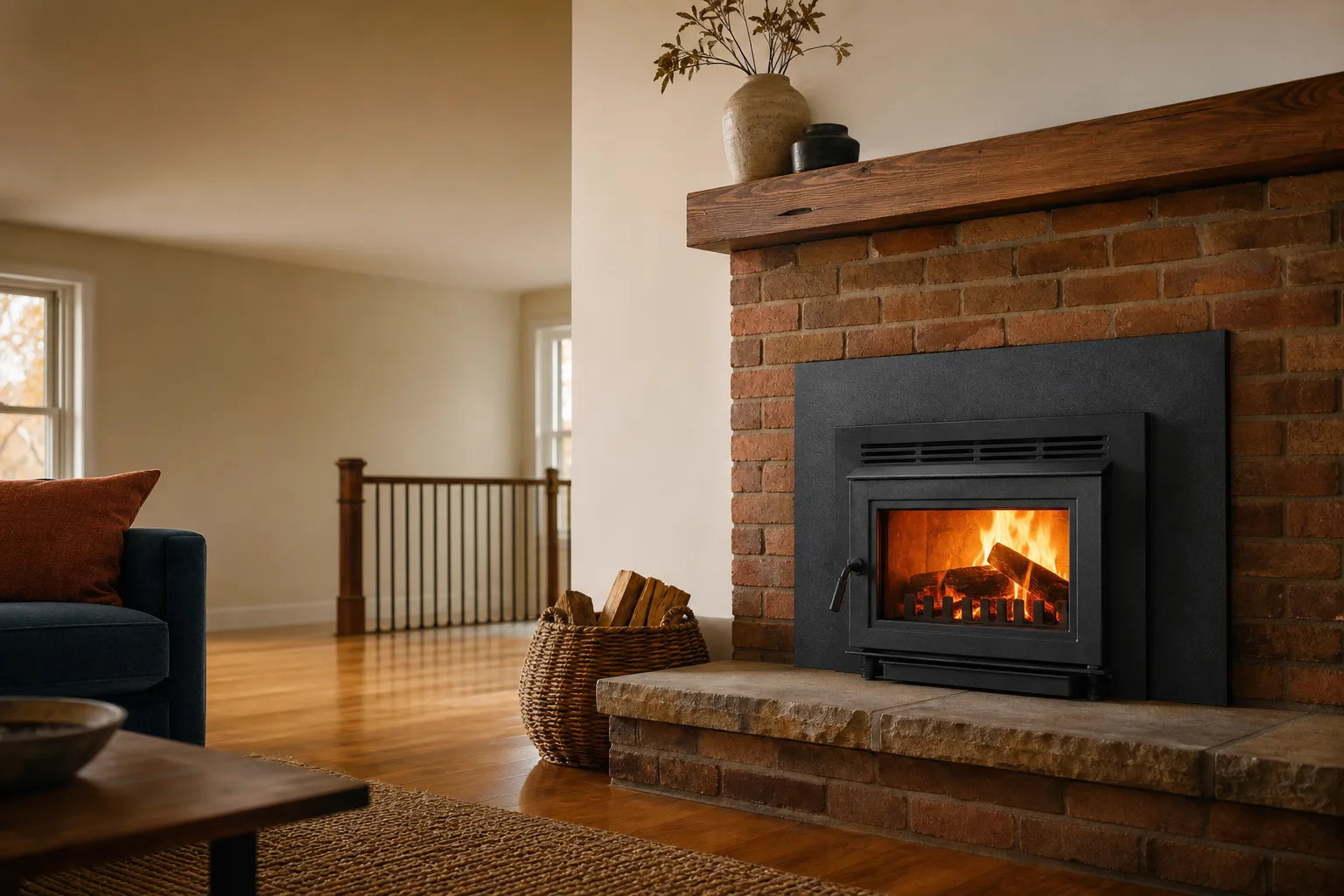
An insert changes the physics. It's a steel or cast iron firebox with a glass door, insulated and gasketed so combustion air comes in only where the designer intended. Because the fire is contained, it burns hotter and more completely. Because the box is sealed, room air isn't being vacuumed up the chimney. Most units add a blower that pushes air across the hot body of the stove and out into the room, so you're moving heat by convection instead of relying on line-of-sight radiation alone.
The visible part is that the insert slides into the masonry opening and a surround panel covers the gap so it looks intentional. The invisible part, the part that matters, is a stainless steel liner connecting the insert's flue collar up through the existing chimney to a new cap at the top.
Myth vs. fact: Myth: an insert is basically a fancy glass door for your fireplace. Fact: a glass door reduces losses when the fire is out. An insert is a separate, sealed appliance that happens to live inside your fireplace opening, with its own venting, its own clearances, and its own certification. They are not the same category of thing.
Two families of design exist and the distinction matters for how you'll operate the stove. Catalytic units route exhaust through a coated honeycomb that ignites smoke at a lower temperature, which gets you long, slow, even burns. The cost is a combustor that eventually degrades and needs replacing, and a bypass damper you have to learn to work. Non-catalytic units use shaped baffles and preheated secondary air to burn the smoke instead. Simpler to live with, fewer parts to replace, generally happier at a brisk burn than a smoldering one. Hybrids exist that do both.
I steer people who want overnight burns and don't mind a bit of ritual toward catalytic. People who want to load it, set it, and not think about it are usually happier non-catalytic. Neither is objectively better.
Who should install wood fireplace inserts, and who shouldn't
Wood fireplace inserts make obvious sense in a few situations. You have a masonry fireplace you rarely use because it's more trouble than it's worth. You want a heat source that works when the power is out. You have access to reasonably priced firewood, or your own woodlot. You're heating a room or a floor that the central system never quite reaches.
They make much less sense if you're romantic about the look of an open fire: an insert is fire behind glass, and no amount of large-view door will make it the same thing. They're also a poor fit if nobody in the house wants a chore. Wood heat is a relationship with an appliance. Somebody splits, stacks, hauls, loads, and empties ash. If that person doesn't exist in your household, you will use it twice and resent it.
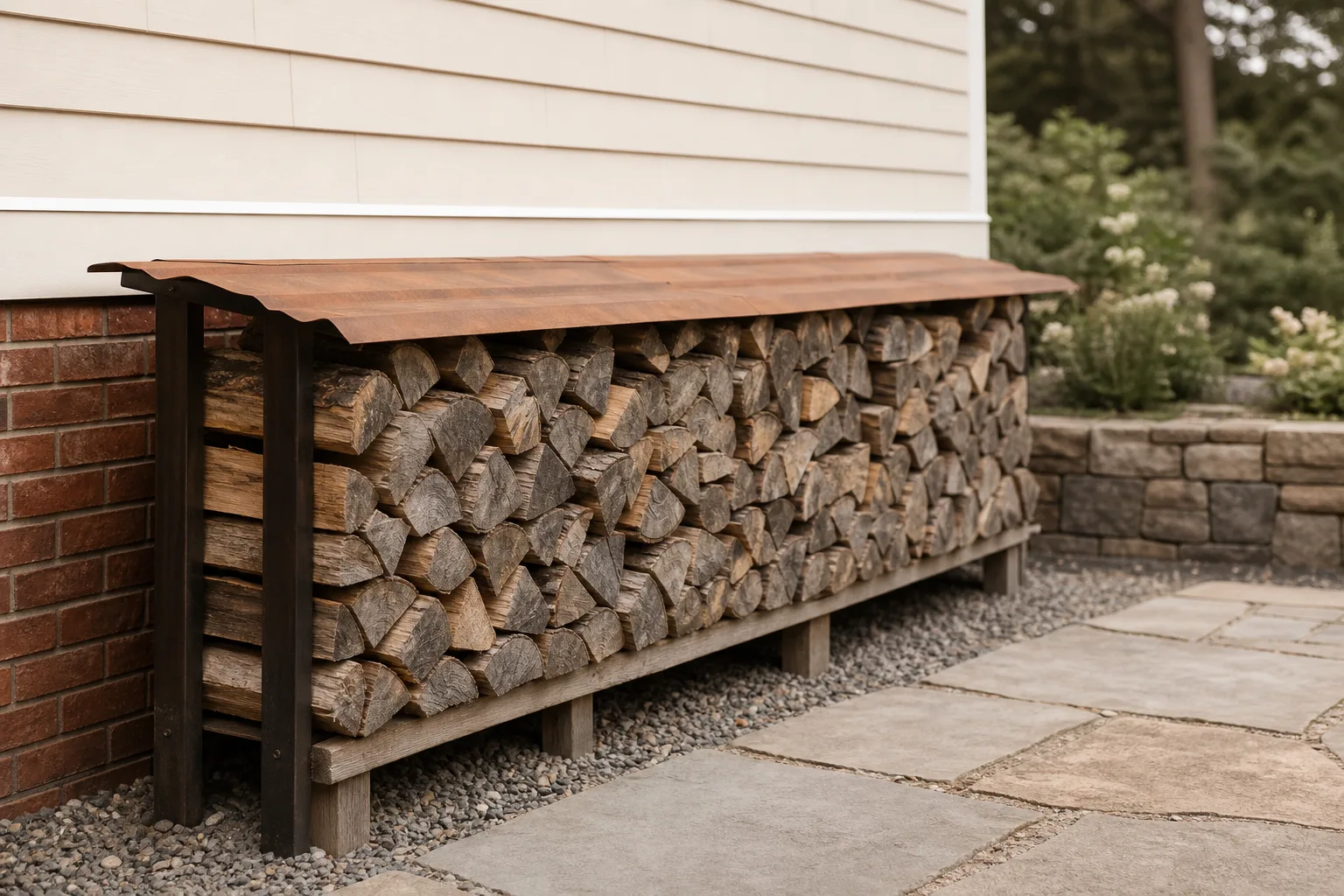
Good to know: the fuel is the appliance. Properly seasoned wood — split, stacked off the ground, covered on top and open on the sides, given a year or more — is not a nice-to-have. Burning wet wood in a modern insert will smoke, glaze the liner, disappoint you on heat output, and make you think you bought a bad stove.
There's a third group worth calling out: people whose "fireplace" isn't masonry at all. If your firebox is a metal box with an air gap around it and a metal chimney above, you have a factory-built zero clearance fireplace, not a masonry one. Those can often accept an insert, but only a model specifically listed for installation in that manufacturer's fireplace. You cannot mix and match. Getting this wrong voids the listing on both appliances and creates a genuine fire hazard, so identify what you actually own before you shop.
And some homes are better served by a freestanding stove entirely. If your fireplace is small, oddly proportioned, or in a corner where a stove would radiate into the room better, a wood stove installation on a hearth pad in front of the opening will often outperform an insert squeezed into the masonry.
Insert, open fireplace, or freestanding stove
Three ways to burn wood in the same corner of the same room, and they behave very differently.
| Open masonry fireplace | Wood insert | Freestanding wood stove | |
|---|---|---|---|
| Primary purpose | Ambience | Heating a room or floor | Heating a zone or small home |
| Net heat to the room | Poor; often a net loss overnight | Good | Best; the whole body radiates |
| Room air pulled up the flue | Continuous while burning | Minimal; sealed firebox | Minimal; sealed firebox |
| Floor space used | None beyond the hearth | None beyond the hearth | Requires clearance on all sides |
| Burn time per load | Short | Long, especially catalytic | Long |
| Venting required | Existing flue, sound and sized | Full stainless liner to the cap | Full liner, or new class A chimney |
| Ash and glass upkeep | Ash only | Ash plus glass and gaskets | Ash plus glass and gaskets |
| Works during a power outage | Yes | Yes; blower off, radiant only | Yes |
| Look of the fire | Unobstructed | Behind glass | Behind glass |
The honest summary: a freestanding stove heats best, an insert heats nearly as well without giving up floor space, and an open fireplace is for looking at.
The measurements that decide everything
Here's where most bad outcomes start. A masonry firebox is rarely a neat rectangle. It's usually wider at the front than at the back, shorter at the back wall than at the lintel, and full of small intrusions: a damper frame, a rounded throat, a raised inner hearth, a gas log line nobody capped properly. Manufacturers publish minimum opening dimensions for a reason, and those minimums assume clean, square measurements.
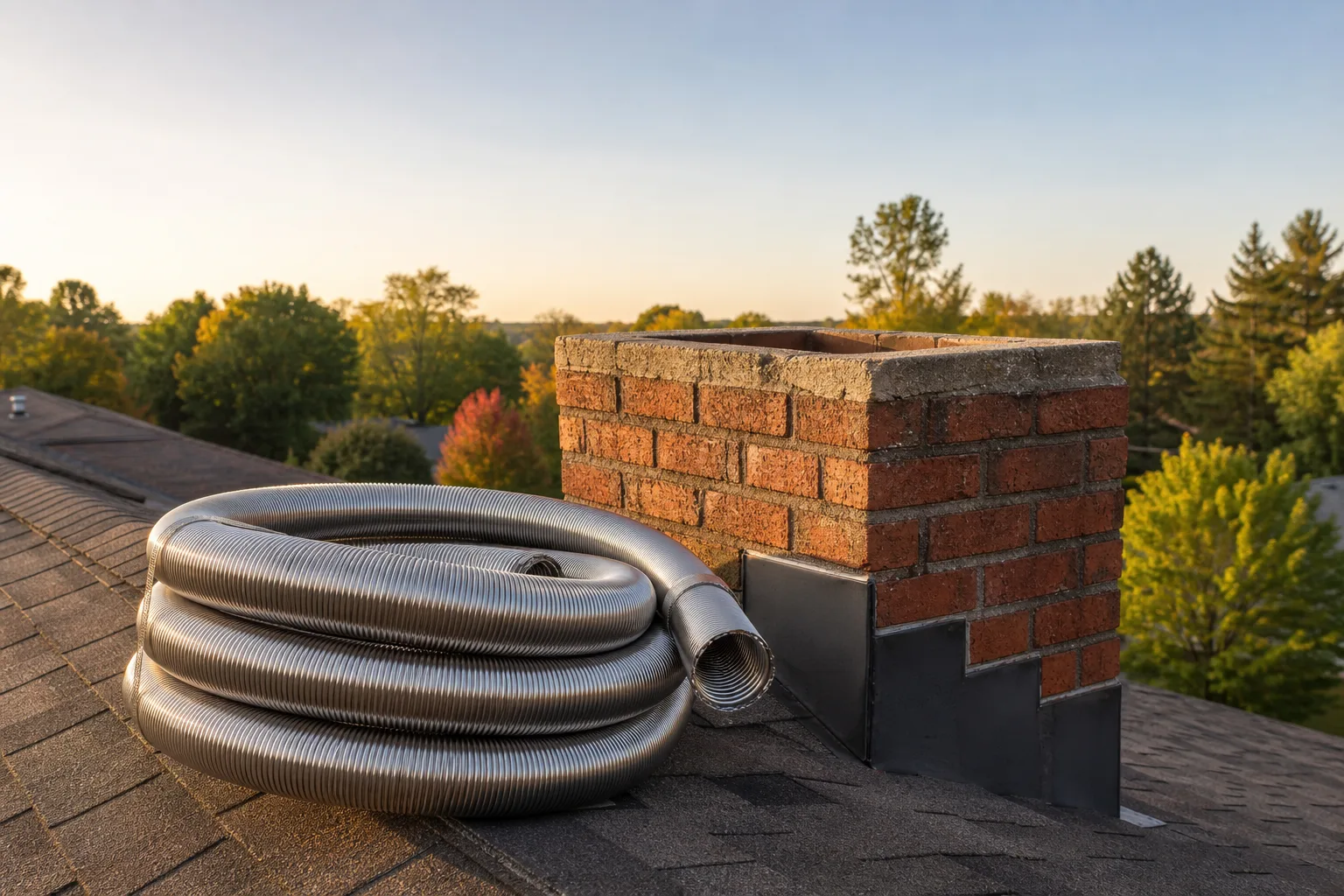
Before you fall in love with a specific model, walk to your fireplace with a tape measure and write these down:
- Front opening width, measured at the very front face of the firebox
- Rear width, measured along the back wall; this is almost always the number that kills a purchase
- Opening height at the front, from the finished hearth surface to the underside of the lintel
- Height at the back wall, which on a sloped-back firebox is noticeably less
- Depth, front face to back wall, at floor level
- Depth at the top, since the back wall usually leans forward
- Height and width of the damper frame and throat opening, where the liner has to pass through
- Hearth extension in front of the opening, measured out from the face
- Distance from the opening to any combustible mantel, trim, or side panelling, and how far those parts project
- Location of the nearest outlet, if you want the blower to run
Pro tip: measure the throat before anything else. Plenty of fireboxes are roomy enough for a large insert but have a damper frame so tight that the required liner won't pass without cutting or removing the damper plate and part of the frame. That's routine work for a professional, but it's the kind of surprise that turns a one-day job into two, and it's better known in advance than discovered with an insert sitting in your driveway.
The flue matters as much as the firebox. Insert manufacturers specify a flue collar size, and the liner has to match it up the full height. A chimney with a small or irregular clay flue, an offset partway up, or heavy creosote buildup may need work before anything can be sleeved through it. This is exactly what a proper chimney inspection is for. That means a camera run up the flue, not a flashlight and a guess from the bottom.
Safety note: NFPA 211 calls for a Level 2 inspection when a system is changed, and adding an insert is unambiguously a system change. It's also required when a home is sold or transferred, after a malfunction, after a chimney fire, and after an external event like a storm, earthquake, or lightning strike. A Level 2 includes video scanning of the internal flue and access to accessible portions of the chimney in attics, crawl spaces, and basements. If someone offers to install an insert without ever looking inside your flue, that's your answer about that contractor.
Not sure your fireplace can take an insert?
Don't buy first and measure later. We'll come out, measure the firebox and the throat, put a camera up the flue, and tell you plainly which units will fit and what the chimney needs first, before you spend anything on an appliance.
Call (513) 655-6702 or request service online.
The liner is not optional, and it's where jobs go wrong
An insert vents a much smaller volume of much cooler exhaust than an open fire does. Drop that exhaust into a big masonry flue sized for an open fireplace and it slows down, cools, and condenses on the way up. Condensed wood exhaust is creosote, and it's the fuel for chimney fires. Understanding what is creosote and how it forms makes the liner requirement obvious rather than an upsell. You're keeping exhaust hot and moving until it exits.
A correct installation runs a continuous stainless liner, sized to the insert's collar, from the appliance to the top of the chimney, insulated where the manufacturer or the chimney's condition calls for it, sealed at the top with a proper top plate and chimney cap, and blocked off at the damper level so the space between the liner and the masonry isn't being heated for nothing.
The shortcut you'll occasionally see is a stub: a couple of feet of liner off the flue collar, terminating just above the damper, dumping into the open masonry flue. It's faster and it's cheaper and it will eventually cause trouble. If your quote is silent on how far the liner runs, ask the question directly. There's more depth on sizing and material choice in our guide to the chimney liner, and the same principles govern connector sizing on freestanding units in wood stove pipe.
From the field: the flues that look worst on camera are usually the ones on chimneys with a damaged or missing cap. Water gets in, mixes with the acidic residue of wood combustion, and works on the mortar joints from the inside where nobody sees it. When someone tells me their draft got worse over a few seasons and nothing else changed, the cap and the crown are the first things I want to look at.
Masonry condition matters too. A liner solves the sizing problem; it does not solve a chimney with spalling brick, open joints, or a cracked crown letting water into the structure. If the exterior needs attention, that work belongs to the same conversation: chimney repointing and broader masonry work are far cheaper to handle while there's already a crew and equipment on site than as a separate emergency two winters later.
What installation day actually looks like
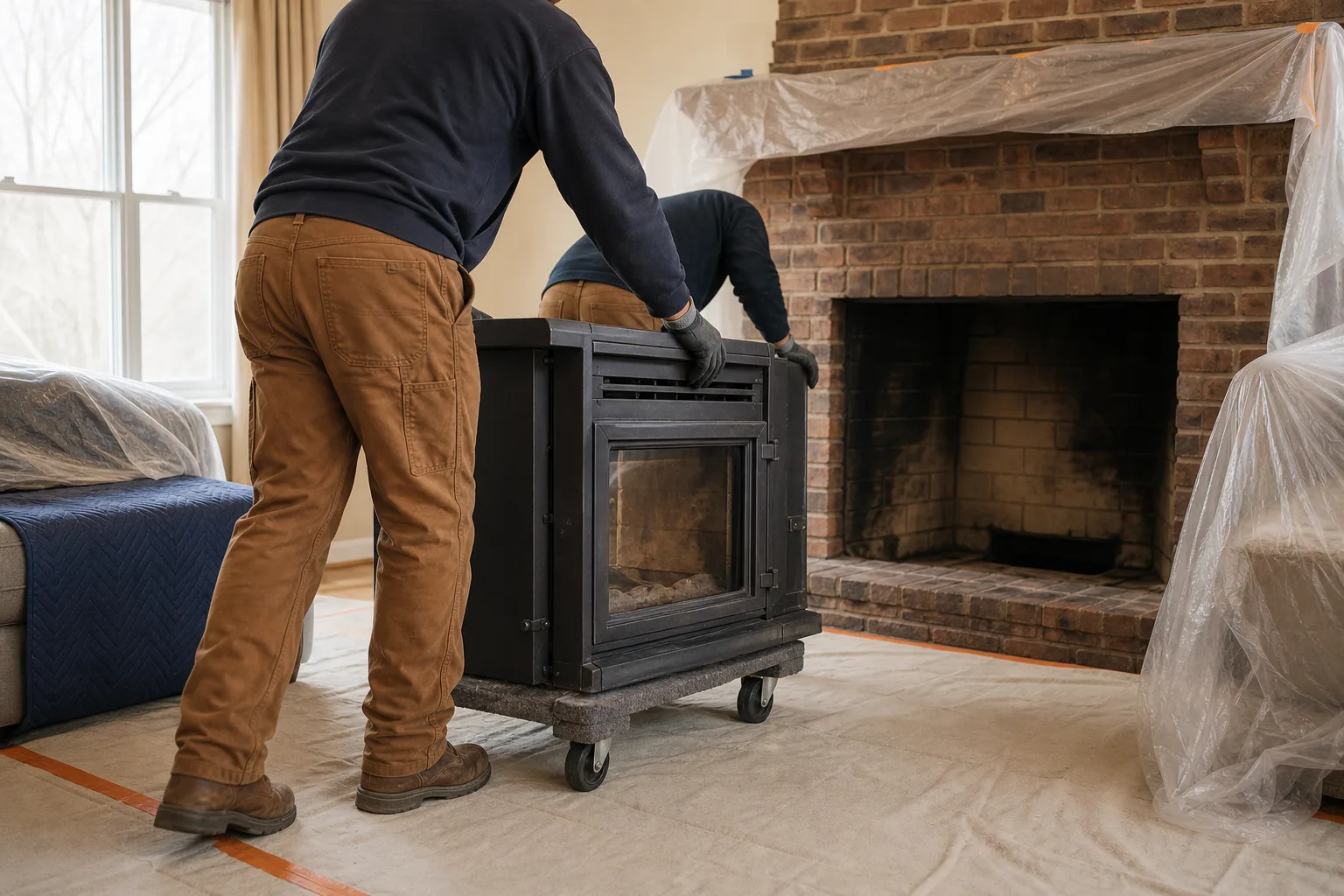
A typical insert job starts with protecting the room: floor coverings from the door to the hearth, plastic over the surrounding furniture, a vacuum running at the opening. The existing firebox gets swept and cleaned out. The damper plate usually comes out, and sometimes part of the frame gets cut to clear the liner path.
Then the liner goes down from the roof, or up from the fireplace, depending on the chimney. It's connected to the insert's flue collar, secured, and sealed at the top with a plate and cap. A block-off plate or insulation closes the throat. The insert itself is heavy (genuinely heavy, often a two-person lift with a stove dolly), and it gets walked into the opening, leveled, shimmed, and connected. The surround panel goes on last, followed by any trim to close the gap between the panel and the masonry face.
Good crews finish with a burn. They'll light it, watch the draft establish, check that the door gasket seals evenly, run the blower, and walk you through the air control and, on a catalytic unit, the bypass. Expect a modest amount of smell during the first few fires as the paint cures; open a window and burn it off rather than worrying about it.
Good to know: ask for the paperwork. You want the manufacturer's manual, the model and serial number, documentation of the liner size and material, and the inspection report. If you sell the house, the next buyer's Level 2 inspection will go far more smoothly with that folder in hand, and if you ever need a warranty claim, it's the only thing that will save you.
If you're weighing whether to hire out or attempt part of it yourself, my honest take is that measuring and shopping are fine DIY territory, and everything above the damper is not. The details of the process are covered further in our fireplace insert installation guide, and if you're still comparing units and installers, fireplace inserts near me is the place to start.
Living with an insert: fuel, habits, and upkeep
The first season is a learning curve. A modern sealed stove doesn't behave like an open fire, and the instinct to choke the air down to make the fire last is exactly wrong: you get a smoldering, smoky, creosote-producing burn and a black glass door. Modern units want to run hot and clean, with the air open until the load is fully engaged, then dialed back to a setting that keeps visible secondary flame or an active combustor.
A few habits do most of the work. Burn seasoned hardwood, not construction scrap, not painted or treated lumber, never driftwood. Build fires with the fuel and the air path the manual describes rather than the way your grandfather did it in an open hearth. Rake coals forward before reloading. Leave an inch of ash on the floor of the firebox as insulation and clear the rest into a metal can with a lid, kept outdoors on a non-combustible surface. Ash holds live embers far longer than people expect.
Maintenance is genuinely light, but it isn't zero. Sweep annually at minimum, more if you burn hard through the season; a liner that serves an insert can accumulate faster than an open flue if the wood is marginal. Inspect the door gasket each year and replace it when the seal goes soft. A dollar bill closed in the door should meet resistance when you pull it out. Check the baffle and the firebrick for cracks. On catalytic units, look at the combustor for plugging or crumbling and know that it's a wear item. Have the cap and the top plate looked at whenever someone's on the roof anyway.
Safety note: an insert slides into a masonry cavity, which means much of the appliance and all of the liner is hidden. That's a strong argument for a proper annual visit from a chimney sweep rather than a shop-vac and a look through the glass. Working carbon monoxide alarms on every level of the house are not optional with any solid-fuel appliance, and detectors have expiration dates printed on the back.
From the field: the single best predictor of how an insert is performing is the glass. Clean glass with a lively fire means dry wood and enough air. Persistent dark film that returns within a day or two of cleaning is the appliance telling you something. Usually wet fuel, occasionally a draft problem, sometimes an operating habit. It's worth paying attention to before it becomes a liner full of glazed creosote.
If wood turns out not to be your relationship, note that the same firebox that takes a wood unit will usually take a pellet insert instead, and that comes with its own trade-offs: electricity dependence, bagged fuel, and a different maintenance rhythm covered in pellet stove installation. Plenty of people go that route after a season of hauling logs, and there's no shame in it.
Ready to talk specifics about your fireplace?
Send us photos of the opening and your measurements, or have us come out and take them properly. We'll tell you what fits, what the chimney needs, and what the liner run involves. No pressure to buy an appliance from anyone.
Call (513) 655-6702 or request service to get on the schedule.
One more thought before you go shopping. The stove you'll be happiest with in five years is usually not the biggest one that fits. Oversized units get run at low output because the room gets uncomfortable otherwise, and low output is exactly where wood stoves burn dirty. Match the appliance to the space you actually want to heat, and let the fit of the firebox, not the size of the showroom floor model, make the decision for you.
Symptom checker
What is your chimney doing?
Tap the closest match for an honest first answer.