



On this pageRaccoon in Chimney or Something Else? Start With the Sound8 sections+7
- Raccoon in Chimney or Something Else? Start With the Sound
- The Ledge You Did Not Know You Had
- What Not to Do Tonight
- If There Are Babies Up There, Everything Changes
- Raccoon in Chimney Removal: What Actually Works
- The Animal Leaves. The Mess Stays.
- Closing the Front Door: Caps, Chase Covers, and Screens
- How VIO Helps With a Raccoon in Chimney
Quick answer
A raccoon in chimney is almost always a female denning on the smoke shelf, the flat ledge just above your damper. Do not light a fire and do not open the damper. Call a licensed wildlife operator to remove the animal, especially if you hear chittering, which means kits. Then have the flue cleaned, inspected, and capped so it does not happen again.
It is the first genuinely cold night of the year. You open the damper, stack the wood, and then you hear it: a slow, deliberate scratching somewhere above your head, coming from a place you cannot point to.
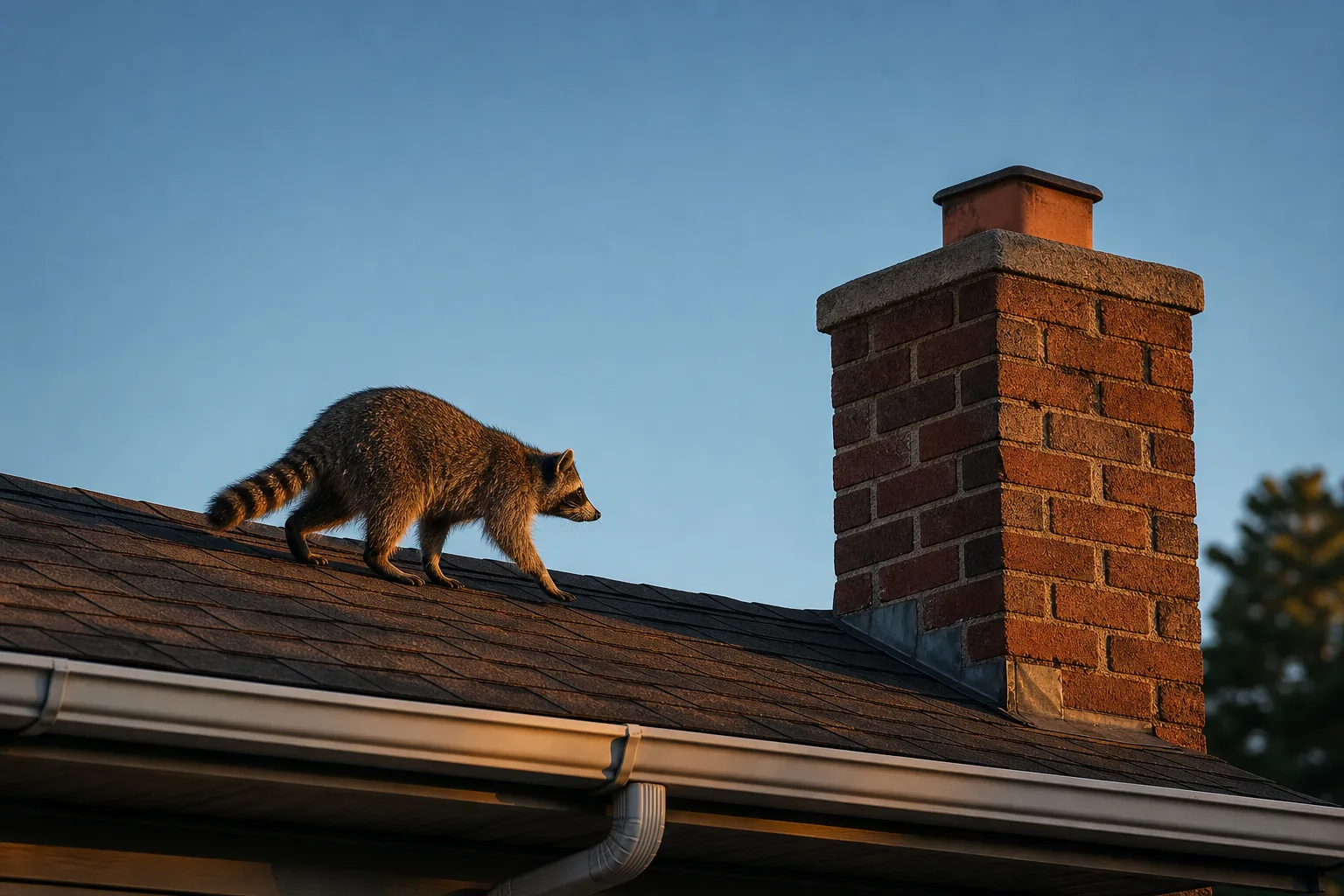
If you have since typed raccoon in chimney into your phone, you are in the right place, and the first thing worth knowing is this. The animal is almost certainly not inside your wall, and it is almost certainly not stuck. It is sitting on a flat ledge you probably did not know your chimney had.
That ledge changes how you should think about the whole problem. So does the answer to one question you may not be able to answer yet: whether she is up there alone.
This guide covers the whole thing: what the sound tells you, what not to do tonight, how the animal comes out, and the half almost nobody writes about, which is the chimney you are left with afterward.
Safety note: Do not light a fire to drive the animal out. It does not reliably work, the damper has to be open for smoke to rise, which hands a panicked adult raccoon a direct route into your living room, and any young animals up there cannot climb out on their own.
Raccoon in Chimney or Something Else? Start With the Sound
Almost every raccoon in chimney call starts with a sound and nothing else. You are not going up on the roof at eleven at night, and you should not. So the identification has to happen from the hearth, by ear.
Sound narrows the field. It does not settle it, and anyone who identifies an animal over the phone with certainty is overselling. What it gives you is which company to call first, which is all you need tonight.
What a raccoon tends to sound like
Weight is the usual giveaway.
A raccoon is heavy enough that people often report hearing mass shifting rather than individual feet: a slow dragging scrape, a long pause, then a thump as it repositions. Not much about it is quick.
If there are kits on the shelf, you may hear something else layered underneath, a high chittering or trilling in bursts, which homeowners often describe as a squeaky toy. If you hear that, treat it as a strong hint that the timeline is no longer yours to set.
The other three suspects
Birds usually read as fast, light, and loud. Chimney swifts are often described making a rolling, mechanical chatter, with wings against the flue tile that sound like paper.
Squirrels tend toward quick, frantic scrabbling and are often heard around first light. Bats are close to silent, and people usually notice a smell, or see them leaving at dusk, before they hear anything.
The table below is a starting point for narrowing it down, not a diagnosis.
| What you hear | When you hear it | Where it seems to come from | Worth suspecting |
|---|---|---|---|
| Slow, heavy dragging and thumping | Dusk and overnight | Low, just above the damper | Raccoon |
| High chittering or trilling in bursts | Any hour, especially when the adult leaves | Same low spot, seems to stay put | Raccoon kits |
| Fast rolling chatter, wing flutter | Daytime, loudest at dawn | High up in the flue | Birds, often chimney swifts |
| Rapid scrabbling and scratching | Early morning, daytime | Moving up and down the flue | Squirrel |
| Almost nothing, plus an ammonia-like smell | Dusk departures | Hard to place, often higher | Bats |
One free tell: look at the hearth. If coarse debris, bark, leaves, or crumbs of mortar are landing on the fireplace floor, something substantial is moving above you.
The Ledge You Did Not Know You Had
Here is the payoff on that open loop, and the one piece of anatomy that explains almost every raccoon in chimney story.
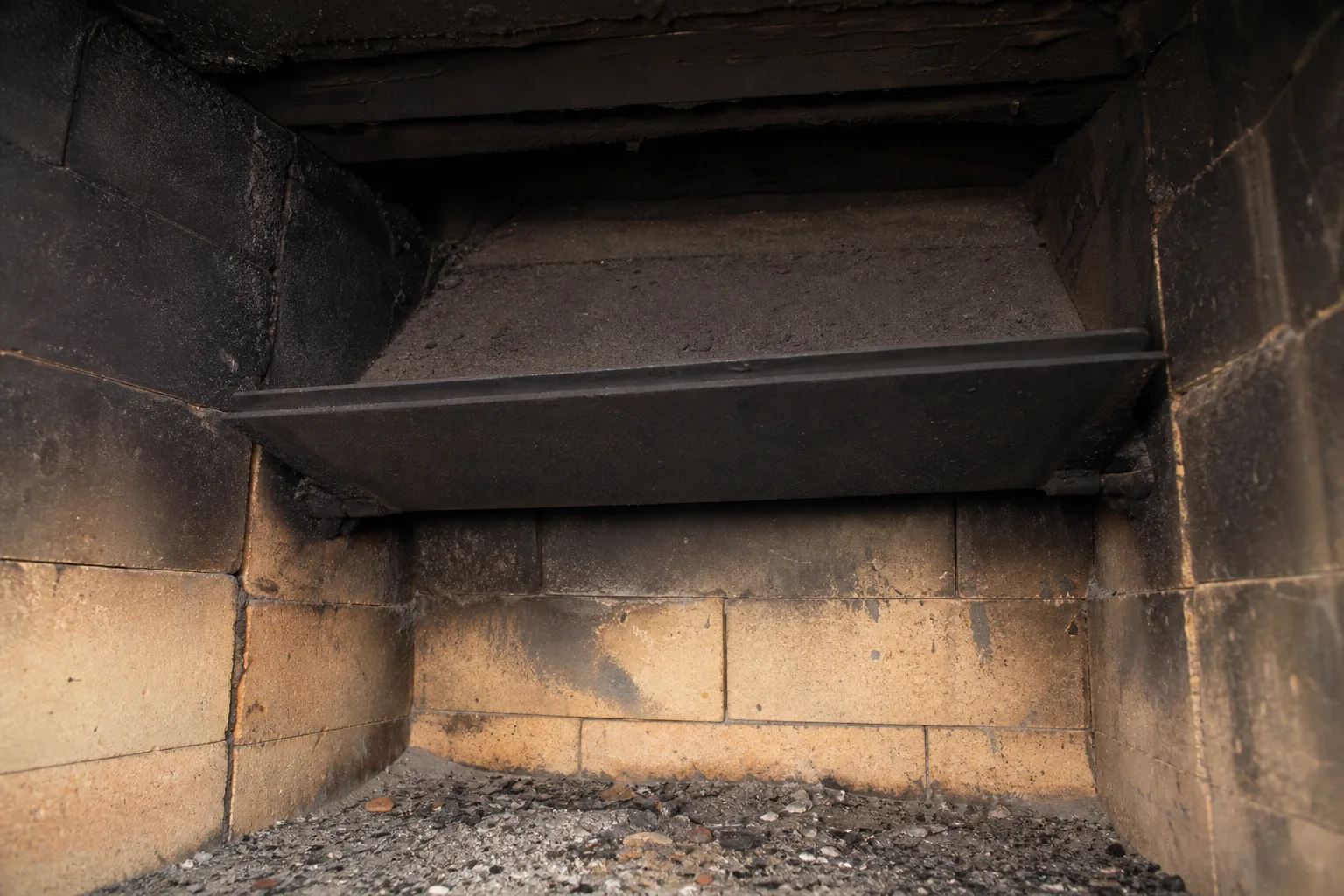
In a standard masonry fireplace, the flue does not run straight down into the firebox. Just above the damper, the passage steps back to form a flat horizontal ledge called the smoke shelf. Its actual job is to catch downdrafts and falling debris and keep them from rolling into your living room.
It is also, from a raccoon's point of view, a perfect apartment. Dry, dark, sheltered from weather, warmed by the house, and with a vertical shaft above it that functions exactly like a hollow tree. That is not a metaphor invented by marketers. It is the reason chimneys attract denning raccoons in the first place.
Good to know: The smoke shelf is why the noise seems to come from inside your wall rather than from up the chimney. The animal is only a couple of feet above the damper, sitting behind and above a closed steel plate, so the sound reaches you through the masonry instead of down the open flue.
Inside a masonry fireplace chimney
The sequence from where you are standing: firebox, throat, damper plate on its hinge, smoke shelf, smoke chamber tapering upward, then flue tiles running to the crown.
The raccoon can be on the smoke shelf, or it can be higher in the smoke chamber. What it cannot do, in most cases, is get past a closed damper into your house. A closed damper is the only thing standing between the two of you, which is exactly why the "open it and look" instinct is a bad one.
Factory-built chimneys and the chase
Not every fireplace is masonry. Many newer homes have a factory-built unit with a round metal pipe running up through a framed box called a chase, finished in siding or stucco to look like a chimney from the street.
Here the animal is usually not in the pipe at all. It is in the dead space of the chase itself, having gotten in under a lifted or corroded chase cover. Same noise, different geometry, and a different repair at the top.
What Not to Do Tonight
Most of the damage in a raccoon in chimney situation is self-inflicted in the first twelve hours. This list is short on purpose.
- Do not light a fire. Covered above, and it is the single most common mistake.
- Do not open the damper. It is the one barrier between a wild animal and your furniture.
- Do not reach up onto the smoke shelf. Not with your hand, not with a broom handle, not with a phone to take a photo.
- Do not pour anything down the flue. Water, bleach, smoke bombs, none of it.
- Do not use mothballs, ammonia rags, or coyote urine. More on this below.
- Do not cap or seal the top yet. Sealing the exit with the animal inside creates a far worse problem, and an animal that dies in a flue is a removal job and an odor job at the same time.
- Do not let the dog into the room. A barking dog directly below a cornered raccoon escalates everything.
- Do not wait a month to see if it resolves. It might, seasonally. The mess and the open flue will not.
Myth vs. fact: You will read everywhere that ammonia, mothballs, or predator urine will chase her out. The honest version: the evidence for any of it is anecdotal, wildlife agencies treat harassment as partial at best, and mothballs are a labeled pesticide being used off-label when you throw them down a chimney. We are not going to tell you to do it.
If you are reading this at a reasonable hour and the noise has been going on for days, the useful move tonight is simply to keep the damper shut, keep the room quiet, and make two phone calls in the morning. We will get to why it is two.
If There Are Babies Up There, Everything Changes
A female raccoon does not pick a chimney because she is lost. Wildlife sources describe chimneys as attractive maternity dens, and once she has settled in, she is not a trespasser you can reason with. She is a mother with young that cannot yet follow her.
This is the fork in the road, and it is what separates a short raccoon in chimney job from a long one. An adult on its own is straightforward. A litter turns it into a timed, regulated, hands-on operation.
Raccoon in Chimney Season: Spring Kits and Fall Shelter Seekers
Wildlife control sources tend to describe two patterns, and they produce fairly different phone calls.
The first is denning season. US wildlife control material commonly gives it as roughly April through August, though it is a general pattern rather than a fixed calendar and it varies by region. That is the window where the chittering sound tends to show up, and where the answer to "how fast can this be over" may stop being up to you.
The second is the cooler part of the year, where you are if you are reading this in late September. Wildlife and chimney companies describe raccoons looking for warm shelter as nights cool off, which tends to overlap with the week households open the damper for the first time since spring. Plenty of discoveries happen right there.
Why forcing her out early backfires
Kits typically stay in the den until they can climb out under their own power, commonly cited at around six to eight weeks after birth. Treat that as an approximate range and not a promise.
Until then she will not voluntarily leave them. Push hard enough and you can separate a mother from young that cannot follow her, which is both a welfare problem and, practically speaking, your problem: young animals left behind in a flue do not survive, and what happens next is an odor issue inside your house.
Good to know: Wildlife rules are set state by state, and some states restrict timing or relocation during denning season. There is no single national rule, and anyone who tells you there is has not checked. A licensed wildlife operator in your state knows what applies to you.
Raccoon in Chimney Removal: What Actually Works
Let me say the uncomfortable thing plainly, because it is the most useful sentence in this article. You need two phone calls, and the first one is not to a chimney company.
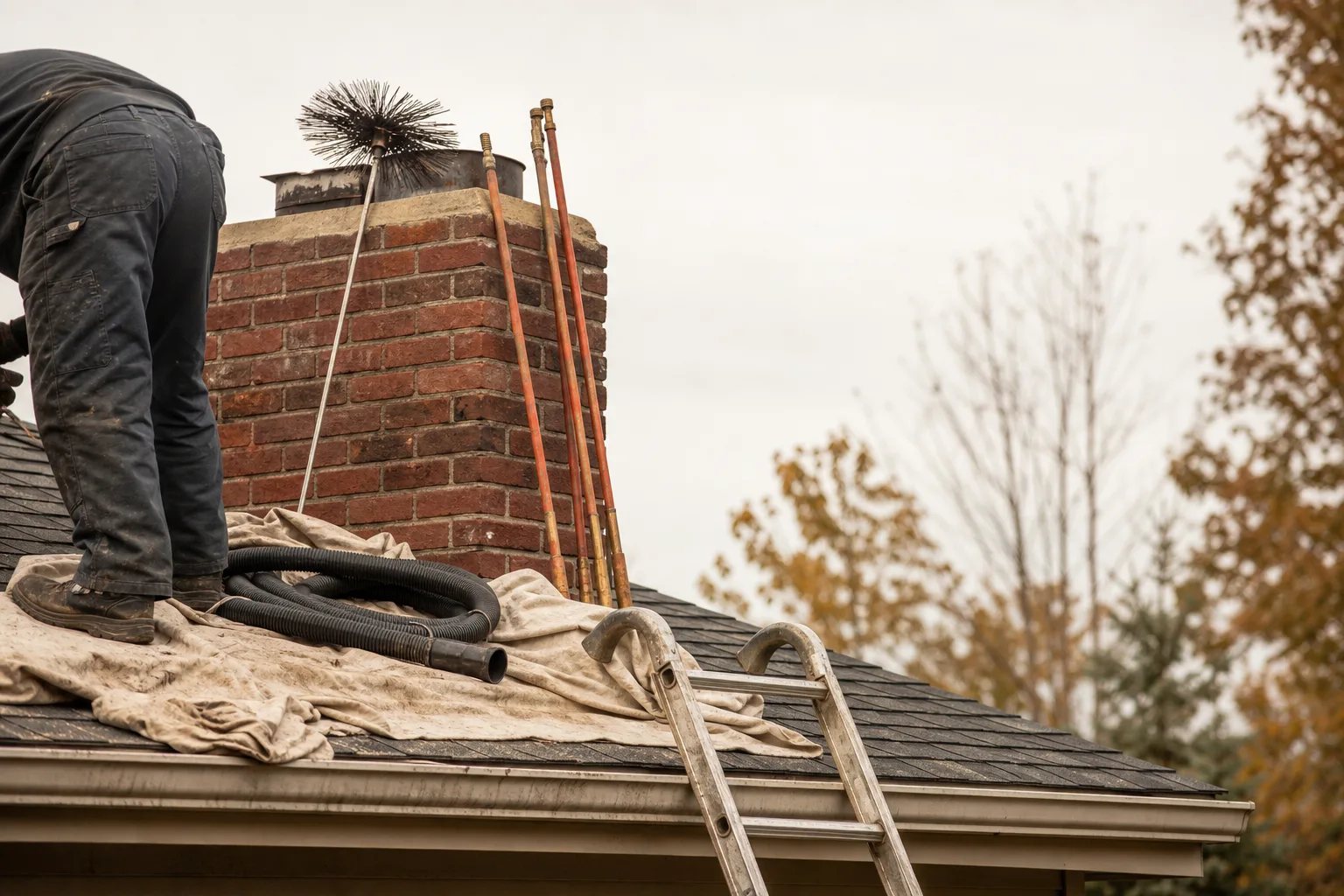
Every raccoon in chimney job splits cleanly in half. Somebody licensed for wildlife removes the animal. Then somebody who works on chimneys deals with what it left behind and closes the way it came in. Different licenses, different insurance, different tools. A company that claims to be excellent at both is worth a second look.
What a licensed wildlife operator actually does
For an adult alone, the approach operators describe most often is a cage trap set at the top of the chimney, positioned so the animal walks into it on its way out.
For a female with kits, it is hands-on. The young are reached from the firebox side, at the smoke shelf, and lifted out. Good operators then reunite them with the mother rather than splitting the family, which is also what actually ends the problem, since a mother whose kits are gone will work hard to get back in.
Either way, the operator is the one who confirms the flue is empty. Do not take your own word for it.
Why this is not a homeowner job
Three reasons, none of them about bravery.
A cornered adult raccoon in a confined shaft is dangerous to handle, and nobody should attempt it from a ladder. State licensing exists for a reason, and doing this yourself may put you on the wrong side of it. And the smoke shelf is a contaminated surface, which is the next section.
When the animal is out and you are ready for the second call, you can get matched with a local chimney company and skip the part where you cold-call five listings.
The Animal Leaves. The Mess Stays.
Every other raccoon in chimney article you have skimmed tonight ends right about here. This is the part that actually costs you something. The raccoon is gone. Your chimney is not the chimney you had in August.
Nesting material and an obstructed flue
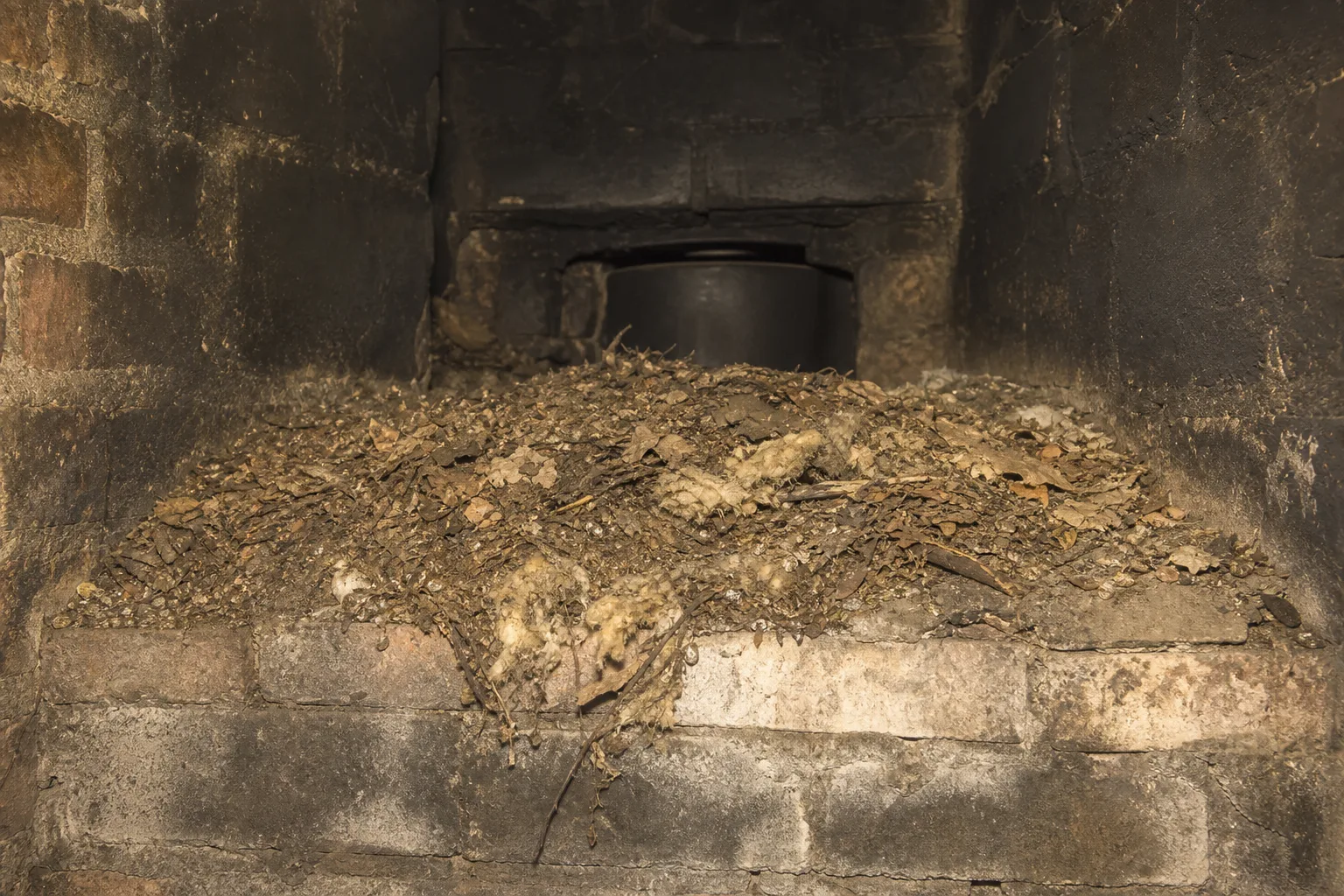
A den is built out of whatever is available on your roof and in your gutters. Leaves, twigs, shredded bark, sometimes insulation pulled in from a nearby attic vent. On a smoke shelf it compacts into a matted, dusty, gray-brown mass.
Two problems with that, and neither is theoretical. It is combustible, sitting directly in the path of the first fire you light. And it obstructs the flue, which means the smoke that should be going up is looking for another way out, and the only other way out is your living room.
From the field: The thing homeowners are least prepared for is not the animal. It is how much material actually comes off a smoke shelf once somebody opens it up and starts pulling. People expect a nest. What comes out looks more like a cleaned-out gutter.
If that flue also serves a wood stove or another solid fuel appliance rather than an open fireplace, the obstruction question gets more serious, not less, because a stove is drafting into that same passage with the door shut. Routine wood stove maintenance assumes a clear flue and a working draft, and neither is safe to assume here.
The health part, stated plainly
No adjectives, just what the CDC publishes.
Raccoons carry an intestinal parasite called Baylisascaris procyonis, the raccoon roundworm. CDC states up to 80 percent of raccoons are affected in the Northeast, Midwest, and West Coast. Infected raccoons usually show no symptoms at all.
Raccoons also defecate in fixed communal sites called latrines, and the CDC explicitly lists chimneys among the urban and suburban latrine locations it has documented, alongside rooftops and attics.
The eggs are the issue. Adult female worms may collectively shed millions of eggs per day, the eggs resist environmental degradation and can survive for years, and they become infectious two to four weeks after being shed. Most human infections occur in young children, because of hand-to-mouth behavior.
That is the entire case for not scooping this out yourself with a dustpan, and for keeping kids away from the hearth until it has been properly cleaned. California's public health department publishes a whole brochure on cleaning up a raccoon latrine, which should tell you how routine a task it is not.
What an inspection after wildlife looks like
A real post-wildlife visit is not a sweep. It is a sweep plus a look.
The sweeping part clears the smoke shelf, the smoke chamber, and the flue of nesting material and droppings, with containment at the hearth and a vacuum rather than a broom. The looking part is a camera scan of the full flue, checking whether liner tiles were damaged, whether the damper still seats and swings, whether anything is cracked where the animal had been working at it.
NFPA 211 requires a Level 2 inspection at sale or transfer of a property, when the system is changed, after a malfunction, after a chimney fire, and after an external event likely to have caused damage. A flue that has been packed with a nest and cannot draft is fairly described as malfunctioning, so a Level 2 scope is a reasonable thing to ask for by name. Ask for it, and ask to see the camera footage.
The raccoon is one phone call. The chimney is the next one. Once the animal is out, the flue still has to be cleared, inspected, and closed at the top. VIO is a referral service, so we do not do that work ourselves. We match you with an independent local chimney company that does. Call (513) 655-6702 or request service and tell them you had wildlife in the flue.
Closing the Front Door: Caps, Chase Covers, and Screens
Everything up to now was cleanup. This is the part that decides whether you do all of it again next year.
An open flue tile at the top of a chimney is, to a raccoon, an unlocked door on an empty house. It does not matter how the last one got evicted. The next one will find the same opening.
What a good chimney cap actually is
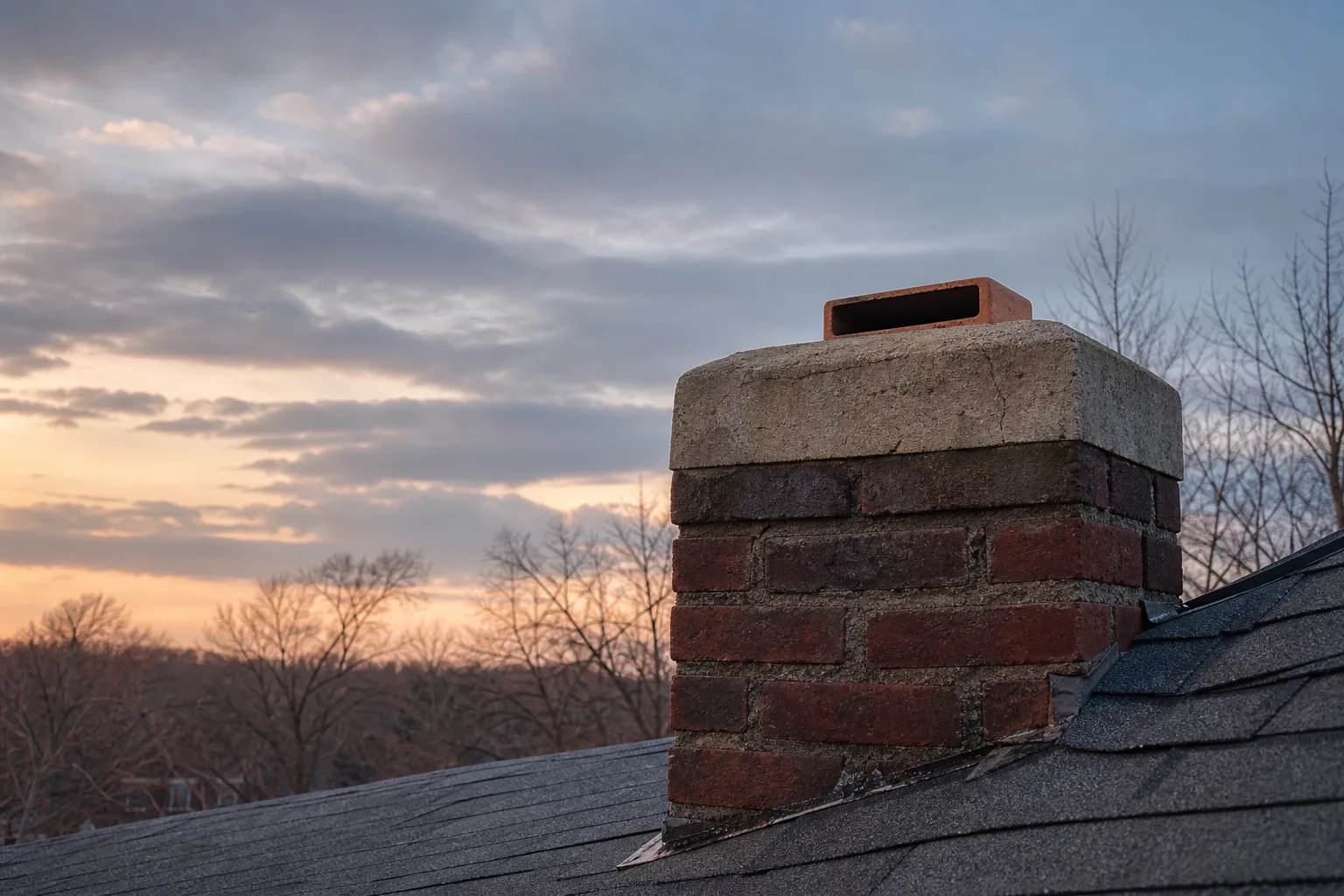
Walk out to the curb and look at your chimney top. If you see nothing but bare clay tile sticking up out of the concrete crown, you have no cap at all, and that black rectangle is the answer to "how did it get in."
A cap is a small stainless steel structure: a lid on short legs, mesh screen on all four sides, fastened to the outside of the flue tile. It keeps rain off the smoke chamber, keeps embers from landing on your roof, and keeps animals out. One part, three jobs.
The detail that matters most for our purposes is the fastening. Raccoons are strong and their hands work like hands. A cap that sits on friction or gravity alone is a cap a raccoon can lift, which is why every source on this problem specifies screwing it down.
Pro tip: Two questions to ask the company at the top of the roof. Is the cap screwed or band-clamped to the flue tile, and which mesh spec does our local code require here? If you get a shrug on either one, that is useful information about the company.
Mesh size, local code, and the question to ask
This is one of the few places where the honest answer is "it depends," and you should be suspicious of anyone who gives you a single number without asking about your appliance.
NFPA 211 language quoted by code aggregators puts spark arrester openings no smaller than three eighths of an inch and no larger than half an inch. Meanwhile the most common animal-resistant caps sold in the US use five-eighths inch mesh, marketed as meeting California's spark arrester requirements.
Translation for a homeowner: mesh size is set by your local code and by what the flue is serving, and finer is not automatically better, because a screen that is too tight chokes the draft and loads up with creosote. Ask which spec applies to your house.
The rest of the roof
If you have a factory-built chimney, your fix is not a flue cap at all. It is the chase cover, the sheet metal top on the box, and the tell is a rust stain running down the siding from a low corner. A galvanized cover that has rusted through is an open door with a lid on it.
While somebody is up there, the rest of the envelope is worth a look: the crown for cracks, the flashing where the chimney meets the shingles, and any nearby attic or gable vent with a bent screen. Raccoons are opportunists, and they work the whole roof, not just the chimney. It is also a sensible trip to fold in whatever seasonal upkeep the appliance below is due for, since the cap and the stove are the same ladder.
The honest framing is that a raccoon in chimney discovery is usually a symptom. The chimney was open, so something moved in. Close it properly and the same animal that evicted you from your own fireplace goes and finds a real tree.
Safety note: Never cap a chimney you have not confirmed is empty. Sealing an animal inside a flue turns a wildlife call into a carcass removal and an odor remediation, and it is a far worse week than the one you are currently having.
How VIO Helps With a Raccoon in Chimney
Here is exactly what we are and are not, because you have had enough vagueness for one week.
VIO is a referral service. We do not do wildlife removal, at all, and we do not send our own crews to anything. What we do is connect homeowners with independent local chimney companies, and every bit of work described in this article is performed by those companies, not by us.
So for a raccoon in chimney situation, we are the second phone call, not the first. Call a licensed wildlife operator to get the animal out. Then come to us for the part that follows.
That second call is where the flue cleaning, the camera inspection, the damper check, and the cap or chase cover get discussed. What the company recommends, and what it finds once it is up there, is between you and that company.
On money, one thing we control and one thing you should control. We ask every company in the network to put its estimate in writing before any work starts, and you should insist on exactly that, for the cleaning, the inspection, and the cap as separate lines. If the roof looks different once the company we match you with is actually up there, that should be a new conversation and a new number, not a surprise on the invoice.
A raccoon in chimney problem has a clear shape to it. Get it cleaned, get it looked at, get the top closed, and you are no longer guessing about what is above your damper.
Before the first fire of the season, look up. If anything has been living in your chimney, you want it cleaned, inspected, and capped before you light it, not after. Call (513) 655-6702 or request service to get matched with a local chimney company.
Symptom checker
What is your chimney doing?
Tap the closest match for an honest first answer.