



On this pageWhat a chimney cap installer actually does up there8 sections+7
- What a chimney cap installer actually does up there
- Single-flue or multi-flue: the thing that decides the whole job
- Metal matters: stainless, galvanized, copper, powder-coated
- Four questions that separate a real chimney cap installer from a guy with a ladder
- When to call a chimney cap installer and when you can climb up yourself
- The crown under the cap, which the cap does not fix
- How a chimney cap installer should leave your roof
- How VIO helps you find a chimney cap installer
Quick answer
A chimney cap installer measures the top of your chimney, selects a cap sized to it, and fastens it so it sheds water and stays put in a storm. Single-flue caps clamp around the outside of the clay flue tile, while multi-flue caps anchor to the crown. On a wood-burning chimney the mesh also serves as the spark arrestor, and the International Residential Code sets those mesh openings between three eighths and one half of an inch.
From the yard it does not look like much. A lid sitting crooked on top of the stack, or rust streaks running down the brick, or a dark square hole open to the sky where something used to be. Then you get closer, you understand what is missing, and you start looking for a chimney cap installer instead of a Saturday project.
That instinct is usually right. But before you call anyone, a few things are worth knowing, because they change who you should hire and what they should be doing up there.
And here is the part that catches homeowners off guard: the cap itself is the cheap part. The thing underneath it is not. We will get to that.
What a chimney cap installer actually does up there
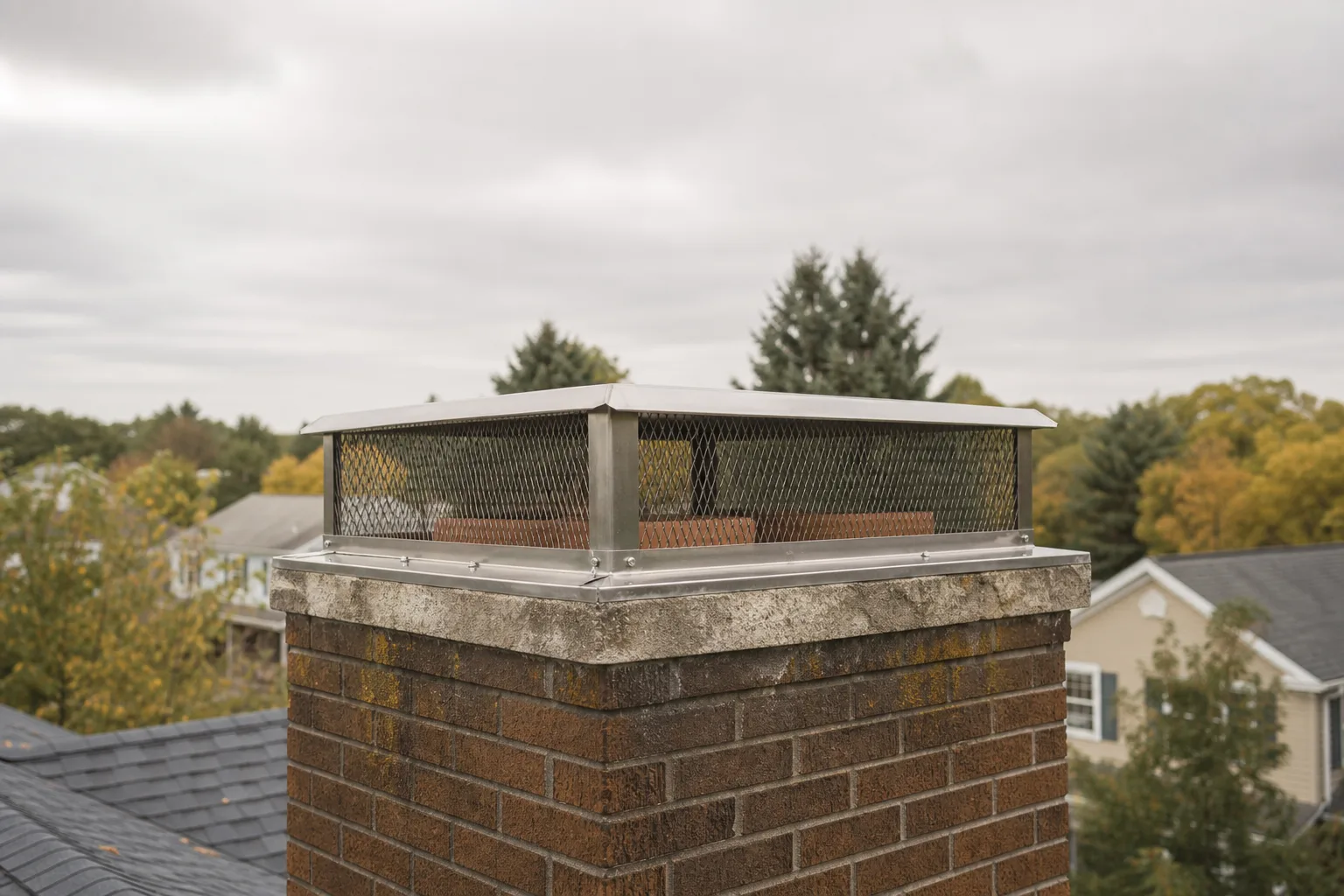
Strip away the product photos and a chimney cap is a small metal roof. Three parts, all visible from a ladder.
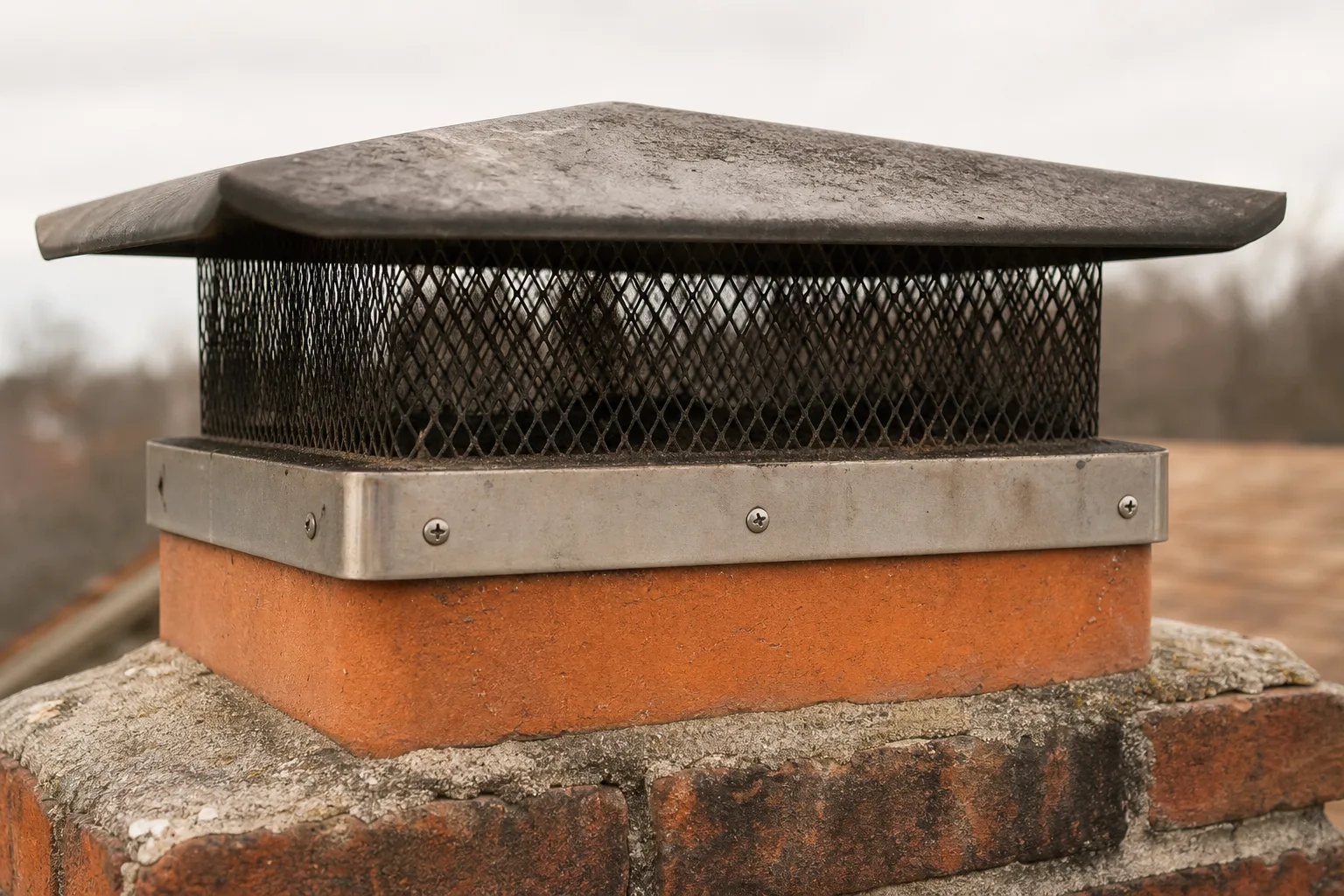
The lid is the top plate. It overhangs the opening, often by around three inches on each side, so water runs off and lands clear of the flue instead of pouring straight down it.
The mesh forms the four walls below that lid. It keeps birds and squirrels out, stops a raccoon from moving into the chimney, catches leaves and twigs, and on a wood-burning chimney it is the spark arrestor, holding embers inside where they belong.
The mounting is the part nobody looks at and the part that decides everything. Either a band clamps around the outside of the clay flue tile, or a flange and corner posts sit flat on the crown and get anchored into it.
Good to know: A cap is doing five jobs at once. Keeping rain and snow out of the flue, keeping animals out, keeping leaves and debris out, holding sparks in, and shielding the concrete crown below it from a season of weather. That last one is the job people forget, and it is the expensive one.
So the work is not "screw a lid on." What a chimney cap installer is really doing is picking the right cap for the way your particular stack is built, fastening it so it does not lift in a storm, and sealing it without hiding what is underneath.
Single-flue or multi-flue: the thing that decides the whole job
This is the distinction almost nothing you will read online explains before a truck pulls into your driveway, and it decides whether the visit takes an hour or turns into a fabrication order.
Single-flue caps: clamped to the clay tile
If your chimney has one flue and the clay tile pokes up a few inches above the crown, you are in single-flue territory. The cap slides down over that protruding tile and a band tightens around the outside of it with screws.
Fast, and the parts are stocked in standard sizes. Three of them cover about ninety percent of single-flue chimneys: nine by nine, nine by thirteen, and thirteen by thirteen.
Multi-flue caps: anchored to the crown
Two flues, a fireplace flue next to a furnace flue, or a stack where no tile protrudes at all. Now the cap has nothing to grab, so it becomes a top-mount: one large lid over the whole top of the chimney, on corner posts, anchored into the crown itself.
That changes the measurement entirely. The number that matters is no longer the flue. It is the length and width of the crown.
It also changes the price conversation, because once your crown falls outside the stock sizes somebody has to make the cap rather than pull it off a shelf. Leg kits exist for stacks with no protruding tile, which is a middle path worth asking your chimney cap installer about.
How to measure before you call a chimney cap installer
You do not have to measure anything yourself. But if you can get to the top safely, a tape measure and a phone camera make the first phone call twice as useful.
For a single flue, measure the outside dimensions of the clay tile, not the opening. That outside number is what a cap is sized to.
For a multi-flue top, measure the length and width of the crown, edge to edge.
Either way, photograph the top of the stack from a few angles. A photo of the crown, the tile and whatever is left of the old cap tells a chimney cap installer more in ten seconds than a paragraph of description.
While you have the camera out, shoot straight down into the flue as well. Knowing roughly what the inside of a chimney is supposed to look like makes it much easier to describe what you are actually seeing.
Pro tip: If that downward shot shows nest material, a heavy black buildup on the tile walls, or daylight coming through a crack, that is a separate conversation and you want it handled on the same visit rather than a second trip out.
One more thing about height. The lid should sit at least five inches above the flue opening; any lower and you are restricting the draft you just paid to protect. Multi-flue caps come in eight, ten and fourteen inch heights partly for this reason.
Metal matters: stainless, galvanized, copper, powder-coated
Four materials show up on real roofs, and they age very differently.
| Material | How it looks and ages | Corrosion behavior | Where it fits | The trade-off |
|---|---|---|---|---|
| Stainless steel | Dull silver-grey, never chrome-bright, hazes slightly with age | Highly resistant to rust and warping, holds up in salt air | The default for a cap you want to stop thinking about | Costs more up front than galvanized |
| Galvanized steel | Matte grey, then rust bleed at the screws, seams and lower mesh edge | Can rust over time; treated as the shorter-life option | Tight budgets, sheltered stacks, a stopgap while you plan crown work | You will be looking at it again sooner |
| Copper | Bright penny-orange, then brown, then green patina | Excellent, and the patina is protective | Older homes and anywhere the chimney is part of the view | The most expensive, and the color changes whether you like it or not |
| Powder-coated steel | Usually black, chalks and chips at the corners first | Depends on the steel underneath and on the coating staying intact | Matching dark trim or a standing seam roof | A chip is a rust starting point |
When galvanized is a decision you will revisit
I will say this plainly rather than hedge it. On a coastal house, or any stack that takes weather from every direction with nothing around it, galvanized is a decision you come back to. It is cheaper on the invoice and it does not stay cheaper.
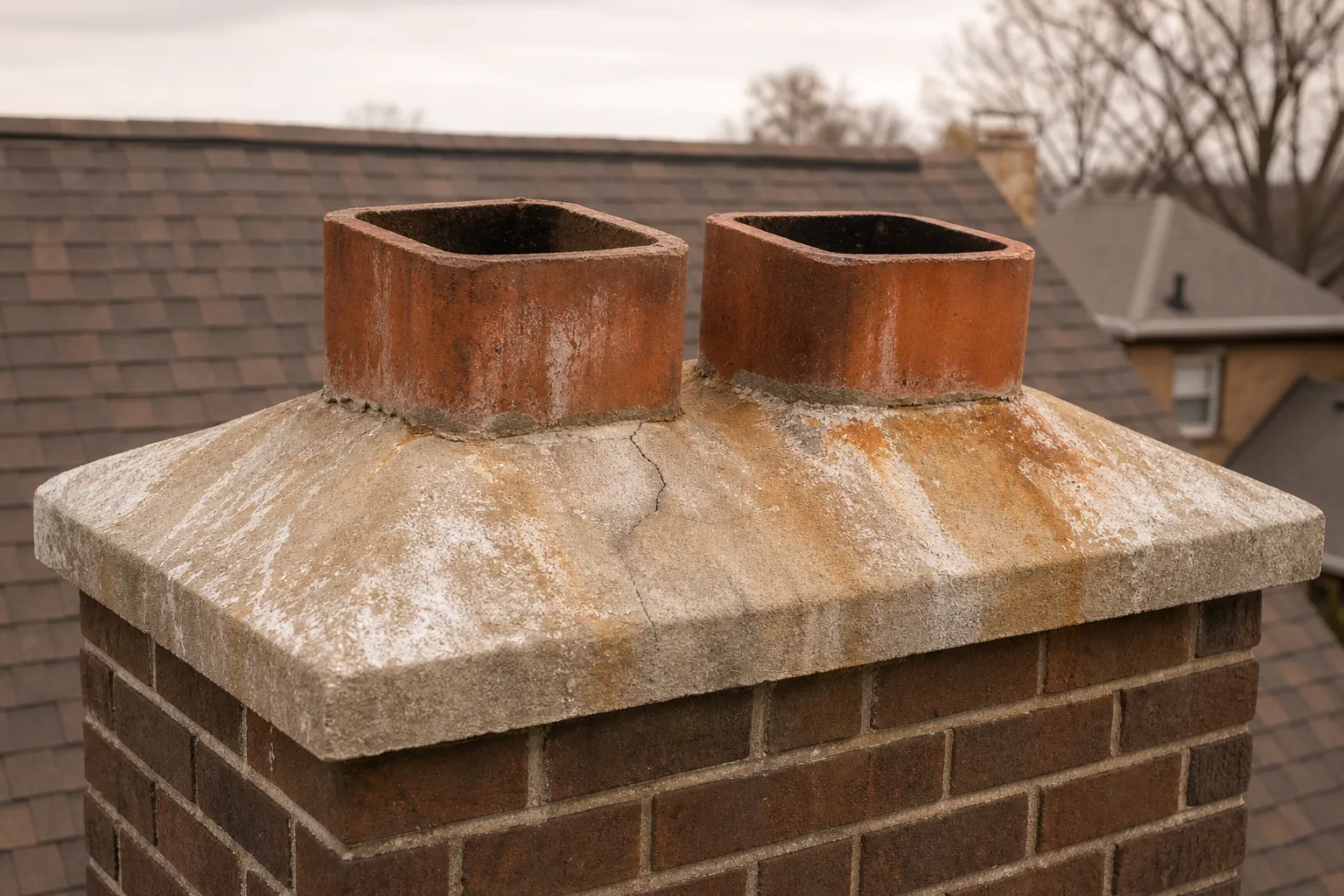
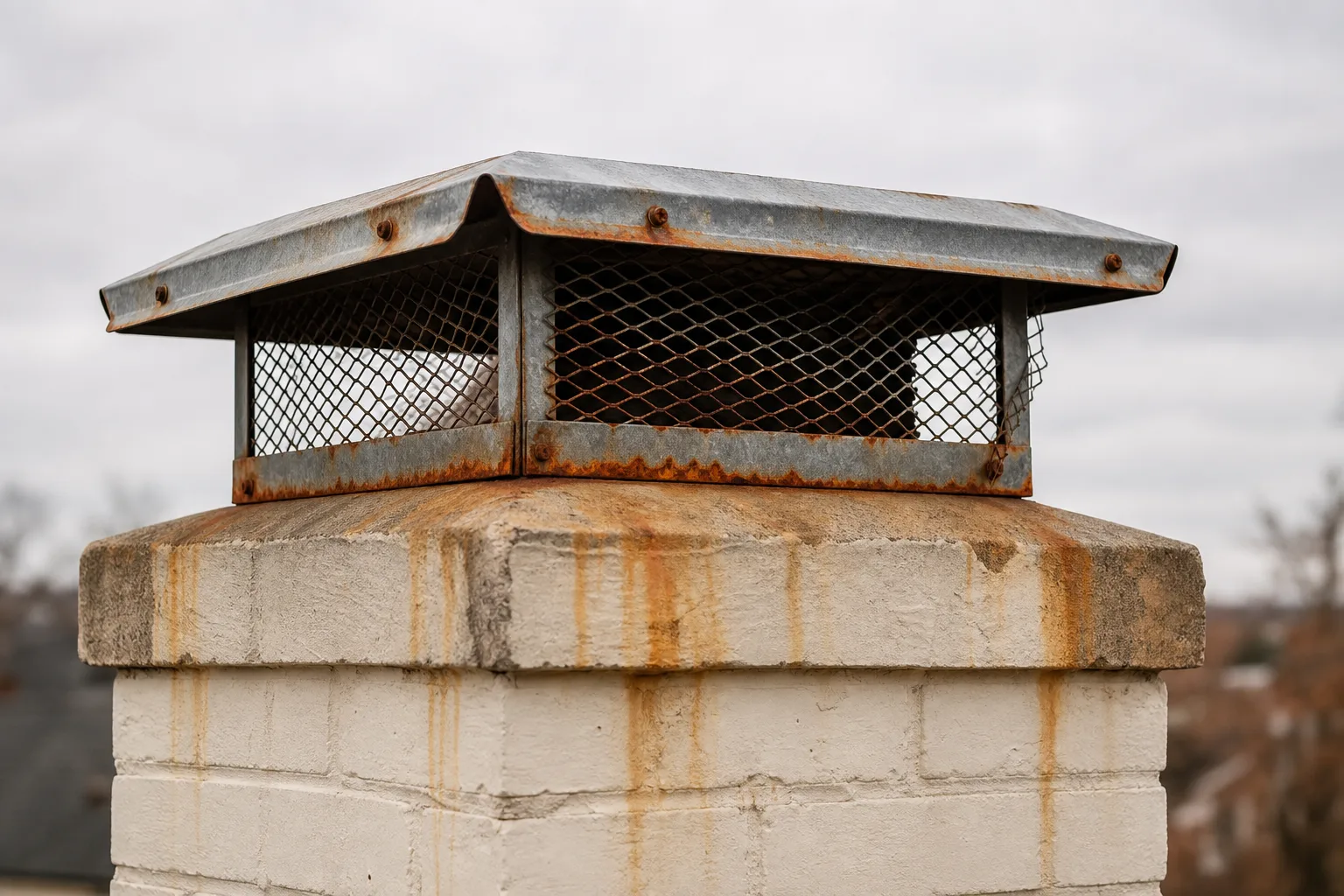
The way it fails is annoying too. It rusts at the fasteners and the seams first, and that rust runs down onto the crown and the brick in orange streaks that do not wash off.
If the budget is tight and the chimney is sheltered, galvanized is a defensible call. Just make it knowing what you chose.
Four questions that separate a real chimney cap installer from a guy with a ladder
Every service page in this business promises quality workmanship. None of them tell you how to check.
Credentials are a reasonable starting filter, and a CSIA certified chimney sweep has at least been tested on how this system works. But a certificate is not the same as the right answers, so here are four questions for the phone call, and what a real answer sounds like.
What good answers sound like
"What are you mounting to?"
A good answer is specific and physical. "Your tile sticks up about four inches, so a single-flue cap bands onto that." Or, "you have two flues and no tile above the crown, so this is a top-mount and I need crown dimensions."
A bad answer is a price with no mention of the tile or the crown. Nobody has looked yet, and the number will move.
"What metal, and what gauge?"
You want a material and a thickness, not "heavy duty." Stainless or copper if you want to forget about it, galvanized if that is the budget and you have agreed it is the budget.
"How are you fastening and sealing it?"
You want a mechanical attachment described, not an adhesive one. On a single-flue cap the band clamps around the outside of the clay tile and the screws tighten the band against it, they are not driven into the tile. On a top-mount the cap is anchored into the crown. Either way sealant is a bead where the cap meets the masonry, never the primary attachment, and never smeared across a crack to make it disappear.
"What condition is my crown in?"
This is the question that tells you who you are dealing with. Anyone who has been on top of a chimney can answer it, because they are standing on the answer. If the response is "I only do caps," you have hired somebody to put a new lid on a problem.
The code numbers you can check yourself
Here is the part almost nobody publishes, and it is the reason you can inspect this work from your own driveway. The International Residential Code, in section R1003.9.2, sets out what a spark arrestor has to be:
- The mesh openings must not pass a sphere larger than half an inch, and must not block a sphere smaller than three eighths of an inch. Too coarse and embers get out. Too fine and you choke the draft.
- The net free area of the arrestor must be at least four times the net free area of the flue outlet it serves.
- The screen must have heat and corrosion resistance equal to 19-gage galvanized steel or 24-gage stainless steel.
- The arrestor must be accessible for cleaning, and the screen or cap must be removable so the flue can be swept.
NFPA 211 lands in the same window on the mesh, no smaller than three eighths and no larger than half an inch. Whether a spark arrestor is required on your chimney at all depends on your local code, your fuel, and whether you sit in a wildfire-prone area, so that part is a question for your building department rather than a blog.
Myth vs. fact: The myth is that a chimney cap is a generic lid and any handyman with a ladder can bolt one on. The fact is that the cap has to be sized to either the tile or the crown, fastened with the right metal so the joint does not become the rust point, and left removable so the flue can still be cleaned. Get any of those three wrong and you have bought a part, not an installation.
Notice what these four questions have in common. Not one of them is about price. Ask them anyway, because the answers tell you whether the price is real.
Need a chimney cap installer who can answer those four questions?
Tell us about your chimney and where you are, and we match you with an independent local company that does cap work, not a handyman with a ladder. One call, no obligation.
Get matched with a chimney cap installer or call (513) 655-6702
When to call a chimney cap installer and when you can climb up yourself
I am not going to pretend nobody should ever do this themselves. A single-flue replacement in kind, on a low roof with a shallow pitch, with the old cap coming off clean, is within reach for a confident homeowner.
The problem is that the job does not announce which version it is until you are up there.
Five stop signs
If any of these describe your chimney, stop and hire someone.
- A pitch or a height you would not work on without a harness. Roof work is the actual hazard here, not the cap.
- Multiple flues, or a crown outside the stock sizes. This needs a cap made to fit, which means somebody has to measure it properly and order it.
- A cracked, crumbling or spalling crown. Anchoring a top-mount cap into failing concrete does not hold, and it hides the thing you should be fixing.
- Damaged or missing flue tile. A single-flue cap has nothing sound to clamp to.
- No cap present at all, and you do not know what was there. If it has been open to the sky for a while, the flue wants a proper chimney inspection and repair look before anything gets sealed over the top of it.
Safety note: Do not do roof work on a wet, frosted or windy day, and do not do it alone. Shingles that feel fine dry are a different surface with dew on them. If a harness and a properly footed ladder are not part of your plan, this is a call, not a project.
What a straightforward replacement involves
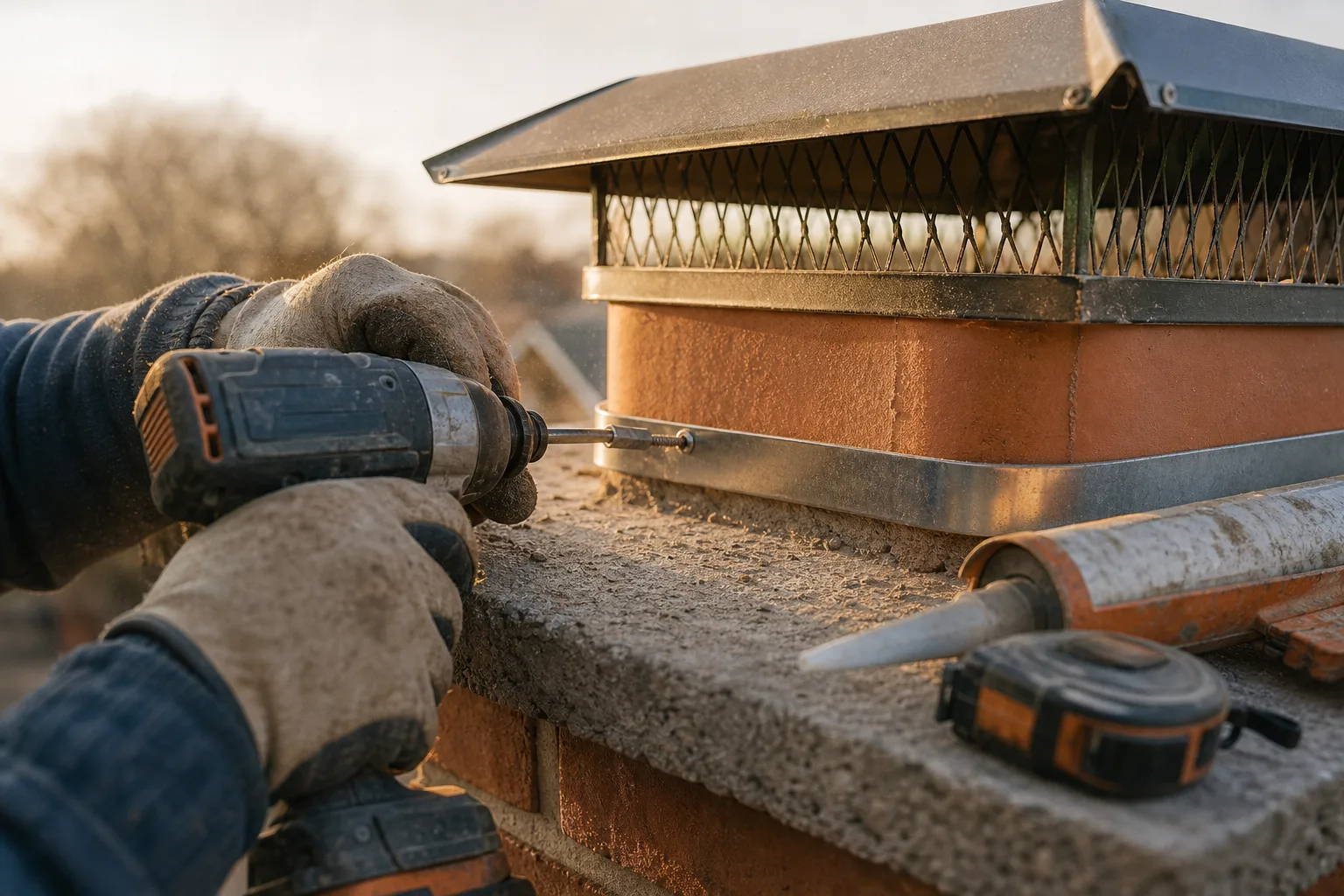
So you know what you are buying either way: measure the outside of the tile, get the matching cap, work the old band loose, lift off the old cap, clean the tile face so the new band seats flat, slide the new cap on, level it, tighten the band with the hardware supplied for it, and run a bead of sealant at the joint.
Then carry the old cap down the ladder instead of leaving it in the gutter. That step separates finished work from work that is merely over.
The crown under the cap, which the cap does not fix
Now the loop from the top of this article gets closed.
The crown is the sloped wash of concrete or mortar covering the top course of brick. Not the cap, not the flue. If you have never had it explained, our guide to what a chimney crown is goes through it properly. It is the surface both the cap and the tile sit on, and it sheds water off the top of the masonry.
A cap protects the crown. A cap does not repair one.
So when you see hairline cracks radiating from the base of the flue tile, chalky white efflorescence, or dark water staining running down the tile into the brick, a new cap is lipstick. The water is already getting in below the level a cap can help with.
From the field: Rust streaks on the crown and down the brick are usually a sign that the cap has been failing longer than the homeowner realizes. By the time the stains are visible from the ground, the water has had a lot of practice finding its way in.
Which is why a good chimney cap installer answers the crown question before you ask it. A cracked crown wants attention on its own terms, whether that means a sealant-grade repair, a rebuild, or chimney parging to resurface the masonry below it.
There is a second reason to take a missing cap seriously rather than treat it as cosmetic. NFPA 211 calls for a Level 2 inspection at specific moments, and they are not optional moments: at the sale or transfer of a property, when the system changes (fuel, appliance, relining, a change in flue shape or size), after a malfunction, after a chimney fire, and after an external event such as a storm, an earthquake or a lightning strike.
Read that last one again. If a storm took your cap off, the storm was the external event, which puts a chimney safety inspection in the same conversation as the replacement rather than in next year's budget.
How a chimney cap installer should leave your roof
Keep this list. Five minutes from the ground with binoculars, or one careful trip up the ladder, and it is the only quality check most homeowners ever get.
- The cap sits level and centered. A lid tilted to one side is throwing water at the crown instead of past it.
- The hardware matches the cap. Use the fasteners the cap is listed and sold with, and follow the manufacturer's instructions for that system. What should worry you is mismatched or leftover hardware improvised on the roof, because odd screws in a cap are usually the first joint to stain and loosen.
- Sealant is a bead, not a smear. A tidy line where the cap meets the masonry is correct. A wide gray patch spread across the crown is somebody hiding a crack.
- The mesh is intact on all four sides. No bent corner, no gap at a seam, no section flattened during the install.
- The lid overhangs the opening. You should see the edge extending past the tile, not sitting flush with it.
- The cap still comes off. Ask them to confirm it. Code expects the screen or cap to be removable for cleaning, and a cap glued down permanently turns next year's sweep into a demolition.
- Nothing was left behind. No old cap in the gutter, no screws on the shingles, no debris pushed down the flue.
Good to know: If your installer cannot get the cap off without cutting it, the flue cannot be properly swept, which means the thing you bought for safety has quietly made every future sweep harder. Removability is not a nice extra. It is in the code.
How VIO helps you find a chimney cap installer
Here is exactly what we are. VIO is a referral service. We do not climb roofs, we do not fabricate caps, and we do not employ technicians.
What we do is take what you are seeing on top of your stack, match it to an independent local chimney company that actually does cap work, and hand the job to people who will be on your roof rather than on a call center script.
The company that shows up works for itself, not for us. Worth saying plainly, because it means you should still ask the four questions above. We also ask every company in the network to put its estimate in writing before any work starts, and you should insist on exactly that, from us or from anyone else.
If the cap turns out to be one item on a longer list, a crown that needs work or a flue that needs looking at, ask the company to walk you through the whole list before anything gets scheduled. Better to find that out on the ground than after a new cap is sitting over a problem.
Finding a chimney cap installer is not the hard part of this job. Finding one who looks at the crown, sizes the cap to your actual chimney, attaches it the way that cap is meant to be attached and leaves the thing removable, that is the hard part. Ask the four questions and you will know inside two minutes which one you have on the phone.
Get your chimney cap handled before the first cold night
Tell us what you are seeing on top of the stack. We pass it to an independent chimney company near you, and we ask every company in the network to put its estimate in writing before any work starts. You should insist on exactly that.
Request a chimney cap installer or call (513) 655-6702. You can also request service online.
Symptom checker
What is your chimney doing?
Tap the closest match for an honest first answer.