



On this pageWhat Is a Chimney Crown, Exactly?7 sections+6
- What Is a Chimney Crown, Exactly?
- Chimney Crown vs. Chimney Cap vs. Chase Cover
- What Is a Chimney Crown Made Of, and Why Concrete Beats Mortar
- The Mortar Wash Problem: When the Chimney Never Had a Crown
- How to Check Your Chimney Crown Without Getting on the Roof
- Seal It, Resurface It, or Replace It
- How VIO Helps With a Chimney Crown You Cannot See
Quick answer
What is a chimney crown? It is the cast concrete slab on top of a masonry chimney, spanning from the outside of the flue liner out to the outer edge of the brick. It slopes down and projects past the wall so rain runs clear instead of soaking into the masonry. It is not the chimney cap, which is the small metal lid covering only the flue opening.
Somebody told you your chimney needs crown work. Maybe a sweep who came for a cleaning, maybe a roofer up there for something else, maybe an inspector's report with a photo you have looked at four times and still cannot read.
So what is a chimney crown, and why are you being asked to pay for a piece of your own house you have never once laid eyes on?
That second question is the real problem, and nobody says it out loud. You can open the damper, you can see the chimney cap from the yard, but the crown sits flat on top of a stack twenty-five feet up. The only people who have seen yours are the ones asking for money.
Here is something else nobody tells you, and we will come back to it. A large share of the chimneys quoted for "crown repair" never had a crown in the first place.
What Is a Chimney Crown, Exactly?
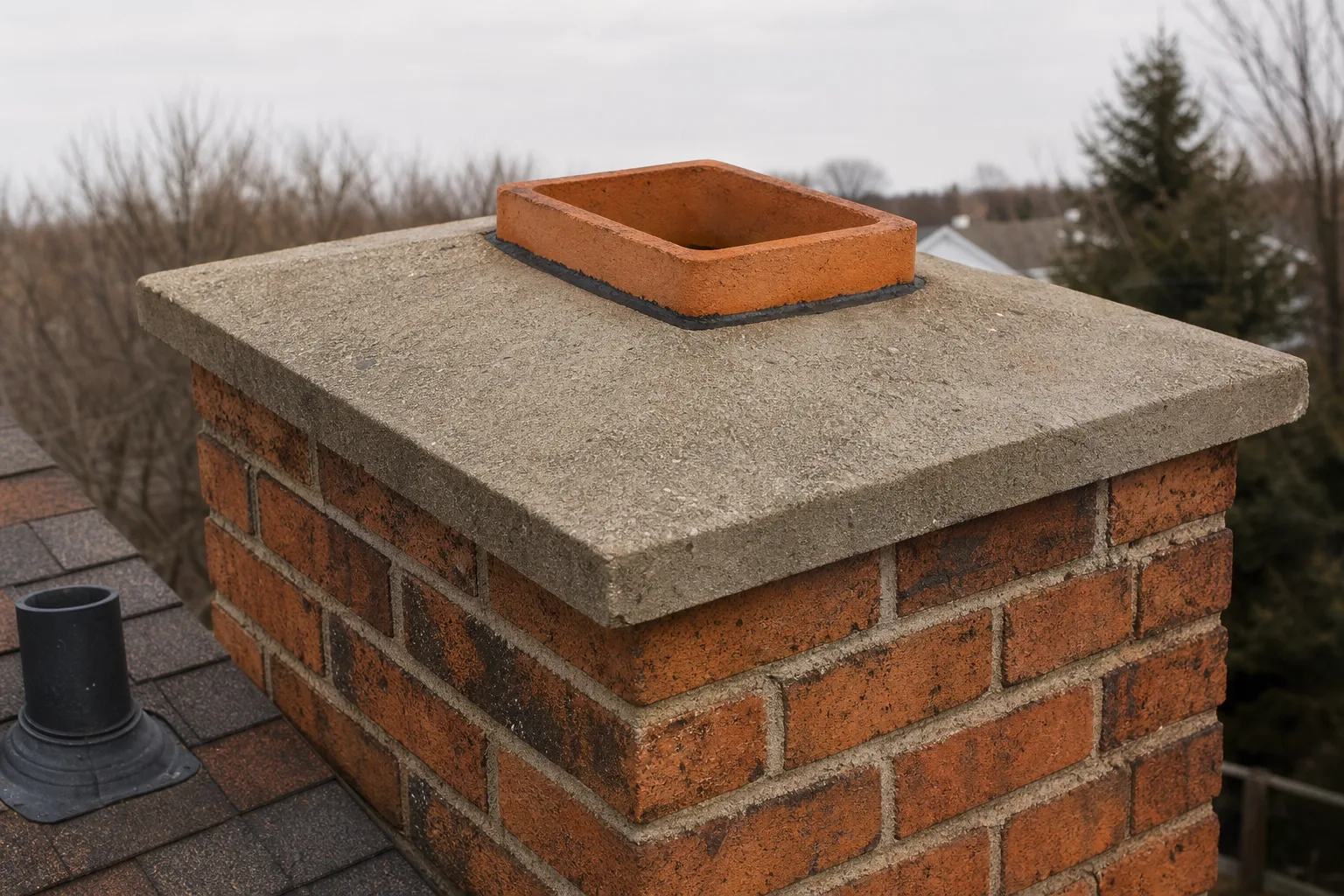
Picture the top of a brick chimney: brick, with a hole in the middle where the flue comes up.
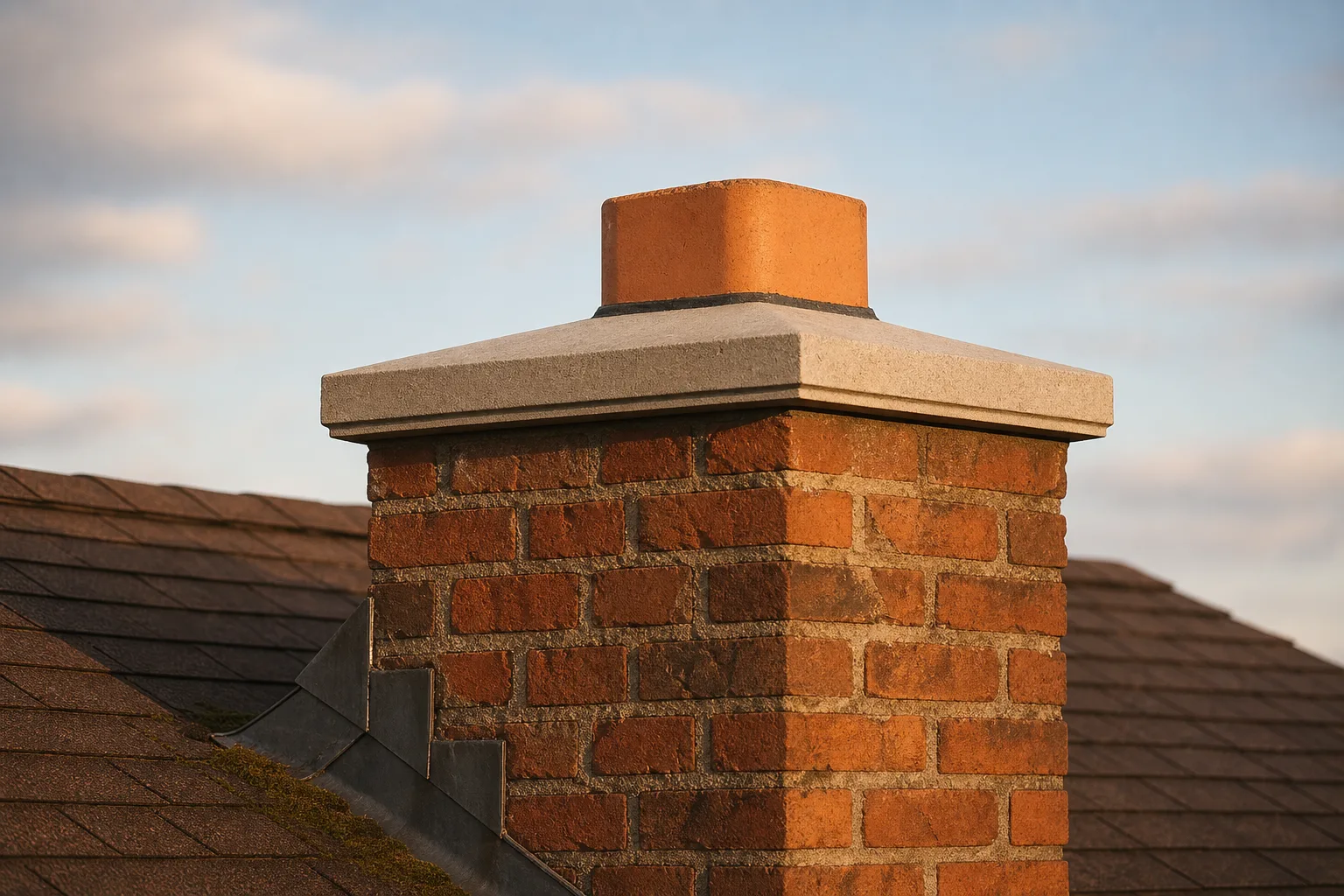
The crown is the concrete slab that covers everything in between. It spans from the outside of the flue liner out to the outer face of the masonry, sealing a gap that would otherwise be an open funnel pointed down into the middle of your chimney.
Where the crown sits, from the flue liner to the outside edge
Your chimney is not solid. Inside the brick shell sits a flue, usually a stack of orange-tan clay tiles, and between that flue and the brick there is a void.
The crown caps that void. It is poured so the top surface slopes down and away from the flue in every direction, and poured wider than the chimney itself, so the edge projects past the brick on all four sides.
That is the whole job: keep water out of the top. The crown is not structural, and it has nothing to do with fire safety directly.
But water in masonry is what turns a small chimney problem into an expensive one. Water gets into a crack, freezes, expands by roughly a tenth of its volume, and levers the crack a little wider. Thaw, refill, freeze, lever again.
What Is a Chimney Crown Supposed to Look Like From the Ground?
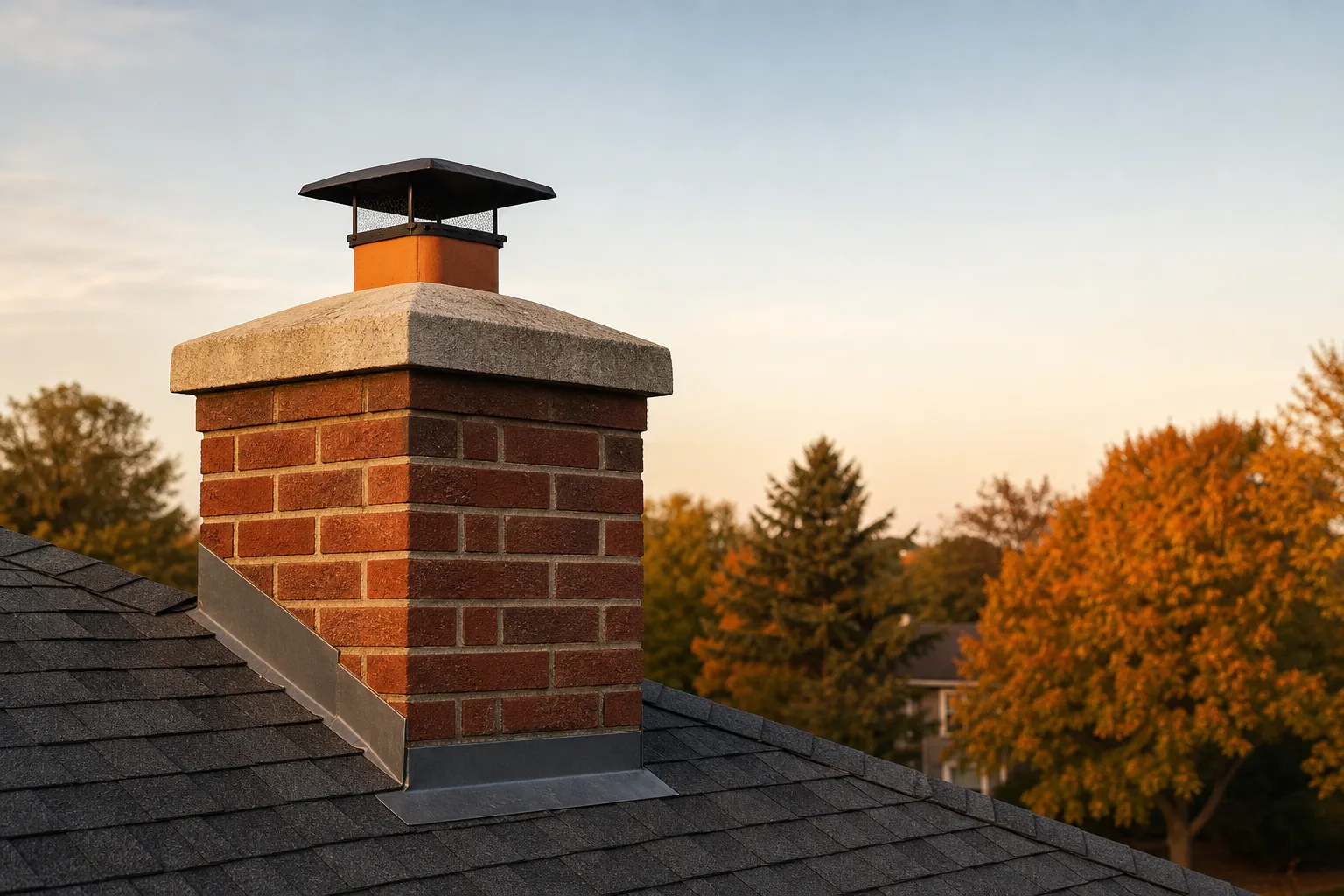
Grey. Not white, not smooth, not clean. A sound crown reads from the driveway as a mottled pale grey slab with a thin dark shadow line running underneath its outer edge.
That shadow line is the most useful thing you can see from the ground, and most people never notice it. It is the overhang, which means concrete is projecting past the brick and water is being thrown clear of the wall.
If the top of your chimney looks like it ends flush with the brick, no lip and no shadow, keep reading. Section four is about you.
Myth vs. fact: The crown is not the chimney cap. The cap is the small metal lid with mesh screens that sits over the flue opening. The crown is the concrete slab underneath it, covering the entire top of the chimney.
Chimney Crown vs. Chimney Cap vs. Chase Cover
This three-way confusion is where the conversation between a homeowner and a contractor tends to go wrong. Somebody says crown, somebody hears cap, and the quote makes no sense.
| Chimney crown | Chimney cap | Chase cover | |
|---|---|---|---|
| What it is | Cast concrete slab | Small metal lid on legs | Flat sheet-metal top |
| What it covers | Whole top of the chimney, liner out to the masonry edge | Only the flue opening | Whole top of a framed chase |
| Which chimney | Masonry | Either type | Factory-built, in a sided chase |
| Its job | Sheds water off the masonry | Keeps rain, animals, and debris out of the flue; often includes a spark arrestor | Sheds water off the chase |
| How it fails | Cracks, then spalls under freeze and thaw | Rusts, blows off, or the mesh clogs | Rusts through and pools water |
| What fails next | The brick and mortar joints below it | The flue and the firebox | Wood framing inside the chase |
Read the "which chimney" row first. If what is outside your house is a wood-framed box wrapped in siding with a metal top, you do not have a crown at all and never did.
Good to know: If your chimney is a framed chase with a metal top, the part that matters is the chase cover. Flat metal holds standing water, standing water rusts through the middle, and the water goes into wood framing rather than masonry.
What Is a Chimney Crown Made Of, and Why Concrete Beats Mortar
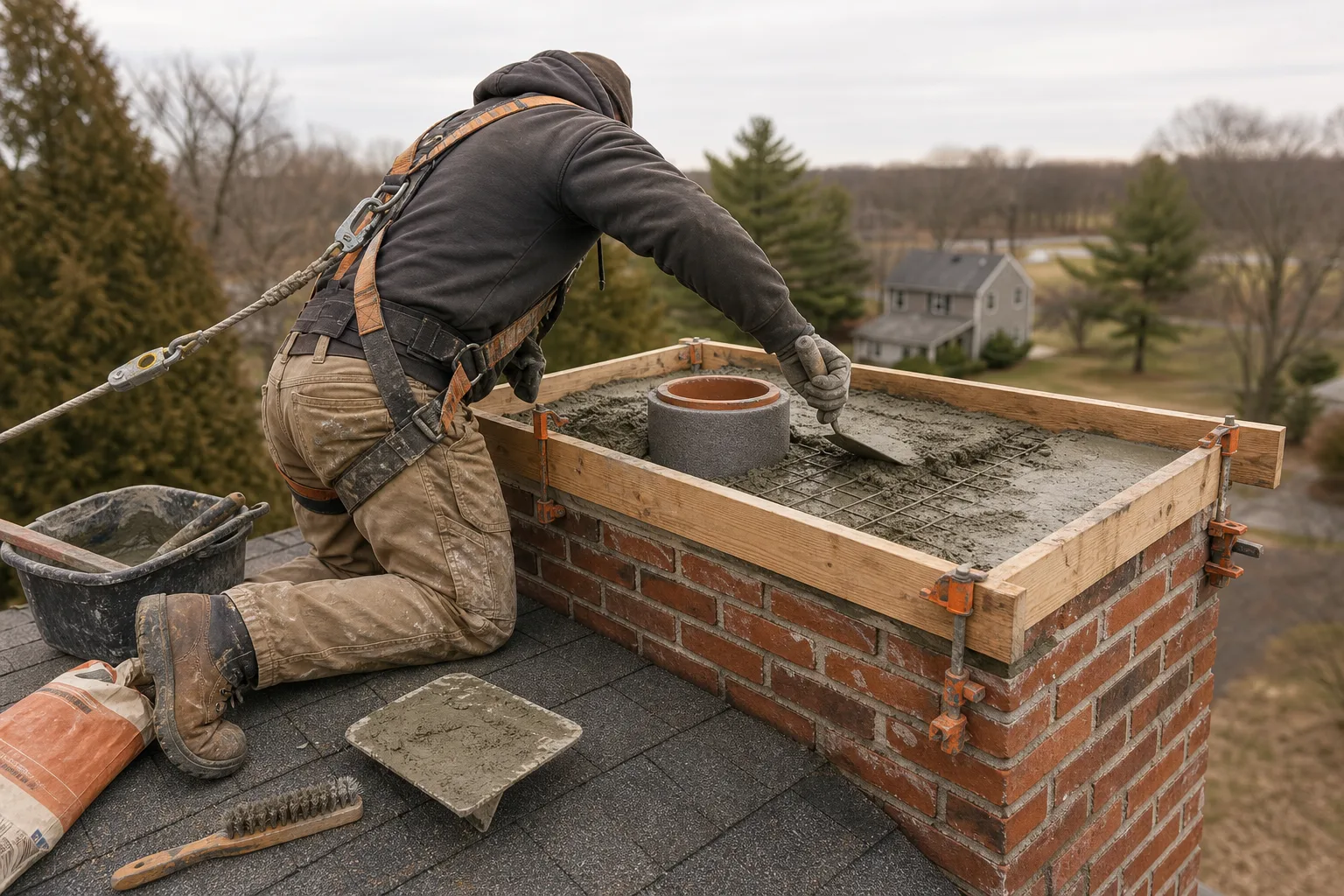
Concrete. Not mortar. That distinction separates a crown that does its job from one that starts cracking almost immediately, and it is the thing the trade is most united about.
Mortar belongs in thin joints between bricks, supported on all sides, and has very little tensile strength. Spread it across a chimney as an unsupported slab and the first freeze-thaw cycle starts pulling it apart.
Cast concrete resists that, and mesh laid in mid-pour helps further. The trade states the rule about as plainly as it can be put: cement, not mortar.
Thickness, overhang, and the drip edge
Three numbers matter, and all three are institute recommendations rather than fire code. Nobody is red-tagging your house over a quarter inch.
Thickness. The figure most widely cited in the trade is a minimum of two inches of cast-in-place or pre-cast concrete. A fair number of sources argue for three to four.
Overhang. Here the sources genuinely disagree, and anyone giving you one confident number is glossing over that. Some trade sources specify a minimum of one and a half inches past the face of the masonry; others put it at two and a half.
The drip edge. A groove cut into the underside of the overhang, commonly described as about a quarter inch wide, at least three eighths deep, set back roughly an inch from the chimney face.
Its purpose is to defeat surface tension. Water running off the crown wants to curl back under the lip and down the brick; the groove gives it nowhere to curl.
Pro tip: Ask about the overhang and the answer you want is a number with a reason attached. "Two inches, because that clears your brick face and you get a lot of wind-driven rain on that side" is somebody who has looked at your house. "Standard" is not an answer.
The bond break and the expansion joint at the flue liner
Two details live underneath the slab where you will never see them. Both come from one physical fact: concrete, clay, and brick expand and contract at different rates.
A bond break goes between the top course of masonry and the underside of the poured crown. The crown rests on the brick rather than being glued to it, so when the two move differently, nothing tears.
An expansion joint goes around the flue liner, because the crown must not touch or bond to the liner at all. A compressible material wraps the liner, commonly cited at about three eighths of an inch, and the gap gets sealed on top. That clearance matters again if the liner is ever replaced, because a flue liner installation means working through the crown.
Skip either one and the crown cracks, not because the concrete work was bad but because it was built rigid into a structure that moves. The crack shows up in the same places every time: radiating from the flue, or running the perimeter.
A crown poured hard against the flue tile is a crown with a crack in its future.
The Mortar Wash Problem: When the Chimney Never Had a Crown
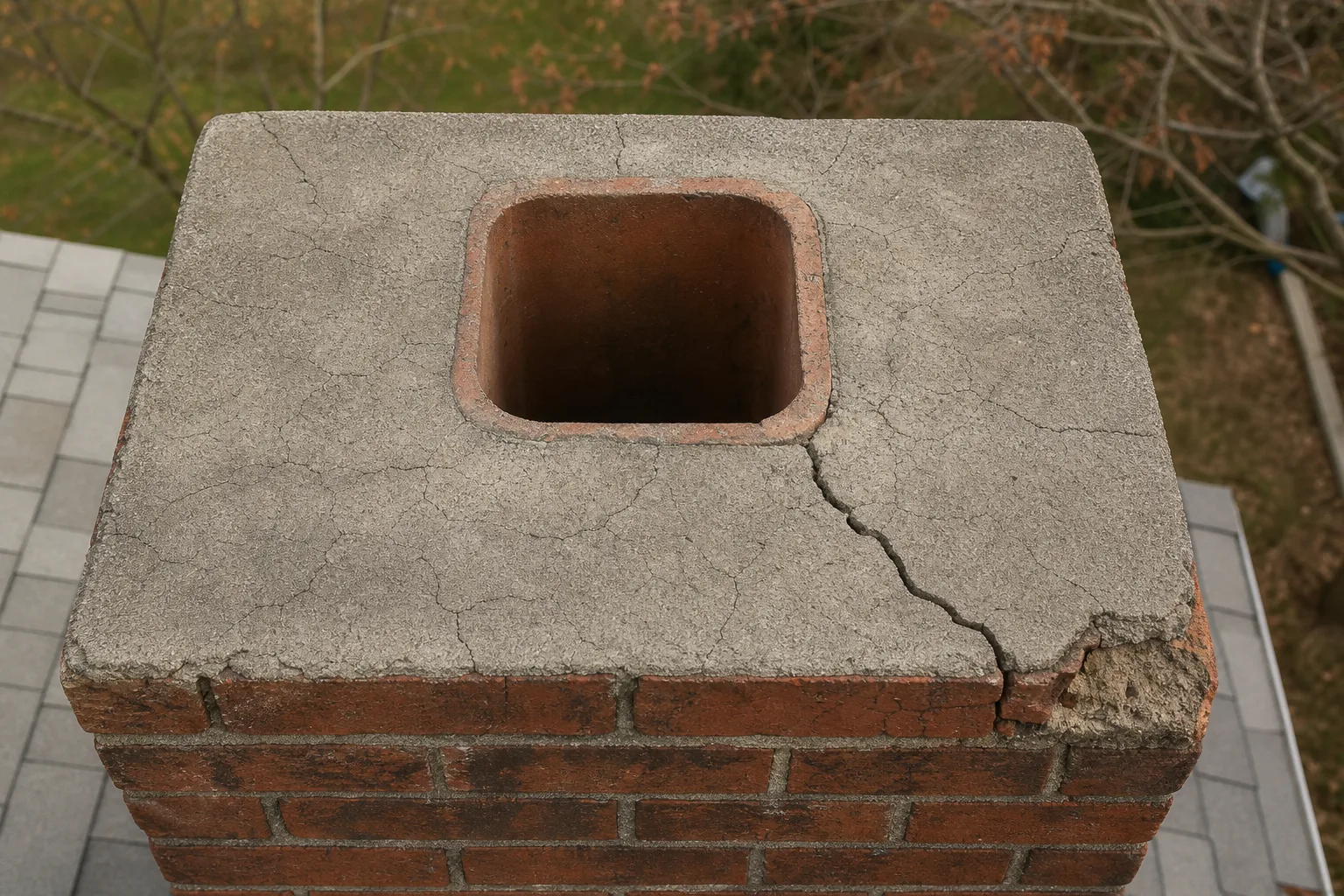
The honest answer to what is a chimney crown has a second half, and it is the half left out of nearly every article on this subject. An enormous number of American chimneys never received one.
What sits on top of them instead is a mortar wash. Someone troweled ordinary mortar across the top of the chimney, sloped it off the top course of brick, smoothed it, and went home.
No reinforcement, no overhang, no drip edge, no bond break. It was the cheap option at build time, chosen by somebody who was never going to hear about it again.
From the driveway, a wash and a crown look similar enough that most homeowners cannot tell them apart. That is the problem in one sentence.
What Is a Chimney Crown Versus a Mortar Wash?
The first tell is the edge. A crown projects past the brick and throws a shadow; a wash stops where the brick stops and throws nothing.
The second tell is the crack pattern. Washes crack early and in a spiderweb, because unreinforced mortar bonded rigidly to brick has nowhere to put the stress. Crowns fail later and usually crack in lines.
The third tell is what the contractor says. If someone tells you your chimney needs a crown built rather than repaired, that is frequently not a sales tactic but an accurate description of putting a part on a house that was missing one.
From the field: The mortar wash conversation is consistently the hardest one to have with a homeowner, because it sounds like the setup for an upsell every single time. People relax once somebody explains what they are looking at, and tense up when nobody explains anything. Suspicion here is a reasonable response to being asked to trust a photograph.
A homeowner searching "what is a chimney crown" the evening after a quote is usually trying to work out whether they are being handled. If the quote says build rather than repair, this section is very likely why.
How to Check Your Chimney Crown Without Getting on the Roof
You are not going up there. Let us take that off the table.
Safety note: Do not get on your roof to look at your chimney. You would be walking a sloped surface toward the one object up there that sticks up and blocks your view of the edge. Every observation below is made with both feet on something solid.
From the ground, with binoculars
Get fifty or sixty feet back from the house, on whichever side gives the best angle up at the chimney, and use binoculars or a zoomed phone camera. Then work this list:
- The shadow line. A visible lip of concrete projecting past the brick, with a shadow underneath. Yes means a crown; no means very possibly a wash.
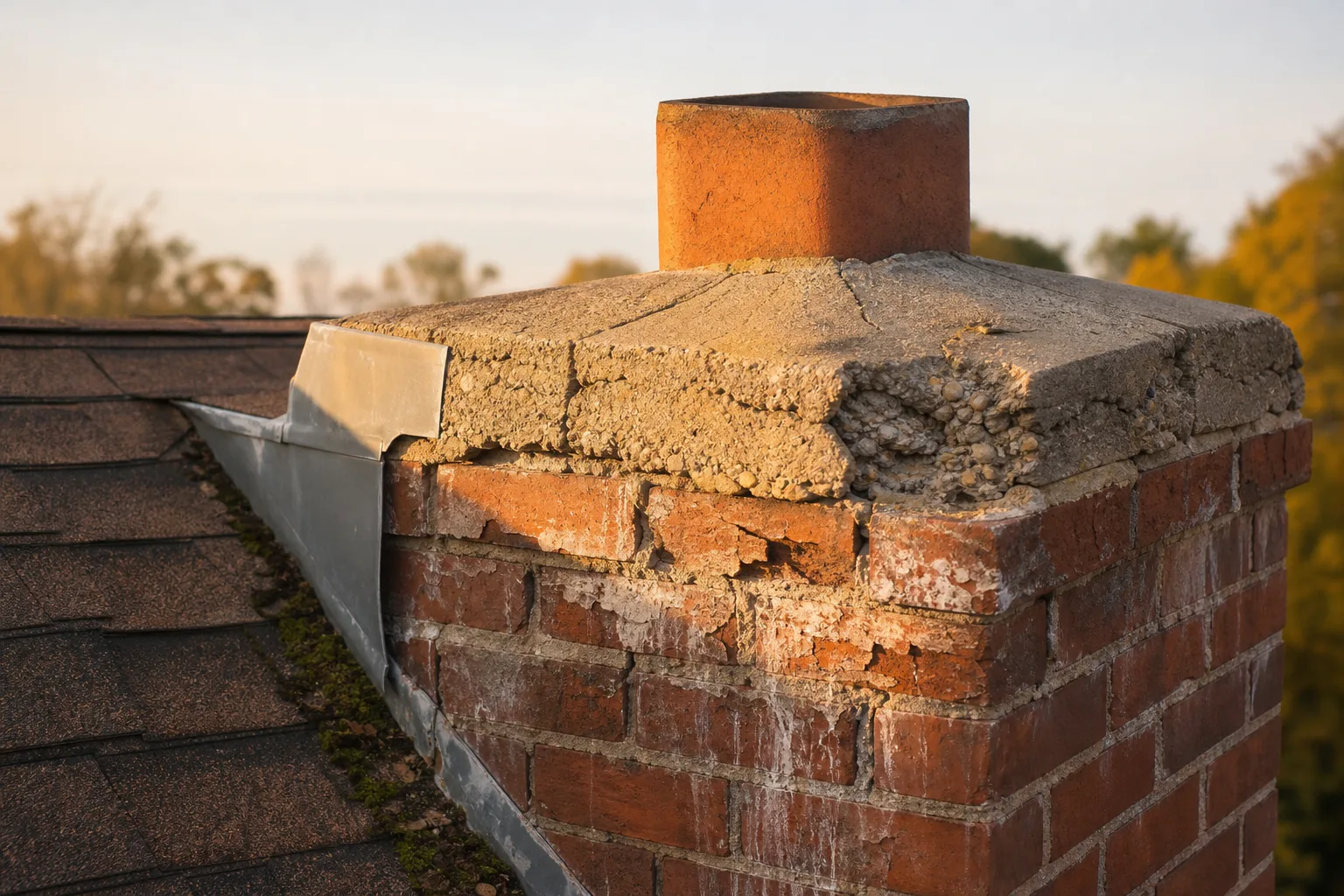
- Missing corners. Chunks gone from the outer corners, which is where crowns break first.
- A crack visible from the yard. If you can see it from sixty feet, it is a significant crack.
- Spalling brick in the top few courses. Faces flaking off in thin plates, leaving a paler surface. Water already got through the top and froze inside the brick.
- White chalky streaking. Called efflorescence: mineral salt left when water moves through masonry and evaporates out the face. Getting it off is a masonry cleaning job, but what it tells you about the crown matters more.
- Dark staining or green-black growth, usually on the north face. Not damage by itself, but that face stays wet.
- The flue tile. Does the clay liner stand a few inches proud of the slab, or does concrete look poured hard up against it?
From an upstairs window
A second-floor window looking toward the chimney gives a better angle at the top surface than the ground ever will.
This is where knowing what is a chimney crown, physically, starts paying off. You want the slope: the surface should fall away from the flue in every direction, and a slab that reads flat is not doing its job.
The photo you should ask for
Here is the highest-value thing you can do in the next ten minutes. Whoever quoted you was on your roof, so they have photos. Ask for the crown pictures, straight down and from the side.
Look for four things: the edge profile, the joint where the slab meets the flue tile, the crack pattern, and the corners.
A contractor who sends them right away is comfortable with you looking.
What Is a Chimney Crown Inspection Actually Looking At?
Everything you just checked, plus what you cannot reach: the underside of the overhang, the perimeter joint, how deep the cracks penetrate, and whether the slab has separated from the masonry.
Crown condition gets evaluated as part of a standard chimney inspection. Under NFPA 211, the national standard for chimneys, fireplaces, vents, and solid fuel-burning appliances in the United States, a Level 2 inspection is required at sale or transfer of the property, when the system is changed, after a malfunction or operating problem, after a chimney fire, and after an external event such as severe weather or an earthquake that could have damaged the chimney.
And here is the honest limit of all of that. The corners, the joint at the liner, the drip edge, and the real depth of a crack are not visible from any angle you can safely reach.
You can rule a crown out from the ground. You cannot clear one.
Not sure what you are looking at up there?
You have taken this as far as binoculars will take you. Whether that slab is sound, resurfaceable, or ready to come off gets decided on the roof.
Tell us what you are seeing and we will match you with a local chimney company that can go up and look.
Call (513) 655-6702, or send us the details online.
Seal It, Resurface It, or Replace It
At some point the answer to what is a chimney crown turns into a more useful question: what does mine need, and how do I know the person telling me is right?
When a crown sealer is the right call
If the slab is structurally sound and the cracking is hairline, the answer is usually a flexible elastomeric crown sealer, brushed or troweled over the whole top surface.
The flexibility is the point. It bridges existing hairline cracks and keeps flexing with them, instead of cracking alongside them the way a rigid patching compound does.
No page should tell you which brand to buy, but that is the category to ask for by name.
When the crown has to come off
Replacement is the honest answer when any of these is true:
- Cracks run through the full depth of the slab
- Material is actively spalling, flaking, or breaking away
- Corners or whole sections are missing
- What you have is a mortar wash rather than a crown
- There is no overhang at all
- The concrete was poured hard against the flue liner with no expansion joint
The last three have nothing to do with how damaged the thing is. They are about how it was built.
A crown with no overhang can be in perfect condition and still be why your brick is spalling, because it has been dumping water down the chimney face since it was poured. Sealing a crown built wrong buys a little time and fixes nothing.
The five words that make a contractor take you seriously
Nobody who asks what is a chimney crown actually wants the definition. They want to hold their own in the next conversation. Ask about these five things, in these words:
- Thickness. How thick is the slab going to be?
- Overhang. How far past the brick face will it project?
- Drip edge. Will you cut a drip groove into the underside?
- Bond break. What goes between the brick and the slab?
- Expansion joint. How are you isolating the crown from the flue liner?
Pro tip: You do not need to know the right answers to these five. You need to watch what happens when you ask. Somebody who answers all five without hesitating, and explains why the numbers suit your chimney, is a different person from somebody who says "we do it to standard."
How VIO Helps With a Chimney Crown You Cannot See
Let us be plain about what VIO is.
VIO CHIMNEY is a referral service. We do not climb roofs and we do not pour concrete. We match homeowners with independent local chimney companies, and those companies are not our employees, so the pro we send works for their own business rather than for us.
You have a symptom, a photo, or a quote, and you need a second set of eyes belonging to somebody who can reach the top of the chimney. Finding that person is what we handle.
If you came here asking what is a chimney crown because somebody handed you a number, tell us what the quote says. Mortar wash versus crown, repair versus rebuild, sealer versus replacement, those are the distinctions a second opinion sorts out fastest.
We ask every company in the network to put its estimate in writing before any work starts, and you should insist on exactly that. A crown described to you in writing, with a thickness and an overhang in it, is a crown somebody has actually thought about.
The question of what is a chimney crown stops being abstract the moment a person is standing next to yours. Until then you have binoculars, a shadow line, and five good questions. That is not nothing.
Get a real answer on your chimney crown
Describe what you are seeing, the stain, the cracks, or the quote you are already holding, and we will connect you with an independent chimney company in your area.
Call (513) 655-6702, or tell us about your chimney online.
Symptom checker
What is your chimney doing?
Tap the closest match for an honest first answer.