



On this pageWhat Chimney Parging Actually Means7 sections+6
- What Chimney Parging Actually Means
- Where the Smoke Chamber Is and Why Its Shape Matters
- Do You Actually Need Chimney Parging? The Honest Answer
- How the Work Gets Done: Trowel or Spray
- Exterior Parging: When It Helps and When It Traps the Problem
- What Drives the Cost of Chimney Parging
- How VIO Helps With Chimney Parging
Quick answer
Chimney parging is the application of a mortar coat over rough or damaged chimney masonry. The term covers two different jobs: an interior coat of refractory mortar that smooths the corbelled brick inside the smoke chamber, which NFPA 211 requires, and an exterior cement or stucco coat over the chimney's visible brickwork. Which one you need depends on where the damage is.
Here is the problem with chimney parging, and almost nobody tells you this up front: the phrase means two completely different jobs.
One happens inside your fireplace, in a dark funnel above the damper that you have probably never looked at. The other happens outside, on the brick you can see from the driveway. Different materials, different reasons, different money.
So when a chimney company hands you an estimate with "parging" on it and a number you were not expecting, you cannot judge that number yet. Not until you know which of the two jobs they mean.
That is what this guide is for. By the end you will know which parging is on your paper, whether you actually need it, and what a legitimate recommendation looks like next to a vague one.
What Chimney Parging Actually Means
Chimney parging is a masonry technique, not a product. You take a rough, stepped, cracked or crumbling masonry surface and you apply a layer of mortar over it to make it smooth and continuous.
That is the whole idea. The argument is only ever about which surface, and with what mortar.
Interior Chimney Parging: The Smoke Chamber Coat
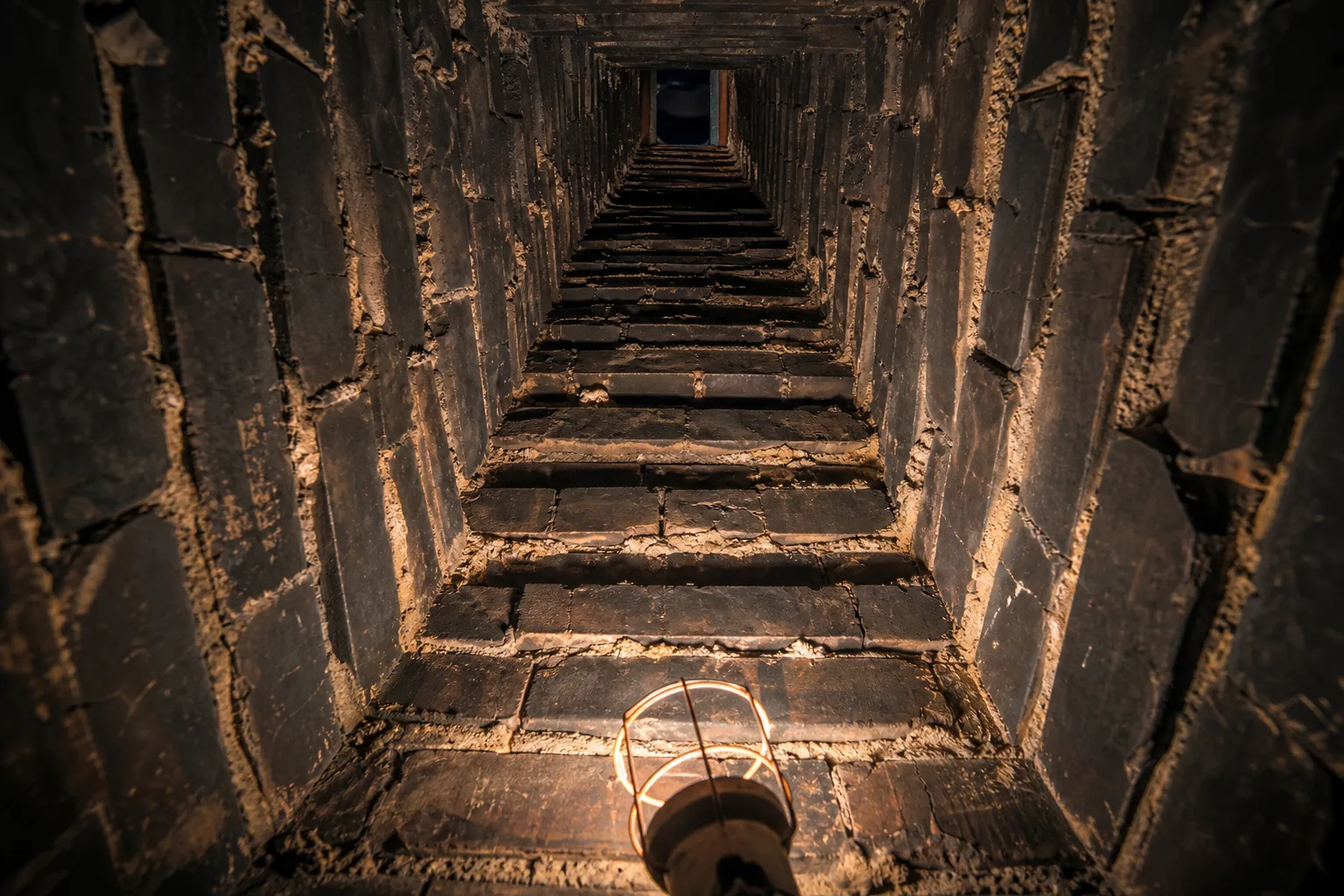
Above your firebox, above the damper, there is a funnel-shaped space that narrows from the full width of the fireplace down to the opening of the flue. That is the smoke chamber.
Its walls are usually built by stepping bricks inward, each course hanging slightly over the one below, like an upside-down staircase. Masons call that corbelling.
The interior parge coat is refractory mortar troweled over those steps to bury them in a smooth slope. This is safety work, and there is a standard behind it.
Exterior Parging: The Stack You See
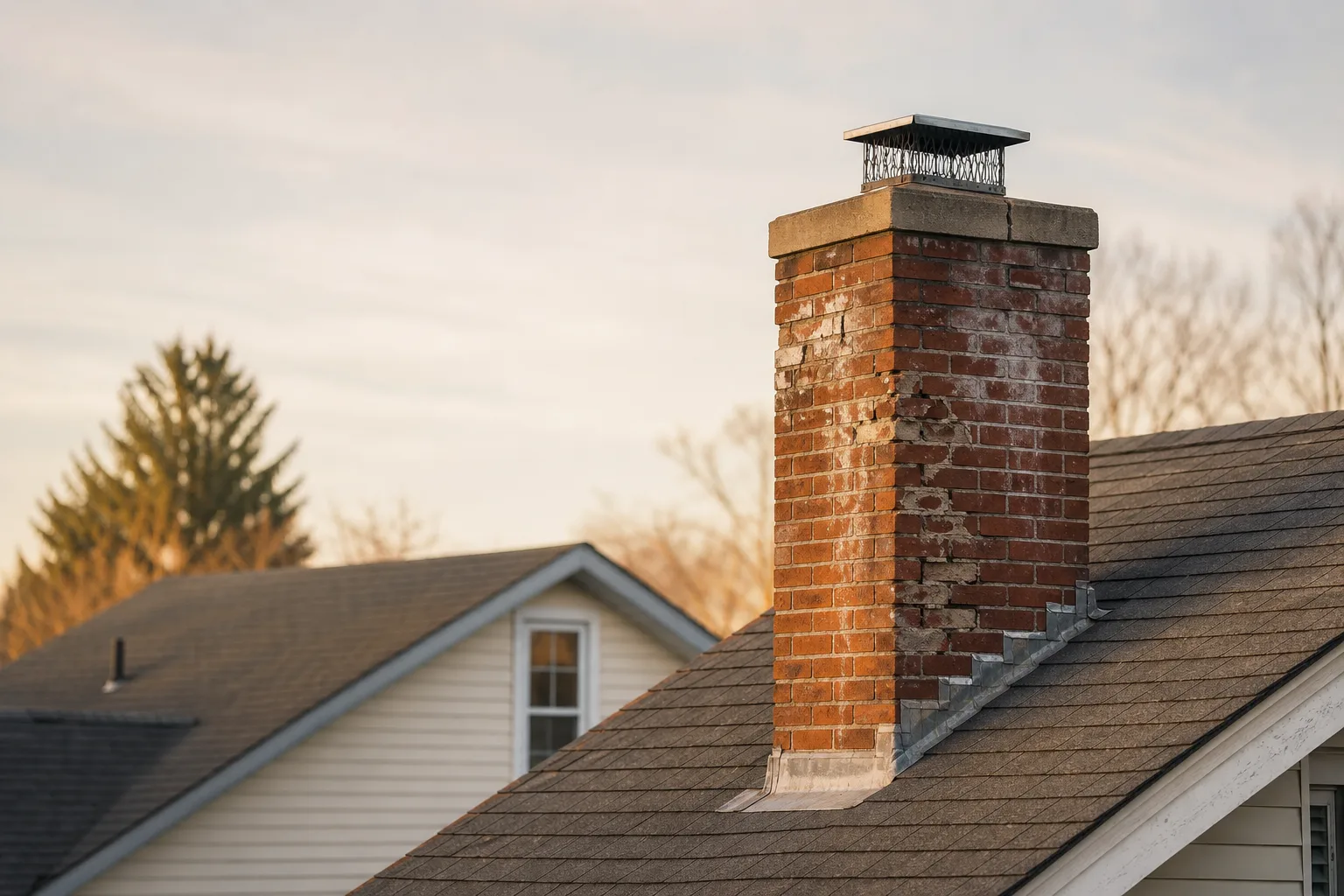
The other job is a cement or stucco coat applied over the outside of the chimney's brickwork, usually the section that rises above the roof.
People do it to cover brick faces that have flaked off, mortar joints that have opened up, or a patchwork of old repairs that looks terrible. It is done partly for appearance and partly to put a continuous surface over masonry that has already been made sound, and it often surfaces as one line inside a larger fireplace restoration conversation.
Exterior chimney parging is also the version most likely to go wrong, for reasons we will get to.
Good to know: an estimate line may not say which one it means. "Parge chimney" or "parging, as needed" tells you nothing about which of the two jobs is being quoted. If your paper does not specify the smoke chamber or the exterior stack, that is your first question back.
| Interior (smoke chamber) | Exterior (the stack) | |
|---|---|---|
| Where | Above the damper, inside | Brick you can see, usually above the roof |
| Material | Refractory mortar rated for high heat | Cement or stucco coat over masonry |
| Main purpose | Smooth the smoke path, protect brick from heat | Cover spalled brick faces, failed mortar joints and uneven surfaces |
| Why it matters | Reduces creosote buildup and chimney fire risk | Gives a uniform surface over masonry that has already been repaired |
| Standard behind it | NFPA 211 requires the chamber be parged smooth | No equivalent code requirement |
| How you inspect it | Camera and light, through the fireplace | Visually, from a ladder or the roof |
Two different trades' worth of conversation under one word. Now you know which column you are in.
Where the Smoke Chamber Is and Why Its Shape Matters
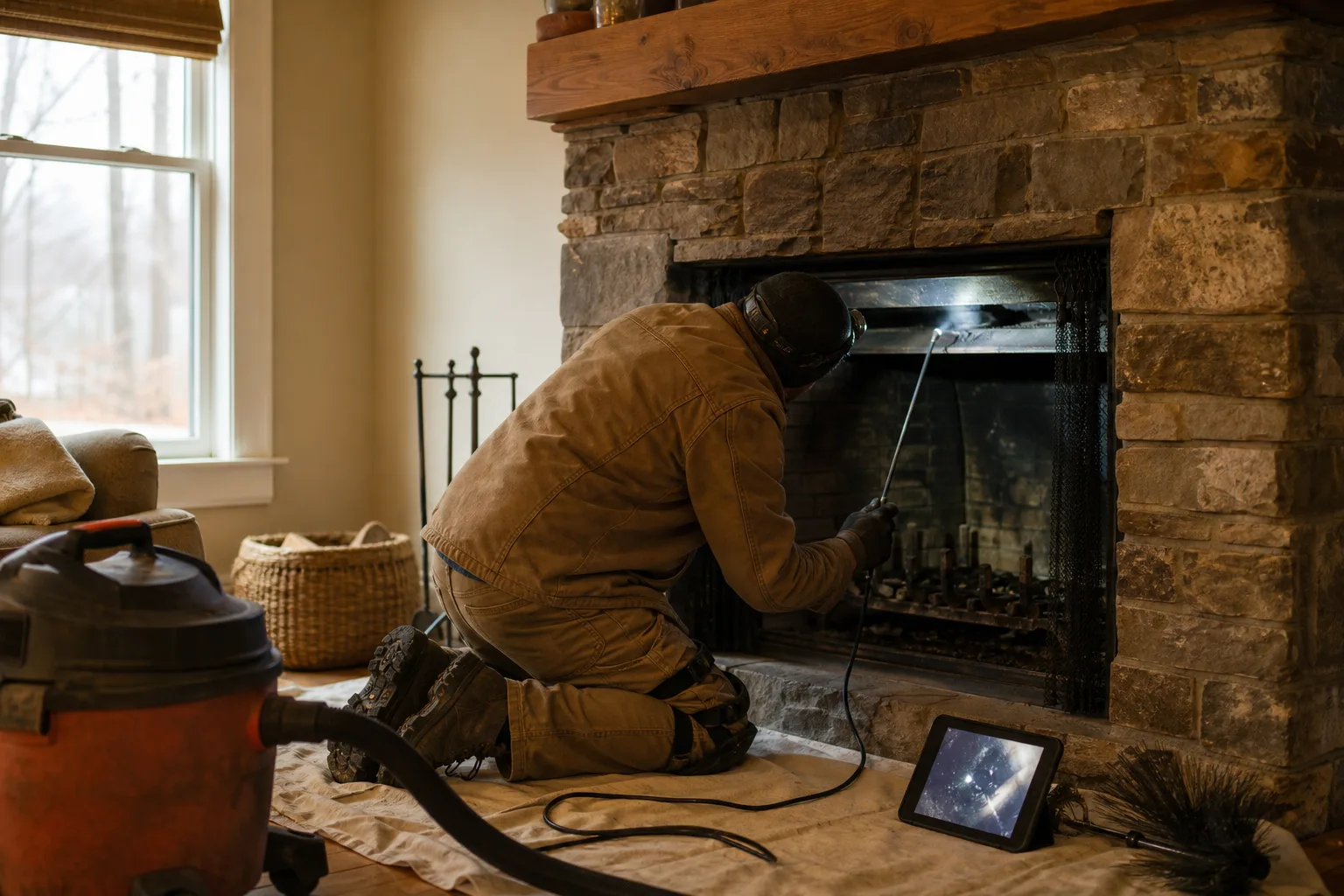
If you want to see what everyone is arguing about, put down a towel, lie on your back on the hearth, and point a flashlight up past the open damper.
Most people have never done this. It is worth doing once.
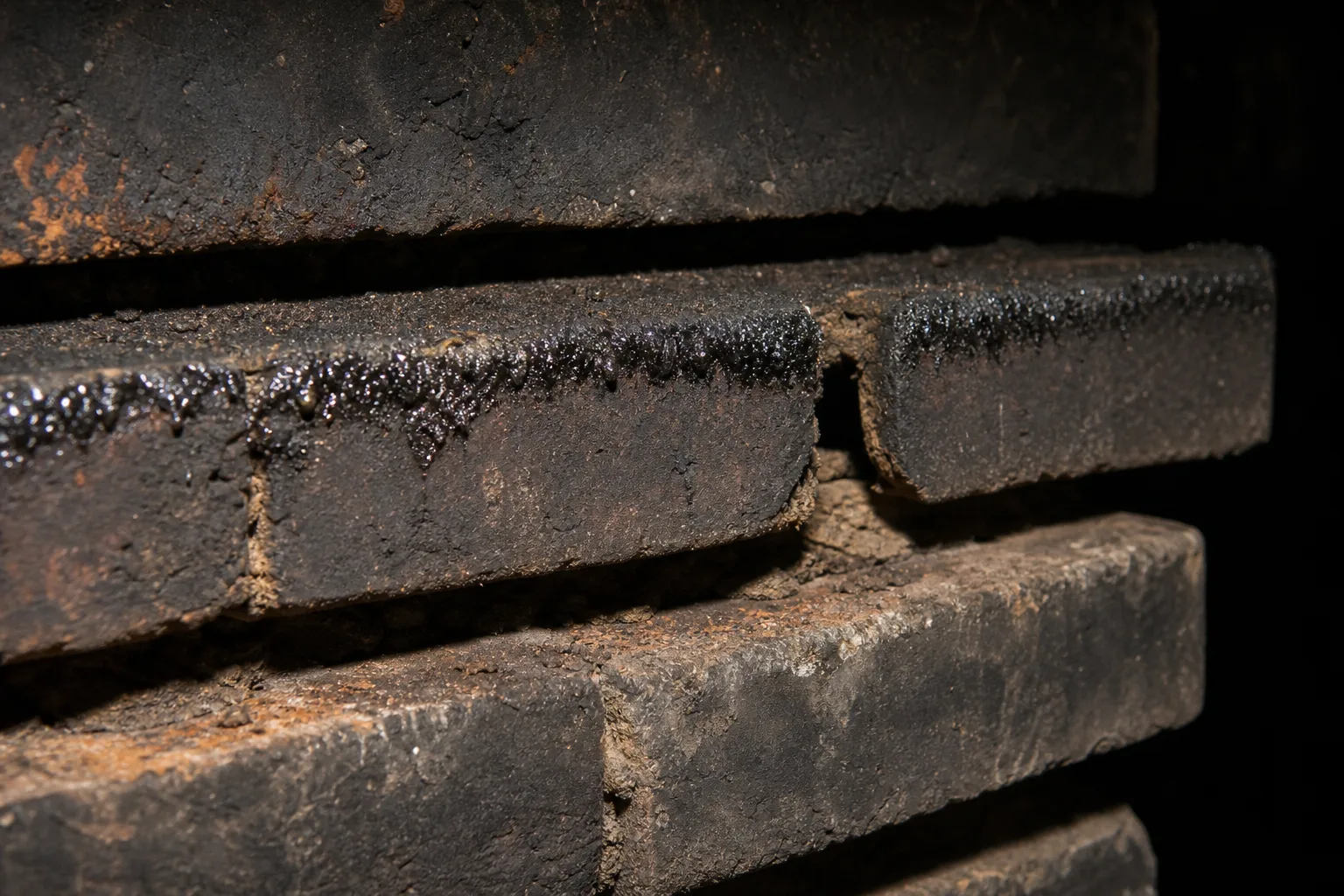
What you will see, if the chamber was never parged, is black brick arranged in a stepped funnel above you, each course jutting out over the one below, with mortar squeezed out between the courses and soot over everything. Some of that black is dull and crusty. Some of it may be shiny, almost tarry.
That shiny part is creosote, and the steps are part of why it is there.
What Corbelled Brick Does to Your Smoke
Smoke leaving a fire wants to move up and out fast, which is the whole basis of how a chimney works. Every corbeled brick it passes creates a small eddy current, a little pocket of turbulence that holds the smoke behind it back instead of letting it climb.
Held-back smoke is slower smoke. Slower smoke is cooler smoke.
And as the temperature of that smoke drops, the volatile compounds in it start condensing onto the cooler surfaces around them. That condensation is how creosote deposits begin.
So the stepped wall is not just ugly. It is a creosote factory operating on physics, every fire, all winter.
A smooth parged surface removes the steps from the equation. The smoke moves faster, stays hotter longer, and deposits less on the way out. The coat also puts a layer of heat-resistant material between the fire's exhaust and the structural brick.
What the Parge Coat Is Made Of
Not regular mortar. This is the part of chimney parging where substituting the wrong material quietly undoes the point of the job.
NFPA 211, the standard that governs chimneys and solid fuel burning appliances, requires that the inner surfaces of the smoke chamber be parged smooth with an insulating refractory mortar.
Corbeling specifically is to be parged smooth with a refractory mortar meeting ASTM C199, able to withstand temperatures up to 1,800°F. Products sold for this use are often rated well above that.
Typical parging mixes for masonry work blend lime, Portland cement, water and masonry cement. For smoke chamber work the refractory rating is the part that cannot be skipped, because the material is sitting directly in the path of hot flue gas. The same logic runs one level higher up the system, which is most of the answer to what a chimney liner is and why it has to be rated for what passes through it.
Safety note: a smooth, correctly parged smoke chamber reduces the risk of chimney fire and helps combustion gases including carbon monoxide leave the chimney the way they should. It reduces risk. It does not eliminate it, and it does not replace a working detector or an annual inspection.
Do You Actually Need Chimney Parging? The Honest Answer
Let us say the thing you are already thinking.
Chimney parging is an easy thing to put on an estimate. It is invisible work in a place the homeowner cannot inspect, it sounds technical, and it is not cheap. That combination is exactly the shape of an upsell, and you are right to be suspicious of it.
Here is the honest position: the work is real, the standard behind it is real, and it is also genuinely easy to recommend to someone who does not need it.
A smoke chamber that was parged correctly when the fireplace was built, and has held up, does not need to be redone because a company noticed it exists. "Your chamber has never been parged" and "your chamber's parging is failing" are specific, checkable claims. "You need parging" on its own is not.
Signs the Work Is Probably Real
The chamber walls show bare, stepped brick with no coating over them at all.
Chunks of old parging have fallen away, leaving patches of exposed brick and a rough, pitted surface.
Mortar joints inside the chamber have eroded back, leaving visible gaps and voids between bricks.
The fireplace smokes into the room on a properly opened damper, with a clean flue, and nobody can find another cause. A rough chamber is one of the things that shows up here.
You have had a chimney fire, or the chimney is being inspected for a home sale. NFPA 211 calls for a Level 2 inspection at property transfer, at appliance replacement, at a change in fuel type, and after a chimney fire. A Level 2 includes a video scan of the flue liner, and if a company sells you a Level 2 without putting a camera in the flue, it does not meet the standard.
Questions to Ask Before You Sign
Print this, or screenshot it. Ask all eight.
- Which parging are you quoting, the smoke chamber or the exterior of the chimney?
- Can you show me photos or camera footage of my chamber, not a sample image?
- What specifically is wrong with it: never parged, failed parging, or open joints?
- What material will you use, and is it rated to ASTM C199?
- Will you trowel it or spray it, and why that method for my chimney?
- Does the damper or firebox have to come apart to reach the chamber?
- Is there anything else that should be repaired before or along with this?
- Will the full scope be written down before work starts?
A company doing honest work answers all eight without getting defensive. If the answers get vague around numbers two and three, that is your signal.
From the field: a picture of your own chamber changes the nature of the conversation. Once you can see the defect being pointed at, you are no longer deciding whether to trust a stranger, you are discussing scope, and those are very different conversations to be in.
Not Sure Which Parging You Actually Need?
You cannot see a smoke chamber from a chair, and you should not approve a masonry repair you have never laid eyes on based on someone's word alone. Tell us what is on your estimate and where you are, and we will connect you with a local chimney company that will put eyes and a camera on it first.
Get a Second Opinion · (513) 655-6702
How the Work Gets Done: Trowel or Spray
There are two accepted ways to do interior chimney parging, and the choice between them is about access, not about quality. Neither is the cheap version of the other.
Hand and Trowel Parging
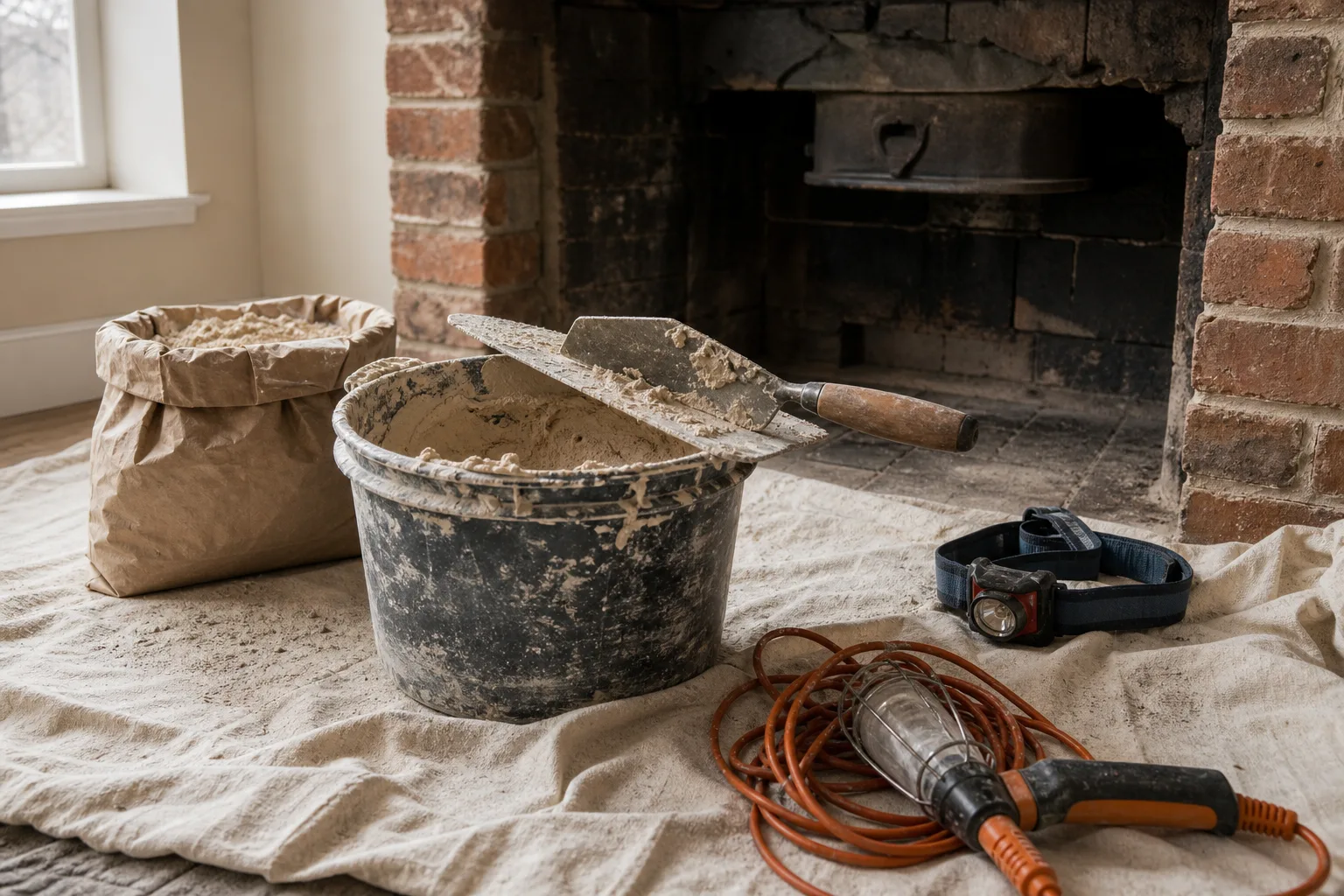
Where the chamber can be reached, refractory mortar is mixed on site and worked onto the walls by hand and pointing trowel, building the stepped brick up into a continuous slope.
The person doing it is on their knees or their back at the hearth, head and shoulders inside the fireplace opening, working overhead in a confined space by work light. It is uncomfortable, slow work, and it is why the labor line is what it is.
Access is the catch. Where the damper assembly sits squarely in the way, reaching the chamber by hand means taking the damper, and sometimes part of the firebox, apart first.
Spray-Applied Refractory Foam
Where the chamber cannot be reached comfortably, there is a second option: a refractory foam sprayed in through the damper opening on a hose.
The material expands as it cures, up to about half again its sprayed volume, and hardens into a closed-cell surface that seals gaps, cracks and voids while insulating the wall behind it.
The practical advantage is the one that matters to your wallet. Because the nozzle fits through the narrow damper opening, nobody has to demolish the damper and firebox just to get an arm in there.
Pro tip: ask which method the company plans to use and why they chose it for your chimney. The answer should be about your chamber's access and geometry. If the answer is about what they happen to own, keep asking.
One more thing worth knowing about chimney parging in an existing fireplace. Parging a smoke chamber is far easier while the chimney is being built, with the walls open and reachable. Doing it after the fact, through a fireplace opening, is harder and more expensive, and sometimes requires sections to be taken apart and put back. That gap between new construction and retrofit is real, and it is most of why the number surprised you.
Exterior Parging: When It Helps and When It Traps the Problem
Now the outside of the chimney, and the part of this article I would most want a homeowner to read.
What Spalling Is and Why It Happens
Brick and mortar are porous. They drink water, slowly, every time it rains.
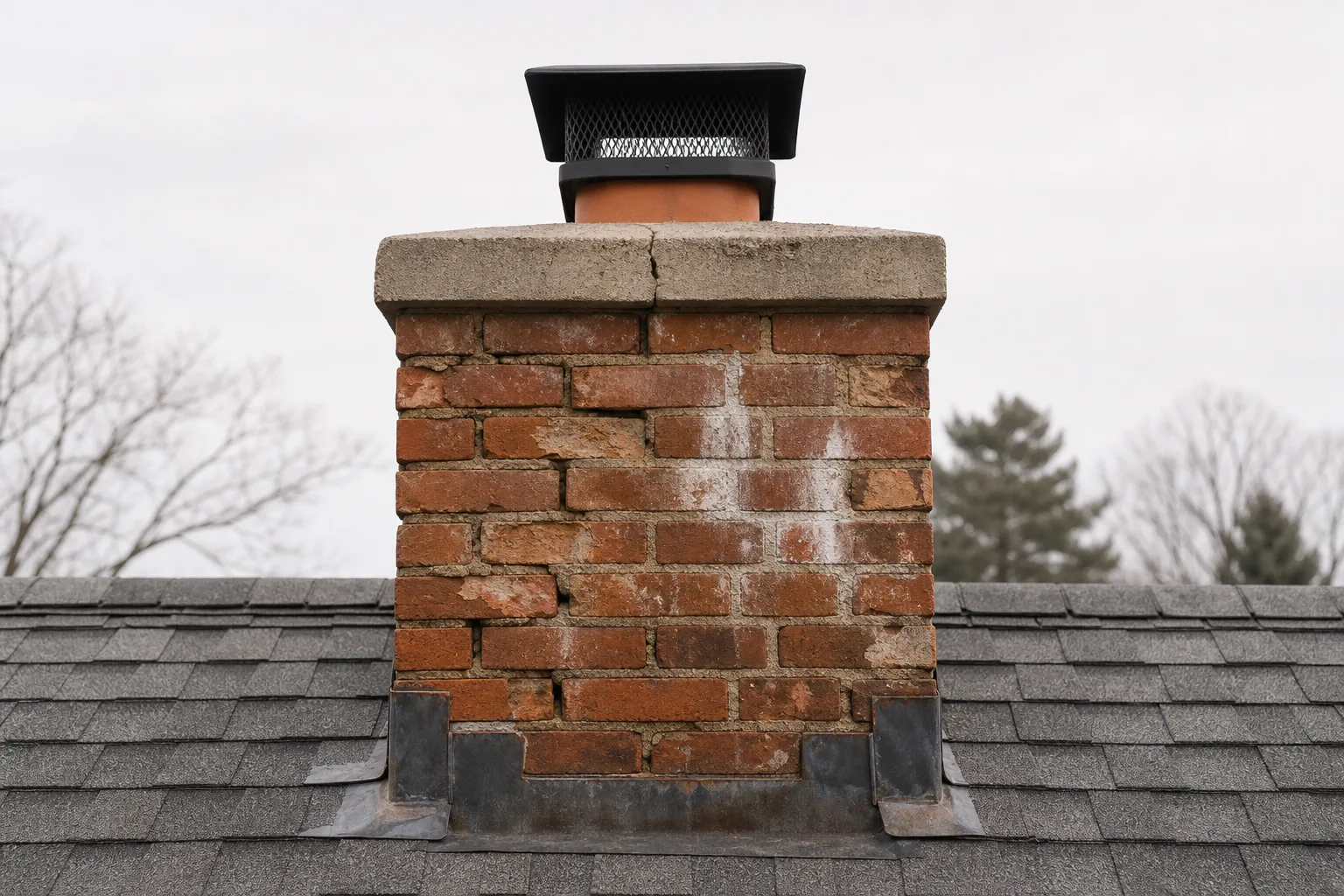
When that absorbed water freezes, it expands inside the brick, and it pushes outward against the face from within. Repeat that a few dozen times over a few winters and the face of the brick starts letting go, flaking off in thin sheets and leaving a lighter, rougher crater behind.
That is spalling, and a chimney is the most exposed masonry on your house. It has weather on all four sides and a roof's worth of runoff finding its way to it.
So a homeowner looks at a stack with flaking faces and open joints and thinks, reasonably: put a coat over it and seal it up.
Fix the Water First, Coat Second
Here is why that instinct backfires.
A parge coat is only as sound as the masonry underneath it. Applied over brick that is already breaking apart, it has nothing stable to hold onto, and it cracks and flakes off on roughly the same schedule the brick did.
Damp brick is worse. Moisture in the masonry compromises adhesion, so the coat never bonds properly to begin with.
And the real damage is what you cannot see. If water is still getting into that chimney, from a cracked crown, from failed flashing, from a missing chimney cap, a coat over the outside does not stop it. It slows the escape route and holds the moisture inside the masonry where the freeze-thaw cycle keeps working on it.
The order that works is unglamorous. Find and stop the water first. Replace the brick that is too far gone. Repoint the open joints. Then, if you still want the uniform surface, coat it.
Getting the surface back to sound, dry masonry is part of that sequence rather than an optional extra, and on a stained or biologically fouled stack it usually starts with proper masonry cleaning.
Myth vs. fact: a parge coat does not waterproof a chimney. It is a surface treatment, not a water management system. The crown, the cap and the flashing are what keep water out of a chimney, and no amount of coating compensates for a failure in any of the three.
There is a season to this too. Cement based products need temperatures above freezing to cure properly, so exterior masonry work has a window that closes when sustained cold arrives. Late September is inside that window in most of the country. February is not.
What Drives the Cost of Chimney Parging
You will not find a dollar figure here, and you should be skeptical of the ones you find elsewhere. National averages for this work are published by companies that sell leads, not by anyone measuring jobs, and the spread on a smoke chamber is wide enough that an average tells you close to nothing.
What is useful is knowing what moves the number on your estimate. Six things do most of the work in pricing chimney parging, and they are broadly the same variables behind any fireplace repair cost you will be quoted.
Access, more than anything else. A chamber a person can reach through the fireplace opening is one job. A chamber that requires the damper assembly, and possibly part of the firebox, to be removed and rebuilt is a different job with a different day count.
The size and shape of the chamber. A tall chamber with steep offsets has more surface area and more awkward geometry than a short, shallow one.
The method. Trowel work and spray application have different material costs and different labor profiles, and the right one for your chimney may not be the cheaper one.
What else the chimney needs first. If the crown is failing or the flue is cracked and headed for chimney flue liner installation, parging the chamber while ignoring that is doing the middle of a job. Sequencing matters and it shows up in the price.
Roof access and setup. For exterior work, a steep pitch, a tall house or anything needing staging changes the day before a trowel is lifted.
The season. Exterior masonry in marginal weather means tenting, heating, or waiting.
Good to know: a written scope is what makes two bids comparable. Two numbers for "parging" tell you nothing if one includes rebuilding the damper and the other does not. Get the scope in writing from everyone you ask, then compare line by line.
How VIO Helps With Chimney Parging
VIO is a referral network, not a chimney company. We do not climb anyone's roof and we do not mix mortar. What we do is connect homeowners with independent local chimney companies and then hold those companies to how they treat the people we send.
For your situation specifically, the useful thing is not a quote. It is a second set of eyes with a camera, before anyone opens a bucket.
Tell us what is written on your estimate and where you are when you request service, and we will match you with a local company that inspects first and shows you what it found. If the recommendation you were given holds up, you will know, and you can move forward with confidence instead of doubt. If it does not hold up, you will know that too.
We ask every company in the network to put its estimate in writing before any work starts, and you should insist on exactly that, from us and from anyone else you call. The pro we send you works for their own business, not for us. That is the deal, and it is why the questions in the checklist above matter as much with our companies as with anybody's.
Find a Chimney Company That Shows You the Chamber
Parging is real work with a real standard behind it, and it is also a line item that is easy to add to an estimate without explaining. The fix for both is the same: someone who inspects first, names the specific defect, and puts the scope in writing. We ask every company in the network to work that way, and you should insist on exactly that.
Request Service · (513) 655-6702
So go back to the paper on your kitchen table.
Find the parging line. If it does not say whether it means the smoke chamber or the exterior of the stack, that is the call to make first, and you can make it in ninety seconds. If it does say, you now know what the work involves, what material it should use, and what the person quoting it should be able to show you.
Chimney parging is not a scam and it is not automatically necessary. It is a specific repair for a specific condition, and the only honest way to know if you have that condition is for someone to look, with a light and a camera, and show you what they see.
Ask for the pictures. Everything else follows from there.
Symptom checker
What is your chimney doing?
Tap the closest match for an honest first answer.