



On this pageWhat's Actually in a Chimney Cleaning Kit7 sections+6
Quick answer
A chimney cleaning kit is a brush head, a set of rods that chain together, and a connector that joins them. Choose it by your flue, not by price. Match the brush shape to the flue's cross section, size the brush half an inch to an inch over the measured inside dimension, use poly bristles on metal liners and wire on clay, and make sure the assembled rods exceed your flue's height.
The same chimney cleaning kit can be the right purchase and the wrong purchase, and the box has nothing to do with which one it turns out to be.
Thirty feet of flexible rod and a drill-driven head is a fine tool in a straight clay flue.
Put that same kit in a stack that bends above the smoke chamber and the brush stops partway up, and you are standing on a roof with a decision to make instead of a clean chimney.
Same kit. Same money. Different chimney.
That is the problem with how this category gets sold. Every product page starts at the product, and the product was never the variable.
So this guide runs the other way around. Chimney first. Purchase second.
And somewhere in the middle, I am going to name the part of this job a chimney cleaning kit is not built for. It is not the cleaning.
What's Actually in a Chimney Cleaning Kit
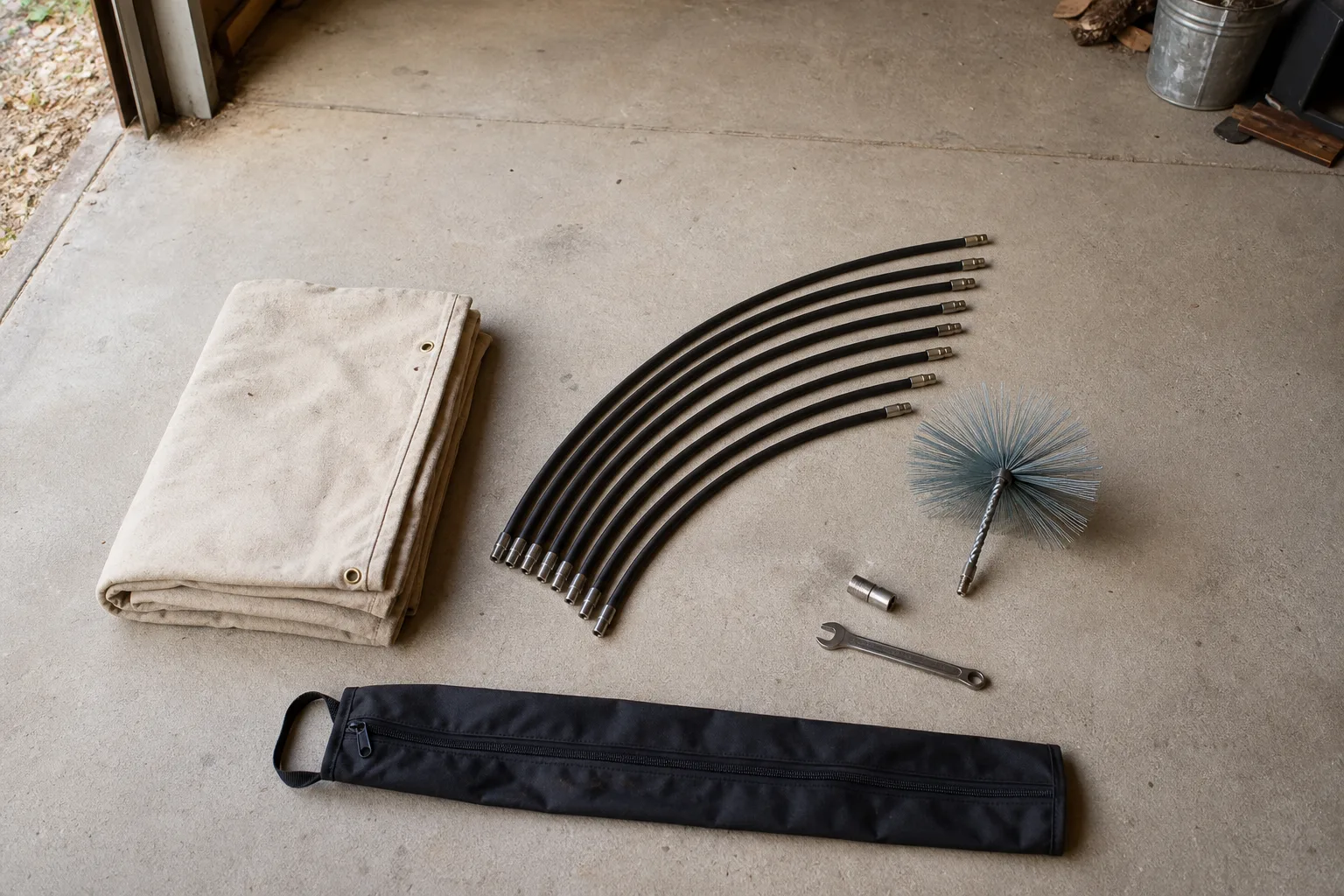
Strip away the packaging and there are three parts that matter.
The brush head. A chimney brush is a cylinder or a box of bristles on a twisted wire spine, with a threaded eye at each end. This is the part that does the work, and it is the easiest part of a chimney cleaning kit to buy wrong.
The rods. Sections that thread or snap together end to end, so you can push the brush the full height of the flue and pull it back.
The connector. A collet or adapter that joins the brush to the first rod. Small, boring, and the piece that strands you if it does not match.
Everything else in the box is convenience. A folded drop cloth, a sponge or wipe, a small wrench, a zip bag to keep the soot off the rest of the garage. Useful, not decisive.
Rods come in two common lengths. Flexible nylon consumer kits are usually built from sections around thirty-nine inches. Traditional rod sets run five feet a section. They chain together as far as you need, which is why the number printed on the box is the total assembled reach, not a limit.
Good to know: rod count in the product title is marketing. Nine short rods and six long ones can reach exactly the same height. The number to compare is total assembled length, and then only against your own flue.
The bristles are where the real decision hides, and we will get there. First, the chimney.
Start With Your Chimney, Not the Kit
Here is the thing nobody selling you a brush will lead with: you cannot choose a chimney cleaning kit until you can describe the hole it goes into.
Three facts. None of them are printed on the kit, and none of them are guessable from the hearth.
What shape is your flue?
Round, square, rectangular, or oval. Brushes are manufactured in all four, and the shape is not a preference setting.
Look at the top of the stack, or at the flue above the damper with a flashlight. Older masonry fireplaces are often rectangular. Wood stove liners are almost always round.
Measure the inside, not the label
Clay liners are sold and discussed by nominal names. An "8x8" is a category, not a measurement, and the usable inside dimension is smaller than the name suggests. Sources do not even agree on by how much.
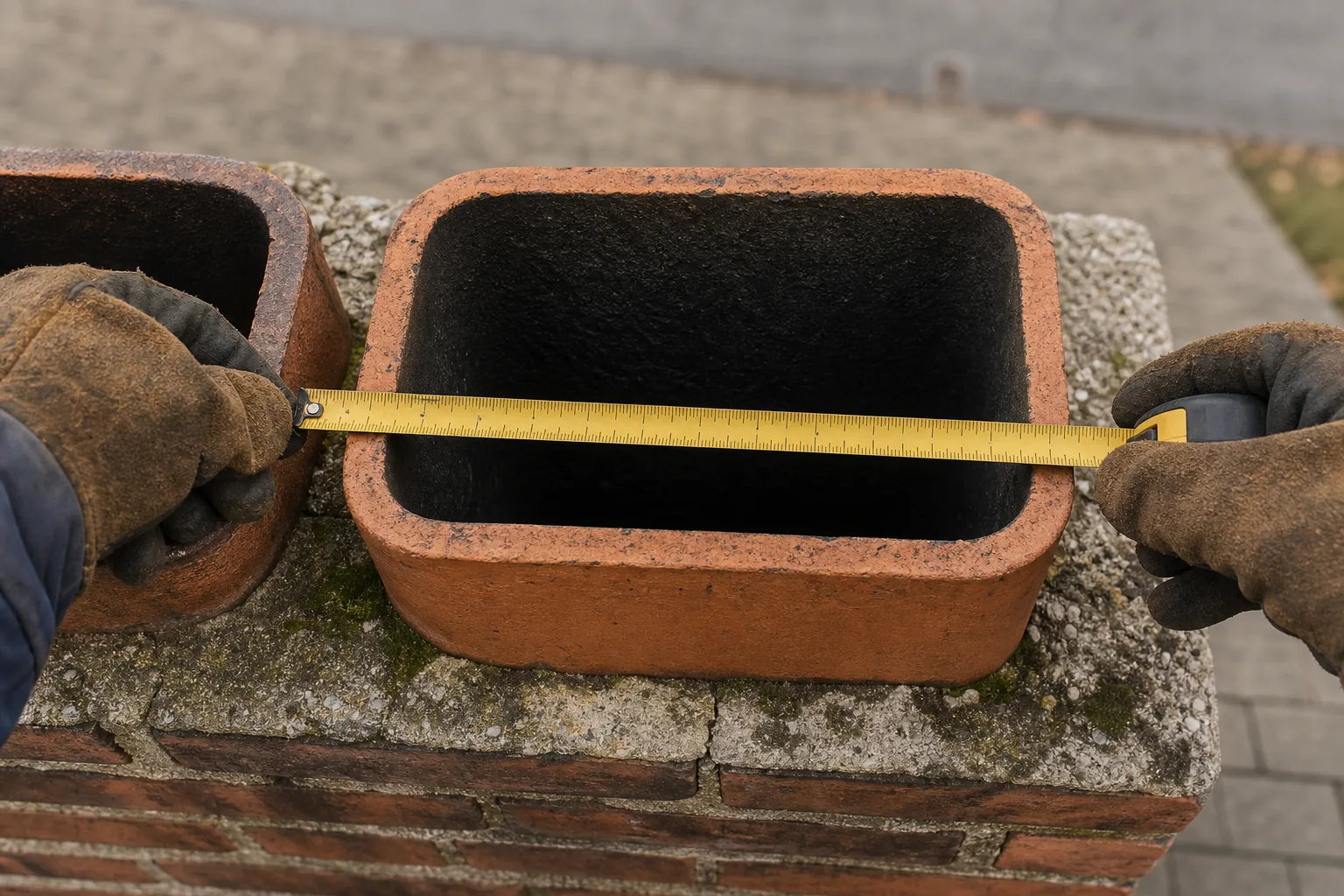
So measure. Tape across the inside opening at the crown, and write the number down.
For context on what you are likely to find: clay tiles commonly turn up in sizes like 8.5 by 8.5, 8.5 by 13, 13 by 13, 13 by 18, and 18 by 18, in two-foot lengths. Round liners are made anywhere from about three inches to thirty-six inches across.
Your number is the only one that counts.
Find out what your liner is made of
Clay tile, a stainless steel chimney liner, cast-in-place, or an old stack with no liner at all.
This single fact decides your bristles, and getting it wrong can cost you more than the kit did.
If you genuinely cannot tell, that is not a failure. It is information: it means you have not yet seen the inside of your own chimney, which is worth fixing before you put a spinning brush in it.
Five things to know before you spend a dollar:
- The shape of your flue's cross section.
- The inside dimension, measured, not assumed.
- What the liner is made of.
- The height from the firebox to the top of the stack.
- Whether you can safely get to that top.
Notice that four of the five are about the chimney and one is about you. Which of the five can you actually answer right now?
How to Size the Brush to Your Flue
Now the shopping starts, and it starts with a number.
The rule that keeps a chimney cleaning kit from getting stuck
Size the brush to the inside dimension of the flue, then go half an inch to a full inch larger. That is the range the trade works to, and it exists for a reason at both ends.
Undersized, and the bristles never press hard enough on the wall to take anything off. You will make two hours of noise and bring down a coffee can of soot.
Oversized is the interesting failure. A bigger brush does not clean better. It wedges.
This is the failure the retailers mention in a single clause and never dwell on. Not injury, not mess. A brush jammed in a flue you cannot reach, attached to thirty feet of rod you now have to decide whether to keep pulling on.
Match the shape, not just the number
A round brush in a rectangular flue sweeps a circle and leaves the corners, and corners are exactly where deposits sit longest.
Square and rectangular brushes exist. Buy the shape you measured.
Poly or wire, decided by your liner
Poly bristles for metal. Wire bristles for clay and masonry. That is the whole rule, and it is not about which is tougher.
Wire scratches stainless steel. Stainless resists corrosion because of a thin passive oxide layer on its surface, and scraping that layer off with steel bristles forces the metal to keep rebuilding it. Every scratch also becomes a pocket where creosote and ash collect.
Many liner manufacturers specify poly brushes in their own literature, and some liner warranties are written around it. Before you buy wire, go read the paperwork that came with your liner.
Clay and masonry flues are the opposite case. The surface is porous, deposits grip it, and a wire brush is the standard choice there.
Pro tip: measure at the top and again at the smoke chamber if you can see both. Some stacks change section on the way up, and the brush that fits the crown is not always the brush that fits the throat.
Rods, Reach, and How You'll Work the Flue
The brush decides whether the job works. The rods decide whether the job is pleasant.
How much rod you actually need
Measure from the firebox floor to the top of the stack, then buy more than that.
You want slack in your hands at the point where the brush reaches the bottom of its travel, because a rod you are straining to hold is a rod you will drop. If your flue runs twenty-two feet, do not buy twenty-two feet of rod.
Flexible or rigid
Flexible nylon rods bend through gentle transitions and suit metal liners. The flexible nylon chimney cleaning kit sold with a drill-driven head is built around exactly that pairing.
Rigid rods give you better push. In a straight masonry flue where you want the brush pressed hard against clay tile, stiffness is an advantage rather than a compromise.
Neither is the better product. They are answers to different chimneys.
Rotary or manual
Rotary kits, the ones that chuck into a cordless drill and spin the head as it travels, have moved from trade equipment to ordinary retail shelves. Retail listing pages for this category now carry them right alongside traditional rod sets.
They earn that on harder deposits. A spinning head breaks up crunchy, hardened buildup that a push-and-pull brush just polishes.
Manual rods give you feel instead. You know when the brush hits something, because your hands tell you, and you can stop.
That feel matters more than people expect. A drill spinning a brush against clay tile, driven by someone who has never done this and cannot see what they are hitting, is a real way to damage a flue.
Top-down or bottom-up
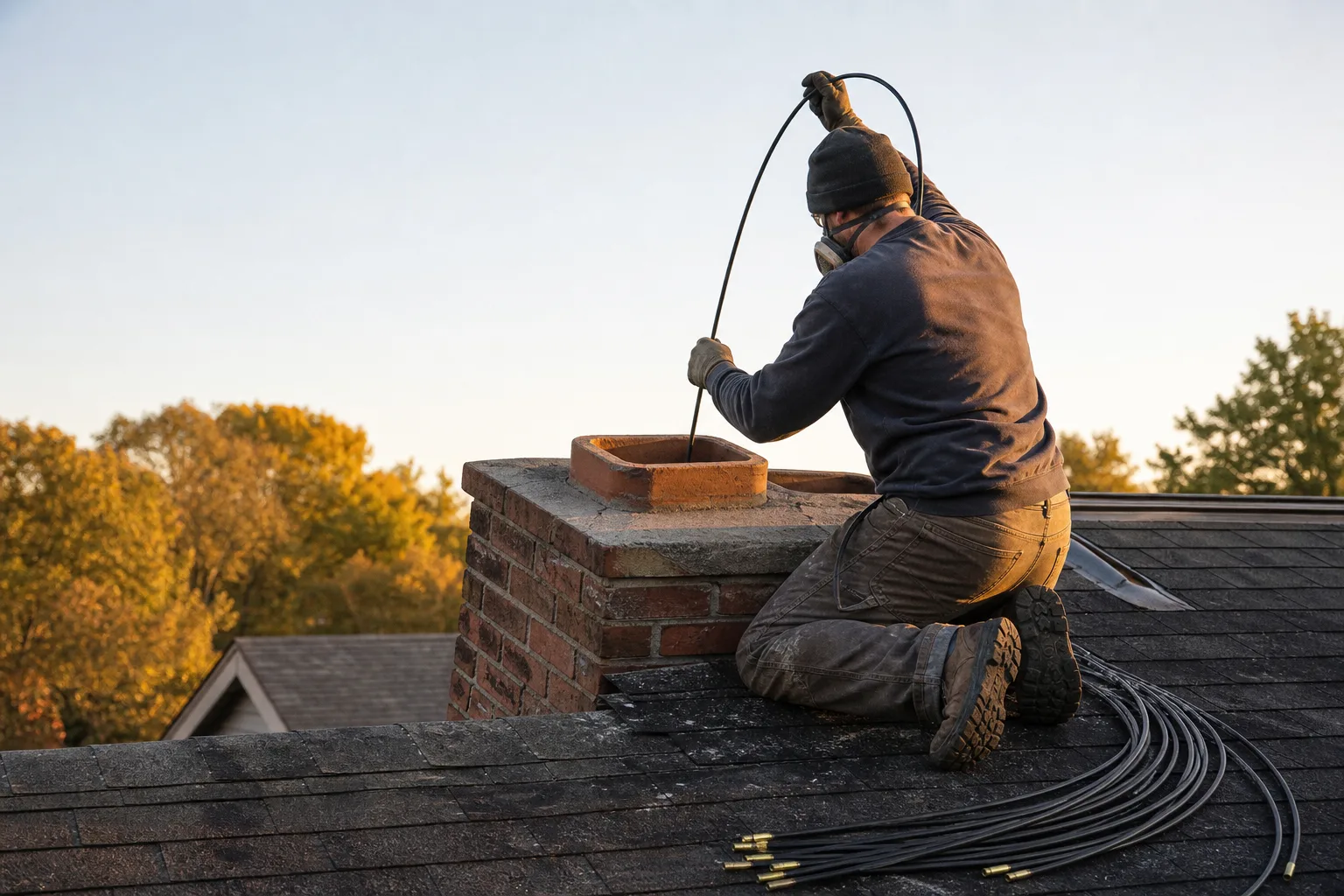
Top-down means the roof. You feed the brush into the flue at the crown, add rods as it descends, work it up and down, then go inside and deal with what fell. If you have never walked through how to clean a chimney start to finish, read that before your first attempt.
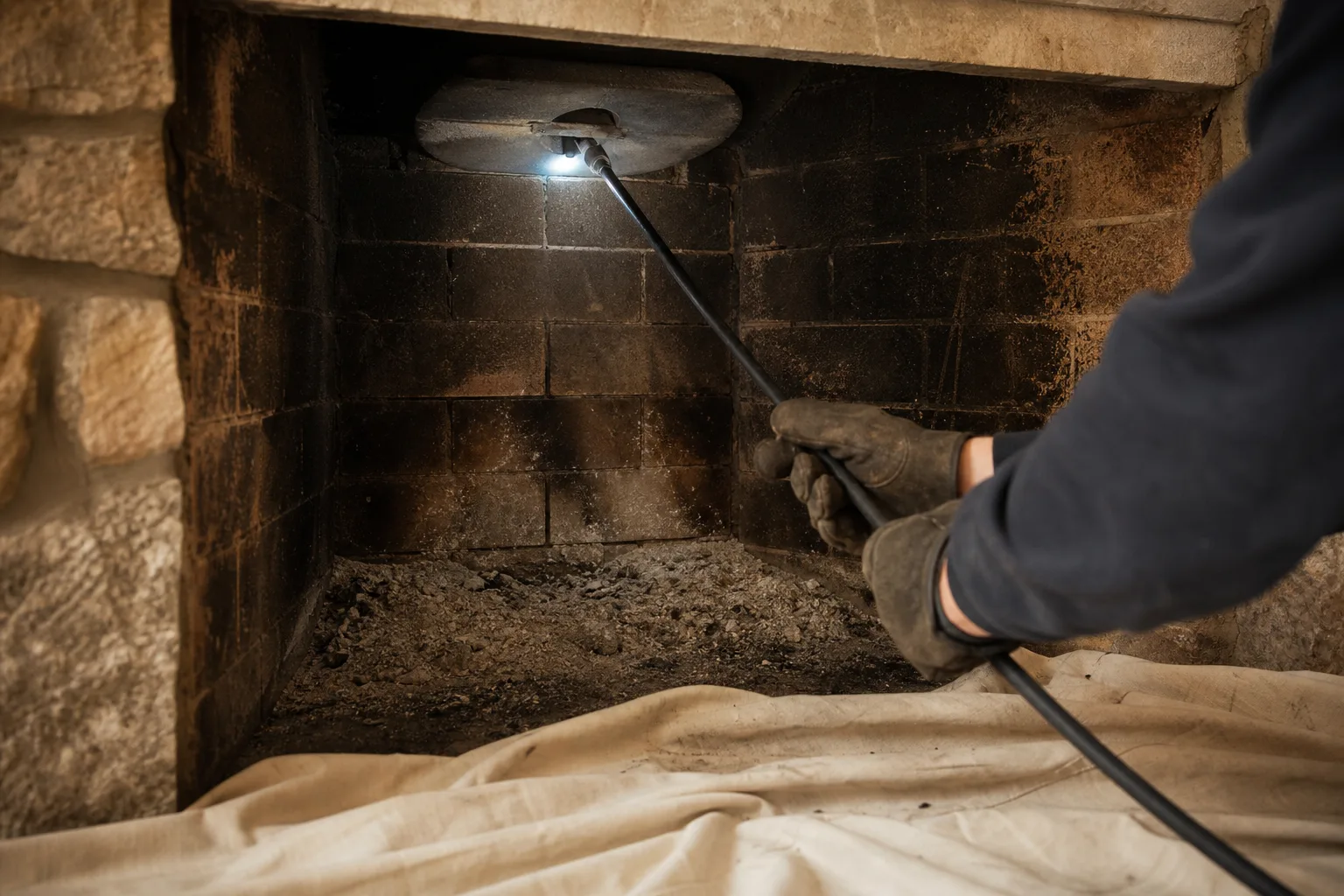
Bottom-up means the firebox. Damper open, the fireplace opening sealed with a drop cloth taped in place, shop vac running, and you push the brush upward from your knees.
Bottom-up keeps you off the roof and puts you underneath everything you dislodge. Top-down is cleaner on your body and worse on your nerves.
Pick based on the roof. That is the right variable to decide on.
Safety note: rods, spinning heads and falling debris can all injure you, so eye protection, gloves and a respirator belong on before the first rod goes in. Height is the risk that changes the whole plan, though. If the roof is steep, wet, iced, high, or simply steeper than anything you have stood on before, that fact alone settles which method you use, and it settles it before the shopping does.
Which Chimney Cleaning Kit Fits Which Chimney
Every buying guide on this topic compares brands. That comparison is useless to you, because the brands change every season and your chimney does not.
Here is the comparison that actually decides the purchase.
| Your chimney | Brush shape | Bristles | Rod type | Rotary or manual |
|---|---|---|---|---|
| Clay tile masonry flue, straight run | Match the tile: square or rectangular | Wire | Rigid or flexible | Either |
| Clay tile with a bend or offset | Match the tile | Wire | Flexible | Manual, and go slowly |
| Round stainless liner, wood stove | Round | Poly only | Flexible | Either |
| Rectangular masonry, open fireplace | Rectangular | Wire | Rigid | Manual |
| Factory-built metal chimney | Round | Poly only | Flexible | Either, with a light hand |
| Unlined, or you are not sure | Do not guess | Do not guess | Do not guess | Get eyes on it first |
Read the bottom row again. If you cannot fill in your own row of that table, the answer is not a different chimney cleaning kit. The answer is finding out what you have. Sweeping is one piece of ongoing chimney maintenance, and the rest of it starts with knowing your own system.
What a Chimney Cleaning Kit Will Not Clean
I promised to name the thing every kit is quietly bad at. Here it is, and it is not one thing, it is three.
Stage 2 and stage 3 creosote
Creosote is classified in three degrees, and they are not three amounts of the same substance. They are three different problems.
First degree is light, flaky, powdery soot. It forms when seasoned wood burns hot enough, and it comes off with an ordinary brush. This is what a homeowner chimney cleaning kit is designed for, and against this it works beautifully.
Second degree is shiny, crunchy, tar-like flakes with a hard porous texture. Brushing alone does not do it. This is where rotary loop tools and drill attachments start being the answer rather than a preference.
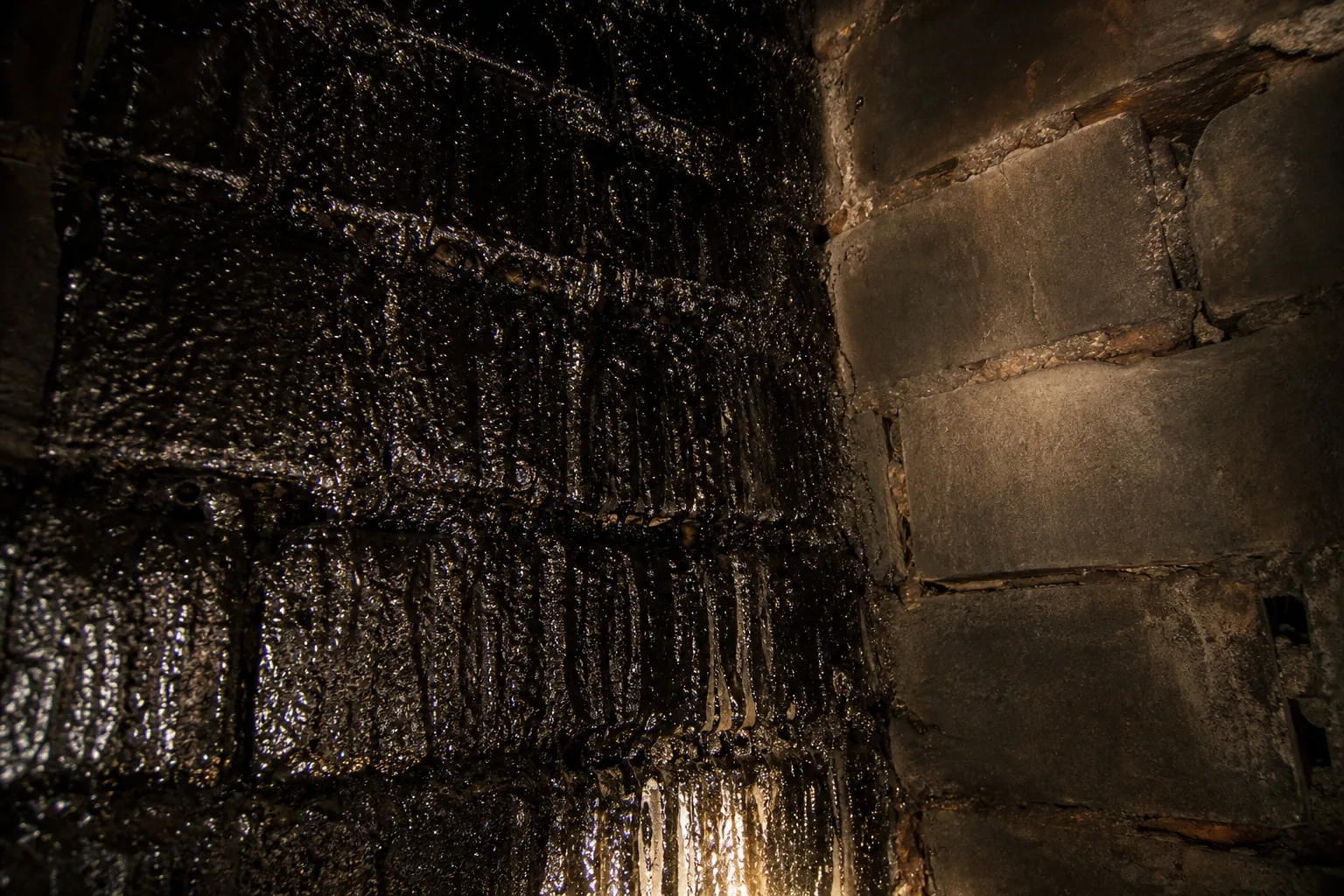
Third degree is glazed: a hard, black, lacquered coating on the flue wall. It is extremely difficult to remove and it is highly flammable.
The visual tell for glazed creosote is worth memorizing, because it is the one thing you can diagnose yourself with a flashlight. It looks wet. Shiny, running, tarry, like something is still dripping. And it is bone dry.
Getting glazed creosote off is not a brushing job, and it is not what a consumer chimney cleaning kit is built to do.
The smoke chamber, the smoke shelf, and offsets
A rod goes where a rod can go, and a chimney is not always a straight line.
Plenty of masonry chimneys change direction above the smoke chamber to move the flue away from the roof ridge. A brush pushed from the top arrives at that bend and stops, and everything above the bend is clean while everything below it is not.
Then there is the smoke shelf, the ledge behind the damper where debris collects. A top-down sweep drops soot onto it. It does not clear it.
Sweeping is not inspecting
This is the part I would want a neighbor to tell me.
You can sweep your own chimney. You cannot inspect it, and those are two different jobs that the word "cleaning" has quietly merged into one. It is also why searching for a chimney sweep in your area turns up companies that quote the two separately.
An NFPA 211 Level 1 inspection is the annual baseline for a system running normally with nothing changed. It is a visual check of the cap and crown, the flashing, the visible flue from above and below, the smoke chamber and damper, the firebox masonry, the hearth extension, and the clearance to combustibles, done with a flashlight and a mirror.
A Level 2 is not a nicer version of that. It is required, not optional, in five situations: when a property is sold or transferred, when the system changes (new appliance, new fuel, a reline), after a malfunction, after a chimney fire, and after an external event like an earthquake or severe weather.
Your chimney cleaning kit satisfies none of that. It was never supposed to.
Myth vs. fact: the myth is "clean your chimney once a year." What the standard calls for annually is the inspection. The sweeping happens when the inspection says it should, which for a light burner might be less often and for a heavy burner might be more.
From the field: the chimneys that surprise people are rarely the filthy-looking ones. They are the ones that looked perfectly fine from the firebox, where everything visible from the hearth was clean and the problem was sitting above the smoke chamber the whole time, out of sight of the person holding the flashlight.
Found something a brush will not move?
Glazed creosote, an offset your rod will not pass, or a flue you cannot see the top of are all jobs for a camera and a trained eye, not a stiffer bristle. VIO matches you with an independent local chimney company that can get up there and tell you what you are actually looking at.
Call (513) 655-6702
How VIO Helps When a Chimney Cleaning Kit Isn't the Answer
VIO is not a chimney company. We are the step before one.
If you have read this far, you are probably in one of three places. You bought the right chimney cleaning kit for your flue and you are set, in which case go have a good Saturday. Or you have hit a wall: a flue you cannot safely reach or see the top of, glazed creosote you now know a brush will not lift, or one of those five Level 2 situations sitting in your lap because you just closed on the house.
The last two are where we are useful.
Tell us where you are and what you found, and we match you with an independent local chimney company working your area. What you are booking is a camera and a documented inspection, the part a chimney cleaning kit was never going to produce. We ask every company in the network to report in writing what it finds, and you should confirm that is what is on the appointment before anyone starts.
On money, so there are no surprises: we ask every company in the network to put its estimate in writing before any work starts, and you should insist on exactly that. Read it before anyone climbs anything.
And if the company we match you with looks at your flue and tells you it is sound and you can keep sweeping it yourself, take that as a good day. That is the answer you were trying to buy in the first place.
Buy the kit. Book the eyes.
The homeowner who does both is doing the job properly. The sweeping is yours. The inspection is a trade job, and it is the half that a chimney cleaning kit cannot do. VIO connects you with independent chimney companies working in your area.
Call (513) 655-6702
Symptom checker
What is your chimney doing?
Tap the closest match for an honest first answer.