



On this pageWhat a Chimney Sweep Kid Actually Did8 sections+7
- What a Chimney Sweep Kid Actually Did
- Why Anyone Sent a Child Up a Chimney
- Chimney Sweep Kid Timeline: 1666 to 1875
- 1775: The First Cancer in History Traced to a Job
- Were There Chimney Sweep Kids in America?
- Myth vs. History: What Chimney Blogs Get Wrong
- What a Chimney Sweep Does Now, and What to Tell Your Own Kid
- How VIO Helps
Quick answer
A chimney sweep kid, called a climbing boy by historians, was a child of roughly four to ten sent up narrow coal flues in Britain from the late 1600s until the 1870s to scrape soot loose by hand. Britain's Chimney Sweepers Act of 1875 ended the practice. No child climbs a chimney today. Modern sweeps work from the hearth and the roof using rods, brushes, a vacuum and an inspection camera.
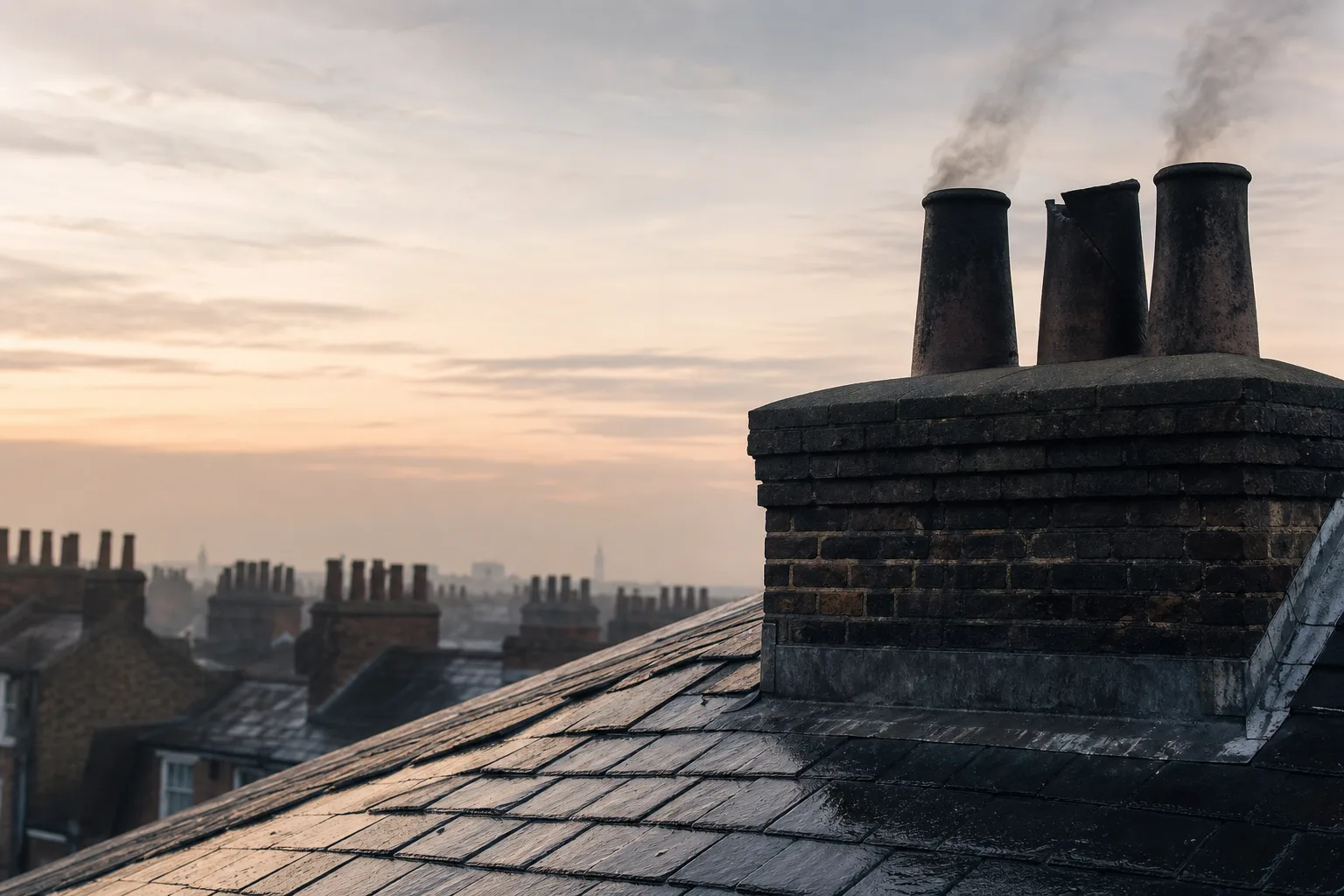
A boy of six stands on a wet slate roof in London before dawn, barefoot, a stiff bristle brush held above his head. He is black from scalp to ankle except for the whites of his eyes.
In a moment he will lower himself into a flue roughly the width of his own shoulders, and there are more chimneys on his master's list before the light is properly up.
That is the chimney sweep kid. It was not a story, and it ran in Britain for close to two hundred years.
Most of what gets written about the chimney sweep kid online is a horror listicle. The ages, the soot, the twisted spines, the end. All of that is true and you will find it below. But two things almost nobody tells you, and they are the most interesting facts on the subject.
The first is that this was an engineering problem before it was a moral one. There is a specific reason British chimneys got narrow enough to need a child, and it starts with a fire in 1666.
The second is that these children gave medicine its first proof that a job can cause cancer.
There is also a question every American page skips: did any of it happen here? It did, and the answer is worse than you would guess from how little anyone writes about it.
What a Chimney Sweep Kid Actually Did
Historians do not usually say "chimney sweep kid." They say climbing boy, and that is the phrase to use if you want primary sources. The job title was technically "apprentice."
Nothing about it resembled an apprenticeship.
Who the children were
They were orphans, workhouse children, parish children handed over by the local authority, or children sold outright by parents who could not feed them. A master sweep took them in, housed them badly, fed them worse, and owned their labor for years.
Ages ran from about four to about ten, most under seven, some recorded as young as three. Six seems to have been the preferred age: strong enough to haul itself up a vertical shaft, still small enough to fit one.
A standard apprenticeship then lasted seven years. Sweep apprenticeships could run longer.
Good to know: To read the actual historical record rather than blog summaries of it, search "climbing boys" and not "chimney sweep kid." Victorian reform literature, parliamentary transcripts and medical journals all use the former. It is the difference between finding nine chimney-company blog posts and finding Hansard.
The climb, step by step
The brush went overhead first. The child braced knees, elbows and bare feet against opposing walls and worked upward by friction, which is why the injuries clustered in knees, ankles and spines.
Going up, he scraped and brushed the soot loose. It fell past him. Onto him, mostly.
Then he slid back down, scooped the soot off the bottom of the fireplace, and carried it out to the master waiting in the street.
Flues were not straight. London flues had bends, sometimes right angles, built in deliberately so smoke would not blow back into the room. A child could get wedged at a bend. Some did.
Why the Phrase "Chimney Sweep Kid" Hides the Worst Part
Here is the detail that reframes everything, and it is usually left out.
The soot had value. It was sold as fertilizer, and the master sweep kept the money from it.
So the child was not just unpaid for the cleaning. He was the harvesting equipment for a second product he never saw a penny from, coming down the flue carrying the master's inventory on his back and in his lungs.
The children were not an unfortunate necessity in a dirty trade. They were a margin.
Why Anyone Sent a Child Up a Chimney
Nobody woke up in 1700 and decided children should go up chimneys. The flues got smaller, then they got bent, and both changes happened for reasons that had nothing to do with children at all.
The Great Fire of London and the chimney that got narrower
The Great Fire of 1666 burned through most of the City of London, and the rebuilding that followed came with a rethink of how English houses handled fire and smoke.
Flues were built narrower than before, and with bends rather than running straight to the sky. Narrower flues drew better. Bends stopped downdrafts and sparks.
Sensible fire-safety decisions, both of them. They also turned the inside of a chimney into a space no adult body could enter.
The figure usually cited for a period flue is around nine by fourteen inches. That was never a formal standard, so treat it as a sense of scale rather than a spec. Then picture getting an adult shoulder into it.
Coal, and why soot stopped falling on its own
The second change was the fuel.
British cities moved from wood to coal, and coal smoke leaves a deposit that is tarry and sticky rather than powdery. It does not flake off and tumble down the way light wood ash does. It bonds to the masonry, which is still how creosote builds up in stages in a wood-burning flue today.
So it had to be physically scraped, by something that could get up there and put pressure on the wall.
Put the two changes together and you have the whole explanation for the chimney sweep kid. A flue too small for an adult, coated in something that will not come off without contact, in a city full of them.
The answer the trade arrived at was a child. That does not excuse it. It does explain it, and understanding why a cruelty happened is usually more useful than being shocked by it.
Pro tip: This is why the modern job looks nothing like the old one. The problem was never "how do we get a person up there." It was "how do we apply force to a surface we cannot reach." Rods and a rotating brush head solve that without a person going anywhere.
Chimney Sweep Kid Timeline: 1666 to 1875
If you came for dates you can cite, this is the section. All of it is from the historical record rather than trade folklore.
| Year | What happened | What it changed |
|---|---|---|
| 1666 | The Great Fire of London | Rebuilding produces narrower, bent flues no adult can enter |
| 1700s | Coal replaces wood in British cities | Deposits turn tarry and must be scraped by hand |
| 1760s | Jonas Hanway campaigns for sweeps' apprentices | First organized public pressure on the practice |
| 1775 | Percivall Pott describes "soot wart" in sweeps | First cancer in history linked to an occupation |
| 1788 | Chimney Sweepers Act | Sets a minimum apprentice age of eight. No enforcement mechanism, so it is widely ignored |
| 1840 | Chimney Sweepers and Chimneys Regulation Act | Raises the age limit again. Commonly reported as twenty-one, and again poorly enforced |
| 1864 | Chimney Sweepers Regulation Act | Further regulation, still without real teeth |
| Feb 1875 | George Brewster, aged eleven or twelve, dies after being sent up a chimney at Fulbourn Hospital, Cambridgeshire | Public outrage |
| 1875 | Chimney Sweepers Act, carried by Lord Shaftesbury | Requires an annual police licence for sweeps and makes enforcement a police duty. This is the one that works |
Look at that column of Acts. 1788, 1840, 1864. Nearly a century of legislation that changed almost nothing, because every one of those laws told sweeps what to do and gave nobody the job of checking.
Lord Shaftesbury worked on this from the 1840s until 1875. Thirty years of a man losing the same argument.
What broke it was not a better-worded statute. It was licensing plus a named enforcer. Once a sweep needed a police licence every year and the police were made responsible for the existing law, the economics of a climbing boy collapsed.
The boy whose death did it was eleven or twelve. Sources differ, so anyone telling you his exact age is guessing.
1775: The First Cancer in History Traced to a Job
A hundred years before the law caught up, a London surgeon noticed something.
Percivall Pott, 1714 to 1788, was treating chimney sweeps for a squamous cell carcinoma of the scrotum. It was common enough among sweeps to have a street name: soot wart.
In 1775 Pott did something nobody had done before. He wrote down that the cancer was caused by the men's work. Specifically by soot, pressed against skin, over years.
That is the first reported occupational cancer in medical history, and the first time anyone demonstrated that a cancer could be caused by an agent in the environment rather than arising from inside the body. Pott is now regarded as the founder of occupational cancer research.
Here is the part that connects it back to the children.
The disease mostly struck sweeps who had been in contact with soot since early childhood. The men Pott was treating were the climbing boys, grown up. The exposure that killed them began when they were six.
So the most consequential thing to come out of the chimney sweep kid era is not a law. It is a diagnosis that eventually taught the world workplaces can be carcinogenic. Every asbestos regulation and every exposure limit descends in part from a surgeon looking at chimney sweeps and asking why.
Almost none of the pages that will tell you about twisted spines will tell you that.
From the field: Mention the trade's age on a driveway and the conversation changes. Homeowners who thought of a sweep as a guy with a brush start asking real questions once they hear the job is three and a half centuries old and that medicine's first occupational cancer was found in the people who did it. Respect for the work tends to arrive with the history.
Were There Chimney Sweep Kids in America?
Yes, and the honest answer has an uncomfortable second half.
Almost every page on this topic writes about England exclusively, which is odd given how many of the people asking are American. So here is the straight version.
The United States never passed a nationwide law specifically prohibiting children from sweeping chimneys. There was no American 1875. Britain got a dedicated statute with a police licence attached. This country got nothing aimed at the trade at all.
Strong federal child labor law did not arrive here until the twentieth century, with the Fair Labor Standards Act of 1938 doing the heavy lifting.
And the American chimney sweep kid was, in the documented cases, a Black child.
Very little documentation survives, and that is itself the point. The record is thin because nobody with the power to write records thought these children were worth recording.
So if you want American dates, an American George Brewster, there is not much there, and I am not going to invent any.
Good to know: The standard governing chimney inspections today is NFPA 211, and it requires a Level 2 inspection at sale or transfer of the property. The same requirement applies after any change to the system, after a malfunction, after a chimney fire, and after an external event like severe weather or an earthquake. A Level 2 adds a video scan of the flue interior.
Myth vs. History: What Chimney Blogs Get Wrong
Search this topic and you notice something. The same pages that carefully cite Acts of Parliament will, two paragraphs later, tell you a king declared sweeps lucky, with no source at all.
Worth separating those two things.
The lucky sweep and the runaway horse
The story goes that a king of England was saved from a runaway horse by a chimney sweep, and declared the trade lucky forever after.
Myth vs. fact: Different sources credit King George II, King George III, and William the Conqueror, dating the event to the sixteenth, eighteenth and eleventh centuries respectively. One widely copied version puts George II in the sixteenth century, a hundred years before he was born. It is folklore, and sweeps are entitled to it, but it should not sit in the same paragraph as a parliamentary record.
The wedding tradition is real in the sense that people genuinely do it. The origin story attached to it is not documented.
The top hat and tails
This one has a more plausible explanation, though still trade tradition rather than established fact.
Master sweeps are said to have worn secondhand formalwear, long coats and tall hats discarded by wealthy clients and undertakers. It marked the master out from his apprentices, and marked him as a man you could let into your front hall.
Note who wore it. The hat was the master's. The chimney sweep kid who went up the flue wore rags and no shoes. The silhouette everyone pictures belongs to the man standing in the street.
Bert, and what Mary Poppins left out
The 1964 Disney film is why a lot of people arrive at this page. "Chim Chim Cher-ee" was written after the songwriters asked about a sketch of a sweep and were told the good-luck folklore.
Bert is fiction, and cheerful fiction. By 1910, when the film is set, the 1875 Act had been in force for thirty-five years and the climbing boys were gone.
The film is not lying so much as set after the bad part. Which is a reasonable thing to tell a child, and it leads into the next section.
What a Chimney Sweep Does Now, and What to Tell Your Own Kid
Nobody enters or climbs inside the flue. Say that clearly, because it is the thing a worried eight-year-old actually needs to hear. A sweep still works from the roof as well as the hearth, but from outside the chimney, not inside it.
The modern toolkit
A sweep working an American house today arrives with roughly this:
- Nested fiberglass rods that screw together, with brush heads sized to the flue
- A cordless drill, for rotary cleaning where the deposit needs more than a straight pull
- Drop cloths taped over the firebox opening so the room stays clean
- A shop vacuum with a HEPA filter and a long hose, running the whole time
- A work light and an inspection camera on a pole or flex line
- A roof harness and anchor if the pitch calls for one
The work happens from two ends, inside at the hearth and from the top of the stack. The camera does what a chimney sweep kid's eyes used to do, and better, because it records.
Pro tip: Ask to see the camera footage. Any sweep who ran a scan can show you the inside of your own flue on a screen, orange clay tile, mortar joints, and whatever is coating it. If someone tells you the flue is cracked or glazed and cannot show you, ask why not.
A sweep worth hiring also carries a credential. The common US one is CSIA certification, a reasonable first filter when you are choosing between companies.
If reading this made you wonder when anyone last looked at your own flue, that is a fair question to ask in October. Tell us where you are and we will look for an independent chimney company near you. Call (513) 655-6702, or request service online and describe what your fireplace is doing.
What to say when a child asks
If your kid just asked whether children really went up chimneys, here is a version you can say out loud without producing nightmares. Steal it.
"Yes, a long time ago. Chimneys used to be really narrow, so people sent small children up inside them to scrape them clean, and it made those kids very sick. People fought about it for almost a hundred years until the law stopped it, and it has been against the law for a very long time now. Today a chimney sweep uses long poles that screw together, a big vacuum, and a little camera on a stick. Nobody goes inside. Want to watch next time someone comes to do ours?"
That last question is the useful part. It turns a grim fact into something your child gets to be curious about, and children handle "that was wrong and people fixed it" better than adults expect.
Kids and a working fireplace today
The chimney sweep kid is history. Children and fireplaces are not.
Safety note: The glass front on a gas fireplace gets hot enough to burn a small hand, and stays hot well after the flame is off. A screen in front of the glass is the standard answer. For a wood firebox, teach a kid-free zone that keeps children back from the fireplace and off the hearth entirely, not a line at the hearth edge, and use a sturdy screen. And keep the annual inspection, because a flue problem is invisible from the living room.
One other thing does go up and down a modern flue uninvited, just not a person. Birds, squirrels and raccoons all find chimneys attractive.
That is what a chimney cap is for, and getting one fitted properly is one of the cheapest things you can do to a chimney.
How VIO Helps
If you came for the history of the chimney sweep kid and left wondering who should look at your own chimney, that is a reasonable way to finish this page.
VIO is a referral service. We match homeowners with independent local chimney companies, and you can ask us for a CSIA-certified sweep. We do not do the work ourselves. Each company in the network is an independent business, responsible for maintaining any licensing and insurance its work requires, and you should verify those credentials directly before anyone starts.
Tell us your location and what the fireplace is doing when you request service: an annual cleaning before the first fire of the season, a smell you cannot place, a draft that will not behave, or a Level 2 inspection because you are selling the house.
We ask every company in the network to put its estimate in writing before any work starts, and you should insist on exactly that.
Three hundred and fifty years ago this trade solved its hardest problem by putting a six-year-old inside a wall. The law ended that in 1875, and what replaced the chimney sweep kid was equipment: rods, a vacuum and a camera. Hiring someone who works that way is a low bar worth clearing.
Ready to have it looked at? VIO works to connect homeowners with independent chimney companies near them. Call (513) 655-6702 or request service and tell us what your fireplace is doing.
Symptom checker
What is your chimney doing?
Tap the closest match for an honest first answer.