



On this pageWhat Class A Chimney Pipe Actually Is8 sections+7
- What Class A Chimney Pipe Actually Is
- Class A Chimney Pipe vs. Stove Pipe: The Line That Costs the Most
- The Parts of a Complete System
- Sizing and Choosing Class A Chimney Pipe
- Planning the Run: Through the Ceiling or Out the Wall
- Doing It Yourself, and What an Inspector Looks For
- Living With Class A Chimney Pipe After It Is Up
- How VIO Helps With a Class A Chimney Pipe Install
Quick answer
Class A chimney pipe is factory-built, listed insulated chimney for solid-fuel appliances such as wood stoves. It is tested to UL 103 HT, which includes a 2100°F chimney-fire test, and its insulated wall lets it pass through ceilings, attics and roofs at a much smaller clearance to combustibles than single-wall stove pipe, commonly two inches. It is the chimney itself, not the connector pipe inside the room.
The black pipe behind your wood stove is not your chimney. It looks like one. It carries smoke like one. It is not one, and learning that after you have already bought thirty feet of it is how a lot of stove projects stall out in October.
What has to happen above the ceiling is Class A chimney pipe, and it is a different animal. Heavier, wider, insulated, and sold as a listed system rather than as a part you pick off a shelf.
This is the guide I wish existed for the moment somebody hands you a stove manual and you go looking for a tape measure. What Class A is. How it differs from the pipe standing in your living room. What a complete run actually consists of. How to size it, how to plan the route, and exactly where the job stops being a weekend and starts being a hole in your roof.
If you are in a hurry, skip to the clearance table. That number is what most people came here for, and it is the one that decides whether your ceiling framing works as it sits.
What Class A Chimney Pipe Actually Is
Class A chimney pipe is factory-built chimney for solid-fuel appliances: wood stoves, wood furnaces, and some coal and pellet equipment. The word that matters in that sentence is chimney. This is the part that takes flue gas from the top of the room to the outside air, through whatever building is in the way.
It is often called all-fuel pipe, and it is not the same thing as Type B vent, which is for gas appliances. Different listing, different job, not interchangeable.
The Listing Is the Product
Class A is tested and listed to UL 103 HT. The HT stands for high temperature, and the test behind it includes a 2100°F chimney-fire condition. That listing is not a marketing badge. It is the entire reason the pipe is allowed to pass within a couple of inches of your ceiling joists.
It is also why the assembly matters more than the section. A manufacturer submits a complete system for testing: pipe, support box, shield, flashing, cap, the locking bands that join it. What comes back listed is the system, not the individual pieces.
Insulated Wall or Air-Cooled Triple Wall
Two common designs. Insulated Class A carries packed mineral wool between an inner liner and an outer shell, usually somewhere around an inch to an inch and a quarter of it. Air-cooled triple-wall designs use moving air in channels between the walls instead.
Insulated pipe keeps flue gas warmer, which matters in a cold climate and on a tall run. Air-cooled designs have their own listings and their own applications. Anyone who tells you flatly that one is always the right answer is selling something.
Good to know: the label on the pipe and the manufacturer's installation instructions govern this install. Not a forum, not a video, and not this article. Where they disagree with anything you read, the instructions win.
Class A Chimney Pipe vs. Stove Pipe: The Line That Costs the Most
Here is the confusion that costs people the most money, and it is not subtle once you see it.
Class A Chimney Pipe and Stove Pipe Do Different Jobs
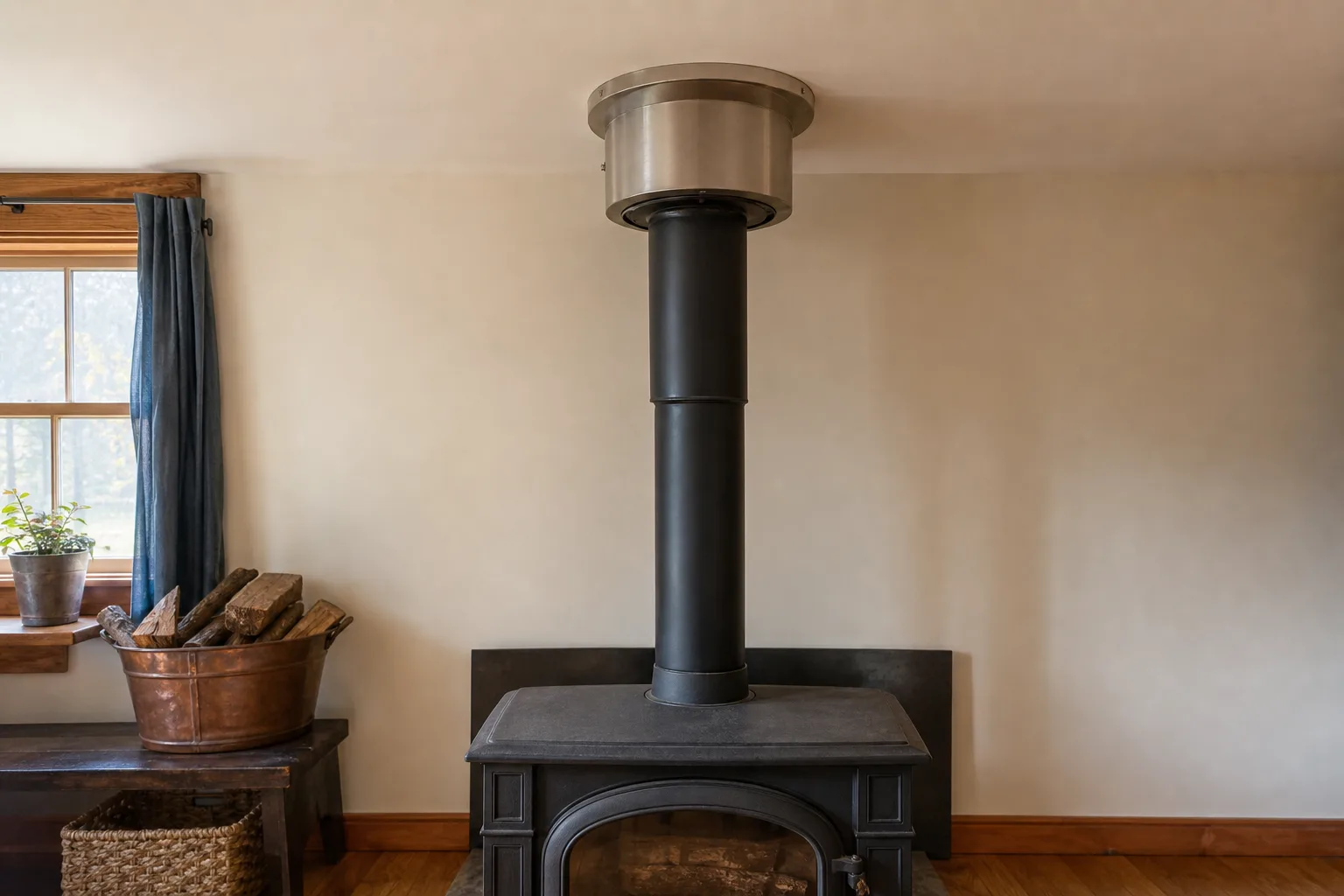
Stove pipe, sometimes called connector pipe, is the black pipe that runs from the stove's flue collar up to the ceiling. Single wall or double wall, thin, cheap by comparison, and it is only allowed to exist inside the room with the appliance.
Class A chimney pipe takes over at that ceiling and goes the rest of the way. It is the only one of the two that is permitted to pass through a ceiling, an attic, a wall cavity, or a roof.
You cannot substitute one for the other, and no amount of adapters changes that. The two are not competing products. They are two segments of one path, and the handoff happens at the ceiling.
Clearance to Combustibles, Side by Side
This is the table. The clearance is the required air gap between the outside of the pipe and anything that can burn: framing, drywall, trim, insulation, stored boxes.
| Pipe type | Where it is allowed to run | Typical clearance to combustibles | What sets the number |
|---|---|---|---|
| Single-wall stove pipe | Inside the appliance room only | 18 inches | NFPA 211 and the appliance listing |
| Double-wall stove pipe | Inside the appliance room only | Commonly 6 inches | The pipe's own listing |
| Class A chimney pipe (insulated) | Through ceilings, attics, walls, roofs | Commonly 2 inches | Its UL 103 HT listing |
| Masonry flue with a proper liner | Built as part of the structure | Per code, varies | Local code and the liner listing |
Two inches is the common listed figure for Class A, not a universal law. Some products list something else. Read your label.
Now go measure. If the framing in your ceiling gives you less than the listed clearance on any side, the opening has to be cut and headed off properly, and that is carpentry before it is chimney work.
Myth vs. fact: insulated Class A chimney pipe does not prevent creosote. Retail copy says it does. What insulation actually does is keep flue gas warm enough that less of it condenses on the way up. Wet fuel and a smoldering fire will still coat any chimney ever made.
The Parts of a Complete System
People price this job by the foot and then get surprised. The pipe sections are the easy part. Everything that lets the pipe cross a building surface is where the parts list gets long.
Inside the Room
An adapter joins the top of the stove pipe to the bottom of the Class A. Above it sits the ceiling support box, and that piece deserves a paragraph of its own.
The support box mounts to the ceiling joists. It carries the weight of every foot of chimney above it and transfers that load into the framing. It also acts as a firestop, holding the required clearance where the pipe crosses the ceiling plane. The round trim collar you see from the couch is the only part of it that shows.
Through the Attic
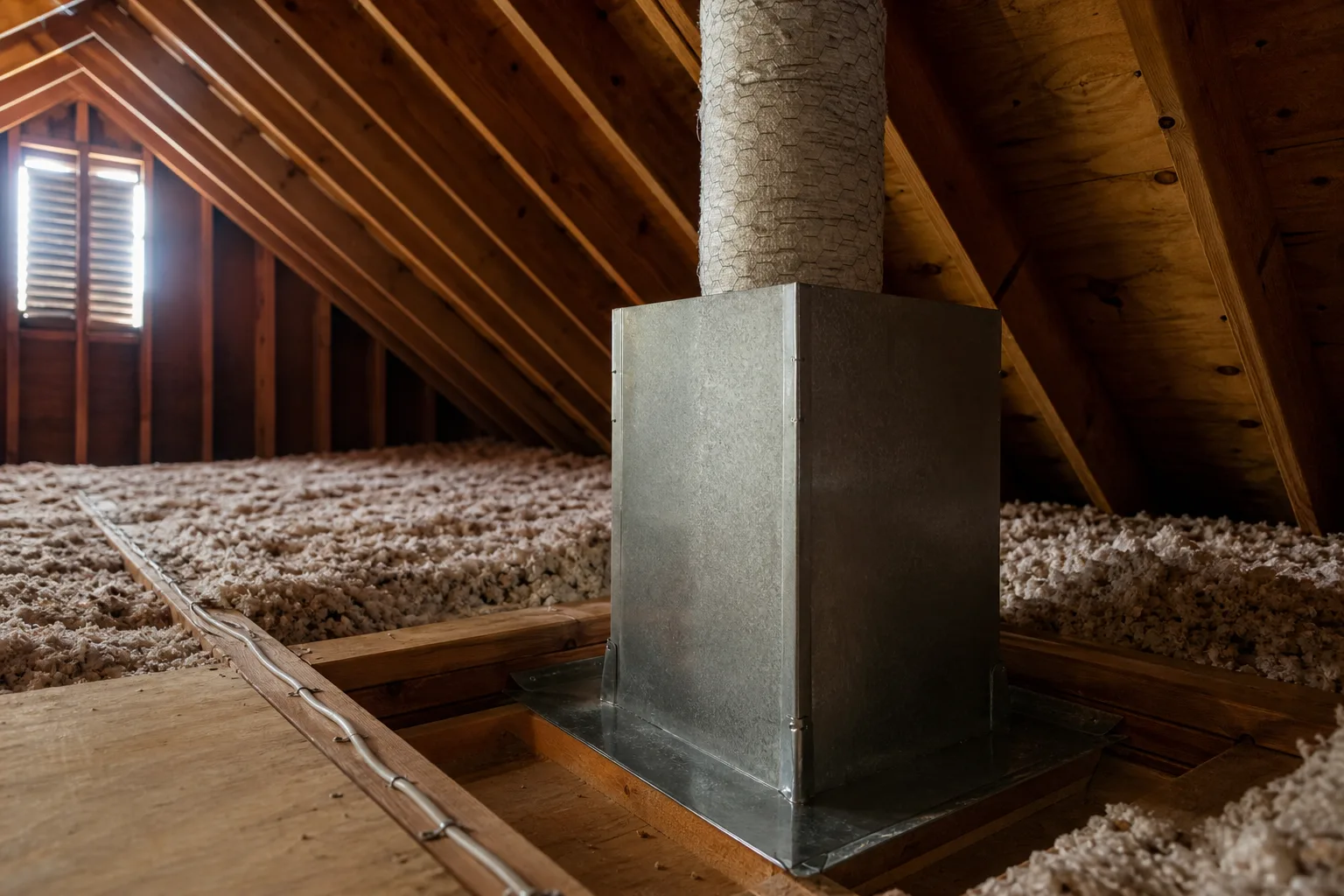
In an unoccupied attic, an insulation shield goes around the pipe: a tall galvanized sleeve with flanges at the bottom that sits in the framed opening. Its job is to hold blown insulation, stored junk, and wiring back off the pipe so the clearance survives the next time someone adds insulation up there.
If you have ever seen cellulose drifted against a warm pipe, you understand why this piece is not optional.
Safety note: the ceiling support box is structural hardware, not trim. It is holding up the chimney. Fastening it to drywall, or to framing that was never sized to carry the load, is one of the failures that turns an install into a rebuild.
Above the Roof
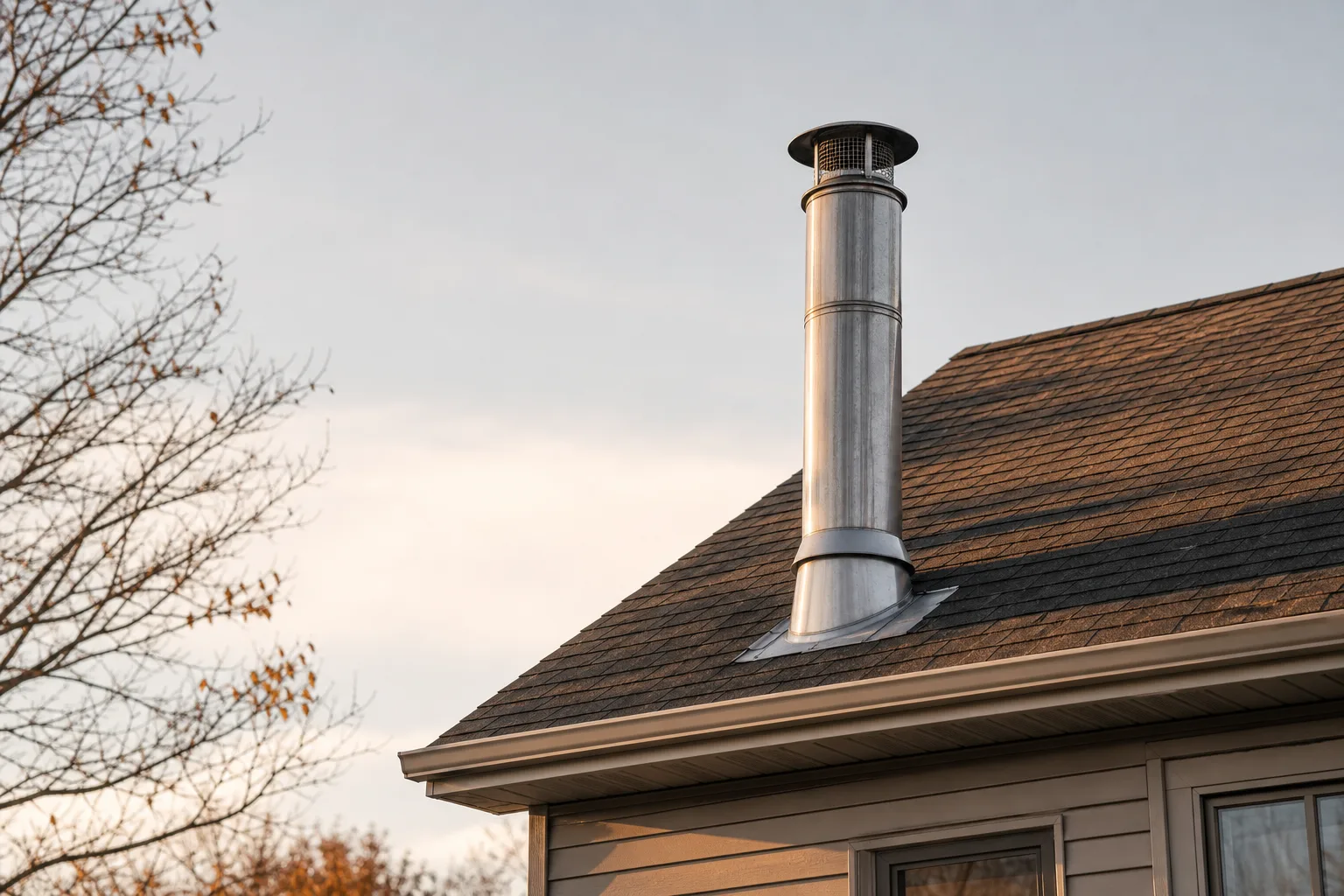
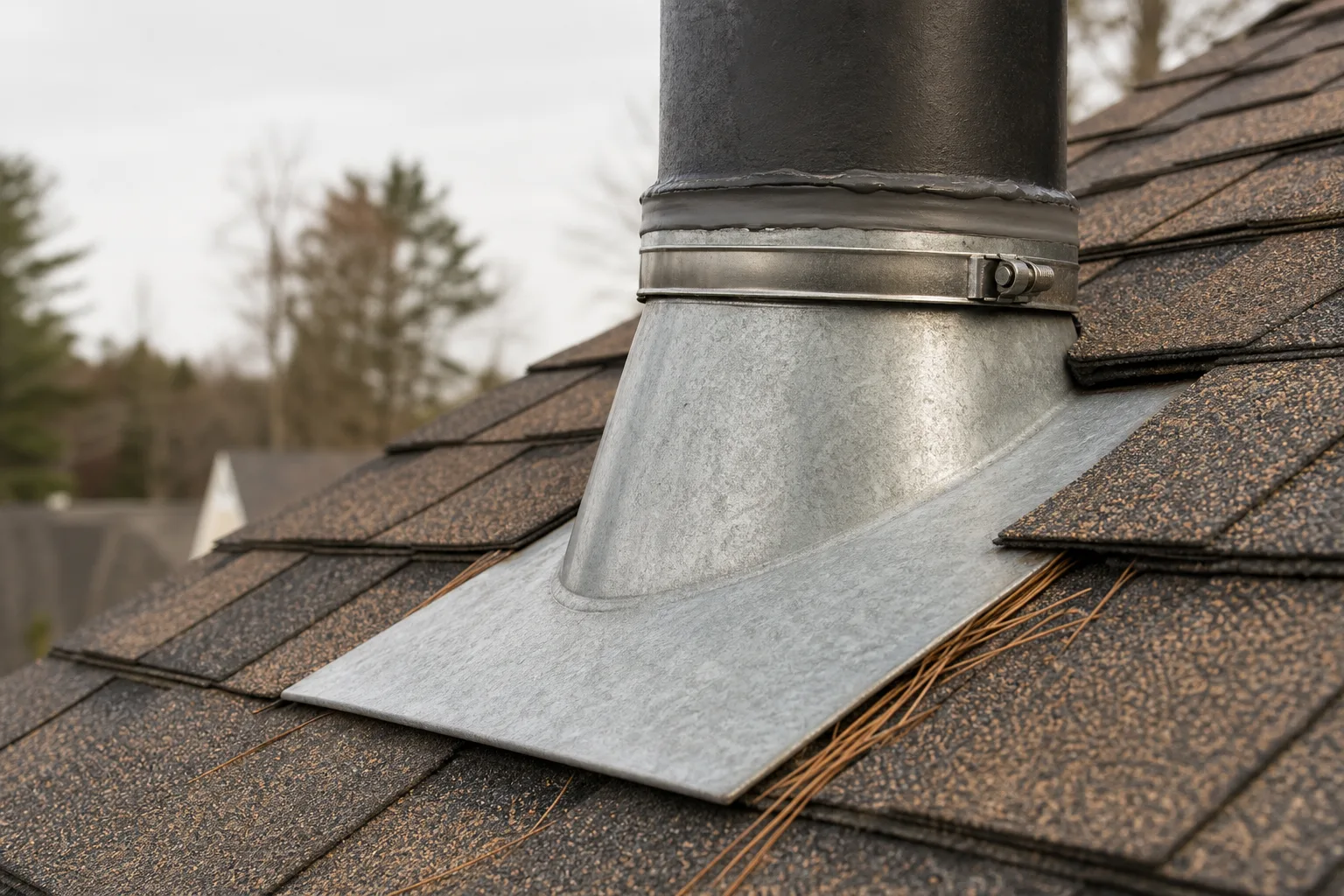
Flashing seals the roof penetration, tucked under the shingles on the upslope side. A storm collar clamps around the pipe just above the flashing cone and takes a bead of sealant along its top edge, which is what actually keeps water from running down the outside of the pipe and into the flashing.
Then the cap, with its spark screen. Add a tee, a tee cap, a wall thimble and wall straps if the run goes outside, and a roof brace if the exposed section is tall.
Sizing and Choosing Class A Chimney Pipe
Three decisions, and only one of them is really yours.
Diameter Comes From the Appliance
Match the appliance's flue outlet, exactly as its manual specifies. Six and eight inch are the common residential sizes, and suppliers stock up to fourteen for larger equipment, which is why you will find whole product categories organized by diameter.
Do not size up because bigger sounds safer. An oversized flue runs cooler, drafts worse, and gives condensation more surface to form on.
Alloys, and What They Mean
Inner liners are commonly 304 or 316L stainless. Outer shells are often 430 stainless or galvanized steel. The heavier corrosion-resistant alloys cost more and hold up better against acidic condensate and coastal air.
That is a real difference, not a spec-sheet flourish, and it is worth understanding before you compare two kits that look identical in a photo.
Why Brands Do Not Mix
Every manufacturer's system is listed as a tested assembly. Mixing components across brands takes the whole run outside its listing and conflicts with NFPA 211, and the locking bands frequently will not physically engage anyway.
So the cheap section from a different maker is not a saving. It is a chimney with no listing behind it.
Pro tip: buy the system, not the sections. Draw your route first, write the full parts list from that route, and only then price it. Everybody who prices pipe by the foot first ends up shopping twice.
Planning the Run: Through the Ceiling or Out the Wall
Two routes, and this is the decision that costs the most to change later.
The Interior Run, Straight Up
The pipe leaves the stove, crosses the ceiling in a support box, passes through the attic in a shield, and exits the roof. More framing work, more roofing work, more places to get water wrong.
It is also usually the better chimney. The whole flue lives inside the heated envelope, which keeps it warmer, which improves draft and reduces condensation.
The Exterior Run, Out and Up the Wall
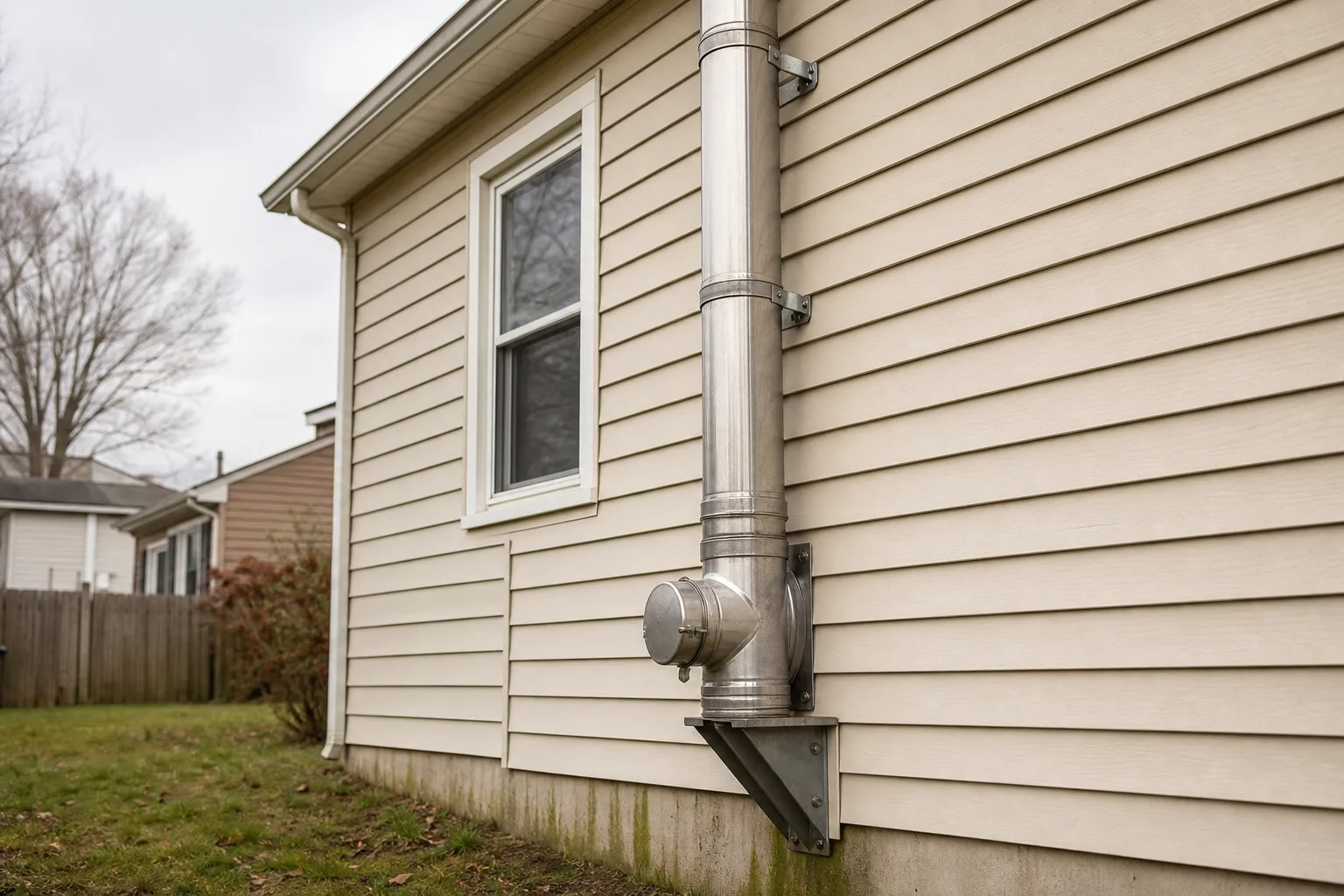
The pipe turns and goes through the wall in a thimble, meets a tee outside with a cleanout cap at the bottom, and climbs the siding on wall straps.
Easier to build. Nothing to cut in the roof, and the cleanout tee is genuinely useful. But that flue is outside in the weather for its whole height, and in a cold climate it runs colder, drafts lazier on startup, and makes more creosote for the same fuel.
My honest opinion, since nobody selling kits will say it plainly: if the interior route is possible, take it. The exterior run is the easier install and the worse chimney.
The 3-2-10 Rule
Wherever it exits, the top has to land in the right place. The chimney must extend at least three feet above the point where it passes through the roof, and at least two feet above anything within ten feet of it. That includes a ridge, a dormer, a second story, a large tree limb.
Measure this on paper before you buy pipe. A steep roof or a nearby ridgeline can add several feet of chimney and a brace you had not planned for.
From the field: it is almost never the pipe sections that make this job long. It is the penetrations. Cutting and heading off a ceiling opening, working around attic wiring, and getting flashing right on a steep roof are what turn a Saturday into a project.
Not sure your ceiling and roof can take the run you have in mind?
Tell us the appliance and where you want the pipe to go, and we will match you with an independent chimney company near you that installs listed Class A systems. Ask them to put the scope and the estimate in writing before any work starts, and insist on exactly that.
Call (513) 655-6702
Doing It Yourself, and What an Inspector Looks For
Plenty of homeowners install Class A pipe competently. Whether you are permitted to is a separate question from whether you are able to, and it depends on your local authority having jurisdiction and, quietly but importantly, on your insurance carrier. Ask both before you start, not after.
Before you buy a single part, work through this:
- Appliance make, model, and flue outlet diameter, taken off the appliance, not remembered.
- The route drawn on paper, interior or exterior, with every surface it crosses marked.
- The joist bay measured against the clearance on your pipe's label.
- Attic obstructions found and located: wiring, ducts, bracing, stored items.
- Roof pitch and the 3-2-10 height calculated, including any nearby ridge or dormer.
- A single manufacturer's parts list, complete, with no substitutions.
- The manufacturer's installation instructions read end to end. All of them.
- Your building department and your insurer asked what they require.
An inspector is looking at clearances, at the support and firestop at every crossing, at the flashing and the termination height, and at whether the assembly is one listed system. NFPA 211 sets three inspection levels: Level 1 covers readily accessible parts, Level 2 adds concealed areas and a video scan of the flue, and Level 3 opens up structure when a hidden hazard is suspected.
A Level 2 is required at sale or transfer of the property, on a system change such as a new appliance or a fuel change, after a malfunction, after a chimney fire, and after an external event like a storm or an earthquake. If you install a stove and chimney, that is a system change.
Safety note: a mixed-brand assembly is outside its listing. That is not a technicality nobody notices. It is exactly the kind of finding an inspector writes up and an insurance adjuster reads later.
Living With Class A Chimney Pipe After It Is Up
Insulated pipe is not maintenance-free, and the smooth stainless interior can make people complacent. Class A chimney pipe still needs regular inspection, and cleaning whenever deposits or conditions warrant it, because the fuel and the fire decide how much deposit forms, not the pipe.
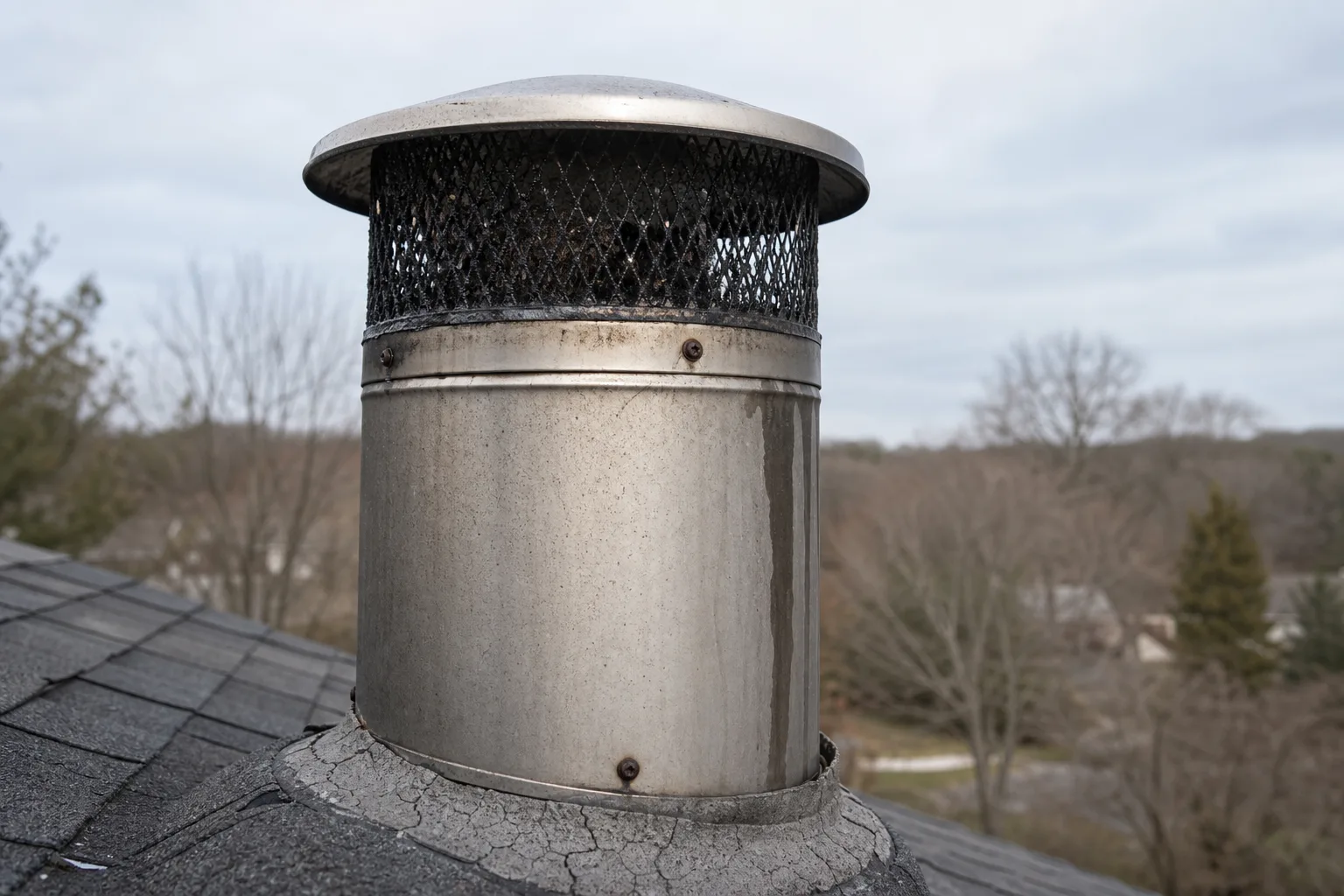
The cap is worth checking closely. Screens load with soot and creosote, mesh can corrode, and a lid can work loose in wind.
The storm collar sealant is another spot to watch. That bead can crack and grey under sun and freeze cycles, and if it opens, water runs down the outside of the pipe and into the flashing rather than over it.
Outside, the stainless dulls and streaks and the galvanized parts spot at the fasteners. Cosmetic on its own, worth a closer look at the whole system for what it says about exposure.
How long the whole system lasts depends on the alloy, how much weather it sees, and whether anyone has been sweeping it. There is no honest single number to give you.
Pro tip: look at the cap first, every time. A screen glazed shiny black is telling you about your fuel and your burn habits, not about your pipe.
How VIO Helps With a Class A Chimney Pipe Install
VIO is a referral service. We do not do the work ourselves, and we are straight with people about that.
Tell us the stove you have or are buying, the flue diameter, and whether the pipe is going through the ceiling or out the wall. We match you with an independent local chimney company that installs listed Class A chimney pipe systems as regular work. The company you hire is its own business, not a VIO employee.
For this particular job, that matters more than it does for a sweep. A Class A install is a listing question, a framing question, and a roofing question at the same time, and the independent company we connect you with should be looking at all three before quoting anything.
We ask every company in the network to put its estimate in writing before any work starts, and you should insist on exactly that. If a route change or a clearance problem turns up mid-job, you want the original scope on paper to compare it against.
Ready to get your Class A chimney pipe run planned and installed?
Tell us the stove, the diameter, and whether the pipe is going through the ceiling or out the wall, and we will connect you with a local company that does this work. VIO is a referral service, the company you hire is independent, and we ask every company in the network to put its estimate in writing before any work starts.
Call (513) 655-6702
Symptom checker
What is your chimney doing?
Tap the closest match for an honest first answer.