



On this pageWhat a "wood stove installation near me" search actually gets you7 sections+6
- What a "wood stove installation near me" search actually gets you
- The site visit comes before the stove, not after
- Venting: where most of the cost and nearly all of the mistakes live
- Clearances, hearth pads, and the wall you thought was fine
- Permits, inspection, and the paperwork that protects you
- What actually drives the cost of the job
- How to vet the installer before you book
Quick answer
A wood stove installation is mostly a venting project. An installer visits the room, checks the wall, ceiling and any existing chimney, then routes the vent one of three ways: into a lined masonry chimney, up through the roof with insulated Class A pipe, or out a wall and up the outside. Clearances, a listed hearth pad, a permit and a code inspection complete the job.
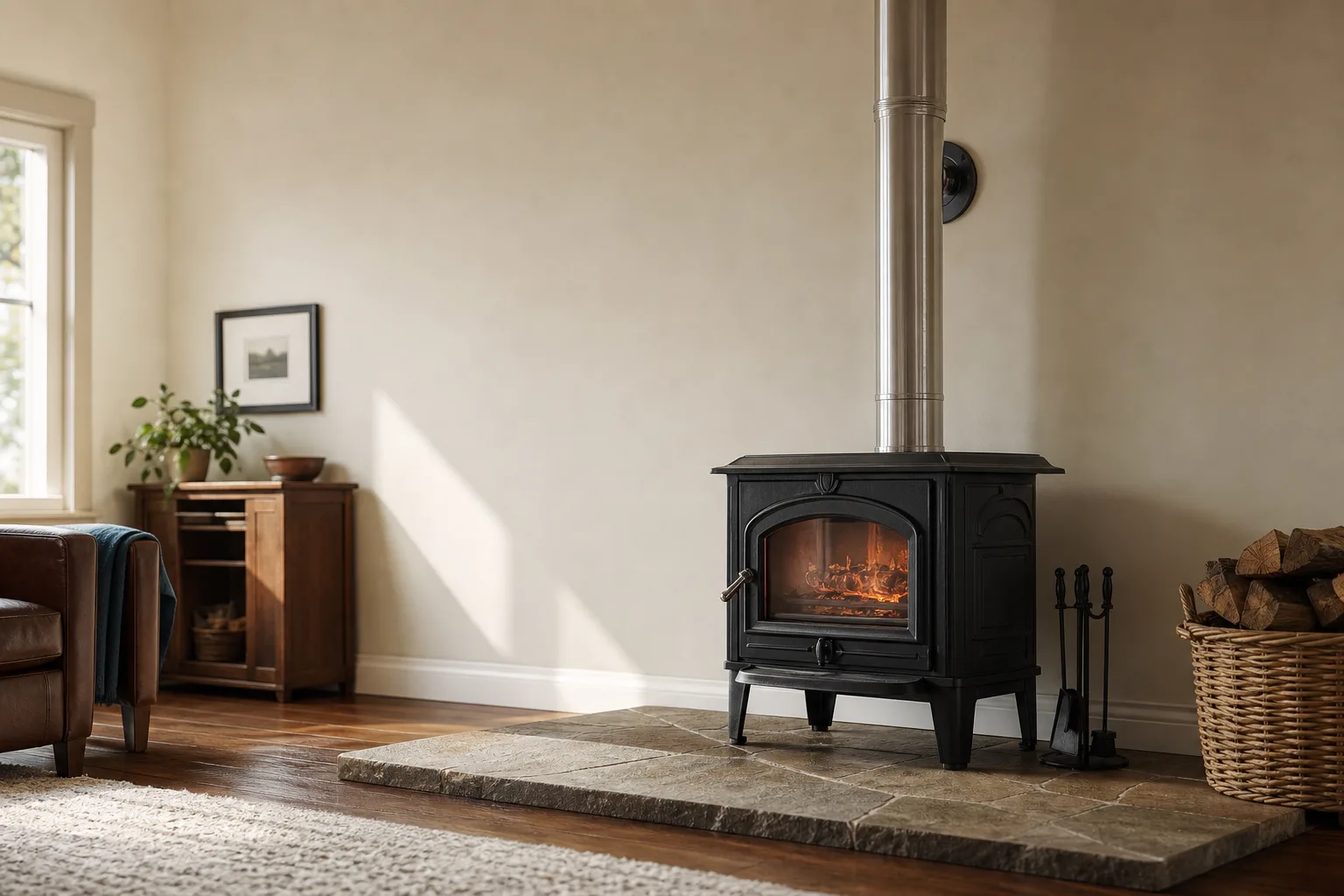
If you are typing wood stove installation near me into your phone, you have almost certainly already picked the stove. Maybe it's sitting in a box in the garage. What you're shopping for now isn't the appliance. It's everything that has to exist around it before that stove is legal to light: a vent that can carry 1,000-degree flue gas out of your house, a floor and walls that can live next to a firebox for twenty winters, and a permit file that says somebody qualified signed off. That's the real job. The stove is the easy part.
Here's the part nobody selling you the stove tends to mention: two homes on the same street can buy the identical model and end up with wildly different installations. One drops into an existing masonry chimney with a new liner. The other needs a full insulated stainless system built from the stove top through the ceiling, the attic, and out the roof. Same stove, same box, completely different day of work. Which one you have is decided by your house, not your catalog.
What a "wood stove installation near me" search actually gets you
Search that phrase and you'll get three different kinds of companies mixed into one list, and they don't do the same thing.
There's the hearth retailer, who sells stoves and either installs them or subcontracts it. There's the chimney company, who lives in venting and masonry and installs stoves as an extension of that. And there's the general handyman or HVAC outfit that will absolutely take the job and may or may not have ever set a Class A chimney. All three will show up on a map pack. Only some of them will be the one you want holding the drill when it goes through your roof deck.
My bias, and I'll own it: for a wood stove, I'd take venting expertise over showroom square footage every time. The appliance is engineered and tested by the manufacturer; you're not going to improve on it. The chimney is built on site, by hand, in your house, by whoever you hired, and that's where installations go wrong. If a company can't talk fluently about draft, liner sizing, and clearance-to-combustible math in the first phone call, keep dialing.
Good to know: "Installation" quotes are not comparable until you know what venting each one includes. A quote that assumes your existing chimney is usable and a quote that includes a full new stainless system are two different projects wearing the same word. Ask each company to write down what venting they're pricing.
The site visit comes before the stove, not after
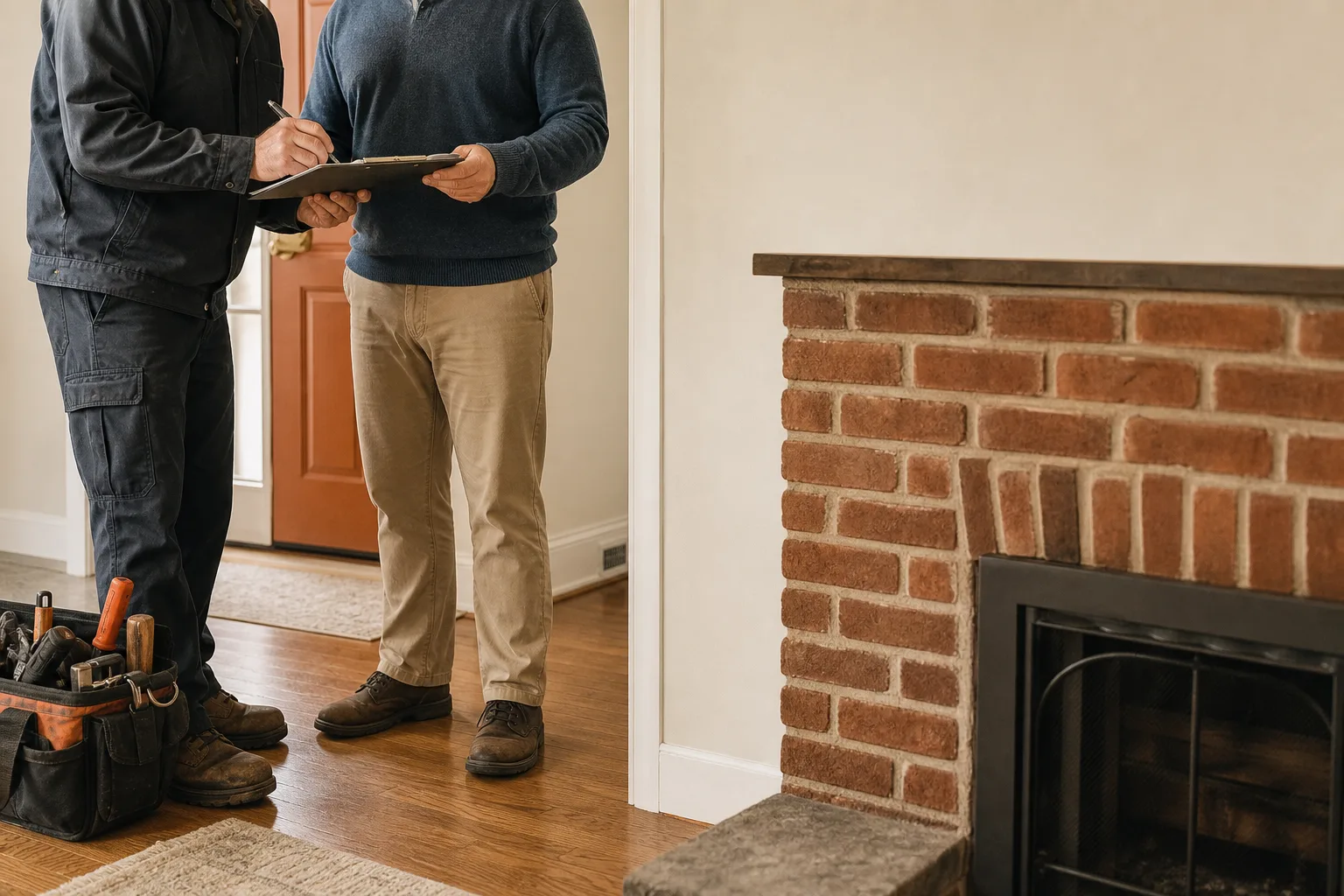
A proper install starts with somebody standing in the room where the stove will go, looking up. Not a phone estimate. Not a photo you texted. Standing there.
What they're working out is a chain of questions, and every answer changes the one after it. Where do you actually want the stove? What is the wall behind it made of, and what's on the other side of that wall? Is there an existing chimney anywhere near that spot, and if so, is it masonry or a factory-built metal system? If it's masonry, is the flue the right size for this stove, and is the liner intact? If there's no chimney, what's the path from the stove top to open sky, and what's in the way of it? Floor joists, ceiling joists, an attic full of blown insulation, a roof valley, a second story.
That last one is where the money hides. A stove on an exterior-ish wall in a single-story room with a clean shot to the roof is a straightforward day. A stove on an interior wall in a two-story house, where the vent has to pass through a bedroom's floor cavity and out a high roof pitch, is a much larger project: more pipe, more framing, more roof work, more risk.
If there is an existing chimney in play, this is also the moment a real chimney inspection near me earns its keep. Nobody should be connecting a new appliance to an old flue they haven't looked inside. The flue may be sized for the open fireplace that used to be there, which is usually far too large for a modern airtight stove. Oversized flues run cool, and cool flues build creosote fast.
Safety note: NFPA 211 calls for a Level 2 inspection under specified conditions: among them a qualifying change to the appliance or venting system, sale or transfer of the property, a malfunction or chimney fire, and an external event such as a storm or earthquake that was likely to have caused damage. Connecting a different appliance to an existing flue generally falls under that appliance-change condition, so ask your installer to confirm it applies to your setup rather than treating the inspection as optional.
Venting: where most of the cost and nearly all of the mistakes live
Three broad paths exist, and your house picks one for you.
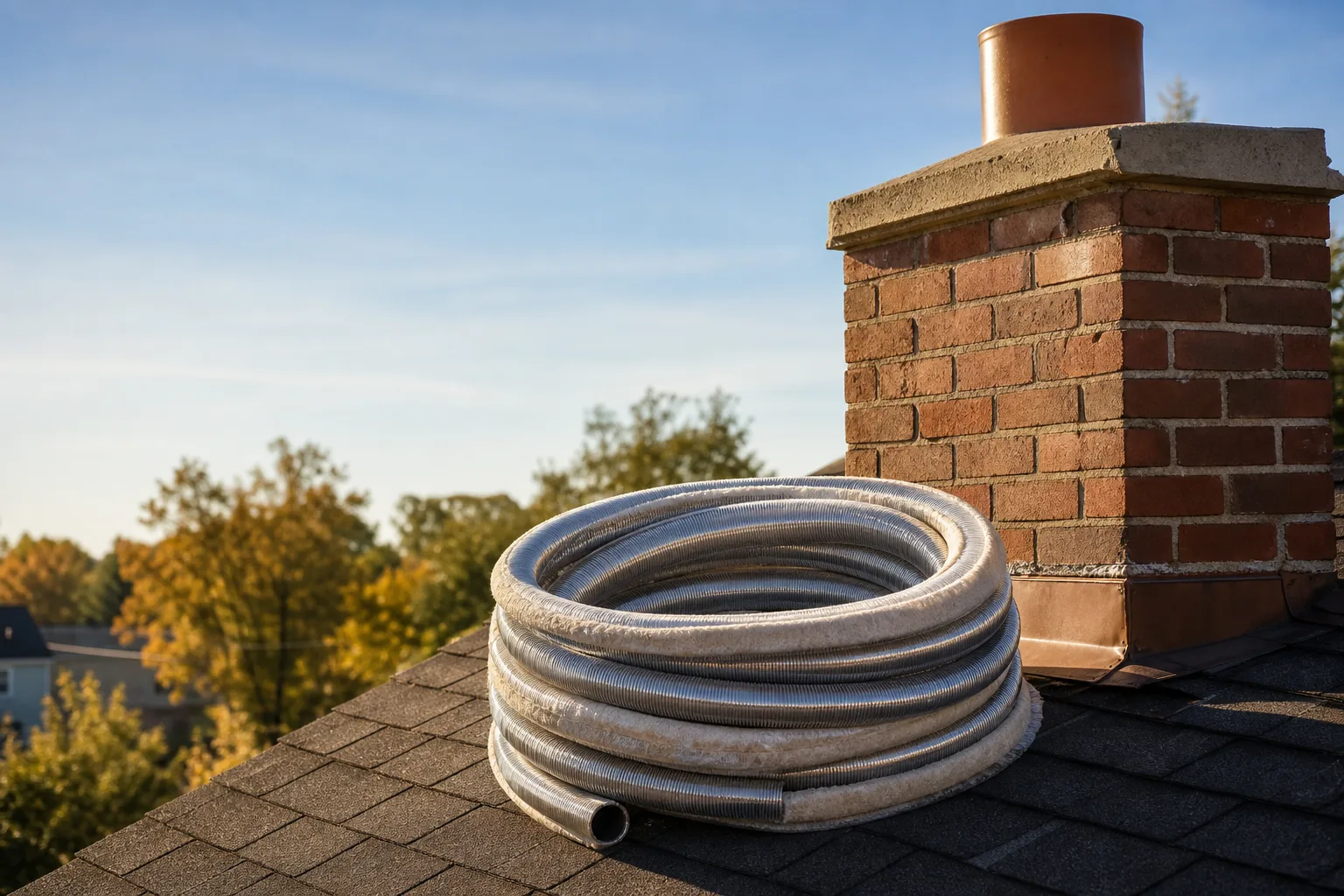
Into an existing masonry chimney. The stove connects with single-wall or double-wall connector pipe into the chimney flue. Very often that means a stainless liner running the full height of the chimney, sized to the stove's flue collar and insulated, but whether a liner is required, and how it has to be built, depends on the condition and size of the existing chimney, the clearances it was built with, the stove's listing, the liner's own listing, and the code your jurisdiction enforces. That's a determination for whoever inspects the chimney, not something to assume from a web page in either direction. When the chimney is interior, properly sized and well insulated, this route can draft beautifully; an uninsulated flue on an exterior wall is a different animal, and height and sizing matter as much as the masonry does.
A new factory-built Class A system straight up. Insulated double-wall chimney sections stacked from a ceiling support box, through the floors and attic above, through a flashed roof penetration, to a cap above the roofline. This is the most common answer in homes with no usable chimney and, honestly, the one that most rewards a careful installer, because every joint, firestop, and flashing detail is a chance to get water or heat where it shouldn't be.
Out through the wall and up the outside. Vent horizontally through an exterior wall with a tee, then run the Class A up the outside of the house to above the roofline. Less interior disruption, and sometimes the only option. The trade-off is real: an exterior chimney sits in cold air all winter, drafts more reluctantly on a cold start, and accumulates deposits more readily than a warm interior chase.
| Venting path | What the work involves | Best when | Watch for |
|---|---|---|---|
| Existing masonry chimney + liner | Usually a full-height insulated stainless liner, new connector pipe, top plate and cap | You have a sound chimney near where the stove goes | Oversized flue, deteriorated crown or mortar, unlined older stack |
| New Class A, interior, through the roof | Ceiling support box, firestops at each level, pipe through attic, roof flashing and storm collar | No existing chimney, or the chimney is nowhere near the stove | Framing obstacles, attic clearance to insulation, roof pitch and valleys |
| Through the wall, exterior run | Wall thimble and tee, exterior brackets up the wall, cap above roofline | Interior routing is blocked or too invasive | Cold-start draft, faster deposit buildup, more visible hardware |
Whichever path you land on, the connector pipe between stove and chimney is its own decision: diameter, single- vs. double-wall, and total length all affect draft. Our wood stove pipe guide walks through why that piece matters more than its price suggests, and the chimney liner guide covers sizing and insulation for the masonry route.
Myth vs. fact: Myth: "The old chimney worked fine for the fireplace, so it'll work fine for the stove." Fact: an open fireplace and an airtight stove are different machines. The fireplace dumped huge volumes of hot air up a large flue. A modern stove sends a much smaller, slower, cooler flue gas volume, and that same large flue will now under-draft and cool the gases on the way up. Sizing the liner to the appliance is not upselling; it's how the stove is designed to work.
Ready to find out which of the three you have?
Tell us where you want the stove and what's on that wall today, and we'll tell you what the installation actually requires there, before you commit to an appliance. Call (513) 655-6702 or request service and we'll set up a look at the room.
Clearances, hearth pads, and the wall you thought was fine
Every stove ships with a listing, a manufacturer's tested set of minimum distances from the stove body and the connector pipe to anything combustible. Walls, trim, mantels, furniture, that built-in bookcase. Those numbers are not suggestions and they are not negotiable by feel. They came out of a lab, and the inspector will have the same manual you do.
Two things surprise homeowners here more than anything else.
The first is what counts as combustible. Drywall is combustible: not the gypsum, but the paper facing and the studs behind it. Plaster over wood lath is combustible. Brick veneer glued directly to a stud wall is not the same as a masonry wall, because the wood behind it is still cooking. If someone waves at a brick-faced wall and says "you're fine, it's brick," ask what's behind the brick.
The second is that clearances can be reduced, but only in specific, listed ways. An approved wall shield with a continuous one-inch ventilated air gap behind it, spaced off the wall with noncombustible standoffs and open at top and bottom, is a tested assembly. Sheet metal screwed flat to the drywall is not; it just moves the heat. Double-wall connector pipe carries a smaller clearance than single-wall for the same reason: the air gap does the work.
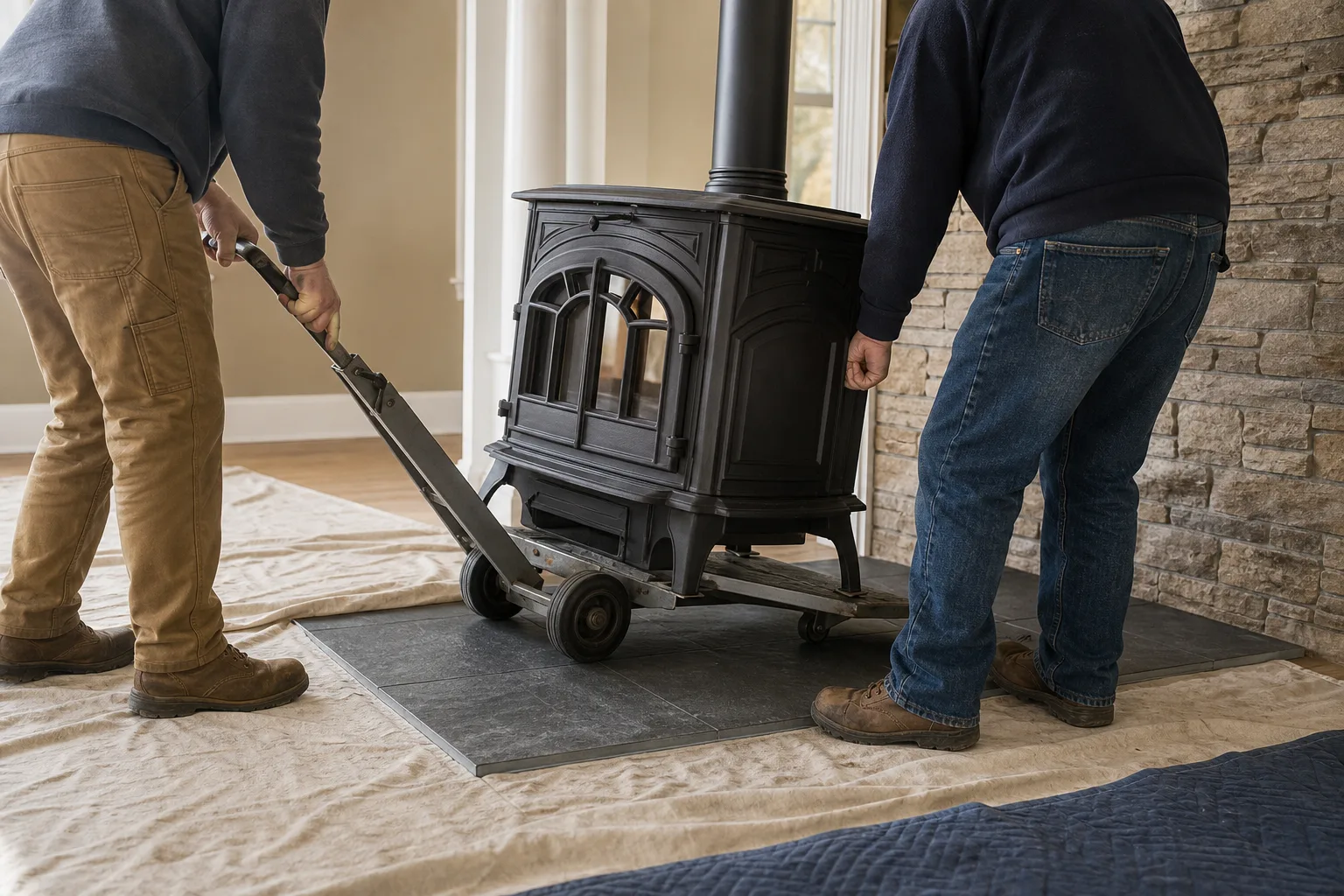
Then there's the floor. Wood stoves need floor protection extending a listed distance in front of the loading door and to the sides, and in many cases the pad must meet a specific R-value, not merely be noncombustible. A slab of slate laid on hardwood is noncombustible and may still fail the R-value requirement outright. Tile over cement board sounds right and often isn't enough on its own. Check what the manual asks for before you buy something beautiful.
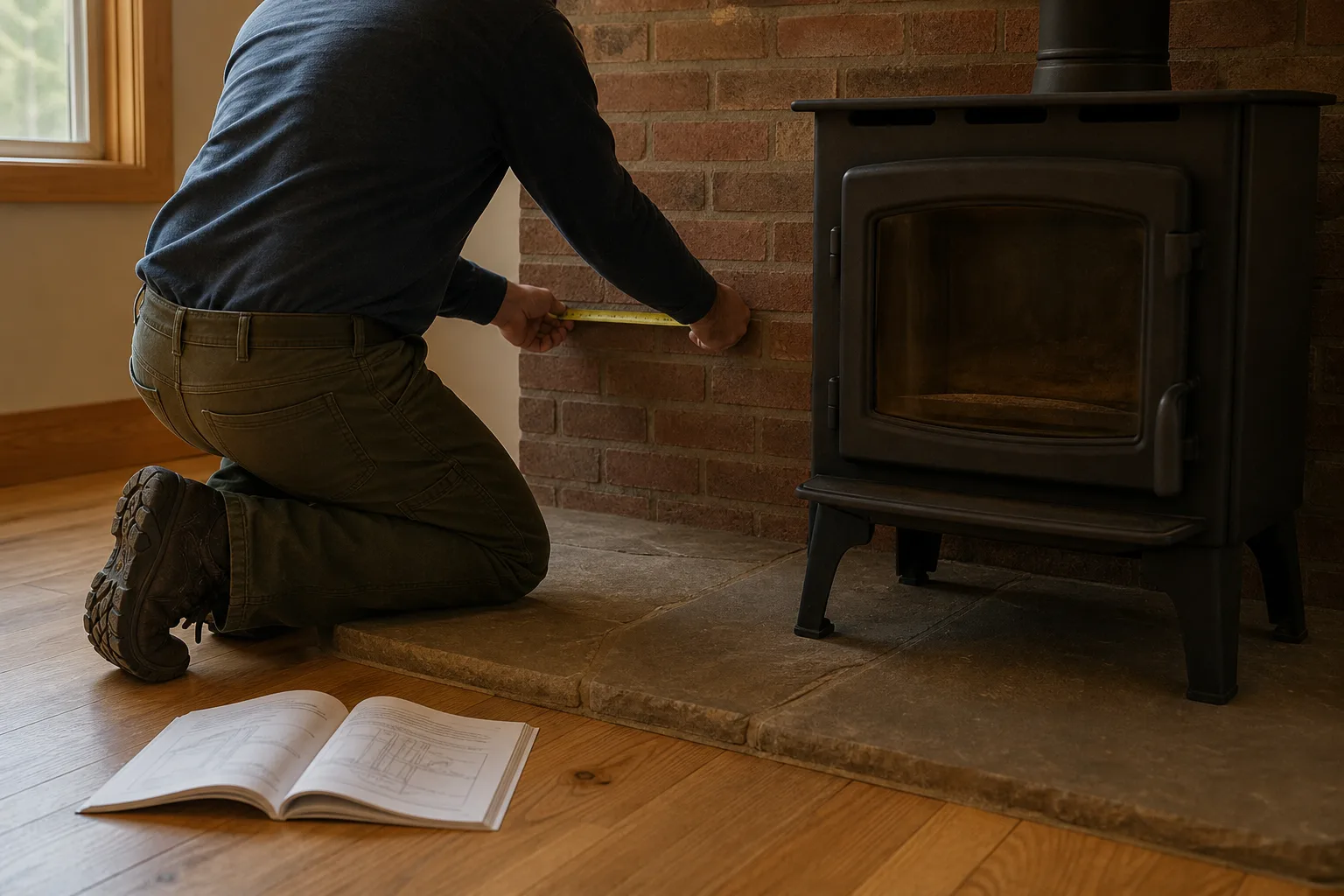
Pro tip: Measure your intended spot before you buy the stove, not after. Take the clearance table from the manual you can download in about a minute, add the hearth pad dimensions, and tape the whole footprint onto the floor with painter's tape. Plenty of stoves that look perfect in a showroom turn out to eat the walking path between the kitchen and the couch. Better to learn that from tape than from a delivery truck.
If the clearance math doesn't work in the room you had in mind, you have real alternatives before you give up. A smaller unit changes the numbers. So does a listed shield. And if there's an existing fireplace nearby, a wood fireplace insert sits inside the existing firebox and often solves a clearance problem that a freestanding stove creates. Different appliance, similar heat, very different install.
Permits, inspection, and the paperwork that protects you
A wood stove installation is a permitted job in most jurisdictions, and the permit is not bureaucratic friction you're clever for avoiding. It is the mechanism by which somebody who doesn't work for the installer looks at the work.
The exact process varies by city and county, so ask your installer what applies to your address; a company working your area every week will know without looking it up. Typically it means a permit pulled before work starts, an inspection after, and a record that the appliance was installed to its listing and to code. Some jurisdictions want the manufacturer's manual on site during the inspection. Nearly all want to see the roof penetration and flashing.
Two more reasons to insist on it, both of which land on you rather than the installer.
Insurance is the first. Carriers vary in what they require, and some ask to be notified about a solid-fuel appliance at all. What is consistent is that a documented, permitted, code-compliant install is a far easier conversation after a claim than an undocumented one. Ask your carrier what they want before the install, not after.
Resale is the second, and it's the one people forget. When you sell, NFPA 211 calls for a Level 2 inspection at transfer of the property. That's a step up from a basic visual check. It covers the accessible portions of the chimney and the connected appliance and typically includes an internal examination of the flue, usually by camera. It doesn't mean anyone opens your walls. It does mean an install that skipped the permit gets discovered at the least convenient possible moment, with a buyer's agent in the room.
From the field: The installs that give me trouble later are rarely the ones where something dramatic failed. They're the ones where a small detail was treated as optional: a firestop skipped at a floor penetration, a storm collar left unsealed, a hearth pad that met the letter of "noncombustible" but not the stove's R-value. None of it looks like anything on day one. It shows up as a stain on a ceiling, or an inspector's flag at resale, or a smell that nobody can locate.
What actually drives the cost of the job
I won't quote you a number, because anyone quoting a number for your house without seeing your house is guessing. What I can do is tell you exactly which levers move it, so you can read a quote and know what you're reading.
Venting is the biggest one, by a wide margin. Vertical distance from the stove to above the roofline sets how much Class A pipe you buy, and insulated chimney sections are the single most expensive component in most installs. A vaulted ceiling or a second story means more pipe. Every offset around a joist or rafter adds fittings.
The roof itself matters. A low-slope asphalt roof takes a standard flashing. A steep pitch, a metal roof, slate, or a penetration near a valley all take more time, more care, and more specialized flashing.
The condition of what's already there. Relining a sound masonry chimney is one price. A chimney that needs the crown rebuilt, the mortar joints addressed, or a new chimney cap first is another, and that masonry work is legitimately separate from the stove install, even though it arrived in the same conversation.
Clearance remediation. Wall shields, hearth pads, moving a mantel, relocating a thermostat or an outlet.
Access and labor. Whether the pipe path runs through finished, occupied space or through an unfinished attic and basement changes the labor substantially, and whether drywall has to be opened and patched changes it again.
A quote that itemizes these lets you make real decisions. A single-line quote lets you make none. Ask for the breakdown; a company that installs stoves properly has no reason to hide it.
How to vet the installer before you book
The phone call is your best filter, and it takes about ten minutes. What you're listening for isn't salesmanship. It's whether the person on the other end asks you questions. Somebody who quotes a wood stove installation without asking what's above the ceiling is quoting a fantasy.
Run this list before you commit:
- Are they certified for solid-fuel appliance installation, and can they say which credential?
- Do they carry liability insurance and workers' comp, and will they send the certificate without drama?
- Will they do an on-site visit before quoting, rather than pricing from photos?
- If an existing chimney is involved, do they include a Level 2 inspection of it?
- Does the quote itemize the venting components, not just "chimney"?
- Who pulls the permit — them or you? (You want the answer to be them.)
- Do they install to the manufacturer's listing, and will they leave the manual with you?
- Who handles the roof flashing, and is that work warranted?
- What's the workmanship warranty, in writing, and for how long?
- Do they service what they install, or do you become someone else's problem in year two?
That last one deserves more weight than it usually gets. Your stove needs annual attention forever. A working relationship with a chimney sweep near me matters more over the life of the appliance than saving a little on installation day. Companies that only sell installs and never come back have no stake in how the system ages.
One more thought on timing. Late summer and early fall are when everyone in the region decides at once that they want heat, and the calendar is what it is: the earlier in the season you start the conversation, the more room there is to do the job unhurried, with the right parts, and to sort out any masonry the chimney turns out to need. Booking a heating appliance in the first cold snap is a decision that tends to cost you options.
Ready to stop guessing what your house needs?
We'll come look at the room, the wall, the ceiling above it, and whatever chimney you already have, and give you a straight answer about what installing a wood stove there actually takes. No pressure to buy anything on the spot. Call (513) 655-6702 or request service to get on the schedule.
If a wood stove turns out not to fit the space or the budget, the conversation isn't over; pellet stove installation has different venting requirements and sometimes fits where a wood stove won't. Either way, the sequence is the same: look at the house first, pick the appliance second, and let the venting decide the rest.
Symptom checker
What is your chimney doing?
Tap the closest match for an honest first answer.