



On this pageWhat Custom Chimney Caps Actually Are (and When a Stock Cap Is Fine)8 sections+7
- What Custom Chimney Caps Actually Are (and When a Stock Cap Is Fine)
- The Parts, and the Words on the Order Form
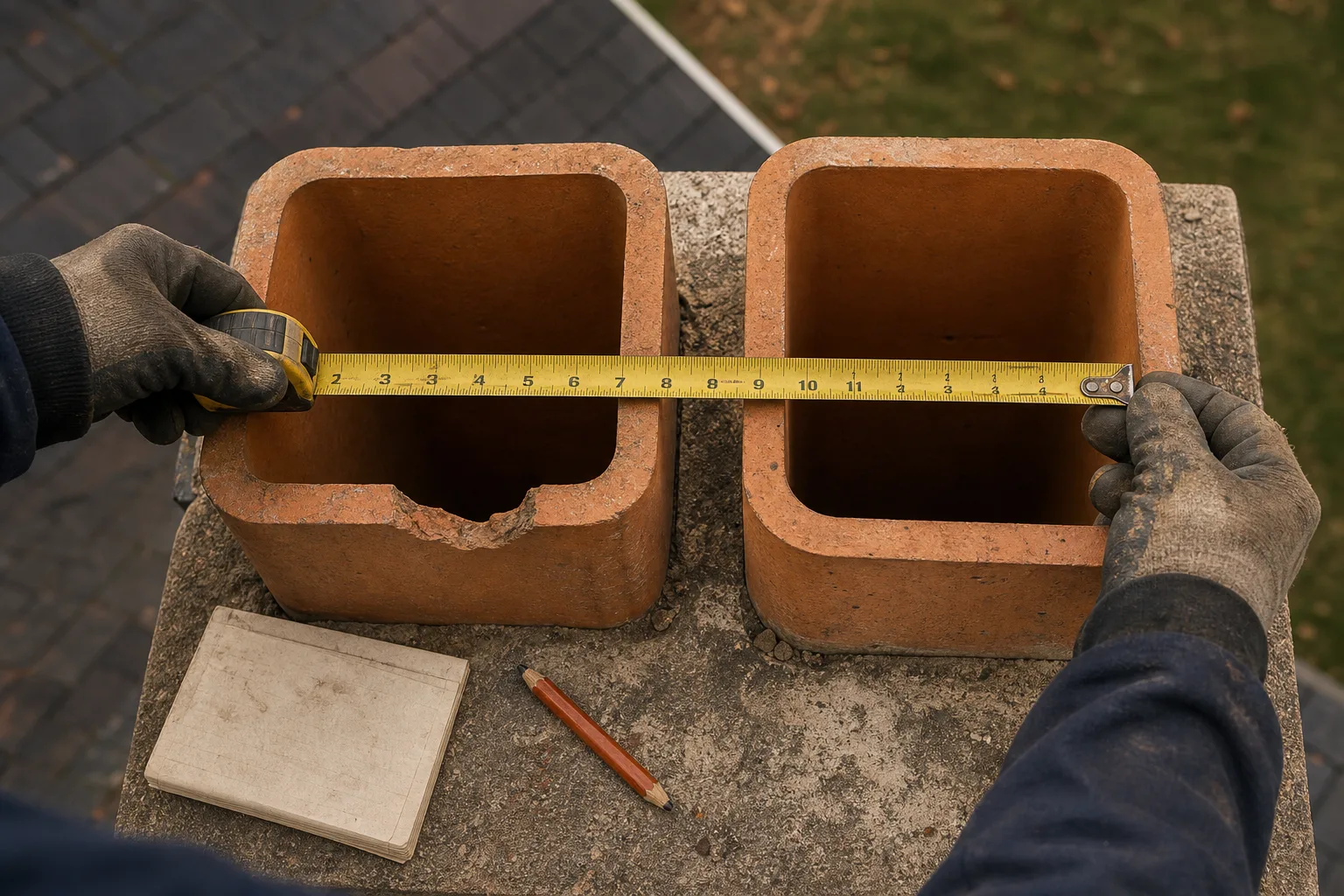
- Measuring a Chimney for Custom Chimney Caps
- Materials: Stainless, Copper, and the Coated Coppers
- The Code a Custom Cap Still Has to Satisfy
- Ordering Custom Chimney Caps Without Regret
- How VIO Helps With Custom Chimney Caps
- Where to Start
Quick answer
Custom chimney caps are made-to-order metal covers fabricated to the measurements of one specific chimney, commonly in stainless steel or copper. They are the answer when a chimney has more than one flue on a single crown, a flue wider than stocked sizes, or a crown shape that nothing standard will sit flat on. Ordering one starts with measuring the crown and the flue tiles, not with choosing a metal.
Custom chimney caps exist for a specific defeat: two clay flue tiles standing side by side on one concrete crown, and nothing on the store shelf sized to straddle both of them.
Sometimes two separate flue-mounted caps handle that chimney, where the tile dimensions, the projection and the spacing allow it. Where they do not, the aisle is closed.
Search the phrase and the companies who build them are easy to find. Sheet metal shops, copper fabricators, chimney supply houses. Their pages are photographs, a menu of metals, a maximum size, and a form.
Those forms ask for dimensions.
What they do not settle for you is which dimensions, taken from where, or what the finished object still has to satisfy once it is bolted down. That is a strange thing to leave to the buyer on an object built to order, and it is what this article is for.
Get the numbers first. Choose the metal second. This purchase goes wrong when that order gets reversed.
What Custom Chimney Caps Actually Are (and When a Stock Cap Is Fine)
Custom chimney caps are made-to-order metal covers, fabricated to the measurements of one particular chimney rather than to a catalog size.
The shops that build them describe the arrangement the same way: each shroud, cap or top is made to order from the buyer's measurements and design changes, and a cap can be built from any of the offered metals to the buyer's specification.
You are not selecting a product. You are commissioning one, which means every specification on the form is one you chose.
The three situations that send people to custom
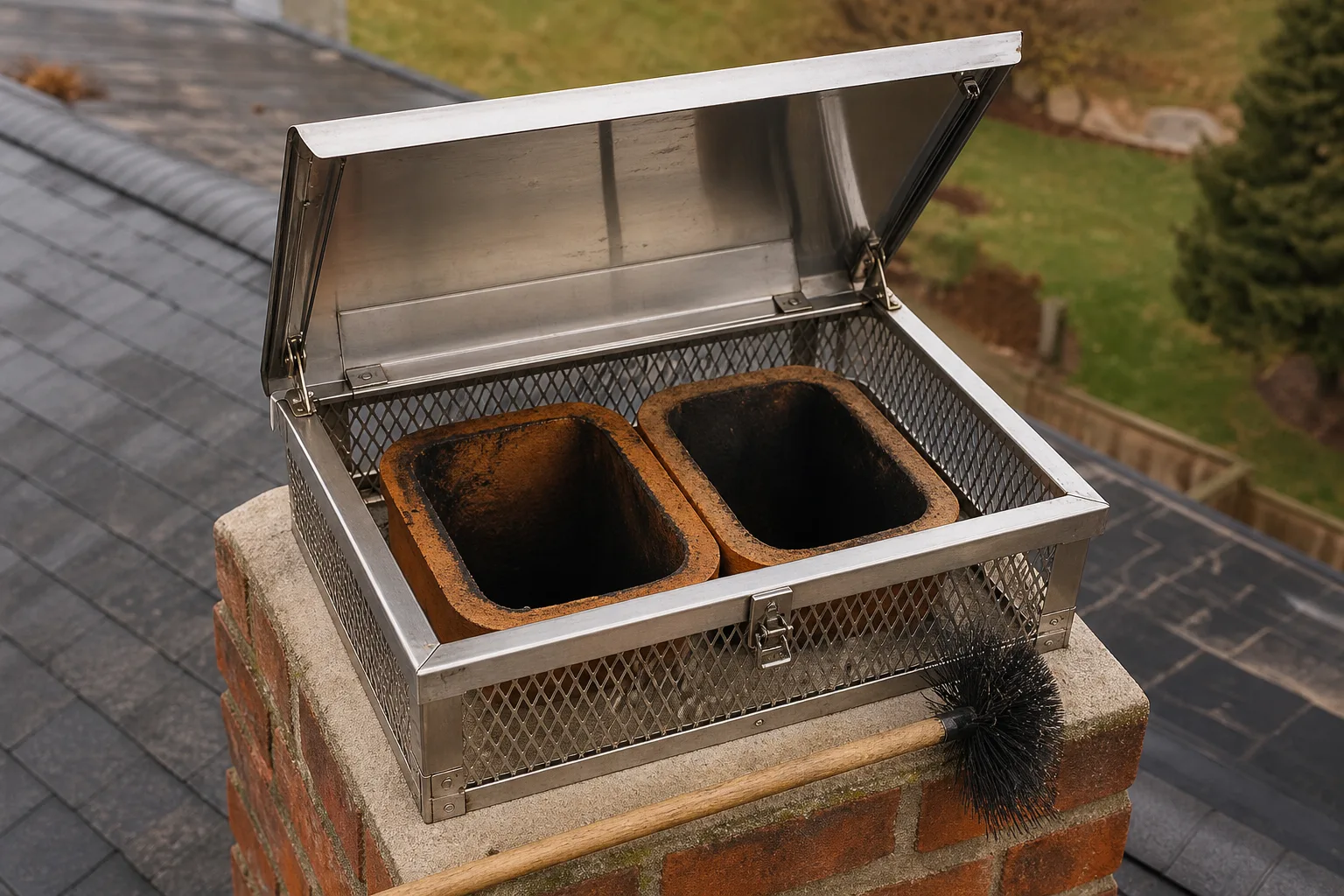
More than one flue on a single crown. A house with a fireplace and a furnace, or two fireplaces, can terminate in two clay tiles projecting from the same slab. A multi-flue cap covers the entire crown as one box, which is a different object from two small caps sitting on two tiles.
A flue larger than the stocked sizes. Store racks stop at a point. Custom fabrication does not stop nearly as early: one manufacturer's custom stainless line states a maximum width of 48 inches and a maximum length of 96 inches, though that is one maker's stated ceiling and not a figure for the category.
Shape, or the house itself. A crown with a slope, a bevel, or an unusual footprint gives a rectangular base nothing flat to land on. Separately, there are houses where a galvanized box on the roofline looks wrong, and copper is a legitimate reason to order custom chimney caps even when a stock size would technically fit.
When the stock size is genuinely enough
Here is the sentence a shop has no reason to write.
If you have one flue, in a standard round or square size, standing on an ordinary flat crown, a stock cap is a real answer. Take the measurements anyway. If they land inside the stocked range, buy the stocked part.
Custom fabrication solves a fit problem. Where there is no fit problem, it is solving nothing.
Good to know: three objects get called the same thing and they are not interchangeable. The crown is the sloped slab of concrete or mortar capping the masonry, with the flue tiles projecting up through it. The cap is the metal lid and screen sitting above the flue opening. A chase cover is the flat metal sheet over the top of a factory-built chase, which is what you have on a house with no brick, and chimney chase covers sorts out that distinction.
The Parts, and the Words on the Order Form
The order forms for custom chimney caps run on four nouns. Knowing them is the difference between describing your chimney and guessing at a dropdown, and our rundown of chimney parts places them in the wider system.
Lid, screen, base, skirt
The lid is the top plate. It can be flat, hipped like a small roof, or hinged so it lifts.
The screen is the band of mesh below it, standing between the flue opening and the weather. Its height is a number on the order form.
The base is what the screen and lid stand on, and it is the part that contacts your chimney.
The skirt is the band that drops down the outside of the crown or the tile and gets fastened. Order forms commonly name two attachment styles here, skirt type and band-around.
Construction differs between builds and between shops. The fabricator's own drawings describe the object you are buying, and that is the document that governs.
Mount styles, which decide everything downstream
This is the field people skip, and it changes the measuring completely.
Top mount sits on the crown itself and covers the whole slab. This is the multi-flue arrangement, and the base is sized to the crown.
Outside mount drops over the outside of a projecting flue tile. The base is sized to the tile, not the crown.
Inside-flue mount goes down inside the flue opening and grips there. The measurement is the inside of the tile, and that is a different number from its outside.
Three mounts, three different sets of numbers off the same chimney. Get this wrong and every measurement you take afterward is correct and useless.
Pro tip: name the mount before you name the metal. A shop can build you anything in copper. It cannot fix a base dimension that was taken from the wrong surface, and neither can you once the piece is cut.
Measuring a Chimney for Custom Chimney Caps
The quote you request will be built from numbers you supply, and the shop is not coming out to check them. On custom chimney caps the buyer is the source of the measurements, and a piece cut to a wrong number is a piece cut to a wrong number.
A single flue
For an outside mount, you want the outside length and width of the flue tile, taken at the tile itself and not at the crown. A round flue gets an outside diameter.
For an inside-flue mount, you want the inside dimensions of that same opening. Those are not the outside numbers minus a guess at the wall thickness. Measure the inside.
Then measure how far the tile projects above the crown, because that number decides whether a skirt has anything to grip.
Two or more flues on one crown
For a multi-flue chimney, the instruction the shops give is to measure the outside dimension of all the flue tiles, so the cap is sized to cover every one of them.
For a top mount, you also want the outside length and width of the crown itself, taken at its widest, plus the projection of the tallest tile.
Base sizing then follows the shop's own arithmetic. One supplier instructs adding 3 inches to the width and 3 inches to the length of the screen dimension to reach the total base size. Another will have its own rule, which is exactly why the fabricator's measuring form is the controlling document rather than any number here.
The measurements people leave out
Screen height. Shops commonly list screen heights of 8, 10, 12, 14 and 16 inches, and commonly specify a minimum clearance of 5 or 6 inches from the top of the flue tile or liner to the underside of the lid. Those are supplier specifications rather than code, and suppliers attach drafting language to them. What draft your system needs is a question for the fabricator and for a chimney professional who has seen the flue.
Lid overhang. A 2 inch overhang past the mesh on all sides is a commonly offered option, and 4 inches is another. Decide it deliberately.
Tiles at different heights. Two flues on one crown do not have to project the same distance. Measure each.
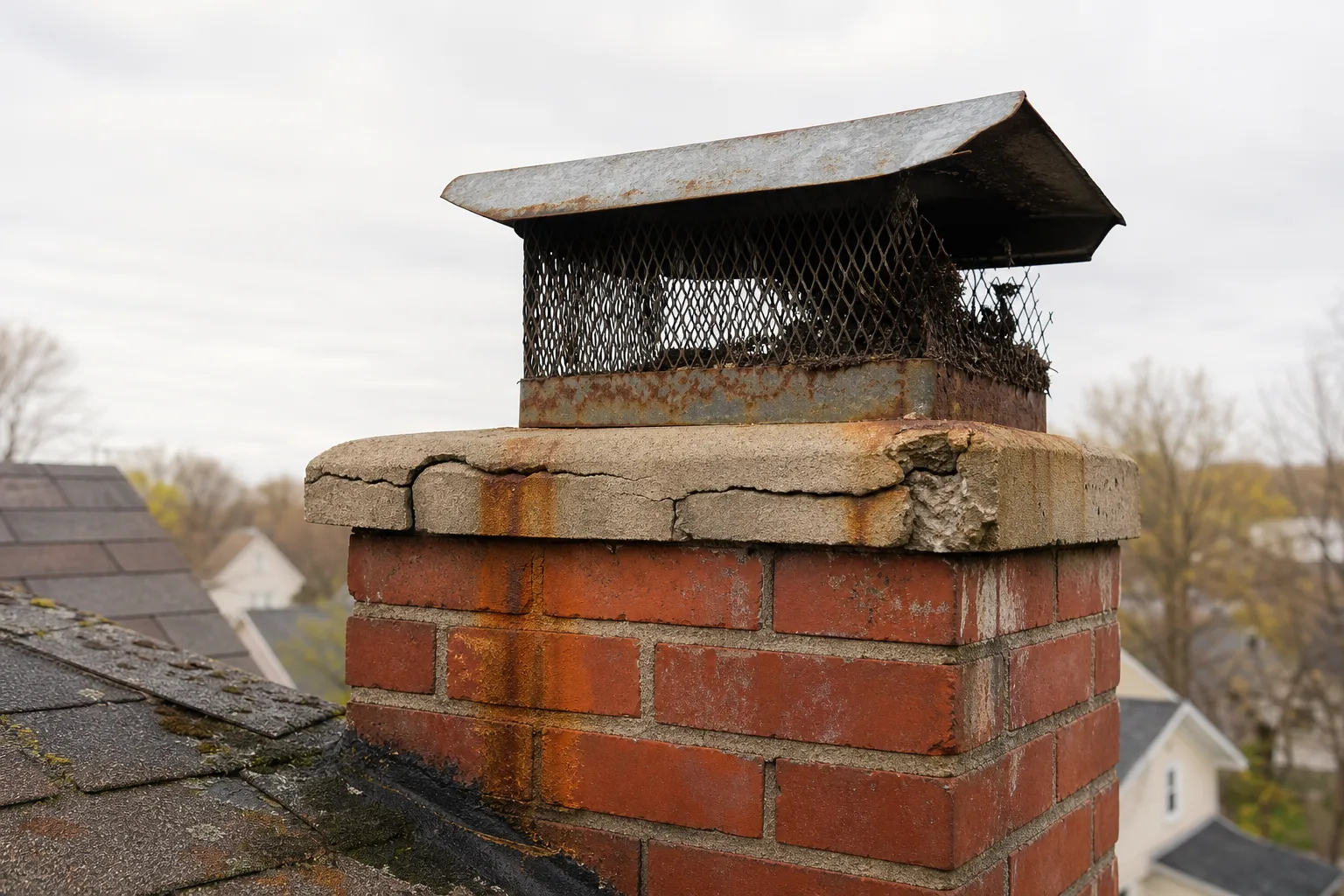
The crown underneath. Not a dimension, but the cap fastens to it, and a cracked or spalling crown is a variable in a purchase you cannot return.
Safety note: the tape measure is not the hazard here. The roof is. Ladder setup, pitch, wet moss, granule loss underfoot, and a chimney you will be leaning against rather than holding are all part of this task, and none of them are improved by doing it alone. If any of that gives you pause, it should.
Here is the list to walk up with:
- Mount style you intend to order: top, outside, or inside-flue.
- Number of flues on the crown.
- Outside length and width of each flue tile.
- Inside length and width, or diameter, if you are mounting inside the flue.
- Outside length and width of the crown at its widest, for a top mount.
- Projection of each tile above the crown, measured separately.
- Desired screen height and lid overhang.
- Photographs: one straight down at the crown, one from each side, one wide enough to show the roof plane.
The measurements come off the top of the chimney.
A fabricator's form starts with dimensions, and the dimensions start with somebody standing at the crown. If that is not a trip you want to make, tell us where you are and we will match you with an independent local chimney company that can take the measurements and look at what the cap is going to sit on. Call (513) 655-6702 or request service.
Materials: Stainless, Copper, and the Coated Coppers
The metal is the enjoyable part of this purchase, which is why it tends to get decided first and should not be.
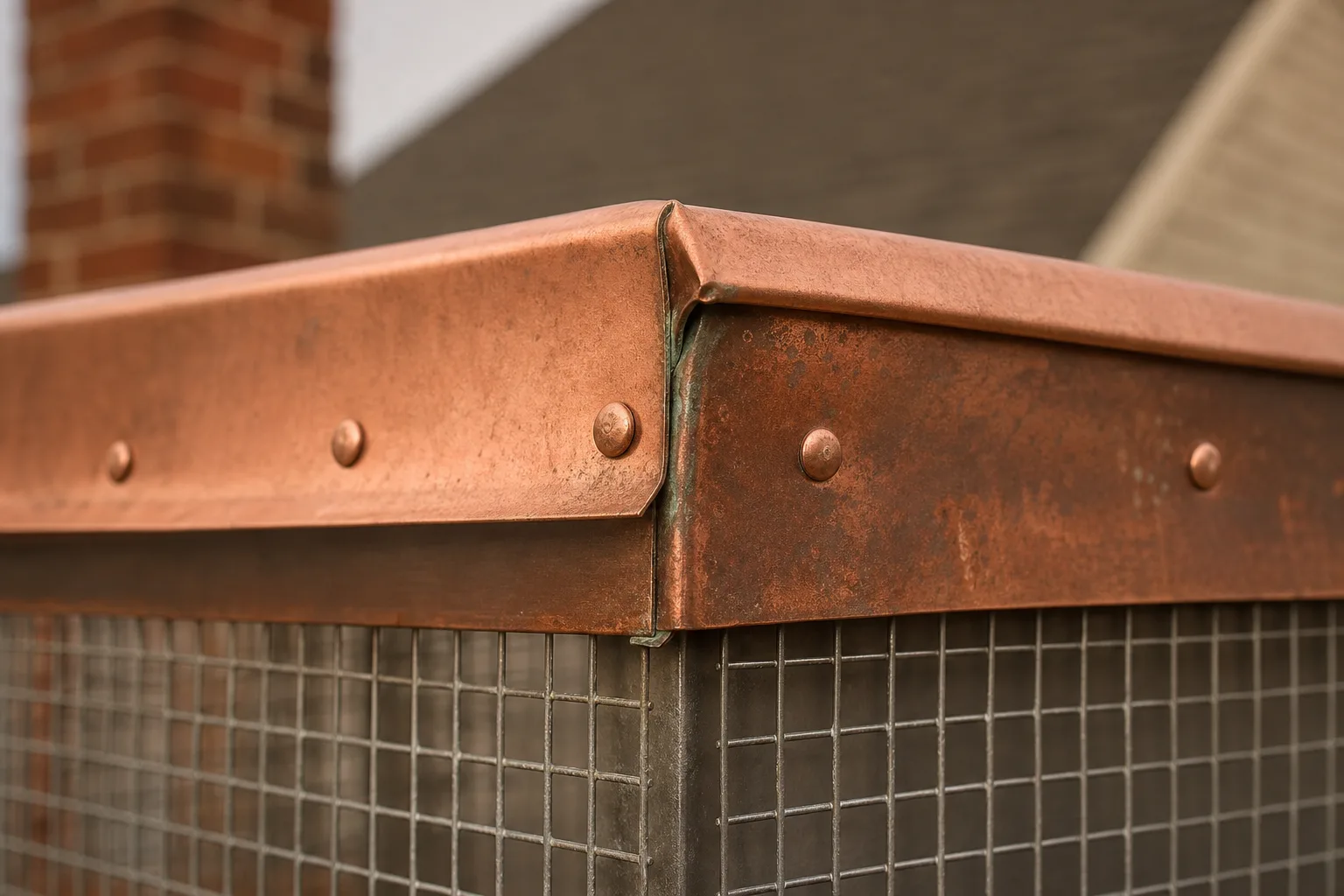
Custom chimney caps are commonly offered in stainless steel, copper, lead-coated copper, pre-patina copper, a grey zinc-tin coated copper alloy, zinc, aluminum, and painted or galvanized steel. 304 is the stainless alloy the shops name. Stainless is commonly quoted as 24 gauge 304 2B and copper as 16 ounce or 20 ounce, though weight is a line on a spec sheet and the shop's own sheet is the one that counts.
| Material | How it is commonly offered | How it ages | What to settle with the fabricator |
|---|---|---|---|
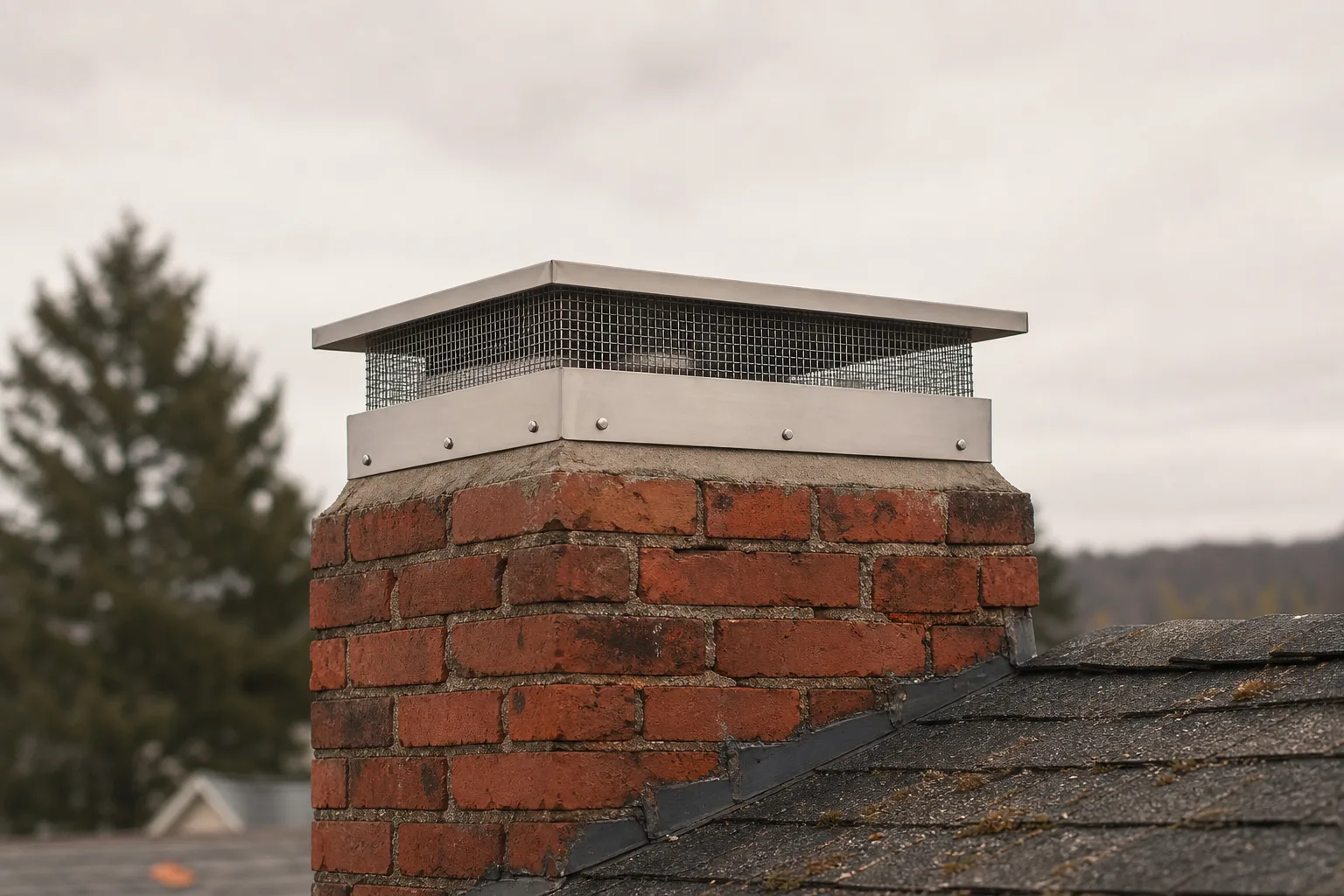
| Stainless steel | 304 alloy, commonly 24 gauge 304 2B | Dulls to a flat grey and streaks; a working finish, not a chrome one | Alloy, gauge, and how seams and fasteners are made |
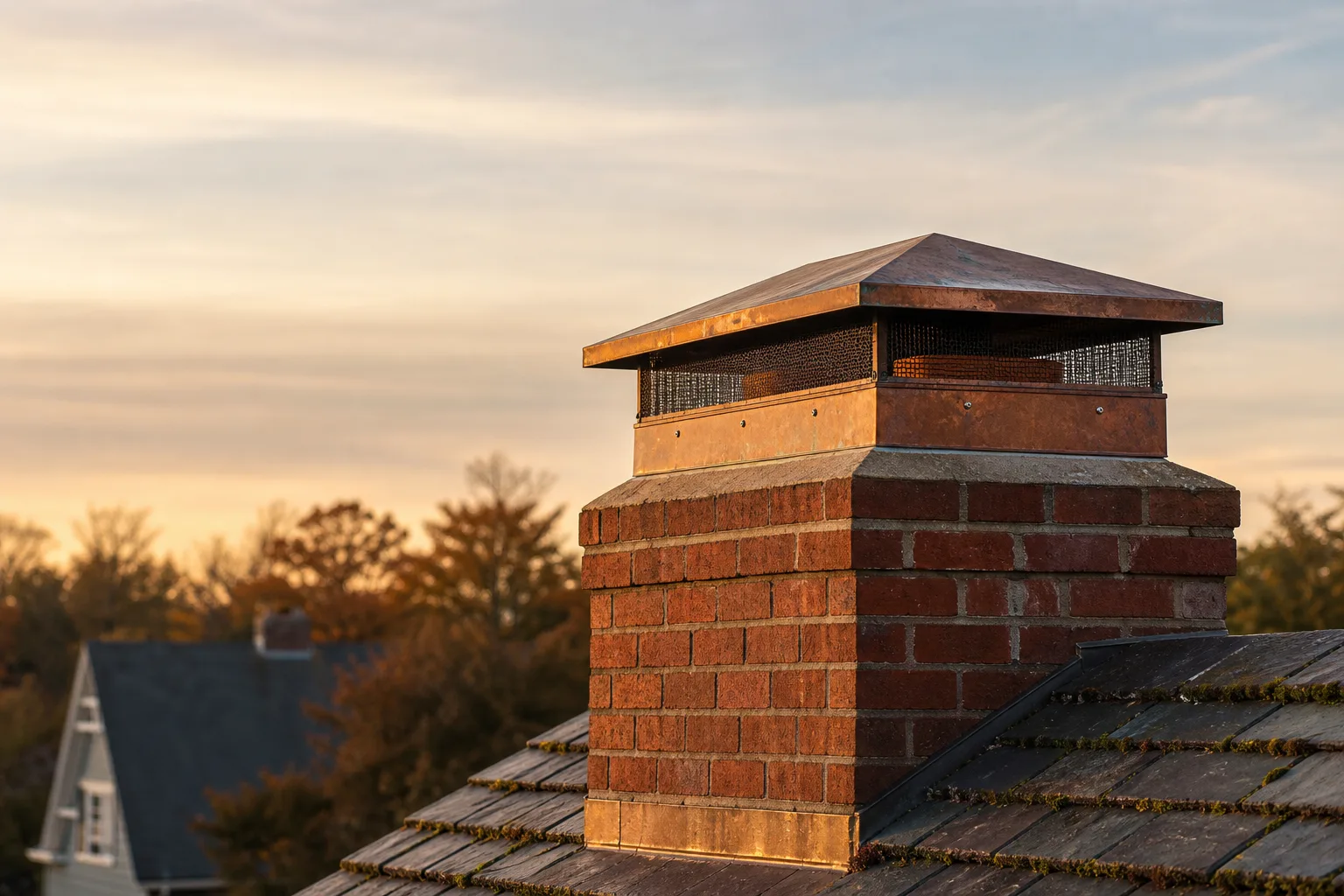
| Copper | Commonly 16 ounce or 20 ounce sheet | Starts bright salmon, darkens, and can patinate toward green; the rate depends on exposure | Weight, seam construction, and what the runoff crosses on its way down |
| Lead-coated copper | Sheet copper with a coated surface | Weathers toward a soft grey rather than green | Whether the coating suits your roof and your local rules |
| Pre-patina copper | Copper supplied already patinated | Arrives near its aged color instead of bright | How closely it will match copper already on the house |
| Painted or galvanized steel | Coated steel | The rust-prone option of the group; coating condition governs | Whether the coating is warranted, and against what |
One thing that table cannot tell you: dissimilar metals. A copper cap, a steel fastener, and a runoff path across whatever your roof and flashing are made of is a real question about metals in contact, and it belongs to the fabricator choosing the fasteners. Ask it out loud. Our guide to flashing around chimney covers the joint below.
No metal here comes with an outcome, either. A material is not a rust guarantee or a fit guarantee.
Myth vs. fact: the myth is that picking the premium metal settles the quality of the cap. The fact is that the metal is one line on an order form that also carries the mount style, the base dimensions, the screen height, and the mesh. A beautiful copper cap built to the wrong base dimension is a beautiful copper cap that does not sit on your chimney.
And none of it matters if the mesh is wrong, which brings us to the part of this purchase that is not a preference.
The Code a Custom Cap Still Has to Satisfy
A stock part and a made-to-order part answer to the same code section, and neither is compliant for your particular chimney simply because it exists. What is different about custom chimney caps is that every specification on the form is one you selected, so raising this is on you.
The relevant section of the International Residential Code is R1003.9.2, which covers spark arrestors. Read it before you tick the mesh box, because it is short and it is specific.
Mesh openings, net free area, corrosion resistance
The code states that openings "shall not permit the passage of spheres having a diameter greater than 1/2 inch nor block the passage of spheres having a diameter less than 3/8 inch." That is a window, not a maximum. Too coarse fails it and too fine fails it.
It states that the screen "shall have heat and corrosion resistance equivalent to 12 gage wire, 19-gage galvanized steel or 24-gage stainless steel."
And it states that the net free area of the arrestor "shall not be less than four times the net free area of the outlet of the chimney flue it serves." Four times, not equal to. The code gives the multiplier and does not explain it, and neither will I. What it means on an order form is that the screen band has to carry a great deal more open area than the flue below it.
Now the part worth the whole section. The mesh sizes commonly offered on custom stainless caps are 3/4 inch and 5/8 inch. Both of those openings are larger than the code's arrestor range.
A rain-cap mesh specification and a spark-arrestor specification are two different things wearing the same word. If an arrestor is required where your chimney stands, the mesh field on the order form is the field that has to satisfy it, and the default on the menu may not. Our guide to the chimney spark arrestor goes further into what that screen is and is not for.
Whether an arrestor is required at all is a local question. The model code section is conditional in its own terms, and states amend it. Your building department answers this, not the fabricator and not this page.
The removability rule, and the word "or"
The same section: the arrestor "shall be accessible for cleaning and the screen or chimney cap shall be removable to allow for cleaning of the chimney flue."
That "or" is load-bearing. The cap does not have to come off if the screen does, and the screen does not have to come off if the cap does. One of the two has to.
So put that question to whoever is drawing your cap. When this chimney gets swept, what comes off, and what tool takes it off?
Whether a given design meets it depends on the design. A hinged lid, a screen panel that unfastens, and an assembly whose fasteners come back out are all arrangements worth asking about by name. Ask the fabricator to say which part is the removable one, and confirm it with your building department rather than reading it off a drawing.
From the field: the mesh field on an order form reads like a preference between two numbers. It is not the same question as whether an arrestor is required where the chimney stands. Settle that second question with the building department first, then answer the first one.
Ordering Custom Chimney Caps Without Regret
You now have numbers, a mount style, a metal, and a mesh question with an answer from your building department. What is left is writing it down in a way that survives a phone call.
What to put in writing on an order for custom chimney caps
Quotes for custom chimney caps get built from the order, not from the conversation, so put all of it on the order:
- The mount style, named.
- Every dimension, with the surface it was taken from stated next to it. "22 by 34, outside of crown" is a measurement. "22 by 34" is a hope.
- The alloy and the gauge, or the copper weight.
- The mesh opening size, as a dimension rather than as a menu choice.
- Screen height and lid overhang.
- Lid style, and whether it is hinged.
- Fastener type and material.
- The drawing, approved by you before fabrication.
Then read it back against your photographs. A drawing you have approved is the object you are going to receive.
One more thing belongs in that conversation, and it is not about the cap. If the crown underneath is cracked or spalling, the cap is about to be fastened to it anyway. CSIA recommends a cast Portland cement crown projecting at least 2 inches past the chimney face, and a crown that has gone is masonry work rather than sheet metal work, which brick chimney repair covers.
Pro tip: the fabricator's own measuring form is the controlling document, not any number in this article. If their form asks for a dimension I have not mentioned, their form wins. If it conflicts with something here, call and ask why.
How VIO Helps With Custom Chimney Caps
Plainly: VIO does not build custom chimney caps. VIO is a referral service. We match homeowners with independent local chimney companies, and the people who show up work for those companies rather than for us.
What that is worth on this job is access to the top of the chimney. The measurements a fabricator needs come off the crown, the condition of the crown is not visible from the ground, and putting a cap on is work at height on a surface not designed to be stood on.
The company we match you with is an independent local business, and its license, its insurance and its certifications are yours to ask for and yours to verify.
On estimates the move is yours: insist on a written estimate before any work starts, and do not let work begin without one in your hands.
One timing note. September sits ahead of the heating season, which makes it a sensible stretch to have the top of a chimney looked at rather than during the months you want to be burning in it.
If a cap is going on, ask what else the visit covers. NFPA 211 sets its own triggers for a Level 2 inspection: a change to the system in fuel, in appliance, or in the shape or material of the flue; property transfer; a chimney fire or a malfunction; and an external event likely to have caused damage. Whether any of those apply to your chimney is a question to raise when you book, not something to read off this page.
Order the cap second. Look at the crown first.
A cap is fastened to whatever is underneath it, and a crown you have not seen is a variable in a purchase you cannot return. Tell us what you can see from the ground and we will connect you with an independent local chimney company in your area. Call (513) 655-6702 or request service.
Where to Start
Custom chimney caps are a measuring job wearing the costume of a shopping job.
The shops that build them are good at building metal. What a shop will not do is stand on your roof, decide which mount your chimney takes, read the tape, and mention that the default mesh on its own menu might not be the one your jurisdiction wants. That part is yours, or it belongs to somebody you bring in to do it.
So go in this order. Settle the mount. Take the numbers, from named surfaces, with photographs. Get the mesh answer from the building department. Look hard at the crown.
Then, and only then, enjoy the part where you choose copper.
Symptom checker
What is your chimney doing?
Tap the closest match for an honest first answer.