



On this pageWhat a Fireplace Insert With Blower Actually Is8 sections+7
- What a Fireplace Insert With Blower Actually Is
- What the Blower Does, and What It Does Not Do
- The Fuel Type Changes What the Blower Is
- Your Chimney Decides Which Insert You Can Install
- Included, Blower-Ready, or Aftermarket
- What to Check Before You Buy
- The Questions to Ask on the Phone
- How VIO Helps With a Fireplace Insert With Blower
Quick answer
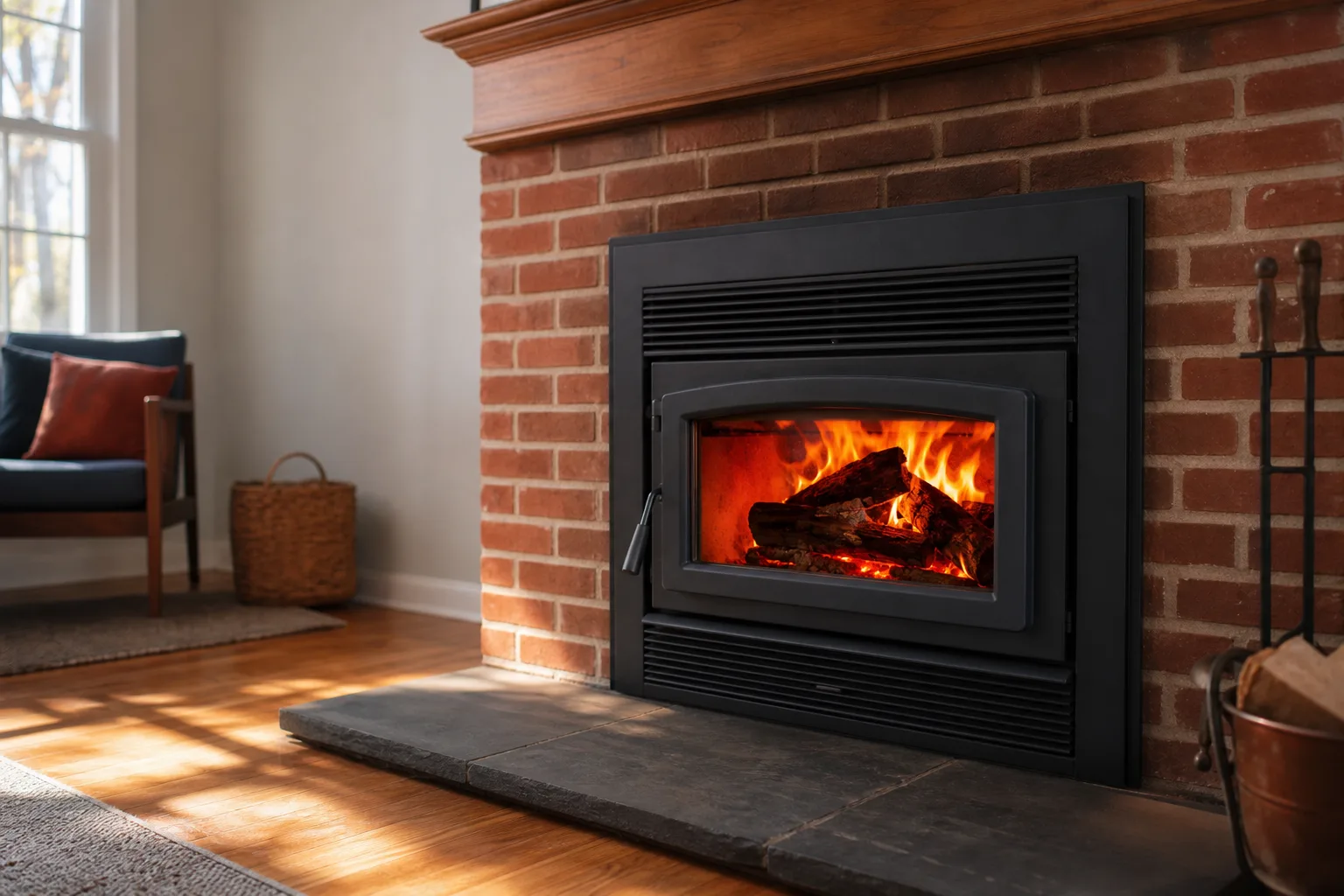
A fireplace insert with blower is a closed, listed heating appliance fitted into an existing fireplace, with a fan that moves room air across the hot firebox and returns it to the room. On wood, gas and pellet units the fan distributes combustion heat. On an electric unit the fan is part of the heater itself. The existing chimney determines which insert can be installed.
A fire can be roaring and the room can still be cold.
That is the specific frustration behind a search for a fireplace insert with blower. The fire is right there, throwing light and doing very little else, while the heat it makes goes up the flue or stays in a masonry firebox that quietly warms the bricks.
So you go looking for the part that fixes it, and "blower" seems like the answer. A fan. Something that pushes the warm air out into the room instead of leaving it behind.
That instinct is not wrong. The fan matters.
But "blower" is the smaller of the two words in your search. The bigger one is already sitting in your wall, it decides more about this project than any product page will tell you, and we will get to it.
What a Fireplace Insert With Blower Actually Is
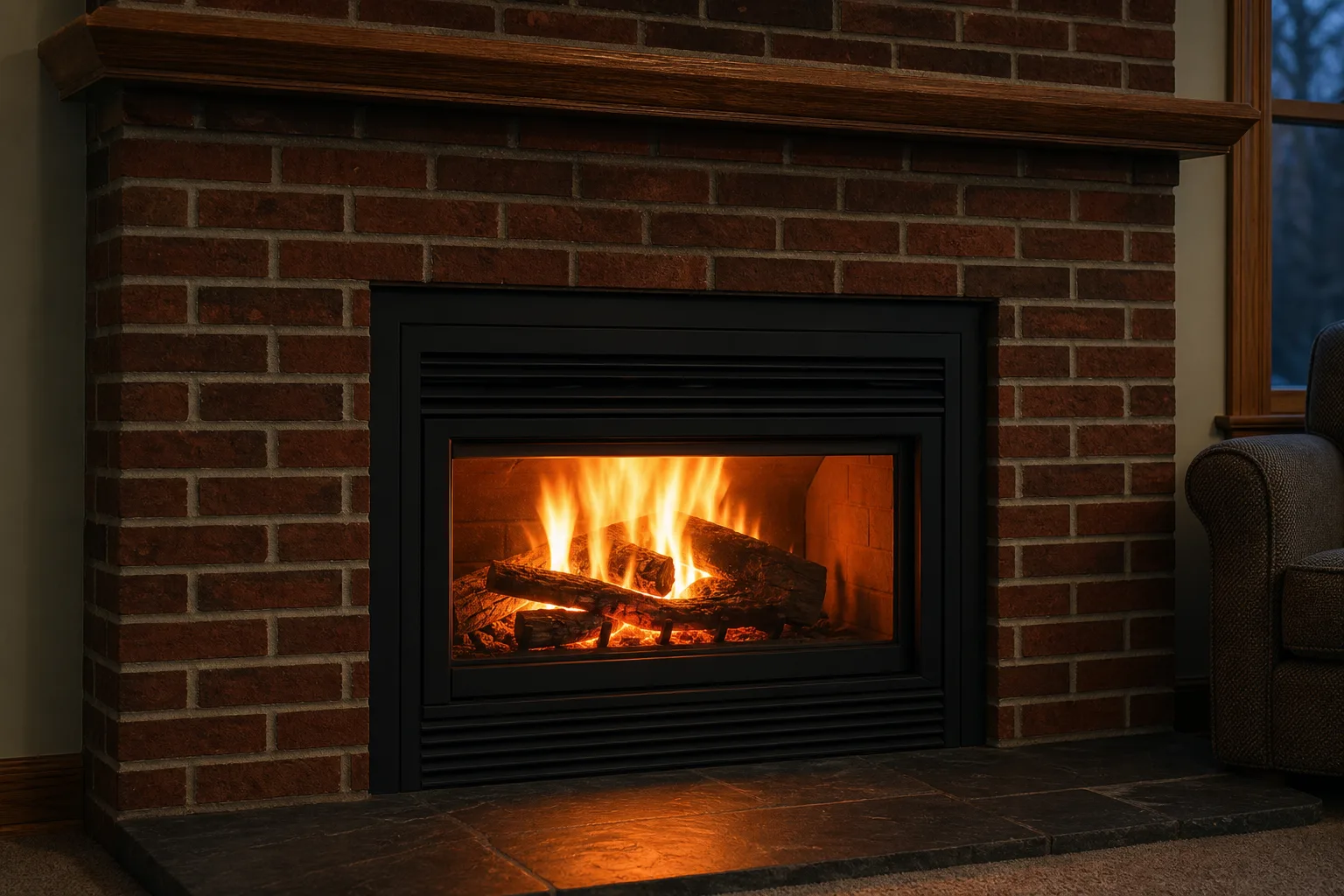
An insert is a closed appliance that goes inside a fireplace you already own.
Not a log set, not a decorative screen, not a kit that bolts onto what is there. A separate machine: a sealed firebox of cast iron or steel with a glass door on the front, fitted into the opening where an open fire used to burn.
The parts you can see from the room
Take a wood insert as the example here, since that is the arrangement people tend to picture. Construction differs between models and between fuels, and the manual for a given unit is what describes that unit.
The door is a large glass panel with a handle to one side. Behind it the firebox, dark and squared off, and on a solid-fuel unit the walls can be lined with firebrick.
And around all of it, a flat metal panel covering the gap between the appliance and the original opening. That panel is the surround, and it can carry louvered slots along the top, the bottom, or both.
Good to know: the surround is the visible seam between old masonry and new appliance. It is where the eye lands, and it is the detail that makes a fireplace insert with blower read as a considered installation rather than a box shoved into a hole.
Why "listed appliance" is the phrase that matters
Here is the part that should change how you shop.
An insert is a listed appliance. It was tested and listed as one complete assembly, and sold as that assembly. It is not a set of parts an installer combines on site to taste.
The conditions attached to that listing, including how the appliance is vented and which accessories may be fitted to it, are part of the product. The manufacturer's instructions are not suggestions. They are the terms under which the thing was tested.
An open masonry fireplace has no such terms. It is structure, part of the house. An insert is a machine you put into the house, and machines arrive with conditions.
What the Blower Does, and What It Does Not Do
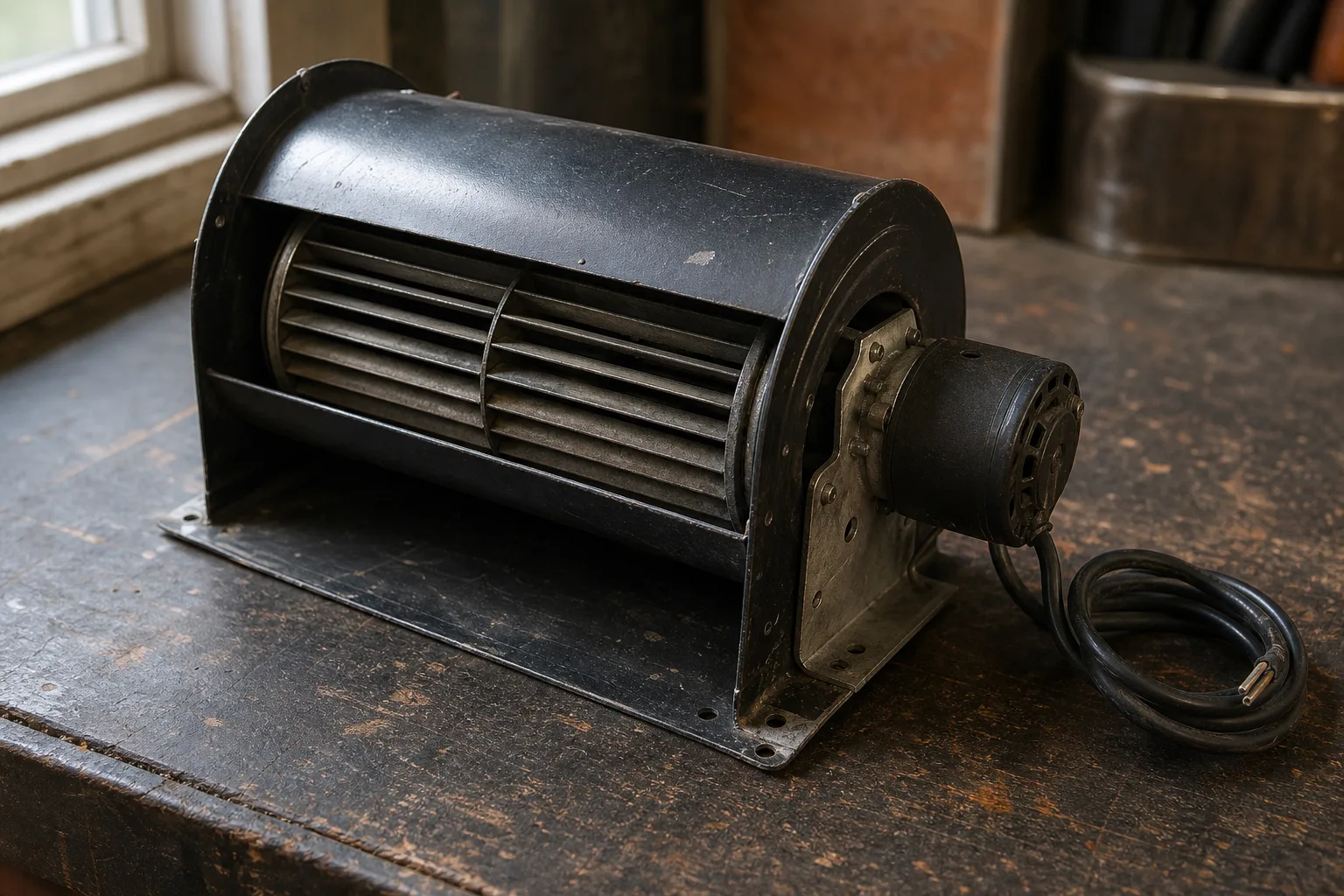
On a fireplace insert with blower, the fan moves room air across the outside of the hot firebox and pushes it back into the room.
That is the mechanism, start to finish. Air from your living room is drawn in, runs along heat-exchange surfaces on the body of the appliance, picks up heat, and comes back out.
On a common arrangement the intake sits low on the trim panel and the discharge sits above it. Those positions vary between models, and the manufacturer's instructions for your unit govern.
A squirrel-cage fan is one common design here, a caged cylindrical wheel turning inside a scroll-shaped housing. That form copes with back pressure better than a propeller-style fan when air has to be pushed around a firebox body.
The two controls, and which one does what
Two separate controls are common on these systems, and they get mistaken for each other constantly.
A snap disc thermostat decides when the fan runs. It closes as temperature rises and opens again as temperature falls, with a fixed gap between the two points. Commonly sold switches are quoted at on around 120°F and off around 90°F, and adjustable versions are sold with set points in the 140 to 180°F range.
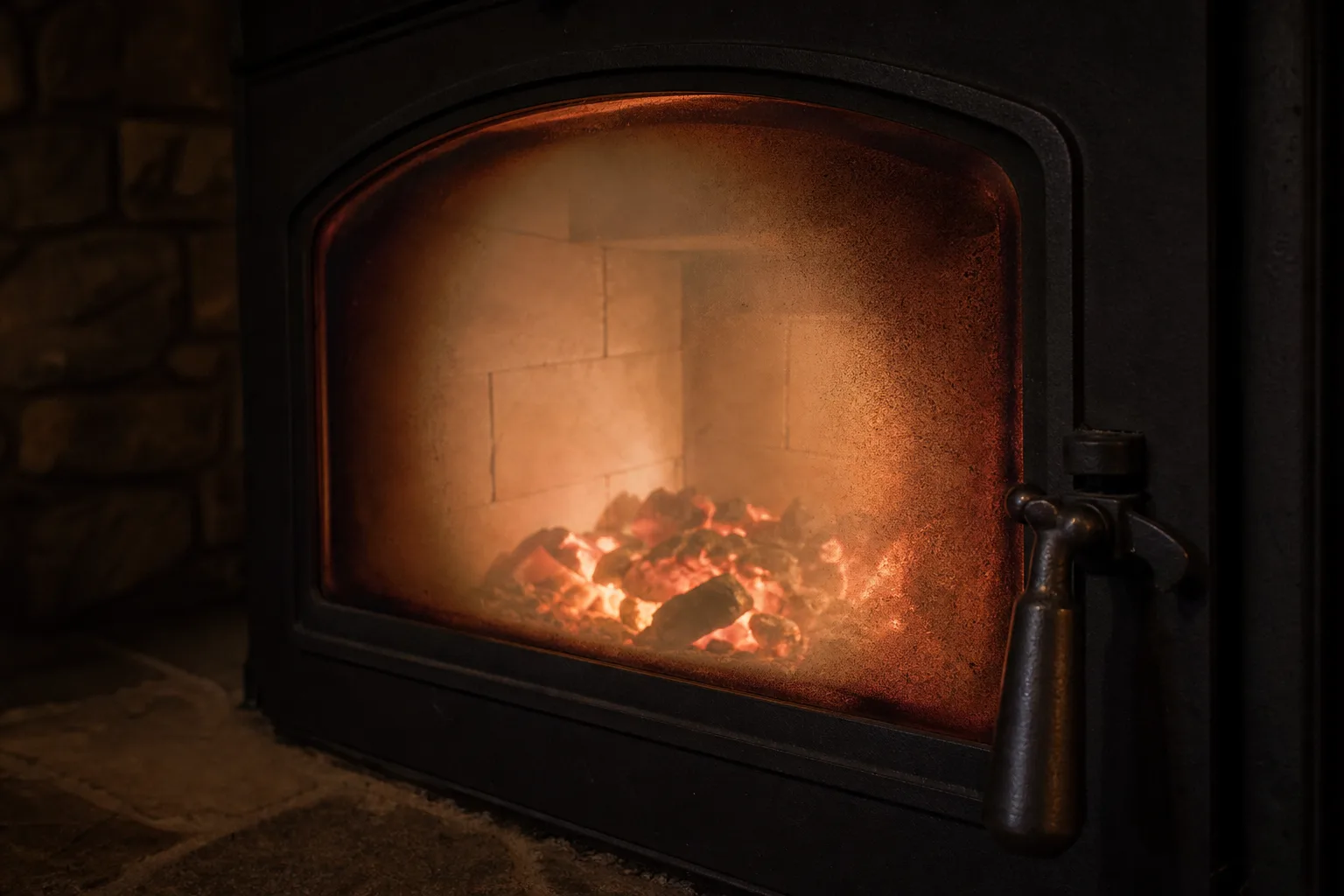
The practical effect is the part worth remembering. The fan starts on its own once the appliance is hot, and it keeps running after the fire has burned down, pushing the leftover heat out into the room instead of letting it fade in the metal.
A rheostat speed control does something different. It sets how fast the fan runs once it is running. It has no say in the timing.
Myth vs. fact: search this topic and you will find percentage gains and multiples of heat attached to blowers, quoted confidently and travelling from page to page with no test behind them and no method attached to them. We are not going to repeat those figures. What can be said is this: heat that stays in the appliance body or goes up the flue is heat that did not reach you, and a fan moves some of it into the room instead. What that comes to in your house depends on your house.
The Fuel Type Changes What the Blower Is
Your search did not say wood. It did not say gas either.
Worth noticing, because the results that come back are sorted by fuel before you arrive, and none of them stop to mention that the fan is doing a different job in each one.
A fireplace insert with blower is not one product. It is four products that share a shape.
On a wood, gas or pellet insert the fan is a distribution device. The fire makes the heat, the appliance body gets hot, the fan moves that heat into the room. Whether a given unit can be operated with the fan switched off is a question for its listing and its manual, and on some designs powered components are part of how the appliance is meant to run at all.
On an electric insert the fan is not distributing combustion heat, because there is no combustion. The flame is an LED effect. The heat is produced electrically, and the fan is part of the heater itself rather than an accessory attached to it.
That difference is invisible across the search results, and it is worth carrying into a showroom.
| Insert type | What the fan is doing | What the chimney needs | What to verify before buying |
|---|---|---|---|
| Wood | Distributing firebox heat into the room | A full-length stainless steel liner, insert collar to chimney top | Flue size and condition, documented; collar size; that any blower kit is approved for your exact model |
| Gas, direct vent | Distributing sealed-firebox heat into the room | A sealed venting arrangement. One common approach runs two flexible aluminum liners in parallel inside the chimney, one drawing combustion air in, one carrying exhaust out | Gas supply, the venting route the manual specifies, clearances, local code |
| Pellet | Distributing heat, alongside a separate combustion fan that is part of how the appliance burns | A stainless vent system, not the arrangement gas inserts use | Venting route, a reliable electrical supply, somewhere to keep fuel |
| Electric | Producing the heat and delivering it. The fan is the heater | No venting for the appliance itself, since nothing is burned | Circuit capacity, and that you have seen the flame effect in person |
Read that first column down and the point makes itself. "With a blower" means four different things depending on what is burning, and on the last row it means the appliance.
If you have already settled on wood, our guide to wood fireplace inserts with blower goes further down that particular path.
Pro tip: the rating plate on the appliance and the manual that ships with it are the spec sheet for that unit. A number you found attached to a category is not. When you are weighing two inserts against each other, weigh their own documents.
Your Chimney Decides Which Insert You Can Install
Here is the bigger word.
Not "blower." Chimney. The flue you already have sets the boundary on what can go into that opening, and it does so before you have picked a brand, a size, or even a fuel. A product page selling you a fireplace insert with blower is showing you the half of the project that is easy to photograph.
What the liner requirement actually says
For wood, the rule is unusually clear, and it comes from the appliance rather than from anybody's preference.
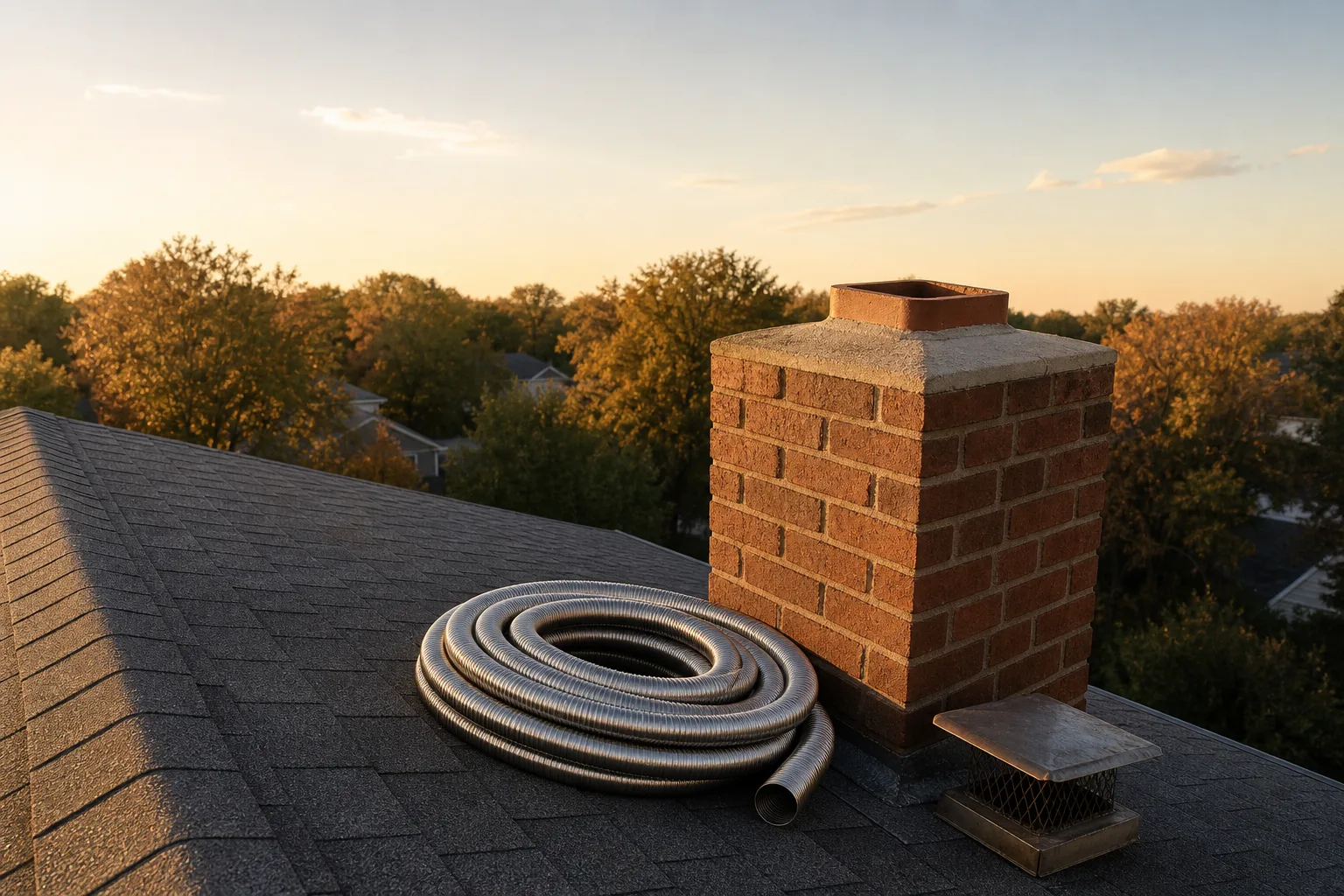
Wood-burning inserts listed to UL 1482, the standard for solid-fuel type room heaters, require a liner running from the insert's flue collar to the chimney termination as a condition of the listing. Not as a recommendation. As a term of the listing the appliance was sold under.
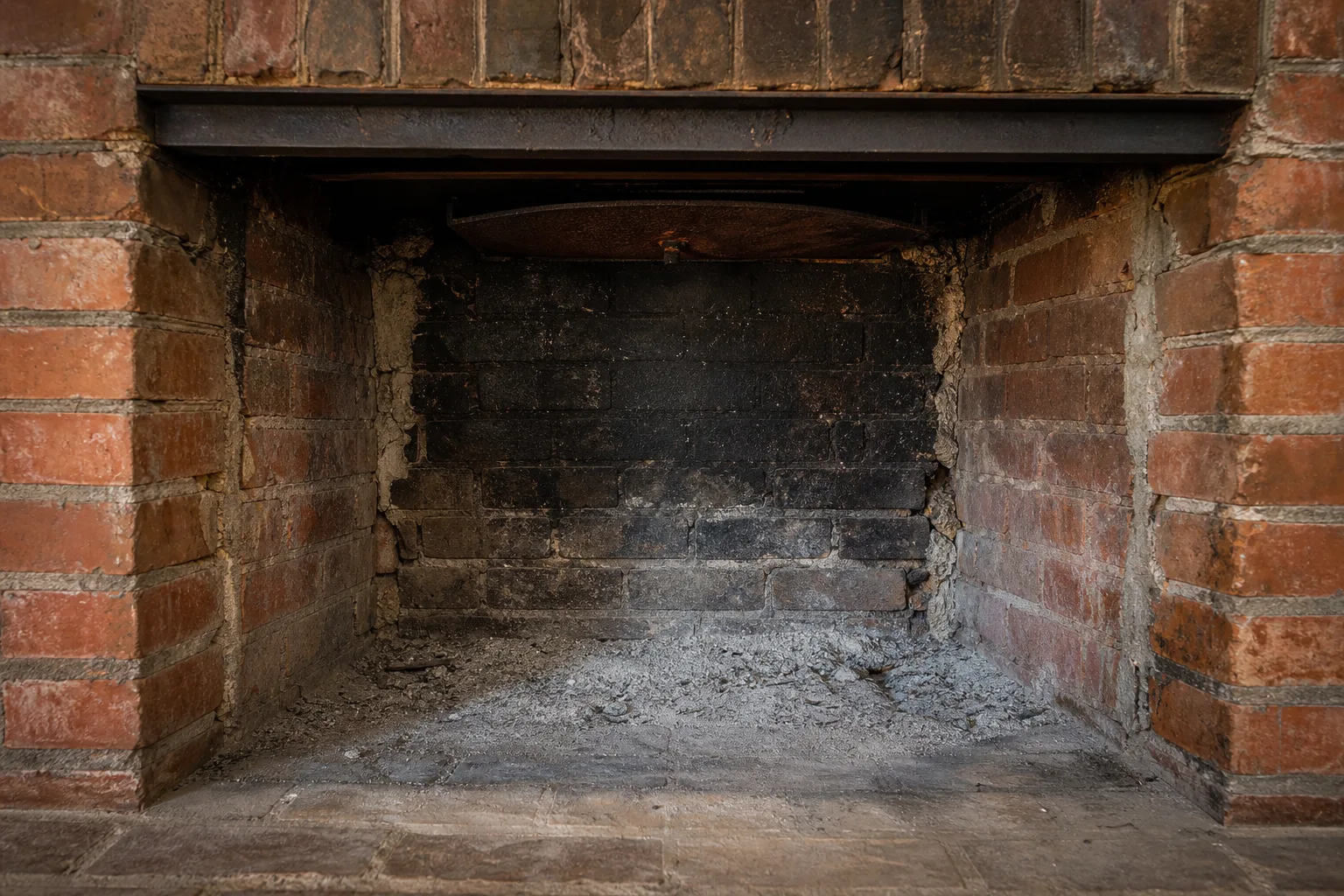
IRC 2024 and NFPA 211 arrive at the same place from the code side. Installing a wood-burning insert into an existing masonry fireplace calls for a full-length stainless steel liner, collar to stack top. The clay tile liner already in the chimney is not used on its own for this.
The liner is sized to the appliance's flue collar. Six inch round and six by eight oval are the collar sizes commonly encountered.
NFPA 211 also requires that the existing flue be evaluated, and relined where necessary, before the new insert goes in. That sequence is the part to hold onto. Evaluation first, appliance second.
Safety note: if the flue is unlined, or if nobody can say what is up there, that is a question for an evaluation and not an input to a shopping decision. Nothing should be ordered until what is in the chimney has been documented.
Why installing an insert triggers a Level 2 inspection
NFPA 211 sets out inspection levels, and one of them lands squarely on this project.
A Level 2 inspection is required when changes are made to the system, including a change of fuel type, a change in the shape or material of the flue, or the addition of an appliance. Putting an insert into an open fireplace is a change to the system on more than one of those counts, and adding a liner changes the flue's material and its shape at the same time.
Level 2 is also required at the sale or transfer of a property, after a chimney fire or a malfunction, and after an external event likely to have caused damage.
Level 3 carries its own separate trigger: a suspected concealed hazard that a Level 1 or a Level 2 cannot evaluate.
Which gives you something concrete to say on the phone: when you call about an insert, "Level 2" is the phrase to use.
Find out what your chimney will take
The insert you can install is decided by the flue you already have, and that is not a question you can answer from the living room floor.
Tell us what you have and what you are thinking about putting into it, and we will match you with an independent local chimney company that can get eyes on the flue and document its size and its condition. That is the information any appliance decision starts from.
Call (513) 655-6702, or request service online.
Included, Blower-Ready, or Aftermarket
The fan arrives one of three ways, and the difference is not only about what you pay.
Some inserts ship with the blower already fitted. Some are sold blower-ready, wired and prepared for a fan bought separately from the same maker. And some existing appliances get a fan added later from a kit.
Buying a fireplace insert with blower already fitted
The straightforward path, and it is straightforward for a reason worth naming. The fan was part of what got tested and listed together with the appliance, so whether it belongs there is not a separate question anyone has to settle.
Blower-ready sits in the middle. The kit is still to come, and the maker has already settled which fan goes in.
Aftermarket is where care is needed.
The question is not whether a kit physically fits. On a listed appliance, accessories and installation have to comply with the listing and the manufacturer's instructions, so what you need to confirm is that the kit is approved for your exact model. A universal part that fits is not the same thing as an approved one.
In relative terms, the money arrives differently on each path: bundled into the appliance on the first, split between the appliance and the kit on the second, and a separate purchase that varies by kit on the third. Where the money goes on the project as a whole is a separate question, and we cover what drives fireplace installation cost on its own.
From the field: a fan that has gone quiet and an appliance that has stopped putting out heat present identically, as a cold room, and the two get mistaken for each other. Before concluding anything about the insert, walk the simple electrical path. Is it plugged in. Is the outlet live. Has the speed control been wound down to nothing. Has the appliance actually reached the temperature the snap disc is sitting there waiting for.
What to Check Before You Buy
None of this needs a professional. All of it is the homework that turns a fireplace insert with blower from a wish into a plan.
- Measure the opening, front and back. Width, height and depth, and take the width at the back as well as the face, because masonry fireboxes taper. An insert has to fit the space that exists, not the space you can see.
- Find out whether there is power at the firebox. A blower needs 120V. Factory-built fireplaces are frequently wired for it during framing. A masonry fireplace built for burning wood does not necessarily have an outlet near it, and getting one there is a small job of its own.
- Get the flue's size and condition documented. Not guessed at from the roof, not assumed from the age of the house. Documented, by somebody who has looked.
- Ask your building department about permits. Requirements vary by jurisdiction, and that department holds the answer for yours. Confirm it before an installation gets scheduled.
- Read the clearance requirements in the manual for any model you are taking seriously. Clearances to combustibles, hearth extension and mantel clearances live in there, and they can rule a model out before anything is ordered.
- Confirm any blower kit is approved for your exact model, in writing, from the maker or the retailer.
- Check the EPA certified wood heater database if wood is on your list. New residential wood heaters sold in the US fall under the EPA 2020 NSPS. Treat an efficiency percentage attached to a model in an advertisement as a claim rather than a rating.
Good to know: the electrical question is the one that catches people out, and it is answerable this afternoon with a flashlight. Look in and around the firebox opening for an outlet. If there is not one, the project does not end. It just belongs in the plan, and in the estimate, rather than turning up as a surprise on installation day.
The Questions to Ask on the Phone
Take these with you. They are blunt on purpose.
"I want a Level 2 inspection, because I am adding an insert." The standard's own language, and it sets the scope of the visit rather than leaving it to be guessed at.
"What size is my flue, and what condition is the liner in?" Ask for the answer in writing, with the footage if a camera goes up.
"My appliance has a six inch round collar." Or a six by eight oval one. Fill that in once you have a model in mind, then ask what relining to match it involves.
"Is there power at the firebox, and if not, what is involved in getting it there?"
"Can I see your license, your insurance and your certifications?" Ask, then actually look at what you are handed.
"Can I have that in writing before any work starts?" On estimates the move is yours. Insist on a written estimate before any work starts, and do not let work begin without one in your hands.
Six sentences, and between them they cover the distance between wanting a fireplace insert with blower and being ready to buy one.
How VIO Helps With a Fireplace Insert With Blower
VIO is a referral service. We do not install appliances and we do not sweep chimneys.
What we do is match you with an independent local chimney company, and for this particular situation that matters more than it might sound like it should.
Because what stands between you and a fireplace insert with blower is not really a product decision. It is a piece of information about your own house that you cannot get from where you are sitting. What size the flue is. What condition it is in. What relining it to suit an appliance would involve.
Tell us what you have, what room it is in, and what you are thinking of putting into the opening. We will match you with a company that can get eyes on the flue and document its size and its condition, which is where any appliance-specific decision starts.
The company we match you with is an independent local business, and its license, its insurance and its certifications are yours to ask for and yours to verify.
Then back to that room, and the fire roaring three feet from where you are cold. A fireplace insert with blower is a real answer to that, and a good one. It just starts a step further back than the product pages suggest, with somebody looking up your chimney and telling you what is actually up there.
Start with the flue, not the showroom
Early September sits ahead of the heating season, which makes it a sensible time to have the chimney looked at rather than during the months you want to be burning in it.
Tell us what you can see and we will take it from there.
Call (513) 655-6702.
Symptom checker
What is your chimney doing?
Tap the closest match for an honest first answer.