



On this pageSo Can You Burn Pine in a Fireplace? The Straight Answer8 sections+7
- So Can You Burn Pine in a Fireplace? The Straight Answer
- The Creosote Myth, and What Actually Coats Your Flue
- Is Your Pine Actually Ready? Test the Stack in Your Yard
- Pine vs Hardwood: What You Gain and What You Give Up
- Open Fireplace, Insert, or Stove: The Distinction Everyone Skips
- How to Burn Pine Well: The Mixed Fire
- How VIO Helps When You Are Burning Pine
- Can You Burn Pine in a Fireplace? The Verdict, and What to Do Next
Quick answer
Yes, you can burn pine in a fireplace. The species is not the problem: creosote comes from wet wood and cool, smoldering fires rather than from pine sap. Burn pine that has seasoned six to twelve months and reads 20% moisture or less on a freshly split face, keep the fire hot instead of damped down, and use a spark screen, because resin pockets pop and throw embers out the front.
Can you burn pine in a fireplace? Yes. People do it constantly, and in parts of the country where pine is what grows, it is simply what gets burned.
Here is how this usually goes. A neighbor takes down a white pine, or a storm drops a limb across the driveway, and suddenly there is a season's worth of free fuel in the yard. Then somebody leans over the fence and says it: never burn that, it'll set your chimney on fire.
The answer does have conditions, and the man at the fence was not entirely wrong. He was right about something real and wrong about why.
There is also one thing about burning pine that the "it's all a myth" crowd never mentions, and it has nothing to do with your flue. We will get there.
So Can You Burn Pine in a Fireplace? The Straight Answer
Yes, with three conditions. Every one of them matters more than the species does.
The wood has to be dry, ideally at or below 20% moisture content. The fire has to run hot rather than smoldering along all evening. And you have to know the condition of your flue, which is the one item you cannot check from the hearth rug.
Get those three right and pine is fuel. Get them wrong and oak will hurt you too.
The Three Things That Actually Decide It
Notice what is missing from that list. Species. Resin. Sap. When people argue about whether can you burn pine in a fireplace is a yes or a no, they are arguing about the variable that matters least.
Moisture is first because water is the enemy of a clean burn. A wet split spends the start of its life boiling off water instead of making heat, and that cooling drags the whole system down.
Temperature is second because the byproducts of combustion condense on cool surfaces. Warm flue, gases go up and out. Cool flue, they stick.
Flue condition is third because it is the record of everything you did last winter.
Myth vs. fact: The story says pine sap coats your chimney with creosote. Research from the University of Georgia found the opposite: the assumption that pine's gum-like resins cause more creosote than hardwood is not supported, and buildup is more often the result of burning wood at relatively low temperatures. The sap is not the villain. The smoldering fire is.
Where the "Never Burn Pine" Rule Came From
The folklore did not appear out of nowhere.
Pine is what people burned when they had nothing better. It is what you scrounge, what falls, what nobody is selling. And scrounged wood tends to be freshly cut, because someone dropped a tree last month and gave it away.
So generations of homeowners burned wet pine in cold, drafty open fireplaces, got the smoky, sluggish fires that wet wood in a cool flue produces, and drew the obvious conclusion. The wood was pine. Therefore pine.
Bad science attached to a correct instinct. The instinct, that something about this is making a mess in my chimney, was right. The diagnosis landed on the wrong variable.
Which is why the honest answer to can you burn pine in a fireplace has to explain the mechanism. So here is the mechanism.
The Creosote Myth, and What Actually Coats Your Flue
Creosote is what is left when wood gas does not finish burning. It leaves the fire as vapor, travels up, hits a surface cooler than itself, and condenses.
Two things drive it: unburned volatiles in the smoke, and a flue cool enough to let them settle.
Wet wood produces both at once. Water evaporating out of the split absorbs energy that would otherwise raise the fire's temperature, so combustion runs incomplete and the flue runs cool. The Chimney Safety Institute of America is direct about this: burning unseasoned wood is a major contributor to creosote buildup.
Dry pine, in a fire that is actually working, is not doing that. Which is the whole reason can you burn pine in a fireplace has a yes attached to it at all.
Stage 1, Stage 2, and Glazed Creosote
Sweeps sort the deposit into three stages, and the gap between them is the gap between a routine morning and a real problem.
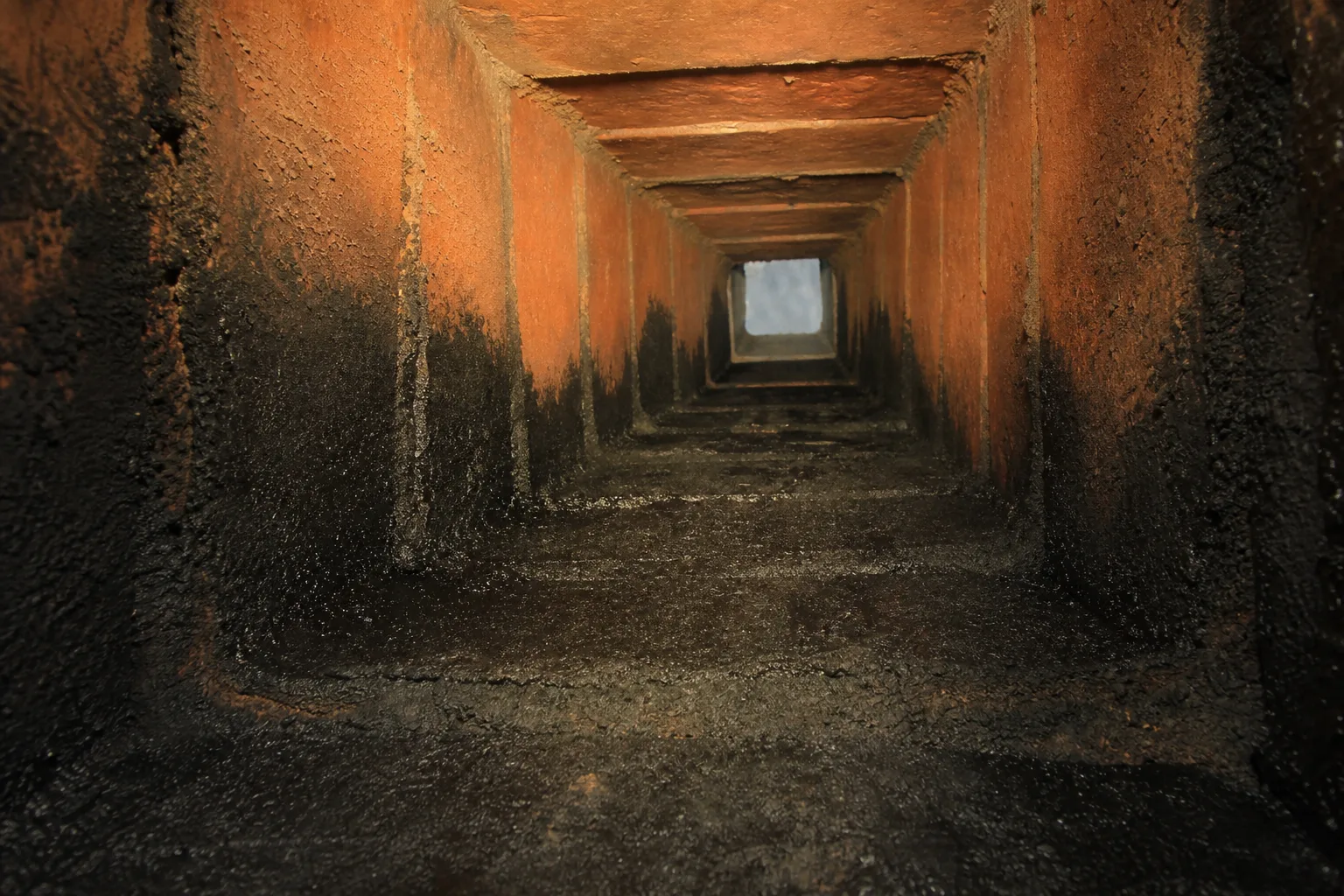
Stage 1 is dull black soot, dry and flaky, and it comes off with a brush. That is what a well-run season leaves behind.
Stage 2 is harder, a crunchy tar-black crust that has to be worked off with rotary tools.
Stage 3 is glazed creosote: a dense, shiny coating that looks almost wet in a light. It is the most dangerous form and it does not brush off. Removing it means chemical treatment, and in bad cases the flue needs relining.
The industry threshold for cleaning is one eighth of an inch at any point in the flue, and sooner if any glaze is present. Past that line, it is time to arrange professional chimney cleaning services.
Why Wet Wood Is the Real Villain
You can burn nothing but seasoned oak and still glaze a flue, if you spend every evening damping the fire down to a slow orange smolder because you want it to last until bedtime.
You can burn nothing but pine and leave almost nothing behind, if the splits are dry and the fire is allowed to run.
Good to know: That eighth of an inch is not a number the trade invented to sell sweeping. Creosote is combustible at any thickness, and the eighth-inch mark is simply where the industry says a cleaning is due, sooner if there is glaze. Flaky stage 1 soot is a brush job; glaze can turn into relining work. The cheap version of this problem is the one you catch early.
Not sure what is on your flue walls? You can measure your wood. You cannot measure your chimney from the living room. A Level 1 inspection is what tells you whether last season left anything behind, and NFPA 211 asks for one every year anyway. VIO CHIMNEY connects homeowners with independent local chimney companies. Tell us what you burn and we will match you with a company in your area. Call (513) 655-6702
Is Your Pine Actually Ready? Test the Stack in Your Yard
Every article that answers can you burn pine in a fireplace tells you to burn "seasoned pine" and then stops, as though seasoned were a label that came with the wood.
It does not. You have a pile in the yard and no idea what is in it. So here is how to find out, using the wood itself.
The End-Grain Check
Pick up a split and look at the cut end.
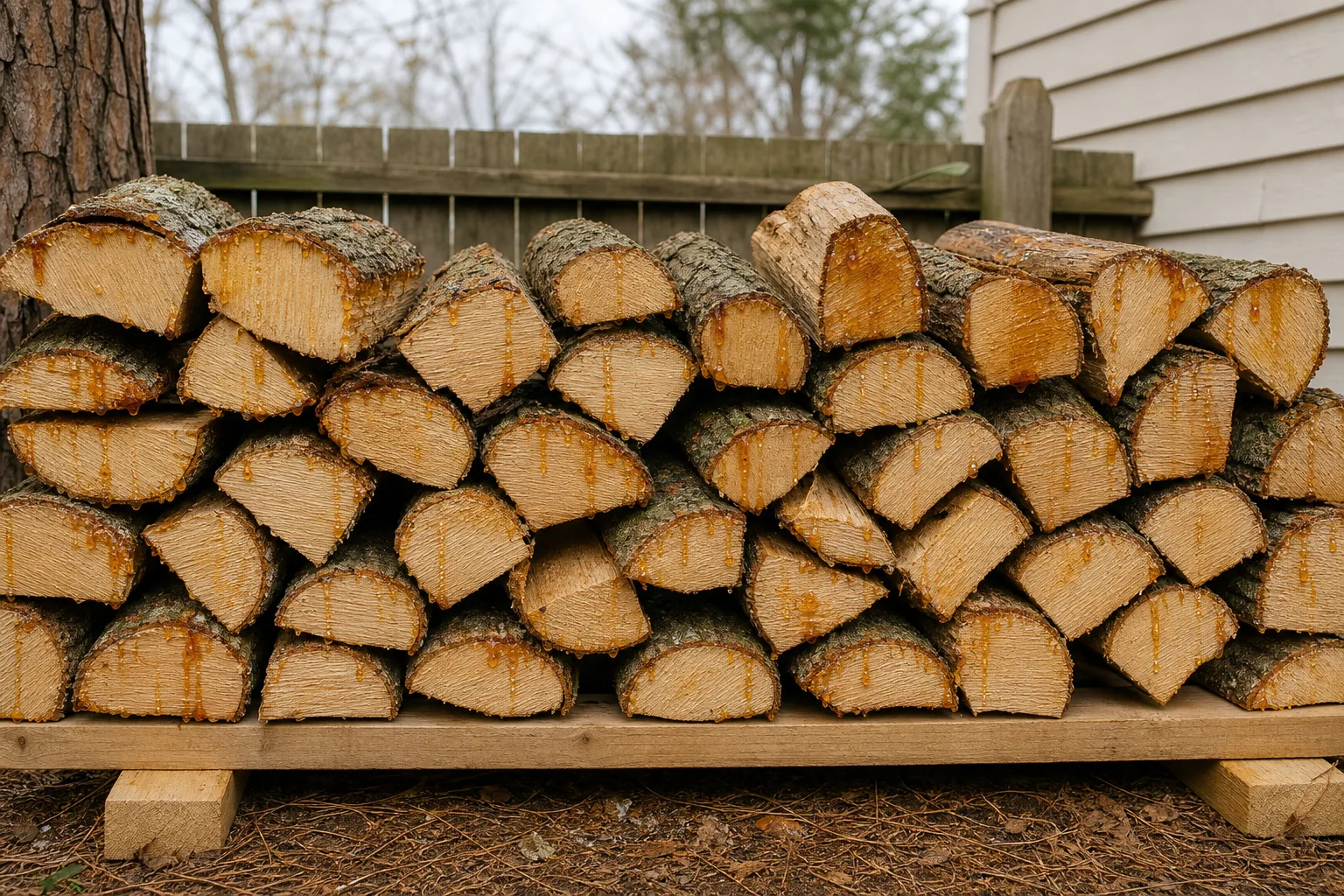
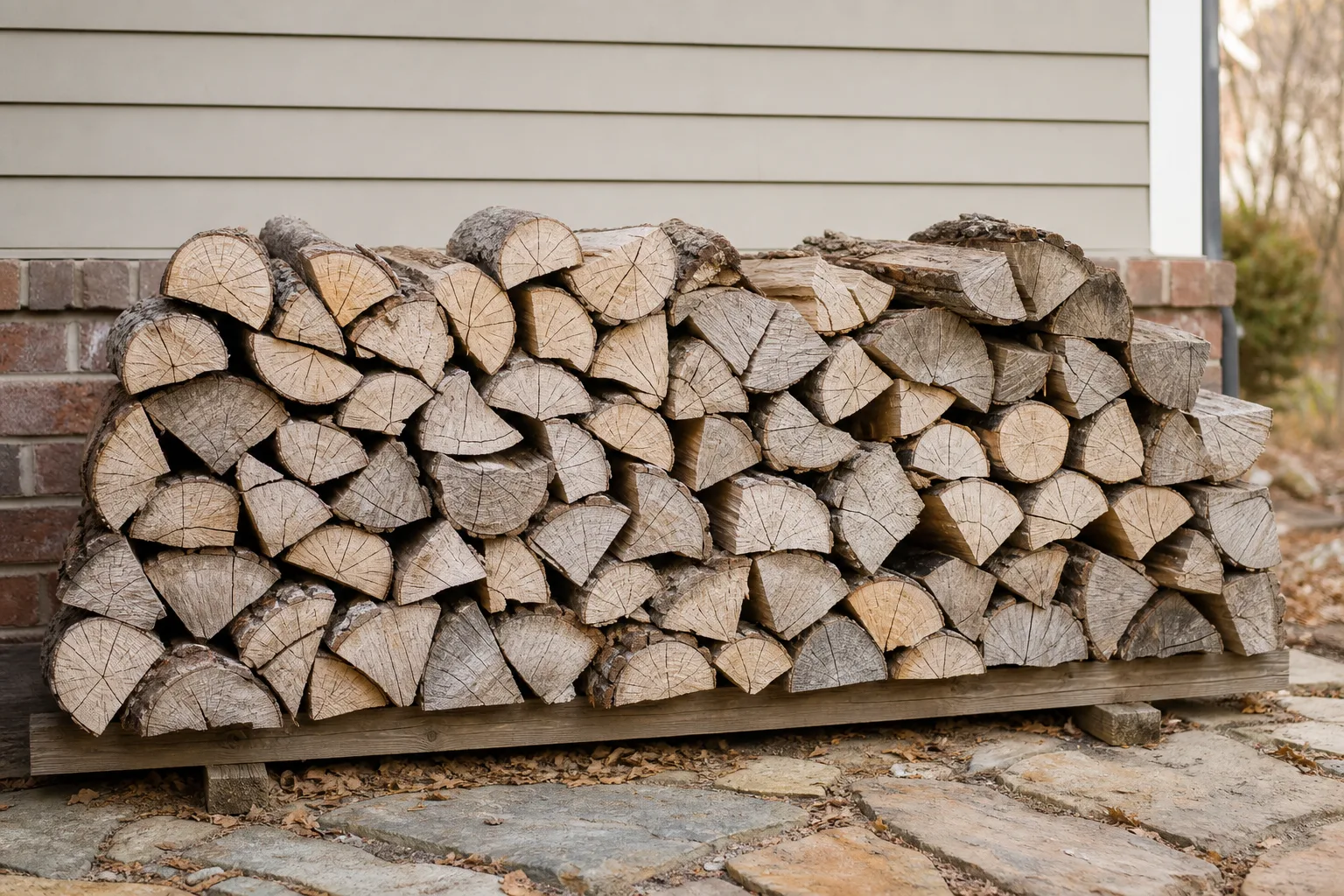
A seasoned split has cracks running from the center outward like a cut pie. Wood shrinks as it dries and the shrinking has to go somewhere. The end will be weathered gray or tan rather than fresh and pale, and the bark will be loose or gone.
A green split has a smooth, uncracked end, slightly damp looking, clean and pale, with the bark still gripping too hard to flick off with a thumb.
Once you have seen the two side by side it stops being a judgment call and becomes a glance.
The Knock Test and the Weight Test
Take two splits of similar size and bang them together.
Dry wood gives a sharp crack, almost like a bat hitting a ball. Wet wood gives a dull thud, because the water inside is damping the vibration.
Then pick one up. Water is heavy, and a green pine split feels startlingly heavier than a seasoned one the same size.
Using a Moisture Meter the Right Way
A meter costs very little and removes the guessing. Two pins, an LCD, a number.
The part almost everyone gets wrong: do not test the outside of the split. The weathered face has been sitting in the sun and reads dry no matter what the interior is doing.
Split a piece fresh and push the pins into the newly exposed inner face, across the grain. That reading is the truth. You want 20% or below.
Pro tip: Test three or four splits from different parts of the stack, not one. The outside rows dry months ahead of the middle, and the middle is where the surprise lives.
How Long Pine Takes to Season
This is the good news about softwood. Pine dries faster than dense hardwood, generally six to twelve months when it is split, stacked off the ground, and top covered with the sides open. The rules for producing properly seasoned firewood are the same for softwood; the clock is just shorter.
Oak and other dense hardwoods, by comparison, take considerably longer.
The range matters more than any single number. Split size, climate, sun and wind all move the finish line.
And "top covered, sides open" is the part people skip. A pile wrapped completely in a tarp is not seasoning. It is a greenhouse.
Is this split ready to burn? Check all of these:
- Radial cracks running out from the center of the cut end
- Bark loose, peeling, or already fallen off
- End grain weathered gray or tan, not fresh and pale
- Noticeably light for its size
- Sharp crack, not a dull thud, when knocked against another split
- A moisture meter reads 20% or lower on a freshly split inner face
- Split and stacked at least six months, off the ground, top covered with the sides open
Good to know: Storm-dropped pine is green wood, no matter how dead the tree looked standing. A limb that came down last week has a full load of water in it. That is next season's fuel, not this one's.
Pine vs Hardwood: What You Gain and What You Give Up
When you ask can you burn pine in a fireplace and get a yes, that yes comes with a trade. Pine is not oak wearing different bark.
What you gain is speed. Pine lights easily, comes up to temperature fast, and throws a tall bright flame.
What you give up is duration. Less dense wood means less energy per armload, so you reload more often, and pine leaves a shallower coal bed. If you want to bank a fire and find embers in the morning, pine is the wrong tool.
| Pine (softwood) | Dense hardwood (oak, hickory) | |
|---|---|---|
| Ignition | Lights fast, up to temperature quickly | Slow to catch, wants an established fire |
| Heat per load | Less energy per armload | More energy per armload |
| Burn duration | Shorter, frequent reloading | Longer, holds through an evening |
| Coal bed | Shallow, burns down quickly | Deep, holds embers overnight |
| Seasoning time | Roughly 6 to 12 months | Considerably longer |
| Best role | Kindling and the establishing load | The holding load |
| Spark tendency | Higher, resin pockets pop | Lower |
Look at that seasoning row again. Pine you split this spring may be ready this winter. Oak you split this spring is a fire for some later winter.
Free wood that can be ready inside a single season is not a consolation prize.
Open Fireplace, Insert, or Stove: The Distinction Everyone Skips
Here is where nearly every page on this topic quietly cheats.
The question can you burn pine in a fireplace is answered, almost universally, with advice about wood stoves. Those are not the same appliance, and the difference is exactly where the old warning still has teeth.
An open masonry firebox pulls large volumes of room air up the flue. That air is not on fire. It dilutes and cools the exhaust on the way up, so an open fireplace runs cooler flue temperatures than a closed appliance does.
A stove or an insert burns in a sealed box with controlled air. The exhaust leaves hotter and stays hotter longer.
So the same load behaves differently depending on what you put it in. That is why the internet argument never resolves: half the people are describing a stove and half are describing a hearth.
Can You Burn Pine in a Fireplace That Has No Doors?
Yes, and this is the case that needs the most care.
An open firebox is the cooler system, so the margin for wet wood is thinner. Dry pine is fine here. Half-seasoned pine in an open fireplace is where the folklore earns its keep.
Burn it in smaller, brighter loads rather than trying to make it last. And use the screen, which brings us to the thing nobody mentions.
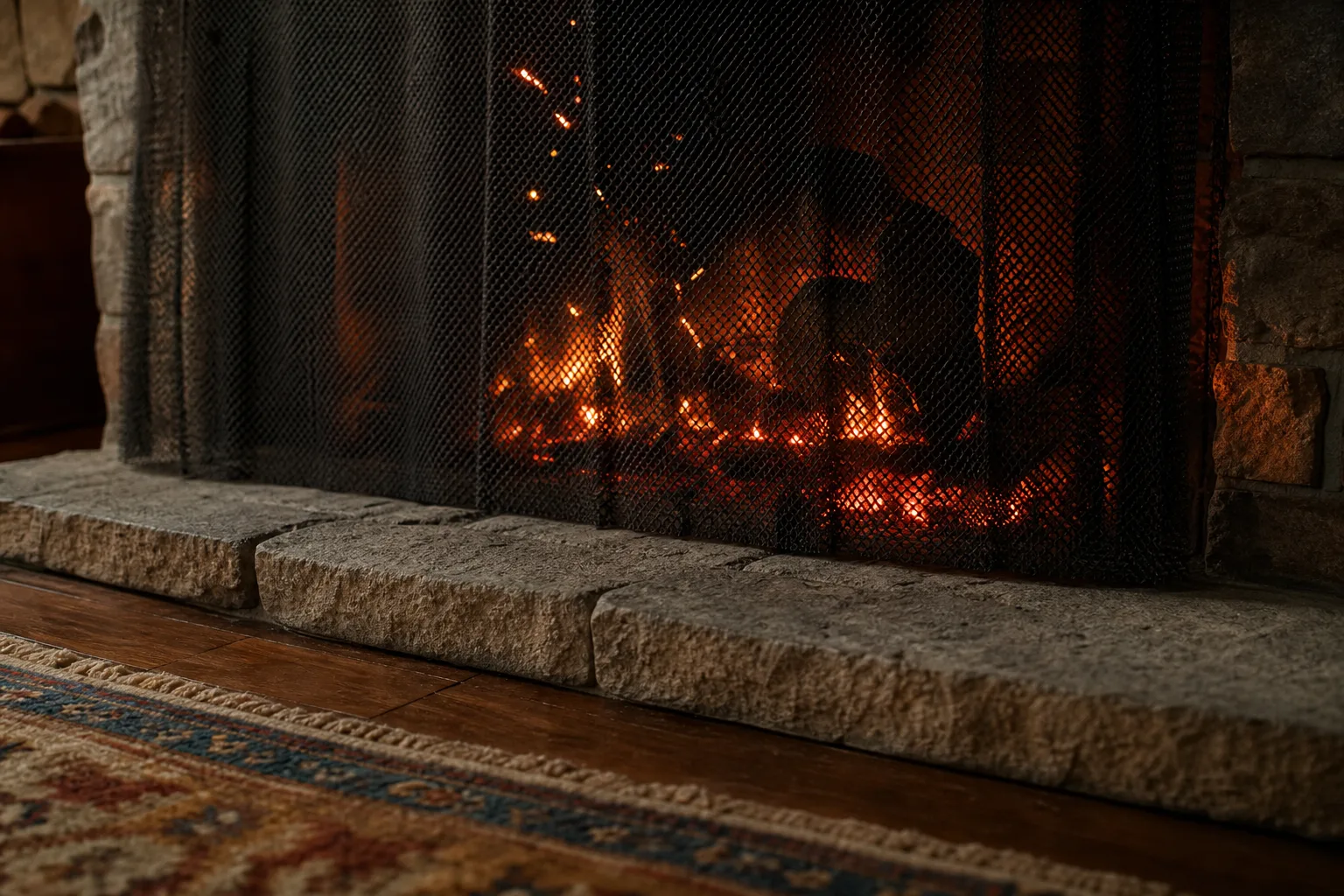
Safety note: The genuine risk of pine in an open fireplace is not the flue. It is the front. Resin pockets and trapped moisture inside knots heat up, vaporize fast, and pop, throwing burning embers out of the firebox. Knots and pine cones are the worst offenders. A mesh spark screen in front of the opening handles it. Glass doors are not a substitute unless your fireplace and its door system are specifically listed for burning with the doors closed, and many are not, so check the manufacturer's instructions before you close them on a fire. An unscreened open fire and a stack of knotty pine is the combination worth actually worrying about.
Inserts and Wood Stoves
Can you burn pine in a fireplace insert or a freestanding stove? Comfortably, and with fewer caveats than the open hearth gets.
The firebox is sealed, so the popping stays where it belongs. The exhaust runs hotter, so the condensation margin is wider. You control the air, so you control the burn. That is one of the quiet arguments for wood burning fireplace inserts in a house with an open hearth and a supply of softwood.
The one discipline that carries over: do not choke the air down to a smolder to stretch the load. That builds deposits in any appliance, with any species.
Prefab Metal Fireboxes
A prefab fireplace comes with a manual, and the manual is not decoration. Most specify seasoned cordwood and nothing else, with real limits on load size.
If you no longer have the manual, the model plate inside the firebox tells you what you own.
From the field: The flues that look worst are rarely the ones belonging to people who burn softwood. They belong to people who run a small, damped-down fire all evening because they want it to last, and never open the air back up. The burning habit tells you more about what is on the flue wall than the woodpile ever does.
How to Burn Pine Well: The Mixed Fire
The species argument is a hobbyist's argument. Nobody has to choose.
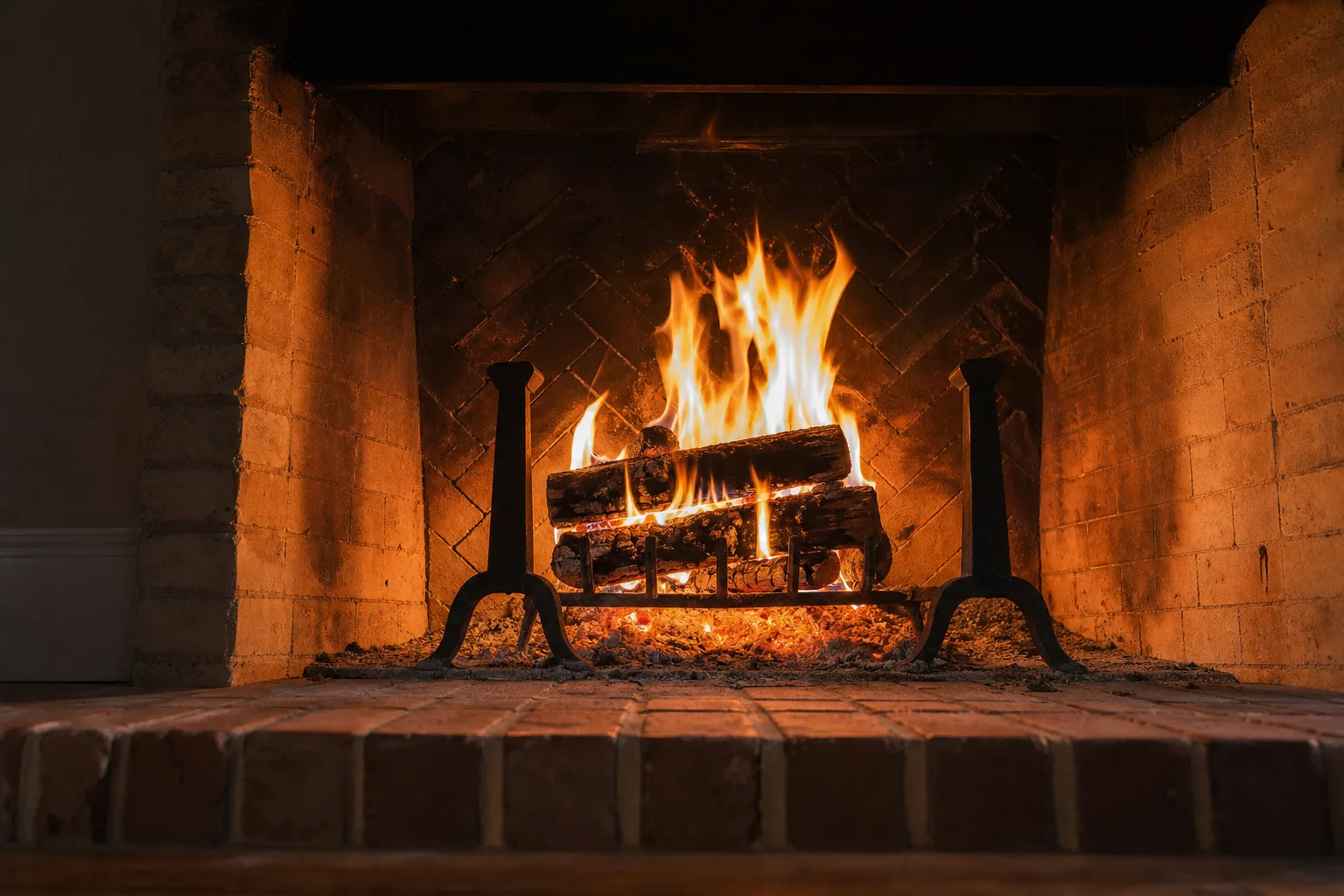
The best fire most people can build uses both: pine to establish it fast and hot, hardwood to hold it once the box is up to temperature. Easy start, long evening.
That is the practical answer to can you burn pine in a fireplace, and it beats any verdict on the species alone.
Building the Fire
Start with small, dry pine splits. Get real flame going and let the firebox and the first few feet of flue warm up before you ask anything of the fire.
Once it is burning hard, add the hardwood. The heat is already there to take it.
Give it air early. The instinct to close the damper the moment the flame looks healthy is the instinct that coats flues.
Pro tip: Split pine smaller than you would split oak. Surface area is what makes softwood catch and run, and a fat pine round in a cold firebox just sits there sulking and smoking.
Knots, Cones, and Pitch Pockets
Pine knots are resin concentrated into a hard lump. They burn long and hot, which is useful, and they pop, which is not. Same for pine cones: excellent fire starters, enthusiastic spark producers.
Not a reason to avoid them. A reason to have the screen closed when they are in the fire.
Outside, the equivalent is a chimney spark arrestor at the top of the flue, catching what goes up the way the screen catches what comes out the front.
What a Cool, Smoldering Fire Costs You
A good pine fire is tall, bright, active, and mostly flame rather than coal. Smoke leaving the chimney should be thin and nearly invisible once it is established.
A bad fire is dark orange, lazy and quiet, with thick gray smoke coming off the stack. That smoke is unburned fuel going up the flue, and not all of it is going all the way out.
Visible smoke an hour into the burn means the wood is wet, the air is choked, or both.
How VIO Helps When You Are Burning Pine
Two of the three conditions on this page are entirely yours. You can dry the wood. You can run the fire hot. That is a woodpile and a habit.
The third is different, because you cannot see up your own chimney. Anyone who answers can you burn pine in a fireplace with a flat yes or no is skipping the only part that needs a set of eyes.
VIO CHIMNEY is a referral service. We match homeowners with independent local chimney companies, and those companies do the work: the annual Level 1 inspection NFPA 211 calls for, the sweeping, the repairs if something turns up. The company we match you with is a local business, not an arm of ours.
For someone about to burn pine, the useful call is the pre-season one. A Level 1 inspection covers the readily accessible parts of the chimney, the appliance and the connection between them, and answers the question this article cannot: what is on your flue walls right now, and whether the structure is sound. It is the same visit that anchors ordinary chimney maintenance for any wood-burning house.
NFPA 211 calls for a Level 2 inspection rather than a Level 1 at specific moments: sale or transfer of the property, changes to the system (a new appliance, a different fuel, a change to the flue), after a malfunction or an operating incident, after a chimney fire, and after an external event like severe weather that could have caused damage.
If any of those describe your situation, say so when you request service, because it changes what needs to happen.
On money: we ask every company in the network to put its estimate in writing before any work starts, and you should insist on exactly that.
Can You Burn Pine in a Fireplace? The Verdict, and What to Do Next
Burn it.
The man at the fence was passing along a rule that got the cause wrong. Pine sap is not what coats your flue. Wet wood and cool, smoldering fires are, and those are habits, not species.
So the answer to can you burn pine in a fireplace is yes, under the three conditions this article has been circling: dry wood, a hot fire, and a flue whose condition you know rather than assume.
Go out to the stack and test it. End grain, weight, knock, meter on a fresh face. Sort the ready wood from the wood that needs another summer, because a mixed pile burned indiscriminately is how good pine gets a bad reputation.
Get a screen in front of the firebox if there is not one there already.
And book the inspection before the first fire, not after something goes wrong. That is the only part of this you cannot figure out from the yard.
Burn the pine. Know the flue. Get the stack seasoned, burn it hot, and start the season knowing what your chimney looks like inside. VIO CHIMNEY is a referral service: we match you with independent chimney companies near you, and we ask every company in the network to put its estimate in writing before any work starts. You should insist on exactly that. Call (513) 655-6702
Symptom checker
What is your chimney doing?
Tap the closest match for an honest first answer.