



On this pageWhat a wood burning fireplace insert actually is8 sections+7
- What a wood burning fireplace insert actually is
- Masonry or prefab: which fireplace inserts wood burning models you can use
- The part nobody budgets for: the chimney liner
- Catalytic, non-catalytic, or hybrid
- Sizing fireplace inserts wood burning: measure before you shop
- What installation day actually looks like
- What a wood burning insert is bad at
- How VIO helps with fireplace inserts wood burning
Quick answer
Fireplace inserts wood burning models are sealed steel or cast iron fireboxes that slide into an existing masonry or factory-built fireplace and turn it into a real heat source. Unlike an open fire, which sends more warm household air up the flue than it returns, an insert controls its combustion air. Every listed wood insert also requires a full length stainless steel chimney liner.
You can have a fire going and a cold living room at the same time. Anyone who owns an open masonry fireplace has lived this, and it is not their imagination.
An open fireplace draws heated household air into the firebox and pushes it up the flue. A little heat radiates back at you. More warmth leaves the house than arrives in the room.
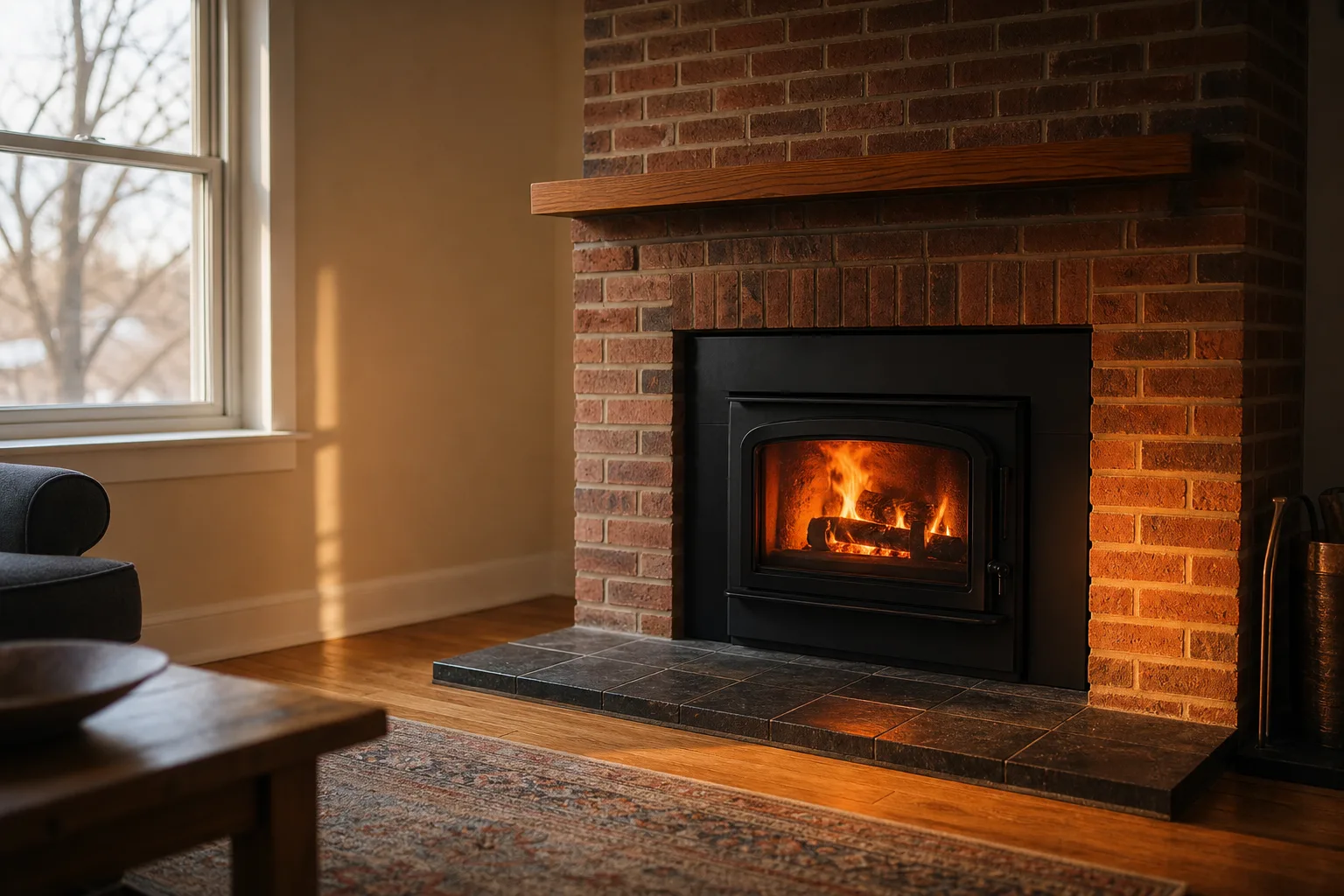
That is the exact problem fireplace inserts wood burning models were built to solve. A sealed firebox, controlled combustion air, and a glass door turn the same masonry opening into something that actually heats.
Search fireplace inserts wood burning and you land in a wall of product grids that assume you have already decided what you are buying. You probably have not.
And there is something worth knowing before you get that far: it is easy to budget for the wrong part of this project. Not the wrong amount, the wrong part. I will come back to which part, because it is the single most useful thing on this page.
First, what the thing is, and whether your fireplace can even take one.
What a wood burning fireplace insert actually is
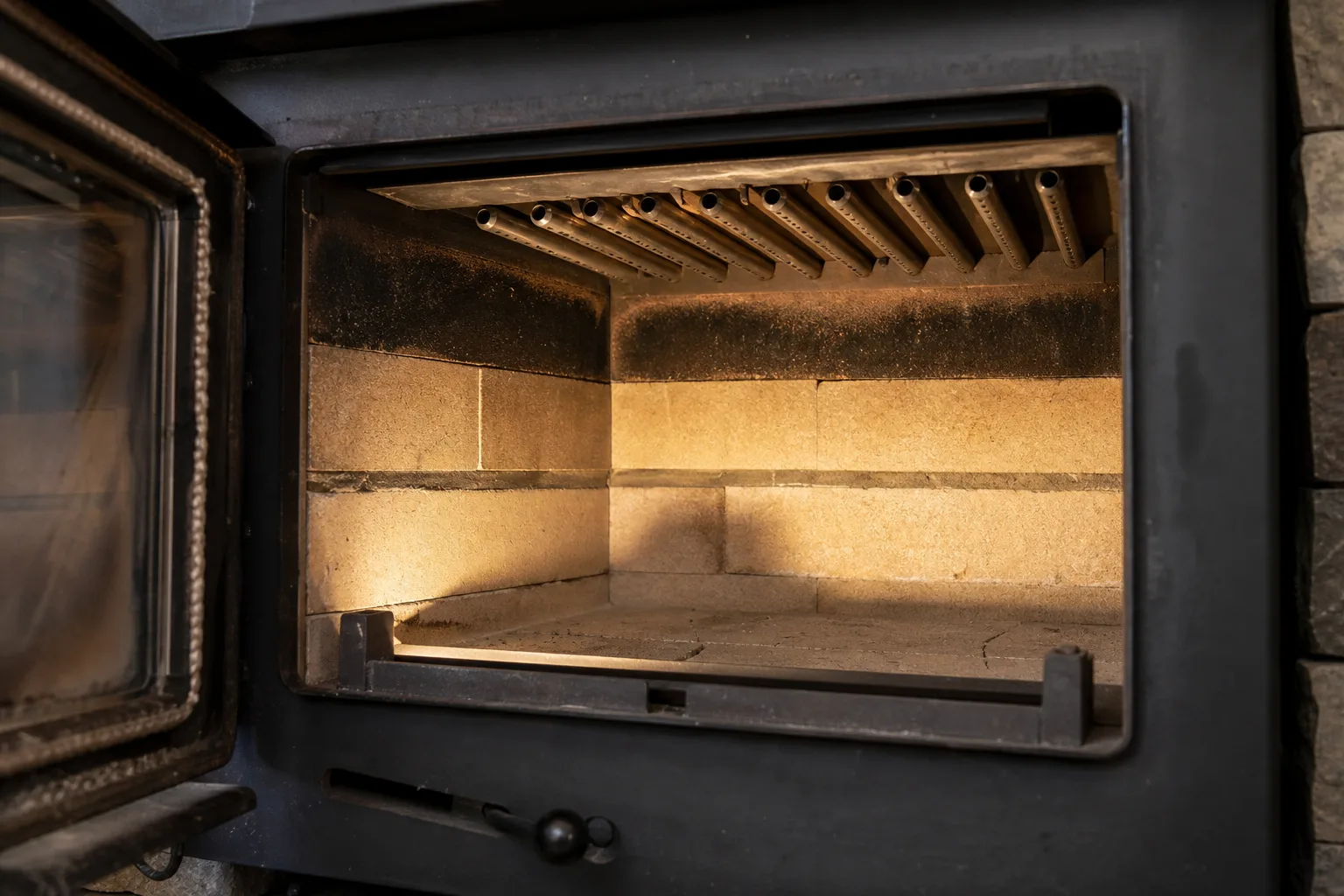
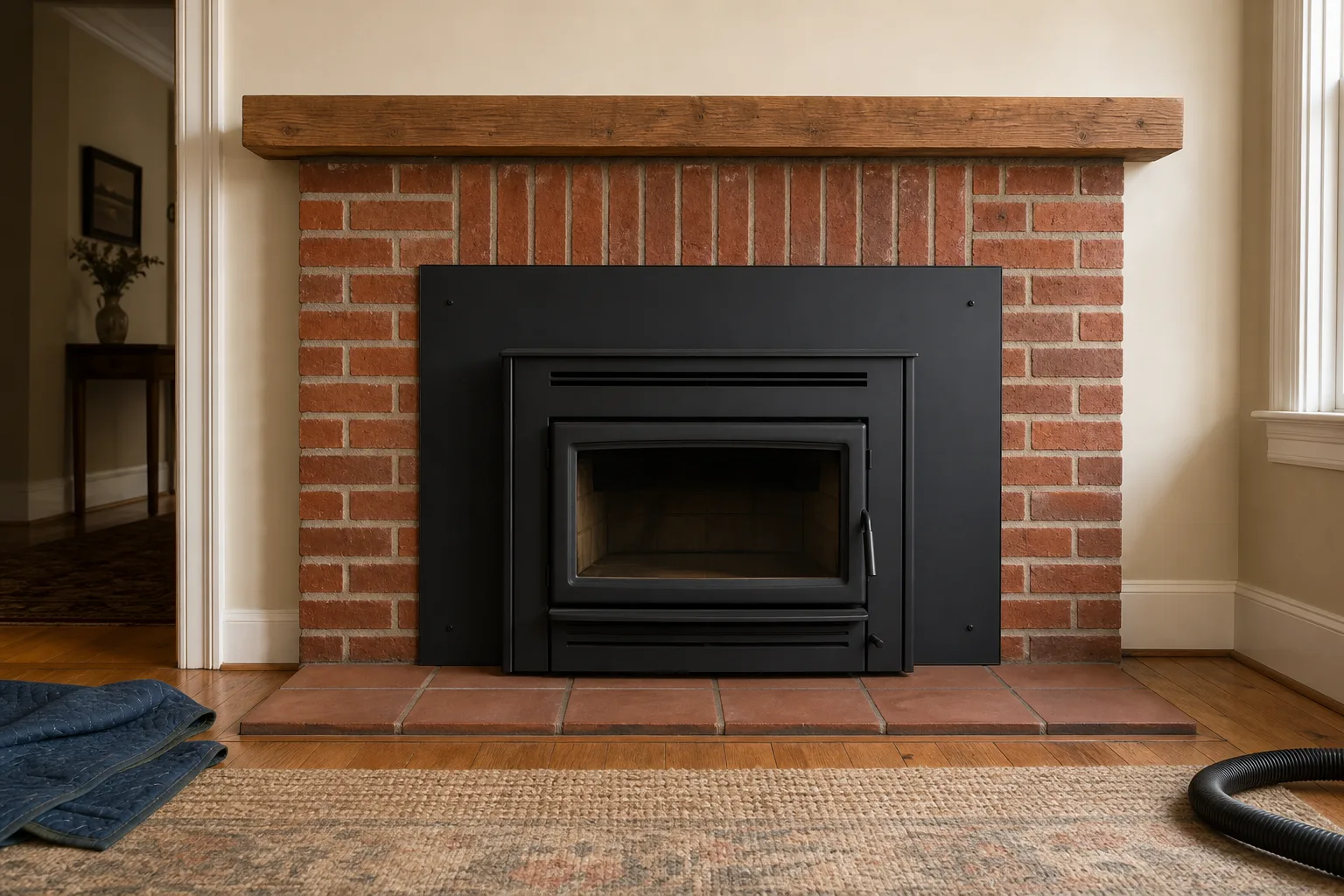
An insert is a sealed firebox, steel or cast iron, that slides into the fireplace opening you already have. The front is mostly ceramic glass in a metal frame, with a handle on one side and an air control lever underneath.
Inside, firebrick lines the walls. Near the top sits either a row of stainless steel air tubes under a baffle, or a catalytic combustor behind a bypass plate. Those are the two ways a modern unit burns its own smoke, and I will come back to them.
A flat steel panel called the surround covers the gap between the insert body and the raw fireplace opening. It is what makes the finished install look intentional rather than like a box shoved in a hole.
Here is the difference that matters. An open fireplace is a hole in the wall with a fire in it, and the fire takes its combustion air from the room. An insert is a closed appliance. You decide how much air reaches the fire, which means you decide how fast the wood burns and how long the heat lasts.
A freestanding wood stove does the same job, but it stands out in the room on its own hearth pad with its own pipe. An insert uses the fireplace cavity you already paid for. That is the whole appeal.
Since May 15, 2020, the EPA's Step 2 standard has required solid fuel room heaters to emit no more than 2.0 grams per hour of particulates tested with crib wood, and 2.5 grams per hour tested with cord wood. The earlier Step 1 limit was 4.5 grams per hour.
Good to know: Each certified unit carries an EPA label listing its own tested emissions figure. When a salesperson quotes an efficiency percentage, ask to see that label rather than the brochure.
Masonry or prefab: which fireplace inserts wood burning models you can use
This is the fork in the road, and almost no page leads with it. Whether you have a real masonry chimney or a factory-built metal fireplace determines which units you are allowed to install. Not which ones look nicer. Which ones are legal.
How to tell in ten seconds
Open the doors and look at the back and side walls of the firebox with a flashlight.
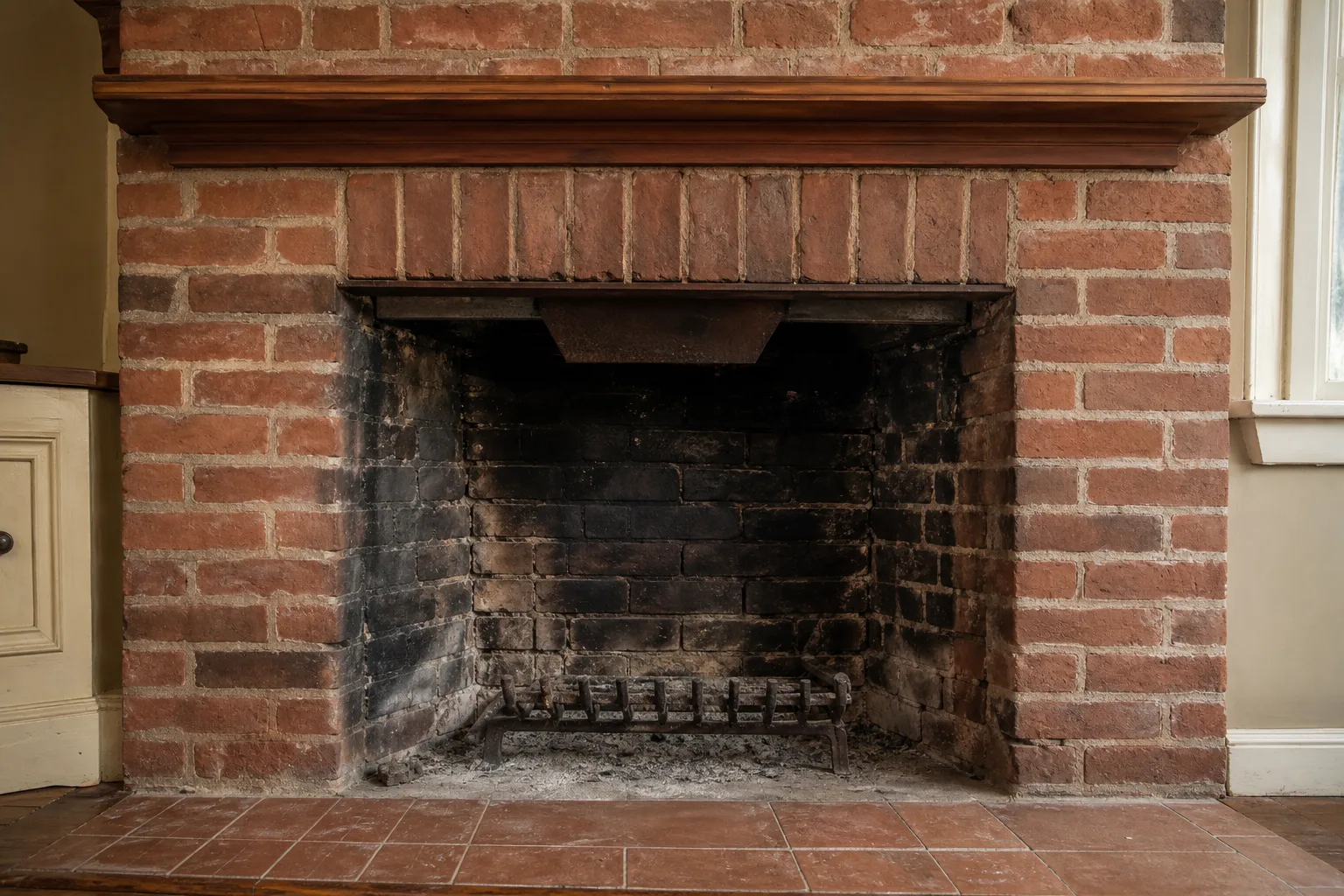
Real masonry shows individual firebricks with visible mortar joints between them. The joints are irregular. The brick is porous and, if the fireplace has been used, black.
A factory-built or prefab fireplace shows refractory panels with a brick pattern stamped into them, in a repeating grid that is a little too neat. At the corners and the top of the opening you will usually find metal seams, sometimes exposed screw heads. From outside, a prefab typically vents through a metal pipe inside a framed chase rather than a brick stack with a masonry crown.
If you have a masonry fireplace
Good news. The masonry path is the wide one, and most wood inserts on the market are listed for installation into a masonry fireplace. Your constraints will be dimensional and structural: the size of the opening, the depth of the firebox, the condition of the flue, and whether the hearth extension in front meets the clearance the unit calls for.
If you have a factory-built fireplace
Stop before you shop. A prefab fireplace is a listed assembly, tested and approved as a complete system. Dropping a wood burning insert into it changes that system, and the manufacturer's listing controls what is permitted.
Some fireplace inserts wood burning manufacturers do produce units specifically listed for installation into certain factory-built fireplaces, identified by fireplace make and model. If your prefab is not on that list, the answer is no, and no installer worth hiring will tell you otherwise. Options at that point are a full fireplace replacement or a freestanding stove.
Myth vs. fact: The myth is that an insert is a universal part and any unit fits any fireplace. The fact is that every wood insert is listed for specific installation conditions, and a prefab fireplace narrows the field hard.
The part nobody budgets for: the chimney liner
Here is the thing I promised at the top. The part people get wrong is not the appliance. It is the chimney.
A wood burning insert cannot vent into your existing flue as it stands. Units listed to UL 1482, which is the standard for solid fuel room heaters, require a liner running from the insert's flue collar all the way to the chimney termination. That requirement is a condition of the listing, not an accessory the installer is upselling you.
Under the 2024 IRC and NFPA 211, installing a wood insert into an existing masonry fireplace calls for a full length flexible stainless steel liner, from the collar at firebox level to the top of the stack.
So the real project is an appliance plus a liner plus labor on a roof. It is easy to price only the first item when shopping fireplace inserts wood burning options and to learn about the other two from a quote, which is exactly how a budget breaks.
Why your existing clay flue is the wrong pipe
Your terra cotta flue was sized for an open fire, which produces a large volume of very hot gas. It is typically far too big in cross section for an insert, and usually rectangular where the appliance wants round.
A modern high efficiency unit pulls so much heat out of the smoke that what reaches the chimney is cooler and more inclined to condense. Cool gas in an oversized masonry flue slows down, drops its moisture and tars on the walls, and builds creosote. That is the reason the liner requirement exists.
The Level 2 inspection, and why it is not optional here
NFPA 211 defines three inspection levels. A Level 2 is required at the sale or transfer of a property, after a malfunction or a chimney fire, after an external event like severe weather, and at any change to the system.
Installing an insert is a change to the system. Different appliance, different fuel path, different flue size and material. That is squarely inside the definition, which is why a competent company will want to scan the flue before quoting anything.
Safety note: If someone offers to set a wood insert into your fireplace without a liner and without looking up the flue first, that is not a shortcut. It is an installation outside the appliance's listing, and an insurance carrier will take an interest in that after a chimney fire.
Before you shop fireplace inserts wood burning, find out what your chimney can take. You can measure the fireplace opening yourself this afternoon. What you cannot do from the living room floor is tell whether the flue above it will accept a liner. Call (513) 655-6702 and VIO will match you with a local chimney company that can look at it.
Catalytic, non-catalytic, or hybrid
Every wood insert has to burn its own smoke to hit the current emissions standard. There are three ways manufacturers do it, and the choice affects how the unit behaves in your house far more than the spec sheet suggests.
Non-catalytic
A baffle at the top of the firebox holds smoke inside longer instead of letting it run straight up the flue, while small stainless tubes inject fresh air into the top of the fire. The smoke ignites a second time on its way out.
Secondary combustion in this design needs the firebox up around 1,100 degrees to work. Non-catalytic units average roughly 71 percent efficiency on a higher heating value basis, with a range across the market of about 60 to 80 percent. They are generally the less expensive design and there is no combustor to replace.
Catalytic
Smoke passes through a coated ceramic honeycomb, and the coating lets the gases and particles ignite at around 500 degrees rather than 1,100. That much lower ignition point is the entire advantage: the unit keeps burning cleanly at low output, long after a non-catalytic firebox has cooled below its secondary burn threshold.
Catalytic units average about 78 percent efficiency on the same basis, with a range of roughly 63 to 84 percent. The combustor is a wear part with a bypass lever to operate, so there is a little more to learn and a little more to maintain.
Hybrid
Both systems in one appliance. Burn tubes handle the hot part of the cycle, the combustor takes over as things cool down, and the result is a clean burn across a wider temperature band than either design manages alone.
| Design | How it burns the smoke | Typical efficiency (HHV) | Best suited to | What you maintain | The tradeoff |
|---|---|---|---|---|---|
| Non-catalytic | Baffle plus secondary air tubes, needs about 1,100°F | Around 71% average, roughly 60 to 80% | Evening and weekend fires, supplemental heat | Baffle and air tubes, no combustor | Loses clean burn when damped down low |
| Catalytic | Coated ceramic combustor ignites smoke near 500°F | Around 78% average, roughly 63 to 84% | Long steady burns, primary or near primary heat | Combustor, bypass mechanism, gasket | More to learn, and a wear part to replace |
| Hybrid | Secondary tubes plus a combustor | Manufacturer specific, generally at the top of the range | Homes that want both long burns and hot fast fires | Everything a catalytic unit needs | Most complex, usually the highest price |
My honest read: choose by how you actually heat, not by which row looks best. If you burn on cold evenings and weekends and the furnace carries the rest, a good non-catalytic unit is the sensible buy. If you intend to run the insert all day through winter and want long, low, steady output, the fireplace inserts wood burning models with a combustor earn their complexity.
Pro tip: The efficiency figures above are category averages on a higher heating value basis, not a promise about any particular unit. The number that applies to your house is on the EPA label of the model you are considering.
Sizing fireplace inserts wood burning: measure before you shop
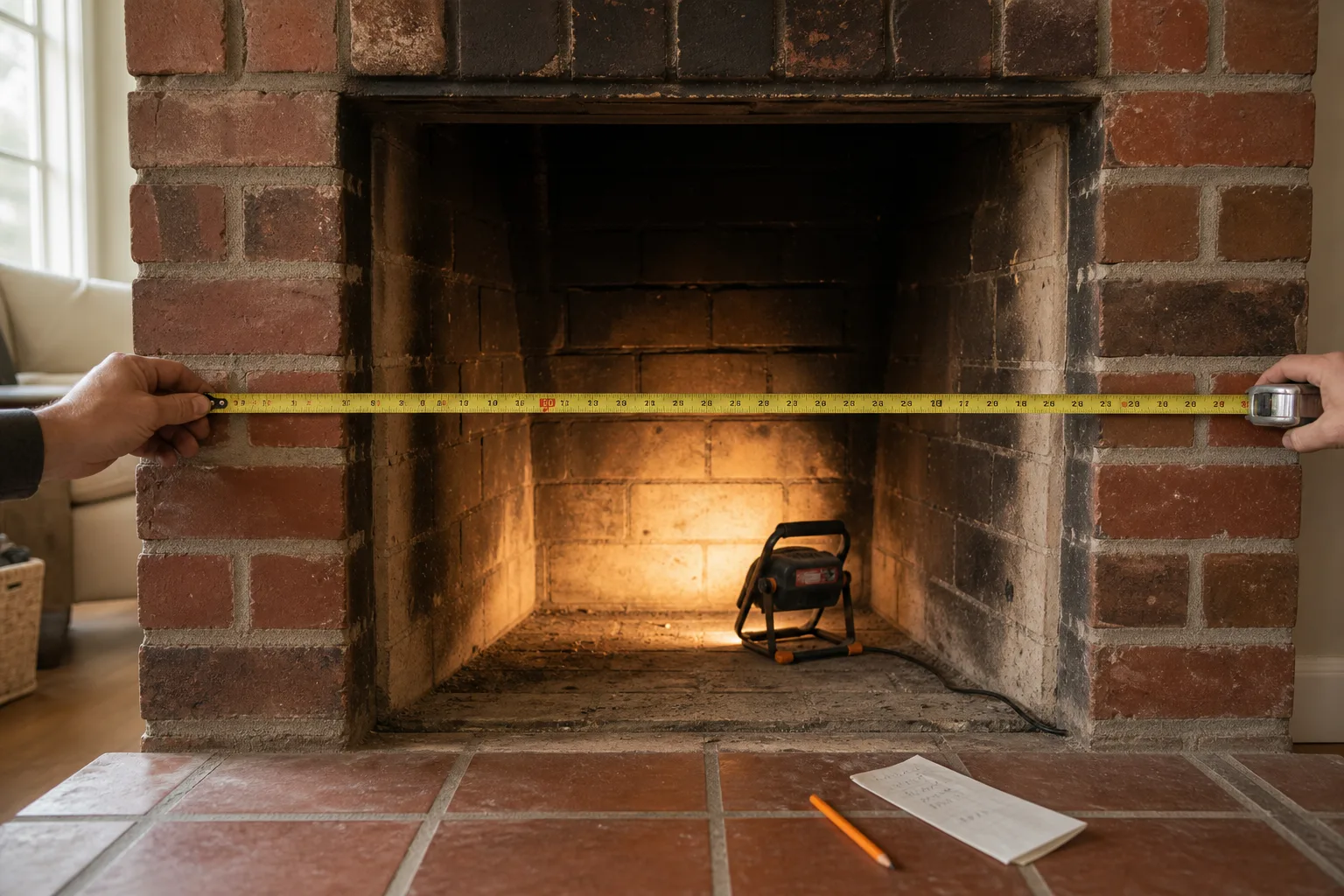
Nothing narrows the field faster than a tape measure. Ten minutes on the hearth eliminates most of the catalog and saves you from falling for a unit that was never going to fit.
The four measurements to take today
Write these down and keep them on your phone. Every dealer and installer will ask for them.
- Front width of the opening. Measure across the face, left to right, at the widest point.
- Rear width of the firebox. Most fireboxes taper toward the back. This number is usually the one that kills a fit.
- Height of the opening at the front. Floor of the firebox to the underside of the lintel.
- Depth, front to back. Measure at the floor of the firebox, not at the top.
- Hearth extension depth. How far the non combustible hearth projects into the room in front of the opening.
- Raised hearth height, if the firebox sits above floor level.
Take each measurement twice. Old fireboxes are rarely square, and if your two readings disagree, use the smaller one.
Sizing fireplace inserts wood burning to the room, not the house
Manufacturers publish a heated square footage range for every model, and those numbers assume an open, reasonably insulated floor plan. Treat them as a rough sort, not an answer.
An insert heats the room it is in, plus whatever the air can reach. A wood insert in a living room with a wide cased opening into the kitchen will warm both. The same unit in a house full of doors and hallways will make one room lovely and leave the bedrooms exactly as they were.
Layout beats square footage every time.
If you want the heat to move, look for a model with a blower: an electric fan in a channel wrapped around the firebox, pulling room air through and returning it warmed. Most are controlled by a thermodisc that closes the circuit once the firebox reaches a set temperature, typically around 110 to 130 degrees. A blower needs power at the fireplace, so check for an outlet in or near the firebox before you assume it is an option.
From the field: Oversizing is an easy mistake to make and an awkward one to live with. A unit with more capacity than the room needs gets run damped down to keep the space comfortable, and a damped down fire is a dirty fire. Buying the bigger box for headroom works against you.
What installation day actually looks like
Knowing the sequence makes it much easier to tell a thorough installer from a fast one.
The crew protects the room first, floor coverings from the hearth out. The firebox gets cleaned out and the old damper plate is removed or fixed permanently open, since the liner has to pass through the throat.
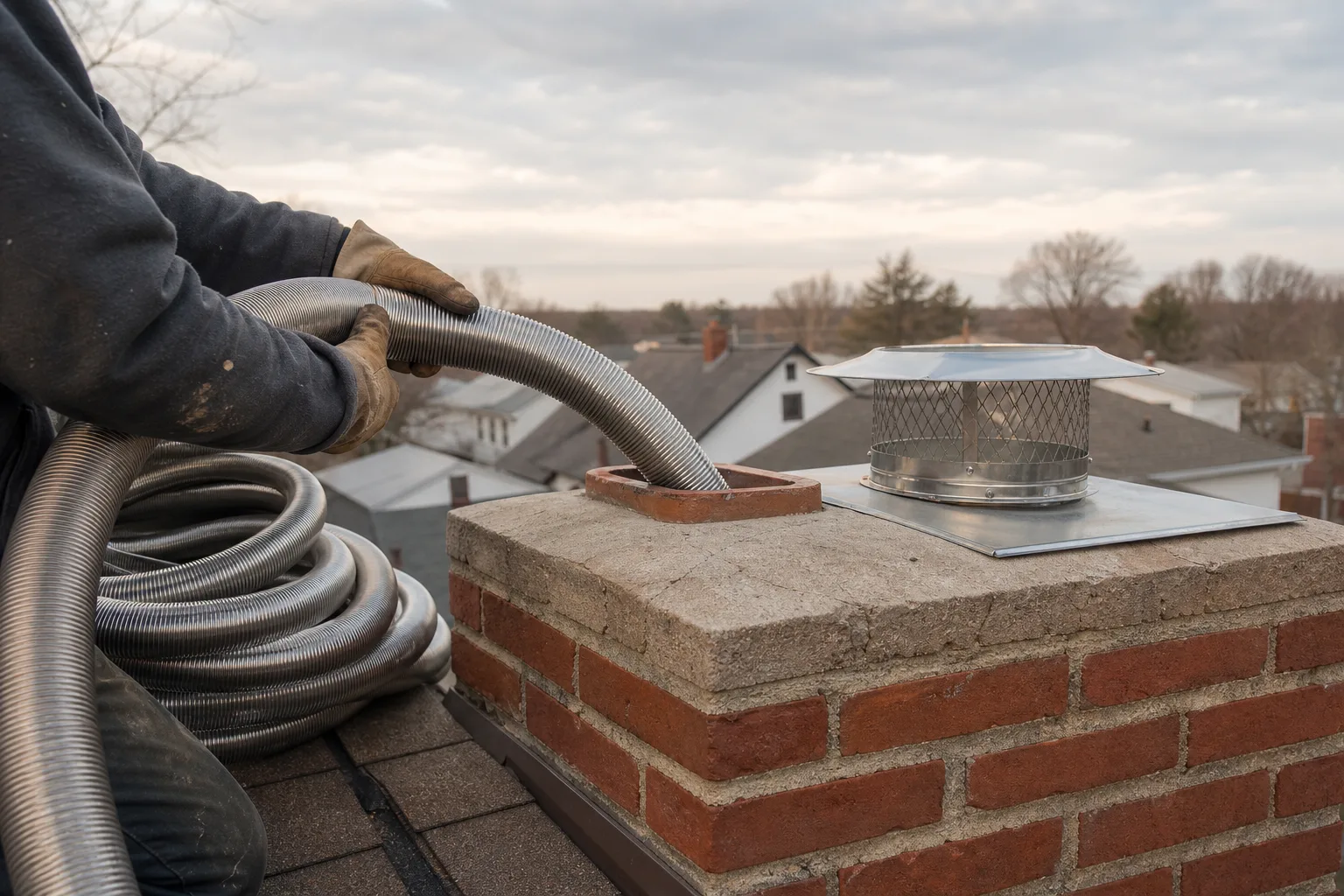
Most of the real work happens on the roof. The stainless liner is fed down the flue from the top, which is why an obstructed or offset chimney turns a routine job into a long one. At the crown it terminates in a top plate and a rain cap, insulated where the manufacturer or the flue condition calls for it.
Inside, the insert is set on the hearth and worked into the opening, the liner is connected to the flue collar, and that connection is sealed and secured rather than just pushed together. The surround panel goes on last, screwed to the casing.
Then break-in fires. Small, progressively warmer burns over the first few uses cure the paint and let the firebrick and gaskets settle. Your manual will spell out the schedule.
Where your jurisdiction requires a permit and a final inspection for a solid fuel appliance, ask for the paperwork.
Pro tip: If a wood insert ever smokes into the room or drafts poorly, the flue collar connection is the first place to look. A compromised seal or an obstruction right at that joint accounts for a large share of draft complaints.
What a wood burning insert is bad at
Every page selling these things skips this part, so here it is plainly. Fireplace inserts wood burning appliances are excellent at one job and mediocre or worse at several others.
They heat the room they are in. If you are picturing whole house warmth from a single unit in a compartmented floor plan, adjust the picture now.
They demand real wood. Seasoned, split, and dry, ideally checked with a firewood moisture meter rather than guessed at. Wet wood in a modern high efficiency unit is the fastest route to a glazed flue and a disappointing fire, and no combustion technology saves you from it.
They need attention: an annual chimney inspection, with sweeping whenever the flue condition calls for it, plus gasket checks, and on a catalytic unit, a combustor that is a consumable part.
They are permanent in a way an open fireplace is not. Your damper is gone, the liner is installed, and the fireplace is now an appliance.
Some jurisdictions restrict or prohibit new wood burning appliance installations, particularly in areas with air quality management districts. Check your local rules before you fall in love with a model.
And the blower needs power. In a winter outage the insert still heats, but by radiation only, which is worth knowing before you count on it as your backup.
How VIO helps with fireplace inserts wood burning
Plainly stated, VIO does not install anything. We are a referral service. We match homeowners with independent local chimney and hearth companies, and that company does the work under its own name. Ask it for its credentials and its references, the same as you would with any contractor.
Here that matters more than usual. The question that decides your project is not which model you like. It is what your chimney will support, and answering it takes someone with a camera on a cable and a ladder.
Call us and we will connect you with a company near you that can run the Level 2 inspection an insert install calls for, tell you whether your flue can take a liner and what kind, and quote the whole job rather than a piece of it.
On estimates: we ask every company in the network to put its estimate in writing before any work starts, and you should insist on exactly that. A quote for fireplace inserts wood burning work should itemize the appliance, the liner and its components, the labor, and the permit if one is required.
The pro we send should be willing to show you the flue footage, not just describe it.
Do it in the right order: measure, inspect, then choose your fireplace inserts wood burning unit. Shopping the appliance first and learning about the chimney last is how budgets break. Call VIO at (513) 655-6702 and we will connect you with an independent chimney company near you that can tell you what your system will support.
Symptom checker
What is your chimney doing?
Tap the closest match for an honest first answer.