



On this pageWhat Chimney and Dryer Vent Cleaning Actually Covers7 sections+6
- What Chimney and Dryer Vent Cleaning Actually Covers
- Two Systems, Two Very Different Clocks
- What a Combined Visit Should Actually Look Like
- Signs You Are Overdue on Either System
- When Booking Them Together Is Not the Right Move
- Questions to Ask Before You Book Chimney and Dryer Vent Cleaning
- How VIO Helps With Chimney and Dryer Vent Cleaning
Quick answer
Chimney and dryer vent cleaning combines two services that a single company can often handle in one appointment. The chimney side begins as an annual inspection under NFPA 211, with sweeping performed only when buildup reaches the condition threshold. The dryer side is a full duct cleaning driven by laundry volume and duct length. Combine the visit when both are due, but let each system follow its own schedule.
Two chores, one list.
The fireplace needs looking at before the first fire of the season, and the dryer has started needing a second cycle to finish a load of towels. So you go searching for chimney and dryer vent cleaning, because somewhere in the back of your mind you have already decided you would rather make one phone call than two.
That instinct is a reasonable place to start. Companies that sweep chimneys often clean dryer vents as well, and the two jobs can sit inside the same appointment.
But there is a catch worth two minutes of your time before you dial. It decides whether you get a real service or a lint brush added to the invoice.
Combining the visit can make good sense when both systems are actually due. Combining the schedule is where people go wrong.
Your chimney and your dryer vent are both exhaust passages, and both fail the same way, by narrowing. That is why one company can sensibly handle both.
What they do not share is a service interval. Treat them as a matched pair on the calendar and you can end up overservicing one while neglecting the other, in the same year, on the same visit.
Here is what chimney and dryer vent cleaning actually includes, how to read each system for yourself, and the questions that separate a company doing both properly from one padding the ticket.
What Chimney and Dryer Vent Cleaning Actually Covers
The phrase bundles two trades that look unrelated from the driveway and turn out to be close cousins.
Both systems move hot, dirty air from an appliance to the outdoors, and both collect a combustible residue along the way. That residue does two things at once: it chokes the airflow the appliance was built around, and it sits there as fuel inside a passage that gets hot.
Different deposits. Same failure mode.
The chimney side of the job
The chimney portion starts as an inspection, not a cleaning. Someone looks at the firebox, the damper, the smoke chamber and the flue, with a bright light and a camera on a flexible pole, and forms a picture of what is coating the inside and what condition the structure is in.
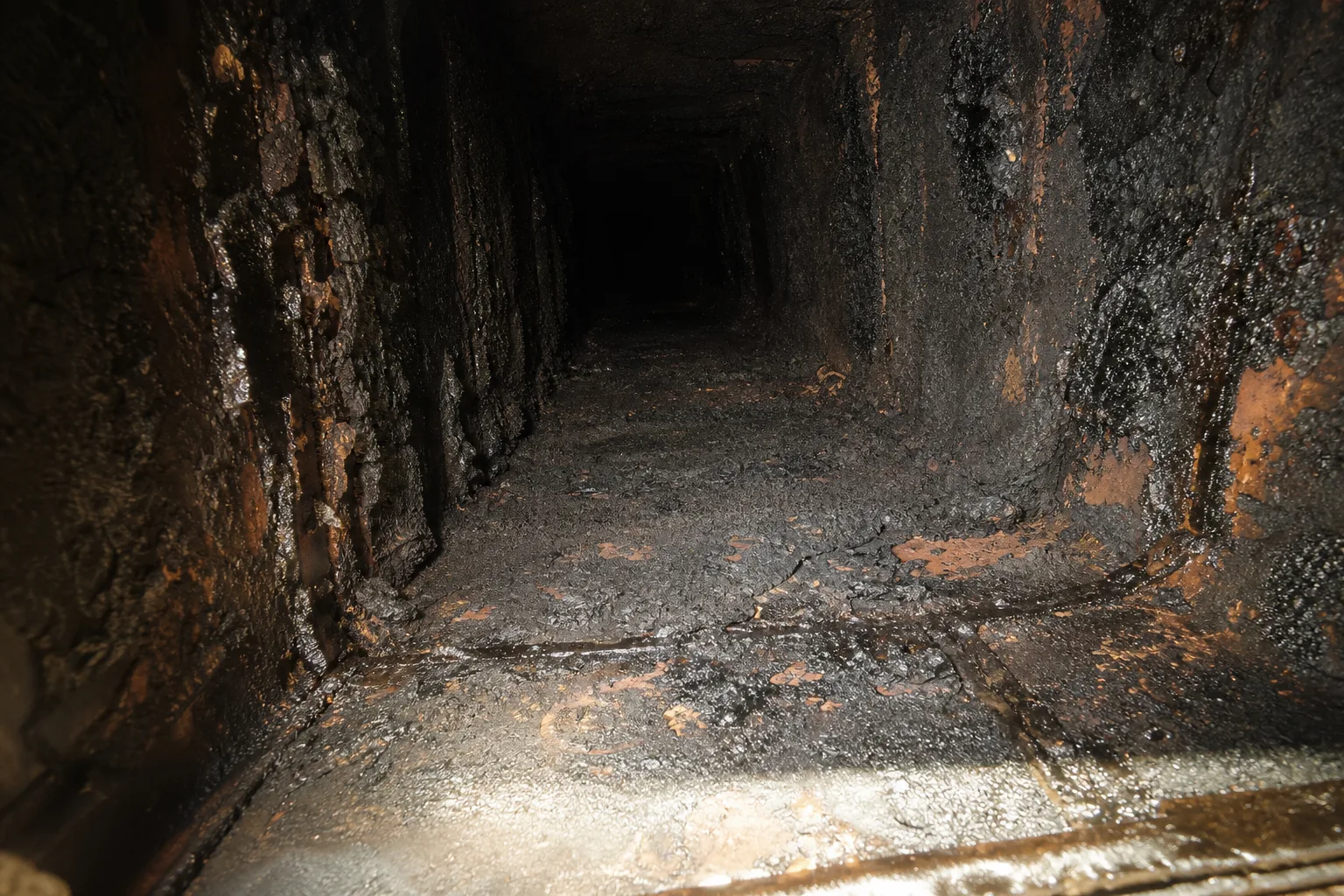
If the flue needs sweeping, that is when brushes and rods come out. Creosote is the target. It arrives as a byproduct of wood that did not burn completely, and it shows up in a range of forms: dull black flaking, crusty granular buildup, or a hard shiny glaze that has baked onto the clay flue liner.
The inspection also catches things a brush will never fix. A cracked crown. Failed flashing where the stack meets the roof. A liner that has gaps in it.
The dryer vent side of the job
The dryer side is simpler in concept and more annoying in practice. A duct runs from the back of your dryer, through a wall or a floor, and terminates at a hood on the outside of the house. Lint travels that whole distance, and some of it stays.
Cleaning means getting a brush through the full run, not just the six inches you can reach.
Two spots matter more than the rest: the exterior hood, where lint collects on the damper flap, and the transition duct behind the appliance, which is the short piece that gets kinked when the dryer is pushed back against the wall.
Good to know: Creosote and lint have nothing in common chemically, but they behave identically once they are inside a duct. Both are combustible, and both reduce the cross section the appliance was engineered around. That is the real reason these two services live under one roof, and it is a better one than "we were already in the neighborhood."
Two Systems, Two Very Different Clocks
Here is the part that changes how you book.
The two systems do not run on the same kind of schedule. They do not even run on the same kind of clock. One is measured by condition. The other is measured by use.
The chimney runs on condition
NFPA 211, the standard covering chimneys, fireplaces, vents and solid fuel burning appliances, is specific here. Section 14.2.1 states that chimneys, fireplaces and vents "shall be inspected at least once a year in accordance with Table 14.3 and cleaned and repaired if necessary."
Read that last clause slowly. The inspection is annual. The cleaning is conditional.
Sweeping is warranted when 1/8 inch or more of soot or creosote has accumulated, when any glaze or scale is present, or when the inspection turns up an obstruction. It is a threshold, not a date.
Which means a fireplace that got light use last winter can be inspected, measured, and cleared without a brush ever going up the flue. It also means a hard burning stove can cross that threshold partway through a single season and need attention before spring.
Your flue does not know what month it is. It knows how much you burned and how well it burned.
The dryer vent runs on volume
The dryer duct has no equivalent inspection standard telling you when it is due, and the interval you see quoted around the internet is not something I would hang a decision on. Sources disagree, and the number that gets repeated does not trace back cleanly.
What actually drives it is not in dispute: how much laundry your household runs, and how long and crooked the duct is.
A short straight run serving two people behaves nothing like a forty foot run with three elbows serving a family that does laundry every day. The second one fills faster, and it fills in the bends.
| The chimney flue | The dryer vent | |
|---|---|---|
| What builds up | Creosote, soot, and sometimes nesting debris | Felted lint, and sometimes nesting debris |
| What the appointment is | An inspection, per NFPA 211 | A cleaning, with no standard fixing when it is due |
| What triggers service | 1/8 inch of buildup, glaze or scale, or an obstruction found | Laundry volume and duct length or bends |
| What drives frequency | How much and how cleanly you burn | How much the dryer runs |
| What failure looks like | Poor draft, smoke coming back into the room, odor | Long dry times, a hot laundry room, a damper that stays shut |
| Is there a year you can skip it | The sweep, yes. The inspection, no. | There is no fixed interval to skip. Timing follows use and condition |
Myth vs. fact: The myth is that a chimney has to be cleaned every year. The fact is that NFPA 211 calls for an annual inspection, and sweeping happens when the condition threshold is met. A company that inspects your flue, measures light buildup, documents it and tells you it does not need sweeping this year has done the job correctly. That is a company worth keeping.
So the advice that comes attached to this service, book them together and do both annually, manages to be wrong in two directions at once. It can mean paying to sweep a flue an inspection would have cleared, while a vent in a high laundry household sits packed for three seasons.
The fix is not complicated. Book chimney and dryer vent cleaning as one visit when both are due, and let each system keep its own schedule.
It is also why the chimney half of your appointment might include no sweeping at all, which in the moment can feel like you got less than you paid for.
Ready to get both handled in one visit?
Tell us what you need looked at, the chimney, the dryer vent, or both, and we will match you with a local company that works on both systems. One call, one appointment on your calendar.
Call (513) 655-6702 or request service online.
What a Combined Visit Should Actually Look Like
You cannot judge work you have never seen described. So here is the shape of a competent chimney and dryer vent cleaning appointment, in order, which gives you something concrete to compare against.
At the fireplace and flue
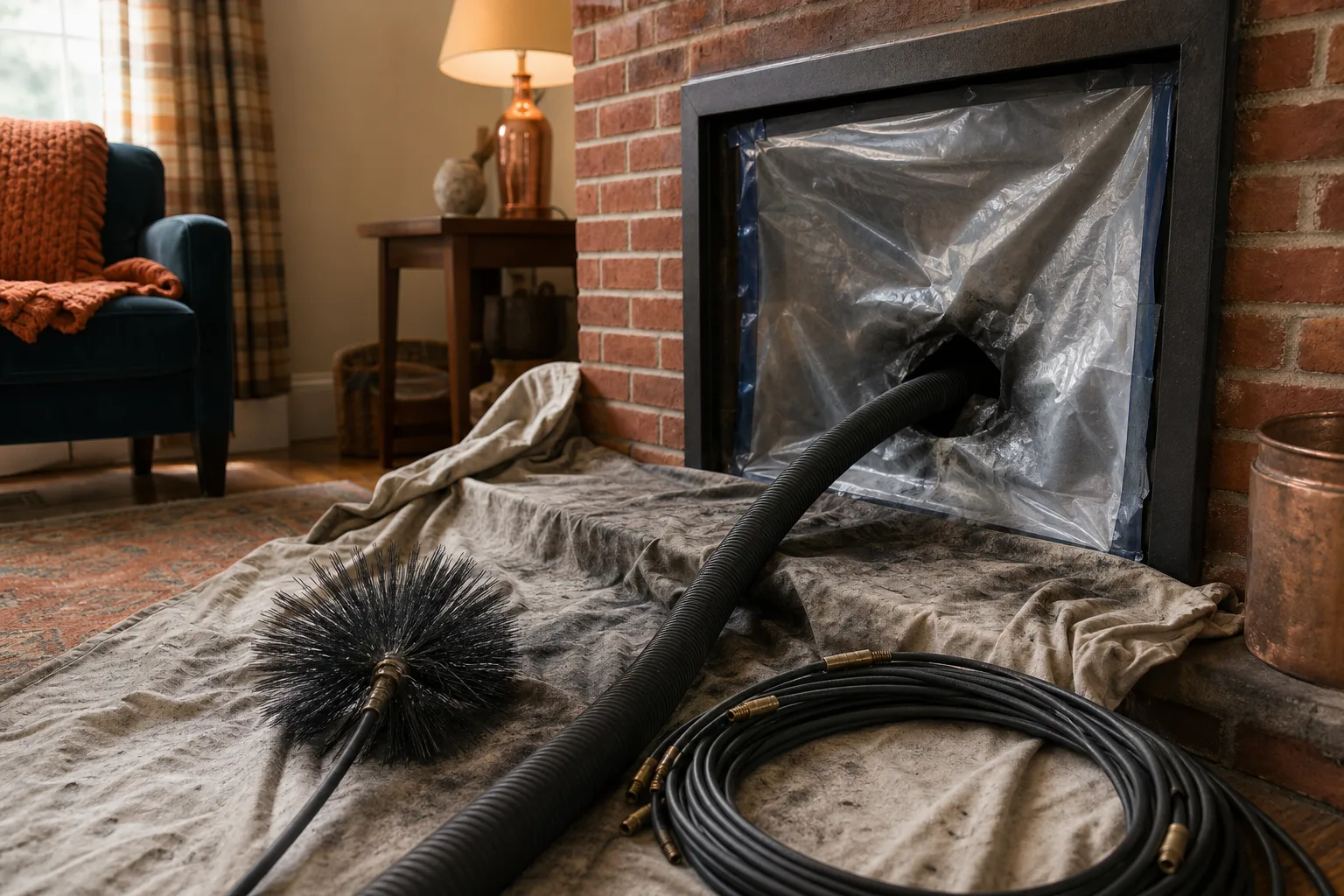
It starts with containment, not with brushes. A drop cloth goes down, the fireplace opening gets sealed off, and a vacuum hose runs into the firebox so that soot has somewhere to go besides your living room. If the room is not protected before the work starts, that tells you something.
Then the look: firebox and firebrick, the damper plate and whether it seats, the smoke shelf behind it, and the flue itself, scanned with a light and a camera.
The person doing this should tell you what they found in plain language: how much buildup, what kind, whether the liner is intact, and whether anything is obstructing the passage.
Sweeping, if it is warranted, comes after that assessment. Not before it.
Outside, at the stack
A good visit does not stop at the firebox. The parts that end a chimney's life sit on top of it.
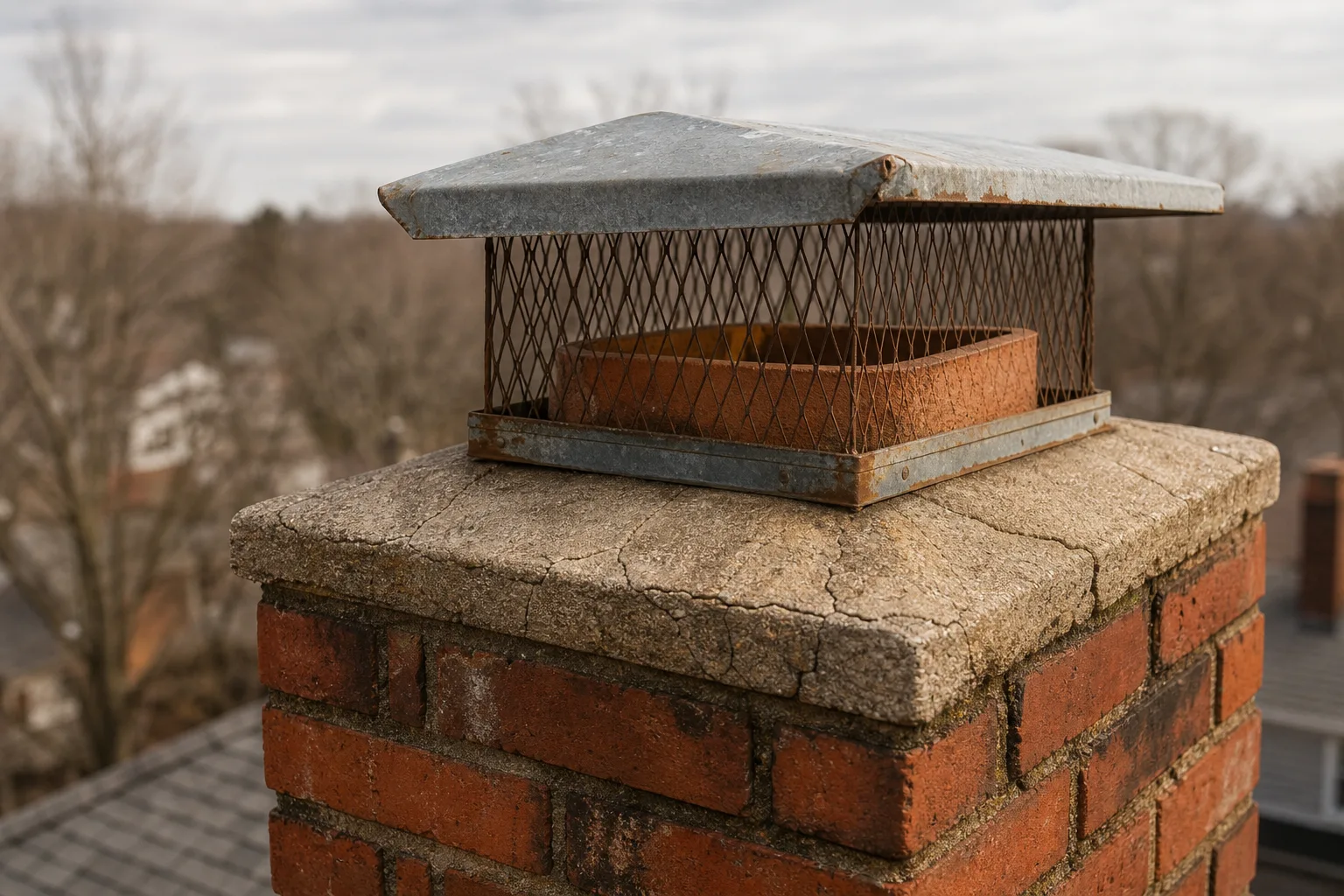
The crown, which is the sloped slab capping the masonry, is a common place for hairline cracking. The chimney cap over the flue opening keeps water and animals out, and mesh sides can be blocked or torn. The flashing where the stack meets the shingles is where leaks start, and tar patching is a sign of a previous attempt at a fix.
None of this gets cleaned. All of it gets looked at, and what they find belongs in writing.
At the dryer
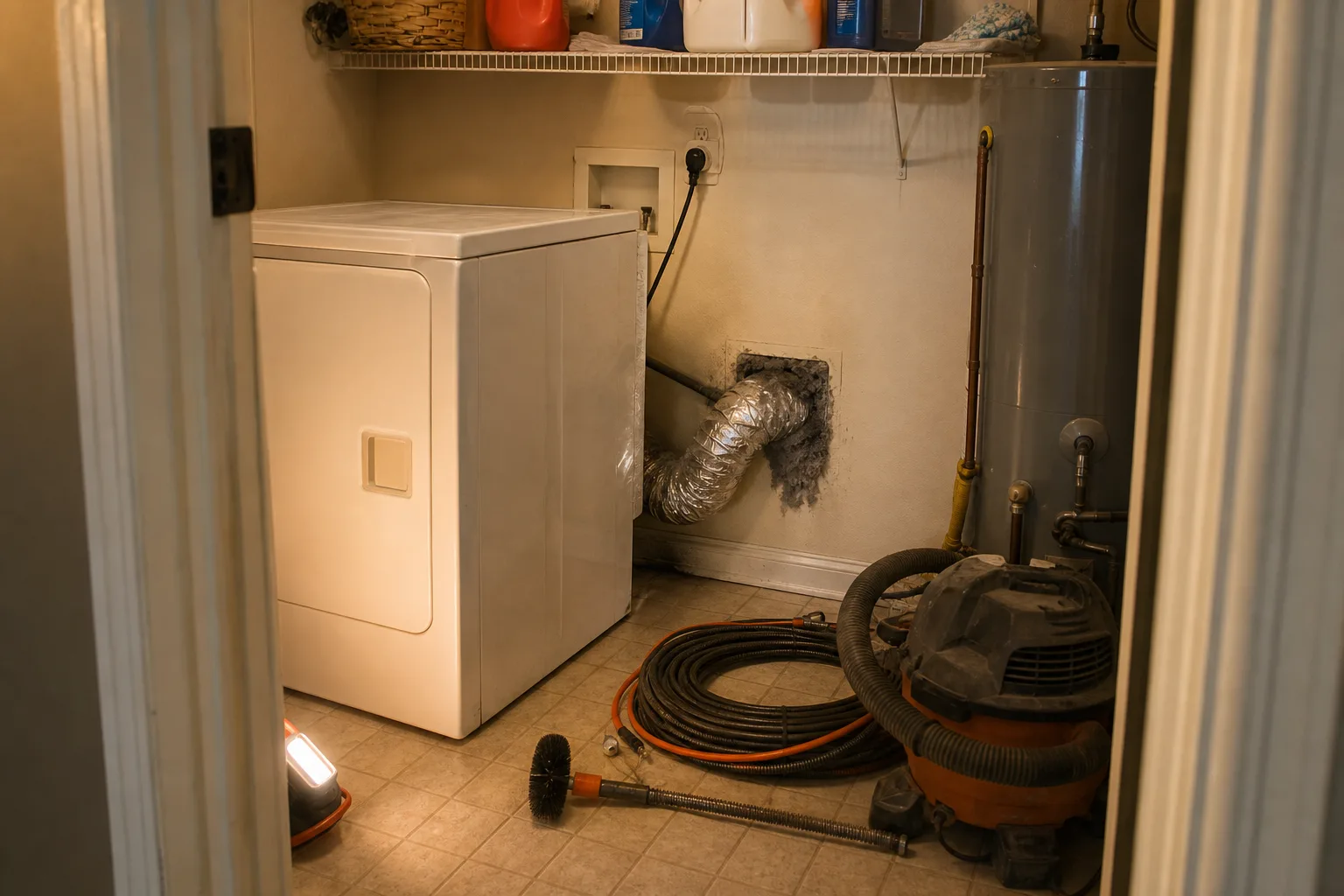
The dryer half is quick, which is not the same as trivial. The appliance gets pulled out, the transition duct behind it comes off, and rods with a brush head go through the run from one end while a vacuum captures from the other.
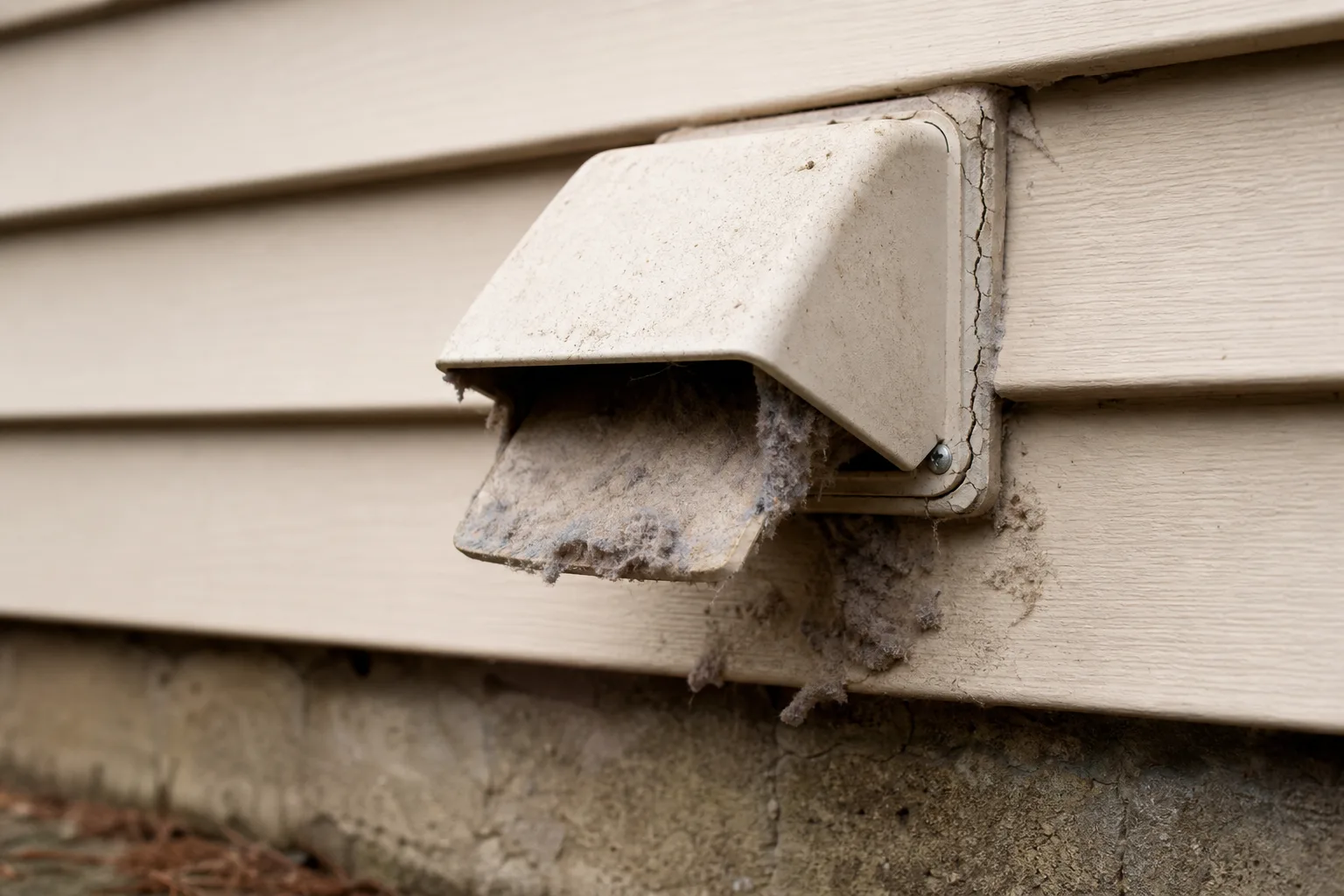
The exterior hood gets checked from outside. The damper flap should swing freely and close at rest, and it should open when the dryer runs.
Worth asking while someone is back there: what the duct is actually made of. Smooth walled rigid metal, at least 4 inch, running directly to the outdoors is what the International Residential Code requires. Crushed foil accordion duct is a different conversation.
Pro tip: You can run the exterior check yourself in about thirty seconds. Turn the dryer on, walk outside, and locate the exterior termination if it is safely reachable. On many houses that is a hood on the wall near the laundry room, though some runs terminate higher up or through the roof, and those are a job for the company you hire rather than a ladder on a Saturday. If you can reach it safely, you should feel steady warm air and see the damper open. A flap that does not move, fuzz caught on its edges, or pale lint on the siding beneath it all point to a restricted run. It is the one part of this system a homeowner can actually see.
Signs You Are Overdue on Either System
Neither system announces itself clearly. Both of them hint, and the hints are easy to explain away.
What the dryer tells you
Clothes still damp at the end of a full cycle is the classic one, and the reflex is to blame the dryer. A laundry room that runs noticeably hot while a load is going is another. So is a hot fabric or burning smell.
Outside, look for a damper that stays shut with the dryer running, or lint visibly caught at the hood.
None of these prove a blockage on their own. Together they make a strong case for getting the run cleared.
What the fireplace tells you
Smoke rolling back into the room instead of drawing up is the obvious signal, though draft problems have several causes and buildup is only one of them. A sharp, smoky odor coming off a cold fireplace, strongest in humid weather, points at deposit on the flue walls.
Flaking black material collecting in the firebox is worth a look. So is a damper that has stopped moving freely. If you want the mechanics behind why any of this happens, how does a chimney work covers the draft side properly.
Safety note: Both systems are fire concerns, and NFPA's research on home fires involving clothes dryers identifies failure to clean as the leading contributing factor, with dust, fiber and lint the leading item first ignited. That is the whole of the fear argument. If you suspect an active problem, stop using the appliance and get it looked at before you use it again.
When Booking Them Together Is Not the Right Move
Booking chimney and dryer vent cleaning together works when both systems need attention. It is not a rule. There are situations where the chimney needs its own appointment, and knowing them keeps you from squeezing a serious inspection into a slot booked for routine work.
NFPA 211 calls for a Level 2 inspection upon sale or transfer of the property; when changes are made to the system, including a change in fuel type, a change to the shape of or material in the flue, or the addition or replacement of an appliance of a dissimilar type, input rating or efficiency; after an operating malfunction; after a chimney fire; and after a potentially damaging external event such as a weather or seismic event.
A Level 2 is a bigger piece of work. It extends to accessible areas including attics, crawl spaces and basements, and it includes video scanning of the internal flue surfaces. Book it as its own thing.
The other case is simple arithmetic. If the vent is due and the chimney was inspected and cleared four months ago, there is nothing to combine. Get the vent done. The flue keeps its own calendar.
One more: if a previous inspection flagged something structural, a liner issue or chimney mortar repair, that is repair work with its own scope. Do not expect it to ride along on a cleaning appointment.
From the field: The transition duct behind the appliance is short, flexible, and easily compressed into an S shape the moment the dryer is slid back against the wall. Lint does not travel through a kink, it collects at one. The rest of the run can look perfectly reasonable while that single crushed elbow is doing all of the blocking, which is why a cleaning that never moves the appliance is not really a cleaning.
Questions to Ask Before You Book Chimney and Dryer Vent Cleaning
Chimney and dryer vent cleaning is an easy service to book badly, because from the outside two very different appointments sound identical on the phone.
These questions sort that out in under three minutes. You are not interrogating anyone. You are giving a good company a chance to show you it is a good company, and a weak one a chance to get vague.
Booking Chimney and Dryer Vent Cleaning on One Appointment
- Does the chimney portion include a written inspection report? You want findings on paper, not a verbal "looked fine." This is the single best filter on the list.
- Is sweeping decided by what the inspection finds? A company that understands the condition threshold will say yes without hesitating. One that quotes a sweep before seeing the flue is selling a calendar, not a service.
- Which inspection level am I getting? For routine seasonal work the answer is a Level 1. If anything on the Level 2 list applies to your house, say so before you book.
- Will the dryer be pulled out and the transition duct cleaned? The answer to this separates a full run cleaning from a vacuum at the wall.
- Will someone check the exterior hood and the damper? Outside is where restriction shows up first.
- What is my duct made of? Rigid smooth walled metal to the outdoors is the code requirement. Ask them to confirm what you actually have.
- What happens if you find something outside the scope of today's visit? You want to hear that it gets documented and quoted separately, not fixed on the spot for a number invented in your driveway.
One more thing worth saying out loud when you call: tell them plainly that you want both systems done. Companies that sell chimney and dryer vent cleaning together will have a routine for it. The ones that do not will hesitate, and that hesitation is useful information.
If the conversation turns toward a liner problem, what is a chimney liner is worth reading before you get a quote on one.
How VIO Helps With Chimney and Dryer Vent Cleaning
VIO is a referral service. We do not do the work ourselves, and the company that shows up at your house is an independent local business, not our employee. Saying that plainly matters more to us than sounding bigger than we are.
What we do is remove the part of this that wastes your afternoon. You tell us once what you need looked at, and we match you with a local company that handles both systems, so you are not calling four numbers to find out who does dryer vents and who only does chimneys. The two trades are not always sold together, and finding the overlap yourself is the tedious part.
We ask every company in the network to put its estimate in writing before any work starts, and you should insist on exactly that, with us or with anyone else you hire. If you are ready now, you can request service and describe both systems in one go.
You came here with two chores on a list, and the useful change is smaller than you expected.
Book the chimney and dryer vent cleaning visit as one appointment when both are genuinely due. Let the flue answer to an inspection and the vent answer to your laundry. Ask for the findings in writing, and read them.
That is the whole difference between a service you bought and a service you understood.
Book chimney and dryer vent cleaning with one call
VIO is a referral service. We connect you with independent local companies that handle chimney and dryer vent cleaning, and we ask every company in the network to put its estimate in writing before any work starts. You should insist on exactly that.
Call (513) 655-6702 or request service online.
Symptom checker
What is your chimney doing?
Tap the closest match for an honest first answer.