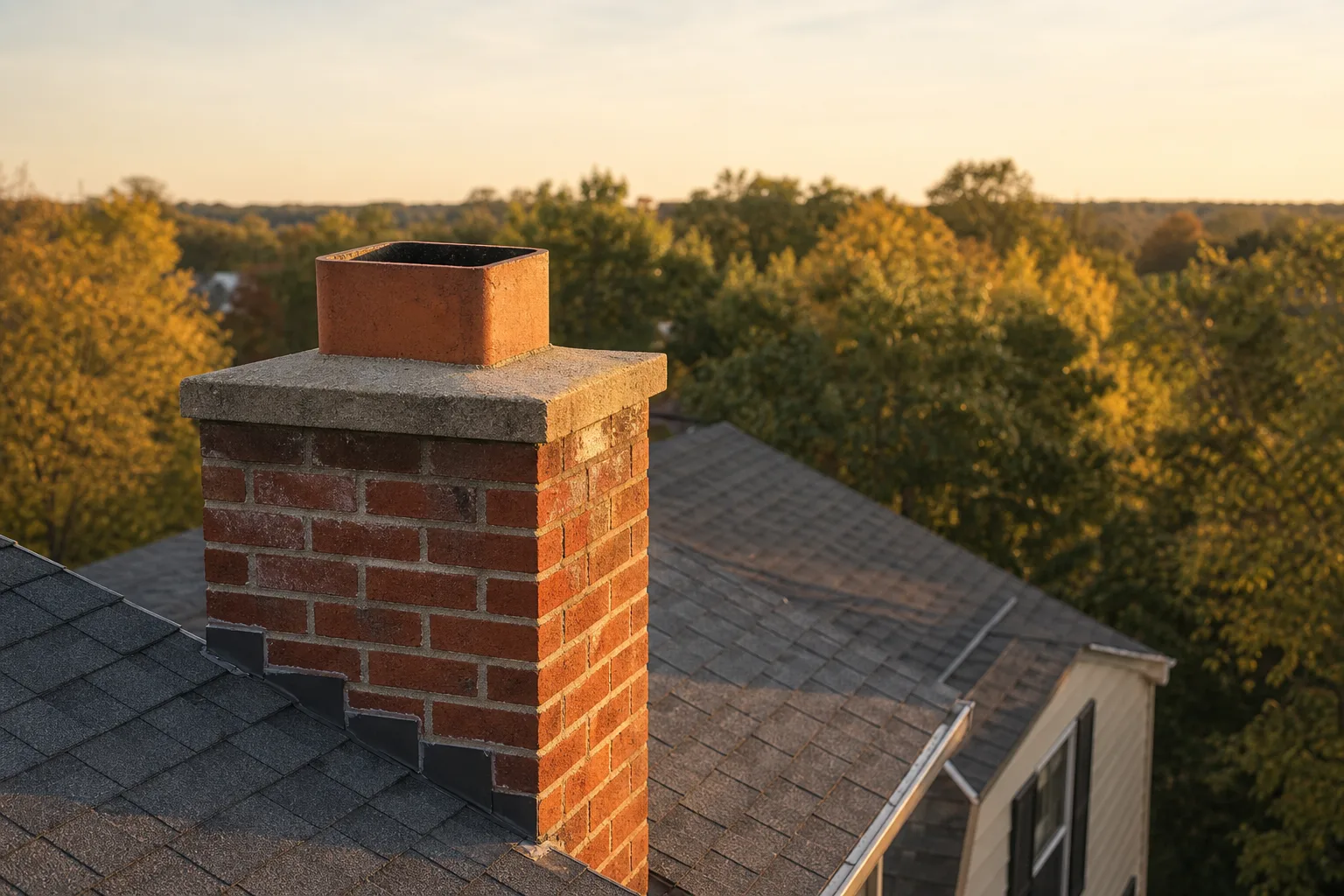




On this pageWhy You Have a Chimney Smell in House (and What It Actually Means)9 sections+8
- Why You Have a Chimney Smell in House (and What It Actually Means)
- First: Is the Smell Dangerous?
- Match Your Smell to Its Cause
- When Does It Smell? The Pattern Tells You More Than the Smell
- What You Can Try Tonight
- Why Cleaning Alone Often Does Not End the Smell
- The Fixes That Actually Hold
- When the Smell Is a Structural Problem
- How VIO Helps With a Chimney Smell in House
Quick answer
A chimney smell in house happens when odor already present in the flue, mostly creosote, is carried indoors by air flowing down the chimney instead of up it. Negative pressure from exhaust fans, dryers or air conditioning drives that reversal, and humidity, trapped water, leaves or an animal in the flue make it stronger. Seal the fireplace opening first, then have the flue, cap and crown inspected.
Why You Have a Chimney Smell in House (and What It Actually Means)
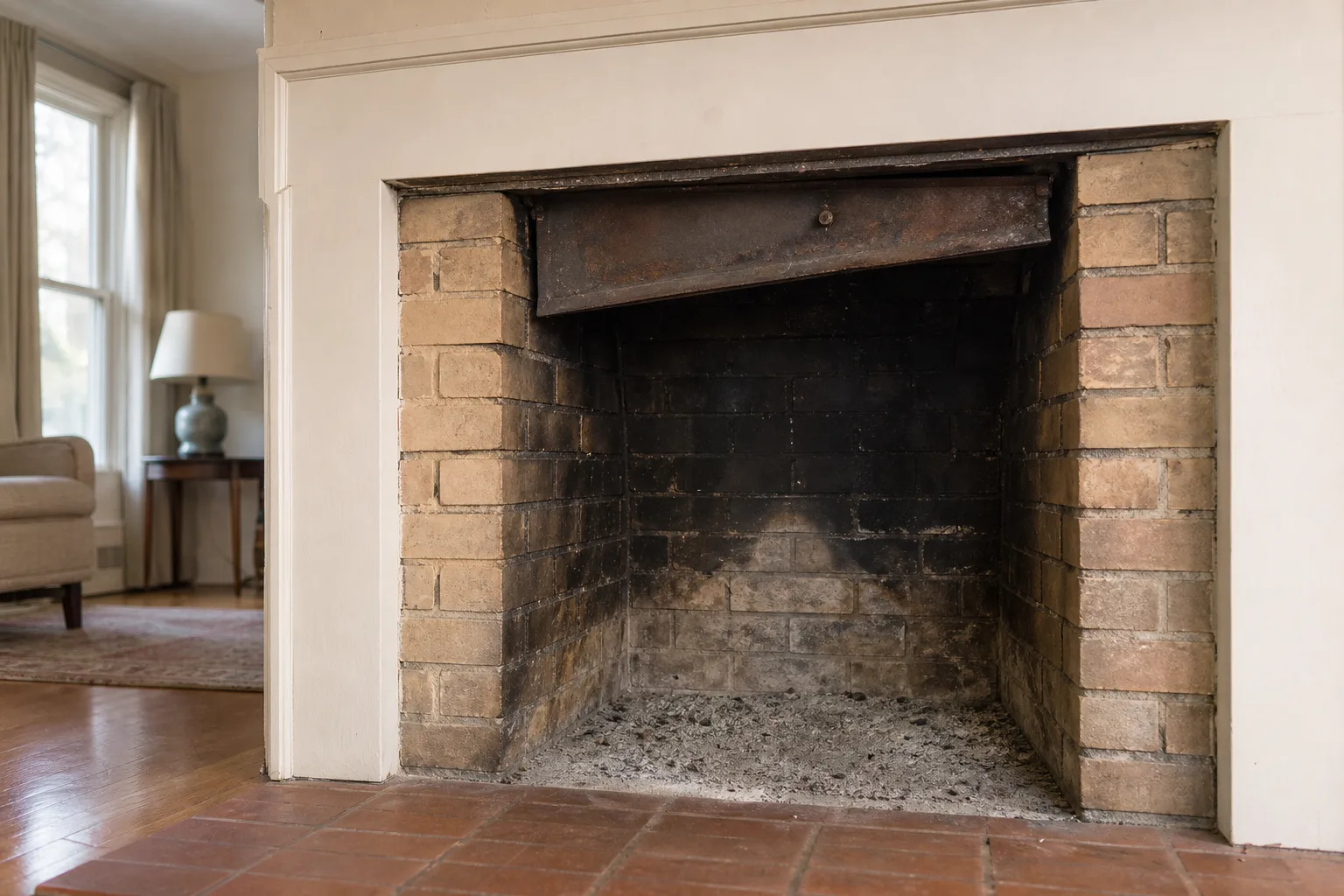
Here is the surprising part about a chimney smell in house: the chimney has smelled like that the entire time. Nothing new grew in there last Tuesday. The smell was sitting in the flue in July, in April, and the winter before that.
What changed is the direction your air is moving.
That single idea reorganizes the problem, and it is why so many homeowners spend a weekend with baking soda and get nowhere. You are not fighting a dirty chimney. You are fighting a house that has started pulling air down the flue instead of pushing it up.
Stay with me for two sections and you will know which version you have.
What the Smell Is Made Of
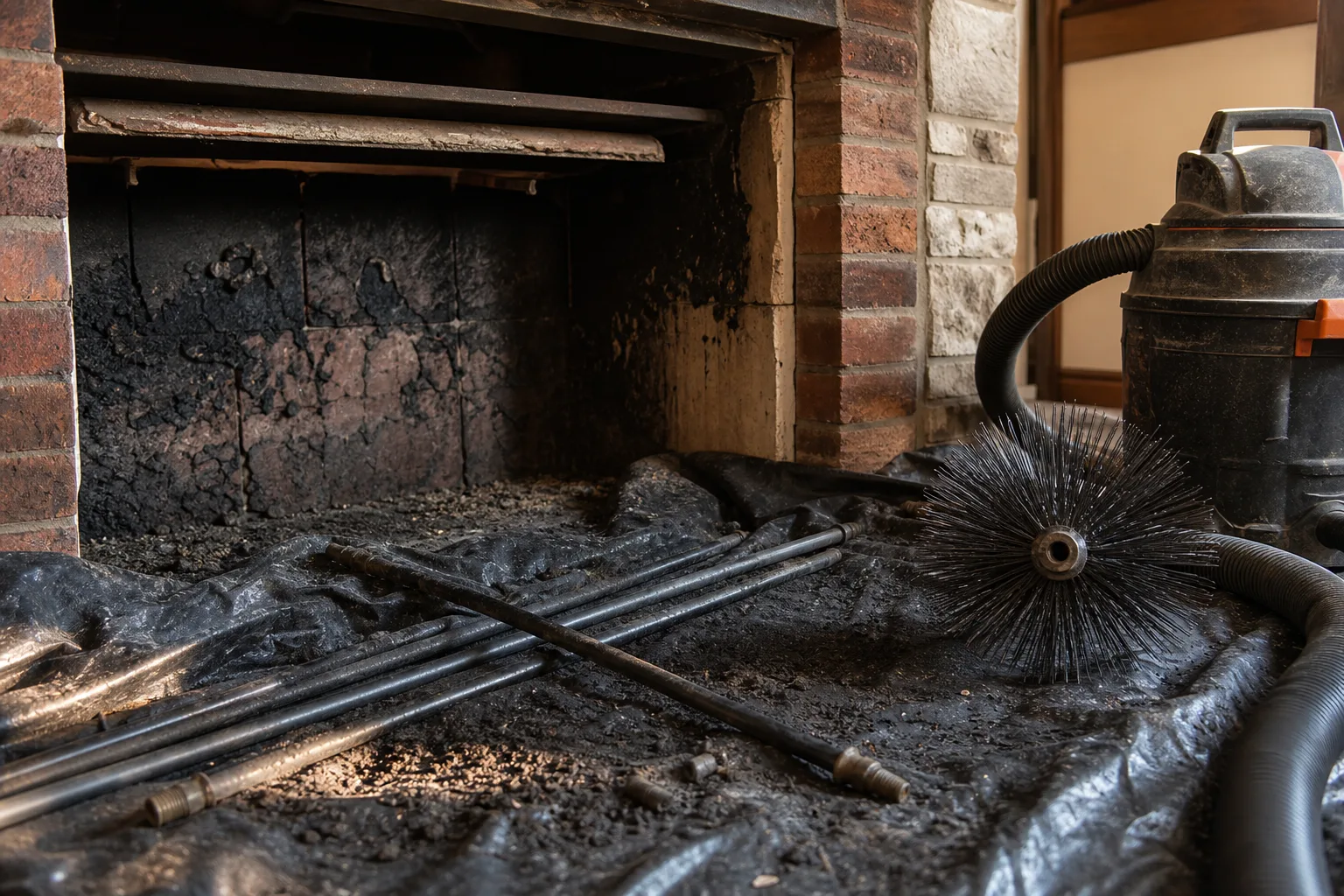
Burn wood and you make creosote. It is an unavoidable byproduct of combustion, it coats the inside of the flue, and it has a strong smell of its own. If you burn in a stove rather than an open fireplace, the same chemistry applies, which is one more reason staying current on wood stove maintenance pays off. Soot, ash, and whatever the last few seasons left behind sit alongside it.
Then add humidity. Damp outside air reacts with the acidity of creosote deposits, and mild background odor turns into something you notice from the next room. That is why complaint season peaks in muggy weather.
A flue can pass an inspection and still smell. That one fact explains most of the frustration in this subject.
Other things contribute. Rainwater in a flue smells sour and sharp, leaves that blew in through a missing cap rot and smell earthy, and an animal that got in and could not get out smells like exactly what it is.
Why It Is Reaching Your Living Room Now
Chimneys work on buoyancy. Builders call it the stack effect: air moves into and out of a building through its unsealed openings, driven by the density difference between inside and out, and that difference comes from both temperature and moisture.
Flip the conditions and the shaft runs backward. Cold, wet air in an unused flue is heavier than the dry air in your heated rooms, so it sinks. Down the chimney, past a throat damper that seals about as well as a screen door, into the room.
Negative pressure does the same thing faster. Every appliance that blows air outdoors has to pull replacement air from somewhere, and your chimney is a large hole in your building envelope. Unbalanced HVAC, exhaust fans, a clothes dryer, another combustion appliance venting, wind on one side of the roof, even a radon mitigation system: any of them can make the flue the path of least resistance for makeup air.
Tight modern construction makes it worse, not better. A well sealed house has fewer easy places to draw makeup air from, so the chimney gets recruited.
So the odor is not really an odor problem. It is a ventilation problem with an odor symptom.
First: Is the Smell Dangerous?
This is the question you actually want answered, so let me take it first.
A chimney smell in house can be a nuisance rather than a hazard. A cold fireplace pushing old creosote odor into the room on a humid day is annoying, worth solving, and not an emergency.
It can also be a signal. And a few situations are not "look into it this week" at all.
Nuisance Odor vs. a Warning Sign
Treat it as a nuisance when the fireplace is cold and unused, the smell is the familiar old-campfire kind, and it comes and goes with the weather.
Treat it as a warning sign when any of the following is true:
- You smell smoke while a fire is burning. That is combustion gas failing to leave the building, and it needs looking at before your next fire.
- The smell arrived alongside water stains on the wall or ceiling near the chimney.
- It is getting steadily stronger week over week rather than tracking the weather.
- There is a rotting smell, which usually means something organic is in the flue and needs removing rather than deodorizing.
- You have a gas fireplace or a furnace venting into that chimney and you smell anything sulfurous or gas-like. Leave and call your gas utility from outside.
Where Carbon Monoxide Fits In
This part matters and it gets muddled constantly.
Carbon monoxide has no smell. None. It cannot be seen or smelled, and high levels of exposure can kill in minutes. Early symptoms are headache, dizziness, weakness, upset stomach, vomiting, chest pain, and confusion.
So follow the logic. If CO is odorless, then the smell in your living room is not CO, and just as importantly, the absence of a smell tells you nothing about whether CO is present. A blocked flue can let CO build up in a house that smells perfectly normal.
Safety note: A chimney odor is never evidence of carbon monoxide, and a house with no odor is never proof there is none. The only thing that detects CO is a working CO alarm. If your fireplace or furnace vents into a chimney and you do not have one on that floor, that is tonight's errand, ahead of everything else in this article.
Which brings us to the useful part: figuring out which of the six or seven common causes is yours. Your nose already has the evidence.
Match Your Smell to Its Cause
Your nose is a decent diagnostic instrument. Work through the categories below and see which one matches a chimney smell in house like yours, reading the middle column as "most likely" rather than "definitely", because two causes can run at once.
| What you smell | Most likely cause | What it points to |
|---|---|---|
| Acrid campfire, old ashtray, burnt | Creosote and soot deposits in the flue, pushed indoors by reversed airflow | An airflow problem, not a dirtiness problem. Sealing and draft work matter more than scrubbing. |
| Sour, sharp, chemical, worse a day after rain | Water sitting in the flue reacting with creosote | Something at the top is letting water in: a missing cap, a cracked crown, failed flashing |
| Musty, earthy, like a wet basement | Decomposing leaves and organic debris on the smoke shelf or in the flue | Usually a missing or damaged cap. Debris removal plus a cap |
| Rotting, putrid, unmistakably dead | An animal that entered the flue and could not get out | Removal by a professional, then screening so it cannot happen again |
| Ammonia-like, sharp animal smell without the rot | An active nest, droppings, or urine in the flue or smoke chamber | Live wildlife. Removal first, then a cap with mesh |
| Barbecue or smoky, only in hot humid weather with the A/C running | Creosote reacting with humid air, drawn in by negative pressure | The classic summer pattern. Sealing the opening and stopping the downdraft |
| Sewer-like or sulfurous near a gas appliance | Not a normal chimney odor | Stop. Leave the house and call your gas utility from outside |
If you found your row in that table, you are most of the way there. The other half of the diagnosis is timing.
When Does It Smell? The Pattern Tells You More Than the Smell
Ask yourself one question and answer it honestly: when, specifically, do you notice it? It is an easy question to skip, and it is the fastest way to narrow the cause. Six patterns are worth checking yourself against.
- Only when the air conditioning is running. Negative pressure plus humidity. The summer pattern.
- Only after rain, or the day after. Water intrusion at the top.
- Only on cold, still nights. Reverse stack effect, with cold heavy air sinking down an unused flue.
- Only when the dryer or the range hood is on. A specific appliance is depressurizing the house and recruiting your chimney for makeup air.
- All the time, at a steady level. Heavy deposits, a badly leaking damper, or organic material in the flue.
- Getting worse week by week. Something is changing. Water, an animal, or deterioration at the top. This is the pattern that deserves a professional look soonest.
Good to know: When the smell shows up narrows the cause faster than what it smells like. A homeowner who can say "only with the A/C on, never in winter" has already ruled out half the list, and any decent chimney tech will ask that question in the first minute.
The Summer Pattern (A/C, Humidity, and a Sealed House)
This one behaves like a textbook case.
Close the house up in July, run the air conditioning, and the house sits slightly negative. Outside air is thick with moisture and it finds the biggest available opening, which is your chimney. That humid air moves down the flue, reacts with the acidity of the creosote, and arrives in the living room smelling like last February.
The damper is closed, and it does not matter, because a cast iron throat damper is a loose-fitting plate, not a seal.
Then the weather breaks and the smell disappears, which makes it easy to never get around to fixing it. It will be back next summer.
The Cold-Night Pattern (Stack Effect in Reverse)
The winter version is quieter and more persistent.
Heated air rises and escapes through the upper part of the house, and cold dense air standing in an unused flue is happy to replace it. You get a faint, constant background odor on still cold nights, strongest in the room with the fireplace, fading when the wind picks up.
Chimney Smell in House After Rain
Rain-triggered odor is its own signature, and it points somewhere specific: the top of the chimney.
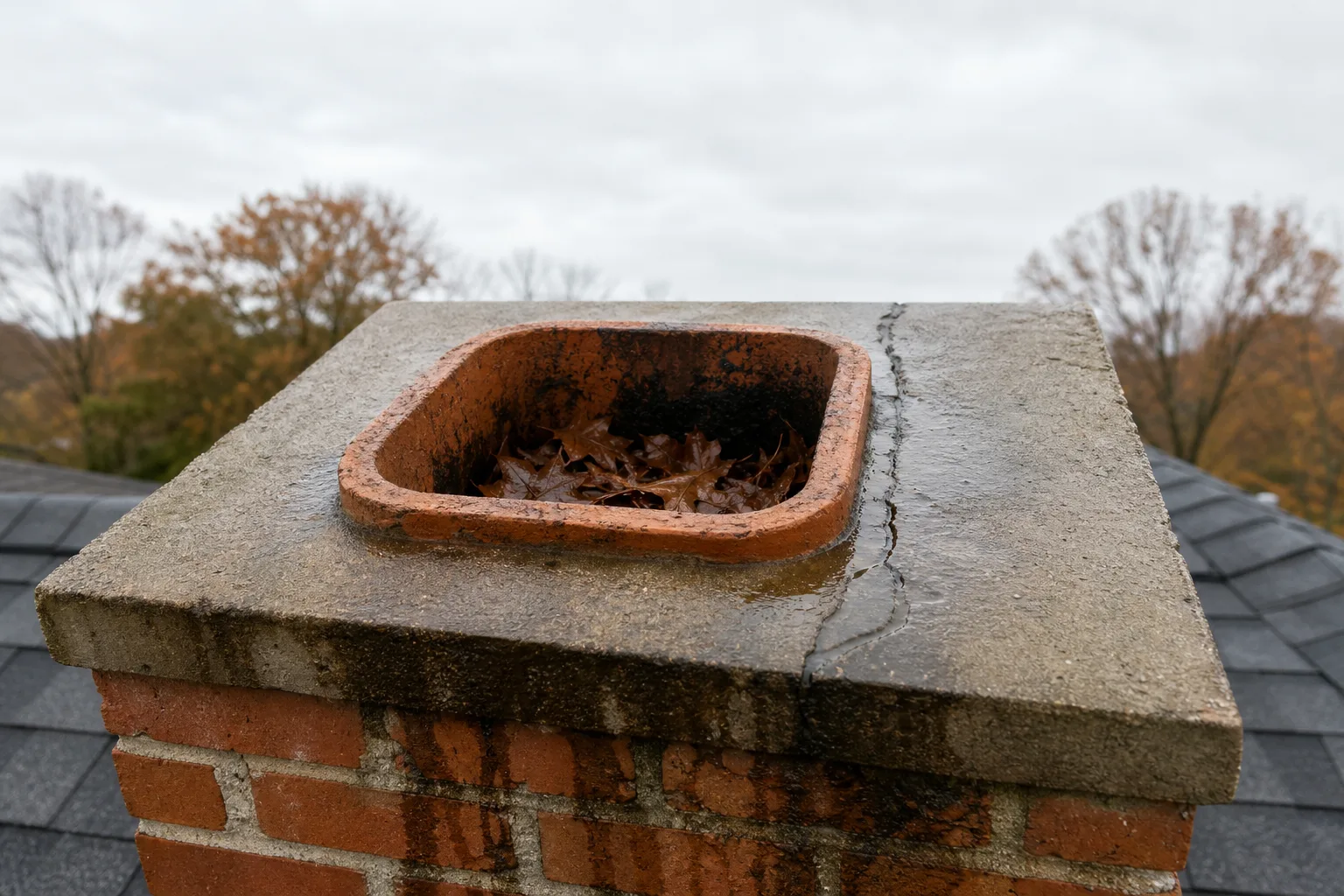
A chimney smell in house that appears within a day of a storm and fades as things dry out means water is getting into the flue. Not condensation. Actual rain, falling straight into an uncapped flue tile or soaking through a crown that has cracked.
Water plus creosote is a sour, sharp smell, distinctly different from dry smoke odor. Once you have smelled them side by side you will not confuse them again.
This pattern is also the one that does the most damage if it is ignored, because the water is not just making a smell. It is working on the masonry, on the liner that protects the inside of the flue, and on anything steel in the system.
What You Can Try Tonight
None of this is a permanent fix. All of it is quick to try, and it will tell you a great deal about which chimney smell in house you are dealing with.
Work down the list in order.
- Run a smoke test at the firebox opening. Light a stick of incense or a wooden match, blow it out, and hold the smoke at the top of the fireplace opening. Watch which way it drifts.
- Check the throat damper. Find the handle, confirm it is actually closed, then look for daylight or feel for a draft around its edges.
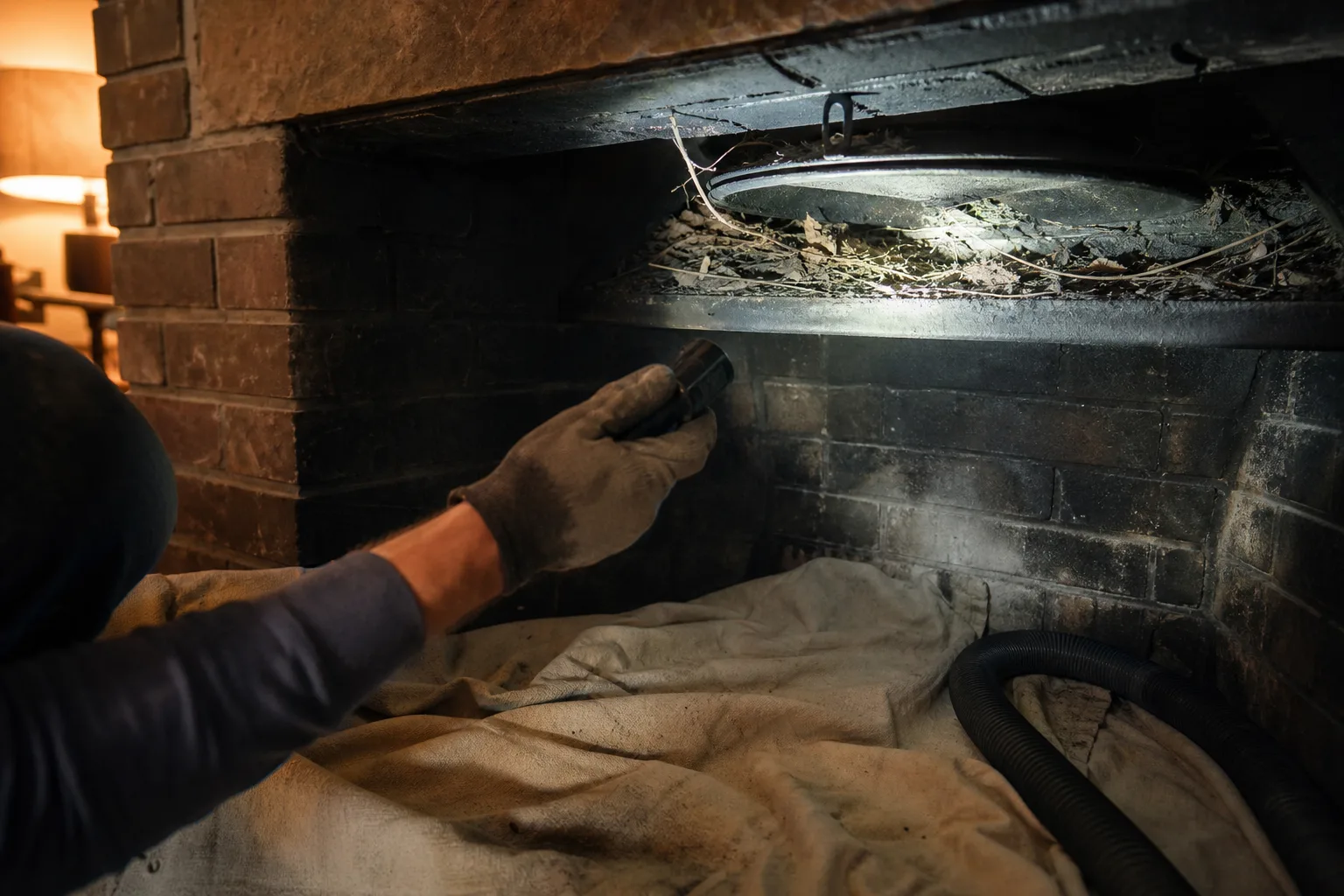
- Shine a flashlight up past the damper, looking for leaves, twigs, or nesting material sitting on the smoke shelf.
- Turn off every exhaust fan and the dryer. Wait twenty minutes. If the smell drops noticeably, you have found your negative pressure source.
- Put a wide bowl of baking soda in the firebox and leave it at least forty-eight hours. Harmless, and it absorbs a surprising amount.
- Try a bowl of white vinegar in the firebox for a day or two as a second pass.
- Seal the opening low and tight. An inflatable fireplace plug or a fitted draft stopper forces the house to find its makeup air somewhere else.
- Open a window in the room for ten minutes. If the odor drops fast, the house is running negative and pulling from the flue.
Pro tip: The smoke test is the whole diagnosis in thirty seconds. If the smoke drifts up and into the fireplace, the flue is drawing correctly and your odor is coming from somewhere else in the room. If it curls out toward you and into the house, air is flowing down the chimney, and every fix that matters is about stopping that flow rather than cleaning what it carries.
Two honest warnings. Deodorizers treat a symptom, so they work for a while and then a humid weekend arrives and you are back where you started.
And if a fuel-burning appliance vents into that chimney, do not block the flue. A plug belongs in an unused open fireplace, nothing else.
Why Cleaning Alone Often Does Not End the Smell
This is the part that a chimney company has a quiet reason not to lead with, so let me just say it.
Sweeping your chimney is usually worth doing. It reduces the odor source and it addresses a genuine fire risk, and NFPA 211 calls for an annual inspection with cleaning and repairs done as necessary. On its own, though, it may not end a chimney smell in house.
The reason follows from everything above. Cleaning removes deposits, it does not change the direction your air is moving. A perfectly swept flue still has creosote soaked into porous masonry, still fills with cold damp air, and still runs backward when your house goes negative.
There is a second reason. Creosote shows up in three broad conditions: light dusty deposits, flaky tar-like buildup, and a hard glazed layer. The glazed kind looks like someone painted the flue tile with black enamel, it resists ordinary brushing, and it is handled with chemical treatment or by installing a new flue liner.
Myth vs. fact: The myth is that a chimney sweeping gets rid of the smell. The fact is that it reduces the source and leaves the delivery mechanism completely untouched. Book the sweeping, by all means, and expect to still have a draft problem afterward.
So when someone tells you a cleaning will solve it, they are not lying to you. They are answering a different question than the one you asked.
Still smelling it after the easy fixes? An odor that survives a cleaning is telling you something about the airflow or the structure, and that takes eyes on the flue. Tell us what you smell and when you smell it, and we will match you with a local chimney company that handles odor diagnosis and inspection. Call (513) 655-6702, or send the details through our request form and we will route it.
The Fixes That Actually Hold
Working sweeps tend to recommend the durable fixes for a chimney smell in house in a fairly consistent order, and the order is worth respecting. Start at the top.
Glass Doors and Sealed Openings
A set of tempered glass fireplace doors can solve the problem outright, and it is a common first move for an experienced sweep.
Doors put a hard barrier between the flue and the room, and unlike a throat damper they are built to close against a frame. They also leave the fireplace usable, which a plug does not.
A Top-Sealing Damper
This is the fix that addresses the most versions of the problem at once, and it rarely comes up in a homeowner's own searching.
A top-sealing damper mounts at the very top of the flue instead of down at the throat. It is a flat metal lid on a hinge, closing against a rubber gasket, operated by a thin stainless cable that runs down the flue to a handle in the firebox.
Because it seals at the top and seals properly, it stops the downdraft rather than slowing it. And because it caps the flue, it keeps rain and humid air out of the chimney at the same time, which removes the fuel for the water-plus-creosote version of the smell.
One device, two causes. That is why it keeps coming up.
Fixing the Negative Pressure Itself
The other direction is to stop making the chimney the path of least resistance.
Providing outside combustion air reduces how much replacement air your appliances have to steal from inside the house. Balancing an HVAC system that returns less than it supplies does the same.
And the throat damper you already have? Close to useless as a seal. Cast iron plates warp, rust, and sit unevenly, and nobody who works on chimneys expects one to stop odor by itself.
From the field: Go at a chimney smell in house with deodorizers and you should expect to circle back to the airflow question, because the odor returns on the next humid stretch of weather. The homeowners who settle it for good are the ones who stop asking what the smell is and start asking which way the air is going.
When the Smell Is a Structural Problem
Sometimes the smell is the first symptom of something that has nothing to do with air pressure.
The Cap and the Crown
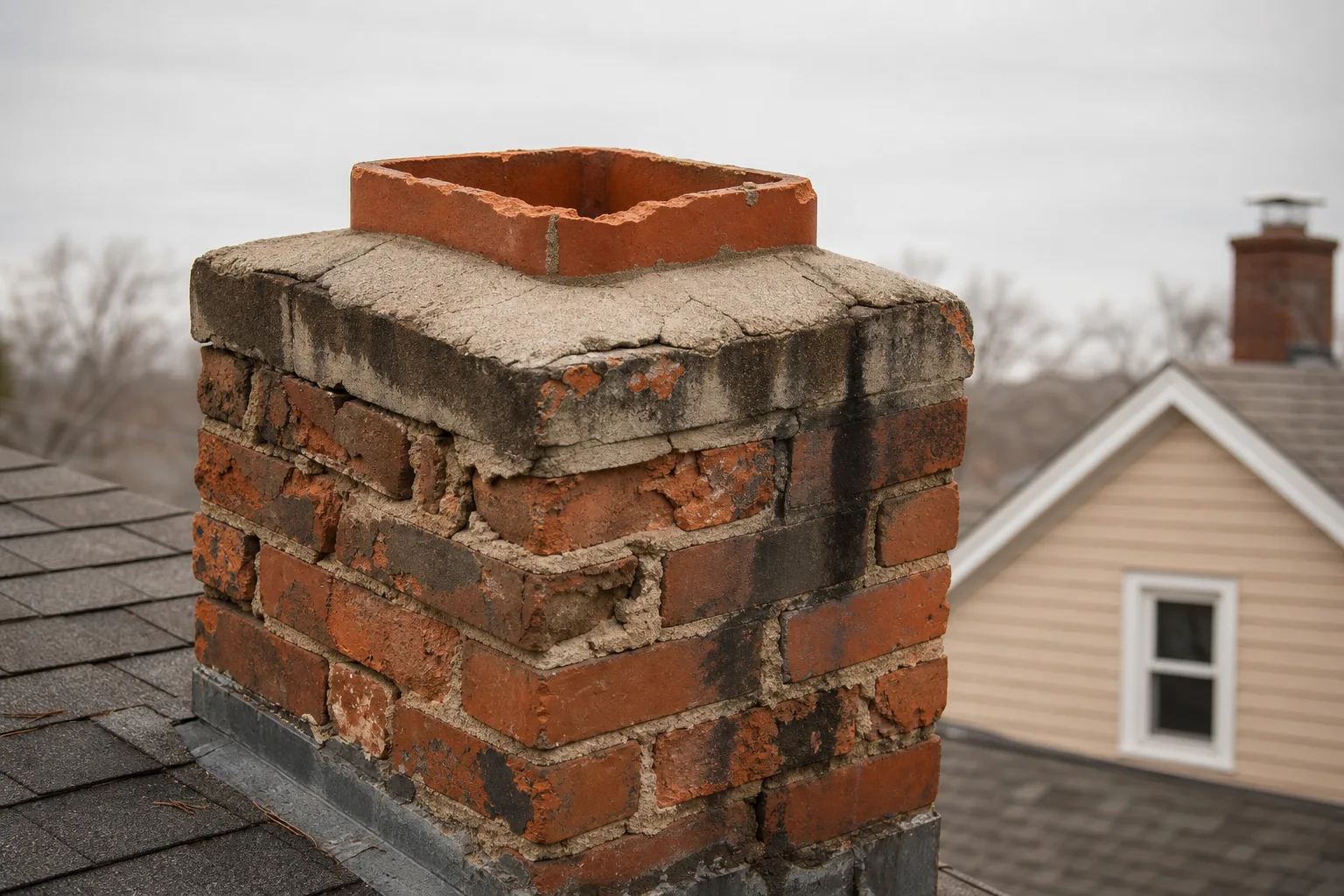
A chimney cap is a small stainless steel or copper hood over the flue opening, standing on short legs with mesh between them. When it is missing, the flue is an open terracotta hole facing the sky, collecting rain, leaves, and animals. That is three of the seven rows in the table above, caused by one missing part.
The crown is different and often confused with the cap. It is the flat concrete slab covering the entire top of a masonry chimney. Crowns crack, and water runs into the crack, soaks the masonry, freezes, and widens it.
So look at the top of your chimney from the ground, ideally with binoculars, on a clear day. A sound chimney top shows tight mortar joints, an unbroken crown sloping slightly to shed water, and a cap seated squarely over the flue. A neglected one shows dark staining down the brick, the kind that cleaning the masonry will improve but not cure, along with mortar eroded back from the joints, spalled brick faces, and either a cracked crown or no cap at all.
Safety note: An odor that arrives with visible staining, white efflorescence, or crumbling mortar at the top of the chimney is a water problem first and an air problem second. Deodorizing that is like mopping around a running tap.
When the Liner Is the Problem
The flue liner is the surface everything else happens on. Clay tile liners crack and shift, metal liners corrode, and some older chimneys were built with no liner at all.
A failed liner lets odor, and more seriously combustion gas, pass into the wall cavity and out into rooms that are not even next to the fireplace. If you smell smoke on a different floor from the fireplace, rule that out first.
This is where standards stop being abstract. NFPA 211 requires that chimneys, fireplaces, and vents be inspected at least once a year for soundness, freedom from deposits, and correct clearances. It also defines inspection levels, and a Level 2 inspection, which includes video scanning of the internal surfaces, is required when a property is sold or transferred, when the system is changed, after a malfunction, after a chimney fire, and after an external event such as severe weather or a lightning strike.
An odor that outlives a cleaning, a sealed damper, and a dry spell is a reasonable trigger for that camera.
How VIO Helps With a Chimney Smell in House
VIO CHIMNEY is a referral network. We do not sweep chimneys, inspect flues, or install dampers. We connect homeowners with independent local chimney companies that do that work themselves.
For a chimney smell in house that matters more than it might sound, because this problem gets misdiagnosed. You describe the smell and the pattern, the two things you worked out above, and we route you to a company that handles odor diagnosis rather than one that will book you a sweeping and hope.
A company we match you with is typically equipped to put a camera up the flue, check the cap and crown, test how the chimney is actually drawing, and tell you whether you are looking at a sealing job or a repair. Ask them to confirm all of that before they come out.
On money, our position is about conduct, not promises. We ask every company in the network to put its estimate in writing before any work starts, and you should insist on exactly that, from them or from anyone else you call.
A chimney smell in house is a solvable problem, and an easier one to deal with in September than in December with a fire already laid. Work out your smell, work out your pattern, run the checks tonight, then get somebody on the roof who can finish the diagnosis.
Get the smell diagnosed before burn season. You have probably narrowed it to two or three causes by now, and every one of them needs somebody on the roof and a camera in the flue. VIO CHIMNEY connects homeowners with independent local chimney companies that handle odor diagnosis, inspection and repair. We ask every company in the network to put its estimate in writing before any work starts, and you should insist on exactly that. Call (513) 655-6702 to get matched.
Symptom checker
What is your chimney doing?
Tap the closest match for an honest first answer.