



On this pageWhat a concrete chimney crown actually is8 sections+7
- What a concrete chimney crown actually is
- What makes a concrete chimney crown correct
- The expansion joint that gets left out
- How a concrete chimney crown fails
- Check your own crown from the ground
- Concrete chimney crown repair or full rebuild
- How to read a crown estimate
- How VIO helps with a concrete chimney crown
Quick answer
A concrete chimney crown is a steel reinforced concrete slab poured across the top of a masonry chimney, described in the trade at four to six inches thick. It sheds water clear of the brick using slope, a projecting overhang, and a drip edge underneath, and it is isolated from the flue tile by an expansion joint. Hairline cracks and small chips fall on the repairable side, while a crumbling slab, cracks through it, or standing water point toward rebuilding.
The grey slab at the top of a chimney is the part nobody looks at until water shows up somewhere inside the house. A concrete chimney crown is that slab. Its whole job is to close the top of the masonry and throw rain clear of the brick instead of letting it soak in.
Here is what is worth knowing before you take a quote on it: some of what fails up there was never built as a concrete crown in the first place. What sits up there instead can be something thinner and weaker occupying the same spot.
The difference between the two is visible from your driveway, and I will show you where to look.
First, what a correct one looks like. Then the part that decides your next move: whether the crown you have can be saved, or whether it needs to come off.
What a concrete chimney crown actually is
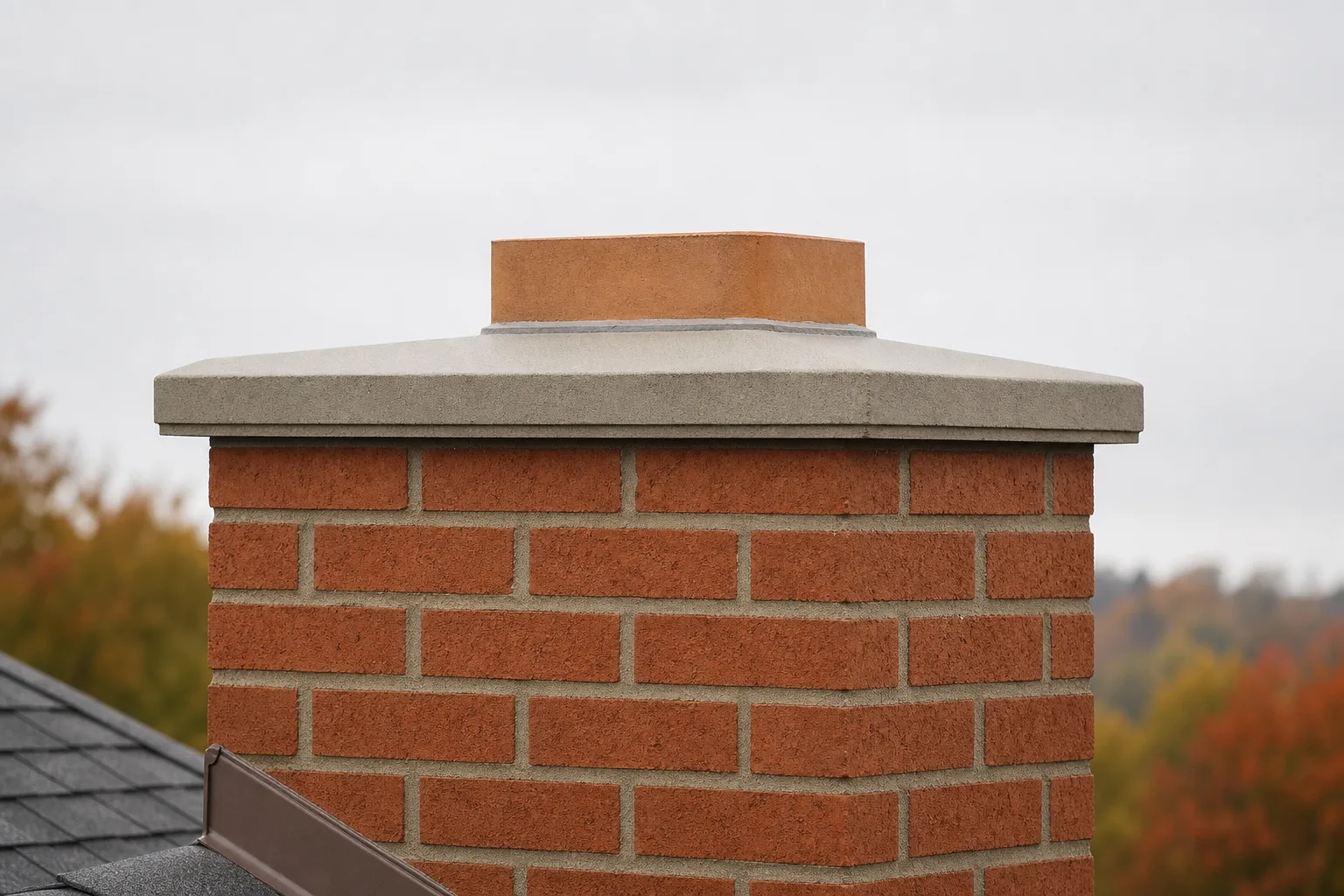
A concrete chimney crown is a solid slab of steel reinforced concrete poured across the top of a masonry stack, described in the trade in the range of four to six inches thick.
It rests on the brick, and the flue tile passes up through an opening in the middle of it.
Everything about its design follows from one idea: water landing on top of a chimney has to get off without touching the brick. That is why a crown is sloped rather than flat, and why its edge hangs past the face of the chimney like the brim of a hat.
A sound crown also closes the top of the masonry against leaves, twigs and debris.
Crown versus cap, and why the mix-up matters
People use crown and cap as though they were the same part. They are not, and the confusion sends homeowners toward the wrong repair.
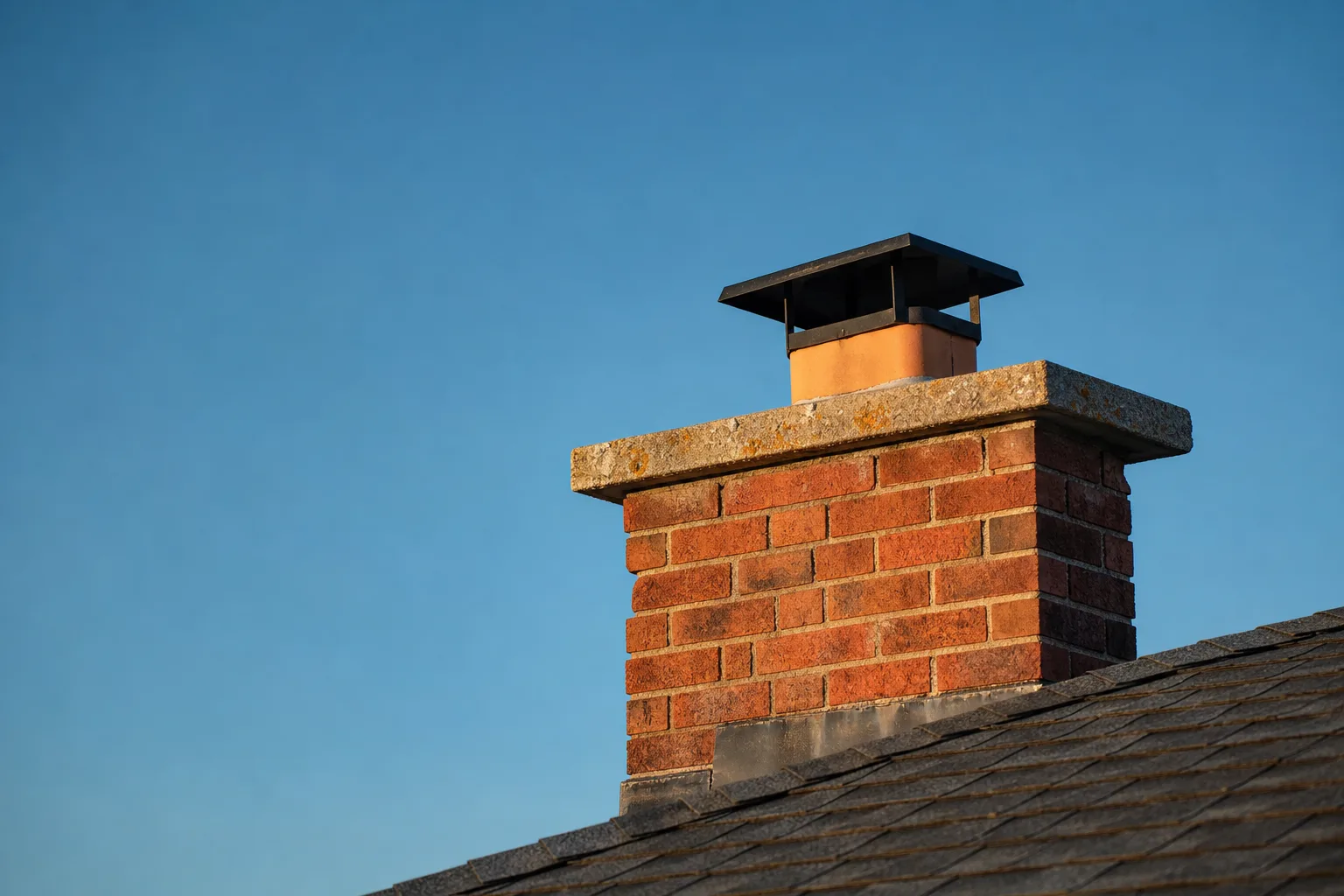
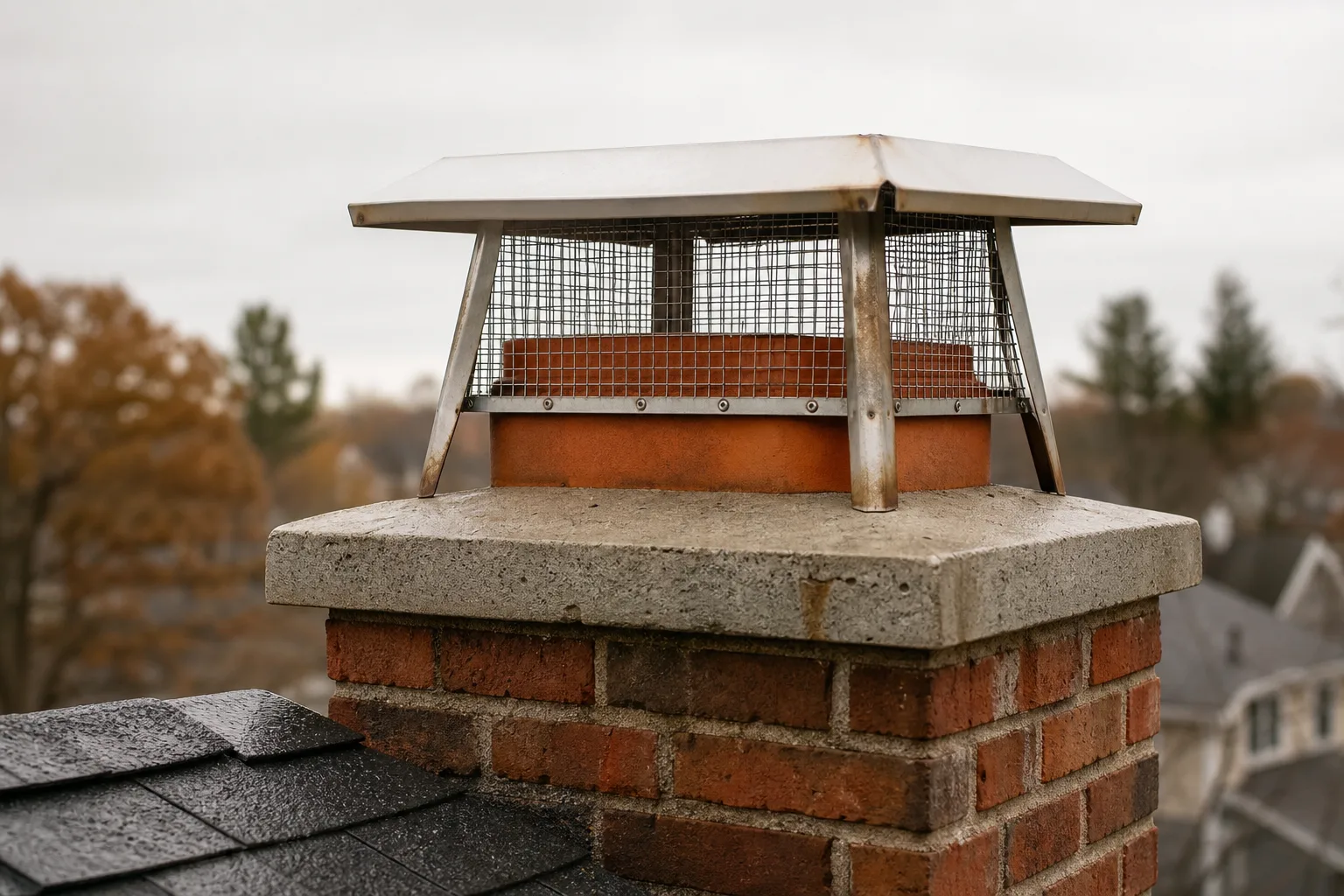
The crown is the concrete slab across the top of the brick. The cap is the metal lid on legs, stainless or black painted sheet metal with mesh screening, that sits over the flue opening itself.
The cap is the part meant to keep birds, squirrels and falling rain out of the flue. A crown cannot do that job, because the flue opening is not something the crown covers.
So if somebody tells you that you need a new chimney cap and then hands you a quote for concrete work, ask which part they mean. The two failures look nothing alike.
What makes a concrete chimney crown correct
Four details separate a concrete chimney crown that does its job from one that will crack. None of them are exotic. All of them are things you can ask about by name.
Thickness and reinforcement
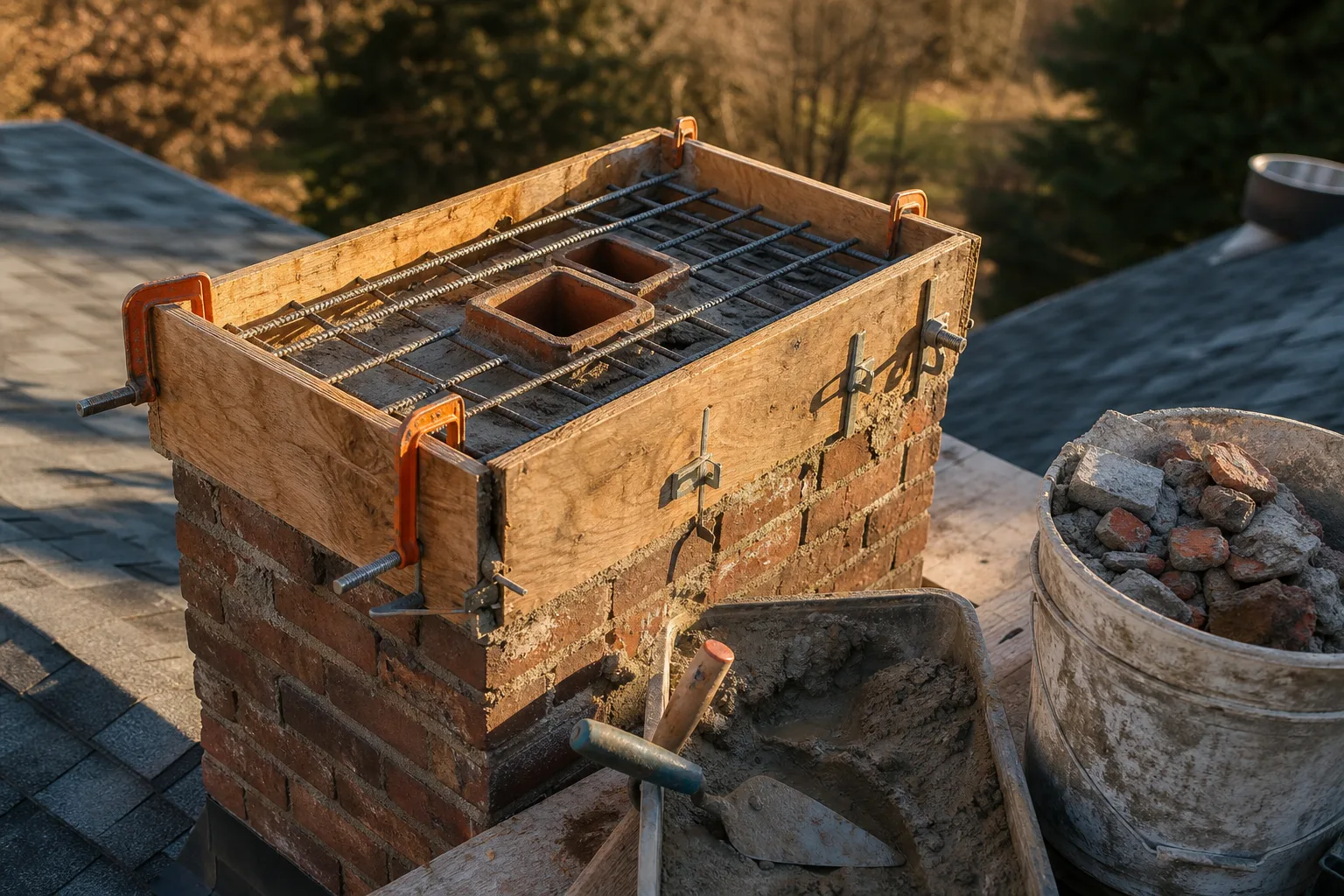
Poured crowns are described as solid slabs in that four to six inch range, with steel reinforcement cast inside, mesh or light rebar. Reinforcement is what keeps a slab that thin from cracking straight through when it moves. And it will move.
Reinforcement is invisible the moment the pour is finished. Which is exactly why it belongs in writing on an estimate.
The overhang on a concrete chimney crown
The slab has to project past the face of the brick so runoff is thrown clear of the wall rather than delivered to it.
How far it should project is a genuine disagreement among sources. Some put the minimum at an inch and a half. Others call for two inches on each side. Others say the crown should extend up to a minimum of two and a half inches beyond the chimney wall.
What all of them agree on is the principle. No overhang means the water runs straight down your brick.
The drip edge underneath
An overhang by itself is not quite enough. Water clings, and it will track back along the underside of a projecting lip and find the wall anyway.
A drip edge is the interruption: a groove cast or cut into the underside of the overhang, so water running inward reaches it and falls instead. Forms can cast one in place, or it gets cut afterward with a small grinder.
A minor detail in the scope of a job, and one a careful mason mentions unasked.
Slope
A crown is sloped so water runs off rather than sits. One trade reference specifies sloping up ten degrees toward the flue tiles.
Flat crowns hold water, and standing water is what drives the damage described below.
Good to know: concrete and mortar are not interchangeable up here. Trade sources are direct about it. The crown should be concrete, and mortar is not the right material at this exposure, because it is neither waterproof enough nor durable enough for weather at the top of a stack. Thin mortar washes got applied anyway.
The expansion joint that gets left out
This is the part homeowner articles about crowns leave out, and it explains the cracks that otherwise make no sense.
The flue tile and the concrete around it do not move together. Run the appliance and the clay liner heats and expands on its own schedule, while the slab outside it does something else entirely.
A crown poured tight against the flue tile gives that movement nowhere to go. So the slab cracks, and it tends to start at the tile and run outward.
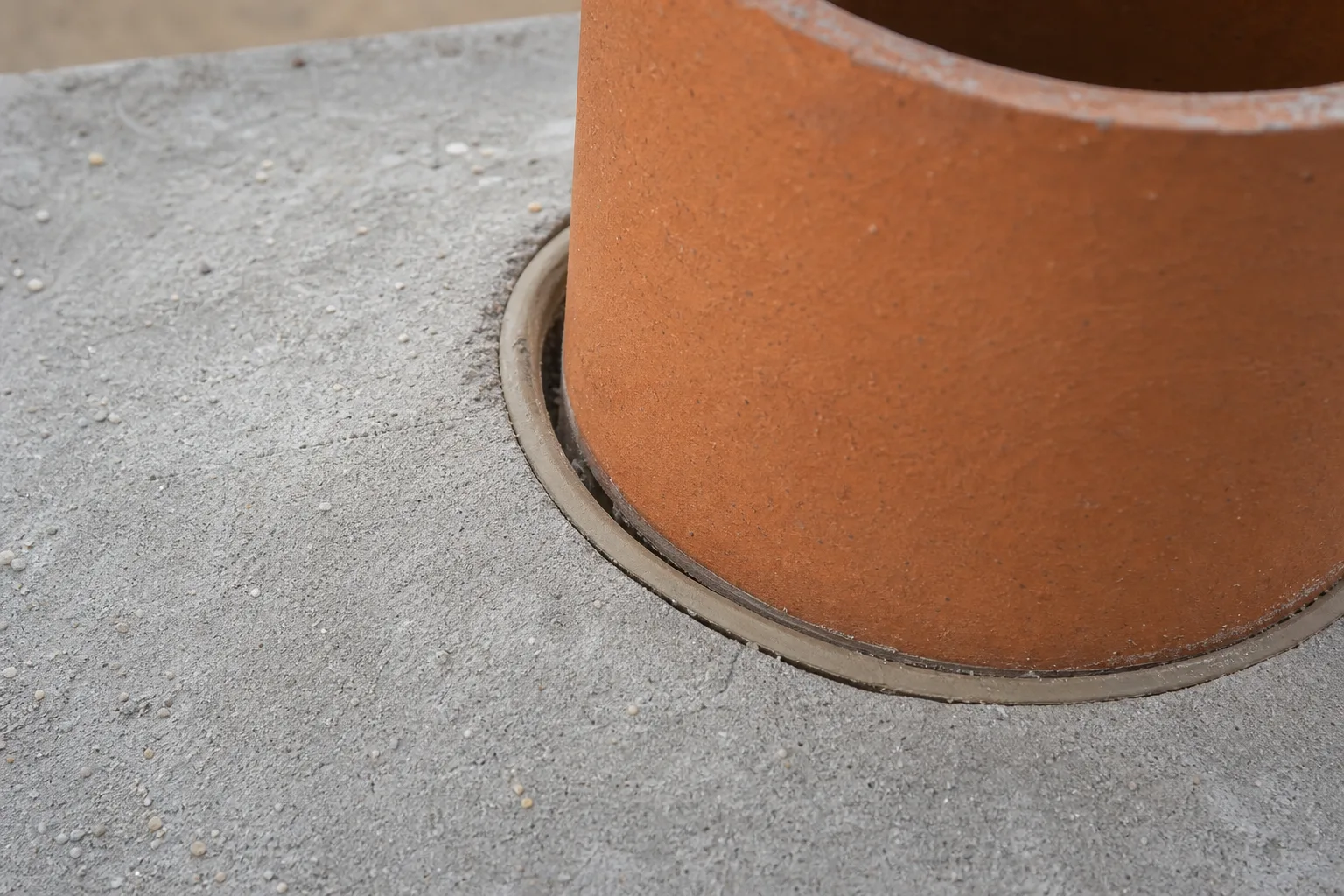
The detail that addresses it is not clever, and it is easy to leave out. The crown gets isolated from the tile with a joint, commonly given as a quarter inch to three eighths of an inch, formed by wrapping the tile in ceramic or mineral fiber insulation before the pour.
The same logic applies underneath. A bond break between the crown and the masonry or chase below is meant to let the two move independently rather than work against each other.
Crown washes built with no joint at all are the classic version, and a missing joint is the common thread in how those washes come apart.
One caution, because it would be easy to make this the villain of the article. It is not. Water, freezing and thawing, a flat profile and a missing overhang each do their own damage, and they compound. The joint is one mode among several, and it belongs in the conversation alongside them.
Pro tip: look at where the flue tile comes out of the concrete. A deliberate line of sealant, or a visible gap around the tile, is a sign the joint was part of the plan. Concrete butted hard against the clay tells you less than it appears to, because the joint is concealed once the pour is done, so ask how the tile was isolated rather than assuming from the surface.
How a concrete chimney crown fails
Crowns do not fail in one way, and that matters when you are trying to read your own. These are the modes worth being able to recognize on a concrete chimney crown.
Cracks radiating from the flue tile
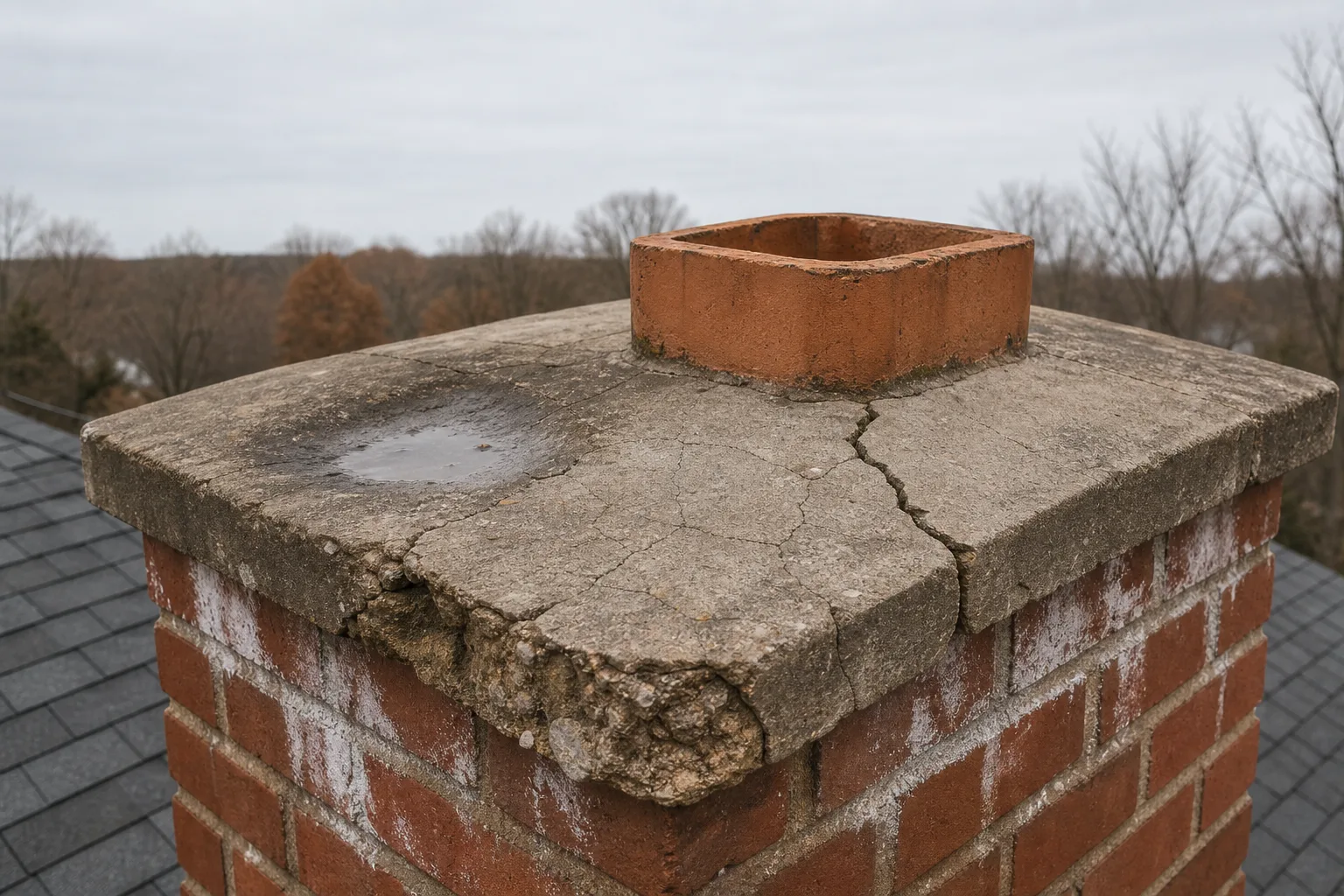
The signature of movement with nowhere to go: one crack, or several, starting at the tile and running out toward the edge.
A hairline version is not automatically a crisis. A crack wide enough to work a coin into is a different conversation.
Spalling and lost edges
Concrete that has taken on water and then frozen comes apart from the surface inward. A rough, crumbling face with the aggregate showing through, then pieces missing, then whole corners gone.
Freeze and thaw cycling drives it, which is why it reads worst in climates that swing back and forth across freezing.
A dip that holds water
A crown that ponds has lost its slope, and standing water at the top of a chimney works on the slab and on the joint around the tile at the same time.
The wash with no overhang at all
This is the one I promised you in the opening.
If the top of your chimney is a thin layer of mortar feathered flush to the brick, with no edge projecting and no shadow underneath, that is a mortar wash. It was never a crown in the structural sense, whatever the previous owner was told.
Look at the brick directly beneath it for a white powdery bloom. That is efflorescence, salts carried out of the masonry by water moving through it, and it says water is getting in somewhere above. Scrubbing it off is masonry cleaning, not a repair.
From the field: the absence of a shadow line under the top edge of a chimney is one of the more telling things visible from ground level. Where no edge projects, nothing is directing runoff away from the brick face, and the masonry below is left taking the water a crown is supposed to send clear.
Check your own crown from the ground
You can learn a surprising amount about a concrete chimney crown without leaving your yard, and the yard is where you should stay.
Stand back far enough to see the whole top of the stack against the sky, then zoom in with binoculars or a phone camera pushed to its limit. A photo beats your eyes here, because you can study it at the kitchen table.
What to work through:
- The shadow line. Is there an edge projecting past the brick, casting a shadow on the wall below, or does the top blend into the brick face?
- Dark lines across the grey surface. Cracks read as fine dark lines. Note whether they start at the flue tile.
- White powdery bloom on the brick in the top course or two. That is efflorescence.
- Dark staining or a wet patch that stays after the rest has dried. That is ponding.
- Missing corners or a rough, pitted face where the concrete is coming apart.
- The joint around the flue tile. A sealant line or a gap, versus concrete pressed straight against the clay.
- The cap. Is there a metal lid with mesh over the flue opening, and is it sitting square?
Photograph anything that looks wrong. Those photos turn a vague phone call into a specific one.
Safety note: a chimney top is a bad place to learn roof work, and a deteriorating crown is loose material at the edge of a fall. Everything on the list above is meant to be checked from the ground with optics. Leave what needs a ladder to somebody equipped for it.
Concrete chimney crown repair or full rebuild
This is the question the internet handles worst, because whoever answers it may be selling one of the two answers.
So here is the line, drawn the way trade sources draw it. Hairline cracks and small chips fall on the repairable side. Removal and rebuilding is what sources call for when the slab is crumbling, when it carries large structural cracks, or when it has dips deep enough to hold standing water.
The logic is simpler than the sales pitch. A coating restores a surface. It cannot restore shape, slope, thickness, an overhang that was never there, or a joint that was never formed.
When patching and a crown coating are the honest answer
If the slab has its geometry, meaning a real projecting edge, it sheds water, and it is sound underneath, then what you have is a surface problem.
The method sources describe is straightforward. Loose material gets scraped off. Small cracks get filled with a sealant, larger chips or dips with a repair mortar. Then the whole top gets a brushable elastomeric coating intended to bridge existing cracks and resist new ones.
A legitimate repair for that condition, not a shortcut.
When a rebuild is what the condition calls for
If the slab is coming apart, cracked through, holding water, or was never a crown at all, coating it puts a flexible skin over a failing substrate.
A rebuild means removing part or all of the old crown down to sound masonry, setting forms, placing reinforcement, and pouring a new crown with the slope, the overhang, the drip edge and the expansion joint detailed from the start.
The bigger job, and the one that lets those four details exist.
| What you are seeing | Which territory that points to | What the work involves |
|---|---|---|
| Hairline cracks in a slab that still has its shape and a projecting edge | Repair territory, since the geometry is intact | Loose material cleaned off, cracks filled, a flexible crown coating brushed over the surface |
| Small chips at the edge, slab otherwise sound | Repair territory | Chips filled with a repair mortar, then a brushable coating across the whole top |
| Cracks wide enough to work a coin into, running through the slab | Rebuild territory as trade sources describe it, because a slab cracked through has lost its continuity | Removing part or all of the old crown, then forming and pouring a new one |
| Crumbling concrete with aggregate showing, corners missing | Rebuild territory | Partial or full removal down to sound masonry, depending on how far the deterioration reaches, then a new crown poured in concrete |
| A dip that holds standing water after rain | Rebuild territory, because slope is not something a coating restores | A new crown formed with slope, an overhang and a joint at the flue tile |
| A thin mortar wash lying flush with the brick, no projecting edge | Not really a repair question, since there is no crown present to repair | Building a crown where one was not there before |
Myth vs. fact: crown sealer gets treated as a dodge, and that is unfair to it. Fact: an elastomeric coating is a recognized method for a slab whose shape is still good and whose cracks are fine. It is also what gets brushed over crowns that needed to come off, which is where the bad reputation comes from. The product is not the problem. Applying it to the wrong condition is.
I am not going to invent a figure for your chimney. What moves the scope is specific to your house: roof access, the size of the stack, whether the flue tile needs work of its own or the masonry below also needs attention, and which side of that line you land on.
Not sure which side of that line your crown is on?
That is a fair reason to ask before committing to a repair. VIO matches you with independent local chimney companies that handle crown work, so you can have the condition looked at before you choose between patching and rebuilding.
Call (513) 655-6702 or request service.
How to read a crown estimate
Here is the payoff I promised at the top. A concrete chimney crown estimate tells you what the person who wrote it intends to do, if you know which words to look for.
A scope worth signing names the material, and it names concrete rather than mortar. It states the thickness. It says the crown is reinforced. It gives the overhang as a dimension. It mentions the drip edge. It describes an expansion joint or bond break at the flue tile. If the old crown is coming off, it says so, and how far down.
A vague estimate reads like "reseal chimney top" with a number after it. No material, no dimensions, no mention of the tile.
That is not automatically dishonest. It is unspecific, and unspecific is how the wrong repair reaches a homeowner who could not tell the difference. You can now tell the difference, so ask.
Two more things worth raising on the call.
Ask whether a CSIA Certified Chimney Sweep is involved. The Chimney Safety Institute of America certification is real and checkable, which is more than can be said for some of the credentials that appear on a truck door.
And know when the standard asks for more than a look at the crown. NFPA 211 calls for a Level 2 inspection upon sale or transfer of the property, upon changes to the system, including a change in fuel type, a change in the shape of or material in the flue, or the replacement or addition of an appliance of a dissimilar type, input rating or efficiency, upon a malfunction or an external event likely to have caused damage, after a chimney fire, and after a "potentially damaging external event such as" an earthquake or other seismic event, or a weather event.
If something on that list applies to your house, the crown is not the only part of the system that should be examined while somebody is up there.
How VIO helps with a concrete chimney crown
VIO does not pour concrete. We are a referral service, and that distinction matters when you are deciding who to trust with the top of your chimney.
What we do is match homeowners with independent local companies that handle crown work. VIO is not the contractor on the job, and the article above is the part we can genuinely hand you: the vocabulary, and the decision.
For a concrete chimney crown, a second opinion is worth more than a first quote. You can now describe what you are seeing, name the details that belong in a scope of work, and judge whether the answer you get back engages with them.
We ask every company in the network to put its estimate in writing before any work starts, and you should insist on exactly that.
One last thing. If water has been moving through the masonry for a while, the crown may not be the end of it. Damage below a leaking chimney top becomes its own scope of work, worth raising while the top is being addressed.
Get the top of your chimney looked at before freeze and thaw season works on it.
Tell us what you are seeing up there and we will match you with independent local companies that do crown work.
Call (513) 655-6702 or request service.
Symptom checker
What is your chimney doing?
Tap the closest match for an honest first answer.